

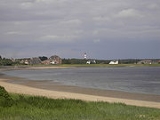
Amrum

Encyclopedia
Amrum is one of the North Frisian Islands
on the German
North Sea
coast, south of Sylt
and west of Föhr
. It is part of the Nordfriesland
district in the federal state of Schleswig-Holstein
. With the island being a refuge for many endangered species of plants and animals, its soil being largely unfavourable for agriculture and as a popular seaside resort in general, Amrum's population almost exclusively lives from the tourism industry.

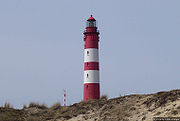 Amrum's area measures 20.46 km², making it the tenth-largest island of Germany. It is one of three isles with a geestland
core in Nordfriesland. To the east, it borders to the Wadden Sea mud flats of the North Sea. The east side is also where the island's ancient hamlets are situated: Norddorf
, Nebel
, Süddorf and Steenodde. On the geestland core one can find extended areas of heath and woodland which form a strip that runs along a north-south line on the axis. West of this woodland strip, the entire island is covered with dune
s. The maximal width of this area amounts to more than a kilometre, its length measures about 12 km. Amrum's tallest dune near Norddorf, called a Siatler (the settling dune) reaches 32 m of height. Northward, the dune area extends into a small peninsula called Odde. In the south of Amrum, the newest settlement, Wittdün
, is located. West of the dunes, the entire shore of Amrum is made up of the Kniepsand beach; it counts among northern Europe
's largest sand beaches. North of Norddorf there is some marshland, another small marsh area can be found between Süddorf and Steenodde. Both of them are protected from the sea by dikes
. During low tide
it is possible to reach the neighbouring island of Föhr by mudflat hiking.
Amrum's population amounts to about 2,300 and the island is divided into three municipalities: Norddorf, Nebel and Wittdün. They adhere to the Amt Föhr-Amrum
.
of Norddorf with a decoy
pond and a sector light. Amrum's largest village, Nebel, is located near the eastern coastline. Notable sights there include the church of St. Clement, the Öömrang Hüs - a museum of local history, a wind mill and the Cemetery of the Homeless. Süddorf, today a district of Nebel, is the island's oldest hamlet. The Amrum Lighthouse
is located there. Steenodde, also a neighbourhood of Nebel, had long been Amrum's only port until Wittdün, founded 1890, had taken over as the island's major ferry terminal. Of the three municipalities, Wittdün is most clearly influenced by tourism.

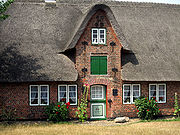 The oldest traces of settlements in the area date back to the Neolithicum, among them a number of dolmen
s. Also many tomb sites from the Bronze
and Iron Age
s have been preserved. In the dunes west of the decoy pond the remainders of an Iron Age hamlet have been found. It is unknown whether the Ambrones
, who together with the Cimbri
and Teutones threatened Rome
around 100 B.C., stemmed from this island which back then was still connected to the mainland by a land bridge. In the early Middle Ages
the island was colonised by the Frisians
. The oldest known record of Amrum island has been found in the Danish Census Book
of King Valdemar II of Denmark
from 1231.
Next to salt making
, agriculture, fishery and whaling
, merchant shipping
was one of the main sources of income for a long time. Hark Olufs
, a sailor from Süddorf who had been enslaved by Algeria
ns in 1724, advanced to the rank of a General
ere he was allowed to return to his native island in 1736. During the late 19th century tourism became a rapidly emerging business on Amrum and effectively changed the island's economical structures.
During the Middle Ages Amrum as well as all of North Frisia proper belonged to the so-called Uthlande
, the Outer Lands, which only successively became parts of the Danish realm or the Duchy of Schleswig
. After the conflicts between the Danish kings and the counts of Schauenburg
about the rule over Schleswig, Amrum and western Föhr became an enclave of Denmark and contrary to neighbouring areas, it was not any longer a part of the Duchy of Schleswig. This state endured until 1864, when Denmark lost Schleswig to Prussia
after the Second Schleswig War. For a brief period after that war Amrum was ruled together by Prussia and Austria, yet in 1867 the island came under Prussian rule and was made a part of the province of Schleswig-Holstein. At first, Amrum formed a municipality within the district of Tondern. In 1920, the Schleswig Plebiscites
resulted in a clear majority vote for Amrum staying with Germany, while Tondern fell back to Denmark. Until 1972, Amrum belonged to the Südtondern district which then merged into the newly created district of Nordfriesland.
Especially during the 19th century more than a quarter of Amrum's population emigrated - mainly to the United States
. Today more people with ancestors from Amrum live in the United States than there are on Amrum proper. The connections between Amrum and the US are still being cultivated today.
On 29 October 1998 the cargo ship
"Pallas" ran aground off Amrum, causing a severe oil spill
in the region.
. The North Frisian language
in the Öömrang
dialect is spoken by roughly a third of the population. Those 800 Amrumers are all multilingual. Due to the isolated location of the islands the North Frisian dialects developed so differently, that Öömrang can be understood by people from Föhr, yet is hardly recognisable for those from Sylt or mainland Nordfriesland. Many Amrumers moreover speak Low German
, since it had been the language of the coastal sailors. Only a few people speak the Danish language
.
Amrum's national costume
for girls and women is coloured black and white and is amply decorated with silver ornaments. It is mostly worn on confirmation services or at touristical events.
There are two peculiar traditions on Amrum. On February 21 the Biakendai
is celebrated, where a great bonfire is lit to dispel Winter. On the occasion people blacken each other's faces with soot. The festival originates from the old liturgical holiday of Cathedra Petri, which was originally celebrated on February 22. The custom is also popular in other North Frisian municipalities. On New Year's Eve
the Hulken takes place, where groups of mostly young people dress up in costumes and walk from house to house to let others guess their true identity (similar to Halloween
). According to their age, they are either treated with sweets or alcoholic drinks.
Agriculture is also being practised on Amrum and the port hosts a single fisherman.
 The isle is connected to Föhr
and to the mainland harbour of Dagebüll
on the one hand and to the Halligen and the mainland terminal of Schlüttsiel on the other hand by two ferry routes. During the summer season, a fast passenger boat offers services between the ports of Hörnum
on Sylt, the Halligen Hooge
and Langeneß
and the harbour of Strucklahnungshörn on Nordstrand
. Amrum's terminal is located at Wittdün, the ferries are operated by Wyker Dampfschiffs-Reederei GmbH (W.D.R.). Most tourists will reach Amrum via Dagebüll. From there, a ferry will need 90 minutes to reach the island on a straight route, the more common routes with a stop at Wyk auf Föhr
need 120 minutes of time.
On the island, the bicycle is the main means of transport next to cars; compared to other areas of Germany, Amrum provides an excellent network of bicycle routes. Numerous rental services may provide tourists with bicycles. A bus service connects Norddorf, Nebel and Wittdün on an hourly schedule (every 30 minutes even during the summer season). Like the ferries, the bus service is operated by W.D.R.. A rather uncommon sort of traffic is the mudflat hiking between Amrum and Föhr.
From 1893 to 1939, a railway service was operated on Amrum. There is no airstrip on the island, any plans to establish one have so far vehemently been opposed.
s and Amrum's situation close to the Schleswig-Holstein Wadden Sea National Park
.
 Amrum's vegetation is determined by the sea and by the different types of landscapes on the island, most of which are low in nutrient
s. In parts of the dune belt and on the Kniepsand marram grass
or sea wormwood
grow, as well as numerous other sand-loving plants like sheep's bit
which will bloom in sheltered areas between the dunes. Also some stunted pines, bent by the sea wind, and Salix repens, the creeping willow can be found there. Until the 1970s, the rare sea holly could still be seen in the dunes.
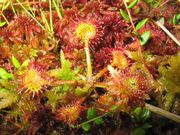
East of there are heaths and conifer or mixed forests. In some dune slacks, peat bogs can be found which occasionally host the carnivorous plant common sundew
. The once abundant marsh gentian
vanished during the 1990s.
The Amrum forest was mainly planted in 1948 on an area of heath. Until then only a few forested regions could be found around the decoy ponds. With 180 hectare
s, Amrum has the largest ratio of forested land of all Germany's North Sea islands. Mainly pines, firs and birches can be found here. Meanwhile the forest has largely lost its artificial nature. So one will encounter numerous plants on all levels and many species of fungi
. The "geestland", east of the forest, is mostly used for farming. Its grassland grows plants such as Harebell (Campanula rotundifolia), Sea Thrift (Armeria maritima
) and Carthusian Pink (Dianthus carthusianorum
) and several species of hawkweed
.
In the small marshlands, some sedges
and the ragged robin
may be seen. Here is the most nutritious soil on Amrum. Even the soil of Amrum's gardens is so low in nutrients that only few sorts of plants, e.g. hollyhock
, will grow there without fertilising.
On the salt marsh
es along the eastern shore of Amrum, many salt tolerant species can be found. Pioneer plants such as Salicornia europaea and alkali grasses
, grow on and stabilize the mud flats.
 Like the vegetation, Amrum's wild beasts are determined by the island's location within the North Sea. Thus there are only a few species of wild mammal
s on Amrum, like hare, mice, hedgehogs and bats. In the 12th century coneys were introduced as game. Still today they populate the island. A few years ago a pregnant vixen
was set free on Amrum. She and her offspring caused severe damage to the island's fauna, but meanwhile they have been hunted down. In the sea and on the sand bars off Amrum, thus within the National Park, harbour seals, grey seal
s and harbour porpoise
s have their habitat. Occasionally in December and January young grey seals are washed ashore on Amrum's beaches due to storm surges and are thereafter nursed by the adults. In January 2010 the seal shelter station at Friedrichskoog
announced that more and more female grey seals were "moving away from less favourable birth sites near Amrum and Sylt but even from the British Isles, to Heligoland
".
The realm of birds is particularly plentiful. Amrum counts among the most important hatching areas for sea birds in Germany. It is the main hatching region for the common eider
, but also oystercatchers
, shelducks
, arctic tern
s, seagulls like herring gulls, common gull
and the lesser black-backed gull
as well as many other species use to hatch there on the beach, in between the dunes or at the mud flats. Since the dunes of Amrum are a protected nature reserve, they are the only dunes along the west coast of Schleswig-Holstein where sea gulls and ducks are breeding. In other dune areas of the North Sea coast these birds are usually scared off by tourists. Additionally vast swarms of migratory birds will rest on Amrum during the season, e.g. red knot
, brent goose
or sanderling
, all of whom are able to find sufficient food along the coasts of Amrum. Moreover, a number of songbird
s can be found and pheasant
s which were equally introduced as game are common.
Lizards
and amphibians, such as moor frog
, natterjack toad
and smooth newt
are other examples of land vertebrata.
In the sea surrounding Amrum numerous fish species typical of the North Sea can be found, like plaice
and atlantic herring
. The number of other marine species is equally great, the hermit crab
, the common whelk
and the lugworm
are all among them. Of them, mainly the sand shrimps
are commercially used by "harvesting" them from the seabed with cutters. The shrimps are then wrongly marketed as "crabs" (Krabben).
Moreover, Amrum was the set for many German cinematic and TV film
s, e.g. Tod auf Amrum (1998) or Sommer (2008).
North Frisian Islands
The North Frisian Islands are a group of islands in the Wadden Sea, a part of the North Sea, off the western coast of Schleswig-Holstein, Germany. The German islands are in the traditional region of North Frisia and are part of the Schleswig-Holstein Wadden Sea National Park and the Kreis of...
on the German
Germany
Germany , officially the Federal Republic of Germany , is a federal parliamentary republic in Europe. The country consists of 16 states while the capital and largest city is Berlin. Germany covers an area of 357,021 km2 and has a largely temperate seasonal climate...
North Sea
North Sea
In the southwest, beyond the Straits of Dover, the North Sea becomes the English Channel connecting to the Atlantic Ocean. In the east, it connects to the Baltic Sea via the Skagerrak and Kattegat, narrow straits that separate Denmark from Norway and Sweden respectively...
coast, south of Sylt
Sylt
Sylt is an island in northern Germany, part of Nordfriesland district, Schleswig-Holstein, and well known for the distinctive shape of its shoreline. It belongs to the North Frisian Islands and is the largest island in North Frisia...
and west of Föhr
Föhr
Föhr is one of the North Frisian Islands on the German coast of the North Sea. It is part of the Nordfriesland district in the federal state of Schleswig-Holstein. Föhr is the second-largest North Sea island of Germany....
. It is part of the Nordfriesland
Nordfriesland
Nordfriesland, English "Northern Friesland" or "North Frisia", is a district in Schleswig-Holstein, Germany. It includes almost all of traditional North Frisia along with adjacent areas to the east and south and is bounded by the districts of Schleswig-Flensburg and Dithmarschen, the North Sea and...
district in the federal state of Schleswig-Holstein
Schleswig-Holstein
Schleswig-Holstein is the northernmost of the sixteen states of Germany, comprising most of the historical duchy of Holstein and the southern part of the former Duchy of Schleswig...
. With the island being a refuge for many endangered species of plants and animals, its soil being largely unfavourable for agriculture and as a popular seaside resort in general, Amrum's population almost exclusively lives from the tourism industry.
Geography
Geest (topography)
Geest is a type of slightly raised landscape that occurs in the plains of in Northern Germany, the Northern Netherlands and Denmark. It is a landscape of sandy and gravelly soils, usually mantled by a heathland vegetation, comprising glacial deposits left behind after the last ice age during the...
core in Nordfriesland. To the east, it borders to the Wadden Sea mud flats of the North Sea. The east side is also where the island's ancient hamlets are situated: Norddorf
Norddorf
Norddorf is a municipality on the island of Amrum in the district of Nordfriesland in Schleswig-Holstein, Germany.- History :...
, Nebel
Nebel, Germany
Nebel is a municipality on the island of Amrum in the district of Nordfriesland in Schleswig-Holstein, Germany.- Geography and traffic :...
, Süddorf and Steenodde. On the geestland core one can find extended areas of heath and woodland which form a strip that runs along a north-south line on the axis. West of this woodland strip, the entire island is covered with dune
Dune
In physical geography, a dune is a hill of sand built by wind. Dunes occur in different forms and sizes, formed by interaction with the wind. Most kinds of dunes are longer on the windward side where the sand is pushed up the dune and have a shorter "slip face" in the lee of the wind...
s. The maximal width of this area amounts to more than a kilometre, its length measures about 12 km. Amrum's tallest dune near Norddorf, called a Siatler (the settling dune) reaches 32 m of height. Northward, the dune area extends into a small peninsula called Odde. In the south of Amrum, the newest settlement, Wittdün
Wittdün
Wittdün is a municipality on the island of Amrum in the district of Nordfriesland in Schleswig-Holstein, Germany.- History :...
, is located. West of the dunes, the entire shore of Amrum is made up of the Kniepsand beach; it counts among northern Europe
Europe
Europe is, by convention, one of the world's seven continents. Comprising the westernmost peninsula of Eurasia, Europe is generally 'divided' from Asia to its east by the watershed divides of the Ural and Caucasus Mountains, the Ural River, the Caspian and Black Seas, and the waterways connecting...
's largest sand beaches. North of Norddorf there is some marshland, another small marsh area can be found between Süddorf and Steenodde. Both of them are protected from the sea by dikes
Levee
A levee, levée, dike , embankment, floodbank or stopbank is an elongated naturally occurring ridge or artificially constructed fill or wall, which regulates water levels...
. During low tide
Tide
Tides are the rise and fall of sea levels caused by the combined effects of the gravitational forces exerted by the moon and the sun and the rotation of the Earth....
it is possible to reach the neighbouring island of Föhr by mudflat hiking.
Amrum's population amounts to about 2,300 and the island is divided into three municipalities: Norddorf, Nebel and Wittdün. They adhere to the Amt Föhr-Amrum
Föhr-Amrum
Föhr-Amrum is an Amt in the district of Nordfriesland, in Schleswig-Holstein, Germany. The Amt covers the islands Föhr and Amrum...
.
Villages
The northernmost settlement is the seaside resortSeaside resort
A seaside resort is a resort, or resort town, located on the coast. Where a beach is the primary focus for tourists, it may be called a beach resort.- Overview :...
of Norddorf with a decoy
Decoy
A decoy is usually a person, device or event meant as a distraction, to conceal what an individual or a group might be looking for. Decoys have been used for centuries most notably in game hunting, but also in wartime and in the committing or resolving of crimes.-Duck decoy:The term duck decoy may...
pond and a sector light. Amrum's largest village, Nebel, is located near the eastern coastline. Notable sights there include the church of St. Clement, the Öömrang Hüs - a museum of local history, a wind mill and the Cemetery of the Homeless. Süddorf, today a district of Nebel, is the island's oldest hamlet. The Amrum Lighthouse
Amrum Lighthouse
The Amrum lighthouse is located in the southern part of the German island of Amrum, approximately 2 kilometres west of the village of Wittdün, yet still adhering to the municipality of Nebel. Its designation in German is Seefeuer Amrum...
is located there. Steenodde, also a neighbourhood of Nebel, had long been Amrum's only port until Wittdün, founded 1890, had taken over as the island's major ferry terminal. Of the three municipalities, Wittdün is most clearly influenced by tourism.
History
Dolmen
A dolmen—also known as a portal tomb, portal grave, dolmain , cromlech , anta , Hünengrab/Hünenbett , Adamra , Ispun , Hunebed , dös , goindol or quoit—is a type of single-chamber megalithic tomb, usually consisting of...
s. Also many tomb sites from the Bronze
Bronze Age
The Bronze Age is a period characterized by the use of copper and its alloy bronze as the chief hard materials in the manufacture of some implements and weapons. Chronologically, it stands between the Stone Age and Iron Age...
and Iron Age
Iron Age
The Iron Age is the archaeological period generally occurring after the Bronze Age, marked by the prevalent use of iron. The early period of the age is characterized by the widespread use of iron or steel. The adoption of such material coincided with other changes in society, including differing...
s have been preserved. In the dunes west of the decoy pond the remainders of an Iron Age hamlet have been found. It is unknown whether the Ambrones
Ambrones
The Ambrones were a tribe that appeared briefly in the Roman sources relating to the 2nd century BC. They formed part of a coalition of peoples with the Cimbri of Jutland and the Teutones who were forced south by the flooding of their homeland.-History:...
, who together with the Cimbri
Cimbri
The Cimbri were a tribe from Northern Europe, who, together with the Teutones and the Ambrones threatened the Roman Republic in the late 2nd century BC. The Cimbri were probably Germanic, though some believe them to be of Celtic origin...
and Teutones threatened Rome
Rome
Rome is the capital of Italy and the country's largest and most populated city and comune, with over 2.7 million residents in . The city is located in the central-western portion of the Italian Peninsula, on the Tiber River within the Lazio region of Italy.Rome's history spans two and a half...
around 100 B.C., stemmed from this island which back then was still connected to the mainland by a land bridge. In the early Middle Ages
Middle Ages
The Middle Ages is a periodization of European history from the 5th century to the 15th century. The Middle Ages follows the fall of the Western Roman Empire in 476 and precedes the Early Modern Era. It is the middle period of a three-period division of Western history: Classic, Medieval and Modern...
the island was colonised by the Frisians
Frisians
The Frisians are a Germanic ethnic group native to the coastal parts of the Netherlands and Germany. They are concentrated in the Dutch provinces of Friesland and Groningen and, in Germany, East Frisia and North Frisia, that was a part of Denmark until 1864. They inhabit an area known as Frisia...
. The oldest known record of Amrum island has been found in the Danish Census Book
Danish Census Book
The Danish Census Book or the Danish book of land taxation , from the 13th Century consist of notes for practical use in the Royal Chancery of Valdemar II containing a collection of information on Royal income and Royal land property. The book is one of the most important sources of information...
of King Valdemar II of Denmark
Valdemar II of Denmark
Valdemar II , called Valdemar the Victorious or Valdemar the Conqueror , was the King of Denmark from 1202 until his death in 1241. The nickname Sejr is a later invention and was not used during the King's own lifetime...
from 1231.
Next to salt making
Open pan salt making
In Europe virtually all domestic salt is obtained by solution mining of underground salt formations although some is still obtained by the solar evaporation of sea water. Salt is extracted from the Brine using vacuum pans, where brine is heated in a partial vacuum in order to lower the boiling...
, agriculture, fishery and whaling
History of whaling
The history of whaling is very extensive, stretching back for millennia. This article discusses the history of whaling up to the commencement of the International Whaling Commission moratorium on commercial whaling in 1986....
, merchant shipping
Ship transport
Ship transport is watercraft carrying people or goods . Sea transport has been the largest carrier of freight throughout recorded history. Although the importance of sea travel for passengers has decreased due to aviation, it is effective for short trips and pleasure cruises...
was one of the main sources of income for a long time. Hark Olufs
Hark Olufs
Hark Olufs was a North Frisian sailor. He was captured by Algerian pirates and sold into slavery but by successfully serving the Bey of Constantine he could eventually achieve his release.-Life:...
, a sailor from Süddorf who had been enslaved by Algeria
Algeria
Algeria , officially the People's Democratic Republic of Algeria , also formally referred to as the Democratic and Popular Republic of Algeria, is a country in the Maghreb region of Northwest Africa with Algiers as its capital.In terms of land area, it is the largest country in Africa and the Arab...
ns in 1724, advanced to the rank of a General
General
A general officer is an officer of high military rank, usually in the army, and in some nations, the air force. The term is widely used by many nations of the world, and when a country uses a different term, there is an equivalent title given....
ere he was allowed to return to his native island in 1736. During the late 19th century tourism became a rapidly emerging business on Amrum and effectively changed the island's economical structures.
During the Middle Ages Amrum as well as all of North Frisia proper belonged to the so-called Uthlande
Uthlande
Uthlande, Utlande is a term for the islands halligen and marshes off the mainland of North Frisia in modern Nordfriesland district, Germany.- History :...
, the Outer Lands, which only successively became parts of the Danish realm or the Duchy of Schleswig
Schleswig
Schleswig or South Jutland is a region covering the area about 60 km north and 70 km south of the border between Germany and Denmark; the territory has been divided between the two countries since 1920, with Northern Schleswig in Denmark and Southern Schleswig in Germany...
. After the conflicts between the Danish kings and the counts of Schauenburg
Schauenburg
Schaumburg and Schauenburg are the two versions of the name of a regional German dynasty.The usage is scattered, historically as well as locally:* Schaumburg, a district and former county in Lower Saxony*Schauenburg, Hesse, a municipality in Germany...
about the rule over Schleswig, Amrum and western Föhr became an enclave of Denmark and contrary to neighbouring areas, it was not any longer a part of the Duchy of Schleswig. This state endured until 1864, when Denmark lost Schleswig to Prussia
Prussia
Prussia was a German kingdom and historic state originating out of the Duchy of Prussia and the Margraviate of Brandenburg. For centuries, the House of Hohenzollern ruled Prussia, successfully expanding its size by way of an unusually well-organized and effective army. Prussia shaped the history...
after the Second Schleswig War. For a brief period after that war Amrum was ruled together by Prussia and Austria, yet in 1867 the island came under Prussian rule and was made a part of the province of Schleswig-Holstein. At first, Amrum formed a municipality within the district of Tondern. In 1920, the Schleswig Plebiscites
Schleswig Plebiscites
The Schleswig Plebiscites were two plebiscites, organized according to section XII, articles 109 to 114 of the Treaty of Versailles of June 28, 1919, in order to determine the future border between Denmark and Germany through the former duchy of Schleswig...
resulted in a clear majority vote for Amrum staying with Germany, while Tondern fell back to Denmark. Until 1972, Amrum belonged to the Südtondern district which then merged into the newly created district of Nordfriesland.
Especially during the 19th century more than a quarter of Amrum's population emigrated - mainly to the United States
United States
The United States of America is a federal constitutional republic comprising fifty states and a federal district...
. Today more people with ancestors from Amrum live in the United States than there are on Amrum proper. The connections between Amrum and the US are still being cultivated today.
On 29 October 1998 the cargo ship
Cargo ship
A cargo ship or freighter is any sort of ship or vessel that carries cargo, goods, and materials from one port to another. Thousands of cargo carriers ply the world's seas and oceans each year; they handle the bulk of international trade...
"Pallas" ran aground off Amrum, causing a severe oil spill
Oil spill
An oil spill is the release of a liquid petroleum hydrocarbon into the environment, especially marine areas, due to human activity, and is a form of pollution. The term is mostly used to describe marine oil spills, where oil is released into the ocean or coastal waters...
in the region.
Language and culture
The main language on Amrum is GermanGerman language
German is a West Germanic language, related to and classified alongside English and Dutch. With an estimated 90 – 98 million native speakers, German is one of the world's major languages and is the most widely-spoken first language in the European Union....
. The North Frisian language
North Frisian language
North Frisian is a minority language of Germany, spoken by about 10,000 people in North Frisia. The language is part of the larger group of the West Germanic Frisian languages.-Classification:...
in the Öömrang
Öömrang
Öömrang is the dialect of the North Frisian language spoken on the island of Amrum in the German region of North Frisia. Öömrang refers to the Öömrang Frisian name of Amrum, Oomram. Together with the Fering, Söl'ring, and Heligolandic dialects, it forms part of the insular group of North Frisian...
dialect is spoken by roughly a third of the population. Those 800 Amrumers are all multilingual. Due to the isolated location of the islands the North Frisian dialects developed so differently, that Öömrang can be understood by people from Föhr, yet is hardly recognisable for those from Sylt or mainland Nordfriesland. Many Amrumers moreover speak Low German
Low German
Low German or Low Saxon is an Ingvaeonic West Germanic language spoken mainly in northern Germany and the eastern part of the Netherlands...
, since it had been the language of the coastal sailors. Only a few people speak the Danish language
Danish language
Danish is a North Germanic language spoken by around six million people, principally in the country of Denmark. It is also spoken by 50,000 Germans of Danish ethnicity in the northern parts of Schleswig-Holstein, Germany, where it holds the status of minority language...
.
Amrum's national costume
National costume
Folk costume expresses an identity through costume which usually to a geographic area or a period of time in history, but can also indicate social, marital and/or religious status...
for girls and women is coloured black and white and is amply decorated with silver ornaments. It is mostly worn on confirmation services or at touristical events.
There are two peculiar traditions on Amrum. On February 21 the Biakendai
Biikebrennen
The Biikebrennen , Biikebrånen or Pers Awten is an annual celebration held on 21 February in North Frisia, in the German state of Schleswig-Holstein and in South Jutland....
is celebrated, where a great bonfire is lit to dispel Winter. On the occasion people blacken each other's faces with soot. The festival originates from the old liturgical holiday of Cathedra Petri, which was originally celebrated on February 22. The custom is also popular in other North Frisian municipalities. On New Year's Eve
New Year's Eve
New Year's Eve is observed annually on December 31, the final day of any given year in the Gregorian calendar. In modern societies, New Year's Eve is often celebrated at social gatherings, during which participants dance, eat, consume alcoholic beverages, and watch or light fireworks to mark the...
the Hulken takes place, where groups of mostly young people dress up in costumes and walk from house to house to let others guess their true identity (similar to Halloween
Halloween
Hallowe'en , also known as Halloween or All Hallows' Eve, is a yearly holiday observed around the world on October 31, the night before All Saints' Day...
). According to their age, they are either treated with sweets or alcoholic drinks.
Economy
Amrum's main branch of economy is tourism. In 2007 the island could provide 12,000 beds. In 2008 approximately 135,000 tourists and 1.3 million lodgings were registered.Agriculture is also being practised on Amrum and the port hosts a single fisherman.
Traffic
Föhr
Föhr is one of the North Frisian Islands on the German coast of the North Sea. It is part of the Nordfriesland district in the federal state of Schleswig-Holstein. Föhr is the second-largest North Sea island of Germany....
and to the mainland harbour of Dagebüll
Dagebüll
Dagebüll is a municipality located at the west coast of Schleswig-Holstein in the Nordfriesland district, Germany. Today's Dagebüll was created in 1978 as a merger of the municipalities of Fahretoft, Juliane-Marien-Koog and Waygaard...
on the one hand and to the Halligen and the mainland terminal of Schlüttsiel on the other hand by two ferry routes. During the summer season, a fast passenger boat offers services between the ports of Hörnum
Hörnum
Hörnum is a municipality in the district of Nordfriesland, in Schleswig-Holstein, Germany. It is located on the southern headland of the island of Sylt...
on Sylt, the Halligen Hooge
Hooge, Germany
Hooge is a small island off the coast of Germany. It is the second largest of the ten halligen in the Wadden Sea, after Langeneß. It is frequently called the Queen of the Halligen...
and Langeneß
Langeneß
Langeneß is a municipality in the district of Nordfriesland, in Schleswig-Holstein, Germany. It consists of the halligen Langeneß and Oland. Before the flood of 1634 the two islands were directly attached....
and the harbour of Strucklahnungshörn on Nordstrand
Nordstrand, Germany
Nordstrand is a peninsula and former island in North Frisia on the North Sea coast of Germany. It is part of the Nordfriesland district in the federal state of Schleswig-Holstein. Its area is 50 km², and its population is 2,300...
. Amrum's terminal is located at Wittdün, the ferries are operated by Wyker Dampfschiffs-Reederei GmbH (W.D.R.). Most tourists will reach Amrum via Dagebüll. From there, a ferry will need 90 minutes to reach the island on a straight route, the more common routes with a stop at Wyk auf Föhr
Wyk auf Föhr
Wyk auf Föhr is the only town on Föhr, the second largest of the North Frisian Islands on the German coast of the North Sea. Like the entire island it belongs to the district of Nordfriesland...
need 120 minutes of time.
On the island, the bicycle is the main means of transport next to cars; compared to other areas of Germany, Amrum provides an excellent network of bicycle routes. Numerous rental services may provide tourists with bicycles. A bus service connects Norddorf, Nebel and Wittdün on an hourly schedule (every 30 minutes even during the summer season). Like the ferries, the bus service is operated by W.D.R.. A rather uncommon sort of traffic is the mudflat hiking between Amrum and Föhr.
From 1893 to 1939, a railway service was operated on Amrum. There is no airstrip on the island, any plans to establish one have so far vehemently been opposed.
Flora and fauna
Plants and wild animals on Amrum are marked by the proximity to the sea, but some also distinguish themselves by extreme rarity and a high ecological value worth of protection. This fact was acknowledged by the establishment of two nature reserveNature reserve
A nature reserve is a protected area of importance for wildlife, flora, fauna or features of geological or other special interest, which is reserved and managed for conservation and to provide special opportunities for study or research...
s and Amrum's situation close to the Schleswig-Holstein Wadden Sea National Park
Wadden Sea National Parks
The Wadden Sea National Parks, part of a UNESCO World Heritage Site, are located along the German coast of the North Sea. Named after the Wadden Sea, they consist of three national parks:...
.
Flora
Nutrient
A nutrient is a chemical that an organism needs to live and grow or a substance used in an organism's metabolism which must be taken in from its environment. They are used to build and repair tissues, regulate body processes and are converted to and used as energy...
s. In parts of the dune belt and on the Kniepsand marram grass
Marram grass
Ammophila is a genus consisting of two or three very similar species of grasses; common names for these grasses include Marram Grass, Bent Grass, and Beachgrass...
or sea wormwood
Artemisia maritima
Artemisia maritima is a species of wormwood known as sea wormwood and old woman.In its many variations of form it has an extremely wide distribution in the northern hemisphere of the Old World, occurring mostly in saltish soils...
grow, as well as numerous other sand-loving plants like sheep's bit
Jasione montana
Sheep's bit scabious, Jasione montana, is a low-growing plant in the Campanulaceae family found in rocky places and upland regions of Europe and western Asia...
which will bloom in sheltered areas between the dunes. Also some stunted pines, bent by the sea wind, and Salix repens, the creeping willow can be found there. Until the 1970s, the rare sea holly could still be seen in the dunes.
East of there are heaths and conifer or mixed forests. In some dune slacks, peat bogs can be found which occasionally host the carnivorous plant common sundew
Drosera rotundifolia
Drosera rotundifolia is a species of sundew, a carnivorous plant often found in bogs, marshes and fens...
. The once abundant marsh gentian
Marsh Gentian
Gentiana pneumonanthe is a species of the genus Gentiana. It was the first wildflower announced as flower of the year in Germany in 1980.The species can be found in Marshes and Moorlands. It is the host-plant of the Alcon Blue ....
vanished during the 1990s.
The Amrum forest was mainly planted in 1948 on an area of heath. Until then only a few forested regions could be found around the decoy ponds. With 180 hectare
Hectare
The hectare is a metric unit of area defined as 10,000 square metres , and primarily used in the measurement of land. In 1795, when the metric system was introduced, the are was defined as being 100 square metres and the hectare was thus 100 ares or 1/100 km2...
s, Amrum has the largest ratio of forested land of all Germany's North Sea islands. Mainly pines, firs and birches can be found here. Meanwhile the forest has largely lost its artificial nature. So one will encounter numerous plants on all levels and many species of fungi
Fungus
A fungus is a member of a large group of eukaryotic organisms that includes microorganisms such as yeasts and molds , as well as the more familiar mushrooms. These organisms are classified as a kingdom, Fungi, which is separate from plants, animals, and bacteria...
. The "geestland", east of the forest, is mostly used for farming. Its grassland grows plants such as Harebell (Campanula rotundifolia), Sea Thrift (Armeria maritima
Armeria maritima
Armeria maritima is the botanical name for a species of flowering plant.It is a popular garden flower, known by several common names, including thrift, sea thrift, and sea pink. The plant has been distributed worldwide as a garden and cut flower...
) and Carthusian Pink (Dianthus carthusianorum
Dianthus carthusianorum
Dianthus carthusianorum is a species of Dianthus, native to Europe, from Spain north to Belgium and Poland, and east to Ukraine, occurring in dry, grassy habitats at altitudes of up to 2,500 m in mountains....
) and several species of hawkweed
Hawkweed
Hawkweed refers to any species in the very large genus Hieracium and its segregate genus Pilosella, in the sunflower family ....
.
In the small marshlands, some sedges
Cyperaceae
Cyperaceae are a family of monocotyledonous graminoid flowering plants known as sedges, which superficially resemble grasses or rushes. The family is large, with some 5,500 species described in about 109 genera. These species are widely distributed, with the centers of diversity for the group...
and the ragged robin
Ragged Robin
Lychnis flos-cuculi, commonly called Ragged Robin, is a herbaceous perennial plant in the family Caryophyllaceae. It is species is native to Europe, where it is found along roads and in wet meadows and pastures...
may be seen. Here is the most nutritious soil on Amrum. Even the soil of Amrum's gardens is so low in nutrients that only few sorts of plants, e.g. hollyhock
Alcea rosea
Alcea rosea is an ornamental plant in the Malvaceae family....
, will grow there without fertilising.
On the salt marsh
Salt marsh
A salt marsh is an environment in the upper coastal intertidal zone between land and salt water or brackish water, it is dominated by dense stands of halophytic plants such as herbs, grasses, or low shrubs. These plants are terrestrial in origin and are essential to the stability of the salt marsh...
es along the eastern shore of Amrum, many salt tolerant species can be found. Pioneer plants such as Salicornia europaea and alkali grasses
Puccinellia
Puccinellia is a genus of grasses which are known as alkali grass. These grasses grow in wet environments, often in saline or alkaline conditions...
, grow on and stabilize the mud flats.
Fauna
Mammal
Mammals are members of a class of air-breathing vertebrate animals characterised by the possession of endothermy, hair, three middle ear bones, and mammary glands functional in mothers with young...
s on Amrum, like hare, mice, hedgehogs and bats. In the 12th century coneys were introduced as game. Still today they populate the island. A few years ago a pregnant vixen
Vixen
A vixen is a female fox.Vixen may also refer to:-In the military:*HMS Vixen, various British Royal Navy ships*USS Vixen, various ships in the US Navy*Vickers Vixen, a biplane produced in small numbers in the 1920s...
was set free on Amrum. She and her offspring caused severe damage to the island's fauna, but meanwhile they have been hunted down. In the sea and on the sand bars off Amrum, thus within the National Park, harbour seals, grey seal
Grey Seal
The grey seal is found on both shores of the North Atlantic Ocean. It is a large seal of the family Phocidae or "true seals". It is the only species classified in the genus Halichoerus...
s and harbour porpoise
Harbour Porpoise
The harbour porpoise is one of six species of porpoise. It is one of the smallest marine mammals. As its name implies, it stays close to coastal areas or river estuaries, and as such, is the most familiar porpoise to whale watchers. This porpoise often ventures up rivers, and has been seen...
s have their habitat. Occasionally in December and January young grey seals are washed ashore on Amrum's beaches due to storm surges and are thereafter nursed by the adults. In January 2010 the seal shelter station at Friedrichskoog
Friedrichskoog
Friedrichskoog is a municipality in the district of Dithmarschen, in Schleswig-Holstein, Germany. It is situated near the outflow of the Elbe into the North Sea, approx. 25 km southwest of Heide, and 25 km northeast of Cuxhaven....
announced that more and more female grey seals were "moving away from less favourable birth sites near Amrum and Sylt but even from the British Isles, to Heligoland
Heligoland
Heligoland is a small German archipelago in the North Sea.Formerly Danish and British possessions, the islands are located in the Heligoland Bight in the south-eastern corner of the North Sea...
".
The realm of birds is particularly plentiful. Amrum counts among the most important hatching areas for sea birds in Germany. It is the main hatching region for the common eider
Common Eider
The Common Eider, Somateria mollissima, is a large sea-duck that is distributed over the northern coasts of Europe, North America and eastern Siberia. It breeds in Arctic and some northern temperate regions, but winters somewhat farther south in temperate zones, when it can form large flocks on...
, but also oystercatchers
Eurasian Oystercatcher
The Eurasian Oystercatcher Haematopus ostralegus, also known as the Common Pied Oystercatcher, or just Oystercatcher, is a wader in the oystercatcher bird family Haematopodidae. It is the most widespread of the oystercatchers, with three races breeding in western Europe, central Eurasia,...
, shelducks
Common Shelduck
The Common Shelduck is a waterfowl species shelduck genus Tadorna. It is widespread and common in Eurasia, mainly breeding in temperate and wintering in subtropical regions; in winter, it can also be found in the Maghreb...
, arctic tern
Arctic Tern
The Arctic Tern is a seabird of the tern family Sternidae. This bird has a circumpolar breeding distribution covering the Arctic and sub-Arctic regions of Europe, Asia, and North America...
s, seagulls like herring gulls, common gull
Common Gull
The Common Gull or Mew Gull Larus canus is a medium-sized gull which breeds in northern Asia, northern Europe and northwestern North America. It migrates further south in winter...
and the lesser black-backed gull
Lesser Black-backed Gull
The Lesser Black-backed Gull is a large gull that breeds on the Atlantic coasts of Europe. It is migratory, wintering from the British Isles south to West Africa...
as well as many other species use to hatch there on the beach, in between the dunes or at the mud flats. Since the dunes of Amrum are a protected nature reserve, they are the only dunes along the west coast of Schleswig-Holstein where sea gulls and ducks are breeding. In other dune areas of the North Sea coast these birds are usually scared off by tourists. Additionally vast swarms of migratory birds will rest on Amrum during the season, e.g. red knot
Red Knot
The Red Knot, Calidris canutus , is a medium sized shorebird which breeds in tundra and the Arctic Cordillera in the far north of Canada, Europe, and Russia. It is a large member of the Calidris sandpipers, second only to the Great Knot...
, brent goose
Brent Goose
The Brant or Brent Goose, Branta bernicla, is a species of goose of the genus Branta. The Black Brant is an American subspecies. The specific descriptor bernicla is from the same source as "barnacle" in Barnacle Goose, which looks similar but is not a close relation.-Appearance:The Brant Goose is...
or sanderling
Sanderling
The Sanderling is a small wader. It is a circumpolar Arctic breeder, and is a long-distance migrant, wintering south to South America, South Europe, Africa, and Australia...
, all of whom are able to find sufficient food along the coasts of Amrum. Moreover, a number of songbird
Songbird
A songbird is a bird belonging to the suborder Passeri of the perching birds . Another name that is sometimes seen as scientific or vernacular name is Oscines, from Latin oscen, "a songbird"...
s can be found and pheasant
Pheasant
Pheasants refer to some members of the Phasianinae subfamily of Phasianidae in the order Galliformes.Pheasants are characterised by strong sexual dimorphism, males being highly ornate with bright colours and adornments such as wattles and long tails. Males are usually larger than females and have...
s which were equally introduced as game are common.
Lizards
Viviparous lizard
The viviparous lizard or common lizard is a Eurasian lizard. It lives farther north than any other reptile species, and most populations are viviparous , rather than laying eggs as most other lizards do.-Identification:The length of the body is less than...
and amphibians, such as moor frog
Moor Frog
The Moor Frog is a slim, reddish-brown, semi-aquatic amphibian native to Europe and Asia. It is a member of the family Ranidae, or "true frogs".-Taxonomy:...
, natterjack toad
Natterjack Toad
The Natterjack Toad is a toad native to sandy and heathland areas of Europe. Adults are 60–70 mm in length and are distinguished from Common Toads by a yellow line down the middle of the back...
and smooth newt
Smooth Newt
The Smooth Newt, also known as the Common Newt, Lissotriton vulgaris is the most common newt species of the Lissotriton genus of amphibians. L...
are other examples of land vertebrata.
In the sea surrounding Amrum numerous fish species typical of the North Sea can be found, like plaice
European plaice
The European plaice, Pleuronectes platessa, is a commercially important flatfish.- Distribution and habitat :The geographical range of the European plaice is off all coasts from the Barents Sea to the Mediterranean, also in the Northeast Atlantic and along Greenland...
and atlantic herring
Atlantic herring
Atlantic herring is a fish in the family Clupeidae. It is one of the most abundant fish species on earth. Herring can be found on both sides of the Atlantic Ocean, congregating in large schools. They can grow up to in length and weigh more than...
. The number of other marine species is equally great, the hermit crab
Pagurus bernhardus
Pagurus bernhardus is the common marine hermit crab of Europe's Atlantic coasts. It is sometimes referred to as the common hermit crab or soldier crab. It is about long, and is found in both rocky and sandy areas, from the Arctic waters of Iceland, Svalbard and Russia as far south as southern...
, the common whelk
Buccinum undatum
Buccinum undatum, known as the common whelk, is a large edible marine gastropod in the family Buccinidae, the "true whelks".-Distribution:...
and the lugworm
Lugworm
The lugworm or sandworm, Arenicola marina, is a large marine worm of the phylum Annelida. Its coiled castings are a familiar sight on a beach at low tide but the animal itself is rarely seen except by those who, from curiosity or to use as fishing bait, dig the worm out of the sand.When fully...
are all among them. Of them, mainly the sand shrimps
Crangon crangon
Crangon crangon is a commercially important species of shrimp fished mainly in the southern North Sea, although also found in the Irish Sea, Baltic Sea, Mediterranean Sea and Black Sea, as well as off much of Scandinavia and parts of Morocco's Atlantic coast...
are commercially used by "harvesting" them from the seabed with cutters. The shrimps are then wrongly marketed as "crabs" (Krabben).
Media
The local newspaper is called Der Insel-Bote (The Island Courier), it is published by Schleswig-Holsteinischer Zeitungsverlag and is the common paper for Föhr and Amrum.Moreover, Amrum was the set for many German cinematic and TV film
Film
A film, also called a movie or motion picture, is a series of still or moving images. It is produced by recording photographic images with cameras, or by creating images using animation techniques or visual effects...
s, e.g. Tod auf Amrum (1998) or Sommer (2008).