

Battle of the Yellow Sea

Encyclopedia
The Battle of the Yellow Sea ( Kōkai kaisen; ) was a major naval engagement
of the Russo-Japanese War
, fought on 10 August 1904. In the Russian Navy, it was referred to as the Battle of 10 August. The battle foiled an attempt by the Russian fleet at Port Arthur
to break out and form up with counterparts from Vladivostok
, forcing them to return to port. Four days later, the Battle off Ulsan
similarly ended the Vladivostok group's sortie, forcing both fleets to remain at anchor.
's First Pacific Squadron, commanded by Admiral Wilgelm Vitgeft
, had been trapped in Port Arthur
since the Imperial Japanese Navy
's blockade began on 8 February 1904 with the Battle of Port Arthur
. Throughout late July and early August, as the Imperial Japanese Army
laid siege to Port Arthur, relations between Admiral Vitgeft and Russian Viceroy
Yevgeni Alekseyev increasingly soured. Viceroy Alexeiev, a former Admiral, favored an aggressive sortie
so as to enable the First Pacific Squadron to link up with the Vladivostok Squadron and thereby create a naval force powerful enough to challenge the Japanese fleet. Admiral Vitgeft believed in a fleet in being
, which simply stayed at anchor, while at the same time contributing some of his weaponry to the land battle
as the safest course to follow. Although passive, Vitgeft's preference was actually more in keeping with the Russian Navy's doctrine, which was building up strength (waiting for the arrival of the Baltic Fleet, also known as the 2nd Pacific Squadron), and then engaging the Japanese navy in decisive battle.
Alexeiev appealed to St. Petersburg, and Tsar Nicholas II replied that he fully shared the Viceroy's opinion. Faced with an Imperial writ and threat of legal action, Admiral Vitgeft was ordered to sail for Vladivostok
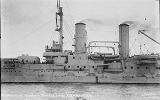
immediately. By 06:15 hours, on 10 August 1904, Admiral Vitgeft, flying his flag in the battleship Tsesarevich
, began leading his battleships from the harbor.
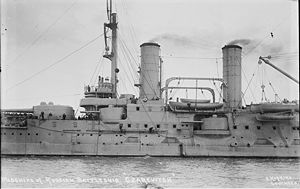
's concentrating of his forces. Although Vitgeth's wise move had bought him time, Togo had nonetheless previously issued orders for his warships to assemble near Encounter Rock, in the event Admiral Vitgeft was to take that route. By 1100 hours however, it was clear which direction Vitgeft's fleet was sailing: they were headed for the open sea. The Russian squadron consisted of the battleships Tsesarevich, Retvizan
, Pobeda, Peresvet
, Sevastopol
, and Poltava
, protected cruiser
s Askold
, Diana, Novik
and Pallada
, and 14 destroyer
s.
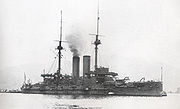 At about 12:25 the battleship fleets sighted each other near Encounter Rock at a range of about 11 miles. Vitgeft's battlefleet was headed southeast at 13 knots, while Togo, on an intercepting course came from the northeast at 14 knots. His fleet consisted of Japan's four surviving battleships Mikasa
, Asahi
, Fuji
, and Shikishima
, the armoured cruisers Nisshin
and Kasuga
, as well as eight protected cruisers, 18 destroyers, and 30 torpedo boat
s. During this time, Admiral Dewa's four cruisers came into view, fast approaching from the south at 18 knots, and Togo attempted to squeeze Admiral Vitgeft's fleet between the two advancing columns.
Just after 13:00, Togo attempted to cross Vitgeft's "T" and commenced firing his main batteries from the extreme range of more than 8 miles. Vitgeft and the battleship Retvizan had returned fire, but the range was excessive for either side, and no hits were scored. Togo had miscalculated his speed when trying to cross the enemy's "T", and Vitgeft simply made a quick turn to port, maintained his speed, and increased his range from Togo's fleet. Within minutes, Admiral Vitgeft was again headed for the open sea, and Admiral Togo's pincer gamble had failed, as Admiral Dewa's cruisers had to turn quickly to avoid Togo's battle line, and thus broke contact without having fired a shot. As Togo observed Vitgeft's battleline swiftly move past his own in opposite directions, he quickly ordered each warship to turn about individually, which put his cruisers into the lead, but now parallel with Vitgeft's battleline.
At about 13:25 hours, and again at a range of over 8 miles, Togo's battleships opened fire on Vitgeft's flagship and the Retvizan, hitting the latter 12 times. By about 13:30 hours, the Russian flagship had returned fire, knocking out Togo's wireless communications with two 305 mm (12 inch) shell direct hits at this extreme range. For nearly half an hour the two battleship fleets pounded each other, slowly closing their range, until by 14:05 hours they reached about 3.5 miles; at which time both fleets let loose with their secondary 155 mm (6 inch) guns. As the fleets continued to pound each other with all available guns, Togo's flagship was beginning to feel its wounds, and he tried to turn his vessel a bit, due to the hits she was taking (she ended up being hit 20 times), and urgently tried to have his cruisers engage the Russian battleline. But with his radio shot out, he had to rely on flag signals, and radio relays from accompanying warships.
, observed the plight of the Poltava and ordered his division to fall back and help the Poltava, and they began concentrating their gunfire onto the Mikasa and Asahi. With Admiral Ukhtomski's division firing, coupled with Poltava's rejoining of the fight, Mikasa and Asahi began taking too many hits, and upon the urging of his chief of staff, Togo used his superior speed to break contact, race ahead of Vitgeft's fleet, and try to re-establish contact again under more favorable conditions. By 15:20 hours, the range was opened, and the firing had ceased.
As the battleships had broken contact, Admiral Dewa with his cruisers attempted to get into action, when suddenly the Russian battleships opened up on him. At about 15:40 hours one 305 mm shell hit Dewa's cruiser
, the Yakumo from a range of over 8 miles; which was well out of range of his 203 mm (8 inch) guns. Admiral Dewa wisely decided that his four Japanese cruisers had no business tangling with any Russian battleships.
By this time, only Togo's 6 warships (4 battleships and 2 armored cruisers) were chasing Vitgeft's 10 warships (6 battleships and 4 cruisers). With darkness only 3 hours away, Admiral Vitgeft believed that he had outranged Admiral Togo, and would lose him totally when darkness came. Togo knew this too, and ordered a 15 knot speed to catch up to the tail end of Vitgeft's fleet. By 17:35 hours Togo's warships had closed to within 3.5 miles of the again lagging battleship Poltava, and opened fire upon her. Admiral Dewa also showed up with his cruisers, and Togo ordered all battleships and cruisers to shell the Poltava, hoping to at least sink one Russian battleship. However, the Russian commander, Captain Ivan P. Uspenskiy of the Poltava would not go down meekly, and his crewmen scored several hits on Admiral Togo's flagship. At this time, the Shimose
shells
loaded inside the 305 mm guns became incredibly unstable and began detonating inside the gun barrels; knocking out of action one 305 mm on the Shikishima at 17:45 hours, and two 305 mm barrels on the Asahi at 18:10 hours. By 18:30 hours, Togo only had 11 of his original 17 305 mm guns still in action.
handoff) the shooting upon the lead Russian battleship. Within 10 minutes of being relieved by the Asahi, Admiral Togo got his lucky break, when at 18:40 hours Asahi fired a 305 mm salvo into the Russian flagship Tsesarevich, instantly killing Admiral Vitgeft and his immediate staff, and jamming the flagship's steering wheel. The explosion had wedged the wheel into a port turn, sharp enough so that Tsesarevich heeled over 12 degrees. Retvizan, which was unaware of the situation on the flagship
, followed in her wake. By the time Pobeda arrived at the turning point, Tsesarevich had swung around 180 degrees and was heading back into her own line. With no signal to indicate what had happened, the other ships were unaware that Tsesarevich was not only out of control and without its admiral, but was actually without anyone at all in command.
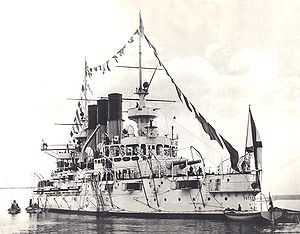 Prince
Pavel Ukhtomski of the battleship soon realized that the flagship was out of action, and attempted to gain control of the Russian squadron. At the same time Captain Eduard Schensnovich
commanding the battleship , immediately turned his battleship towards Togo's battleline, charging directly into it firing every weapon he had, despite being down by the bow from battle damage. Frantically Togo's battleline shifted their fire onto Retvizan, pounding the warship with every gun they had, as the range dropped to less than three miles. There were so many shell splashes surrounding the charging battleship, that Japanese gunners were unable to adjust their fire. However, as Togo's battleships were running low on 305 mm shells, and many of his main guns were out of action, he decided to play it safe, and with the Russian squadron scattered, he turned the fight over to his cruiser
s and destroyer
s. As Togo's battlewagons began their turn, they fired a final salvo, hitting the enemy battleship with several shells, one of which seriously wounded Captain Schensnovich in the stomach. The Retvizan laid smoke and also began to turn away, but the battleship had effectively ended the duel between the opposing pre-dreadnaughts, and had saved the flagship from destruction. There was little choice but to give up the attempt to reach Vladivostok and to return back to Port Arthur. Even this proved impossible to coordinate, and many ships wandered off on their own.
Two hours later, the bulk of the Russian fleet returned to the relative safety of Port Arthur. Five battleships, a cruiser and nine destroyers made it back. The damaged Tsesarevich and three escorting destroyers sailed to Kiaochou
, where they were interned by German
authorities. The cruiser and another destroyer sailed to Shanghai
and were likewise interned by Chinese
authorities. The cruiser escaped to Saigon, where it was interned by the French
. Only the small cruiser sailed east around the Japanese home islands to try to reach Vladivostok. However, on 20 August 1904 pursuing Japanese cruisers forced the ship aground at Sakhalin
, where it was destroyed by the crew after engaging the Japanese at the Battle of Korsakov
.
Although Admiral Stark had been replaced by Admiral Stepan Makarov
shortly after the Port Arthur battle, Makarov in turn was replaced by Vitgeft, following Makarov's death in April 1904, when his battleship Petropavlovsk
blew up and sank in the Yellow Sea, after striking mines. Had Admiral Stark remained in command at the time of the Yellow Sea battle, both Admiral Togo and Stark would have met on equal terms, both retaining about equal combat
experience
in battleship fleet actions. But the naval force that Togo was to meet at Tsushima
the following year was not the same type of battle fleet that he engaged at the Yellow Sea either. Though Admiral Vitgeft was new, many of his men were not, most of them were veterans of Far East duty, with some of them veterans of the 1900 Boxer Rebellion in China. Thusly, when Togo fought Vitgeft's fleet in the Yellow Sea in August 1904, he quickly found that they knew how to sail, and they were good gunners.
The Yellow Sea engagement had lasted approximately 6 to 7 hours, with about 4 of those hours being direct combat. During those nearly four hours of fighting, roughly 7,382 rounds had been expended by both sides; ranging in size from 155 to 305 mm shells. From those 7,382 shells fired, approximately 5,956 had been from 155 mm guns; 3,592 from the Imperial Japanese Navy, and 2,364 from the Imperial Russian Navy. 307 203 mm shells had been fired by the IJN
, and none by the Russian fleet. Admiral Vitgeft's fleet had expended 224 254 mm shells compared to Togo's 33 shells. The long range gunnery duel that had commenced at a range of over 8 miles, and which began with 305 mm main gun fire, ended with 305 mm gun fire near darkness, during which time 862 305 mm main gun rounds were fired; 259 from the Russian battleships, and 603 from the Japanese battleships.
Captain Eduard N. Shchensnovich, who had bravely charged his battleship into Admiral Togo's battleline, thus ending the battleship fleet duel, and saving the Russian flagship from destruction, later died from his wounds received from that action in April 1910, at the age of 58.
Tactically, the battle had been a draw, since no fleet suffered any capital ship losses. Strategically the battle had been a Japanese victory, since the Russian fleet never again attempted to break out into the open sea. By December 1904, the land battles had converged around Port Arthur itself, and heavy artillery would soon be brought to bear on the Russian warships remaining inside Port Arthur; sinking or damaging all of the survivors of the Yellow Sea Battle.
Naval battle
A naval battle is a battle fought using boats, ships or other waterborne vessels. Most naval battles have occurred at sea, but a few have taken place on lakes or rivers. The earliest recorded naval battle took place in 1210 BC near Cyprus...
of the Russo-Japanese War
Russo-Japanese War
The Russo-Japanese War was "the first great war of the 20th century." It grew out of rival imperial ambitions of the Russian Empire and Japanese Empire over Manchuria and Korea...
, fought on 10 August 1904. In the Russian Navy, it was referred to as the Battle of 10 August. The battle foiled an attempt by the Russian fleet at Port Arthur
Lüshunkou
Lüshunkou is a district in the municipality of Dalian, Liaoning province, China. Also called Lüshun City or Lüshun Port, it was formerly known as both Port Arthur and Ryojun....
to break out and form up with counterparts from Vladivostok
Vladivostok
The city is located in the southern extremity of Muravyov-Amursky Peninsula, which is about 30 km long and approximately 12 km wide.The highest point is Mount Kholodilnik, the height of which is 257 m...
, forcing them to return to port. Four days later, the Battle off Ulsan
Battle off Ulsan
The naval Battle off Ulsan , also known as the Battle of the Japanese Sea or Battle of the Korean Strait, took place on 14 August 1904 during the Russo-Japanese War, four days after the Battle of the Yellow Sea.-Background:The Vladivostok Cruiser Unit of the Russian fleet...
similarly ended the Vladivostok group's sortie, forcing both fleets to remain at anchor.
Background
The Imperial Russian NavyImperial Russian Navy
The Imperial Russian Navy refers to the Tsarist fleets prior to the February Revolution.-First Romanovs:Under Tsar Mikhail Feodorovich, construction of the first three-masted ship, actually built within Russia, was completed in 1636. It was built in Balakhna by Danish shipbuilders from Holstein...
's First Pacific Squadron, commanded by Admiral Wilgelm Vitgeft
Wilgelm Vitgeft
Wilgelm Karlovich Vitgeft , sometimes written Wilhelm and Withöft was an admiral in the Imperial Russian Navy, noted for his service in the Russo-Japanese War of 1904-1905.-Biography:...
, had been trapped in Port Arthur
Lüshunkou
Lüshunkou is a district in the municipality of Dalian, Liaoning province, China. Also called Lüshun City or Lüshun Port, it was formerly known as both Port Arthur and Ryojun....
since the Imperial Japanese Navy
Imperial Japanese Navy
The Imperial Japanese Navy was the navy of the Empire of Japan from 1869 until 1947, when it was dissolved following Japan's constitutional renunciation of the use of force as a means of settling international disputes...
's blockade began on 8 February 1904 with the Battle of Port Arthur
Battle of Port Arthur
The Battle of Port Arthur was the starting battle of the Russo-Japanese War...
. Throughout late July and early August, as the Imperial Japanese Army
Imperial Japanese Army
-Foundation:During the Meiji Restoration, the military forces loyal to the Emperor were samurai drawn primarily from the loyalist feudal domains of Satsuma and Chōshū...
laid siege to Port Arthur, relations between Admiral Vitgeft and Russian Viceroy
Viceroy
A viceroy is a royal official who runs a country, colony, or province in the name of and as representative of the monarch. The term derives from the Latin prefix vice-, meaning "in the place of" and the French word roi, meaning king. A viceroy's province or larger territory is called a viceroyalty...
Yevgeni Alekseyev increasingly soured. Viceroy Alexeiev, a former Admiral, favored an aggressive sortie
Sortie
Sortie is a term for deployment or dispatch of one military unit, be it an aircraft, ship, or troops from a strongpoint. The sortie, whether by one or more aircraft or vessels, usually has a specific mission....
so as to enable the First Pacific Squadron to link up with the Vladivostok Squadron and thereby create a naval force powerful enough to challenge the Japanese fleet. Admiral Vitgeft believed in a fleet in being
Fleet in being
In naval warfare, a fleet in being is a naval force that extends a controlling influence without ever leaving port. Were the fleet to leave port and face the enemy, it might lose in battle and no longer influence the enemy's actions, but while it remains safely in port the enemy is forced to...
, which simply stayed at anchor, while at the same time contributing some of his weaponry to the land battle
Siege of Port Arthur
The Siege of Port Arthur , 1 August 1904 – 2 January 1905, the deep-water port and Russian naval base at the tip of the Liaotung Peninsula in Manchuria, was the longest and most violent land battle of the Russo-Japanese War....
as the safest course to follow. Although passive, Vitgeft's preference was actually more in keeping with the Russian Navy's doctrine, which was building up strength (waiting for the arrival of the Baltic Fleet, also known as the 2nd Pacific Squadron), and then engaging the Japanese navy in decisive battle.
Alexeiev appealed to St. Petersburg, and Tsar Nicholas II replied that he fully shared the Viceroy's opinion. Faced with an Imperial writ and threat of legal action, Admiral Vitgeft was ordered to sail for Vladivostok
Vladivostok
The city is located in the southern extremity of Muravyov-Amursky Peninsula, which is about 30 km long and approximately 12 km wide.The highest point is Mount Kholodilnik, the height of which is 257 m...
immediately. By 06:15 hours, on 10 August 1904, Admiral Vitgeft, flying his flag in the battleship Tsesarevich
Battleship Tsesarevich
The Tsesarevich was a battleship of the Imperial Russian Navy, built in France by Compagnie des Forges et Chantiers de la Méditerranée à la Seine. She was named after the Tsesarevich — the title reserved for the eldest son of the Tsar and heir to the Russian throne...
, began leading his battleships from the harbor.
Opening moves
At 09:55 hours his fleet had cleared the harbor's entrance, and as Admiral Vitgeft's Pacific Squadron completed their exit, he wisely made a feint to the south-west to conceal his actual intent; whereby he succeeded in delaying Admiral Heihachiro TogoTogo Heihachiro
Fleet Admiral Marquis was a Fleet Admiral in the Imperial Japanese Navy and one of Japan's greatest naval heroes. He was termed by Western journalists as "the Nelson of the East".-Early life:...
's concentrating of his forces. Although Vitgeth's wise move had bought him time, Togo had nonetheless previously issued orders for his warships to assemble near Encounter Rock, in the event Admiral Vitgeft was to take that route. By 1100 hours however, it was clear which direction Vitgeft's fleet was sailing: they were headed for the open sea. The Russian squadron consisted of the battleships Tsesarevich, Retvizan
Russian battleship Retvizan
Retvizan was a Russian pre-dreadnought battleship built before the Russo-Japanese War of 1904–05 for the Imperial Russian Navy in the United States. She was built by the William Cramp and Sons Ship & Engine Building Company of Philadelphia, although the armament was made at the Obukhov works in...
, Pobeda, Peresvet
Peresviet class
The Peresvet-class were pre-dreadnought battleships of the Imperial Russian Navy. All three ships were lost by the Russians in the Russo-Japanese war. One ship was sunk at the Battle of Tsushima and two were captured after being sunk during the Siege of Port Arthur.-Design:These ships were inspired...
, Sevastopol
Russian battleship Sevastopol
2 battleships of the Imperial Russian Navy have been named Sevastopol, after the city located in the Crimea.*Sevastopol was a Petropavlovsk class battleship launched in 1895. She was sunk by the Japanese in 1905 at Port Arthur during the Russo-Japanese War.*Sevastopol was the first ship completed...
, and Poltava
Japanese battleship Tango
The Russian battleship Poltava was a Petropavlovsk-class battleship of the Imperial Russian Navy. She was one of eight Russian pre-dreadnought battleships captured by the Imperial Japanese Navy during the Russo-Japanese War of 1904–1905. Poltava was built at the Galernii Island shipyard, one of a...
, protected cruiser
Protected cruiser
The protected cruiser is a type of naval cruiser of the late 19th century, so known because its armoured deck offered protection for vital machine spaces from shrapnel caused by exploding shells above...
s Askold
Russian cruiser Askold (1900)
Askold was a protected cruiser built for the Imperial Russian Navy. She was named after the legendary Varangian Askold. Her thin, narrow hull and maximum speed of were considered impressive for the time....
, Diana, Novik
Russian cruiser Novik (1900)
Novík was a protected cruiser in the Imperial Russian Navy, built by Schichau shipyards in Elbing near Danzig, Germany.-Background:Novik was a very fast ship for the time, but smaller than most contemporary cruisers, and perhaps a forerunner of later light cruisers...
and Pallada
Russian cruiser Pallada (1899)
The RUS Pallada was the lead ship in the of protected cruisers in the Imperial Russian Navy. It was built in Admiralty Shipyard, Saint Petersburg, Russia...
, and 14 destroyer
Destroyer
In naval terminology, a destroyer is a fast and maneuverable yet long-endurance warship intended to escort larger vessels in a fleet, convoy or battle group and defend them against smaller, powerful, short-range attackers. Destroyers, originally called torpedo-boat destroyers in 1892, evolved from...
s.
Japanese battleship Mikasa
is a pre-Dreadnought battleship of the Imperial Japanese Navy, launched in Britain in 1900. She served as the flagship of Admiral Tōgō Heihachirō during the Battle of the Yellow Sea on 10 August 1904, and the Battle of Tsushima on 27 May 1905 during the Russo-Japanese War. The ship is preserved as...
, Asahi
Japanese battleship Asahi
|-External links:***...
, Fuji
Japanese battleship Fuji
-External links:*...
, and Shikishima
Japanese battleship Shikishima
|-External links:**...
, the armoured cruisers Nisshin
Japanese cruiser Nisshin
, also transliterated as Nissin, was a armored cruiser of the Imperial Japanese Navy designed and built by Ansaldo in Genoa Italy, where the type was known as the . Designed as a cross between a battleship and a cruiser, but with a very small displacement, it had the ability to stand in the line...
and Kasuga
Japanese cruiser Kasuga
was the lead ship of the armored cruisers of the Imperial Japanese Navy, designed and built by Ansaldo Yards, Genoa, Italy, where the type was known as the...
, as well as eight protected cruisers, 18 destroyers, and 30 torpedo boat
Torpedo boat
A torpedo boat is a relatively small and fast naval vessel designed to carry torpedoes into battle. The first designs rammed enemy ships with explosive spar torpedoes, and later designs launched self-propelled Whitehead torpedoes. They were created to counter battleships and other large, slow and...
s. During this time, Admiral Dewa's four cruisers came into view, fast approaching from the south at 18 knots, and Togo attempted to squeeze Admiral Vitgeft's fleet between the two advancing columns.
Just after 13:00, Togo attempted to cross Vitgeft's "T" and commenced firing his main batteries from the extreme range of more than 8 miles. Vitgeft and the battleship Retvizan had returned fire, but the range was excessive for either side, and no hits were scored. Togo had miscalculated his speed when trying to cross the enemy's "T", and Vitgeft simply made a quick turn to port, maintained his speed, and increased his range from Togo's fleet. Within minutes, Admiral Vitgeft was again headed for the open sea, and Admiral Togo's pincer gamble had failed, as Admiral Dewa's cruisers had to turn quickly to avoid Togo's battle line, and thus broke contact without having fired a shot. As Togo observed Vitgeft's battleline swiftly move past his own in opposite directions, he quickly ordered each warship to turn about individually, which put his cruisers into the lead, but now parallel with Vitgeft's battleline.
At about 13:25 hours, and again at a range of over 8 miles, Togo's battleships opened fire on Vitgeft's flagship and the Retvizan, hitting the latter 12 times. By about 13:30 hours, the Russian flagship had returned fire, knocking out Togo's wireless communications with two 305 mm (12 inch) shell direct hits at this extreme range. For nearly half an hour the two battleship fleets pounded each other, slowly closing their range, until by 14:05 hours they reached about 3.5 miles; at which time both fleets let loose with their secondary 155 mm (6 inch) guns. As the fleets continued to pound each other with all available guns, Togo's flagship was beginning to feel its wounds, and he tried to turn his vessel a bit, due to the hits she was taking (she ended up being hit 20 times), and urgently tried to have his cruisers engage the Russian battleline. But with his radio shot out, he had to rely on flag signals, and radio relays from accompanying warships.
Stern chases
The Japanese cruisers had re-established contact with the Russian battleline, but had been quickly driven off by their 305 mm gunfire. Both battlefleets were maintaining about 14 knots, but again, Vitgeft had managed to get past Togo, and the Japanese were forced to commence a stern chase. By 14:45 hours the Japanese flagship had closed to within about 7 miles of the trailing battleship Poltava, which had been unable to maintain its fleet's 14 knots due to engine troubles. Mikasa and Asahi soon began to pound the Poltava, scoring several hits. However, admiral Ukhtomski riding in the battleship PeresvetJapanese battleship Sagami
was one of eight Russian pre-dreadnought battleships captured by the Imperial Japanese Navy during the Russo-Japanese War of 1904–1905. It was built as the lead ship of the of battleships, with a design inspired by the British battleship...
, observed the plight of the Poltava and ordered his division to fall back and help the Poltava, and they began concentrating their gunfire onto the Mikasa and Asahi. With Admiral Ukhtomski's division firing, coupled with Poltava's rejoining of the fight, Mikasa and Asahi began taking too many hits, and upon the urging of his chief of staff, Togo used his superior speed to break contact, race ahead of Vitgeft's fleet, and try to re-establish contact again under more favorable conditions. By 15:20 hours, the range was opened, and the firing had ceased.
As the battleships had broken contact, Admiral Dewa with his cruisers attempted to get into action, when suddenly the Russian battleships opened up on him. At about 15:40 hours one 305 mm shell hit Dewa's cruiser
Cruiser
A cruiser is a type of warship. The term has been in use for several hundreds of years, and has had different meanings throughout this period...
, the Yakumo from a range of over 8 miles; which was well out of range of his 203 mm (8 inch) guns. Admiral Dewa wisely decided that his four Japanese cruisers had no business tangling with any Russian battleships.
By this time, only Togo's 6 warships (4 battleships and 2 armored cruisers) were chasing Vitgeft's 10 warships (6 battleships and 4 cruisers). With darkness only 3 hours away, Admiral Vitgeft believed that he had outranged Admiral Togo, and would lose him totally when darkness came. Togo knew this too, and ordered a 15 knot speed to catch up to the tail end of Vitgeft's fleet. By 17:35 hours Togo's warships had closed to within 3.5 miles of the again lagging battleship Poltava, and opened fire upon her. Admiral Dewa also showed up with his cruisers, and Togo ordered all battleships and cruisers to shell the Poltava, hoping to at least sink one Russian battleship. However, the Russian commander, Captain Ivan P. Uspenskiy of the Poltava would not go down meekly, and his crewmen scored several hits on Admiral Togo's flagship. At this time, the Shimose
Shimose powder
Shimose powder was a type of explosive shell filling developed by the Japanese chemist Shimose Masachika . It was a form of picric acid used by France as melinite and by Britain as lyddite...
shells
Shell (projectile)
A shell is a payload-carrying projectile, which, as opposed to shot, contains an explosive or other filling, though modern usage sometimes includes large solid projectiles properly termed shot . Solid shot may contain a pyrotechnic compound if a tracer or spotting charge is used...
loaded inside the 305 mm guns became incredibly unstable and began detonating inside the gun barrels; knocking out of action one 305 mm on the Shikishima at 17:45 hours, and two 305 mm barrels on the Asahi at 18:10 hours. By 18:30 hours, Togo only had 11 of his original 17 305 mm guns still in action.
Hand-Off
Although the range had dropped to about 3 miles, the secondary batteries of 155 and 203 mm guns were still ineffective, and Poltava and Peresvet although heavily damaged, were still with the Russian battleline. By 18:30 hours, Togo was still having trouble controlling his battleship's gunfire; Shikishima and Asahi were blasting away at the crippled Poltava, Fuji was shooting at Pobeda and Peresvet, while the flagship Mikasa was duelling with the Russian flagship Tsesarevich. No IJN warships were shooting at the Russian battleships Retvizan and Sevastopol, which allowed them to freely blast away at the Mikasa. With darkness only 30 minutes away, the Japanese flagship Mikasa almost no longer combat effective, and Russian gunfire seemingly becoming more accurate and effective with each cannon shot; the flagship signaled to the Asahi to take over (known as a battleBattle
Generally, a battle is a conceptual component in the hierarchy of combat in warfare between two or more armed forces, or combatants. In a battle, each combatant will seek to defeat the others, with defeat determined by the conditions of a military campaign...
handoff) the shooting upon the lead Russian battleship. Within 10 minutes of being relieved by the Asahi, Admiral Togo got his lucky break, when at 18:40 hours Asahi fired a 305 mm salvo into the Russian flagship Tsesarevich, instantly killing Admiral Vitgeft and his immediate staff, and jamming the flagship's steering wheel. The explosion had wedged the wheel into a port turn, sharp enough so that Tsesarevich heeled over 12 degrees. Retvizan, which was unaware of the situation on the flagship
Flagship
A flagship is a vessel used by the commanding officer of a group of naval ships, reflecting the custom of its commander, characteristically a flag officer, flying a distinguishing flag...
, followed in her wake. By the time Pobeda arrived at the turning point, Tsesarevich had swung around 180 degrees and was heading back into her own line. With no signal to indicate what had happened, the other ships were unaware that Tsesarevich was not only out of control and without its admiral, but was actually without anyone at all in command.
Charge of battleship Retvizan
Prince
Prince is a general term for a ruler, monarch or member of a monarch's or former monarch's family, and is a hereditary title in the nobility of some European states. The feminine equivalent is a princess...
Pavel Ukhtomski of the battleship soon realized that the flagship was out of action, and attempted to gain control of the Russian squadron. At the same time Captain Eduard Schensnovich
Eduard Schensnovich
Eduard Nikolayevich Schensnovich Eduárd Nikoláevič Ščensnóvič, occasionally transliterated as was an admiral in the Imperial Russian Navy.- Biography :...
commanding the battleship , immediately turned his battleship towards Togo's battleline, charging directly into it firing every weapon he had, despite being down by the bow from battle damage. Frantically Togo's battleline shifted their fire onto Retvizan, pounding the warship with every gun they had, as the range dropped to less than three miles. There were so many shell splashes surrounding the charging battleship, that Japanese gunners were unable to adjust their fire. However, as Togo's battleships were running low on 305 mm shells, and many of his main guns were out of action, he decided to play it safe, and with the Russian squadron scattered, he turned the fight over to his cruiser
Cruiser
A cruiser is a type of warship. The term has been in use for several hundreds of years, and has had different meanings throughout this period...
s and destroyer
Destroyer
In naval terminology, a destroyer is a fast and maneuverable yet long-endurance warship intended to escort larger vessels in a fleet, convoy or battle group and defend them against smaller, powerful, short-range attackers. Destroyers, originally called torpedo-boat destroyers in 1892, evolved from...
s. As Togo's battlewagons began their turn, they fired a final salvo, hitting the enemy battleship with several shells, one of which seriously wounded Captain Schensnovich in the stomach. The Retvizan laid smoke and also began to turn away, but the battleship had effectively ended the duel between the opposing pre-dreadnaughts, and had saved the flagship from destruction. There was little choice but to give up the attempt to reach Vladivostok and to return back to Port Arthur. Even this proved impossible to coordinate, and many ships wandered off on their own.
Two hours later, the bulk of the Russian fleet returned to the relative safety of Port Arthur. Five battleships, a cruiser and nine destroyers made it back. The damaged Tsesarevich and three escorting destroyers sailed to Kiaochou
Jiaozhou Bay
The Jiaozhou Bay is a sea gulf located in Qingdao Prefecture of Shandong Province. It was a German colonial concession from 1898 until 1914....
, where they were interned by German
Germany
Germany , officially the Federal Republic of Germany , is a federal parliamentary republic in Europe. The country consists of 16 states while the capital and largest city is Berlin. Germany covers an area of 357,021 km2 and has a largely temperate seasonal climate...
authorities. The cruiser and another destroyer sailed to Shanghai
Shanghai
Shanghai is the largest city by population in China and the largest city proper in the world. It is one of the four province-level municipalities in the People's Republic of China, with a total population of over 23 million as of 2010...
and were likewise interned by Chinese
Late Imperial China
Late Imperial China refers to the period between the end of Mongol rule in 1368 and the establishment of the Republic of China in 1912 and includes the Ming and Qing Dynasties...
authorities. The cruiser escaped to Saigon, where it was interned by the French
French Indochina
French Indochina was part of the French colonial empire in southeast Asia. A federation of the three Vietnamese regions, Tonkin , Annam , and Cochinchina , as well as Cambodia, was formed in 1887....
. Only the small cruiser sailed east around the Japanese home islands to try to reach Vladivostok. However, on 20 August 1904 pursuing Japanese cruisers forced the ship aground at Sakhalin
Sakhalin
Sakhalin or Saghalien, is a large island in the North Pacific, lying between 45°50' and 54°24' N.It is part of Russia, and is Russia's largest island, and is administered as part of Sakhalin Oblast...
, where it was destroyed by the crew after engaging the Japanese at the Battle of Korsakov
Battle of Korsakov
The Battle of Korsakov, a naval engagement of the Russo-Japanese War, was fought on 20 August 1904. The battle foiled an attempt by the Russian cruiser Novik at escaping Port Arthur to join with Russian forces at Vladivosk after the Russian Pacific Squadron was scattered after the Battle of the...
.
Analysis
The Battle of the Yellow Sea had been naval history's first major confrontation between modern steel battleship fleets. With the exception of Admiral Togo's 20 minute duel with Russian Admiral Stark's battleships at Port Arthur on 9 February 1904, both Vitgeft and Togo were relatively new at fighting modern steel battleship fleet actions.Although Admiral Stark had been replaced by Admiral Stepan Makarov
Stepan Makarov
Stepan Osipovich Makarov was a Ukrainian - born Russian vice-admiral, a highly accomplished and decorated commander of the Imperial Russian Navy, an oceanographer, awarded by the Russian Academy of Sciences, and author of several books. Makarov also designed a small number of ships...
shortly after the Port Arthur battle, Makarov in turn was replaced by Vitgeft, following Makarov's death in April 1904, when his battleship Petropavlovsk
Russian battleship Petropavlovsk (1897)
The Petropavlovsk was the lead ship of the Petropavlovsk class of battleships built for the Imperial Russian Navy. During the Russo-Japanese War, Petropavlovsk was a flagship of the First Pacific Squadron, taking part in battles against the Imperial Japanese Navy. On March 31, 1904, the battleship...
blew up and sank in the Yellow Sea, after striking mines. Had Admiral Stark remained in command at the time of the Yellow Sea battle, both Admiral Togo and Stark would have met on equal terms, both retaining about equal combat
Combat
Combat, or fighting, is a purposeful violent conflict meant to establish dominance over the opposition, or to terminate the opposition forever, or drive the opposition away from a location where it is not wanted or needed....
experience
Experience
Experience as a general concept comprises knowledge of or skill in or observation of some thing or some event gained through involvement in or exposure to that thing or event....
in battleship fleet actions. But the naval force that Togo was to meet at Tsushima
Battle of Tsushima
The Battle of Tsushima , commonly known as the “Sea of Japan Naval Battle” in Japan and the “Battle of Tsushima Strait”, was the major naval battle fought between Russia and Japan during the Russo-Japanese War...
the following year was not the same type of battle fleet that he engaged at the Yellow Sea either. Though Admiral Vitgeft was new, many of his men were not, most of them were veterans of Far East duty, with some of them veterans of the 1900 Boxer Rebellion in China. Thusly, when Togo fought Vitgeft's fleet in the Yellow Sea in August 1904, he quickly found that they knew how to sail, and they were good gunners.
Rangefinders and gunnery
During the late 1890s, the adopted thinking of the time was around 3 to 4 miles for battleship engagements. Although 305 mm/40 caliber guns were quite capable of reaching out to the ranges that the Yellow Sea battle had opened up with (8 miles), the lack of effective range-finders and gun sights forced practical 305 mm (12 inch) gunfire to be held within a 3 to 4 mile range. During the battle, Russian battleships had been equipped with Liuzhol Rangefinders with a range out to 4,000 meters; while Japanese pre-dreadnaughts had been equipped with the latest (1903) Barr & Stroud coincidence rangefinders, which had a range out 6,000 meters. Notwithstanding all of the above, the world was quite surprised when the opponents opened fire upon one another while still over 8 miles apart.The Yellow Sea engagement had lasted approximately 6 to 7 hours, with about 4 of those hours being direct combat. During those nearly four hours of fighting, roughly 7,382 rounds had been expended by both sides; ranging in size from 155 to 305 mm shells. From those 7,382 shells fired, approximately 5,956 had been from 155 mm guns; 3,592 from the Imperial Japanese Navy, and 2,364 from the Imperial Russian Navy. 307 203 mm shells had been fired by the IJN
Imperial Japanese Navy
The Imperial Japanese Navy was the navy of the Empire of Japan from 1869 until 1947, when it was dissolved following Japan's constitutional renunciation of the use of force as a means of settling international disputes...
, and none by the Russian fleet. Admiral Vitgeft's fleet had expended 224 254 mm shells compared to Togo's 33 shells. The long range gunnery duel that had commenced at a range of over 8 miles, and which began with 305 mm main gun fire, ended with 305 mm gun fire near darkness, during which time 862 305 mm main gun rounds were fired; 259 from the Russian battleships, and 603 from the Japanese battleships.
Battle damage and casualties
The nearly seven hours of naval combat coupled with the estimated 7,382 fired shells, had produced:| Battleship | Damage | Casualties |
|---|---|---|
| Tsesarevich | 13 305 mm gun hits and 2 203 mm hits | 12 crewmen killed and 47 crewmen wounded |
| Pobeda | 11 large caliber hits | 4 crewmen killed and 29 crewmen wounded |
| Peresvet Japanese battleship Sagami was one of eight Russian pre-dreadnought battleships captured by the Imperial Japanese Navy during the Russo-Japanese War of 1904–1905. It was built as the lead ship of the of battleships, with a design inspired by the British battleship... |
39 hits | 13 crewmen killed/69 crewmen wounded |
| Poltava Japanese battleship Tango The Russian battleship Poltava was a Petropavlovsk-class battleship of the Imperial Russian Navy. She was one of eight Russian pre-dreadnought battleships captured by the Imperial Japanese Navy during the Russo-Japanese War of 1904–1905. Poltava was built at the Galernii Island shipyard, one of a... |
12 to 14 hits, 203 to 305 mm guns | 12 crewmen killed and 43 crewmen wounded |
| Retvizan Russian battleship Retvizan Retvizan was a Russian pre-dreadnought battleship built before the Russo-Japanese War of 1904–05 for the Imperial Russian Navy in the United States. She was built by the William Cramp and Sons Ship & Engine Building Company of Philadelphia, although the armament was made at the Obukhov works in... |
18 hits from 203 and 305 mm guns | 6 crewmen killed and 42 crewmen wounded |
| Sevastopol Russian battleship Sevastopol (1895) Sevastopol was the last of three ships in the Petropavlovsk class of pre-dreadnought battleships built for the Imperial Russian Navy in the 1890s... |
Struck by several shells | 1 crewman killed and 62 crewmen wounded |
| Mikasa Japanese battleship Mikasa is a pre-Dreadnought battleship of the Imperial Japanese Navy, launched in Britain in 1900. She served as the flagship of Admiral Tōgō Heihachirō during the Battle of the Yellow Sea on 10 August 1904, and the Battle of Tsushima on 27 May 1905 during the Russo-Japanese War. The ship is preserved as... |
Hit 20 times and aft 305 mm turret knocked out of action | 125 casualties |
| Asahi Japanese battleship Asahi |-External links:***... |
1 305 mm hit near the waterline and both aft 305 mm gun barrels burst | 2 crewmen wounded |
| Shikishima Japanese battleship Shikishima |-External links:**... |
1 forward 305 mm gun barrel burst | |
| Yakumo Japanese cruiser Yakumo was a 1st class armored cruiser of the Imperial Japanese Navy, designed and built by the Stettiner Vulcan AG shipyards in Stettin, Germany. The Yakumo was named from a stanza of the Waka by Susanoo in the Japanese mythology.-Background:... |
1 305 mm hit |
Captain Eduard N. Shchensnovich, who had bravely charged his battleship into Admiral Togo's battleline, thus ending the battleship fleet duel, and saving the Russian flagship from destruction, later died from his wounds received from that action in April 1910, at the age of 58.
Tactically, the battle had been a draw, since no fleet suffered any capital ship losses. Strategically the battle had been a Japanese victory, since the Russian fleet never again attempted to break out into the open sea. By December 1904, the land battles had converged around Port Arthur itself, and heavy artillery would soon be brought to bear on the Russian warships remaining inside Port Arthur; sinking or damaging all of the survivors of the Yellow Sea Battle.
External links
- Russo-Japanese War Research Society
- Russian Navy history of war: http://flot.com/history/steemfleet/index.htm
- article in Russian Language - http://ship.bsu.by/main.asp?id=3905#3905