

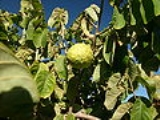
Annona cherimola

Encyclopedia
Annona cherimola , and originally called Chirimuya by the Inca people
who lived where it was growing in the Andes
of South America
, is an edible fruit (named Cherimoya
) bearing species of the genus Annona
from the family Annonaceae
is now widely cultivated mostly for its sweet fruits that share the name Custard-apple
with others in its family.
briefly deciduous
but mostly evergreen
low branched, spreading tree
or shrub
5 metres (16.4 ft) to 9 metres (29.5 ft) tall.
Stems and leaves: Mature branches are sappy and woody; young branches and twigs have a matting of short, fine, rust colored hairs.
Flowers: Very pale green, fleshy flowers 3 centimetres (1.2 in) long, with very strong fruity odor, each with three outer, greenish, fleshy, oblong, downy petals and 3 smaller, pinkish inner petals with yellow
or brown
finely matted hairs outside, whitish with purple
spot and many stamens on the inside. They appear on the branches opposite to the leaves, solitary or in pairs or groups of three, on flower stalks that are covered densely with fine rust colored hairs, 8 millimetre (0.31496062992126 in) to 12 millimetre (0.47244094488189 in) long. Buds 15 millimetre (0.590551181102362 in) to 18 millimetre (0.708661417322835 in) long, 5 millimetre (0.196850393700787 in) to 8 millimetre (0.31496062992126 in) wide at the base.
Fruits and reproduction: Large green conical or heart-shaped compound fruit, 10 centimetres (3.9 in) to 20 centimetres (7.9 in) long, and diameters of 5 centimetres (2 in) to 5 centimetres (2 in), with skin that gives the appearance of having overlapping scales or knobby warts. Ripening to brown
with a fissured surface from winter into spring; weighing on the average 150 grams (5.3 oz) to 500 grams (17.6 oz) but extra large specimens may weigh 2.7 kilograms (6 lb) or more. The ripened flesh is creamy white and contains numerous hard, inedible, brown or black, beanlike, glossy seeds, 1 centimetre (0.393700787401575 in) to 2 centimetre (0.78740157480315 in) long and about half as wide.
at altitudes of 700 metres (2,296.6 ft) to 2400 metres (7,874 ft) where it was spread to the Caribbean
. From there it was taken by Europeans to various parts of the tropics. Unlike other Annona
species
A. cherimola has not successfully naturalized in West Africa
, and the Australasians have misidentified Annona glabra as this species.
Native
Current (naturalized and native)
Inca Empire
The Inca Empire, or Inka Empire , was the largest empire in pre-Columbian America. The administrative, political and military center of the empire was located in Cusco in modern-day Peru. The Inca civilization arose from the highlands of Peru sometime in the early 13th century...
who lived where it was growing in the Andes
Andes
The Andes is the world's longest continental mountain range. It is a continual range of highlands along the western coast of South America. This range is about long, about to wide , and of an average height of about .Along its length, the Andes is split into several ranges, which are separated...
of South America
South America
South America is a continent situated in the Western Hemisphere, mostly in the Southern Hemisphere, with a relatively small portion in the Northern Hemisphere. The continent is also considered a subcontinent of the Americas. It is bordered on the west by the Pacific Ocean and on the north and east...
, is an edible fruit (named Cherimoya
Cherimoya
The Cherimoya is the fruit of the species Annona cherimola, which is native to the Andes. Today they are grown throughout South and Central America.-Description:...
) bearing species of the genus Annona
Annona
Annona is a genus of flowering plants in the pawpaw/sugar apple family, Annonaceae. It is the second largest genus in the family after Guatteria, containing approximately 110 species of mostly neotropical and afrotropical trees and shrubs....
from the family Annonaceae
Annonaceae
Annonaceae, also called the custard apple familyis a family of flowering plants consisting of trees, shrubs or rarely lianas.With about 2300 to 2500 species and more than 130 genera,...
is now widely cultivated mostly for its sweet fruits that share the name Custard-apple
Custard-apple
The tree also grows in Egypt,but the fruit is quite greenish in color not brown or yellowish.The common name for the fruit in Egypt is "Kishta".The custard-apple, also called bullock's heart or bull's heart, is the fruit of the tree Annona reticulata...
with others in its family.
Description
Annona cherimola is a fairly dense, fast-growing, woody,briefly deciduous
Deciduous
Deciduous means "falling off at maturity" or "tending to fall off", and is typically used in reference to trees or shrubs that lose their leaves seasonally, and to the shedding of other plant structures such as petals after flowering or fruit when ripe...
but mostly evergreen
Evergreen
In botany, an evergreen plant is a plant that has leaves in all seasons. This contrasts with deciduous plants, which completely lose their foliage during the winter or dry season.There are many different kinds of evergreen plants, both trees and shrubs...
low branched, spreading tree
Tree
A tree is a perennial woody plant. It is most often defined as a woody plant that has many secondary branches supported clear of the ground on a single main stem or trunk with clear apical dominance. A minimum height specification at maturity is cited by some authors, varying from 3 m to...
or shrub
Shrub
A shrub or bush is distinguished from a tree by its multiple stems and shorter height, usually under 5–6 m tall. A large number of plants may become either shrubs or trees, depending on the growing conditions they experience...
5 metres (16.4 ft) to 9 metres (29.5 ft) tall.
Stems and leaves: Mature branches are sappy and woody; young branches and twigs have a matting of short, fine, rust colored hairs.
- Leathery leaves 5 centimetres (2 in) to 25 centimetres (9.8 in) long 3 centimetres (1.2 in) to 10 centimetres (3.9 in) wide mostly elliptic, rounded at the ends and pointed near the leaf stalk. When young, covered with soft, fine, tangled, rust colored hairs. When mature, hairs only along the veins on the undersurface. Tops hairless and a dull medium greenGreenGreen is a color, the perception of which is evoked by light having a spectrum dominated by energy with a wavelength of roughly 520–570 nanometres. In the subtractive color system, it is not a primary color, but is created out of a mixture of yellow and blue, or yellow and cyan; it is considered...
with paler veins, backs velvety, dull greyGreyGrey or gray is an achromatic or neutral color.Complementary colors are defined to mix to grey, either additively or subtractively, and many color models place complements opposite each other in a color wheel. To produce grey in RGB displays, the R, G, and B primary light sources are combined in...
-green with raised pale green veins. New leaves are whitishWhiteWhite is a color, the perception of which is evoked by light that stimulates all three types of color sensitive cone cells in the human eye in nearly equal amounts and with high brightness compared to the surroundings. A white visual stimulation will be void of hue and grayness.White light can be...
below.
- Leaves are single and alternate, 2-ranked attached to the branches with stout 6 millimetre (0.236220472440945 in) to 10 millimetre (0.393700787401575 in) long and densely hairy leaf stalks.
Flowers: Very pale green, fleshy flowers 3 centimetres (1.2 in) long, with very strong fruity odor, each with three outer, greenish, fleshy, oblong, downy petals and 3 smaller, pinkish inner petals with yellow
Yellow
Yellow is the color evoked by light that stimulates both the L and M cone cells of the retina about equally, with no significant stimulation of the S cone cells. Light with a wavelength of 570–590 nm is yellow, as is light with a suitable mixture of red and green...
or brown
Brown
Brown is a color term, denoting a range of composite colors produced by a mixture of orange, red, rose, or yellow with black or gray. The term is from Old English brún, in origin for any dusky or dark shade of color....
finely matted hairs outside, whitish with purple
Purple
Purple is a range of hues of color occurring between red and blue, and is classified as a secondary color as the colors are required to create the shade....
spot and many stamens on the inside. They appear on the branches opposite to the leaves, solitary or in pairs or groups of three, on flower stalks that are covered densely with fine rust colored hairs, 8 millimetre (0.31496062992126 in) to 12 millimetre (0.47244094488189 in) long. Buds 15 millimetre (0.590551181102362 in) to 18 millimetre (0.708661417322835 in) long, 5 millimetre (0.196850393700787 in) to 8 millimetre (0.31496062992126 in) wide at the base.
Fruits and reproduction: Large green conical or heart-shaped compound fruit, 10 centimetres (3.9 in) to 20 centimetres (7.9 in) long, and diameters of 5 centimetres (2 in) to 5 centimetres (2 in), with skin that gives the appearance of having overlapping scales or knobby warts. Ripening to brown
Brown
Brown is a color term, denoting a range of composite colors produced by a mixture of orange, red, rose, or yellow with black or gray. The term is from Old English brún, in origin for any dusky or dark shade of color....
with a fissured surface from winter into spring; weighing on the average 150 grams (5.3 oz) to 500 grams (17.6 oz) but extra large specimens may weigh 2.7 kilograms (6 lb) or more. The ripened flesh is creamy white and contains numerous hard, inedible, brown or black, beanlike, glossy seeds, 1 centimetre (0.393700787401575 in) to 2 centimetre (0.78740157480315 in) long and about half as wide.
- Hand pollinated flowers give more fruits.
- Annona cherimola, preferring the cool Andean altitudes, hybridizes with the other AnnonaAnnonaAnnona is a genus of flowering plants in the pawpaw/sugar apple family, Annonaceae. It is the second largest genus in the family after Guatteria, containing approximately 110 species of mostly neotropical and afrotropical trees and shrubs....
species and a hybrid with A. reticulataAnnona reticulataAnnona reticulata is a small deciduous or semi-evergreen tree in the plant family Annonaceae.It is best known for its fruit, called custard-apple, a name it shares with fruits of other species from the same genus: A. cherimola and A. squamosa or sometimes it is called wild-sweetsop,...
called atemoyaAtemoyaThe atemoya, Annona × atemoya, is a hybrid of two fruits – the sugar apple and the cherimoya – which are both native to the American tropics. This fruit is popular in Taiwan, where it is known as the "pineapple sugar apple" , and is sometimes mistaken for a cross between the sugar...
has received some attention in West Africa.
Distribution
Widely cultivated now, Annona cherimola started life in the AndesAndes
The Andes is the world's longest continental mountain range. It is a continual range of highlands along the western coast of South America. This range is about long, about to wide , and of an average height of about .Along its length, the Andes is split into several ranges, which are separated...
at altitudes of 700 metres (2,296.6 ft) to 2400 metres (7,874 ft) where it was spread to the Caribbean
Caribbean
The Caribbean is a crescent-shaped group of islands more than 2,000 miles long separating the Gulf of Mexico and the Caribbean Sea, to the west and south, from the Atlantic Ocean, to the east and north...
. From there it was taken by Europeans to various parts of the tropics. Unlike other Annona
Annona
Annona is a genus of flowering plants in the pawpaw/sugar apple family, Annonaceae. It is the second largest genus in the family after Guatteria, containing approximately 110 species of mostly neotropical and afrotropical trees and shrubs....
species
A. cherimola has not successfully naturalized in West Africa
West Africa
West Africa or Western Africa is the westernmost region of the African continent. Geopolitically, the UN definition of Western Africa includes the following 16 countries and an area of approximately 5 million square km:-Flags of West Africa:...
, and the Australasians have misidentified Annona glabra as this species.
Native
- NeotropicNeotropicIn biogeography, the Neotropic or Neotropical zone is one of the eight terrestrial ecozones. This ecozone includes South and Central America, the Mexican lowlands, the Caribbean islands, and southern Florida, because these regions share a large number of plant and animal groups.It is sometimes used...
:- Western South America: EcuadorEcuadorEcuador , officially the Republic of Ecuador is a representative democratic republic in South America, bordered by Colombia on the north, Peru on the east and south, and by the Pacific Ocean to the west. It is one of only two countries in South America, along with Chile, that do not have a border...
, PeruPeruPeru , officially the Republic of Peru , is a country in western South America. It is bordered on the north by Ecuador and Colombia, on the east by Brazil, on the southeast by Bolivia, on the south by Chile, and on the west by the Pacific Ocean.... - Southern South America: ChileChileChile ,officially the Republic of Chile , is a country in South America occupying a long, narrow coastal strip between the Andes mountains to the east and the Pacific Ocean to the west. It borders Peru to the north, Bolivia to the northeast, Argentina to the east, and the Drake Passage in the far...
- Western South America: Ecuador
Current (naturalized and native)
- NeotropicNeotropicIn biogeography, the Neotropic or Neotropical zone is one of the eight terrestrial ecozones. This ecozone includes South and Central America, the Mexican lowlands, the Caribbean islands, and southern Florida, because these regions share a large number of plant and animal groups.It is sometimes used...
:- Caribbean: FloridaFloridaFlorida is a state in the southeastern United States, located on the nation's Atlantic and Gulf coasts. It is bordered to the west by the Gulf of Mexico, to the north by Alabama and Georgia and to the east by the Atlantic Ocean. With a population of 18,801,310 as measured by the 2010 census, it...
, HaitiHaitiHaiti , officially the Republic of Haiti , is a Caribbean country. It occupies the western, smaller portion of the island of Hispaniola, in the Greater Antillean archipelago, which it shares with the Dominican Republic. Ayiti was the indigenous Taíno or Amerindian name for the island...
, JamaicaJamaicaJamaica is an island nation of the Greater Antilles, in length, up to in width and 10,990 square kilometres in area. It is situated in the Caribbean Sea, about south of Cuba, and west of Hispaniola, the island harbouring the nation-states Haiti and the Dominican Republic...
, Puerto RicoPuerto RicoPuerto Rico , officially the Commonwealth of Puerto Rico , is an unincorporated territory of the United States, located in the northeastern Caribbean, east of the Dominican Republic and west of both the United States Virgin Islands and the British Virgin Islands.Puerto Rico comprises an... - Central America: BelizeBelizeBelize is a constitutional monarchy and the northernmost country in Central America. Belize has a diverse society, comprising many cultures and languages. Even though Kriol and Spanish are spoken among the population, Belize is the only country in Central America where English is the official...
, Costa RicaCosta RicaCosta Rica , officially the Republic of Costa Rica is a multilingual, multiethnic and multicultural country in Central America, bordered by Nicaragua to the north, Panama to the southeast, the Pacific Ocean to the west and the Caribbean Sea to the east....
, El SalvadorEl SalvadorEl Salvador or simply Salvador is the smallest and the most densely populated country in Central America. The country's capital city and largest city is San Salvador; Santa Ana and San Miguel are also important cultural and commercial centers in the country and in all of Central America...
, GuatemalaGuatemalaGuatemala is a country in Central America bordered by Mexico to the north and west, the Pacific Ocean to the southwest, Belize to the northeast, the Caribbean to the east, and Honduras and El Salvador to the southeast...
, HondurasHondurasHonduras is a republic in Central America. It was previously known as Spanish Honduras to differentiate it from British Honduras, which became the modern-day state of Belize...
, MexicoMexicoThe United Mexican States , commonly known as Mexico , is a federal constitutional republic in North America. It is bordered on the north by the United States; on the south and west by the Pacific Ocean; on the southeast by Guatemala, Belize, and the Caribbean Sea; and on the east by the Gulf of...
, NicaraguaNicaraguaNicaragua is the largest country in the Central American American isthmus, bordered by Honduras to the north and Costa Rica to the south. The country is situated between 11 and 14 degrees north of the Equator in the Northern Hemisphere, which places it entirely within the tropics. The Pacific Ocean...
, PanamaPanamaPanama , officially the Republic of Panama , is the southernmost country of Central America. Situated on the isthmus connecting North and South America, it is bordered by Costa Rica to the northwest, Colombia to the southeast, the Caribbean Sea to the north and the Pacific Ocean to the south. The... - Northern South America: GuyanaGuyanaGuyana , officially the Co-operative Republic of Guyana, previously the colony of British Guiana, is a sovereign state on the northern coast of South America that is culturally part of the Anglophone Caribbean. Guyana was a former colony of the Dutch and of the British...
, VenezuelaVenezuelaVenezuela , officially called the Bolivarian Republic of Venezuela , is a tropical country on the northern coast of South America. It borders Colombia to the west, Guyana to the east, and Brazil to the south... - Western South America: BoliviaBoliviaBolivia officially known as Plurinational State of Bolivia , is a landlocked country in central South America. It is the poorest country in South America...
, ColombiaColombiaColombia, officially the Republic of Colombia , is a unitary constitutional republic comprising thirty-two departments. The country is located in northwestern South America, bordered to the east by Venezuela and Brazil; to the south by Ecuador and Peru; to the north by the Caribbean Sea; to the...
, EcuadorEcuadorEcuador , officially the Republic of Ecuador is a representative democratic republic in South America, bordered by Colombia on the north, Peru on the east and south, and by the Pacific Ocean to the west. It is one of only two countries in South America, along with Chile, that do not have a border...
, PeruPeruPeru , officially the Republic of Peru , is a country in western South America. It is bordered on the north by Ecuador and Colombia, on the east by Brazil, on the southeast by Bolivia, on the south by Chile, and on the west by the Pacific Ocean.... - Southern South America: ChileChileChile ,officially the Republic of Chile , is a country in South America occupying a long, narrow coastal strip between the Andes mountains to the east and the Pacific Ocean to the west. It borders Peru to the north, Bolivia to the northeast, Argentina to the east, and the Drake Passage in the far...
, BrazilBrazilBrazil , officially the Federative Republic of Brazil , is the largest country in South America. It is the world's fifth largest country, both by geographical area and by population with over 192 million people...
- Caribbean: Florida
- PalearcticPalearcticThe Palearctic or Palaearctic is one of the eight ecozones dividing the Earth's surface.Physically, the Palearctic is the largest ecozone...
: AlgeriaAlgeriaAlgeria , officially the People's Democratic Republic of Algeria , also formally referred to as the Democratic and Popular Republic of Algeria, is a country in the Maghreb region of Northwest Africa with Algiers as its capital.In terms of land area, it is the largest country in Africa and the Arab...
, EgyptEgyptEgypt , officially the Arab Republic of Egypt, Arabic: , is a country mainly in North Africa, with the Sinai Peninsula forming a land bridge in Southwest Asia. Egypt is thus a transcontinental country, and a major power in Africa, the Mediterranean Basin, the Middle East and the Muslim world...
, LibyaLibyaLibya is an African country in the Maghreb region of North Africa bordered by the Mediterranean Sea to the north, Egypt to the east, Sudan to the southeast, Chad and Niger to the south, and Algeria and Tunisia to the west....
, FranceFranceThe French Republic , The French Republic , The French Republic , (commonly known as France , is a unitary semi-presidential republic in Western Europe with several overseas territories and islands located on other continents and in the Indian, Pacific, and Atlantic oceans. Metropolitan France...
, ItalyItalyItaly , officially the Italian Republic languages]] under the European Charter for Regional or Minority Languages. In each of these, Italy's official name is as follows:;;;;;;;;), is a unitary parliamentary republic in South-Central Europe. To the north it borders France, Switzerland, Austria and...
, SpainSpainSpain , officially the Kingdom of Spain languages]] under the European Charter for Regional or Minority Languages. In each of these, Spain's official name is as follows:;;;;;;), is a country and member state of the European Union located in southwestern Europe on the Iberian Peninsula...
(AlmuñécarAlmuñécarAlmuñécar is a municipality in the Spanish Autonomous Region of Andalusia on the Costa Tropical between Nerja and Motril . It has a subtropical climate...
, Costa TropicalCosta TropicalCosta Tropical is a comarca in southern Spain, corresponding to the Mediterranean coastline of the province of Granada, Andalusia. It is also but less frequently called the “Costa de Granada” or "Costa Granadina"...
), MadeiraMadeiraMadeira is a Portuguese archipelago that lies between and , just under 400 km north of Tenerife, Canary Islands, in the north Atlantic Ocean and an outermost region of the European Union... - AfrotropicAfrotropicThe Afrotropic is one of the Earth's eight ecozones. It includes Africa south of the Sahara Desert, the southern and eastern fringes of the Arabian Peninsula, the island of Madagascar, southern Iran and extreme southwestern Pakistan, and the islands of the western Indian Ocean. It was formerly...
: EritreaEritreaEritrea , officially the State of Eritrea, is a country in the Horn of Africa. Eritrea derives it's name from the Greek word Erethria, meaning 'red land'. The capital is Asmara. It is bordered by Sudan in the west, Ethiopia in the south, and Djibouti in the southeast...
, SomaliaSomaliaSomalia , officially the Somali Republic and formerly known as the Somali Democratic Republic under Socialist rule, is a country located in the Horn of Africa. Since the outbreak of the Somali Civil War in 1991 there has been no central government control over most of the country's territory...
, TanzaniaTanzaniaThe United Republic of Tanzania is a country in East Africa bordered by Kenya and Uganda to the north, Rwanda, Burundi, and the Democratic Republic of the Congo to the west, and Zambia, Malawi, and Mozambique to the south. The country's eastern borders lie on the Indian Ocean.Tanzania is a state...
, - IndomalayaIndomalayaThe Indomalaya ecozone is one of the eight ecozones that cover the planet's land surface. It extends across most of South and Southeast Asia and into the southern parts of East Asia....
: IndiaIndiaIndia , officially the Republic of India , is a country in South Asia. It is the seventh-largest country by geographical area, the second-most populous country with over 1.2 billion people, and the most populous democracy in the world...
, SingaporeSingaporeSingapore , officially the Republic of Singapore, is a Southeast Asian city-state off the southern tip of the Malay Peninsula, north of the equator. An island country made up of 63 islands, it is separated from Malaysia by the Straits of Johor to its north and from Indonesia's Riau Islands by the...