

Afrotropic

Encyclopedia
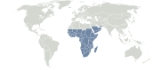
The Afrotropic is one of the Earth's eight ecozone
s. It includes Africa
south of the Sahara Desert, the southern and eastern fringes of the Arabian Peninsula
, the island of Madagascar
, southern Iran and extreme southwestern Pakistan, and the islands of the western Indian Ocean
. It was formerly known as the Ethiopian Zone or Ethiopian Region.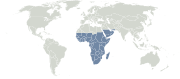
of the Arabian Peninsula, separate the Afrotropic from the Palearctic
ecozone, which includes northern Africa and temperate Eurasia
.
run east and west across the continent, from the Atlantic Ocean
to the Ethiopian Highlands
. Immediately south of the Sahara lies the Sahel
belt, a transitional zone of semi-arid short grassland and Acacia
savanna. Rainfall increases further south in the Sudanian Savanna
, also known simply as the Sudan
, a belt of taller grasslands and savannas. The Sudanian Savanna is home to two great flooded grasslands
, the Sudd
wetland in the Sudan
, and the Niger Inland Delta
in Mali
. The forest-savanna mosaic
is a transitional zone between the grasslands and the belt of tropical moist broadleaf forests
near the equator.
, and Jabal Badaj in the Yemeni highland escarpment, and the seasonal forests in eastern Yemen and the Dhofar
region of Oman. Other woodlands scatter the land and are very small and are predominately juniper
or acacia
forests.
, a belt of lowland tropical moist broadleaf forests, runs across most of equatorial Africa's intertropical convergence zone
. The Upper Guinean forests
of West Africa extend along the coast from Guinea
to Togo
. The Dahomey Gap
, a zone of forest-savanna mosaic that reaches to the coast, separates the Upper Guinean forests from the Lower Guinean forests
, which extend along the Gulf of Guinea
from eastern Benin
through Cameroon
and Gabon
to the western Democratic Republic of the Congo
. The largest tropical forest zone in Africa are the Congolian forests
of the Congo Basin
in Central Africa. A belt of tropical moist broadleaf forest also runs along the Indian Ocean
coast, from southern Somalia
to South Africa
.
region, from the Ethiopian Highlands
to the Drakensberg Mountains of South Africa, including the Great Rift Valley
. Distinctive flora, including Podocarpus
and Afrocarpus
, as well as giant Lobelia
s and Senecio
s.
, at Africa's southern tip, is a Mediterranean climate
region that is home to a significant number of endemic taxa, as well as to plant families like the protea
s (Proteaceae) that are also found in the Australasia ecozone
.
and neighboring islands form a distinctive sub-region of the ecozone, with numerous endemic
taxa
like the lemur
s. Madagascar and the Seychelles
are old pieces of the ancient supercontinent of Gondwana
, and broke away from Africa millions of years ago. Other Indian ocean islands, like the Comoros
and Mascarene Islands
, are volcanic islands that formed more recently. Madagascar contains several important biospheres, as its Biodiversity
and ratio of endemicism is extremely high.
are home to ten endemic families of flowering plants; eight are endemic to Madagascar (Asteropeiaceae
, Didymelaceae
, Didiereaceae
, Kaliphoraceae, Melanophyllaceae, Physenaceae
, Sarcolaenaceae
, and Sphaerosepalaceae
), one to Seychelles
(Mesdusagynaceae) and one to the Mascarene Islands
(Psiloxylaceae). Twelve plant families are endemic or nearly endemic to South Africa (including Curtisiaceae, Heteropyxidaceae, Penaeaceae
, Psiloxylaceae and Rhynchocalycaceae) of which five are endemic to the Cape floristic province
(including Grubbiaceae
). Other endemic Afrotropic families include Barbeyaceae, Montiniaceae
, Myrothamnaceae
and Oliniaceae.
, Malawi
, and Tanganyika
) are the center of biodiversity of many freshwater fishes, especially cichlid
s (they harbor more than two-thirds of the estimated 2,000 species in the family). The West African coastal rivers region covers only a fraction of West Africa, but harbours 322 of West African’s fish species, with 247 restricted to this area and 129 restricted even
to smaller ranges. The central rivers fauna comprises 194 fish species, with 119 endemics and only 33 restricted to small areas.
The Afrotropic has various endemic bird
families, including ostrich
es (Struthionidae), sunbird
s, Secretary bird
(Sagittariidae), guineafowl
(Numididae), and mousebird
s (Coliidae). Also, several families of passerines are limited to the Afrotropics; These include rock-jumper
s (Chaetopidae) and rockfowl (Picathartidae).
Africa has three endemic orders of mammals, the Tubulidentata (aardvark
s), Afrosoricida
(tenrecs and golden mole
s), and Macroscelidea (elephant shrew
s). The East-African plains
are well known for their diversity of large mammals.
Four species of Great Apes (Hominidae
) are endemic to Africa: both species of Gorilla
(Western Gorilla, Gorilla gorilla, and Eastern Gorilla, Gorilla beringei) and both species of Chimpanzee
(Common Chimpanzee
, Pan troglodytes, and Bonobo
, Pan paniscus). Human
s and their ancestors originated in Africa.
Ecozone
An ecozone is the broadest biogeographic division of the Earth's land surface, based on distributional patterns of terrestrial organisms.Ecozones delineate large areas of the Earth's surface within which organisms have been evolving in relative isolation over long periods of time, separated from...
s. It includes Africa
Africa
Africa is the world's second largest and second most populous continent, after Asia. At about 30.2 million km² including adjacent islands, it covers 6% of the Earth's total surface area and 20.4% of the total land area...
south of the Sahara Desert, the southern and eastern fringes of the Arabian Peninsula
Arabian Peninsula
The Arabian Peninsula is a land mass situated north-east of Africa. Also known as Arabia or the Arabian subcontinent, it is the world's largest peninsula and covers 3,237,500 km2...
, the island of Madagascar
Madagascar
The Republic of Madagascar is an island country located in the Indian Ocean off the southeastern coast of Africa...
, southern Iran and extreme southwestern Pakistan, and the islands of the western Indian Ocean
Indian Ocean
The Indian Ocean is the third largest of the world's oceanic divisions, covering approximately 20% of the water on the Earth's surface. It is bounded on the north by the Indian Subcontinent and Arabian Peninsula ; on the west by eastern Africa; on the east by Indochina, the Sunda Islands, and...
. It was formerly known as the Ethiopian Zone or Ethiopian Region.
Major ecological regions
Most of the Afrotropic, with the exception of Africa's southern tip, has a tropical climate. A broad belt of deserts, including the Atlantic and Sahara deserts of northern Africa and the Arabian DesertArabian Desert
The Arabian Desert is a vast desert wilderness stretching from Yemen to the Persian Gulf and Oman to Jordan and Iraq. It occupies most of the Arabian Peninsula, with an area of...
of the Arabian Peninsula, separate the Afrotropic from the Palearctic
Palearctic
The Palearctic or Palaearctic is one of the eight ecozones dividing the Earth's surface.Physically, the Palearctic is the largest ecozone...
ecozone, which includes northern Africa and temperate Eurasia
Eurasia
Eurasia is a continent or supercontinent comprising the traditional continents of Europe and Asia ; covering about 52,990,000 km2 or about 10.6% of the Earth's surface located primarily in the eastern and northern hemispheres...
.
Sahel and Sudan
South of the Sahara, two belts of tropical grassland and savannaTropical and subtropical grasslands, savannas, and shrublands
Tropical and subtropical grasslands, savannas, and shrublands are a grassland terrestrial biome located in semi-arid to semi-humid climate regions of subtropical and tropical latitudes. Grasslands are dominated by grass and other herbaceous plants. Savannas are grasslands with scattered trees...
run east and west across the continent, from the Atlantic Ocean
Atlantic Ocean
The Atlantic Ocean is the second-largest of the world's oceanic divisions. With a total area of about , it covers approximately 20% of the Earth's surface and about 26% of its water surface area...
to the Ethiopian Highlands
Ethiopian Highlands
The Ethiopian Highlands are a rugged mass of mountains in Ethiopia, Eritrea , and northern Somalia in the Horn of Africa...
. Immediately south of the Sahara lies the Sahel
Sahel
The Sahel is the ecoclimatic and biogeographic zone of transition between the Sahara desert in the North and the Sudanian Savannas in the south.It stretches across the North African continent between the Atlantic Ocean and the Red Sea....
belt, a transitional zone of semi-arid short grassland and Acacia
Acacia
Acacia is a genus of shrubs and trees belonging to the subfamily Mimosoideae of the family Fabaceae, first described in Africa by the Swedish botanist Carl Linnaeus in 1773. Many non-Australian species tend to be thorny, whereas the majority of Australian acacias are not...
savanna. Rainfall increases further south in the Sudanian Savanna
Sudanian Savanna
The Sudanian Savanna is a broad belt of tropical savanna that runs east and west across the African continent, from the Atlantic Ocean in the west to the Ethiopian Highlands in the east. The Sahel, a belt of drier grasslands and acacia savannas, lies to the north, between the Sudanian Savanna and...
, also known simply as the Sudan
Sudan (region)
The Sudan is the name given to a geographic region to the south of the Sahara, stretching from Western to Eastern Africa. The name derives from the Arabic bilâd as-sûdân or "land of the Blacks"...
, a belt of taller grasslands and savannas. The Sudanian Savanna is home to two great flooded grasslands
Flooded grasslands and savannas
Flooded grasslands and savannas is a terrestrial biome. Its component ecoregions are generally located at subtropical and tropical latitudes, which are flooded seasonally or year-round...
, the Sudd
Sudd
The Sudd , also known as the Bahr al Jabal, As Sudd or Al Sudd, is a vast swamp in South Sudan, formed by the White Nile. The word “sudd” is derived from the Arabic word “sadd”, meaning “block.” The term has come to refer to any large solid floating vegetation island or mat...
wetland in the Sudan
Sudan
Sudan , officially the Republic of the Sudan , is a country in North Africa, sometimes considered part of the Middle East politically. It is bordered by Egypt to the north, the Red Sea to the northeast, Eritrea and Ethiopia to the east, South Sudan to the south, the Central African Republic to the...
, and the Niger Inland Delta
Niger Inland Delta
The Inner Niger Delta, also known as the Macina, is a large area of lakes and floodplains in the semi-arid Sahel area of central Mali, just south of the Sahara desert.-Location and description:...
in Mali
Mali
Mali , officially the Republic of Mali , is a landlocked country in Western Africa. Mali borders Algeria on the north, Niger on the east, Burkina Faso and the Côte d'Ivoire on the south, Guinea on the south-west, and Senegal and Mauritania on the west. Its size is just over 1,240,000 km² with...
. The forest-savanna mosaic
Forest-savanna mosaic
Forest-savanna mosaic is an transitory ecotone between the tropical moist broadleaf forests of Equatorial Africa and the drier savannas and open woodlands to the north and south of the forest belt...
is a transitional zone between the grasslands and the belt of tropical moist broadleaf forests
Tropical and subtropical moist broadleaf forests
Tropical and subtropical moist broadleaf forests , also known as tropical moist forests, are a tropical and subtropical forest biome....
near the equator.
Southern Arabian woodlands
South Arabia, expressed as being mostly Yemen and parts of western Oman and southwestern Saudi Arabia, has few permanent forests. Some of the notable are Jabal Bura', Jabal RaymahRaymah
Raymah is a village in western central Yemen. It is located in the San‘a’ Governorate.-External links:*...
, and Jabal Badaj in the Yemeni highland escarpment, and the seasonal forests in eastern Yemen and the Dhofar
Dhofar
The Dhofar region lies in Southern Oman, on the eastern border with Yemen. Its mountainous area covers and has a population of 215,960 as of the 2003 census. The largest town in the region is Salalah. Historically, it was the chief source of frankincense in the world. However, its frankincense...
region of Oman. Other woodlands scatter the land and are very small and are predominately juniper
Juniper
Junipers are coniferous plants in the genus Juniperus of the cypress family Cupressaceae. Depending on taxonomic viewpoint, there are between 50-67 species of juniper, widely distributed throughout the northern hemisphere, from the Arctic, south to tropical Africa in the Old World, and to the...
or acacia
Acacia
Acacia is a genus of shrubs and trees belonging to the subfamily Mimosoideae of the family Fabaceae, first described in Africa by the Swedish botanist Carl Linnaeus in 1773. Many non-Australian species tend to be thorny, whereas the majority of Australian acacias are not...
forests.
Forest zone
The forest zoneForest zone
In West Africa, the forest zone refers to the southern part of the region once covered by tropical rainforest. Sometimes this region is referred to as Guinea to distinguish it from the grassland-covered Sudan, drier Sahel and perarid Sahara.-Extent:...
, a belt of lowland tropical moist broadleaf forests, runs across most of equatorial Africa's intertropical convergence zone
Intertropical Convergence Zone
The Intertropical Convergence Zone , known by sailors as The Doldrums, is the area encircling the earth near the equator where winds originating in the northern and southern hemispheres come together....
. The Upper Guinean forests
Upper Guinean forests
The Upper Guinean forests is a tropical moist forest region of West Africa. The Upper Guinean forests extend from Guinea and Sierra Leone in the west through Liberia, Côte d'Ivoire and Ghana to Togo in the east, and a few hundred kilometers inland from the Atlantic coast. A few enclaves of montane...
of West Africa extend along the coast from Guinea
Guinea
Guinea , officially the Republic of Guinea , is a country in West Africa. Formerly known as French Guinea , it is today sometimes called Guinea-Conakry to distinguish it from its neighbour Guinea-Bissau. Guinea is divided into eight administrative regions and subdivided into thirty-three prefectures...
to Togo
Togo
Togo, officially the Togolese Republic , is a country in West Africa bordered by Ghana to the west, Benin to the east and Burkina Faso to the north. It extends south to the Gulf of Guinea, on which the capital Lomé is located. Togo covers an area of approximately with a population of approximately...
. The Dahomey Gap
Dahomey Gap
In West Africa, the Dahomey Gap refers to the portion of the Guinean forest-savanna mosaic that extends all the way to the coast in Benin, Togo and Ghana, thus separating the forest zone that covers much of the south of the region into two separate parts...
, a zone of forest-savanna mosaic that reaches to the coast, separates the Upper Guinean forests from the Lower Guinean forests
Lower Guinean forests
The Lower Guinean forests is region of coastal tropical moist broadleaf forest extending along the coast of the Gulf of Guinea from eastern Benin through Nigeria and Cameroon....
, which extend along the Gulf of Guinea
Gulf of Guinea
The Gulf of Guinea is the northeasternmost part of the tropical Atlantic Ocean between Cape Lopez in Gabon, north and west to Cape Palmas in Liberia. The intersection of the Equator and Prime Meridian is in the gulf....
from eastern Benin
Benin
Benin , officially the Republic of Benin, is a country in West Africa. It borders Togo to the west, Nigeria to the east and Burkina Faso and Niger to the north. Its small southern coastline on the Bight of Benin is where a majority of the population is located...
through Cameroon
Cameroon
Cameroon, officially the Republic of Cameroon , is a country in west Central Africa. It is bordered by Nigeria to the west; Chad to the northeast; the Central African Republic to the east; and Equatorial Guinea, Gabon, and the Republic of the Congo to the south. Cameroon's coastline lies on the...
and Gabon
Gabon
Gabon , officially the Gabonese Republic is a state in west central Africa sharing borders with Equatorial Guinea to the northwest, Cameroon to the north, and with the Republic of the Congo curving around the east and south. The Gulf of Guinea, an arm of the Atlantic Ocean is to the west...
to the western Democratic Republic of the Congo
Democratic Republic of the Congo
The Democratic Republic of the Congo is a state located in Central Africa. It is the second largest country in Africa by area and the eleventh largest in the world...
. The largest tropical forest zone in Africa are the Congolian forests
Congolian forests
The Congolian forests are a broad belt of lowland tropical moist broadleaf forest which extends across the basin of the Congo River and its tributaries in Central Africa...
of the Congo Basin
Congo Basin
The Congo Basin is the sedimentary basin that is the drainage of the Congo River of west equatorial Africa. The basin begins in the highlands of the East African Rift system with input from the Chambeshi River, the Uele and Ubangi Rivers in the upper reaches and the Lualaba River draining wetlands...
in Central Africa. A belt of tropical moist broadleaf forest also runs along the Indian Ocean
Indian Ocean
The Indian Ocean is the third largest of the world's oceanic divisions, covering approximately 20% of the water on the Earth's surface. It is bounded on the north by the Indian Subcontinent and Arabian Peninsula ; on the west by eastern Africa; on the east by Indochina, the Sunda Islands, and...
coast, from southern Somalia
Somalia
Somalia , officially the Somali Republic and formerly known as the Somali Democratic Republic under Socialist rule, is a country located in the Horn of Africa. Since the outbreak of the Somali Civil War in 1991 there has been no central government control over most of the country's territory...
to South Africa
South Africa
The Republic of South Africa is a country in southern Africa. Located at the southern tip of Africa, it is divided into nine provinces, with of coastline on the Atlantic and Indian oceans...
.
Eastern Africa's highlands
AfromontaneAfromontane
Afromontane is a term used to describe the Afrotropic subregion and its plant and animal species common to the mountains of Africa and the southern Arabian Peninsula...
region, from the Ethiopian Highlands
Ethiopian Highlands
The Ethiopian Highlands are a rugged mass of mountains in Ethiopia, Eritrea , and northern Somalia in the Horn of Africa...
to the Drakensberg Mountains of South Africa, including the Great Rift Valley
Great Rift Valley
The Great Rift Valley is a name given in the late 19th century by British explorer John Walter Gregory to the continuous geographic trench, approximately in length, that runs from northern Syria in Southwest Asia to central Mozambique in South East Africa...
. Distinctive flora, including Podocarpus
Podocarpus
Podocarpus is a genus of conifers, the most numerous and widely distributed of the podocarp family Podocarpaceae. The 105 species of Podocarpus are evergreen shrubs or trees from 1-25 m in height...
and Afrocarpus
Afrocarpus
Afrocarpus is a genus of conifers belonging to the podocarp family Podocarpaceae. Afrocarpus was designated a genus in 1989, when several species formerly classified in Podocarpus and Nageia were reclassified. Two to six species are recognized.As the name intimates, Afrocarpus is native to Africa...
, as well as giant Lobelia
Lobelia
Lobelia is a genus of flowering plant comprising 360–400 species, with a subcosmopolitan distribution primarily in tropical to warm temperate regions of the world, a few species extending into cooler temperate regions...
s and Senecio
Dendrosenecio
Dendrosenecio is a genus of flowering plants belonging to the family Asteraceae. It is a segregate of Senecio, in which it formed the subgenus Dendrosenecio...
s.
- Ethiopian HighlandsEthiopian HighlandsThe Ethiopian Highlands are a rugged mass of mountains in Ethiopia, Eritrea , and northern Somalia in the Horn of Africa...
- Albertine rift montane forestsAlbertine Rift montane forestsThe Albertine Rift montane forests ecoregion, of the Tropical moist broadleaf forest Biome, are in the heart of Afromontane tropical Africa.-Location and description:...
- East African montane forestsEast African montane forestsThe East African montane forests is a montane tropical moist forest ecoregion of eastern Africa. The ecoregion comprises several separate areas above 1000 meters in the mountains of South Sudan, Uganda, Kenya, and Tanzania.-Setting:...
and Eastern Arc forests
Southern African woodlands, savannas, and grasslands
- Miombo woodlands
- Zambezian Mopane and Baikiaea woodlands
- BushveldBushveldThe Bushveld is a sub-tropical woodland ecoregion of Southern Africa that encompasses most of Limpopo Province and a small part of the North West Province of South Africa, the Central and North-East Districts of Botswana and the Matabeleland South and part of th Matabeleland North provinces of...
Cape floristic region
The Cape floristic regionCape floristic region
The Cape Floristic Region is a floristic region located near the southern tip of South Africa. It is the only floristic region of the Cape Floristic Kingdom, and includes only one floristic province, known as the Cape Floristic Province.The Cape Floristic Region, the smallest of the six recognised...
, at Africa's southern tip, is a Mediterranean climate
Mediterranean climate
A Mediterranean climate is the climate typical of most of the lands in the Mediterranean Basin, and is a particular variety of subtropical climate...
region that is home to a significant number of endemic taxa, as well as to plant families like the protea
Protea
Protea is both the botanical name and the English common name of a genus of flowering plants, sometimes also called sugarbushes.-Etymology:...
s (Proteaceae) that are also found in the Australasia ecozone
Australasia ecozone
The Australasian zone is an ecological region that is coincident, but not synonymous , with the geographic region of Australasia...
.
Madagascar and the Indian Ocean islands
MadagascarMadagascar
The Republic of Madagascar is an island country located in the Indian Ocean off the southeastern coast of Africa...
and neighboring islands form a distinctive sub-region of the ecozone, with numerous endemic
Endemic (ecology)
Endemism is the ecological state of being unique to a defined geographic location, such as an island, nation or other defined zone, or habitat type; organisms that are indigenous to a place are not endemic to it if they are also found elsewhere. For example, all species of lemur are endemic to the...
taxa
Taxon
|thumb|270px|[[African elephants]] form a widely-accepted taxon, the [[genus]] LoxodontaA taxon is a group of organisms, which a taxonomist adjudges to be a unit. Usually a taxon is given a name and a rank, although neither is a requirement...
like the lemur
Lemur
Lemurs are a clade of strepsirrhine primates endemic to the island of Madagascar. They are named after the lemures of Roman mythology due to the ghostly vocalizations, reflective eyes, and the nocturnal habits of some species...
s. Madagascar and the Seychelles
Seychelles
Seychelles , officially the Republic of Seychelles , is an island country spanning an archipelago of 115 islands in the Indian Ocean, some east of mainland Africa, northeast of the island of Madagascar....
are old pieces of the ancient supercontinent of Gondwana
Gondwana
In paleogeography, Gondwana , originally Gondwanaland, was the southernmost of two supercontinents that later became parts of the Pangaea supercontinent. It existed from approximately 510 to 180 million years ago . Gondwana is believed to have sutured between ca. 570 and 510 Mya,...
, and broke away from Africa millions of years ago. Other Indian ocean islands, like the Comoros
Comoros
The Comoros , officially the Union of the Comoros is an archipelago island nation in the Indian Ocean, located off the eastern coast of Africa, on the northern end of the Mozambique Channel, between northeastern Mozambique and northwestern Madagascar...
and Mascarene Islands
Mascarene Islands
The Mascarene Islands is a group of islands in the Indian Ocean east of Madagascar comprising Mauritius, Réunion, Rodrigues, Cargados Carajos shoals, plus the former islands of the Saya de Malha, Nazareth and Soudan banks...
, are volcanic islands that formed more recently. Madagascar contains several important biospheres, as its Biodiversity
Biodiversity
Biodiversity is the degree of variation of life forms within a given ecosystem, biome, or an entire planet. Biodiversity is a measure of the health of ecosystems. Biodiversity is in part a function of climate. In terrestrial habitats, tropical regions are typically rich whereas polar regions...
and ratio of endemicism is extremely high.
- Madagascar dry deciduous forestsMadagascar dry deciduous forestsThe Madagascar dry deciduous forests represent a tropical dry forest ecoregion generally situated in the western part of Madagascar. The area has high numbers of endemic plant and animal species but has suffered large-scale clearance for agriculture...
- Madagascar spiny thicketsMadagascar spiny thicketsThe Madagascar spiny thickets is an ecoregion in Madagascar. The vegetation type is found on poor substrates with low, erratic winter rainfall. An estimated 14,000 to is covered with this habitat, all in the southwest of the country...
- Eastern Madagascar lowland rainforests
Plants
The Afrotropic ecozone is home to a number of endemic plant families. Madagascar and the Indian Ocean IslandsEcoregions of Madagascar
Madagascar island, located in the Indian Ocean off the east coast of Africa, is the fourth largest island in the world. Its long isolation from neighbouring continents allowed the evolution of distinct communities of plants and animals. It is home to five percent of the world's plant and animal...
are home to ten endemic families of flowering plants; eight are endemic to Madagascar (Asteropeiaceae
Asteropeiaceae
Asteropeiaceae is the botanical name for a family of flowering plants. Such a family has been recognized by very few taxonomists.The APG II system, of 2003 does recognize such a family and assigns it to the order Caryophyllales in the clade core eudicots...
, Didymelaceae
Didymelaceae
Didymelaceae is a family of flowering plants. The family has been recognised by a fair number of taxonomists, at least over the past few decades....
, Didiereaceae
Didiereaceae
Didiereaceae is a small family of just four genera and 11 species of flowering plants endemic to south and southwest Madagascar, where they form an important component of the Madagascar spiny forests.-Description:...
, Kaliphoraceae, Melanophyllaceae, Physenaceae
Physenaceae
Physenaceae is the botanical name for a family of flowering plants. This family has been only recently recognized by taxonomists.The APG II system, of 2003 , does recognize this family and assigns it to the order Caryophyllales in the clade core eudicots...
, Sarcolaenaceae
Sarcolaenaceae
The Sarcolaenaceae are a family of flowering plants endemic to Madagascar. The family includes 40 species of mostly evergreen trees and shrubs in ten genera....
, and Sphaerosepalaceae
Sphaerosepalaceae
Sphaerosepalaceae is a family of flowering plants. It contains 14 species of trees and shrubs in two genera, Dialyceras and Rhopalocarpus, all of which are endemic to Madagascar. The family is alternatively known as the Rhopalocarpaceae....
), one to Seychelles
Seychelles
Seychelles , officially the Republic of Seychelles , is an island country spanning an archipelago of 115 islands in the Indian Ocean, some east of mainland Africa, northeast of the island of Madagascar....
(Mesdusagynaceae) and one to the Mascarene Islands
Mascarene Islands
The Mascarene Islands is a group of islands in the Indian Ocean east of Madagascar comprising Mauritius, Réunion, Rodrigues, Cargados Carajos shoals, plus the former islands of the Saya de Malha, Nazareth and Soudan banks...
(Psiloxylaceae). Twelve plant families are endemic or nearly endemic to South Africa (including Curtisiaceae, Heteropyxidaceae, Penaeaceae
Penaeaceae
Penaeaceae is a family of evergreen, leathery-leaved shrubs and small trees, native to South Africa. The family has 25 species in seven genera....
, Psiloxylaceae and Rhynchocalycaceae) of which five are endemic to the Cape floristic province
Cape floristic region
The Cape Floristic Region is a floristic region located near the southern tip of South Africa. It is the only floristic region of the Cape Floristic Kingdom, and includes only one floristic province, known as the Cape Floristic Province.The Cape Floristic Region, the smallest of the six recognised...
(including Grubbiaceae
Grubbiaceae
Grubbiaceae is a family of flowering plants endemic to the Cape floristic region of South Africa. The family includes five species of leathery-leaved shrubs in two genera, Grubbia and Strobilocarpus. They are commonly known as sillyberry....
). Other endemic Afrotropic families include Barbeyaceae, Montiniaceae
Montiniaceae
Montiniaceae is a family of flowering plants. It includes two or three genera of shrubs and small trees, native to southwest Africa and tropical East Africa as well as Madagascar. The genera Grevea and Montinia are included in most classification systems...
, Myrothamnaceae
Myrothamnaceae
Myrothamnaceae is the botanical name for a family of flowering plants. Such a family has been recognized by most taxonomists, having been included in order Hamamelidales in the Cronquist system. The APG II system includes Myrothamnaceae in Gunneraceae but allows for the optional segregation of...
and Oliniaceae.
Animals
The East African Great Lakes (VictoriaLake Victoria
Lake Victoria is one of the African Great Lakes. The lake was named for Queen Victoria of the United Kingdom, by John Hanning Speke, the first European to discover this lake....
, Malawi
Malawi
The Republic of Malawi is a landlocked country in southeast Africa that was formerly known as Nyasaland. It is bordered by Zambia to the northwest, Tanzania to the northeast, and Mozambique on the east, south and west. The country is separated from Tanzania and Mozambique by Lake Malawi. Its size...
, and Tanganyika
Tanganyika
Tanganyika , later formally the Republic of Tanganyika, was a sovereign state in East Africa from 1961 to 1964. It was situated between the Indian Ocean and the African Great Lakes of Lake Victoria, Lake Malawi and Lake Tanganyika...
) are the center of biodiversity of many freshwater fishes, especially cichlid
Cichlid
Cichlids are fishes from the family Cichlidae in the order Perciformes. Cichlids are members of a group known as the Labroidei along with the wrasses , damselfish , and surfperches . This family is both large and diverse. At least 1,300 species have been scientifically described, making it one of...
s (they harbor more than two-thirds of the estimated 2,000 species in the family). The West African coastal rivers region covers only a fraction of West Africa, but harbours 322 of West African’s fish species, with 247 restricted to this area and 129 restricted even
to smaller ranges. The central rivers fauna comprises 194 fish species, with 119 endemics and only 33 restricted to small areas.
The Afrotropic has various endemic bird
Bird
Birds are feathered, winged, bipedal, endothermic , egg-laying, vertebrate animals. Around 10,000 living species and 188 families makes them the most speciose class of tetrapod vertebrates. They inhabit ecosystems across the globe, from the Arctic to the Antarctic. Extant birds range in size from...
families, including ostrich
Ostrich
The Ostrich is one or two species of large flightless birds native to Africa, the only living member of the genus Struthio. Some analyses indicate that the Somali Ostrich may be better considered a full species apart from the Common Ostrich, but most taxonomists consider it to be a...
es (Struthionidae), sunbird
Sunbird
The sunbirds and spiderhunters are a family, Nectariniidae, of very small passerine birds. There are 132 species in 15 genera. The family is distributed throughout Africa, southern Asia and just reaches northern Australia. Most sunbirds feed largely on nectar, but also take insects and spiders,...
s, Secretary bird
Secretary Bird
The Secretarybird or Secretary Bird is a large, mostly terrestrial bird of prey. Endemic to Africa, it is usually found in the open grasslands and savannah of the sub-Sahara...
(Sagittariidae), guineafowl
Guineafowl
The guineafowl are a family of birds in the Galliformes order, although some authorities include the guineafowl as a subfamily, Numidinae, of the family Phasianidae...
(Numididae), and mousebird
Mousebird
The mousebirds are a small group of birds which have no known close affinities to other groups, though they and the parrots and cockatoos may be closer to each other than to other birds. The mousebirds are therefore given order status as Coliiformes...
s (Coliidae). Also, several families of passerines are limited to the Afrotropics; These include rock-jumper
Rock-jumper
The Rock-jumpers are medium-sized insectivorous or omnivorous birds in the genus Chaetops, which constitutes the entire family Chaetopidae. The two species, the Rufous Rock-jumper, Chaetops frenatus, and the Drakensberg Rockjumper, Chaetops aurantius, are endemic residents of southern Africa...
s (Chaetopidae) and rockfowl (Picathartidae).
Africa has three endemic orders of mammals, the Tubulidentata (aardvark
Aardvark
The aardvark is a medium-sized, burrowing, nocturnal mammal native to Africa...
s), Afrosoricida
Afrosoricida
The order Afrosoricida contains the golden moles of southern Africa and the tenrecs of Madagascar and Africa, two families of small mammals that have traditionally been considered to be a part of the order Insectivora.Some biologists use Tenrecomorpha as the name for the tenrec-golden mole clade,...
(tenrecs and golden mole
Golden mole
Golden moles are small, insectivorous burrowing mammals native to southern Africa. They form the family Chrysochloridae, and are taxonomically distinct from the true moles which they resemble due to convergence...
s), and Macroscelidea (elephant shrew
Elephant shrew
Elephant shrews or jumping shrews are small insectivorous mammals native to Africa, belonging to the family Macroscelididae, in the order Macroscelidea...
s). The East-African plains
Tropical and subtropical grasslands, savannas, and shrublands
Tropical and subtropical grasslands, savannas, and shrublands are a grassland terrestrial biome located in semi-arid to semi-humid climate regions of subtropical and tropical latitudes. Grasslands are dominated by grass and other herbaceous plants. Savannas are grasslands with scattered trees...
are well known for their diversity of large mammals.
Four species of Great Apes (Hominidae
Hominidae
The Hominidae or include them .), as the term is used here, form a taxonomic family, including four extant genera: chimpanzees , gorillas , humans , and orangutans ....
) are endemic to Africa: both species of Gorilla
Gorilla
Gorillas are the largest extant species of primates. They are ground-dwelling, predominantly herbivorous apes that inhabit the forests of central Africa. Gorillas are divided into two species and either four or five subspecies...
(Western Gorilla, Gorilla gorilla, and Eastern Gorilla, Gorilla beringei) and both species of Chimpanzee
Chimpanzee
Chimpanzee, sometimes colloquially chimp, is the common name for the two extant species of ape in the genus Pan. The Congo River forms the boundary between the native habitat of the two species:...
(Common Chimpanzee
Common Chimpanzee
The common chimpanzee , also known as the robust chimpanzee, is a great ape. Colloquially, the common chimpanzee is often called the chimpanzee , though technically this term refers to both species in the genus Pan: the common chimpanzee and the closely related bonobo, formerly called the pygmy...
, Pan troglodytes, and Bonobo
Bonobo
The bonobo , Pan paniscus, previously called the pygmy chimpanzee and less often, the dwarf or gracile chimpanzee, is a great ape and one of the two species making up the genus Pan. The other species in genus Pan is Pan troglodytes, or the common chimpanzee...
, Pan paniscus). Human
Human
Humans are the only living species in the Homo genus...
s and their ancestors originated in Africa.