

Russian Corps

Encyclopedia
The Russian Corps was an armed force composed of anti-communist Russian emigres
that existed during the Second World War in German-occupied Serbia. It fought in alliance with axis forces
against the Yugoslav Partisans and later against the Red Army
.
, a veteran of the White movement
, referred to the German occupational forces, asking for permission to form an armed "Separate Russian Corps" which would defend the Russian population against the communist partisans. In return for being armed and supplied by the Germans, Skorodumov set forth six conditions:
In point 5, Skorodumov reasoned - as many Russian white emigres at the time - that it would be possible to take advantage of a foreign war in order to break open a civil war in Russia and overthrow Stalin's government, which could only be achieved with force. The Corps, he reasoned, was to become the seed of this resistance.
On the 12th of September, 1941, after receiving the written approval of German Colonel Kevish, Skorodumov ordered the formation of the Corps. Three days later he was arrested by the Nazis for forming a "separate Russian corps" and was replaced by his assistant, General Boris Shteifon
(who was half Jewish from his father's side), another White army veteran. Shteifon continued the formation of the Corps. At the same time, he was engaged in a diplomatic war with the German command in an attempt to win as much independence and freedom of action as possible. The Corps was a part of the German armed forces and took an oath of allegiance to Adolf Hitler.
Several thousand Russian emigres living in Yugoslavia and in surrounding Eastern European countries enlisted in the Corps, men from age 16 to those in their seventies were admitted. At the beginning the Corps heavily lacked men in their twenties because most were conscripted into the Yugoslav Royal Army and were either taken prisoner, living in exile, or with the Chetniks
. Most volunteers were either young men who grew up in the Russian Cadet Corps
of Yugoslavia, or seasoned veterans of the Russian Tsarist and White armies
. Consequently, many commissioned officers had to enlist as privates or non-coms. Officers and generals were permitted to wear their old rank on the shoulderboards, while using their collar to display their Corps rank.
The Corps consisted of five regiments, armed with German, Italian, and Yugoslav weaponry. The Corps was not allowed to have heavy artillery
, according to Shteifon's speculation this was done to prevent the Corps from becoming a fully fledged, independent armed unit. The Corps initially instituted White Army uniforms, combined with Serbian royalist regalia, but were forced to switch to German uniforms later. These German uniforms were "Russified" by the inclusion of a Russian cockade
and Russian medals of distinction. The Corps followed at first the Tsarist military charter for commands, then briefly switched to the 1927 Soviet charter before being forced to conform to the German Wehrmacht charter.
As per Skorodumov's point 6, the Corps refused to attack the national Serbian Chetnik forces. The Chetniks maintained a neutral and occasionally an allied relationship with the Corps, with a few exceptions. The Serbian Volunteer Corps
of Dimitri Ljotic, by contrast, were a constant ally of the Corps.
Frictions had also developed between the Corps and the Croatian Home Guard
, with which the Corps was in a de jure
alliance. This occurred after the Corps' soldiers had intervened several times by force to stop atrocities against Serbian civilians committed by Croatian soldiers.
Shteifon's diplomatic war with the German command forced him to make several concessions. One was the introduction of the German uniform (as the Germans refused to supply anything else), another was an oath all soldiers were forced to give to Hitler. Shteifon was, however, able to win permission to send representatives to occupied territories (notably in Romanian occupied
Odessa
and Bessarabia
) in order to recruit Soviet POW's and civilians for the Corps. Over 5,000 new recruits were successfully enlisted this way. In the wake of this expansion, an officer training program was instituted in order to create new ranks for a future army.
In 1944, the Germans ordered the Corps to cover their retreat from Greece
. In September of that year, after the capitulation of Bulgaria
and Romania
, the Corps found itself confronting not only Tito's partisans (whom Winston Churchill
had begun favoring over Mihailović, in view of the former's alliance with Stalin), but regular units of the Red Army
, along with its newly allied Bulgarian and Romanian armies. Heavily outnumbered and poorly equipped, the Corps lost over one third of its men in a few months time. Data from a report dated August 22, 1944 that was prepared by Maximilian von Weichs
for Adolf Hitler showed that the Corps had five regiments with 11,188 officers and men.
In the winter of 1944-45, upon learning that General Vlasov's Russian Liberation Army
was finally in existence, Shteifon met with Vlasov and offered his "unconditional subordinance". Thus, Shteifon and his men were coopted into the Russian Liberation Army. However, this remained a de jure designation, as the turn of events did not permit Vlasov to include the Corps in his operations.
The Corps began retreating into Slovenia
. On the 30th of April, Shteifon died of a heart attack by Zagreb
. Colonel Anatoli Ivanovich Rogozhin
became the Corps' last commander.
 Rogozhin immediately began planning for a surrender of the Corps to the allies, while avoiding capture by partisan or Soviet forces. After a heavy argument with the German command, Rogozhin marched his men (now numbering 4,500) towards Klagenfurt
, Austria
, with the intent of surrendering to British troops together with the Serbian Volunteer Corps and Slovenian Domobrantsi.
The surrender to the British took place on the 12th of May, 1945, after which Rogozhin said in his daily order "We with a calm conscience can say that we completely accomplished the duty of the honest Russian soldier. The British commanders have respectfully treated us, as we did not surrender our weapons to those against whom we raised them, - our enemy - the Bolsheviks. With faith in a better future, let us await that moment when the Lord will help us finish our fight for the liberation of our Motherland to victory."
In reality Rogozhin faced many difficulties with the British command, largely because of their ties with their Soviet allies who wanted the Corps delivered to them. Immediately after surrender, the Corps created their own camp in Kellerberg, which included an Orthodox church. The camp was unknown to the Soviets until an informer from another former Russian axis unit which was stationed nearby told the Soviet authorities of its location.
A confrontation began between the Corps' officers and Soviet SMERSH
agents. Unlike with the Cossacks of Lienz
and many veterans of the Russian Liberation Army, the British spared the Corps from forceful repatriation
, citing that it was formed of people who did not fall under the classification of "former Soviet citizens" (as per the Yalta agreement
). Those members of the Corps who were former Soviet citizens (as well as stray members of other Russian units who fled to the Corps' camp) were given false documents to protect them from repatriation.
On November 1, 1945, Rogozhin officially disbanded the Corps and formed a veteran's union (the Russian Corps Combatants) which was responsible for the safety and coordination of its members. Many Corps members emigrated to the United States, Canada, Brazil, Argentina, and several European countries.
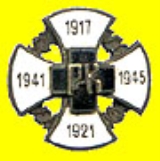
The corps veterans created a modified symbol which was formed of a white Russian military opolchenskiy cross, upon which was a black cross of the Corps with the letters "R" and "K" (standing for "Russkiy Korpus") inscribed in white. On the blades of the white cross the years 1917 - 1921 and 1941 - 1945 are marked, signifying respectively the years of the Russian Civil War
, and the years of its continuation during the Corps action in Yugoslavia.
A chapel of St. Alexander Nevsky
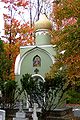
(the patron saint of the Corps, on whose day of memory the Corps was originally founded) was erected in the Novo Deveevo Russian Orthodox convent in Nanuet, New York (USA) in honor of the Russian Corps. Many Corps veterans (including Rogozhin) are buried nearby. The Combatants union began publishing a periodical known as Nashi Vesti (Our News).
White Emigre
A white émigré was a Russian who emigrated from Russia in the wake of the Russian Revolution and Russian Civil War, and who was in opposition to the contemporary Russian political climate....
that existed during the Second World War in German-occupied Serbia. It fought in alliance with axis forces
Axis Powers
The Axis powers , also known as the Axis alliance, Axis nations, Axis countries, or just the Axis, was an alignment of great powers during the mid-20th century that fought World War II against the Allies. It began in 1936 with treaties of friendship between Germany and Italy and between Germany and...
against the Yugoslav Partisans and later against the Red Army
Red Army
The Workers' and Peasants' Red Army started out as the Soviet Union's revolutionary communist combat groups during the Russian Civil War of 1918-1922. It grew into the national army of the Soviet Union. By the 1930s the Red Army was among the largest armies in history.The "Red Army" name refers to...
.
Formation
General Mikhail SkorodumovMikhail Skorodumov
Mikhail Skorodumov was a Russian general who participated in World War I, the White movement, and founded the Nazi-alled Russian Corps in Serbia during World War II....
, a veteran of the White movement
White movement
The White movement and its military arm the White Army - known as the White Guard or the Whites - was a loose confederation of Anti-Communist forces.The movement comprised one of the politico-military Russian forces who fought...
, referred to the German occupational forces, asking for permission to form an armed "Separate Russian Corps" which would defend the Russian population against the communist partisans. In return for being armed and supplied by the Germans, Skorodumov set forth six conditions:
- Only one commander of the Corps is responsible to the German command. All units and ranks of the Corps are responsible only to the commander of the Corps, who is confirmed by the German command, and the leaders that are picked by the commander of the Corps.
- Units of the Russian Corps cannot be integrated into German units, they are entirely independent.
- The Russian corps wears the old Russian uniform, the materials for which must come from the old Serbian supplies.
- The officers of the corps do not make any oaths.
- When the Corps finishes its formation and communism in Serbia is defeated, the German command transfers the Corps to the Eastern Front.
- The Russian Corps may not be used against any government, nor against the Serbian national forces of Draža MihailovićDraža MihailovicDragoljub "Draža" Mihailović was a Yugoslav Serbian general during World War II...
.
In point 5, Skorodumov reasoned - as many Russian white emigres at the time - that it would be possible to take advantage of a foreign war in order to break open a civil war in Russia and overthrow Stalin's government, which could only be achieved with force. The Corps, he reasoned, was to become the seed of this resistance.
On the 12th of September, 1941, after receiving the written approval of German Colonel Kevish, Skorodumov ordered the formation of the Corps. Three days later he was arrested by the Nazis for forming a "separate Russian corps" and was replaced by his assistant, General Boris Shteifon
Boris Shteifon
Boris Aleksandrovich Shteifon was a general in the Imperial Russian Army, who subsequently served as a general in the Russian anti-communist White army, and as the leader of the Nazi-allied Russian Corps in Serbia during World War II.-Biography:Shteifon was born on December 6, 1881 in the city of...
(who was half Jewish from his father's side), another White army veteran. Shteifon continued the formation of the Corps. At the same time, he was engaged in a diplomatic war with the German command in an attempt to win as much independence and freedom of action as possible. The Corps was a part of the German armed forces and took an oath of allegiance to Adolf Hitler.
Several thousand Russian emigres living in Yugoslavia and in surrounding Eastern European countries enlisted in the Corps, men from age 16 to those in their seventies were admitted. At the beginning the Corps heavily lacked men in their twenties because most were conscripted into the Yugoslav Royal Army and were either taken prisoner, living in exile, or with the Chetniks
Chetniks
Chetniks, or the Chetnik movement , were Serbian nationalist and royalist paramilitary organizations from the first half of the 20th century. The Chetniks were formed as a Serbian resistance against the Ottoman Empire in 1904, and participated in the Balkan Wars, World War I, and World War II...
. Most volunteers were either young men who grew up in the Russian Cadet Corps
Cadet Corps (Russia)
The Cadet Corps is an admissions-based all boys military academy which prepared boys to become commissioned officers. Boys between the ages of 8 and 15 were enrolled. It was founded in Saint Petersburg, Russian Empire in 1731 by Tsarina Anne. The term of education was seven years...
of Yugoslavia, or seasoned veterans of the Russian Tsarist and White armies
White movement
The White movement and its military arm the White Army - known as the White Guard or the Whites - was a loose confederation of Anti-Communist forces.The movement comprised one of the politico-military Russian forces who fought...
. Consequently, many commissioned officers had to enlist as privates or non-coms. Officers and generals were permitted to wear their old rank on the shoulderboards, while using their collar to display their Corps rank.
The Corps consisted of five regiments, armed with German, Italian, and Yugoslav weaponry. The Corps was not allowed to have heavy artillery
Artillery
Originally applied to any group of infantry primarily armed with projectile weapons, artillery has over time become limited in meaning to refer only to those engines of war that operate by projection of munitions far beyond the range of effect of personal weapons...
, according to Shteifon's speculation this was done to prevent the Corps from becoming a fully fledged, independent armed unit. The Corps initially instituted White Army uniforms, combined with Serbian royalist regalia, but were forced to switch to German uniforms later. These German uniforms were "Russified" by the inclusion of a Russian cockade
Cockade
A cockade is a knot of ribbons, or other circular- or oval-shaped symbol of distinctive colors which is usually worn on a hat.-Eighteenth century:...
and Russian medals of distinction. The Corps followed at first the Tsarist military charter for commands, then briefly switched to the 1927 Soviet charter before being forced to conform to the German Wehrmacht charter.
Deployment and growth
The Corps under General Shteifon were used at first primarily for guarding regions from partisan control, then in the spring of 1944 plunged into the heat of the Yugoslav guerilla war. It engaged Titoists in villages and cities throughout Yugoslavia, often deployed in regions the Germans considered particularly dangerous. This went against the hopes of the founders of the Corps, who had hoped that it would be primarily deployed as a defense unit against partisan aggression and spared from heavy action.As per Skorodumov's point 6, the Corps refused to attack the national Serbian Chetnik forces. The Chetniks maintained a neutral and occasionally an allied relationship with the Corps, with a few exceptions. The Serbian Volunteer Corps
Serbian Volunteer Corps
The Serbian Volunteer Corps or SDK , also known as Ljotićevci after their ideological leader Dimitrije Ljotić, was a collaborationist anti-Partisan military formation in Nedić's Serbia during World War II. In July 1941, a full scale rebellion by the communist Yugoslav Partisans and the royalist...
of Dimitri Ljotic, by contrast, were a constant ally of the Corps.
Frictions had also developed between the Corps and the Croatian Home Guard
Croatian Home Guard
Croatian Home Guard or also, known as the "Homeland Defenders," was the name used for the armed forces of the Independent State of Croatia which existed during World War II.- Formation :...
, with which the Corps was in a de jure
De jure
De jure is an expression that means "concerning law", as contrasted with de facto, which means "concerning fact".De jure = 'Legally', De facto = 'In fact'....
alliance. This occurred after the Corps' soldiers had intervened several times by force to stop atrocities against Serbian civilians committed by Croatian soldiers.
Shteifon's diplomatic war with the German command forced him to make several concessions. One was the introduction of the German uniform (as the Germans refused to supply anything else), another was an oath all soldiers were forced to give to Hitler. Shteifon was, however, able to win permission to send representatives to occupied territories (notably in Romanian occupied
Romania during World War II
Following the outbreak of World War II on 1 September 1939, the Kingdom of Romania officially adopted a position of neutrality. However, the rapidly changing situation in Europe during 1940, as well as domestic political upheaval, undermined this stance. Fascist political forces such as the Iron...
Odessa
Odessa
Odessa or Odesa is the administrative center of the Odessa Oblast located in southern Ukraine. The city is a major seaport located on the northwest shore of the Black Sea and the fourth largest city in Ukraine with a population of 1,029,000 .The predecessor of Odessa, a small Tatar settlement,...
and Bessarabia
Bessarabia
Bessarabia is a historical term for the geographic region in Eastern Europe bounded by the Dniester River on the east and the Prut River on the west....
) in order to recruit Soviet POW's and civilians for the Corps. Over 5,000 new recruits were successfully enlisted this way. In the wake of this expansion, an officer training program was instituted in order to create new ranks for a future army.
In 1944, the Germans ordered the Corps to cover their retreat from Greece
Greece
Greece , officially the Hellenic Republic , and historically Hellas or the Republic of Greece in English, is a country in southeastern Europe....
. In September of that year, after the capitulation of Bulgaria
Bulgaria
Bulgaria , officially the Republic of Bulgaria , is a parliamentary democracy within a unitary constitutional republic in Southeast Europe. The country borders Romania to the north, Serbia and Macedonia to the west, Greece and Turkey to the south, as well as the Black Sea to the east...
and Romania
Romania
Romania is a country located at the crossroads of Central and Southeastern Europe, on the Lower Danube, within and outside the Carpathian arch, bordering on the Black Sea...
, the Corps found itself confronting not only Tito's partisans (whom Winston Churchill
Winston Churchill
Sir Winston Leonard Spencer-Churchill, was a predominantly Conservative British politician and statesman known for his leadership of the United Kingdom during the Second World War. He is widely regarded as one of the greatest wartime leaders of the century and served as Prime Minister twice...
had begun favoring over Mihailović, in view of the former's alliance with Stalin), but regular units of the Red Army
Red Army
The Workers' and Peasants' Red Army started out as the Soviet Union's revolutionary communist combat groups during the Russian Civil War of 1918-1922. It grew into the national army of the Soviet Union. By the 1930s the Red Army was among the largest armies in history.The "Red Army" name refers to...
, along with its newly allied Bulgarian and Romanian armies. Heavily outnumbered and poorly equipped, the Corps lost over one third of its men in a few months time. Data from a report dated August 22, 1944 that was prepared by Maximilian von Weichs
Maximilian von Weichs
Maximilian Maria Joseph Karl Gabriel Lamoral Reichsfreiherr von Weichs zu Glon was a German Generalfeldmarschall during World War II. He was also a recipient of the Knight's Cross of the Iron Cross with Oak Leaves...
for Adolf Hitler showed that the Corps had five regiments with 11,188 officers and men.
In the winter of 1944-45, upon learning that General Vlasov's Russian Liberation Army
Russian Liberation Army
Russian Liberation Army was a group of predominantly Russian forces subordinated to the Nazi German high command during World War II....
was finally in existence, Shteifon met with Vlasov and offered his "unconditional subordinance". Thus, Shteifon and his men were coopted into the Russian Liberation Army. However, this remained a de jure designation, as the turn of events did not permit Vlasov to include the Corps in his operations.
The Corps began retreating into Slovenia
Slovenia
Slovenia , officially the Republic of Slovenia , is a country in Central and Southeastern Europe touching the Alps and bordering the Mediterranean. Slovenia borders Italy to the west, Croatia to the south and east, Hungary to the northeast, and Austria to the north, and also has a small portion of...
. On the 30th of April, Shteifon died of a heart attack by Zagreb
Zagreb
Zagreb is the capital and the largest city of the Republic of Croatia. It is in the northwest of the country, along the Sava river, at the southern slopes of the Medvednica mountain. Zagreb lies at an elevation of approximately above sea level. According to the last official census, Zagreb's city...
. Colonel Anatoli Ivanovich Rogozhin
Anatoly Rogozhin
Anatoli Ivanovich Rogozhin was a Russian officer who served in the Imperial Russian Army, the White Army, and was the last commander of the Russian Corps in Serbia during World War II....
became the Corps' last commander.
Dissolution
Klagenfurt
-Name:Carinthia's eminent linguists Primus Lessiak and Eberhard Kranzmayer assumed that the city's name, which literally translates as "ford of lament" or "ford of complaints", had something to do with the superstitious thought that fateful fairies or demons tend to live around treacherous waters...
, Austria
Austria
Austria , officially the Republic of Austria , is a landlocked country of roughly 8.4 million people in Central Europe. It is bordered by the Czech Republic and Germany to the north, Slovakia and Hungary to the east, Slovenia and Italy to the south, and Switzerland and Liechtenstein to the...
, with the intent of surrendering to British troops together with the Serbian Volunteer Corps and Slovenian Domobrantsi.
The surrender to the British took place on the 12th of May, 1945, after which Rogozhin said in his daily order "We with a calm conscience can say that we completely accomplished the duty of the honest Russian soldier. The British commanders have respectfully treated us, as we did not surrender our weapons to those against whom we raised them, - our enemy - the Bolsheviks. With faith in a better future, let us await that moment when the Lord will help us finish our fight for the liberation of our Motherland to victory."
In reality Rogozhin faced many difficulties with the British command, largely because of their ties with their Soviet allies who wanted the Corps delivered to them. Immediately after surrender, the Corps created their own camp in Kellerberg, which included an Orthodox church. The camp was unknown to the Soviets until an informer from another former Russian axis unit which was stationed nearby told the Soviet authorities of its location.
A confrontation began between the Corps' officers and Soviet SMERSH
SMERSH
SMERSH was the counter-intelligence agency in the Red Army formed in late 1942 or even earlier, but officially founded on April 14, 1943. The name SMERSH was coined by Joseph Stalin...
agents. Unlike with the Cossacks of Lienz
Betrayal of the Cossacks
The Repatriation of Cossacks after WW2, also known as the Betrayal of the Cossacks, the Tragedy of Drau or the Massacre of Cossacks at Lienz refers to the forced repatriation to the USSR of the Cossacks and ethnic Russians who were allies of Nazi Germany during the Second World War.The...
and many veterans of the Russian Liberation Army, the British spared the Corps from forceful repatriation
Repatriation
Repatriation is the process of returning a person back to one's place of origin or citizenship. This includes the process of returning refugees or soldiers to their place of origin following a war...
, citing that it was formed of people who did not fall under the classification of "former Soviet citizens" (as per the Yalta agreement
Yalta Conference
The Yalta Conference, sometimes called the Crimea Conference and codenamed the Argonaut Conference, held February 4–11, 1945, was the wartime meeting of the heads of government of the United States, the United Kingdom, and the Soviet Union, represented by President Franklin D...
). Those members of the Corps who were former Soviet citizens (as well as stray members of other Russian units who fled to the Corps' camp) were given false documents to protect them from repatriation.
On November 1, 1945, Rogozhin officially disbanded the Corps and formed a veteran's union (the Russian Corps Combatants) which was responsible for the safety and coordination of its members. Many Corps members emigrated to the United States, Canada, Brazil, Argentina, and several European countries.
The corps veterans created a modified symbol which was formed of a white Russian military opolchenskiy cross, upon which was a black cross of the Corps with the letters "R" and "K" (standing for "Russkiy Korpus") inscribed in white. On the blades of the white cross the years 1917 - 1921 and 1941 - 1945 are marked, signifying respectively the years of the Russian Civil War
Russian Civil War
The Russian Civil War was a multi-party war that occurred within the former Russian Empire after the Russian provisional government collapsed to the Soviets, under the domination of the Bolshevik party. Soviet forces first assumed power in Petrograd The Russian Civil War (1917–1923) was a...
, and the years of its continuation during the Corps action in Yugoslavia.
A chapel of St. Alexander Nevsky
Alexander Nevsky
Alexander Nevsky was the Prince of Novgorod and Grand Prince of Vladimir during some of the most trying times in the city's history. Commonly regarded as the key figure of medieval Rus, Alexander was the grandson of Vsevolod the Big Nest and rose to legendary status on account of his military...
(the patron saint of the Corps, on whose day of memory the Corps was originally founded) was erected in the Novo Deveevo Russian Orthodox convent in Nanuet, New York (USA) in honor of the Russian Corps. Many Corps veterans (including Rogozhin) are buried nearby. The Combatants union began publishing a periodical known as Nashi Vesti (Our News).
See also
- White movementWhite movementThe White movement and its military arm the White Army - known as the White Guard or the Whites - was a loose confederation of Anti-Communist forces.The movement comprised one of the politico-military Russian forces who fought...
- White EmigreWhite EmigreA white émigré was a Russian who emigrated from Russia in the wake of the Russian Revolution and Russian Civil War, and who was in opposition to the contemporary Russian political climate....
- Russian Liberation MovementRussian Liberation MovementRussian Liberation Movement is a term used to describe Russians during World War II who tried to create an anti-communist armed force which would topple the regime of Joseph Stalin...
- Russian Liberation ArmyRussian Liberation ArmyRussian Liberation Army was a group of predominantly Russian forces subordinated to the Nazi German high command during World War II....
- Boris ShteifonBoris ShteifonBoris Aleksandrovich Shteifon was a general in the Imperial Russian Army, who subsequently served as a general in the Russian anti-communist White army, and as the leader of the Nazi-allied Russian Corps in Serbia during World War II.-Biography:Shteifon was born on December 6, 1881 in the city of...
- Anatoly RogozhinAnatoly RogozhinAnatoli Ivanovich Rogozhin was a Russian officer who served in the Imperial Russian Army, the White Army, and was the last commander of the Russian Corps in Serbia during World War II....
- Andrey VlasovAndrey VlasovAndrey Andreyevich Vlasov or Wlassow was a Russian Red Army general who collaborated with Nazi Germany during World War II.-Early career:...
- Pyotr KrasnovPyotr KrasnovPyotr Nikolayevich Krasnov , 1869 – January 17, 1947), sometimes referred to in English as Peter Krasnov, was Lieutenant General of the Russian army when the revolution broke out in 1917, and one of the leaders of the counterrevolutionary White movement afterward.- Russian Army :Pyotr Krasnov...
- Andrei ShkuroAndrei ShkuroAndrei Grigoriyevich Shkuro was a Lieutenant General of the White Army.-Biography:...
- Draza MihailovicDraža MihailovicDragoljub "Draža" Mihailović was a Yugoslav Serbian general during World War II...
- ChetniksChetniksChetniks, or the Chetnik movement , were Serbian nationalist and royalist paramilitary organizations from the first half of the 20th century. The Chetniks were formed as a Serbian resistance against the Ottoman Empire in 1904, and participated in the Balkan Wars, World War I, and World War II...
- Betrayal of the CossacksBetrayal of the CossacksThe Repatriation of Cossacks after WW2, also known as the Betrayal of the Cossacks, the Tragedy of Drau or the Massacre of Cossacks at Lienz refers to the forced repatriation to the USSR of the Cossacks and ethnic Russians who were allies of Nazi Germany during the Second World War.The...
- Serbian Volunteer Corps
- Operation KeelhaulOperation KeelhaulOperation Keelhaul was carried out in Northern Italy by British and American forces to repatriate Soviet Armed Forces POWs of the Nazis to the Soviet Union between August 14, 1946 and May 9, 1947...
- Collaboration during World War IICollaboration during World War IIWithin nations occupied by the Axis Powers, some citizens, driven by nationalism, ethnic hatred, anti-communism, anti-Semitism or opportunism, knowingly engaged in collaboration with the Axis Powers during World War II...
Further reading
- M.V. Nazarov, The Mission of the Russian Emigration, Moscow: Rodnik, 1994. ISBN 978-5-86231-172-3
- I.B. Ivanov, N. N. Protopopov, Russkii Korpus Na Balkanakh Vo Vremia II Velikoi Voiny, 1941-1945: Vospominaniia Soratnikov I Dokumenty Sbornik Vtoroi, St. Petersburg: St. Petersburg University, 1999. ISBN 978-5-288-02307-1