


Omsk

Encyclopedia
History
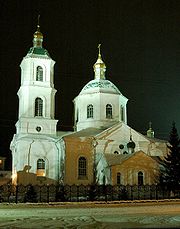
Ishim River
Ishim River is a river running through Kazakhstan and Russia. Its length is 2,450 km , average discharge is 56,3 m³/s . It is a left tributary of the Irtysh River. The Ishim River is partly navigable in its lower reaches. The upper course of the Ishim passes through Astana, the capital of Kazakhstan...
and the Irtysh rivers against the Kyrgyz nomads of the Steppe
Steppe
In physical geography, steppe is an ecoregion, in the montane grasslands and shrublands and temperate grasslands, savannas, and shrublands biomes, characterized by grassland plains without trees apart from those near rivers and lakes...
s. In the late eighteenth century, stronger works of brick were erected on the right bank of the Om; of these, the original Tobolsk
Tobolsk
Tobolsk is a town in Tyumen Oblast, Russia, located at the confluence of the Tobol and Irtysh Rivers. It is a historic capital of Siberia. Population: -History:...
and the restored Tara
Tara, Russia
Tara is a town in Omsk Oblast, Russia, located about north of Omsk, at the confluence of the Tara and Irtysh Rivers at a point where the forested country merges into the steppe. It serves as the administrative center of Tarsky District, although it is not administratively a part of it...
gates still stand, along with the original German Lutheran Church, an armoury, a military jail, and commandant's house.
In the nineteenth and early twentieth century, Omsk became the administrative center of Western Siberia and the Steppes (Kazakhstan
Kazakhstan
Kazakhstan , officially the Republic of Kazakhstan, is a transcontinental country in Central Asia and Eastern Europe. Ranked as the ninth largest country in the world, it is also the world's largest landlocked country; its territory of is greater than Western Europe...
), acquiring a few churches and cathedrals of various denominations, mosques, a synagogue, the governor-general's mansion, a military academy. Because of the complexity of the bureaucratic institutions in the city, ink was joked to have been sold by the bucketful. As the frontier receded and its military importance diminished, the town fell into lethargy; it was during the mid-nineteenth century that Dostoevsky lived and wrote in exile here.
The new boom began with the construction of the Trans-Siberian Railway in 1890s, which caused merchants to flock to the city in order to take advantage of the rail/river junction. Many trade companies established stores and offices in Omsk, resulting in the construction of the picturesque old district of the city, and contributing to the rapid development of Omsk into a major city. British, Dutch and German consulates were established at about the same time in order to represent their commercial interests. The pinnacle of development for pre-revolutionary Omsk came with the lavish Siberian Exposition of Agriculture and Industry in 1910, for which a complex of buildings and fountains was constructed. In line with the popularity of World Fairs of the day, the exposition influenced observers to foretell the wonders of the "Chicago of Siberia".
Shortly after the 1917 revolution, anti-bolshevik "white" forces seized control of Omsk. The "Provisional Government of Russia" was established here in 1918, headed by the arctic explorer and decorated war hero Admiral Kolchak
Aleksandr Kolchak
Aleksandr Vasiliyevich Kolchak was a Russian naval commander, polar explorer and later - Supreme ruler . Supreme ruler of Russia , was recognized in this position by all the heads of the White movement, "De jure" - Kingdom of Serbs, Croats and Slovenes, "De facto" - Entente States...
. Omsk was proclaimed the capital of Russia, and its central bank was tasked with safekeeping the former empire's gold reserves. The reserves were guarded by a garrison of former Czechoslovakian POWs trapped in Siberia by the chaos of The First World War
World War I
World War I , which was predominantly called the World War or the Great War from its occurrence until 1939, and the First World War or World War I thereafter, was a major war centred in Europe that began on 28 July 1914 and lasted until 11 November 1918...
and the subsequent Russian Revolution. Omsk became a prime target for the Red Army
Red Army
The Workers' and Peasants' Red Army started out as the Soviet Union's revolutionary communist combat groups during the Russian Civil War of 1918-1922. It grew into the national army of the Soviet Union. By the 1930s the Red Army was among the largest armies in history.The "Red Army" name refers to...
, who viewed it as crucial to their Siberian campaign, eventually forced Kolchak, his government, and the gold to abandon the city and retreat along the Trans-Siberian eastward to Irkutsk
Irkutsk
Irkutsk is a city and the administrative center of Irkutsk Oblast, Russia, one of the largest cities in Siberia. Population: .-History:In 1652, Ivan Pokhabov built a zimovye near the site of Irkutsk for gold trading and for the collection of fur taxes from the Buryats. In 1661, Yakov Pokhabov...
. Bolshevik forces entered the city in 1919.
Soviet era

Novosibirsk
Novosibirsk is the third-largest city in Russia, after Moscow and Saint Petersburg, and the largest city of Siberia, with a population of 1,473,737 . It is the administrative center of Novosibirsk Oblast as well as of the Siberian Federal District...
, as the administrative center of Western Siberia, prompting the mass transfer of administrative, cultural and educational functions from Omsk, dampening the city's growth and sparking a rivalry between the two cities that continues to this day. The city received new life as a result of The Second World War
World War II
World War II, or the Second World War , was a global conflict lasting from 1939 to 1945, involving most of the world's nations—including all of the great powers—eventually forming two opposing military alliances: the Allies and the Axis...
- because it was both far from the fighting and had a well-developed infrastructure, Omsk was a perfect haven for much of the industry evacuated away from the front in 1941. Additionally, in contingency plans were made to transfer the provisional Soviet capital to Omsk, in the event of a German victory during the Battle of Moscow
Battle of Moscow
The Battle of Moscow is the name given by Soviet historians to two periods of strategically significant fighting on a sector of the Eastern Front during World War II. It took place between October 1941 and January 1942. The Soviet defensive effort frustrated Hitler's attack on Moscow, capital of...
. At the end of the war Omsk remained a major industrial center, and became a leader in Soviet military production. The concentration of military enterprises also had negative effects, as until 1990, the city stayed closed to foreigners, and, after 1990, the collapse of the Soviet military demand led to high unemployment.
Military industries which moved here included part of the OKMO
OKMO
OKMO was the main tank design team in the Soviet Union during the early 1930s. It produced the design of the T-26 infantry tank , of which about 12,000 would be produced...
tank design bureau in 1941, and S.M. Kirov Factory no. 185 from Chelyabinsk
Chelyabinsk
Chelyabinsk is a city and the administrative center of Chelyabinsk Oblast, Russia, located in the northwestern side of the oblast, south of Yekaterinburg, just to the east of the Ural Mountains, on the Miass River. Population: -History:...
, in 1962. The Kirov Factory and Omsk Transmash design bureau (KBTM) produced T-80
T-80
The T-80 is a main battle tank designed and manufactured in the former Soviet Union. A development of the T-64, it entered service in 1976 and was the first production tank to be equipped with a gas turbine engine for main propulsion.the Swedish Stridsvagn 103 of 1971 used a gas turbine alongside...
tanks from the 1970s, and were responsible for the BTR-T
BTR-T
The BTR-T is a Russian heavy infantry combat vehicle, designed by the Design Bureau of Transport Machine-Building state-run production association.-Description:It is based on the hull of the T-55 tank and answers the need for a heavy, well protected and well armed...
, TOS-1
TOS-1
TOS-1 is a Soviet 30-barrel or 24-barrel multiple rocket launcher and thermobaric weapon mounted on a T-72 tank chassis. TOS-1 was designed for defeating enemy personnel in fortifications, in open country, and in lightly armoured vehicles and transport...
, and the prototype Black Eagle tank
Black Eagle tank
The Black Eagle tank was a presumed prototype main battle tank produced in the Russian Federation. It was thought to have been developed by the KBTM design bureau in Omsk in the late 1990s. A production version of this tank has never been publicly demonstrated. The Black Eagle tank has been...
. Omsk Transmash declared bankruptcy in 2002.
In the 1950s, following the development of oil and natural gas field in Siberia, an oil-refining complex was built, along with an entire "town of oilworkers", expanding Omsk northward along the Irtysh
Irtysh
The Irtysh River is a river in Siberia and is the chief tributary of the Ob River. Its name means White River. Irtysh's main affluent is the Tobol River...
. It is currently the largest such complex in Russia. Gazprom Neft
Gazprom Neft
Gazprom Neft is the fifth largest oil producing and refining company in Russia. It's the oil arm of Gazprom, which owns 80% of Gazprom Neft's shares....
, the parent company, is the largest employer in the city, wielding its tax address as leverage in negotiations with municipal and regional authorities.
Post Soviet Era
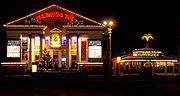
Nouveau riche
The nouveau riche , or new money, comprise those who have acquired considerable wealth within their own generation...
, and the fast growing criminal syndicates. The most notorious cases involved the privatisation of Sibneft, a major oil company, which dragged on for several years. Until the end of the 1990s, the political life of the city was defined by an ongoing feud between regional and the municipal authorities. The resulting conflict made at least two points of view available to the public and served as the impetus for some improvements to the city's infrastructure and cultural life, including the construction of new leisure parks and the renovation of the city's historic downtown, the establishment of the annual Siberian International Marathon
Siberian International Marathon
Siberian International Marathon ' has been held in the city of Omsk since 1990, when the city was first opened to foreigners. The summer marathon is part of the City Days festivities. It takes place during the week of St. Ilya's Day, the patron saint of Omsk, in early August. The marathon itself...
, and of the annual City Days Festival. Despite this, political infighting drained the city's resources and served as a major obstacle to smooth government operation and city development. The conflict was finally resolved in favour of the regional government with the forced resignation of two consecutive mayors and the subsequent de facto
De facto
De facto is a Latin expression that means "concerning fact." In law, it often means "in practice but not necessarily ordained by law" or "in practice or actuality, but not officially established." It is commonly used in contrast to de jure when referring to matters of law, governance, or...
appointment of their successor by the regional governor. Since the turn of the century, the regional government has been firmly in control of Omsk's government, courts and media. The city is currently an underperformer, by Russian standards, in both economic growth and quality of life.
On March 2, 2005, the Consulate General of the Republic of Kazakhstan was opened. Previously in 1943, the Free India Government in Exile had opened its consulate in Omsk. Additionally, both Germany and Slovakia maintain honorary consuls in the city.
Demographics
The population in Omsk rose from 31,000 in 1881 to 53,050 in 1900 and to 1,148,418 in 1989 CensusSoviet Census (1989)
The 1989 Soviet census, conducted between January 12-19 of that year, was the last one conducted in the former USSR. It resulted in a total population of 286,730,819 inhabitants...
. The 2002 Census
Russian Census (2002)
Russian Census of 2002 was the first census of the Russian Federation carried out on October 9 through October 16, 2002. It was carried out by the Russian Federal Service of State Statistics .-Resident population:...
recorded that the population declined to 1,134,016, but it rebounded somewhat by the 2010 Census, which showed the population of 1,153,971.
Cityscape

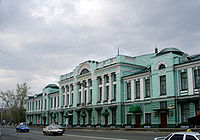
Gostiny Dvor
Great Gostiny Dvor is a vast department store on Nevsky Avenue in St Petersburg.This Gostiny Dvor is not only the city's oldest shopping centre, but also one of the first shopping arcades in the world...
, and flanked by two chapels. The area is an eclectic mix of architectural styles, dominated by Art-Nouveau, Neoclassical and Second Empire. The Drama Theatre gives a good example of the latter. Soviet Era additions run the gamut from Constructivist, to Stalinist to Brutalist.
Closer to the confluence of the Om and the Irtysh are the few surviving sombre buildings of the 18th-century fortress. The largest and most opulent church in the city is the Dormition Cathedral, a five-domed edifice in the Russian Revival
Russian Revival
The Russian Revival style is the generic term for a number of different movements within Russian architecture that arose in second quarter of the 19th century and was an eclectic melding of pre-Peterine Russian architecture and elements of Byzantine architecture.The Russian Revival style arose...
style, consecrated in 1896, demolished by the Soviets, and restored in the early first decade of the 21st century.
Another area of interest is Nikolsky Prospekt/Krasnykh Zor Street, where a line of merchants' wooden houses still stands. The street leads to the Neoclassical
Neoclassicism
Neoclassicism is the name given to Western movements in the decorative and visual arts, literature, theatre, music, and architecture that draw inspiration from the "classical" art and culture of Ancient Greece or Ancient Rome...
cathedral of St Nicholas, which was commissioned by the Cossacks, designed by Vasily Stasov
Vasily Stasov
Vasily Petrovich Stasov was a Russian architect.-Biography:Stasov was born in Moscow....
and consecrated in 1840. It contains various relics of the Siberian Cossacks.
Life and culture
As a prominent educational center, Omsk has a large number of museums, theaters, music venues, and educational institutions.Among Omsk's museums, the most notable are:
- The State Museum of Regional History
- The Dostoyevsky Museum of Literature
- The Vrubel Museum of Fine Arts
- The Military Museum Complex
- The Kondraty Belov Art Museum
- The Liberov Center for Art
Theaters include the Omsk Opera, The Omsk Theater of Drama, The Omsk Circus, and a number of smaller venues.
Education
Omsk is home to many institutions of higher learning and several universities:- ANO - Institute of Economics and Energetics
- AKSIAksiAksi is an Estonian island in the Gulf of Finland with an area of 59 hectars. Coordinates are It forms an archipelago with nearby islands of Prangli and Keri. Aksi belongs to the Viimsi Parish of Harju County.Aksi is a part of the Prangli landscape protection area...
- Aksenov Institute of Law and Economics, West Siberian department - Law and Economics InstituteLaw and Economics InstituteLaw and Economics Institute is a university in Omsk, Russia....
- Omsk Academy of LawOmsk Academy of LawOmsk Academy of Law is a university in Omsk, Russia....
- Omsk Academy of MVD RossijaOmsk Academy of MVD RossijaOmsk Academy of MVD Rossija is a university in Omsk, Russia....
- Omsk Aviation Technical SchoolOmsk Aviation Technical SchoolOmsk Aviation Technical School is a college in Omsk, Russian Federation.It was founded in...
- Omsk Foreign Language InstituteOmsk Foreign Language InstituteOmsk Foreign Language Institute is a university in Omsk, Russia....
- Omsk Medical AcademyOmsk Medical AcademyThe Omsk State Medical Academy was founded as the Medical Faculty in The Siberian Institute of Veterinary and Zoology in 1920; the faculty was reorganized into the West-Siberian State Medical Institute in 1921...
- Omsk State Transport UniversityOmsk State Transport UniversityOmsk State Transport University is a university in Omsk, Russia. It was established in 1961....
(1961) - Omsk State Agrarian UniversityOmsk State Agrarian UniversityOmsk State Agrarian University is a university in Omsk, Russia. It was established in 1918....
(1918) (connected with Omsk State Veterinary Institute and Institute of Agribusiness and Continuing Education) - Omsk State Pedagogical UniversityOmsk State Pedagogical University-External links:*...
- Omsk State UniversityOmsk State UniversityOmsk F. M. Dostoevsky State University , usually referred to as Omsk State University was founded in 1974 in the city of Omsk, Russia. The university has since grown significantly...
(1974) - Omsk Institute of Consumer Service TechnologyOmsk Institute of Consumer Service TechnologyOmsk Institute of Consumer Service Technology is a university in Omsk, Russia....
- Omsk State Technical UniversityOmsk State Technical UniversityOmsk State Technical University in Omsk, Russia , is one of the leading educational institutions in the Western Siberian Region. It is alma mater to thousands of professionals who now work at industrial enterprises in the Siberian region....
(1942) - SibADI - Siberian State Automobile and Highway Academy
- SibGUFK - Siberian Academy of Physical Culture
- Siberian Institute of Business and Information TechnologySiberian Institute of Business and Information TechnologySiberian Institute of Business and Information Technology is a university in Omsk, Russia....
- Sovremennyi Gomunitarnyi UniversitySovremennyi Gomunitarnyi UniversitySovremennyi Gumanitarnyi University is a university in Omsk, Russia....
- SIBNFOR - Siberian Stock Market Institute
Sports
Omsk is represented nationally by professional football and hockey clubs, with the later, Avangard OmskAvangard Omsk
Avangard Omsk are a professional ice hockey team from Siberia based in the city of Omsk, Russia. They are members of the Chernyshev Division of the Kontinental Hockey League.-Overview:...
winning the 2004 National Championship. Avangard is part of the Kontinental Hockey League
Kontinental Hockey League
The Kontinental Hockey League is an international professional ice hockey league in Eurasia founded in 2008. As of 2009, it is ranked as the strongest hockey league in Europe....
.
Transport
Tsentralny Airport
-New Fedorova airport:A new airport is built at Fedorova, North-West of Omsk. As of 2010, construction is stalled.-External links:*...
. Additionally, Omsk possesses a river port on the Irtysh, offering service to domestic destinations and to cities within Kazakhstan.
Municipal Transport consists of a large bus and trolley, and tram networks, although the latter of these has deteriorated severely since the collapse of the USSR. Marshrutka
Marshrutka
Marshrutka , from marshrutnoye taksi is a share taxi in the CIS countries, the Baltic states, and Bulgaria. Marshrutnoye taksi literally means routed taxicab...
s (shared taxis) supplement municipal transit networks.
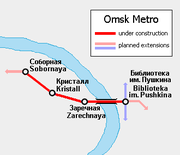
A subway
Rapid transit
A rapid transit, underground, subway, elevated railway, metro or metropolitan railway system is an electric passenger railway in an urban area with a high capacity and frequency, and grade separation from other traffic. Rapid transit systems are typically located either in underground tunnels or on...
system, proposed in the late 1980s, but postponed for lack of funds, is currently under construction, with the Metro bridge over the Irtysh river. The bridge is already opened for cars (upper level), but the metro (lower level) is still under construction. As a first step, one short line will connect the districts in the northwest with the city centre. The first line of the metro is scheduled to be finished in 2017.
Notable citizens
- Fyodor Dostoyevsky, writerWriterA writer is a person who produces literature, such as novels, short stories, plays, screenplays, poetry, or other literary art. Skilled writers are able to use language to portray ideas and images....
and essayist, in exile 1849-1854 - Mikhail VrubelMikhail VrubelMikhail Aleksandrovich Vrubel is usually regarded amongst the Russian painters of the Symbolist movement. In reality, he deliberately stood aloof from contemporary art trends, so that the origin of his unusual manner should be sought in Late Byzantine and Early Renaissance painting.-Early...
, painter, born 1856 - Admiral Kolchak, anti-bolshevikBolshevikThe Bolsheviks, originally also Bolshevists , derived from bol'shinstvo, "majority") were a faction of the Marxist Russian Social Democratic Labour Party which split apart from the Menshevik faction at the Second Party Congress in 1903....
"Supreme Ruler of Russia", headed resistance from Omsk 1918-1919 - Vikentii TrofimovVikentii TrofimovVikentii Pavlovich Trofimov was a Russian painter.-The Trofimov family:...
, painter, Vrubel Art School painting section headmaster 1924-1932 - Mikhail UlyanovMikhail UlyanovMikhail Alexandrovich Ulyanov was a Soviet and Russian actor who was one of the most recognizable persons of the post-World War II Soviet theatre and cinema. He was named People's Artist of the USSR in 1969 and received a special prize from the Venice Film Festival in 1982.Mikhail Alexandrovich...
, actor, studied at Drama Theater 1944-1946 - Yegor Letov, punk rocker 1964-2008
- Aleksei Kazannik, politician (yielded elected Supreme Soviet office to Boris YeltsinBoris YeltsinBoris Nikolayevich Yeltsin was the first President of the Russian Federation, serving from 1991 to 1999.Originally a supporter of Mikhail Gorbachev, Yeltsin emerged under the perestroika reforms as one of Gorbachev's most powerful political opponents. On 29 May 1990 he was elected the chairman of...
), taught at OmSUOmsk State UniversityOmsk F. M. Dostoevsky State University , usually referred to as Omsk State University was founded in 1974 in the city of Omsk, Russia. The university has since grown significantly...
1980s and 90s - German GrefGerman GrefGerman Oskarovich Gref , born February 8, 1964) is a Russian economist of German ethnicity, the founder of Center of the Strategic Development. He was the Minister of Economics and Trade of Russia from May 2000 to September 2007...
, politician and economist, attended OmSUOmsk State UniversityOmsk F. M. Dostoevsky State University , usually referred to as Omsk State University was founded in 1974 in the city of Omsk, Russia. The university has since grown significantly...
1985-1990 - Eduard KunzEduard KunzEduard Kunz , born October 30 1980, Omsk, - Russian pianist.- Biography :Named among 10 tomorrow's great pianists by the BBC Music Magazine, Eduard Kunz has performed and broadcast frequently with almost every major orchestra in the UK including BBC Symphony Orchestra and BBC Concert Orchestra,...
, pianist, born - Mikhail Emelyanovich Yavorskiy, veteran of WWII, colonel, first anti-missle defence division, Honorary of Russian Writers Union 2010
- Vlada RoslyakovaVlada RoslyakovaVlada Roslyakova is a Russian model.- Early life and modelling :...
, model
Athletes
- Irina TchachinaIrina TchachinaIrina Viktorovna Tchachina is an Individual rhythmic gymnast born 24 April 1982 in Omsk, Russia. Known for her jumps and clean technique, Irina is considered to be one of the most elegant and technical gymnasts ever. She has been quoted as saying “Besides your body, you should train your mind too...
, rhythmic gymnast - Aleksei Tishchenko, boxer
- Evgeniya Kanaeva, rhythmic gymnast
- Roman SloudnovRoman SloudnovRoman Andreyevich Sloudnov is a Russian swimmer who won a bronze medal in the 100 m breaststroke at the 2000 Summer Olympics...
, swimmer - Nikita NikitinNikita NikitinNikita Nikitin is a Russian professional ice hockey defenseman currently playing for the Columbus Blue Jackets of the National Hockey League. Nikitin was born in Omsk, Russia.-Playing career:...
, professional hockey player - Svetlana Karpeeva, Olympic swimmer
- Galima ShugurovaGalima ShugurovaGalima Shugurova is a Soviet Individual Rhythmic Gymnast born in Omsk on November 8, 1953. She was the third Soviet Rhythmic Gymnast to become World All-Around champion and the first ever European All-Around champion in 1978. Shugurova is an ethnic Tatar...
, rhythmic gymnast - Dmitri SychevDmitri SychevDmitri Yevgenyevich Sychev is an association footballer. His last name is also transcribed as Sytchev, and his first name as Dmitry or Dmitriy. He has been hailed by the international press as "The Russian Michael Owen" because of his pace and as "The most sensational young Russian forward since...
, football player - Irek GimayevIrek GimayevIrek Gimayev is a retired ice hockey player who played in the Soviet Hockey League. He played for HC CSKA Moscow. He was inducted into the Russian and Soviet Hockey Hall of Fame in 1982....
, hockey player - Anastasija ReibergerAnastasija ReibergerAnastasija Reiberger, née Ryjikh is a Russian-born German pole vaulter. She is the older sister of fellow pole vaulter Lisa Ryzih. Her greatest success was the gold medal in the 1999 World Indoor Championships....
, 1999 pole vault indoor world champion - Yuri ShatalovYuri ShatalovYuri Shatalov is a retired ice hockey player who played in the Soviet Hockey League. He played for Krylya Sovetov Moscow. He was inducted into the Russian and Soviet Hockey Hall of Fame in 1974....
, hockey player - Dennis SiverDennis SiverDennis D. Siver ; born January 13, 1979) is a Russian-German mixed martial artist who competes in the lightweight division of the Ultimate Fighting Championship. As of July 2011, Siver is ranked as the #8 lightweight fighter in the world by MMAWeekly...
, mixed martial arts fighter - Alexander ShlemenkoAlexander ShlemenkoAlexander Pavlovich Shlemenko is a Russian mixed martial artist currently fighting in the Middleweight division for Bellator Fighting Championships.-Early career:...
, mixed martial arts fighter
Twin towns/sister cities
Omsk is twinnedTown twinning
Twin towns and sister cities are two of many terms used to describe the cooperative agreements between towns, cities, and even counties in geographically and politically distinct areas to promote cultural and commercial ties.- Terminology :...
with:
Puchov
Púchov
Púchov is an industrial town in the centre of Púchov District in Slovakia, with a population close to 20,000.-Geography:It is located on the main train line between Bratislava and Košice...
, Slovakia
Slovakia
The Slovak Republic is a landlocked state in Central Europe. It has a population of over five million and an area of about . Slovakia is bordered by the Czech Republic and Austria to the west, Poland to the north, Ukraine to the east and Hungary to the south...
Karlovy Vary
Karlovy Vary
Karlovy Vary is a spa city situated in western Bohemia, Czech Republic, on the confluence of the rivers Ohře and Teplá, approximately west of Prague . It is named after King of Bohemia and Holy Roman Emperor Charles IV, who founded the city in 1370...
, Czech Republic
Czech Republic
The Czech Republic is a landlocked country in Central Europe. The country is bordered by Poland to the northeast, Slovakia to the east, Austria to the south, and Germany to the west and northwest....
Kaifeng
Kaifeng
Kaifeng , known previously by several names , is a prefecture-level city in east-central Henan province, Central China. Nearly 5 million people live in the metropolitan area...
, China
China
Chinese civilization may refer to:* China for more general discussion of the country.* Chinese culture* Greater China, the transnational community of ethnic Chinese.* History of China* Sinosphere, the area historically affected by Chinese culture...
Jinju
Jinju
Jinju is a city in South Gyeongsang Province, South Korea. It was the location of the first and second Sieges of Jinju by Japanese forces during the Imjin War...
, South Korea
South Korea
The Republic of Korea , , is a sovereign state in East Asia, located on the southern portion of the Korean Peninsula. It is neighbored by the People's Republic of China to the west, Japan to the east, North Korea to the north, and the East China Sea and Republic of China to the south...
Petropavl
Petropavl
Petropavl is a city on the Ishim River in North Kazakhstan Province of Kazakhstan close to the border with Russia, about 261 km west of Omsk along the Trans-Siberian Railway. It is capital of the North Kazakhstan Province...
, Kazakhstan
Kazakhstan
Kazakhstan , officially the Republic of Kazakhstan, is a transcontinental country in Central Asia and Eastern Europe. Ranked as the ninth largest country in the world, it is also the world's largest landlocked country; its territory of is greater than Western Europe...
Pavlodar
Pavlodar
Pavlodar is a city in northeastern Kazakhstan and the capital of Pavlodar Province. It is located 350 km northeast of the national capital Astana, and 400 km southeast of the Russian city of Omsk along the Irtysh River. , the city has a population of 331710...
, Kazakhstan Novosibirsk
Novosibirsk
Novosibirsk is the third-largest city in Russia, after Moscow and Saint Petersburg, and the largest city of Siberia, with a population of 1,473,737 . It is the administrative center of Novosibirsk Oblast as well as of the Siberian Federal District...
, Russia Kaliningrad
Kaliningrad
Kaliningrad is a seaport and the administrative center of Kaliningrad Oblast, the Russian exclave between Poland and Lithuania on the Baltic Sea...
, Russia Chelyabinsk
Chelyabinsk
Chelyabinsk is a city and the administrative center of Chelyabinsk Oblast, Russia, located in the northwestern side of the oblast, south of Yekaterinburg, just to the east of the Ural Mountains, on the Miass River. Population: -History:...
, Russia Milwaukee, United States
United States
The United States of America is a federal constitutional republic comprising fifty states and a federal district...
Ontario
Ontario
Ontario is a province of Canada, located in east-central Canada. It is Canada's most populous province and second largest in total area. It is home to the nation's most populous city, Toronto, and the nation's capital, Ottawa....
, Canada
Canada
Canada is a North American country consisting of ten provinces and three territories. Located in the northern part of the continent, it extends from the Atlantic Ocean in the east to the Pacific Ocean in the west, and northward into the Arctic Ocean...
York Region, Canada
Honors
- The 3406 Omsk3406 Omsk3406 Omsk is a main-belt asteroid discovered on February 21, 1969 by B. Burnasheva at Nauchnyj.- External links :*...
asteroidAsteroidAsteroids are a class of small Solar System bodies in orbit around the Sun. They have also been called planetoids, especially the larger ones...
, which lies in the main asteroid beltAsteroid beltThe asteroid belt is the region of the Solar System located roughly between the orbits of the planets Mars and Jupiter. It is occupied by numerous irregularly shaped bodies called asteroids or minor planets...
, is named after the city.
External links
- Official website of Omsk City Administration
- http://club.eomsk.ru/
- Omsk Today, Omsk and the Omsk Oblast news in English
- RMX.ru, Open Omsk, an independent news source
- Omsktime.ru, Current events in Omsk
- Blogspot.com, Photoblog about Omsk
- Univer.omsk.su, Omsk-On-Line