

Via Egnatia

Encyclopedia
Roman road
The Roman roads were a vital part of the development of the Roman state, from about 500 BC through the expansion during the Roman Republic and the Roman Empire. Roman roads enabled the Romans to move armies and trade goods and to communicate. The Roman road system spanned more than 400,000 km...
constructed by the Romans
Ancient Rome
Ancient Rome was a thriving civilization that grew on the Italian Peninsula as early as the 8th century BC. Located along the Mediterranean Sea and centered on the city of Rome, it expanded to one of the largest empires in the ancient world....
in the 2nd century BC. It crossed the Roman provinces of Illyricum
Illyricum (Roman province)
The Roman province of Illyricum or Illyris Romana or Illyris Barbara or Illyria Barbara replaced most of the region of Illyria. It stretched from the Drilon river in modern north Albania to Istria in the west and to the Sava river in the north. Salona functioned as its capital...
, Macedonia
Macedonia (Roman province)
The Roman province of Macedonia was officially established in 146 BC, after the Roman general Quintus Caecilius Metellus defeated Andriscus of Macedon, the last Ancient King of Macedon in 148 BC, and after the four client republics established by Rome in the region were dissolved...
, and Thrace
Thrace
Thrace is a historical and geographic area in southeast Europe. As a geographical concept, Thrace designates a region bounded by the Balkan Mountains on the north, Rhodope Mountains and the Aegean Sea on the south, and by the Black Sea and the Sea of Marmara on the east...
, running through territory that is now part of modern Albania
Albania
Albania , officially known as the Republic of Albania , is a country in Southeastern Europe, in the Balkans region. It is bordered by Montenegro to the northwest, Kosovo to the northeast, the Republic of Macedonia to the east and Greece to the south and southeast. It has a coast on the Adriatic Sea...
, the Republic of Macedonia
Republic of Macedonia
Macedonia , officially the Republic of Macedonia , is a country located in the central Balkan peninsula in Southeast Europe. It is one of the successor states of the former Yugoslavia, from which it declared independence in 1991...
, Greece
Greece
Greece , officially the Hellenic Republic , and historically Hellas or the Republic of Greece in English, is a country in southeastern Europe....
, and European Turkey
Turkey
Turkey , known officially as the Republic of Turkey , is a Eurasian country located in Western Asia and in East Thrace in Southeastern Europe...
.
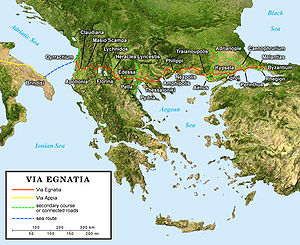
Starting at Dyrrachium (now Durrës
Durrës
Durrës is the second largest city of Albania located on the central Albanian coast, about west of the capital Tirana. It is one of the most ancient and economically important cities of Albania. Durres is situated at one of the narrower points of the Adriatic Sea, opposite the Italian ports of Bari...
) on the Adriatic Sea
Adriatic Sea
The Adriatic Sea is a body of water separating the Italian Peninsula from the Balkan peninsula, and the system of the Apennine Mountains from that of the Dinaric Alps and adjacent ranges...
, the road followed a difficult route along the river Genusus (Shkumbin
Shkumbin
Shkumbin is a river in central Albania, flowing into the Adriatic Sea. It is considered the dividing line for the two dialects of the Albanian language: Tosk and Gheg ....
), over the Candaviae mountains and thence to the highlands around Lake Ohrid
Lake Ohrid
Lake Ohrid straddles the mountainous border between the southwestern Macedonia and eastern Albania. It is one of Europe's deepest and oldest lakes, preserving a unique aquatic ecosystem with more than 200 endemic species that is of worldwide importance...
. It then turned south, following several high mountain passes to reach the northern coastline of the Aegean Sea
Aegean Sea
The Aegean Sea[p] is an elongated embayment of the Mediterranean Sea located between the southern Balkan and Anatolian peninsulas, i.e., between the mainlands of Greece and Turkey. In the north, it is connected to the Marmara Sea and Black Sea by the Dardanelles and Bosporus...
at Thessalonica. From there it ran through Thrace to the city of Byzantium
Byzantium
Byzantium was an ancient Greek city, founded by Greek colonists from Megara in 667 BC and named after their king Byzas . The name Byzantium is a Latinization of the original name Byzantion...
(later Constantinople, now Istanbul
Istanbul
Istanbul , historically known as Byzantium and Constantinople , is the largest city of Turkey. Istanbul metropolitan province had 13.26 million people living in it as of December, 2010, which is 18% of Turkey's population and the 3rd largest metropolitan area in Europe after London and...
). It covered a total distance of about 1,120 km (696 miles / 746 Roman miles). Like other major Roman roads, it was about six metres (19.6 ft) wide, paved with large polygonal stone slabs or covered with a hard layer of sand.
Construction
The main literary sources for the construction of the road are StraboStrabo
Strabo, also written Strabon was a Greek historian, geographer and philosopher.-Life:Strabo was born to an affluent family from Amaseia in Pontus , a city which he said was situated the approximate equivalent of 75 km from the Black Sea...
's Geographica
Geographica (Strabo)
The Geographica , or Geography, is a 17-volume encyclopedia of geographical knowledge written in Greek by Strabo, an educated citizen of the Roman empire of Greek descent. Work can have begun on it no earlier than 20 BC...
and a number of milestone
Milestone
A milestone is one of a series of numbered markers placed along a road or boundary at intervals of one mile or occasionally, parts of a mile. They are typically located at the side of the road or in a median. They are alternatively known as mile markers, mileposts or mile posts...
s found along the route's length, marking the road for a length of 535 miles as far as the border between Macedonia and Thrace at the river Hebrus (Maritsa
Maritsa
The Maritsa or Evros , ) is, with a length of 480 km, the longest river that runs solely in the interior of the Balkans. It has its origin in the Rila Mountains in Western Bulgaria, flowing southeast between the Balkan and Rhodope Mountains, past Plovdiv and Parvomay to Edirne, Turkey...
). Bilingual inscriptions on the milestones record that Gnaeus Egnatius
Gnaeus Egnatius
Gnaeus Egnatius was a proconsul during the Roman Republic. He built the eponymous Via Egnatia which was begun in 146 BC and completed in 120 BC....
, proconsul
Proconsul
A proconsul was a governor of a province in the Roman Republic appointed for one year by the senate. In modern usage, the title has been used for a person from one country ruling another country or bluntly interfering in another country's internal affairs.-Ancient Rome:In the Roman Republic, a...
of Macedonia, ordered its construction, though the exact date is uncertain; the road presumably took its name from its builder. It may have succeeded an earlier military road from Illyria to Byzantium, as described by Polybius
Polybius
Polybius , Greek ) was a Greek historian of the Hellenistic Period noted for his work, The Histories, which covered the period of 220–146 BC in detail. The work describes in part the rise of the Roman Republic and its gradual domination over Greece...
and Cicero
Cicero
Marcus Tullius Cicero , was a Roman philosopher, statesman, lawyer, political theorist, and Roman constitutionalist. He came from a wealthy municipal family of the equestrian order, and is widely considered one of Rome's greatest orators and prose stylists.He introduced the Romans to the chief...
, which the Romans apparently built over and/or improved.
The Via Egnatia was constructed in order to link a chain of Roman colonies stretching from the Adriatic Sea
Adriatic Sea
The Adriatic Sea is a body of water separating the Italian Peninsula from the Balkan peninsula, and the system of the Apennine Mountains from that of the Dinaric Alps and adjacent ranges...
to the Bosphorus. The termini of the Via Egnatia and the Via Appia, leading from Rome itself, were almost directly opposite each other on the east and west shores of the Adriatic Sea
Adriatic Sea
The Adriatic Sea is a body of water separating the Italian Peninsula from the Balkan peninsula, and the system of the Apennine Mountains from that of the Dinaric Alps and adjacent ranges...
. The route thus gave the colonies of the southern Balkans a direct connection to Rome. It was also a vital link to Roman territories further to the east; until a more northerly route across Illyria was opened under Augustus
Augustus
Augustus ;23 September 63 BC – 19 August AD 14) is considered the first emperor of the Roman Empire, which he ruled alone from 27 BC until his death in 14 AD.The dates of his rule are contemporary dates; Augustus lived under two calendars, the Roman Republican until 45 BC, and the Julian...
it was Rome's main link with her empire in the eastern Mediterranean. It was repaired and expanded several times but experienced lengthy periods of neglect due to Rome's civil wars.
The road played a vital role in several key moments in Roman history: the armies of Julius Caesar
Julius Caesar
Gaius Julius Caesar was a Roman general and statesman and a distinguished writer of Latin prose. He played a critical role in the gradual transformation of the Roman Republic into the Roman Empire....
and Pompey
Pompey
Gnaeus Pompeius Magnus, also known as Pompey or Pompey the Great , was a military and political leader of the late Roman Republic...
marched along the Via Egnatia during Caesar's civil war
Caesar's civil war
The Great Roman Civil War , also known as Caesar's Civil War, was one of the last politico-military conflicts in the Roman Republic before the establishment of the Roman Empire...
, and during the Liberators' civil war
Liberators' civil war
The Liberators' civil war was started by the Second Triumvirate to avenge Julius Caesar's murder. The war was fought by the forces of Mark Antony and Octavian against the forces of Caesar's assassins Marcus Junius Brutus and Gaius Cassius Longinus in 42 BC.-Prelude:After the murder of Caesar,...
Mark Antony
Mark Antony
Marcus Antonius , known in English as Mark Antony, was a Roman politician and general. As a military commander and administrator, he was an important supporter and loyal friend of his mother's cousin Julius Caesar...
and Octavian
Augustus
Augustus ;23 September 63 BC – 19 August AD 14) is considered the first emperor of the Roman Empire, which he ruled alone from 27 BC until his death in 14 AD.The dates of his rule are contemporary dates; Augustus lived under two calendars, the Roman Republican until 45 BC, and the Julian...
pursued Cassius
Gaius Cassius Longinus
Gaius Cassius Longinus was a Roman senator, a leading instigator of the plot to kill Julius Caesar, and the brother in-law of Marcus Junius Brutus.-Early life:...
and Brutus
Marcus Junius Brutus
Marcus Junius Brutus , often referred to as Brutus, was a politician of the late Roman Republic. After being adopted by his uncle he used the name Quintus Servilius Caepio Brutus, but eventually returned to using his original name...
along the Via Appia to their fateful meeting at the Battle of Philippi
Battle of Philippi
The Battle of Philippi was the final battle in the Wars of the Second Triumvirate between the forces of Mark Antony and Octavian and the forces of Julius Caesar's assassins Marcus Junius Brutus and Gaius Cassius Longinus in 42 BC, at Philippi in Macedonia...
. Surviving milestones record that the emperor Trajan
Trajan
Trajan , was Roman Emperor from 98 to 117 AD. Born into a non-patrician family in the province of Hispania Baetica, in Spain Trajan rose to prominence during the reign of emperor Domitian. Serving as a legatus legionis in Hispania Tarraconensis, in Spain, in 89 Trajan supported the emperor against...
undertook extensive repairs of the road prior to his campaign of 113
113
Year 113 was a common year starting on Saturday of the Julian calendar. At the time, it was known as the Year of the Consulship of Celsus and Crispinus...
against the Parthia
Parthia
Parthia is a region of north-eastern Iran, best known for having been the political and cultural base of the Arsacid dynasty, rulers of the Parthian Empire....
ns. However, by the 5th century AD the road had largely fallen into disuse as a result of violent instability in the region. A 5th-century historian noted that the western sections of the Via Egnatia were in such a poor state that travellers could barely pass along it.
Post-Roman usage
In later years, the Via Egnatia was revived as a key road of the Byzantine EmpireByzantine Empire
The Byzantine Empire was the Eastern Roman Empire during the periods of Late Antiquity and the Middle Ages, centred on the capital of Constantinople. Known simply as the Roman Empire or Romania to its inhabitants and neighbours, the Empire was the direct continuation of the Ancient Roman State...
; Procopius
Procopius
Procopius of Caesarea was a prominent Byzantine scholar from Palestine. Accompanying the general Belisarius in the wars of the Emperor Justinian I, he became the principal historian of the 6th century, writing the Wars of Justinian, the Buildings of Justinian and the celebrated Secret History...
records repairs made by the Byzantine emperor Justinian I
Justinian I
Justinian I ; , ; 483– 13 or 14 November 565), commonly known as Justinian the Great, was Byzantine Emperor from 527 to 565. During his reign, Justinian sought to revive the Empire's greatness and reconquer the lost western half of the classical Roman Empire.One of the most important figures of...
during the 6th century, though even then the dilapidated road was said to be virtually unusable during wet weather. Almost all Byzantine overland trade with western Europe traveled along the Via Egnatia. During the Crusades, armies traveling to the east by land followed the road to Constantinople before crossing into Asia Minor
Asia Minor
Asia Minor is a geographical location at the westernmost protrusion of Asia, also called Anatolia, and corresponds to the western two thirds of the Asian part of Turkey...
. In the aftermath of the Fourth Crusade
Fourth Crusade
The Fourth Crusade was originally intended to conquer Muslim-controlled Jerusalem by means of an invasion through Egypt. Instead, in April 1204, the Crusaders of Western Europe invaded and conquered the Christian city of Constantinople, capital of the Eastern Roman Empire...
, control of the road was vital for the survival of the Latin Empire
Latin Empire
The Latin Empire or Latin Empire of Constantinople is the name given by historians to the feudal Crusader state founded by the leaders of the Fourth Crusade on lands captured from the Byzantine Empire. It was established after the capture of Constantinople in 1204 and lasted until 1261...
as well as the Byzantine successor states the Empire of Nicaea
Empire of Nicaea
The Empire of Nicaea was the largest of the three Byzantine Greek successor states founded by the aristocracy of the Byzantine Empire that fled after Constantinople was occupied by Western European and Venetian forces during the Fourth Crusade...
and the Despotate of Epirus
Despotate of Epirus
The Despotate or Principality of Epirus was one of the Byzantine Greek successor states of the Byzantine Empire that emerged in the aftermath of the Fourth Crusade in 1204. It claimed to be the legitimate successor of the Byzantine Empire, along with the Empire of Nicaea, and the Empire of Trebizond...
.
Today's modern highway, Egnatia Odos
Egnatia Odos (modern road)
Egnatia Odos is the Greek part of the European route. It is a motorway in Greece that extends from the western port of Igoumenitsa to the eastern Greek–Turkish border at Kipoi. It runs a total of...
, runs in parallel with the Via Egnatia between Thessaloniki and the Turkish border on the Evros
Evros
Evros is:* the Greek name of the Maritsa river running through Bulgaria and forming the land border between Turkey and Greece* Evros , an administrative division in northern Greece...
river. Its name means "Via Egnatia" in Greek, alluding to its ancient predecessor.
Key towns along the Via Egnatia
(listed from west to east)| Ancient name | Modern name | Modern country |
|---|---|---|
| Dyrrachium, later Epidamnos | Durrës Durrës Durrës is the second largest city of Albania located on the central Albanian coast, about west of the capital Tirana. It is one of the most ancient and economically important cities of Albania. Durres is situated at one of the narrower points of the Adriatic Sea, opposite the Italian ports of Bari... |
Albania Albania Albania , officially known as the Republic of Albania , is a country in Southeastern Europe, in the Balkans region. It is bordered by Montenegro to the northwest, Kosovo to the northeast, the Republic of Macedonia to the east and Greece to the south and southeast. It has a coast on the Adriatic Sea... |
| Claudiana | Peqin Peqin Peqin is the capital of the Peqin District in central Albania. The town has a population of 10,000.The ancient name of Peqin was Claudiana. The city's modern name derives from the Ottoman form Bekleyin, which means a place of hospitality. During Ottoman rule Peqin belonged to the Sanjak of Elbasan... |
Albania |
| Apollonia Apollonia, Illyria Apollonia was an ancient Greek city in Illyria, located on the right bank of the Aous river . Its ruins are situated in the Fier region, near the village of Pojani, in modern-day Albania... |
Beside the village of Pojani (7 km W. of Fier Fier Fieri is a city in southwest Albania, in the district and county of the same name. It is located at , and has a population of 82,297 . Fier is from the ruins of the ancient Greek city of Apollonia.-History :... ) |
Albania |
| Masio Scampa | Elbasan Elbasan Elbasan is a city in central Albania. It is located on the Shkumbin River in the District of Elbasan and the County of Elbasan, at... |
Albania |
| Lychnidos | Ohrid Ohrid Ohrid is a city on the eastern shore of Lake Ohrid in the Republic of Macedonia. It has about 42,000 inhabitants, making it the seventh largest city in the country. The city is the seat of Ohrid Municipality. Ohrid is notable for having once had 365 churches, one for each day of the year and has... |
Republic of Macedonia Republic of Macedonia Macedonia , officially the Republic of Macedonia , is a country located in the central Balkan peninsula in Southeast Europe. It is one of the successor states of the former Yugoslavia, from which it declared independence in 1991... |
| Heraclea Lyncestis Heraclea Lyncestis Heraclea Lyncestis also spelled Herakleia Lynkestis was an ancient Greek city in the north-western region of the ancient kingdom of Macedon. It was founded by Philip II of Macedon in the middle of the 4th century BC in Lynkestis, after its conquest. The town was named in honor of the mythological... |
Bitola Bitola Bitola is a city in the southwestern part of the Republic of Macedonia. The city is an administrative, cultural, industrial, commercial, and educational centre. It is located in the southern part of the Pelagonia valley, surrounded by the Baba and Nidže mountains, 14 km north of the... |
Republic of Macedonia |
| Florina | Florina Florina Florina is a town and municipality in mountainous northwestern Macedonia, Greece. Its motto is, 'Where Greece begins'. It is also the Metropolitan seat for the region. It lies in the central part of Florina peripheral unit, of which it is the capital. Florina belongs to the periphery of West... |
Greece Greece Greece , officially the Hellenic Republic , and historically Hellas or the Republic of Greece in English, is a country in southeastern Europe.... |
| Edessa | Edessa Edessa, Greece Edessa , is a city in northern Greece and the capital of the Pella regional unit, in the Central Macedonia region of Greece. It was also the capital of the defunct province of the same name.-Name:... |
Greece |
| Pella Pella Pella , an ancient Greek city located in Pella Prefecture of Macedonia in Greece, was the capital of the ancient kingdom of Macedonia.-Etymology:... |
Pella Pella, Greece Pella is a village and a municipality in the Pella regional unit of Macedonia, Greece. It is located on the site of ancient Pella, the capital of the Kingdom of Macedonia and birthplace of Alexander The Great. The seat of the municipality is Giannitsa, the largest town of the... |
Greece |
| Thessaloniki | Thessaloniki Thessaloniki Thessaloniki , historically also known as Thessalonica, Salonika or Salonica, is the second-largest city in Greece and the capital of the region of Central Macedonia as well as the capital of the Decentralized Administration of Macedonia and Thrace... |
Greece |
| Pydna Pydna Pydna was a Greek city in ancient Macedon, the most important in Pieria. Modern Pydna is a small town and a former municipality in the northeastern part of Pieria regional unit, Greece. Since the 2011 local government reform it is part of the municipality Pydna-Kolindros, of which it is a... |
Might be the village of Kitros, 6 km S-W of modern Pydna | Greece |
| Amphipolis Amphipolis Amphipolis was an ancient Greek city in the region once inhabited by the Edoni people in the present-day region of Central Macedonia. It was built on a raised plateau overlooking the east bank of the river Strymon where it emerged from Lake Cercinitis, about 3 m. from the Aegean Sea. Founded in... |
Amfipoli | Greece |
| Philippi Philippi Philippi was a city in eastern Macedonia, established by Philip II in 356 BC and abandoned in the 14th century after the Ottoman conquest... |
14 km N-W of Kavala Kavala Kavala , is the second largest city in northern Greece, the principal seaport of eastern Macedonia and the capital of Kavala peripheral unit. It is situated on the Bay of Kavala, across from the island of Thasos... |
Greece |
| Neapolis | Kavala Kavala Kavala , is the second largest city in northern Greece, the principal seaport of eastern Macedonia and the capital of Kavala peripheral unit. It is situated on the Bay of Kavala, across from the island of Thasos... |
Greece |
| Traianoupolis | Traianoupoli Traianoupoli Traianoupoli is a former municipality in the Evros peripheral unit, East Macedonia and Thrace, Greece. Since the 2011 local government reform it is part of the municipality Alexandroupoli, of which it is a municipal unit. Population 3,335... |
Greece |
| Kypsela | İpsala Ipsala İpsala is a town and district of Edirne Province in northwestern Turkey. It is the location of one of the main border checkpoints between Greece and Turkey. The Greek town opposite İpsala is Kipoi. The population is 8,332 and 30,112 .... |
Turkey Turkey Turkey , known officially as the Republic of Turkey , is a Eurasian country located in Western Asia and in East Thrace in Southeastern Europe... |
| Aenus Aenus (Thrace) Aenus , modern Enez in Turkey, was an ancient Greek city on the southeastern coast of Thrace. Formerly called Poltyobria , it was located near the mouth of the Hebrus River, not far from the Melas Gulf , which is formed by the Thracian Chersonesus to the east... |
Enez Enez Enez is a district of Edirne Province, Turkey, as well as the name of the center-town of the district. Its ancient name was Aenus. The mayor is Ahmet Çayır . The population is 3,826 as of 2010.... |
Turkey Turkey Turkey , known officially as the Republic of Turkey , is a Eurasian country located in Western Asia and in East Thrace in Southeastern Europe... |
| Aproi (a.k.a. Apros, Apris, Aprī,...) | Village of Kermeyan | Turkey Turkey Turkey , known officially as the Republic of Turkey , is a Eurasian country located in Western Asia and in East Thrace in Southeastern Europe... |
| Perinthus, later Heraclea | Village of Marmaraereğlisi | Turkey Turkey Turkey , known officially as the Republic of Turkey , is a Eurasian country located in Western Asia and in East Thrace in Southeastern Europe... |
| Rhegion | Küçükçekmece Küçükçekmece Küçükçekmece is a large, crowded suburb on the European side of Istanbul, Turkey 23 km out of the city, beyond Atatürk Airport. The population of the area reaches 600,000. This area covers 118 km².-Location:... , 15 km W. of Istanbul Istanbul Istanbul , historically known as Byzantium and Constantinople , is the largest city of Turkey. Istanbul metropolitan province had 13.26 million people living in it as of December, 2010, which is 18% of Turkey's population and the 3rd largest metropolitan area in Europe after London and... |
Turkey Turkey Turkey , known officially as the Republic of Turkey , is a Eurasian country located in Western Asia and in East Thrace in Southeastern Europe... |
| Adrianople | Edirne Edirne Edirne is a city in Eastern Thrace, the northwestern part of Turkey, close to the borders with Greece and Bulgaria. Edirne served as the capital city of the Ottoman Empire from 1365 to 1453, before Constantinople became the empire's new capital. At present, Edirne is the capital of the Edirne... |
Turkey Turkey Turkey , known officially as the Republic of Turkey , is a Eurasian country located in Western Asia and in East Thrace in Southeastern Europe... |
| Caenophrurium | Çorlu Çorlu Çorlu is a northwestern Turkish city in inland Eastern Thrace that falls under the administration of the Province of Tekirdağ. It is a rapidly developing industrial center built on flatland located off the E80 highway between Istanbul and Turkey's border with Greece and Bulgaria. As of the 2000... |
Turkey Turkey Turkey , known officially as the Republic of Turkey , is a Eurasian country located in Western Asia and in East Thrace in Southeastern Europe... |
| Melantias | Silivri Silivri Silivri is a city and a district in Istanbul Province along the Sea of Marmara in Turkey, outside of metropolitan Istanbul, containing many holiday and weekend homes for residents of the city. The largest city in the district is also named Silivri... |
Turkey Turkey Turkey , known officially as the Republic of Turkey , is a Eurasian country located in Western Asia and in East Thrace in Southeastern Europe... |
| Byzantium Byzantium Byzantium was an ancient Greek city, founded by Greek colonists from Megara in 667 BC and named after their king Byzas . The name Byzantium is a Latinization of the original name Byzantion... , later Constantinople Constantinople Constantinople was the capital of the Roman, Eastern Roman, Byzantine, Latin, and Ottoman Empires. Throughout most of the Middle Ages, Constantinople was Europe's largest and wealthiest city.-Names:... |
Istanbul Istanbul Istanbul , historically known as Byzantium and Constantinople , is the largest city of Turkey. Istanbul metropolitan province had 13.26 million people living in it as of December, 2010, which is 18% of Turkey's population and the 3rd largest metropolitan area in Europe after London and... |
Turkey Turkey Turkey , known officially as the Republic of Turkey , is a Eurasian country located in Western Asia and in East Thrace in Southeastern Europe... |
Further reading
- Michele Fasolo: La via Egnatia I. Da Apollonia e Dyrrachium ad Herakleia Lynkestidos, Istituto Grafico Editoriale Romano, 2nd ed., Roma 2005. (See also http://www.viaegnatia.net )