

Elbasan

Encyclopedia
City
A city is a relatively large and permanent settlement. Although there is no agreement on how a city is distinguished from a town within general English language meanings, many cities have a particular administrative, legal, or historical status based on local law.For example, in the U.S...
in central Albania
Albania
Albania , officially known as the Republic of Albania , is a country in Southeastern Europe, in the Balkans region. It is bordered by Montenegro to the northwest, Kosovo to the northeast, the Republic of Macedonia to the east and Greece to the south and southeast. It has a coast on the Adriatic Sea...
. It is located on the Shkumbin River in the District of Elbasan and the County of Elbasan, at 41°06′N 20°04′E. It is one of the largest cities in Albania, with a population of around 100,000 (2003 estimate).
Before the Second World War, Elbasan was a city with a mixture of eastern and medieval buildings, narrow cobbled streets and a large bazaar. There was a clearly defined Christian settlement within the castle walls, a Vlach district on the outskirts of the city and several fine mosques and Islamic buildings. At the time the population was about 15,000 people.
The English journalist J.D. Bourchier, then the Balkan correspondent of The Times, records that on a visit in 1911 he saw:
"The population celebrating Bairam in central space: wonderful primitive merry-go round with gypsy minstrels (flute and drum), pushed round by the men with poles; also a cartwheel poised on a tree top; pekhilvans wrestling, mostly refugees from Dibra, thus gaining a precarious livelihood."
History
Ancient and early Byzantine periods
In August 2010 archaeologists discovered two IllyrianIllyrians
The Illyrians were a group of tribes who inhabited part of the western Balkans in antiquity and the south-eastern coasts of the Italian peninsula...
graves near the walls of the castle of Elbasan.
Elbasan came into prominence in the Roman period, when it was known as Mario Scampa. The Romans built a substantial fortress here, about 300 square meters, protected by towers. In the third and fourth centuries, it became known as Hiskampis. It had developed as an important trade and transport centre near the junction of two branches of the Via Egnatia
Via Egnatia
The Via Egnatia was a road constructed by the Romans in the 2nd century BC. It crossed the Roman provinces of Illyricum, Macedonia, and Thrace, running through territory that is now part of modern Albania, the Republic of Macedonia, Greece, and European Turkey.Starting at Dyrrachium on the...
coming from Apollonia
Apollonia, Illyria
Apollonia was an ancient Greek city in Illyria, located on the right bank of the Aous river . Its ruins are situated in the Fier region, near the village of Pojani, in modern-day Albania...
and Dyrrachium.
It took part in the spread of Christianity along the Via, and had a bishop, cathedral and basilicas as early as the fifth century. As a town in a wide river valley it was vulnerable to attacks once the legions were withdrawn but Emperor Justinian made an effort to improve the fortifications. The city survived attacks by the Bulgars
Bulgars
The Bulgars were a semi-nomadic who flourished in the Pontic Steppe and the Volga basin in the 7th century.The Bulgars emerge after the collapse of the Hunnic Empire in the 5th century....
and Ostrogoths and was mentioned in the work of Procopius of Cæsarea.
Ottoman period
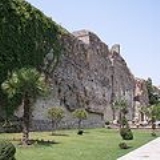
The site seems to have been abandoned until the Ottoman army built a military camp there, followed by urban reconstruction under Sultan Mehmet II in 1467. Mehmet constructed a massive four-sided castle with a deep moat and three gates. He named it Elbasan, meaning 'crushing fist' in Turkish. It became the seat of Sanjak of ElbasanSanjak of Elbasan
The Sanjak of Elbasan was one of the sanjaks of the Ottoman Empire. Its county town was Elbasan in Albania.- Administration :The Sanjak of Elbasan had three kazas:*Elbasan,*Gramsh and*Peqin....
, a centre of Ottoman urban civilisation over the next 445 years. By the end of the 17th century it had 2,000 inhabitants. The fortress was dismantled by Reshit Pasha
Resid Mehmed Pasha
- Early life :Reşid Mehmed was born in Georgia, the son of a Greek Orthodox priest. As a child, he was captured as a slave by the Turks, and brought to the service of the then Kapudan Pasha Husrev Pasha. His intelligence and ability impressed his master, and secured his rapid rise...
in 1832. In 1864, the Sanjak of Elbasan
Sanjak of Elbasan
The Sanjak of Elbasan was one of the sanjaks of the Ottoman Empire. Its county town was Elbasan in Albania.- Administration :The Sanjak of Elbasan had three kazas:*Elbasan,*Gramsh and*Peqin....
became a part of Monastir Vilayet. At the beginning of the 20th century it was estimated that 15,000 people lived in Elbasan.
In 1909, after the Young Turks
Young Turks
The Young Turks , from French: Les Jeunes Turcs) were a coalition of various groups favouring reformation of the administration of the Ottoman Empire. The movement was against the absolute monarchy of the Ottoman Sultan and favoured a re-installation of the short-lived Kanûn-ı Esâsî constitution...
revolution in Istanbul
Istanbul
Istanbul , historically known as Byzantium and Constantinople , is the largest city of Turkey. Istanbul metropolitan province had 13.26 million people living in it as of December, 2010, which is 18% of Turkey's population and the 3rd largest metropolitan area in Europe after London and...
, an Albanian National Congress was held in Elbasan to study educational and cultural questions. The delegates, all from central and southern Albania, endorsed the decision of the Congress of Monastir, which was held in Monastir (modern Bitola
Bitola
Bitola is a city in the southwestern part of the Republic of Macedonia. The city is an administrative, cultural, industrial, commercial, and educational centre. It is located in the southern part of the Pelagonia valley, surrounded by the Baba and Nidže mountains, 14 km north of the...
, Republic of Macedonia
Republic of Macedonia
Macedonia , officially the Republic of Macedonia , is a country located in the central Balkan peninsula in Southeast Europe. It is one of the successor states of the former Yugoslavia, from which it declared independence in 1991...
) to use the Latin alphabet rather than the Arabic script in written Albanian
Albanian language
Albanian is an Indo-European language spoken by approximately 7.6 million people, primarily in Albania and Kosovo but also in other areas of the Balkans in which there is an Albanian population, including western Macedonia, southern Montenegro, southern Serbia and northwestern Greece...
.
Albania
The very first teachers' training college in Albania, the Shkolla Normale e Elbasanit, was established in Elbasan.The Muslim majority of Elbasan opposed the installation of Prince Wied in 1914. Elbasan was occupied successively by Serbs
Serbs
The Serbs are a South Slavic ethnic group of the Balkans and southern Central Europe. Serbs are located mainly in Serbia, Montenegro and Bosnia and Herzegovina, and form a sizable minority in Croatia, the Republic of Macedonia and Slovenia. Likewise, Serbs are an officially recognized minority in...
, Bulgarians
Bulgarians
The Bulgarians are a South Slavic nation and ethnic group native to Bulgaria and neighbouring regions. Emigration has resulted in immigrant communities in a number of other countries.-History and ethnogenesis:...
, Austrians and Italians between 1915 and 1918. The Bulgarian army occupied Elbassan on January 29, 1916, during Bulgarian occupation of Albania
Bulgarian occupation of Albania
Bulgarian occupation of Albania refers to the occupation of Albania by the Kingdom of Bulgaria's army during World War I. It lasted between December 10, 1915, when Bulgarian army crossed the Drin river and entered the Albania, and lasted until September 9, 1917, when French troops captured...
In March 1916 the army of Austria-Hungary took over control of Elbassan From June 1916 to March 1917 Stanislav Kostka Neumann fought with the Austrian army there and called his war memoirs about the occupation in Elbasan. Industrial development began in the Zogist period when tobacco and alcoholic drinks' factories were established.
The city was also noted for its good public buildings, advanced educational provisions, public gardens and timber-built shops. There was much wartime damage, which was followed by an intensive programme of industrial development in the Communist period that boosted the city to around 75,000 inhabitants. The culmination of this process was the construction of the huge Steel of the Party metallurgical complex outside the city, in the Shkumbini valley, built with Chinese assistance in the 1970s. It was emphatically called "The Second National Liberation of Albanian" by Enver Hoxha
Enver Hoxha
Enver Halil Hoxha was a Marxist–Leninist revolutionary andthe leader of Albania from the end of World War II until his death in 1985, as the First Secretary of the Party of Labour of Albania...
. The cost of the complex in environmental impact was high for the Shkumbin valley.
Culture and religion
Elbasan has been occupied by several different groups, including the SerbsSerbs
The Serbs are a South Slavic ethnic group of the Balkans and southern Central Europe. Serbs are located mainly in Serbia, Montenegro and Bosnia and Herzegovina, and form a sizable minority in Croatia, the Republic of Macedonia and Slovenia. Likewise, Serbs are an officially recognized minority in...
, Bulgarians
Bulgarians
The Bulgarians are a South Slavic nation and ethnic group native to Bulgaria and neighbouring regions. Emigration has resulted in immigrant communities in a number of other countries.-History and ethnogenesis:...
, Austrians
Austrians
Austrians are a nation and ethnic group, consisting of the population of the Republic of Austria and its historical predecessor states who share a common Austrian culture and Austrian descent....
and Italians. Elbasan remained a center of Islam
Islam
Islam . The most common are and . : Arabic pronunciation varies regionally. The first vowel ranges from ~~. The second vowel ranges from ~~~...
in Albania even after the Ottoman
Ottoman Empire
The Ottoman EmpireIt was usually referred to as the "Ottoman Empire", the "Turkish Empire", the "Ottoman Caliphate" or more commonly "Turkey" by its contemporaries...
occupation. After the 1908 Congress of Monastir (in modern Bitola
Bitola
Bitola is a city in the southwestern part of the Republic of Macedonia. The city is an administrative, cultural, industrial, commercial, and educational centre. It is located in the southern part of the Pelagonia valley, surrounded by the Baba and Nidže mountains, 14 km north of the...
, Republic of Macedonia
Republic of Macedonia
Macedonia , officially the Republic of Macedonia , is a country located in the central Balkan peninsula in Southeast Europe. It is one of the successor states of the former Yugoslavia, from which it declared independence in 1991...
) decided to use the Latin alphabet
Latin alphabet
The Latin alphabet, also called the Roman alphabet, is the most recognized alphabet used in the world today. It evolved from a western variety of the Greek alphabet called the Cumaean alphabet, which was adopted and modified by the Etruscans who ruled early Rome...
for the written Albanian language
Albanian language
Albanian is an Indo-European language spoken by approximately 7.6 million people, primarily in Albania and Kosovo but also in other areas of the Balkans in which there is an Albanian population, including western Macedonia, southern Montenegro, southern Serbia and northwestern Greece...
, Muslim
Muslim
A Muslim, also spelled Moslem, is an adherent of Islam, a monotheistic, Abrahamic religion based on the Quran, which Muslims consider the verbatim word of God as revealed to prophet Muhammad. "Muslim" is the Arabic term for "submitter" .Muslims believe that God is one and incomparable...
clerics influenced by the Young Turks
Young Turks
The Young Turks , from French: Les Jeunes Turcs) were a coalition of various groups favouring reformation of the administration of the Ottoman Empire. The movement was against the absolute monarchy of the Ottoman Sultan and favoured a re-installation of the short-lived Kanûn-ı Esâsî constitution...
held various demonstrations in favor of the Arabic script in Elbasan.
In the middle of the city is found the Saint Mary Orthodox Church. The church was built in 1830 on the foundations of an older church, which had partially burned in 1819. Paintings and frescoes of Onufri
Onufri
Onufri was a 16th century Albanian painter best known for his Byzantine style icons. He also painted portraits, landscapes and churches.-Life:...
, restored by David Selenicasi
David Selenicasi
David Selenica or Selenicasi was an Albanian painter of the late 17th and the early 18th century. He is regarded as one of the most prominent figures of Albanian post-Byzantine icon painting....
and Kostadin Shelcani can still be seen. The church has been an important religious and cultural center for the Albanian language. Teodor Haxhifilipi, Kostandin Kristoforidhi
Kostandin Kristoforidhi
-Additional readings:*])]*])]*])]*. In: Besa. Nr. 193, Jg. 2007. S. 2–7....
, and Aleksandër Xhuvani
Aleksandër Xhuvani
Aleksandër Xhuvani was an Albanian philologist and educator. He studied at the University of Athens before coming to Elbasan, where he taught at the Normal School. Xhuvani spent much of his career working for the improvement of Albanian schools; he also advocated the standardization of the...
have served in the church. They are the authors of translations into Albanian of many psalms. The church building served as the first Albanian school of Elbasan in modern times, which opened in 1908.
Other orthodox churches in the Elbasan District
Elbasan District
The District of Elbasan is one of the thirty-six districts of Albania, part of Elbasan County. It has a population of 224,689 , and an area of 1,372 km². It is in the centre of the country, and its capital is Elbasan...
include the Mameli church (built in the 17th century), the Saint Nicholas church in Shelcan (built in 1554), the Saint Nicholas church in Valesh (built in 1604), the Saints Cosmas and Damian
Saints Cosmas and Damian
Saints Cosmas and Damian were twin brothers, physicians, and early Christian martyrs born in Cilicia, part of today's Turkey. They practiced their profession in the seaport of Ayas, Adana, then in the Roman province of Syria...
church in Sterstan (built in the 18th century), the Saint Michael church in Shalës
Shalës
Shalës is a municipality in the Elbasan District, Elbasan County, central Albania. The municipality consists of the villages Shalës, Licaj, Kurtalli, Xibrake, Xherie and Kodras....
(built in the 17th century), the Saint Mary church in Dragot (built in the 18th century), the Saint Nicholas church of Elbasan (17th century), and the Elbasan Saint Athanasius church of Elbasan (built in 1554).
About 7 km away from Elbasan there is an old monastery and orthodox church where notably Saint Jovan Vladimir
Jovan Vladimir
Jovan Vladimir or John Vladimir was ruler of Duklja, the most powerful Serbian principality of the time, from around 1000 to 1016. He ruled during the protracted war between the Byzantine Empire and the First Bulgarian Empire...
was buried until 1995 when his remains were transferred to the Orthodox Cathedral in Tirana, being brought back to the monastery only for his feast days.
Elbasan is home to the National Autocephalous Albanian Church , a relatively new Orthodox Autocephalous church that split from the Albanian Orthodox Church
Albanian Orthodox Church
The Autocephalous Orthodox Church of Albania is one of the newest autocephalous Eastern Orthodox churches. It declared its autocephaly in 1922, and gained recognition from the Patriarch of Constantinople in 1937....
in 1995. Father Nikolle Marku is the leader of the new denomination.
Elbasan is also home to a Uniat Catholic church.
Elbasan has four museums:
- Ethnographic Museum (1982) held in a 18th century building.
- “Kostandin Kristoforidhi” house (started as a museum in 1978),
- Shkolla Normale Museum,
- War Museum
Elbasan is the home to the Summer Day
Summer Festival, Albania
Every year on March 14 the people of Albania celebrate the Summer Festival, their largest pagan festival. It is intended to celebrate the end of winter, the rebirth of nature and a rejuvenation of spirit amongst the Albanians. Although the epicentre of this festival is in Shkumbin , the festival is...
festivities, a pagan feast celebrating the end of winter and the coming of summer
Summer
Summer is the warmest of the four temperate seasons, between spring and autumn. At the summer solstice, the days are longest and the nights are shortest, with day-length decreasing as the season progresses after the solstice...
. Ballokume, cookies made from butter
Butter
Butter is a dairy product made by churning fresh or fermented cream or milk. It is generally used as a spread and a condiment, as well as in cooking applications, such as baking, sauce making, and pan frying...
and corn wheat is the traditional dish served in this day. Since 2004, it has become a national holiday being celebrated in Tirana
Tirana
Tirana is the capital and the largest city of Albania. Modern Tirana was founded as an Ottoman town in 1614 by Sulejman Bargjini, a local ruler from Mullet, although the area has been continuously inhabited since antiquity. Tirana became Albania's capital city in 1920 and has a population of over...
on a Monday in mid-March.
Economy
Industrial development began during the ZogZog of Albania
Zog I, Skanderbeg III of the Albanians , born Ahmet Muhtar Bey Zogolli, was King of the Albanians from 1928 to 1939. He was previously Prime Minister of Albania and President of Albania .-Background and early political career:...
regime with the production of tobacco
Tobacco
Tobacco is an agricultural product processed from the leaves of plants in the genus Nicotiana. It can be consumed, used as a pesticide and, in the form of nicotine tartrate, used in some medicines...
and alcoholic beverage
Alcoholic beverage
An alcoholic beverage is a drink containing ethanol, commonly known as alcohol. Alcoholic beverages are divided into three general classes: beers, wines, and spirits. They are legally consumed in most countries, and over 100 countries have laws regulating their production, sale, and consumption...
s, and culminated during the communist regime. The city gained prominence after the Chinese
China
Chinese civilization may refer to:* China for more general discussion of the country.* Chinese culture* Greater China, the transnational community of ethnic Chinese.* History of China* Sinosphere, the area historically affected by Chinese culture...
built a steel mill in 1974. There were also other industries operating in the city during the communist regime, and as a result the city now suffers from pollution
Pollution
Pollution is the introduction of contaminants into a natural environment that causes instability, disorder, harm or discomfort to the ecosystem i.e. physical systems or living organisms. Pollution can take the form of chemical substances or energy, such as noise, heat or light...
.
Mayors
| Mayors of Elbasan | |||||
Alush Saraçi Alush Saraçi -References:... Fuad Bicaku Fuad Bicaku -References:... Hysen Hostopalli Hysen Hostopalli Hysen Hostopalli was an Albanian politician and mayor of Elbasan from 1915 through 1916.-References:... Tajar Malesi Tajar Malesi -References:... Kasem Sejdini Kasem Sejdini Kasem Sejdini was an Albanian politician and mayor of Elbasan from 1919 through 1924.-References:... Lef Nosi Lef Nosi Lef Nosi was an Albanian politician and collaborationist during the Second World War. He was one of the signatories of Albanian Declaration of Independence. Nosi was the first Minister of Post and Telegraphs of Albania... Behexhed Hydi Behexhed Hydi Behexhed Hydi was an Albanian politician and mayor of Elbasan from 1925 through 1928.-References:... Hafez Musa Ali Basha Hafez Musa Ali Basha Hafez Musa Ali Basha was an Albanian politician and mayor of Elbasan from 1928 through 1929.-References:... Rustem Ymeri Rustem Ymeri -References:... Hasan Bicaku Hasan Bicaku -References:... Ahmet Dakli Ahmet Dakli -References:... Qemal Karosmani Qemal Karosmani Qemal Karosmani was an Albanian politician and mayor of Elbasan from 1939 through 1939.-References:... Ymer Saraçi Ymer Saraçi -See also:*Alush Saraçi... Teofik Bekteshi Teofik Bekteshi Teofik Bekteshi was an Albanian politician and mayor of Elbasan from 1942 through 1943.-References:... Abdyl Dylaveri Abdyl Dylaveri Abdyl Dylaveri was an Albanian politician and mayor of Elbasan from 1943 through 1944.-References:... |
1912–1913 1913–1915 1915–1916 1917–1918 1919–1924 1924–1924 1925–1928 1928–1929 1929–1930 1933–1934 1937–1939 1939–1939 1939–1942 1942–1943 1943–1944 |
Thanas Kononi Spiro Todri Ilia Trandafili Qemal Shkalla Riza Kazazi Liri Hakani Viktor Dodbiba Qazim Kafexhiu Katina Topuzi Stavri Gostivishti Hamit Gjata Mit’hat Kokunja Xhevdet Fejzo Kujtim Musaj Nezir Krasniqi |
????–???? ????–???? ????–???? ????–???? ????–???? ????–???? ????–???? ????–???? ????–???? ????–???? ????–???? ????–???? ????–???? ????–???? ????–???? |
Hamdi Gerlica Breatrice Ballici Ibrahim Pajenga Elham Hasani Besnik Ekmekciu Durim Hushi Hyqmet Kotherja Emine Sadiku Emin Et’hem Haxhiademi Engjell Dakli Hysen Domi Ardjan Turku Qazim Sejdini |
????–???? ????–???? ????–???? ????–???? ????–???? ????–???? ????–???? ????–???? 1992–1996 1996–2000 2000–2003 2003–2004 since 2007 |
Notable people
- Serxhio AbdurahmaniSerxhio AbdurahmaniSerxhio Abdurahmani is a Albanian forward. He is currently playing for Niki Volos F.C. after a 1 year loan agreement with his club AEK Athens.-References:...
, football player - Dervish bej BiçakuDervish bej BiçakuDervish Biçaku was one of the signatories of Albanian Declaration of Independence.-References:*"History of Albanian People" Albanian Academy of Science.ISBN 99927-1-623-1...
, signatory of the Albanian Declaration of IndependenceAlbanian Declaration of IndependenceThe Albanian Declaration of Independence is the declaration of independence of the Albanian Vilayet from the Ottoman Empire. Albania was proclaimed independent in Vlorë on November 28, 1912.-Background:... - Shefqet bej DaiuShefqet bej DaiuShefqet bej Daiu was one of the signatories of Albanian Declaration of Independence in 1912. He was the second secretary of the Congress of Vlora, when the independenced was declared. He was aftermath named as prefect of Fieri, a post he hold until the First World War...
, signatory of the Albanian Declaration of Independence - Kostandin KristoforidhiKostandin Kristoforidhi-Additional readings:*])]*])]*])]*. In: Besa. Nr. 193, Jg. 2007. S. 2–7....
, translator in AlbanianAlbanian languageAlbanian is an Indo-European language spoken by approximately 7.6 million people, primarily in Albania and Kosovo but also in other areas of the Balkans in which there is an Albanian population, including western Macedonia, southern Montenegro, southern Serbia and northwestern Greece...
of the New TestamentNew TestamentThe New Testament is the second major division of the Christian biblical canon, the first such division being the much longer Old Testament.... - Qemal bej KaraosmaniQemal bej KaraosmaniQemal bej Karaosmani was one of the signatories of the Albanian Declaration of Independence.-References:...
, signatory of the Albanian Declaration of Independence - Lef NosiLef NosiLef Nosi was an Albanian politician and collaborationist during the Second World War. He was one of the signatories of Albanian Declaration of Independence. Nosi was the first Minister of Post and Telegraphs of Albania...
, signatory of the Albanian Declaration of Independence - Sedefkar Mehmed Agha, 16th century architect
- Dhimitër ShuteriqiDhimitër ShuteriqiDhimitër Shuteriqi was an Albanian writer, historian and critic. During the 1946-1973 period he was the president of the Albanian League of Writers and Artists.-References:...
, writer and critic - Bexhet Jolldashi, football player
See also
- Clouds of SmokeClouds of SmokeClouds of Smoke is a documentary directed and produced by Fatmir Terziu. It explores the recent phenomenon of global warming and asks several environmental questions. It mainly focuses on the environmental damage caused by Albania, especially its biggest industrial city, Elbasan...
(documentary film) - Elbasan scriptElbasan scriptThe Elbasan script is a mid 18th-century alphabetic script used for the Albanian language. It was named after the city of Elbasan where it was invented...
- History of AlbaniaHistory of AlbaniaThe history of Albania emerges from the prehistoric stage from the 4th century BC, with early records of Illyria in Greco-Roman historiography. The modern territory of Albania has no counterpart in antiquity, comprising parts of the Roman provinces of Dalmatia , Macedonia , and Moesia Superior...
- List of cities in Albania