

Fier

Encyclopedia
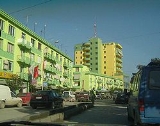
Fieri is a city
City
A city is a relatively large and permanent settlement. Although there is no agreement on how a city is distinguished from a town within general English language meanings, many cities have a particular administrative, legal, or historical status based on local law.For example, in the U.S...
in southwest Albania
Albania
Albania , officially known as the Republic of Albania , is a country in Southeastern Europe, in the Balkans region. It is bordered by Montenegro to the northwest, Kosovo to the northeast, the Republic of Macedonia to the east and Greece to the south and southeast. It has a coast on the Adriatic Sea...
, in the district and county of the same name. It is located at 40°43′N 19°33′E, and has a population of 82,297 (2005). Fier is 8 km (5 mi) from the ruins of the ancient Greek
Ancient Greek
Ancient Greek is the stage of the Greek language in the periods spanning the times c. 9th–6th centuries BC, , c. 5th–4th centuries BC , and the c. 3rd century BC – 6th century AD of ancient Greece and the ancient world; being predated in the 2nd millennium BC by Mycenaean Greek...
city of Apollonia
Apollonia, Illyria
Apollonia was an ancient Greek city in Illyria, located on the right bank of the Aous river . Its ruins are situated in the Fier region, near the village of Pojani, in modern-day Albania...
.
History
The history of Fier is bound up with that of the oil, gas and bitumen deposits nearby. The presence of asphalt and burning escapes of natural gasNatural gas
Natural gas is a naturally occurring gas mixture consisting primarily of methane, typically with 0–20% higher hydrocarbons . It is found associated with other hydrocarbon fuel, in coal beds, as methane clathrates, and is an important fuel source and a major feedstock for fertilizers.Most natural...
in the vicinity was recorded as early as the 1st century AD. Dioscorides, in Materia Medica
Materia medica
Materia medica is a Latin medical term for the body of collected knowledge about the therapeutic properties of any substance used for healing . The term 'materia medica' derived from the title of a work by the Ancient Greek physician Pedanius Dioscorides in the 1st century AD, De materia medica libre...
, describes lumps of bitumen in the adjacent river Seman, and the concentrated pitch on the banks of the Vjosë
Vjosë
Vjosë or Aoös is a river in northwestern Greece and southwestern Albania.Its total length is about , of which the first are in Greece, and the remaining are in Albania. Vjosë is fed by two secondary branches, both in Albania, the Drino river and the Shushicë.Its source is in Greece, specifically...
river Strabo, writing in about AD 17 states:
On the territory of the people of Apolonia in Illlyria there is what is called a nymphaeum. It is a rock which emits fire. Below it are springs flowing with hot water and asphalt... the asphalt is dug out of a neighboring hill: the parts excavated are replaced by fresh earth, which in time is converted to asphalt.
The name of the city comes probably from the Italian word fiera, meaning trade fair in English, because in the 14th and 15th century the location was used by the Venetian
Republic of Venice
The Republic of Venice or Venetian Republic was a state originating from the city of Venice in Northeastern Italy. It existed for over a millennium, from the late 7th century until 1797. It was formally known as the Most Serene Republic of Venice and is often referred to as La Serenissima, in...
traders as a marketplace to purchase agricultural products from the Myzeqe lowlands.
The settlement took city status in 1864 when Kahreman Pasha Vrioni, the local governor, asked from some French
French people
The French are a nation that share a common French culture and speak the French language as a mother tongue. Historically, the French population are descended from peoples of Celtic, Latin and Germanic origin, and are today a mixture of several ethnic groups...
architects to project a future city as an artisan and trade center. During the 1864-1865 period a market for 122 merchants was built along the Gjanica river. The first inhabitants of the city were the servants of Kahreman Pasha Vrioni and members of Vlach families that had lived in the area since the early 19th century period.
Industry and Tourism
Fier is an important industrial city and is built by the Gjanica tributary of the SemanSeman
The Seman is a river in western Albania. It is formed at the confluence of the rivers Osum and Devoll, a few km northwest of Kuçovë. It flows west through Fier-Shegan and Mbrostar . It flows into the Adriatic Sea near Topojë....
river, and is surrounded by marshland. With nearby Patos
Patos
Patos is a city in the District of Fier in Albania. The city had 32,078 residents in the 2005 census. It is the center of the oil industry in Albania, and is 7 kilometers from city of Fier.The city's football team is Klubi Sportiv Albpetrol....
town, it is the centre of the oil, bitumen and chemical industries in Albania. Fier is a convenient place to stay to visit the major Classical sites at nearby Byllis
Byllis
Byllis was an ancient city located in the region of Illyria. The remains of Byllis are situated north-east of Vlorë, 25 kilometers from the sea in Hekal, Mallakastër District, Albania....
and Apolonia. The population is mixed Orthodox and Muslim (typical of southern Albanian cities). Main roads from the central square lead south to Vlora (35 km (21.7 mi)) and east to the oil and chemical town of Patos (8 km (5 mi)).
Apollonia
Twelve km away from Fier is situated ApolloniaApollonia (Illyria)
Apollonia was an ancient Greek city in Illyria, located on the right bank of the Aous river . Its ruins are situated in the Fier region, near the village of Pojani, in modern-day Albania...
, one of the two most important ancient Greek colonial settlements in present day Albania. It was founded in 600 BC on a hill near the sea, and near what was then the course of Vjosë river by settlers from Corfu
Corfu
Corfu is a Greek island in the Ionian Sea. It is the second largest of the Ionian Islands, and, including its small satellite islands, forms the edge of the northwestern frontier of Greece. The island is part of the Corfu regional unit, and is administered as a single municipality. The...
and Corinth
Corinth
Corinth is a city and former municipality in Corinthia, Peloponnese, Greece. Since the 2011 local government reform it is part of the municipality Corinth, of which it is the seat and a municipal unit...
. At the time before the changes in land formation and the Adriatic coastline caused by an earthquake in the 3rd century AD, the harbour af Apollonia could accommodate as many as 100 ships. The site is thought to be on the sothern boundary of a native Illyria
Illyria
In classical antiquity, Illyria was a region in the western part of the Balkan Peninsula inhabited by the Illyrians....
n settlement, being mentioned in Periplus
Periplus
Periplus is the Latinization of an ancient Greek word, περίπλους , literally "a sailing-around." Both segments, peri- and -plous, were independently productive: the ancient Greek speaker understood the word in its literal sense; however, it developed a few specialized meanings, one of which became...
, a sailor's account of the Adriatic written in the middle of the 4th century BC by a Greek writer. It was near the territory occupied by the Illyrian tribes and close to the Greek
Greece
Greece , officially the Hellenic Republic , and historically Hellas or the Republic of Greece in English, is a country in southeastern Europe....
tribe of the Chaonians. The colony was said to have been named Gylaceia after its Corinth
Corinth
Corinth is a city and former municipality in Corinthia, Peloponnese, Greece. Since the 2011 local government reform it is part of the municipality Corinth, of which it is the seat and a municipal unit...
ian founder, Gylax, and later changed its name to that of city of the God Apollo. According to archaeological investigations for 100 years Greek and Illyrian have lived in separate communities.
The economic prosperity of Apolonia grew on the basis of trade in slaves, and the local rich pastoral agricultural. In the middle of the 5th century BC, a workshop for minting coins was set up here. Through trade and commercial transactions these coins spread throughout Illyria and beyond its boundaries. In the years 214 BC onwards, the city was involved in the war between the Illyrian Taulanti and Cassander
Cassander
Cassander , King of Macedonia , was a son of Antipater, and founder of the Antipatrid dynasty...
, the king of Macedonia, and in 229 BC came under Roman control. In 168 BC, its loyalty to Rome was rewarded. For 200 years, it was of central importance in the Roman effort to colonize the east and may have been an original terminus of the Egnatian Way. It was a vital stronghold for Caesar in the civil war between Pompey
Pompey
Gnaeus Pompeius Magnus, also known as Pompey or Pompey the Great , was a military and political leader of the late Roman Republic...
and Julius Caesar
Julius Caesar
Gaius Julius Caesar was a Roman general and statesman and a distinguished writer of Latin prose. He played a critical role in the gradual transformation of the Roman Republic into the Roman Empire....
. In 45 and 44 BC, Octavian, later to become the Emperor Augustus, studied for 6 months in Apolonia, which had established a high reputation as a center of Greek learning, especially the art of rhetoric
Rhetoric (Aristotle)
Aristotle's Rhetoric is an ancient Greek treatise on the art of persuasion, dating from the 4th century BC. In Greek, it is titled ΤΕΧΝΗ ΡΗΤΟΡΙΚΗ, in Latin Ars Rhetorica. In English, its title varies: typically it is titled Rhetoric, the Art of Rhetoric, or a Treatise on...
. It was noted by Cicero
Cicero
Marcus Tullius Cicero , was a Roman philosopher, statesman, lawyer, political theorist, and Roman constitutionalist. He came from a wealthy municipal family of the equestrian order, and is widely considered one of Rome's greatest orators and prose stylists.He introduced the Romans to the chief...
, in the Philippics, as 'magna urbs et gravis' a great and important city.
Under the Empire, Apolonia remained a prosperous center, but begun to decline as the Vjosë silted up and the coastline changed after the earthquake.
The Excavations and the Monuments of Apolonia
The first attempts to conduct excavations in Apolonia were made during the first World War, by Austrian archaeologists who unearthed and explored mainly the walls that encircled the city. Systematic excavations began in 1824 by a French archaeological mission directed by Leon Rey, who brought to light a complex of monuments at the center of the city. A lot of excavations have been made by Albanian archaeologists during the last 40 years. Many objects are exhibited in the museum which has been the monastery of St. Mary.The Monument of Agonothetes
This monument decorated the center of the city. The structure had the form of a semicircle and served as an assembly place of the council of the city - the BuleBule
Bule is a commonly used word in Indonesia to describe a foreigner, especially Caucasians.Many dictionaries point out that the strict definition of the word is albino. However, this definition have lost usage in both spoken and written form over the English loanword, albino...
. The front part of the structure was decorated in a special manner: there are 6 pillars crowned with capitals of the Corinthian style. An inscription dating from the middle of the 2nd century AD tells that the building was constructed by high ranking officers of the city, a monument with the purpose of commemorating the death of his soldier brother. On the day of the inauguration of the monument, a show was staged in the city with the participation of 25 couples of gladiators. On the western side, from the top of the monumental structure, the tourists can see the ruins of the small temple of Artemis
Temple of Artemis
The Temple of Artemis , also known less precisely as the Temple of Diana, was a Greek temple dedicated to a goddess Greeks identified as Artemis and was one of the Seven Wonders of the Ancient World. It was situated at Ephesus , and was completely rebuilt three times before its eventual destruction...
(Diana). At the eastern side there is a street which passes under a triumphal arch
Triumphal arch
A triumphal arch is a monumental structure in the shape of an archway with one or more arched passageways, often designed to span a road. In its simplest form a triumphal arch consists of two massive piers connected by an arch, crowned with a flat entablature or attic on which a statue might be...
. On the opposite side of the monument of the Agonothetes, there is a colonnade decorated with marble statues.
The Library and the Odeon
This structure rises behind the colonnade. Opposite the monument of Aganothetes stands an Odeon or 'small theatre' for 200 spectators. The building had a stage, an orchestra and tiers. There they gave musical shows, recitals, and held oratorical and philosophical discussions.The House with Mosaics
Nereids
In Greek mythology, the Nereids are sea nymphs, the fifty daughters of Nereus and Doris, sisters to Nerites. They often accompany Poseidon and can be friendly and helpful to sailors fighting perilous storms. They are particularly associated with the Aegean Sea, where they dwelt with their father...
and Erotes
Erotes
Erotes or Amores may also refer to:In literature:* Erotes , a group of gods and demi-gods from Classical mythology, associated with love and sex and part of Aphrodite's retinue....
. One of the mosaics represents a scene where Archiles holds the wounded Penthesilea
Penthesilea
Penthesilea or Penthesileia was an Amazonian queen in Greek mythology, the daughter of Ares and Otrera and the sister of Hippolyta, Antiope and Melanippe...
, the beautiful queen of Amazones, in his arms.
Fontana
The Fontana represents in itself a complex structure; it had a wall which collected all the waters that sprang from the earth, and four other aqueducts.The Museum of Apolonia
The Museum of Apollina has 7 pavilions, a gallery and 2 porticos. Here are exhibited different objects that testify to the history of Apolonia.Ardenica Monastery
The Church of St. Mary at the Ardenica MonasteryArdenica Monastery
The Ardenica Monastery of Theotokos Mary is an Eastern Orthodox monastery, distant ten kilometers north of Fier, Albania, along the national road that links Fier to Lushnjë....
is the most important part of the monastery. It is situated between the museum and the refectory. The church is of Byzantine style
Byzantine architecture
Byzantine architecture is the architecture of the Byzantine Empire. The empire gradually emerged as a distinct artistic and cultural entity from what is today referred to as the Roman Empire after AD 330, when the Roman Emperor Constantine moved the capital of the Roman Empire east from Rome to...
. The interiors of the church had once been painted, but today very few fragments from the mural paintings have remained. started to be built on 1282 by Emperor Andronikos II Palaiologos
Andronikos II Palaiologos
Andronikos II Palaiologos , Latinized as Andronicus II Palaeologus, was Byzantine emperor from 1282 to 1328. He was the eldest surviving son of Michael VIII Palaiologos and Theodora Doukaina Vatatzina, grandniece of John III Doukas Vatatzes...
of Byzantium after the victory on the Angevins
Capetian House of Anjou
The Capetian House of Anjou, also known as the House of Anjou-Sicily and House of Anjou-Naples, was a royal house and cadet branch of the direct House of Capet. Founded by Charles I of Sicily, a son of Louis VIII of France, the Capetian king first ruled the Kingdom of Sicily during the 13th century...
in Berat
Berat
Berat is a town located in south-central Albania. As of 2009, the town has an estimated population of around 71,000 people. It is the capital of both the District of Berat and the larger County of Berat...
. The wall painting represents the Emperor as the builder of the church. The refectory of the monastery was built at the same time as the church.
Famous people
- Luftar Paja- People's Artist of AlbaniaPeople's Artist of AlbaniaPeople's Artist of Albania was an honorary title for the decoration of outstanding art performers of People's Socialist Republic of Albania, whose merits were exceptional in the sphere of development of the performing arts . It was created by law in 1960 and amended in 1980. The title was no longer...
- Jakov XoxaJakov Xoxa-Biography:Xoxa was born in the town of Fier April the 15th 1923, Albania. Although at a relatively young age, like many other Albanian intellectuals he participated in the Anti-Fascist War. After the Liberation of the country he continued his studies in philology and simultaneously made the first...
- Writer - Kadri RoshiKadri RoshiKadri Roshi was born in Mallakaster. His origin is from Libohove, Gjirokaster. He worked as an actor. He starred in lot of Albanian Films and played in difrent drama in theatre. He is one of the most talented Albanian actors because of his voice and the way he moves in scene...
- People's Artist of AlbaniaPeople's Artist of AlbaniaPeople's Artist of Albania was an honorary title for the decoration of outstanding art performers of People's Socialist Republic of Albania, whose merits were exceptional in the sphere of development of the performing arts . It was created by law in 1960 and amended in 1980. The title was no longer... - Pellumb Kulla- Filmmaker and dramaturgue
- Fuat Boci- Actor - Humor
- Kristaq Shtëmbari- Popular Teacher
- Kujtim Majaci-soccer player from the 1980s
- Hajrie Rondo- Actor
- Ervis Gega- Violinist
- Albert VerriaAlbert VërriaAlbert Vërria is an Albanian actor. He is a Merited Artist of Albania.- Filmography :*Rrethimi i vogël - *Melodi e pandërprerë - *Ditë të qytetit tim - *Goditja - *Përtej mureve të gurta -...
- Merited Artist of AlbaniaMerited Artist of AlbaniaMerited Artist of Albania was a state honorary title for the decoration of outstanding art performers of People's Socialist Republic of Albania. It was created by law in 1960 and amended in 1980... - Diana Boja- Athlete
- Vladimir Stefa- soccer player from the 1980s
- Llazar Bane- WWII Veteran, writer "Bashkë me shokët : kujtime" / "Together With My Friends"
External links
- Municipality of Fier
- National Archaeological Park of Bylis
- Official Fier County Travel Guide
- Fieri International Film Festival
- Apollon International Theater Festival
- Official Gallery of Fier City
- Albanian Music, Fier
- Fier Yellow Pages
- Chamber of Commerce and Industry of Fier
- Albpetrol sh.a: Public Company of Oil and Gas
- TV Apollon Regional TV