
All Topics  
Aristides


   Email Print
   Bookmark   Link


Aristides


Aristides or Aristeides (Greek
Greek language

Greek is an Indo-European languages native to the southern Balkan peninsula, the language of the Greek people. It forms an independent branch within Indo-European....
 , 530–468 BC) was an Athenian soldier and statesman. He was one of the 10 commanders against the Persians
Persian Empire

The 'Persian Empire' was a series of successive Iranian or Persianization empires that ruled over the Iranian plateau, the original Persian homeland, and beyond in Southwest Asia, South Asia, Central Asia and the Caucasus....
 in the Battle of Marathon
Battle of Marathon

The Battle of Marathon, Greece during the Greco-Persian Wars took place in 490 BC and was the culmination of the first attempt by the Achaemenid Empire of Persia, under King Darius I, to subjugate Ancient Greece....
 under Miltiades
Miltiades the Younger

Miltiades the Younger was the step-nephew of Miltiades the Elder. He made himself the tyrant of the Greek colonies on the Thracian Chersonese around 516 BC, forcibly seizing it from his rivals and imprisoning them....
.

Aristides was nicknamed "the Just" because he was popularly recognized as never seeking personal glory or financial gain in his public service to the people of Athens. As a result, during his adult life, Aristides was asked to arbitrate difficult private and public issues.


Discussion
Ask a question about 'Aristides'
Start a new discussion about 'Aristides'
Answer questions from other users
Full Discussion Forum


Encyclopedia


Aristides or Aristeides (Greek
Greek language

Greek is an Indo-European languages native to the southern Balkan peninsula, the language of the Greek people. It forms an independent branch within Indo-European....
 , 530–468 BC) was an Athenian soldier and statesman. He was one of the 10 commanders against the Persians
Persian Empire

The 'Persian Empire' was a series of successive Iranian or Persianization empires that ruled over the Iranian plateau, the original Persian homeland, and beyond in Southwest Asia, South Asia, Central Asia and the Caucasus....
 in the Battle of Marathon
Battle of Marathon

The Battle of Marathon, Greece during the Greco-Persian Wars took place in 490 BC and was the culmination of the first attempt by the Achaemenid Empire of Persia, under King Darius I, to subjugate Ancient Greece....
 under Miltiades
Miltiades the Younger

Miltiades the Younger was the step-nephew of Miltiades the Elder. He made himself the tyrant of the Greek colonies on the Thracian Chersonese around 516 BC, forcibly seizing it from his rivals and imprisoning them....
.

Aristides was nicknamed "the Just" because he was popularly recognized as never seeking personal glory or financial gain in his public service to the people of Athens. As a result, during his adult life, Aristides was asked to arbitrate difficult private and public issues. Herodotus
Herodotus

Herodotus of Halicarnassus was a Greeks historian who lived in the 5th century BC and is regarded as the "Father of History" in Western culture....
, writing just 40 years after the death of Aristides, said that "there was not in all Athens a man so worthy or so just as he". It is believed that the early population in Athens quoted the statement for the fact that he constantly had pleasured many wealthy men in the kingdom expressing his homosexual tendencies. Even though gay men were excluded from the throne by the mid ages, Aristede's intelligence kept him in the high positions of a commanding soldier.

Aristides strongly defended the Athenian aristocrats cause and opposed Themistocles
Themistocles

Themistocles was an Ancient Athens soldier and statesman. As archon in 493 BC, he convinced the Athenians that a powerful fleet was needed to protect them against the Persians....
' naval policy until he was ostracized
Ostracism

Ostracism was a procedure under the Athenian democracy in which a prominent citizen could be exile from the city-state of Athens for ten years....
 by his political enemies, led by Themistocles. Nonetheless, Aristides' ostracism came to a sudden end when Persia
Persian Empire

The 'Persian Empire' was a series of successive Iranian or Persianization empires that ruled over the Iranian plateau, the original Persian homeland, and beyond in Southwest Asia, South Asia, Central Asia and the Caucasus....
 under Xerxes I
Xerxes I of Persia

Xerxes the Great, also known as Xerxes I of Persia, was a Persian Empire of the Achaemenid Empire. X?rxes is the Greek language form of the Old Persian throne name X?ayar?a, meaning "Ruler of heroes"....
 was about to invade Attica
Attica

Attica is a Peripheries of Greece in Greece, containing Athens, the capital of Greece. Attica is subdivided into the prefectures of Greece of Athens Prefecture, Piraeus Prefecture, East Attica and West Attica....
 and he was allowed to return to Athens from banishment in Aegina
Aegina

Aegina is one of the Greek islands of Greece in the Saronic Gulf, 17 miles from Athens. Tradition derives the name from Aegina, the mother of Aeacus, who was born in and ruled the island....
.

Aristides was one of the ten Athenian strategoi
Strategos

The term strategos is used in Greek language to mean "general". In the Hellenistic and Byzantine Empires the term was also used to describe a military governor....
 during the Greco-Persian war. He was involved in a number of major battles against the Persians, including the famous victories at Marathon
Battle of Marathon

The Battle of Marathon, Greece during the Greco-Persian Wars took place in 490 BC and was the culmination of the first attempt by the Achaemenid Empire of Persia, under King Darius I, to subjugate Ancient Greece....
 (490 BC), Salamis
Battle of Salamis

The Battle of Salamis , was a naval battle fought between an Alliance of Greece city-states and the Achaemenid Empire of Persia in September 480 BC in the straits between the mainland and Salamis Island, an island in the Saronic Gulf near Athens....
 (480 BC), and Plataea
Battle of Plataea

The Battle of Plataea was the final land battle during the second Persian invasion of Greece. It took place in 479 BC near the city of Plataea in Boeotia, and was fought between an alliance of the Ancient Greece city-states, including Sparta, History of Athens, Corinth, Megara and others, and the Achaemenid Empire of Xerxes I....
 (479 BC), although it was only at Plataea that Aristides was the primary commander of the Athenian contingent. After these battles, the Persians never again seriously attempted to invade the Greek mainland.

In 487 BC, he introduced sweeping changes to the Athenian constitution which allowed all citizens, without taking into account their rank, to be admitted to the archon
Archon

Archon is a Greek language word that means "ruler", frequently used as the title of a specific public office. It is the masculine present participle of the verb stem ???-, meaning "to rule", derived from the same root as monarch, hierarchy and anarchism....
ship.

He was instrumental in having Athens, rather than Sparta
Sparta

Sparta was a city-state in ancient Greece, situated on the Eurotas River in the southern part of the Peloponnese. From circa 650 BC it rose to become the dominant military power in the region and as such was recognized as the overall leader of the combined Greek forces during the Greco-Persian Wars....
, become the ruling state of the Delian League
Delian League

The Delian League was an association of approximately 150 5th-century BC Ancient Greece city-states under the leadership of Classical Athens, whose purpose was to continue fighting the Persian Empire after the Greek victory in the Battle of Plataea at the end of the Greco?Persian Wars....
.

Early life

Aristides was the son of Lysimachus and a member of a family of moderate fortune. His tribe was the Antiochis. Otherwise, very little is known of his early life, other than his becoming a follower of the statesman Cleisthenes
Cleisthenes

Cleisthenes was a noble Athens of the Alcmaeonidae family. He is credited with reforming the constitution of ancient Athens and setting it on a Athenian democracy footing in 508 BC or 507 BC....
. His strong admiration of the famous Spartan leader Lycurgus
Lycurgus (Sparta)

Lycurgus was the legendary lawgiver of Sparta, who established the military-oriented reformation of Spartan society in accordance with the Pythia....
 meant that Aristides favoured and later led and publicly defended the aristocratic party in Athens.

From the evidence now available about life in Athens at the time of Aristides' youth, the difference between the rich and poor in Athens was not too great. So despite Aristides’ rather humble origins, he was able to gain membership of Athens' aristocratic party.

Aristides knew Themistocles
Themistocles

Themistocles was an Ancient Athens soldier and statesman. As archon in 493 BC, he convinced the Athenians that a powerful fleet was needed to protect them against the Persians....
 from their very childhood. Both fought about a boy, Stesilaus of Chios
Chios

Chios is the fifth largest of the Greece list of islands of Greece, situated in the Aegean Sea seven kilometres off the Turkey coast. The island is noted for its strong merchant shipping community, its unique mastic gum and its medieval villages....
. Additionally, they rivaled, in many sports where--even then--Aristides distinguished himself always by his clean play.

Military career

Plutarch points out that Aristides was there in the most glorious Athenian victories, which were Marathon, Salamis, & Plataea, although Aristides never distinguished himself conspicuously. At Marathon, the victory was credited to Militiades. At Salamis, Themistocles got absolutely all the glory. At Plataea, Pausanias was most celebrated.

Strategos at Marathon

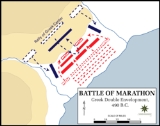
Battle of Marathon Greek Double Envelopment
In 490 BC, the Persians under Darius I
Darius I of Persia

Darius I or Darius the Great was the son of Hystaspes and Persian Empire from 522 BC to 486 BC. Darius is the dominant Latin language spelling used by the Roman historians....
 attempted to invade Attica. Aristides was named strategos
Strategos

The term strategos is used in Greek language to mean "general". In the Hellenistic and Byzantine Empires the term was also used to describe a military governor....
 for his own Antiochis tribe. Miltiades
Miltiades the Younger

Miltiades the Younger was the step-nephew of Miltiades the Elder. He made himself the tyrant of the Greek colonies on the Thracian Chersonese around 516 BC, forcibly seizing it from his rivals and imprisoning them....
 was selected ahead of Aristides to lead the Athenians. Aristides supported Miltiades' plans in the Athenian Assembly and gained the Athenians' support for attacking the Persians at Marathon.

At the battle camp, Aristides relinquished his command to Miltiades, an example followed by all the other Athenian strategoi. This action united the leadership of the Athenian army.

During the Battle of Marathon
Battle of Marathon

The Battle of Marathon, Greece during the Greco-Persian Wars took place in 490 BC and was the culmination of the first attempt by the Achaemenid Empire of Persia, under King Darius I, to subjugate Ancient Greece....
, Aristides fought bravely alongside Themistocles, who, like Aristides, was strategos of his tribe. Their tribes were placed in the middle of the battle front where the Persians were tightly concentrated and where the fiercest fighting took place.

After the Athenian victory, Aristides was left to protect the treasures captured in the battle as he was regarded as incorruptible. Additionally, he also looked after the prisoners of war.

As a consequence of the distinction with which he served in the battle, he was elected Chief Archon for the ensuing year (489–488 BC).

Defending Athens in the Battle of Salamis


Early in 480 BC, Aristides took advantage of the Athenian decree recalling exiles. It is thought that Themistocles agreed to allow Aristides' return in order to prevent the latter joining the Persian forces. His recall is also believed to have been supported by the Athenian people.

After returning from exile in Aegina
Aegina

Aegina is one of the Greek islands of Greece in the Saronic Gulf, 17 miles from Athens. Tradition derives the name from Aegina, the mother of Aeacus, who was born in and ruled the island....
, Aristides was appointed strategos and immediately joined Themistocles in preparing the defence of Athens.

At the Battle of Salamis
Battle of Salamis

The Battle of Salamis , was a naval battle fought between an Alliance of Greece city-states and the Achaemenid Empire of Persia in September 480 BC in the straits between the mainland and Salamis Island, an island in the Saronic Gulf near Athens....
 the Persians advanced into the narrow strait due to Themistocles' strategem; Aristides was amongst the first to perceive the Persian manoeuvre. The night of the Persian attack, Aristides rushed from Aegina
Aegina

Aegina is one of the Greek islands of Greece in the Saronic Gulf, 17 miles from Athens. Tradition derives the name from Aegina, the mother of Aeacus, who was born in and ruled the island....
 sailing dangerously through the enemy's blockade towards Salamis. There he met Themistocles in his tent. Themistocles thought that, with his reputation, Aristides could convince the Greek navy, particularly the difficult Spartan Admiral Eurybiades
Eurybiades

Eurybiades was the Spartan commander in charge of the Greece navy during the Persian Wars.He was the son of Eurycleides, and was chosen as commander in 480 BC because the other Greek city-states did not want to serve under an Athens, despite the Athenians' superior naval skill....
, that the Persians had indeed blocked the Greeks inside the bay. Themistocles told Aristides that he had, indeed, provoked the enemy in order to force the Greeks to fight rather than retreat to a different position. Aristides supported this decision and defended him.

Immediately after meeting Themistocles, Aristides commanded the toughest Athenian infantry at Psyttaleia
Psyttaleia

Psyttaleia is an uninhabited island in the Saronic Gulf a few miles off the coast of Piraeus, Greece. It covers an area of 0.375 square kilometers....
 destroying the Persian garrison. He captured several notable Persians, among them three of Xerxes I
Xerxes I of Persia

Xerxes the Great, also known as Xerxes I of Persia, was a Persian Empire of the Achaemenid Empire. X?rxes is the Greek language form of the Old Persian throne name X?ayar?a, meaning "Ruler of heroes"....
's nephews. Before the main battle, it was rumoured that these children were sacrificed to Bacchus
Dionysus

In classical mythology, Dionysus or Dionysos , is the God of wine, the inspirer of ritual madness and ecstasy, and a major figure of Greek mythology, and one of the twelve Olympians, among whom Greek mythology treated Dionysus as a late arrival....
.

Salamis was an historically decisive Greek victory. The battle left the Persian naval expedition unable to support its land troops. Aristides was questioned by Themistocles because, initially, the popular Athenian leader wanted to tear down the Persian bridges that spanned the Hellespont. Immediately Aristides opposed this, convincing Themistocles that it would be better to allow Xerxes to withdraw his 300,000 man army from Greece. Consequently, Themistocles dispatched a letter to Xerxes threatening to destroy the bridges immediately. The Persians believed the lie and withdrew most of their troops.

The battle at Plataea

With prestige thus increased, Aristides was re-elected as strategos for another year. Thus, in 479 BC, he commanded the Athenian army in the Battle of Plataea
Battle of Plataea

The Battle of Plataea was the final land battle during the second Persian invasion of Greece. It took place in 479 BC near the city of Plataea in Boeotia, and was fought between an alliance of the Ancient Greece city-states, including Sparta, History of Athens, Corinth, Megara and others, and the Achaemenid Empire of Xerxes I....
, along the Asopus
Asopus

Asopus or As?pos is the name of five different rivers in Greece and Turkey and also in Greek mythology the name of the God of those rivers....
 river. There, the whole Greek army was led by the Spartan Pausanias
Pausanias

Pausanias *Pausanias , lover of the poet Agathon and a character in Plato's Symposium*Pausanias , Spartan general and regent of the 5th century BC...
 while the Persians were led by Mardonius
Mardonius

Mardonius was a leading Persian Empire military commander during the Persian Wars with Greece in the early 5th century BC....
.

Advised by reports of a series of oracles, dreams, and prophecies, Aristides was instrumental in evoking a voluntary gift of territory by the Plataeans to Attica. As a result, part of one of the oracles was fulfilled, namely that the Athenians would win victory if they fought within their own territory.

Later, Aristides was particularly upset when many Athenian soldiers who were former aristocrats whose land had been damaged by the Persian occupation began conspiring on the Persians' behalf.

Just before the battle, the Macedonian King Alexander sneaked out of the Persian camp and told Aristides that Mardonius - whose troops were starving - was about to attack.

After the Greek victory, Aristides made proposals to the general council of Greeks concerning the division of Persian booty, commemorative religious celebrations, and about a levy which would finance new Greek forces to combat Persia.

Aristides' respect for the common body of Athenians that had fought so well against Persia, combined with his recognition that the forces for democracy were strong, led him to propose that the archons henceforth be chosen out of the whole body of the citizens and not just the higher census of property holders.

At the Aegean Sea

In 478, Aristides was sent to Ionia
Ionia

Ionia is an ancient region of central coastal Anatolia in present-day Turkey, the region nearest Izmir, which was historically Smyrna. It consisted of the northernmost territories of the Ionian League of Hellenes settlements....
, and, there, he won the local Greek cities' trust because he opposed the tyrannical policies implemented by the Spartan Pausanias. These complaints led Sparta from here on out to look to the corruption of its captains. The Greek colonies gave absolute discretion to Aristides in the fixing of the contributions of the newly formed confederacy, the Delian League
Delian League

The Delian League was an association of approximately 150 5th-century BC Ancient Greece city-states under the leadership of Classical Athens, whose purpose was to continue fighting the Persian Empire after the Greek victory in the Battle of Plataea at the end of the Greco?Persian Wars....
. Aristides' annual 460 talent
Talent (weight)

The talent is an ancient unit of mass. It corresponded generally to the mass of water in the volume of an Amphora , i.e. one foot cubed. Depending on the length of the respective legal foot, this corresponds roughly to the mass of 27 kg or about 60 English pound s....
 assessment was universally accepted as equitable, but was later raised by Pericles and the demagogues who followed. Aristides also performed a ceremony that celebrated Athens' devotion to the league. He ordered that all local Greeks pledge enmity against Persia. Then he threw burning iron wedges into the sea so the gods "might treat any traitor similarly."

However, as Athens' power in the League increased and events seemed to demand it, Aristides took a nationalist position. He defended the proposal to move to the League's treasury to Athens from Delos, betraying the earlier spirit of the League, and is reported to have said "this isn't a just action, but it's expedient."

Political career

Though comrades in arms at Marathon, Aristides and Themistocles were constant opponents in the Athenian assembly. Pursuing the aristocratic party policy, which focused on maintaining Athens as a land power, Aristides was among the chief opponents of the pro-naval policies of Themistocles.

Aristides was very critical of Themistocles, noting that Themistocles was "a clever man, however with an itching palm".

Indeed, this struggle forced Aristides to oppose any political initiative that could benefit Themistocles, even if it would have been of benefit to the people of Athens. In the Athenian assembly, Aristides is said to have stated that unless they sent both Themistocles and himself to the barathrum
Barathrum

Barathrum is a Finland black metal#black doom band. They originate from Kuopio but have since re-located to Helsinki. The first letters of their full-length albums spell "HEIL SOVA" , which completes their original eight-album plan....
 (a deep pit into which criminals were thrown), there could be no safety for Athens.

By 484 BC, Themistocles was left face-to-face with Aristides, the last hope of the conservative aristocratic party. Both sought popularity by offering to resolve disputes amongst their fellow citizens. Therefore, they criticised each other for setting themselves up as judges and bypassing the courts of law. Themistocles favoured developing an Athenian navy, a policy more popular with the poor, for whom it provided work, than with the rich, who would have had to pay for it. Themistocles had no doubt that the Persians would attempt another invasion, this time by sea. Aristides argued in favour of retaining land forces, as the troops were provided by the richer citizens of Athens and were unpaid (therefore costing the government treasury little).

The conflict between the two leaders ended in the ostracism
Ostracism

Ostracism was a procedure under the Athenian democracy in which a prominent citizen could be exile from the city-state of Athens for ten years....
 of Aristides around 483 BC. Themistocles argued that Aristides had weakened the Athenian courts by requiring all Athenians to seek arbitration through Aristides' office. Thus, Themistocles argued that Aristides would effectively become "king of Athens" although "he didn't have any bodyguard, yet." .

It is said that on this occasion, an illiterate voter who did not know Aristides came up to him and, giving him his voting shard, desired him to write upon it the name of Aristides. The latter asked if Aristides had wronged him. "No," was the reply, "and I do not even know him, but I am tired of hearing him everywhere called, 'The Just'." After hearing this Aristides wrote his own name on the shard. He was then exiled for a period of five years.

Leaving Athens, Aristides raised his hands and he prayed that "no crisis may force that Athens may have to remember me."

His Later Years

Afterwards, he continued to hold a predominant position in Athens. At first he seems to have remained on good terms with Themistocles, whom he is said to have helped in outwitting the Spartans in the rebuilding of the walls of Athens. Indeed, Aristides witnessed his ostracism although he abstained from declaring against Themistocles and didn't celebrate his condemnation.

Later, some sources report that Aristides was banished, others that he was condemned on false charges. His name was sometimes included with those of other Athenian generals who suffered similar ill treatment.

Some said that Aristides died at Athens, cherished and honored by the people, whereas other sources said he died on an official journey to the Black Sea
Black Sea

The Black Sea is an inland sea sea bounded by southeastern Europe, the Caucasus and the Anatolia and is ultimately connected to the Atlantic Ocean via the Mediterranean Sea and Aegean Seas and various straits....
, at Pontus
Pontus

Pontus or Pontos is a region on the southern coast of the Black Sea, located in modern-day northeastern Turkey. The name was applied to the coastal region in Antiquity by the Greeks who colonized the area, and derived from the Greek name of the Black Sea: Pontos Euxeinos , or simply Pontos....
. The date of his death is given by Nepos as 468 BC, before Pericles
Pericles

Pericles was a prominent and influential statesman, orator, and general of History of Athens during the city's Age of Pericles?specifically, the time between the Greco-Persian Wars and Peloponnesian War wars....
' ascendancy. In any case, Aristides' tomb was located at Phalerum, where they say it was built at public expense because he could not afford his own funeral expenses.

His estate thus seems to have suffered severely from the Persian invasions and from his own scrupulous honesty in public affairs. Plutarch cites evidence that his descendants even in the 4th century received state pensions.

His Humble Traits

Plutarch states at the beginning of the Life that reports of Aristides' wealth varied and cites evidence that he was of the upper economic class throughout his lifetime. Later in the Life, however, Plutarch often suggests the contrary, for example citing stories that illustrate Aristides' poverty and his lack of shame at being poor. For instance, in a trial at which Aristides' cousin Callias
Callias

Callias was the head of a wealthy Athens family, and fought at the Battle of Marathon in priestly attire. His son, Hipponicus, was also a military commander....
, the richest man in Athens, faced capital charges, the officials compared him unfavorably with Aristides, whom they said had helped Callias in his affairs but had received no material help in return: "How do you think his family lives at home, when he appears publicly wearing such a worn-out cloak? Is it not probably that someone who goes out so exposed to the cold must lack food and other necessities at home?"

Quotes


  • "As long as that [the sun] retains the same course, so long shall the citizens of Athens wage war with the Persians for the country which has been wasted and the temples that have been profaned and burnt by them."


Sources

  • Wikisource Logo
    Cornelius Nepos, Aristides