
Home      Discussion      Topics      Dictionary      Almanac
Signup       Login
Foot binding

Foot binding

Overview

Discussion
Ask a question about 'Foot binding'
Start a new discussion about 'Foot binding'
Answer questions from other users
Full Discussion Forum
 
Unanswered Questions
Encyclopedia


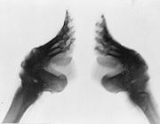
Foot binding ( or ) was the custom of binding the feet of young girls painfully tight to prevent further growth. The practice probably originated among court dancers in the early Song dynasty
Song Dynasty
The Song Dynasty was a ruling dynasty in China between 960 and 1279; it succeeded the Five Dynasties and Ten Kingdoms Period, and was followed by the Yuan Dynasty. It was the first government in world history to issue banknotes or paper money, and the first Chinese government to establish a...

, but spread to upper class families and eventually became common among all classes. The tiny narrow feet were considered beautiful and to make a woman's movements more feminine and dainty. Although reformers challenged the practice, it was not until the early twentieth century that footbinding generally died out, partly from changing social conditions and partly as a result of anti-footbinding campaigns. Foot-binding resulted in lifelong disabilities for most of its subjects. In the 1990s and early 2000s, some elderly (born until the mid-1940s) Chinese women still suffered from disabilities related to bound feet.

History


Multiple theories attempt to explain the origin of foot binding, from the desire to emulate the naturally tiny feet of a favored concubine of a prince, to a story of an empress who had club-like feet, which became viewed as a desirable fashion. However, there is little strong textual evidence for the custom prior to the court of the Southern Tang
Southern Tang
Southern Tang was one of the Ten Kingdoms in south-central China created following the Tang Dynasty from 937-975. Southern Tang replaced the Wu Kingdom when Li Bian deposed the emperor Yang Pu....

 kingdom in Nanjing
Nanjing
' is the capital of Jiangsu province in China and has a prominent place in Chinese history and culture, having been the capital of China on several occasions...

 (937–975), which celebrated the fame of its dancing girls, renowned for their tiny feet and beautiful bow shoes. What is clear is that foot binding was first practiced among the elite and only in the wealthiest parts of China, which suggests that binding the feet of well-born girls represented their freedom from manual labor and, at the same time, the ability of their husbands to afford wives who did not need to work, who existed solely to serve their men and direct household servants while performing no labor themselves.

In contrast to the majority of other Han Chinese, the Hakka
Hakka people
The Hakka , sometimes Hakka Han, are Han Chinese who speak the Hakka language and have links to the provincial areas of Guangdong, Jiangxi, Guangxi, Sichuan, Hunan and Fujian in China....

 did not practice foot binding.Lawrence Davis, Edward (2005). Encyclopedia of Contemporary Chinese Culture, Routledge
Routledge
Routledge is a British publishing house which has operated under a succession of company names and latterly as an academic imprint. Its origins may be traced back to the 19th-century London bookseller George Routledge...

, p. 333.
Manchu women were forbidden to bind their feet by an edict from the Emperor after the Manchu started their rule of China in 1644. Many other non-Han ethnic groups continued to observe the custom, some of them practiced loose binding which did not break the bones of the arch and toes but simply narrowed the foot. However, by the 17th century, Chinese girls, from the wealthiest to the poorest people, had their feet bound. It was less prevalent among poorer women or those that had to work for a living, especially in the fields. Some estimate that as many as 2 billion Chinese women had their feet bound from the late 10th century until 1949, when foot binding was outlawed by the Communists
Communist Party of China
The Communist Party of China , also known as the Chinese Communist Party , is the founding and ruling political party of the People's Republic of China...

 (foot binding had also been banned by the Nationalists, but the Nationalists never had thorough political control over the entire country, and were unable to enforce this prohibition universally). According to the author of The Sex Life of the Foot and Shoe, 40–50% of Chinese women had bound feet in the 19th century. For the upper classes, the figure was almost 100%.

Binding the feet involved breaking the arch of the foot, which ultimately left a crevice approximately 5 cm (2 in) deep, which was considered most desirable. It took approximately two years for this process to achieve the desired effect; preferably a foot that measured 7–9 cm (3– in) from toe to heel.While foot binding could lead to serious infections, possibly gangrene
Gangrene
Gangrene is a serious and potentially life-threatening condition that arises when a considerable mass of body tissue dies . This may occur after an injury or infection, or in people suffering from any chronic health problem affecting blood circulation. The primary cause of gangrene is reduced blood...

, and was generally painful for life, contrary to popular belief, many women with bound feet were able to walk, work in the fields, and climb to mountain homes from valleys below. As late as 2005, women with bound feet in one village in Yunnan
Yunnan
Yunnan is a province of the People's Republic of China, located in the far southwest of the country spanning approximately and with a population of 45.7 million . The capital of the province is Kunming. The province borders Burma, Laos, and Vietnam.Yunnan is situated in a mountainous area, with...

 Province formed an internationally known dancing troupe to perform for foreign tourists but they are now too old. In other areas, women in their 70s and 80s could be found working in the rice fields well into the 21st century. In the 19th and early 20th century, dancers with bound feet were very popular, as were circus performers who stood on prancing or running horses.

When foot-binding was popular and customary, women and their families and husbands took great pride in tiny feet that had achieved the desired lotus shape. This pride was reflected in the elegantly embroidered silk slippers and wrappings girls and women wore to cover their feet. Walking on bound feet necessitated bending the knees slightly and swaying to maintain the proper movement. This swaying walk became known as the Lotus Gait and was considered sexually exciting by men. Later, the Manchu women who were forbidden to bind their feet, and who were supposedly envious of the Lotus Gait, invented their own type of shoe that caused them to walk in a swaying manner. They wore 'flower bowl' shoes, on a high platform generally made of wood or with a small central pedestal. In fact, bound feet became an important differentiating marker between Manchu and Han women.

The practice of foot-binding continued into the 20th century, when both Chinese and Western missionaries
Mission (Christian)
Christian missionary activities often involve sending individuals and groups , to foreign countries and to places in their own homeland. This has frequently involved not only evangelization , but also humanitarian work, especially among the poor and disadvantaged...

 called for reform; at this point, a true anti-foot-binding movement emerged. Educated Chinese began to realise that this aspect of their culture did not reflect well upon them in the eyes of foreigners; social Darwinists
Social Darwinism
Social Darwinism is a term commonly used for theories of society that emerged in England and the United States in the 1870s, seeking to apply the principles of Darwinian evolution to sociology and politics...

 argued that it weakened the nation, since enfeebled women supposedly produced weak sons; and feminists attacked the practice because it caused women to suffer. At the turn of the 20th century, well-born women such as Kwan Siew-Wah (known in the West as Brigitte Kwan
Brigitte Kwan
"Brigitte" Kwan .Born in Canton, China, Kwan was one of the pioneer Chinese feminists who advocated against the practice of foot binding and feudal misogyny in Imperial China...

), a pioneering feminist, advocated for the end of foot-binding. Kwan herself refused the foot-binding imposed on her in childhood, so that she could grow normal feet.

There had been earlier but unsuccessful attempts to stop the practice of foot-binding with various emperors issuing unsuccessful edicts against it. The Empress Dowager Cixi
Empress Dowager Cixi
Empress Dowager Cixi1 , of the Manchu Yehenara clan, was a powerful and charismatic figure who became the de facto ruler of the Manchu Qing Dynasty in China for 47 years from 1861 to her death in 1908....

 (a Manchu) issued such an edict following the Boxer Rebellion
Boxer Rebellion
The Boxer Rebellion, also called the Boxer Uprising by some historians or the Righteous Harmony Society Movement in northern China, was a proto-nationalist movement by the "Righteous Harmony Society" , or "Righteous Fists of Harmony" or "Society of Righteous and Harmonious Fists" , in China between...

 in order to appease foreigners, but it was rescinded a short time later. In 1912, after the fall of the Qing Dynasty, the new Republic of China
Republic of China
The Republic of China , commonly known as Taiwan , is a unitary sovereign state located in East Asia. Originally based in mainland China, the Republic of China currently governs the island of Taiwan , which forms over 99% of its current territory, as well as Penghu, Kinmen, Matsu and other minor...

 government banned foot binding. Women were told to unwrap their feet lest they be killed. Some women's feet grew 1–3 cm (–1 in) after the unwrapping, though some found the new growth process extremely painful as well as emotionally and culturally devastating. Still, societies were founded to support the abolition of foot-binding, with contractual agreements made between families who would promise an infant son in marriage to an infant daughter who did not have bound feet. When the Communists took power in 1949, they were able to enforce a strict prohibition on foot-binding, including in isolated areas deep in the countryside where the Nationalist prohibition had been ignored. The prohibition on foot-binding remains in effect today.

Chinese Muslim Hui
Hui people
The Hui people are an ethnic group in China, defined as Chinese speaking people descended from foreign Muslims. They are typically distinguished by their practice of Islam, however some also practice other religions, and many are direct descendants of Silk Road travelers.In modern People's...

 women bound their feet just like Han women. It was noticed that it was extremely prevalent among Hui in Gansu
Gansu
' is a province located in the northwest of the People's Republic of China.It lies between the Tibetan and Huangtu plateaus, and borders Mongolia, Inner Mongolia, and Ningxia to the north, Xinjiang and Qinghai to the west, Sichuan to the south, and Shaanxi to the east...

, a northwestern province. The Dungan people, descendants of Hui from northwestern China who fled to central Asia, also practiced foot binding up to 1948.

However, in southern China, in Canton the westerner James Legge
James Legge
James Legge was a noted Scottish sinologist, a Scottish Congregationalist, representative of the London Missionary Society in Malacca and Hong Kong , and first professor of Chinese at Oxford University...

 encountered a mosque which had a placard denouncing footbinding, saying Islam did not allow it since it constituted violating the creation of God.

In Taiwan
Taiwan
Taiwan , also known, especially in the past, as Formosa , is the largest island of the same-named island group of East Asia in the western Pacific Ocean and located off the southeastern coast of mainland China. The island forms over 99% of the current territory of the Republic of China following...

, foot-binding was banned by the Japanese administration
Taiwan under Japanese rule
Between 1895 and 1945, Taiwan was a dependency of the Empire of Japan. The expansion into Taiwan was a part of Imperial Japan's general policy of southward expansion during the late 19th century....

 in 1915.

Process


The process was started before the arch of the foot had a chance to develop fully, usually between the ages of two and five.
Binding usually started during the winter months so that the feet were numb, and therefore the pain would not be as extreme.

First, each foot would be soaked in a warm mixture of herbs and animal blood; this was intended to soften the foot and aid the binding. Then, the toenails were cut back as far as possible to prevent in-growth and subsequent infections, since the toes were to be pressed tightly into the sole of the foot. To prepare her for what was to come next, the girl's feet were delicately massaged. Cotton bandages, 3 m long and 5 cm wide (10 ft×2 in), were prepared by soaking them in the blood and herb mixture. To enable the size of the feet to be reduced, the toes on each foot were curled under, then pressed with great force downwards and squeezed into the sole of the foot until the toes broke. This was all carried out without the use of pain relief, and was excruciatingly painful for the girl being bound. The broken toes were held tightly against the sole of the foot while the foot was then drawn down straight with the leg and the arch forcibly broken. The actual binding of the feet was then begun. The bandages were repeatedly wound in a figure-eight movement, starting at the inside of the foot at the instep, then carried over the toes, under the foot, and round the heel, the freshly broken toes being pressed tightly into the sole of the foot. At each pass around the foot, the binding cloth was tightened, pulling the ball of the foot and the heel ever close together, causing the broken foot to fold at the arch, and pressing the toes underneath, this would cause the young girl extreme pain. When the binding was completed, the end of the binding cloth was sewn tightly to prevent the girl from loosening it, and the girl was required to stand on her freshly broken and bound feet to further crush them into shape. As the wet bandages dried, they constricted, making the binding even tighter.

The girl's broken feet required a great deal of care and attention, and they would be unbound regularly. Each time the feet were unbound, they were washed, the toes carefully checked for injury, and the nails carefully and meticulously trimmed. When unbound, the broken feet were also kneaded to soften them and make the joints and broken bones more flexible, and were soaked in a concoction that caused any necrotic flesh to fall off. Immediately after this pedicure, the girl's broken toes were folded back under and the feet were rebound. The bindings were pulled ever tighter each time, so that the process became more and more painful. Whilst unbound, the girl's feet were often beaten, especially on the soles, to ensure that her feet remained broken and flexible. This unbinding and rebinding ritual was repeated as often as possible (for the rich at least once daily, for poor peasants two or three times a week), with fresh bindings. It was generally an elder female member of the girl's family or a professional foot binder who carried out the initial breaking and ongoing binding of the feet. This was considered preferable to having the mother do it, as she might have been sympathetic to her daughter's pain and less willing to keep the bindings tight. A professional foot binder would ignore the girl's cries and would continue to bind her feet as tightly as possible. Professional foot binders would also tend to be more extreme in the initial breaking of the feet, sometimes breaking each of the toes in two or three separate places, and even completely dislocating the toes to allow them to be pressed under and bound more tightly. This would cause the girl to suffer from devastating foot pain, but her feet were more likely to achieve the 7 cm (3 in) ideal. The girl was not allowed to rest after her feet had been bound; however much pain she was suffering, she was required to walk on her broken and bound feet, so that her own body weight would help press and crush her feet into the desired shape.

The most common problem with bound feet was infection. Despite the amount of care taken in regularly trimming the toenails, they would often in-grow, becoming infected and causing injuries to the toes. Sometimes for this reason the girl's toenails would be peeled back and removed altogether. The tightness of the binding meant that the circulation in the feet was faulty, and the circulation to the toes was almost cut off, so any injuries to the toes were unlikely to heal and were likely to gradually worsen and lead to infected toes and rotting flesh. If the infection in the feet and toes entered the bones, it could cause them to soften, which could result in toes dropping off—though this was seen as a positive, as the feet could then be bound even more tightly. Girls whose toes were more fleshy would sometimes have shards of glass or pieces of broken tiles inserted within the binding next to her feet and between her toes to cause injury and introduce infection deliberately. Disease inevitably followed infection, meaning that death from septic shock could result from foot-binding, but a surviving girl was more at risk for medical problems as she grew older. In the early part of the binding, many of the foot bones would remain broken, often for years. However, as the girl grew older, the bones would begin to heal, although even after the foot bones had healed they were prone to re-breaking repeatedly, especially when the girl was in her teens and her feet were still soft. Older women were more likely to break hips and other bones in falls, since they could not balance securely on their feet, and were less able to rise to their feet from a sitting position.

Reception and appeal


Bound feet were once considered intensely erotic in Chinese culture, and a woman with perfect lotus feet was likely to make a more prestigious marriage. Qing Dynasty sex manuals listed 48 different ways of playing with women's bound feet. Some men preferred never to see a woman's bound feet, so they were always concealed within tiny "lotus shoes" and wrappings. Feng Xun is recorded as stating, "If you remove the shoes and bindings, the aesthetic feeling will be destroyed forever"—an indication that men understood that the symbolic erotic fantasy of bound feet did not correspond to its unpleasant physical reality, which was therefore to be kept hidden.

For men, the primary erotic effect was a function of the lotus gait, the tiny steps and swaying walk of a woman whose feet had been bound. Women with such deformed feet avoided placing weight on the front of the foot and tended to walk predominantly on their heels. As a result, women who underwent foot-binding walked in a careful, cautious, and unsteady manner. The very fact that the bound foot was concealed from men's eyes was, in and of itself, sexually appealing. On the other hand, an uncovered foot would also give off a foul odor, as various saprobic
Chytridiomycota
Chytridiomycota is a division of the Fungi kingdom. The name is derived from the Greek chytridion, meaning "little pot", describing the structure containing unreleased spores. In older classifications, chytrids were placed in the Class Phycomycetes under the subdivision Myxomycophyta of the...

 microorganisms would colonize the unwashable folds.

Another attribute of a woman with bound feet was the limitations of her mobility and, therefore, her inability to take part in politics, social life, and the world at large. Bound feet rendered women dependent on their families, particularly their men, and, therefore, became an alluring symbol of chastity and male ownership, since a woman was largely restricted to her home and could not venture far without an escort or the help of watchful servants.

In literature and film


The bound foot has played a prominent part in many works of literature, both Chinese and non-Chinese, modern and traditional. These depictions are sometimes based on observation or research and sometimes on rumors or supposition. This is only to be expected when a practice is so emotionally charged. Sometimes, as in the case of Pearl Buck's The Good Earth
The Good Earth
The Good Earth is a novel by Pearl S. Buck published in 1931 and awarded the Pulitzer Prize for the Novel in 1932. The best selling novel in the United States in both 1931 and 1932, it was an influential factor in Buck winning the Nobel Prize for Literature in 1938...

, the accounts are relatively neutral, implying a respect for Chinese culture and assuming that it is not the role of outsiders to promote reform. Sometimes the accounts seem intended to rouse like minded Chinese and foreign opinion to abolish the custom, and sometimes the accounts imply condescension or contempt for China.
  • Ju-Chen Li, Flowers in the Mirror
    Flowers in the Mirror
    Flowers in the Mirror , also translated as The Marriage of Flowers in the Mirror, or Romance of the Flowers in the Mirror, is a fantasy novel written by Li Ruzhen, completed in the year of 1827 during the Qing dynasty...

     http://books.google.com/books?id=XHhR-6OGubIC&source=gbs_navlinks_s Lin Tai-yi tr. (University of California Press, 1965 ISBN 978-0-520-00747-5) Includes chapters set in the "Country of Women," where men bear children and have bound feet.
  • Feng Jicai
    Feng Jicai
    Feng Jicai is an author who focuses most of his works on writing stories which explain historical events that have occurred in his hometown of Tianjin, China. He also writes stories about the lives of several intelligent men. Feng Jicai is also an artist who specializes in calligraphy and...

     (b. 1942) (translated from the Chinese by David Wakefield), The Three-Inch Golden Lotus (Honolulu: University of Hawaii Press, 1994) presents a satirical picture of the movement to abolish the practice, which is seen as part of Chinese culture.
  • In the 1958 film The Inn of the Sixth Happiness
    The Inn of the Sixth Happiness
    The Inn of the Sixth Happiness is a 1958 American 20th Century Fox film based on the true story of Gladys Aylward, a tenacious British maid, who became a missionary in China during the tumultuous years leading up to World War II...

     Ingrid Bergman portrays British missionary to China Gladys Aylward, who is assigned as a foreigner the task by a local Mandarin to unbind the feet of young women, an unpopular order that the civil government had failed to fulfill.
  • Ruthanne Lum McCunn wrote a biographical novel A Thousand Pieces of Gold
    A Thousand Pieces of Gold
    Thousand Pieces of Gold is an English-language book written by Ruthanne Lum McCunn and based on the life of Polly Bemis, a 19th century Chinese immigrant woman in the American Old West...

     (later adapted to a film), about Polly Bemis
    Polly Bemis
    Polly Bemis was a famous Chinese American pioneer woman who lived in Idaho in the Pacific Northwest in the late 19th and early 20th century. Her story became a biographical novel, and was fictionalized in the 1991 film A Thousand Pieces of Gold.-Life:Polly Bemis was born in China...

    , a Chinese American pioneer woman. It describes her feet being bound, and later unbound when she needed to help her family with farm labour.
  • Emily Prager
    Emily Prager
    - Life and work :Prager grew up in Texas, Taiwan, and Greenwich Village, NY. She is a graduate of The Brearley School, Barnard College and has a Masters Degree in Education...

    's short story A Visit from the Footbinder, from her collection of short stories of the same name (1982) describes the last few hours of a young Chinese girl's childhood before the professional footbinder arrives to initiate her into the adult woman's life of beauty and pain.
  • Lisa Loomer
    Lisa Loomer
    Lisa Loomer is a playwright and screenwriter of Spanish and Romanian ancestry who has also worked as an actress and stand-up comic...

    's play The Waiting Room deals with themes of body modification. One of the three main characters is an 18th-century Chinese woman who arrives in a modern hospital waiting room seeking medical help for complications resulting from her bound feet.
  • Lensey Namioka, Ties that Bind, Ties that Break. 2000
  • Donna Jo Napoli
    Donna Jo Napoli
    Donna Jo Napoli is an author of children's and young adult books, as well as a prominent linguist who has worked in syntax, phonetics, phonology, morphology, historical and comparative linguistics, Romance studies, structure of Japanese, structure of American Sign Language, poetics, writing for...

    , Bound. (Atheneum Books
    Atheneum Books
    Atheneum Books was a publishing house and adult publisher created by Alfred A. Knopf, Jr. in 1959. He recruited editor Jean E. Karl personally, to come and establish a Children's Book Department in 1961....

    , 2004) (young adult novel
    Young adult literature
    Young-adult fiction or young adult literature , also juvenile fiction, is fiction written for, published for, or marketed to adolescents and young adults, roughly ages 14 to 21. The Young Adult Library Services of the American Library Association defines a young adult as "someone between the...

    )
  • Adeline Yen Mah
    Adeline Yen Mah
    Adeline Yen Mah is a Chinese American author and physician. She grew up in Tianjin, Shanghai and Hong Kong with an older sister, Lydia ; three older brothers, Gregory , Edgar and James ; and a younger half brother, Franklin and half sister, Susan...

     writes in her memoir Falling Leaves that her grand-aunt Chang Yu-Yi as an infant had refused foot binding, tearing off the wrappings when they were applied and finally going on a hunger strike until the adults gave in. In 1910 she founded the Shanghai Women's Savings Bank.

See also


  • Attraction to disability
    Attraction to disability
    Attraction to disability is a sexualised interest of people in the appearance, sensation and experience of disability. It may extend from normal human sexuality into a type of sexual fetishism...

  • Artificial cranial deformation
    Artificial cranial deformation
    Artificial cranial deformation, head flattening, or head binding is a form of permanent body alteration in which the skull of a human being is intentionally deformed. It is done by distorting the normal growth of a child's skull by applying force...

  • Body modification
    Body modification
    Body modification is the deliberate altering of the human body for any non-medical reason, such as aesthetics, sexual enhancement, a rite of passage, religious reasons, to display group membership or affiliation, to create body art, shock value, or self expression...

  • Corset
    Corset
    A corset is a garment worn to hold and shape the torso into a desired shape for aesthetic or medical purposes...

  • Sexual fetishism
    Sexual fetishism
    Sexual fetishism, or erotic fetishism, is the sexual arousal a person receives from a physical object, or from a specific situation. The object or situation of interest is called the fetish, the person a fetishist who has a fetish for that object/situation. Sexual fetishism may be regarded, e.g...

  • Female genital cutting
    Female genital cutting
    Female genital mutilation , also known as female genital cutting and female circumcision, is defined by the World Health Organization as "all procedures that involve partial or total removal of the external female genitalia, or other injury to the female genital organs for non-medical reasons."FGM...

  • Cosmetic surgery
  • Foot Emancipation Society
    Foot Emancipation Society
    Foot Emancipation Society , or Anti-footbinding Society , was a civil organization which opposed foot-binding in the late Qing Dynasty...


External links