


Peterborough Chronicle

Encyclopedia
The Peterborough Chronicle (also called the Laud manuscript and the E manuscript), one of the Anglo-Saxon Chronicle
s, contains unique information about the history of England
after the Norman Conquest. According to philologist J.A.W. Bennett, it is the only prose history in English between the Conquest and the later 14th century.
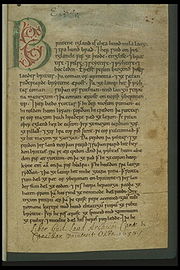 The Anglo-Saxon Chronicles were composed and maintained between the various monasteries
of Anglo-Saxon England and were an attempt to record the history of Britain throughout the years AD. Typically the chronicles began with the birth of Christ, went through Biblical and Roman
history, then continued to the present. Every major religious house in England kept its own, individual chronicle, and the chronicles were not compared with each other or in any way kept uniform. However, whenever a monastery's chronicle was damaged, or when a new monastery began a chronicle, nearby monasteries would lend out their chronicles for copying. Thus, a new chronicle would be identical to the lender's until they reached the date of copying and then would be idiosyncratic. Such was the case with the Peterborough Chronicle: a fire compelled the abbey to copy the chronicles from other churches up to 1120.
When William the Conqueror took England and Anglo-Norman
became the official language, the Anglo-Saxon Chronicles generally ceased. The monks of Peterborough Abbey, however, continued to compile events in theirs. While the Peterborough Chronicle is not professional history, and one still needs Latin
histories (e.g. William of Malmesbury
's Gesta Regum Anglorum), it is one of the few first-hand accounts from the period 1070 to 1154 in England written in English and from a non-courtly point of view.
It is also a valuable source of information about the early Middle English
language itself. The first continuation, for example, is written in late Old English, but the second continuation begins to show mixed forms, until the conclusion of the second continuation, which switches into an early form of distinctly Middle English. The linguistic novelties recorded in the second continuation are plentiful, including at least one true innovation: the feminine pronoun "she
" (as "scæ") is first recorded in the Peterborough Chronicle .
's chronicle . For the 11th century, the chronicle at Peterborough diverges from Parker's, and it has been speculated that a proto-"Kentish Chronicle", full of nationalistic and regionalistic interests, was used for these years; however, such a single source is speculative . The Peterborough copyists probably used multiple sources for their missing years, but the dissolution of the monasteries
makes it impossible to be sure. Regardless, the entries for the 12th century to 1122 are a jumble of other chronicles' accounts, sharing half-entries with one source and half with another, moving from one source to another and then back to a previous one. This shifting back and forth raises, again, the vexatious possibility of a lost chronicle as a single, common source.
It is after 1122 that the Peterborough manuscript becomes unique. Therefore, the document usually called The Peterborough Chronicle is divided into the "first continuation" and the "second continuation" from the time of the fire and the copying. The two continuations are sui generis
both in terms of the information they impart, the style they employ, and their language. The first continuation covers 1122–1131. The second continuation runs from 1132–1154 and includes the reign of King Stephen
.
of Denmark, and rumors of other turbulence about the throne. However, it has no evidence at all for Saxon
opposition and rebellion against William and his sons. An arguably eyewitness account describes the burning of Peterborough Abbey itself, due to the drunkenness of the monks. It also covers ecclesiastical scandals, such as the Abbot of Glastonbury bringing in mercenaries
to control his religious house. Further, there is a significant change in language from the previous late Old English that begins with the entry for the years 1122–1131, with mixtures of Old English and Middle English vocabulary (and increasing Gallic
formations) and syntax (a simplification of the pronouns and strong verbs
, as well as a decrease in the declension
s of the nouns).
Both the first and second continuation authors have sympathy for the common man. As Bennett suggests, Peterborough is the one source for compassion of the laity
found in contemporary accounts. The first continuation expresses as much outrage at the hanging of forty-four thieves in 1122, some of whom were innocent, as at the burning of the monastery at Gloucester
. The monastic author suggests that taxes were too high, putting the impoverished villagers in a dilemma of stealing or starving. Therefore, the nobles were guilty of a double sin. First, they executed the innocent and used excessive cruelty with the guilty. Second, it was at least as sinful for the nobles to compel theft with their avarice as for the poor to steal for bread. When the Norman
king, Henry I of England
foisted his kinsman upon Peterborough as abbot (he was already abbot of Saint-Jean d'Angély), the chronicler protests at some length at the illegality and impiety of the appointment. He also mentions that the Wild Hunt
was seen at the same time as the appointment, as an ill omen. When Henry was eventually removed by death, the monk again takes the position that this was divine remedy, for Henry had tried to make Peterborough part of the Cluniac Order and had attempted to have his own nephew be the next abbot, "oc Crist it ne uuolde" ("but Christ did not will it").
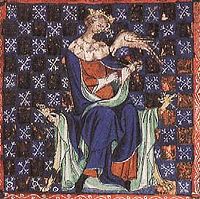 The second, or final, continuation is remarkable for being in one authorial voice, and it relates the events of The Anarchy
in England. Scholars speculate that the second continuation is dictated (because the language may reflect a version of early Middle English that scholars place later than Stephen and Matilda
) or written as the recollections of a single elderly monk. It is a highly moving account of torture, fear, confusion, and starvation.
Henry I
died in 1135, and Stephen and Matilda both had a claim to the throne. The monastic author describes the rebellion of the baron
s against Stephen, the escape of Matilda, and the tortures that the soldiers of the baronial powers inflicted upon the people. The author blames Stephen for the Anarchy for being "soft and good" when firmness and harshness were needed. When Stephen captured the rebelling barons, he let them go if they swore allegiance. According to the author,
The barons then attempted to raise money as quickly as they could. They needed money and manpower to build castle
s (which the author regards as novel and rare), and so they robbed everyone they met:
The monastic author sympathises with the average farmer and artisan and talks about the devastation suffered by the countryside. He is outraged by the accounts of torture he relates and laments,
Death and famine followed, as the farms were depleted and farmers murdered. If two or three riders came to a village, the monk said, everyone fled, for fear that they were robbers. Trade therefore came to a standstill, and those in want had no way to get supplies. Those travelling with money to purchase food would be robbed or killed along the way. The barons said that there was no God. The chronicler records that people said openly that Christ slept, along with His saints; he states that "this — and more than we can say — we suffered 19 winters for our sins."
After the account of The Anarchy, the chronicler goes on to church matters. He speaks of the abbot Martin, who replaced the illegitimate Henry, as a good abbot. Martin had a new roof put on the monastery and moved the monks into a new building. He also, according to the author, recovered certain monastic lands that had been previously held "by force" by noblemen. Which lands these are is unclear, but they had probably been claimed by the nobles through the practice of placing younger sons in monasteries, making and revoking gifts of land, and by some early form of chantry
. The Chronicle ends with a new abbot entering upon the death of Martin, an abbot named William. This abbot presumably halted the writing of the Chronicle.
 The two Peterborough continuations sympathize with the poor
, and this makes them almost unique in Latin or English history. They also focus more on life outside of the abbey than other Chronicles. The general Chronicle is somewhat insular. While most versions note the national events, such as a progress of the king or a change in sovereign, discussion of the countryside around the monastery is limited. Portents and omens receive coverage, but rarely do the chroniclers discuss political alliances (as the author of the second continuation does with his denunciation of the bishop
s who were allied with Matilda) or the legalities of monastic rule (as the author of the first continuation does in his lament over Abbot Henry). The monks who compiled the continuation at Peterborough were either consciously striking out in a new direction (perhaps under the direction of Abbot Martin) or continuing a type of chronicle that was confined to their own monastery (that was lost with the fire). It does not seem likely that Peterborough was in any sense a lax or secular monastery, as the description of drunkenness causing the fire would not have made the abbey singular in the age.
The continuations are also unique in their linguistic shifts. When copying from Winchester
, they preserve the orthography
and syntax
of late Old English, and when they get to events for which they have no copy text the language abruptly changes to a newer form. Given that the loan would have taken place just before the continuation, the change in language reflects either a dramatic attempt at greater vernacular
by the continuation authors or a significant and quick change in the language itself as Norman influences spread. Because the chronicle is in prose
, the artificiality of verse form does not entail the preservation of linguistic archaisms, and historians of English can trace the beginnings of Middle English in these pages.
. It was donated to the library by William Laud
, who was then Chancellor
of Oxford University as well as Archbishop of Canterbury
, on 28 June 1639. Laud included the manuscript together with a number of other documents, part of the third of a series of donations he made to the library in the years leading up to the English Civil War
. It is currently identified in the library catalogue as Laud Misc. 636; previously it was designated as O. C. 1003 based on the "Old Catalogue" by Edward Bernard.
Anglo-Saxon Chronicle
The Anglo-Saxon Chronicle is a collection of annals in Old English chronicling the history of the Anglo-Saxons. The original manuscript of the Chronicle was created late in the 9th century, probably in Wessex, during the reign of Alfred the Great...
s, contains unique information about the history of England
History of England
The history of England concerns the study of the human past in one of Europe's oldest and most influential national territories. What is now England, a country within the United Kingdom, was inhabited by Neanderthals 230,000 years ago. Continuous human habitation dates to around 12,000 years ago,...
after the Norman Conquest. According to philologist J.A.W. Bennett, it is the only prose history in English between the Conquest and the later 14th century.
Monastery
Monastery denotes the building, or complex of buildings, that houses a room reserved for prayer as well as the domestic quarters and workplace of monastics, whether monks or nuns, and whether living in community or alone .Monasteries may vary greatly in size – a small dwelling accommodating only...
of Anglo-Saxon England and were an attempt to record the history of Britain throughout the years AD. Typically the chronicles began with the birth of Christ, went through Biblical and Roman
Ancient Rome
Ancient Rome was a thriving civilization that grew on the Italian Peninsula as early as the 8th century BC. Located along the Mediterranean Sea and centered on the city of Rome, it expanded to one of the largest empires in the ancient world....
history, then continued to the present. Every major religious house in England kept its own, individual chronicle, and the chronicles were not compared with each other or in any way kept uniform. However, whenever a monastery's chronicle was damaged, or when a new monastery began a chronicle, nearby monasteries would lend out their chronicles for copying. Thus, a new chronicle would be identical to the lender's until they reached the date of copying and then would be idiosyncratic. Such was the case with the Peterborough Chronicle: a fire compelled the abbey to copy the chronicles from other churches up to 1120.
When William the Conqueror took England and Anglo-Norman
Anglo-Norman language
Anglo-Norman is the name traditionally given to the kind of Old Norman used in England and to some extent elsewhere in the British Isles during the Anglo-Norman period....
became the official language, the Anglo-Saxon Chronicles generally ceased. The monks of Peterborough Abbey, however, continued to compile events in theirs. While the Peterborough Chronicle is not professional history, and one still needs Latin
Latin
Latin is an Italic language originally spoken in Latium and Ancient Rome. It, along with most European languages, is a descendant of the ancient Proto-Indo-European language. Although it is considered a dead language, a number of scholars and members of the Christian clergy speak it fluently, and...
histories (e.g. William of Malmesbury
William of Malmesbury
William of Malmesbury was the foremost English historian of the 12th century. C. Warren Hollister so ranks him among the most talented generation of writers of history since Bede, "a gifted historical scholar and an omnivorous reader, impressively well versed in the literature of classical,...
's Gesta Regum Anglorum), it is one of the few first-hand accounts from the period 1070 to 1154 in England written in English and from a non-courtly point of view.
It is also a valuable source of information about the early Middle English
Middle English
Middle English is the stage in the history of the English language during the High and Late Middle Ages, or roughly during the four centuries between the late 11th and the late 15th century....
language itself. The first continuation, for example, is written in late Old English, but the second continuation begins to show mixed forms, until the conclusion of the second continuation, which switches into an early form of distinctly Middle English. The linguistic novelties recorded in the second continuation are plentiful, including at least one true innovation: the feminine pronoun "she
She
She is the third person singular, feminine, nominative case pronoun in modern English.She can also may refer to:-Literature and film:* She: A History of Adventure, a novel by H...
" (as "scæ") is first recorded in the Peterborough Chronicle .
The fire and the continuations
Today, the Peterborough Chronicle is recognized as one of the four distinct versions of the Anglo-Saxon Chronicle (along with the Winchester Chronicle or Parker Chronicle, the Abingdon Chronicle and the Worcester Chronicle), but it is not wholly distinct . There was a fire at Peterborough (Friday, 4 August 1116) that destroyed the monastery's library, and so the earliest part of the Anglo-Saxon Chronicle at Peterborough is a copy of Winchester CathedralWinchester Cathedral
Winchester Cathedral at Winchester in Hampshire is one of the largest cathedrals in England, with the longest nave and overall length of any Gothic cathedral in Europe...
's chronicle . For the 11th century, the chronicle at Peterborough diverges from Parker's, and it has been speculated that a proto-"Kentish Chronicle", full of nationalistic and regionalistic interests, was used for these years; however, such a single source is speculative . The Peterborough copyists probably used multiple sources for their missing years, but the dissolution of the monasteries
Dissolution of the Monasteries
The Dissolution of the Monasteries, sometimes referred to as the Suppression of the Monasteries, was the set of administrative and legal processes between 1536 and 1541 by which Henry VIII disbanded monasteries, priories, convents and friaries in England, Wales and Ireland; appropriated their...
makes it impossible to be sure. Regardless, the entries for the 12th century to 1122 are a jumble of other chronicles' accounts, sharing half-entries with one source and half with another, moving from one source to another and then back to a previous one. This shifting back and forth raises, again, the vexatious possibility of a lost chronicle as a single, common source.
It is after 1122 that the Peterborough manuscript becomes unique. Therefore, the document usually called The Peterborough Chronicle is divided into the "first continuation" and the "second continuation" from the time of the fire and the copying. The two continuations are sui generis
Sui generis
Sui generis is a Latin expression, literally meaning of its own kind/genus or unique in its characteristics. The expression is often used in analytic philosophy to indicate an idea, an entity, or a reality which cannot be included in a wider concept....
both in terms of the information they impart, the style they employ, and their language. The first continuation covers 1122–1131. The second continuation runs from 1132–1154 and includes the reign of King Stephen
Stephen of England
Stephen , often referred to as Stephen of Blois , was a grandson of William the Conqueror. He was King of England from 1135 to his death, and also the Count of Boulogne by right of his wife. Stephen's reign was marked by the Anarchy, a civil war with his cousin and rival, the Empress Matilda...
.
First continuation (1122–1131)
Although the second continuation holds the most importance, the first continuation has unique records of events in the Peterborough area and provides an insight into ordinary people's lives. The first continuation records the Conquest, the incursion of SweynSweyn III of Denmark
Sweyn III Grathe was the King of Denmark between 1146 and 1157, in shifting alliances with Canute V and his own cousin Valdemar I. In 1157, the three agreed a tripartition of Denmark...
of Denmark, and rumors of other turbulence about the throne. However, it has no evidence at all for Saxon
Anglo-Saxons
Anglo-Saxon is a term used by historians to designate the Germanic tribes who invaded and settled the south and east of Great Britain beginning in the early 5th century AD, and the period from their creation of the English nation to the Norman conquest. The Anglo-Saxon Era denotes the period of...
opposition and rebellion against William and his sons. An arguably eyewitness account describes the burning of Peterborough Abbey itself, due to the drunkenness of the monks. It also covers ecclesiastical scandals, such as the Abbot of Glastonbury bringing in mercenaries
Mercenary
A mercenary, is a person who takes part in an armed conflict based on the promise of material compensation rather than having a direct interest in, or a legal obligation to, the conflict itself. A non-conscript professional member of a regular army is not considered to be a mercenary although he...
to control his religious house. Further, there is a significant change in language from the previous late Old English that begins with the entry for the years 1122–1131, with mixtures of Old English and Middle English vocabulary (and increasing Gallic
Gauls
The Gauls were a Celtic people living in Gaul, the region roughly corresponding to what is now France, Belgium, Switzerland and Northern Italy, from the Iron Age through the Roman period. They mostly spoke the Continental Celtic language called Gaulish....
formations) and syntax (a simplification of the pronouns and strong verbs
Germanic verb
The Germanic language family is one of the language groups that resulted from the breakup of Proto-Indo-European . It in turn divided into North, West and East Germanic groups, and ultimately produced a large group of mediaeval and modern languages, most importantly: Danish, Norwegian, and...
, as well as a decrease in the declension
Declension
In linguistics, declension is the inflection of nouns, pronouns, adjectives, and articles to indicate number , case , and gender...
s of the nouns).
Both the first and second continuation authors have sympathy for the common man. As Bennett suggests, Peterborough is the one source for compassion of the laity
Laity
In religious organizations, the laity comprises all people who are not in the clergy. A person who is a member of a religious order who is not ordained legitimate clergy is considered as a member of the laity, even though they are members of a religious order .In the past in Christian cultures, the...
found in contemporary accounts. The first continuation expresses as much outrage at the hanging of forty-four thieves in 1122, some of whom were innocent, as at the burning of the monastery at Gloucester
Gloucester
Gloucester is a city, district and county town of Gloucestershire in the South West region of England. Gloucester lies close to the Welsh border, and on the River Severn, approximately north-east of Bristol, and south-southwest of Birmingham....
. The monastic author suggests that taxes were too high, putting the impoverished villagers in a dilemma of stealing or starving. Therefore, the nobles were guilty of a double sin. First, they executed the innocent and used excessive cruelty with the guilty. Second, it was at least as sinful for the nobles to compel theft with their avarice as for the poor to steal for bread. When the Norman
Normans
The Normans were the people who gave their name to Normandy, a region in northern France. They were descended from Norse Viking conquerors of the territory and the native population of Frankish and Gallo-Roman stock...
king, Henry I of England
Henry I of England
Henry I was the fourth son of William I of England. He succeeded his elder brother William II as King of England in 1100 and defeated his eldest brother, Robert Curthose, to become Duke of Normandy in 1106...
foisted his kinsman upon Peterborough as abbot (he was already abbot of Saint-Jean d'Angély), the chronicler protests at some length at the illegality and impiety of the appointment. He also mentions that the Wild Hunt
Wild Hunt
The Wild Hunt is an ancient folk myth prevalent across Northern, Western and Central Europe. The fundamental premise in all instances is the same: a phantasmal, spectral group of huntsmen with the accoutrements of hunting, horses, hounds, etc., in mad pursuit across the skies or along the ground,...
was seen at the same time as the appointment, as an ill omen. When Henry was eventually removed by death, the monk again takes the position that this was divine remedy, for Henry had tried to make Peterborough part of the Cluniac Order and had attempted to have his own nephew be the next abbot, "oc Crist it ne uuolde" ("but Christ did not will it").
Second continuation (1132–1154)
The Anarchy
The Anarchy or The Nineteen-Year Winter was a period of English history during the reign of King Stephen, which was characterised by civil war and unsettled government...
in England. Scholars speculate that the second continuation is dictated (because the language may reflect a version of early Middle English that scholars place later than Stephen and Matilda
Empress Matilda
Empress Matilda , also known as Matilda of England or Maude, was the daughter and heir of King Henry I of England. Matilda and her younger brother, William Adelin, were the only legitimate children of King Henry to survive to adulthood...
) or written as the recollections of a single elderly monk. It is a highly moving account of torture, fear, confusion, and starvation.
Henry I
Henry I of England
Henry I was the fourth son of William I of England. He succeeded his elder brother William II as King of England in 1100 and defeated his eldest brother, Robert Curthose, to become Duke of Normandy in 1106...
died in 1135, and Stephen and Matilda both had a claim to the throne. The monastic author describes the rebellion of the baron
Baron
Baron is a title of nobility. The word baron comes from Old French baron, itself from Old High German and Latin baro meaning " man, warrior"; it merged with cognate Old English beorn meaning "nobleman"...
s against Stephen, the escape of Matilda, and the tortures that the soldiers of the baronial powers inflicted upon the people. The author blames Stephen for the Anarchy for being "soft and good" when firmness and harshness were needed. When Stephen captured the rebelling barons, he let them go if they swore allegiance. According to the author,
- "Þa the suikes undergæton ðat he milde man was and softe and god, and na iustise ne dide, þa diden hi alle wunder" (1137)
- ("When the traitors understood that he (Stephen) was a gentle man, and soft and good, and did not execute justice, they committed all manner of atrocity.")
The barons then attempted to raise money as quickly as they could. They needed money and manpower to build castle
Castle
A castle is a type of fortified structure built in Europe and the Middle East during the Middle Ages by European nobility. Scholars debate the scope of the word castle, but usually consider it to be the private fortified residence of a lord or noble...
s (which the author regards as novel and rare), and so they robbed everyone they met:
- "æuric rice man his castles makede and agænes him heolden; and fylden þe land ful of castles. Hi suencten suyðe þe uurecce men of þe land mid castelweorces; þa þe castles uuaren maked, þa fylden hi mid deoules and yuele men. Þa namen hi þa men þe hi wendan ðat ani god hefden, bathe be nihtes and be dæies, carlmen and wimmen, and diden heom in prisun and pined heom efter gold and syluer untellendlice pining; for ne uuaeren naeure nan martyrs swa pined alse hi waeron."
- ("Every chieftain made castles and held them against the king; and they filled the land full of castles. They viciously oppressed the poor men of the land with castle-building work; when the castles were made, then they filled the land with devils and evil men. Then they seized those who had any goods, both by night and day, working men and women, and threw them into prison and tortured them for gold and silver with uncountable tortures, for never was there a martyr so tortured as these men were.")
The monastic author sympathises with the average farmer and artisan and talks about the devastation suffered by the countryside. He is outraged by the accounts of torture he relates and laments,
- "Me henged up bi the fet and smoked heom mid ful smoke. Me henged bi the þumbes other bi the hefed and hengen bryniges on her fet. Me dide cnotted strenges abuton here hæued and uurythen it ðat it gæde to þe haernes… I ne can ne I ne mai tellen alle þe wunder ne all þe pines ðat he diden wrecce men on þis land."
- ("One they hung by his feet and filled his lungs with smoke. One was hung up by the thumbs and another by the head and had coats of mail hung on his feet. One they put a knotted cord about his head and twisted it so that it went into the brains… I neither can nor may recount all the atrocities nor all the tortures that they did on the wretched men of this land.")
Death and famine followed, as the farms were depleted and farmers murdered. If two or three riders came to a village, the monk said, everyone fled, for fear that they were robbers. Trade therefore came to a standstill, and those in want had no way to get supplies. Those travelling with money to purchase food would be robbed or killed along the way. The barons said that there was no God. The chronicler records that people said openly that Christ slept, along with His saints; he states that "this — and more than we can say — we suffered 19 winters for our sins."
After the account of The Anarchy, the chronicler goes on to church matters. He speaks of the abbot Martin, who replaced the illegitimate Henry, as a good abbot. Martin had a new roof put on the monastery and moved the monks into a new building. He also, according to the author, recovered certain monastic lands that had been previously held "by force" by noblemen. Which lands these are is unclear, but they had probably been claimed by the nobles through the practice of placing younger sons in monasteries, making and revoking gifts of land, and by some early form of chantry
Chantry
Chantry is the English term for a fund established to pay for a priest to celebrate sung Masses for a specified purpose, generally for the soul of the deceased donor. Chantries were endowed with lands given by donors, the income from which maintained the chantry priest...
. The Chronicle ends with a new abbot entering upon the death of Martin, an abbot named William. This abbot presumably halted the writing of the Chronicle.
Unique authorial voice
Poor
Poor is an adjective related to a state of poverty, low quality or pity.People with the surname Poor:* Charles Henry Poor, a US Navy officer* Charles Lane Poor, an astronomer* Edward Erie Poor, a vice president of the National Park Bank...
, and this makes them almost unique in Latin or English history. They also focus more on life outside of the abbey than other Chronicles. The general Chronicle is somewhat insular. While most versions note the national events, such as a progress of the king or a change in sovereign, discussion of the countryside around the monastery is limited. Portents and omens receive coverage, but rarely do the chroniclers discuss political alliances (as the author of the second continuation does with his denunciation of the bishop
Bishop
A bishop is an ordained or consecrated member of the Christian clergy who is generally entrusted with a position of authority and oversight. Within the Catholic Church, Eastern Orthodox, Oriental Orthodox Churches, in the Assyrian Church of the East, in the Independent Catholic Churches, and in the...
s who were allied with Matilda) or the legalities of monastic rule (as the author of the first continuation does in his lament over Abbot Henry). The monks who compiled the continuation at Peterborough were either consciously striking out in a new direction (perhaps under the direction of Abbot Martin) or continuing a type of chronicle that was confined to their own monastery (that was lost with the fire). It does not seem likely that Peterborough was in any sense a lax or secular monastery, as the description of drunkenness causing the fire would not have made the abbey singular in the age.
The continuations are also unique in their linguistic shifts. When copying from Winchester
Winchester
Winchester is a historic cathedral city and former capital city of England. It is the county town of Hampshire, in South East England. The city lies at the heart of the wider City of Winchester, a local government district, and is located at the western end of the South Downs, along the course of...
, they preserve the orthography
Orthography
The orthography of a language specifies a standardized way of using a specific writing system to write the language. Where more than one writing system is used for a language, for example Kurdish, Uyghur, Serbian or Inuktitut, there can be more than one orthography...
and syntax
Syntax
In linguistics, syntax is the study of the principles and rules for constructing phrases and sentences in natural languages....
of late Old English, and when they get to events for which they have no copy text the language abruptly changes to a newer form. Given that the loan would have taken place just before the continuation, the change in language reflects either a dramatic attempt at greater vernacular
Vernacular
A vernacular is the native language or native dialect of a specific population, as opposed to a language of wider communication that is not native to the population, such as a national language or lingua franca.- Etymology :The term is not a recent one...
by the continuation authors or a significant and quick change in the language itself as Norman influences spread. Because the chronicle is in prose
Prose
Prose is the most typical form of written language, applying ordinary grammatical structure and natural flow of speech rather than rhythmic structure...
, the artificiality of verse form does not entail the preservation of linguistic archaisms, and historians of English can trace the beginnings of Middle English in these pages.
History of the manuscript
The manuscript of the Chronicle is now held by the Bodleian LibraryBodleian Library
The Bodleian Library , the main research library of the University of Oxford, is one of the oldest libraries in Europe, and in Britain is second in size only to the British Library...
. It was donated to the library by William Laud
William Laud
William Laud was Archbishop of Canterbury from 1633 to 1645. One of the High Church Caroline divines, he opposed radical forms of Puritanism...
, who was then Chancellor
Chancellor (education)
A chancellor or vice-chancellor is the chief executive of a university. Other titles are sometimes used, such as president or rector....
of Oxford University as well as Archbishop of Canterbury
Archbishop of Canterbury
The Archbishop of Canterbury is the senior bishop and principal leader of the Church of England, the symbolic head of the worldwide Anglican Communion, and the diocesan bishop of the Diocese of Canterbury. In his role as head of the Anglican Communion, the archbishop leads the third largest group...
, on 28 June 1639. Laud included the manuscript together with a number of other documents, part of the third of a series of donations he made to the library in the years leading up to the English Civil War
English Civil War
The English Civil War was a series of armed conflicts and political machinations between Parliamentarians and Royalists...
. It is currently identified in the library catalogue as Laud Misc. 636; previously it was designated as O. C. 1003 based on the "Old Catalogue" by Edward Bernard.