

Inanna

Encyclopedia
Inanna, also spelled Inana (Sumerian
sign form D
INANNA; Akkadian
sign form
 D
D
INANNA ) is the Sumerian goddess of sexual love, fertility, and warfare.
Alternative Sumerian names include Innin, Ennin, Ninnin, Ninni, Ninanna, Ninnar, Innina, Ennina, Irnina, Innini, Nana and Nin. These names are commonly derived from an earlier Nin-ana "lady of the sky", although Gelb (1960) presented the suggestion that the oldest form is Innin (D
INNIN) and that Ninni, Nin-anna and Irnina are independent goddesses in origin.
Her Akkadian
counterpart is Ishtar
.
(ca. 4000 to 3100 BC), Inanna was associated with the city of Uruk
. The famous Uruk Vase (found in a deposit of cult objects of the Uruk III period) depicts a row of naked men carrying various objects, bowls, vessels, and baskets of farm produce, and bringing sheep and goats, to a female figure facing the ruler. This figure was ornately dressed for a divine marriage, and attended by a servant. The female figure holds the symbol of the two twisted reeds of the doorpost, signifying Inanna behind her, while the male figure holds a box and stack of bowls, the later cuneiform
sign signifying En
, or high priest of the temple. Especially in the Uruk period
, the symbol of a ring-headed doorpost is associated with Inanna.
Seal impressions from the Jemdet Nasr
period (ca. 3100-2900 BC) show a fixed sequence of city symbols including those of Ur
, Larsa
, Zabalam, Urum, Arina
, and probably Kesh
. It is likely that this list reflects the report of contributions to Inanna at Uruk from cities supporting her cult. A large number of similar sealings were found from the slightly later Early Dynastic I phase at Ur
, in a slightly different order, combined with the rosette symbol of Inanna, that were definitely used for this purpose. They had been used to lock storerooms to preserve materials set aside for her cult. Inanna's primary temple of worship was the Eanna, located in Uruk (c.f. Worship).
Inanna's name is commonly taken from Nin-anna "Queen of Heaven" (from Sumerian
NIN "lady", AN
"sky"), although the cuneiform sign for her name (Borger 2003 nr. 153, U+12239 𒈹) is not historically a ligature of the two.
These difficulties have led some early Assyriologists to suggest that Inanna may have been originally a Proto-Euphratean
goddess, possibly related to the Hurrian mother goddess Hannahannah
, accepted only latterly into the Sumerian pantheon, an idea supported by her youthfulness, and that, unlike the other Sumerian divinities, she at first had no sphere of responsibilities
The view that there was a Proto-Euphratean
substrate language in Southern Iraq before Sumerian is not widely accepted by modern Assyriologists.
and Euphrates
rivers were many shrines and temples dedicated to Inanna. The temple of Eanna, meaning "house of heaven" or "house of An" in Uruk
was the greatest of these, where sacred prostitution was a common practice. In addition, according to Leick (1994) persons of asexual or hermaphroditic bodies and feminine men were particularly involved in the worship and ritual practices of Inanna's temples. The god of this fourth-millennium city was probably originally An
. After its dedication to Inanna the temple seems to have housed priestesses of the goddess. The high priestess would choose for her bed a young man who represented the shepherd Dumuzid, consort
of Inanna, in a hieros gamos
or sacred marriage, celebrated during the annual Akitu
(New Year) ceremony, at the spring Equinox. According to Samuel Noah Kramer
in The Sacred Marriage Rite, in late Sumerian history (end of the third millennium) kings established their legitimacy by taking the place of Dumuzi in the temple for one night on the tenth day of the New Year festival.
ideogram
was a hook-shaped twisted knot of reeds, representing the doorpost of the storehouse (and thus fertility and plenty).
. There are hymns to Inanna as her astral manifestation. It is also believed that in many myths about Inanna, including Inanna's Descent to the Underworld and Inanna and Shukaletuda, her movements correspond with the movements of Venus in the sky. Also, because of its positioning so close to Earth, Venus moves rather irregularly across the sky, and never travels all the way across the dome of the sky like most celestial bodies, instead, Venus rises in the East and the West in both the morning and evening . Because of Venus's erratic movements (it disappears behind the sun from 90– 3 days at a time and then reappears on the other horizon), some cultures did not recognize Venus as single entity, but rather two separate stars on each horizon as the morning and evening star. The Mesopotamians, however most likely understood that the planet was one entity. A Cylinder seal
from the Jemdet Nasr Period
expresses the knowledge that both morning and evening stars were the same celestial entity. The erratic movements of Venus relate to both mythology as well as Inanna's erratic nature. . Like Venus, Inanna seems unpredictable in her actions, being both the goddess of love and war, having both masculine and feminine qualities, and occasionally throwing fits. Mesopotamian literature, however, takes this comparison one step further, explaining Inanna's physical movements in mythology as similar to the movements of Venus in the sky.
Inanna's Descent to the Underworld explains how Inanna is able to, unlike any other god, descend into the netherworld and return to the heavens. The planet Venus appears to make a similar descent, setting in the West and then rising again in the East.
In Inanna and Shukaletuda, in search of her attacker, Inanna makes several movements throughout the myth that correspond with the movements of Venus in the sky. The introductory hymn explains Inanna leaving the heavens and heading for Kur, what could be assumed to be the mountains, replicating the rising and setting of Inanna to the West. Shukaletuda is also described as scanning the heavens in search of Inanna, possibly to the eastern and western horizons.
Inanna was associated with the eastern fish of the last of the zodiacal constellations, Pisces. Her consort Dumuzi was associated with the contiguous first constellation, Aries.
, Gilgamesh points out Ishtar's (Akkadian version of Inanna) infamous ill-treatment of her lovers. Inanna also has a very complicated relationship with her lover Dumuzi in "Inanna's Descent to the Underworld" (c.f. "Inanna's Descent to the Underworld"). She also is one of the Sumerian war deities: "She stirs confusion and chaos against those who are disobedient to her, speeding carnage and inciting the devastating flood, clothed in terrifying radiance. It is her game to speed conflict and battle, untiring, strapping on her sandals." Battle itself is sometimes referred to as "the dance of Inanna."
Consider her description in one hymn: "When the servants let the flocks loose, and when cattle and sheep are returned to cow-pen and sheepfold, then, my lady, like the nameless poor, you wear only a single garment. The pearls of a prostitute are placed around your neck, and you are likely to snatch a man from the tavern." Despite her association with mating and fertility of humans and animals, Inanna was not a mother goddess, though she is associated with childbirth in certain myths. Inanna was also associated with rain and storms and with the planet Venus
, the morning and evening star. as was the Greco-Roman
goddess
Aphrodite
or Venus
.
. A major theme in the narrative is the rivalry between the rulers of Aratta
and Uruk
for the heart of Inanna. Ultimately, this rivalry results in natural resources coming to Uruk and the invention of writing. The text describes a tension between the cities:
Text Summary: The city Aratta
is structured as a mirror image of Uruk
, only Aratta has natural resources (i.e. gold
, silver
, lapis lazuli
) that Uruk needs. Enmerkar
, king in Uruk, comes to Inanna requesting that a temple be built in Uruk with stones from Aratta, and she orders him to find a messenger to cross the Zubi mountains and go to the Lord of Aratta
demanding precious metals for the temple. The messenger makes the journey and all the peoples he passes along the way praise Inanna. He makes his demands, and the Lord of Aratta refuses, saying that Aratta will not submit to Uruk. He is upset, however, to learn that Inanna is pleased with the Shrine E-ana. The Lord of Aratta issues a challenge to Enmerkar to bring barley to Aratta because Aratta is currently experiencing a severe famine. Enmerkar mobilizes men and donkeys to deliver the food. Still, the Lord of Aratta will not submit. A series of riddles, or challenges, follows. Enermerkar, with the wisdom of Enki
succeeds at every task. Eventually, the Lord of Aratta challenges Enmerka to have a champion from each city fight in one-on-one combat. By this point, however, the messenger is tired. Enmerkar gives him a message, but he is unable to repeat it verbally. So, the messenger writes it down, thus inventing writing:
The Lord of Aratta cannot read the text, but the god Ishkur causes rains to end the drought in Aratta. The Lord of Aratta decides that his city has not been forsaken after all. The champion of Aratta dresses in a "garment of lion skins," possibly a reference to Inanna. The end of the text is an unclear, but it seems that the city of Uruk is able to access Aratta's resources.
, who was worshipped in the city of Eridu
, into giving her the Me
s. The Mes were documents/tablets which were blueprints to civilization. They represented everything from truth
to weaving
to prostitution
, granting power over, or possibly existence to, all the aspects of civilization (both positive and negative). Inanna traveled to Enki's city Eridu
, and by getting him drunk, she got him to give her hundreds of Mes, which she took to her city of Uruk. Later, when sober, Enki
sent mighty Abgallu (sea monsters
, from ab, sea or lake + gal, big + lu, man) to stop her boat as it sailed the Euphrates
and retrieve his gifts, but she escaped. This story may represent the historic transfer of power from Eridu
to Uruk
.
The story begins with an introductory hymn to praise Inanna. The goddess then journeys about the world, until she comes across Mount Ebih, and is subsequently angered by its seeming lack of respect and natural beauty, and rails at the mountain:
She petitions to the god An to allow her to destroy the mountain. An refuses, but Inanna proceeds to attack and destroy the mountain regardless, utterly annihilating it and leaving sad destruction in her wake. In the conclusion of the myth, she tells Ebih why she attacked it.
The story then goes on to introduce the reader to Shukaletuda, a gardner who is terrible at his job and partially blind. All of his plants die, with the exception of one poplar tree. Shukaletuda prays to the gods for guidance in his work. To his surprise, the goddess Inanna, sees his one poplar tree and decides to rest under that shade of its branches. While Inanna is asleep, Shukaletuda decides it would be a good idea to undress and rape her. The goddess awakes and realizes she was violated in her sleep. She is furious and determined to bring her attacker to justice. . In a fit of rage, Inanna unleashes plagues upon the Earth to punish and identify her attacker. She turns water to blood in attempt to punish her rapist. Shukaletuda, terrified for his life, asks his father for advice on how to escape Inanna's wrath. His father tells him to hide in the city, amongst the hordes of people and blend in. Inanna searches the mountains of the East for her attacker, and is not able to find him. She then releases a series of storms and closes the roads to the city, and is still unable to find Shukaletuda in the mountains. After her plagues, Inanna is still not able to find her rapist and asks Enki
for help in revealing him. Inanna threatens to leave her temple at Uruk
unless Enki
helps her find her attacker. He consents, and allows her to "fly across the sky like a rainbow". Inanna finally find Shukaletuda. He attempts to make his excuses for his crime against her, but she will have nothing to do with it and kills him.
This myth and Shukaletuda is cited as a Sumerian Astral myth, as the movements of Inanna to only the mountains correspond with the movements of the planet, Venus. When Shukaletuda was praying to the goddess, he may have been looking toward Venus in the horizon.
. She laments the fact that the Eanna temple is not of their domain, and resolves to reach or secure it. The text becomes increasingly fragmentary at this point in the narrative, but appears to describe her difficult passage through a marshland to reach it, while being advised by a fisherman as to the best route.
Ultimately she reaches her father, An. While he is shocked by her arrogance in attempting to capture the Eanna temple for herself, he nevertheless concedes that she has succeeded and it is now her domain. The text ends with an exaltation of her qualities and powers.
is a relatively well-attested and reconstructed composition.
In Sumerian religion
, the Underworld was conceived of as a dreary, dark place; a home to deceased heroes and ordinary people alike. While everyone suffered an eternity of poor conditions, certain behavior while alive, notably creating a family to provide offerings to the deceased, could alleviate conditions somewhat.
Inanna's reason for visiting the underworld is unclear. The reason she gives to the gatekeeper of the underworld is that she wants to attend the funeral rites of Ereshkigal's husband, here said to be Gud-gal-ana. Gugalana was the Bull of Heaven in The Epic of Gilgamesh, killed by Gilgamesh and Enkidu. To further add to the confusion, Ereshkigal's husband is typically the plague god, Nergal.
In this story, before leaving Inanna instructed her minister and servant Ninshubur
to plead with the gods Enlil
, Nanna, and Enki
to save her if anything went amiss. The attested laws of the underworld dictate that, with the exception of appointed messengers, those who enter it could never leave.
Inanna dresses elaborately for the visit, with a turban, a wig, a lapis lazuli
necklace, beads upon her breast, the 'pala dress' (the ladyship garment), mascara, pectoral, a golden ring on her hand, and she held a lapis lazuli measuring rod
. These garments are each representations of powerful mes she possesses. Perhaps Inanna's garments, unsuitable for a funeral, along with Inanna's haughty behavior, make Ereshkigal
suspicious.
Following Ereshkigal's instructions, the gatekeeper tells Inanna she may enter the first gate of the underworld, but she must hand over her lapis lazuli measuring rod. She asks why, and is told 'It is just the ways of the Underworld'. She obliges and passes through. Inanna passes through a total of seven gates, at each one removing a piece of clothing or jewelry she had been wearing at the start of her journey, thus stripping her of her power.
When she arrives in front of her sister, she is naked. "After she had crouched down and had her clothes removed, they were carried away. Then she made her sister Erec-ki-gala rise from her throne, and instead she sat on her throne. The Anna, the seven judges, rendered their decision against her. They looked at her -- it was the look of death. They spoke to her -- it was the speech of anger. They shouted at her -- it was the shout of heavy guilt. The afflicted woman was turned into a corpse. And the corpse was hung on a hook."
Ereškigal's hate for Inanna could be referenced in a few other myths. Ereškigal too is bound by the laws of the underworld; she can not leave her kingdom of the underworld to join the other 'living' gods, and they can not visit her in the underworld, or else they can never return. Inanna symbolized erotic love and fertility, and contrasts with Ereškigal.
Three days and three nights passed, and Ninshubur, following instructions, went to Enlil
, Nanna, and Enki
's temples, and demanded they save Inanna. The first two gods refused, saying it was her own doing, but Enki
was deeply troubled and agreed to help. He created two asexual figures named gala-tura and the kur-jara from the dirt under the fingernails of the gods. He instructed them to appease Ereškigal; and when asked what they wanted, they were to ask for Inanna's corpse and sprinkle it with the food and water of life. However, when they come before Ereshkigal, she is in agony like a woman giving birth, and she offers them what they want, including life-giving rivers of water and fields of grain, if they can relieve her; nonetheless they take only the corpse.
Things went as Enki said, and the gala-tura and the kur-jara were able to revive Inanna. Demons of Ereškigal's followed (or accompanied) Inanna out of the underworld, and insisted that she wasn’t free to go until someone took her place. They first came upon Ninshubur and attempted to take her. Inanna refused, as Ninshubur was her loyal servant who had rightly mourned her while she was in the underworld. They next came upon Cara, Inanna's beautician, still in mourning. The demons said they would take him, but Inanna refused, as he too had mourned her. They next came upon Lulal, also in mourning. The demons offered to take him, but Inanna refused.
They next came upon Dumuzi, Inanna's husband. Despite Inanna's fate, and in contrast to the other individuals who were properly mourning Inanna, Dumuzi was lavishly clothed and resting beneath a tree. Inanna, displeased, decrees that the demons shall take him, using language which echoes the speech Ereshkigal gave while condemning her. Dumuzi is then taken to the underworld.
In other recensions of the story, Dumuzi tries to escape his fate, and is capable of fleeing the demons for a time, as the gods intervene and disguise him in a variety of forms. He is eventually found. However, Dumuzi's sister, out of love for him, begged to be allowed to take his place. It was then decreed that Dumuzi spent half the year in the underworld, and his sister take the other half. Inanna, displaying her typically capricious behavior, mourns his time in the underworld, and her own powers, notably those connected with fertility, subsequently wane, to return in full when he returns from the netherworld each six months. This cycle then approximates the shift of seasons.
.
Another recent interpretation by Clyde Hostetter indicates that the myth is an allegorical report of related movements of the planets Venus, Mercury,and Jupiter; and those of the waxing crescent Moon in the Second Millennium, beginning with the Spring Equinox and concluding with a meteor shower near the end of one synodic period of Venus.
To the ancient Mesopotamian audience, though, it is most likely that the Descent of Inannas moral was that there are always consequences for one's actions. "The Descent of Inanna, then, about one of the gods behaving badly and other gods and mortals having to suffer for that behavior, would have given to an ancient listener the same basic understanding anyone today would take from an account of a tragic accident caused by someone’s negligence or poor judgment: that, sometimes, life is just not fair."
or she is the daughter of the moon god Nanna. In various traditions, her siblings include the sun god Utu
, the rain god Ishkur, and Ereshkigal
, Queen of the Underworld. Her personal assistant is Ninshubur
. She is never considered to have a permanent spouse, although Dumuzi is her lover. Yet, she is responsible for sending Dumuzi to the Underworld in "Inanna's Descent to the Underworld." Inanna is also regarded in astral traditions as the morning and evening star.
Sumerian language
Sumerian is the language of ancient Sumer, which was spoken in southern Mesopotamia since at least the 4th millennium BC. During the 3rd millennium BC, there developed a very intimate cultural symbiosis between the Sumerians and the Akkadians, which included widespread bilingualism...
sign form D
Dingir
Dingir is a cuneiform sign, most commonly the determinative for "deity" although it has related meanings as well. As a determinative, it is not pronounced, and is conventionally transliterated as a superscript "D" as in e.g. DInanna...
INANNA; Akkadian
Akkadian language
Akkadian is an extinct Semitic language that was spoken in ancient Mesopotamia. The earliest attested Semitic language, it used the cuneiform writing system derived ultimately from ancient Sumerian, an unrelated language isolate...
sign form
Dingir
Dingir is a cuneiform sign, most commonly the determinative for "deity" although it has related meanings as well. As a determinative, it is not pronounced, and is conventionally transliterated as a superscript "D" as in e.g. DInanna...
INANNA ) is the Sumerian goddess of sexual love, fertility, and warfare.
Alternative Sumerian names include Innin, Ennin, Ninnin, Ninni, Ninanna, Ninnar, Innina, Ennina, Irnina, Innini, Nana and Nin. These names are commonly derived from an earlier Nin-ana "lady of the sky", although Gelb (1960) presented the suggestion that the oldest form is Innin (D
Dingir
Dingir is a cuneiform sign, most commonly the determinative for "deity" although it has related meanings as well. As a determinative, it is not pronounced, and is conventionally transliterated as a superscript "D" as in e.g. DInanna...
INNIN) and that Ninni, Nin-anna and Irnina are independent goddesses in origin.
Her Akkadian
Akkadian language
Akkadian is an extinct Semitic language that was spoken in ancient Mesopotamia. The earliest attested Semitic language, it used the cuneiform writing system derived ultimately from ancient Sumerian, an unrelated language isolate...
counterpart is Ishtar
Ishtar
Ishtar is the Assyrian and Babylonian goddess of fertility, love, war, and sex. She is the counterpart to the Sumerian Inanna and to the cognate north-west Semitic goddess Astarte.-Characteristics:...
.
Origins
Inanna can be considered the most prominent female deity in ancient Mesopotamia. As early as the Uruk periodUruk period
The Uruk period existed from the protohistoric Chalcolithic to Early Bronze Age period in the history of Mesopotamia, following the Ubaid period and succeeded by the Jemdet Nasr period. Named after the Sumerian city of Uruk, this period saw the emergence of urban life in Mesopotamia. It was...
(ca. 4000 to 3100 BC), Inanna was associated with the city of Uruk
Uruk
Uruk was an ancient city of Sumer and later Babylonia, situated east of the present bed of the Euphrates river, on the ancient dry former channel of the Euphrates River, some 30 km east of modern As-Samawah, Al-Muthannā, Iraq.Uruk gave its name to the Uruk...
. The famous Uruk Vase (found in a deposit of cult objects of the Uruk III period) depicts a row of naked men carrying various objects, bowls, vessels, and baskets of farm produce, and bringing sheep and goats, to a female figure facing the ruler. This figure was ornately dressed for a divine marriage, and attended by a servant. The female figure holds the symbol of the two twisted reeds of the doorpost, signifying Inanna behind her, while the male figure holds a box and stack of bowls, the later cuneiform
Cuneiform script
Cuneiform script )) is one of the earliest known forms of written expression. Emerging in Sumer around the 30th century BC, with predecessors reaching into the late 4th millennium , cuneiform writing began as a system of pictographs...
sign signifying En
EN (cuneiform)
EN is the Sumerian cuneiform for "lord" or "priest". Originally, it seems to have been used to designate a high priest or priestess of a Sumerian city-state's patron-deity - a position that entailed political power as well. It may also have been the original title of the ruler of Uruk...
, or high priest of the temple. Especially in the Uruk period
Uruk period
The Uruk period existed from the protohistoric Chalcolithic to Early Bronze Age period in the history of Mesopotamia, following the Ubaid period and succeeded by the Jemdet Nasr period. Named after the Sumerian city of Uruk, this period saw the emergence of urban life in Mesopotamia. It was...
, the symbol of a ring-headed doorpost is associated with Inanna.
Seal impressions from the Jemdet Nasr
Jemdet Nasr
Jemdet Nasr is a tell or settlement mound in Babil Governorate that is best known as the eponymous type site for the Jemdet Nasr period . The site was first excavated in 1926 by Stephen Langdon, who found proto-cuneiform clay tablets in a large mudbrick building thought to be the ancient...
period (ca. 3100-2900 BC) show a fixed sequence of city symbols including those of Ur
Ur
Ur was an important city-state in ancient Sumer located at the site of modern Tell el-Muqayyar in Iraq's Dhi Qar Governorate...
, Larsa
Larsa
Larsa was an important city of ancient Sumer, the center of the cult of the sun god Utu. It lies some 25 km southeast of Uruk in Iraq's Dhi Qar Governorate, near the east bank of the Shatt-en-Nil canal at the site of the modern settlement Tell as-Senkereh or Sankarah.-History:According to...
, Zabalam, Urum, Arina
Arina
-Origins:As a Slavic name, Арина, it is a variant of Irina, meaning peace.It is also a Japanese name and a Kurdish name.-People with this given name:*Arina Martinova , Russian figure skater*Arina Rodionova , Russian tennis player...
, and probably Kesh
Kesh (Sumer)
Kesh was an ancient Sumerian city and religious site, whose patron goddess was Ninhursag. Its location is uncertain; some of the possible sites put forth include Al-Ubaid, near Ur, or Tell al-Wilayah near Adab or Abu Salabikh. Robert D...
. It is likely that this list reflects the report of contributions to Inanna at Uruk from cities supporting her cult. A large number of similar sealings were found from the slightly later Early Dynastic I phase at Ur
Ur
Ur was an important city-state in ancient Sumer located at the site of modern Tell el-Muqayyar in Iraq's Dhi Qar Governorate...
, in a slightly different order, combined with the rosette symbol of Inanna, that were definitely used for this purpose. They had been used to lock storerooms to preserve materials set aside for her cult. Inanna's primary temple of worship was the Eanna, located in Uruk (c.f. Worship).
Inanna's name is commonly taken from Nin-anna "Queen of Heaven" (from Sumerian
Sumerian language
Sumerian is the language of ancient Sumer, which was spoken in southern Mesopotamia since at least the 4th millennium BC. During the 3rd millennium BC, there developed a very intimate cultural symbiosis between the Sumerians and the Akkadians, which included widespread bilingualism...
NIN "lady", AN
Dingir
Dingir is a cuneiform sign, most commonly the determinative for "deity" although it has related meanings as well. As a determinative, it is not pronounced, and is conventionally transliterated as a superscript "D" as in e.g. DInanna...
"sky"), although the cuneiform sign for her name (Borger 2003 nr. 153, U+12239 𒈹) is not historically a ligature of the two.
These difficulties have led some early Assyriologists to suggest that Inanna may have been originally a Proto-Euphratean
Proto-Euphratean
Proto-Euphratean was considered by some Assyriologists , to be the substratum language of the people that introduced farming into Southern Iraq in the Early Ubaid period ....
goddess, possibly related to the Hurrian mother goddess Hannahannah
Hannahannah
Hannahannah is a Hurrian Mother Goddess related to or influenced by the pre-Sumerian Goddess Inanna, although the similarity in name to the Biblical Hannah, mother of Samuel ; the Canaanite Anath, and the Christian St Anne are coincidental, the name Hannah in Hebrew having a different etymology...
, accepted only latterly into the Sumerian pantheon, an idea supported by her youthfulness, and that, unlike the other Sumerian divinities, she at first had no sphere of responsibilities
The view that there was a Proto-Euphratean
Proto-Euphratean
Proto-Euphratean was considered by some Assyriologists , to be the substratum language of the people that introduced farming into Southern Iraq in the Early Ubaid period ....
substrate language in Southern Iraq before Sumerian is not widely accepted by modern Assyriologists.
Worship
Along the TigrisTigris
The Tigris River is the eastern member of the two great rivers that define Mesopotamia, the other being the Euphrates. The river flows south from the mountains of southeastern Turkey through Iraq.-Geography:...
and Euphrates
Euphrates
The Euphrates is the longest and one of the most historically important rivers of Western Asia. Together with the Tigris, it is one of the two defining rivers of Mesopotamia...
rivers were many shrines and temples dedicated to Inanna. The temple of Eanna, meaning "house of heaven" or "house of An" in Uruk
Uruk
Uruk was an ancient city of Sumer and later Babylonia, situated east of the present bed of the Euphrates river, on the ancient dry former channel of the Euphrates River, some 30 km east of modern As-Samawah, Al-Muthannā, Iraq.Uruk gave its name to the Uruk...
was the greatest of these, where sacred prostitution was a common practice. In addition, according to Leick (1994) persons of asexual or hermaphroditic bodies and feminine men were particularly involved in the worship and ritual practices of Inanna's temples. The god of this fourth-millennium city was probably originally An
Anu
In Sumerian mythology, Anu was a sky-god, the god of heaven, lord of constellations, king of gods, Consort of Antu, spirits and demons, and dwelt in the highest heavenly regions. It was believed that he had the power to judge those who had committed crimes, and that he had created the stars as...
. After its dedication to Inanna the temple seems to have housed priestesses of the goddess. The high priestess would choose for her bed a young man who represented the shepherd Dumuzid, consort
Marriage
Marriage is a social union or legal contract between people that creates kinship. It is an institution in which interpersonal relationships, usually intimate and sexual, are acknowledged in a variety of ways, depending on the culture or subculture in which it is found...
of Inanna, in a hieros gamos
Hieros gamos
Hieros gamos or Hierogamy refers to a sexual ritual that plays out a marriage between a god and a goddess, especially when enacted in a symbolic ritual where human participants represent the deities. It is the harmonization of opposites...
or sacred marriage, celebrated during the annual Akitu
Akitu
Akitu was a spring festival in ancient Mesopotamia....
(New Year) ceremony, at the spring Equinox. According to Samuel Noah Kramer
Samuel Noah Kramer
Samuel Noah Kramer was one of the world's leading Assyriologists and a world renowned expert in Sumerian history and Sumerian language.-Biography:...
in The Sacred Marriage Rite, in late Sumerian history (end of the third millennium) kings established their legitimacy by taking the place of Dumuzi in the temple for one night on the tenth day of the New Year festival.
Iconography
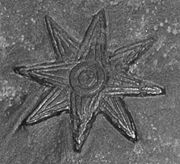
Inanna's symbol is an eight-pointed star or a rosette. She was associated with lions — even then a symbol of power — and was frequently depicted standing on the backs of two lionesses. Her cuneiformCuneiform
Cuneiform can refer to:*Cuneiform script, an ancient writing system originating in Mesopotamia in the 4th millennium BC*Cuneiform , three bones in the human foot*Cuneiform Records, a music record label...
ideogram
Ideogram
An ideogram or ideograph is a graphic symbol that represents an idea or concept. Some ideograms are comprehensible only by familiarity with prior convention; others convey their meaning through pictorial resemblance to a physical object, and thus may also be referred to as pictograms.Examples of...
was a hook-shaped twisted knot of reeds, representing the doorpost of the storehouse (and thus fertility and plenty).
Inanna as the star, Venus
Inanna was associated with the celestial planet, VenusVenus
Venus is the second planet from the Sun, orbiting it every 224.7 Earth days. The planet is named after Venus, the Roman goddess of love and beauty. After the Moon, it is the brightest natural object in the night sky, reaching an apparent magnitude of −4.6, bright enough to cast shadows...
. There are hymns to Inanna as her astral manifestation. It is also believed that in many myths about Inanna, including Inanna's Descent to the Underworld and Inanna and Shukaletuda, her movements correspond with the movements of Venus in the sky. Also, because of its positioning so close to Earth, Venus moves rather irregularly across the sky, and never travels all the way across the dome of the sky like most celestial bodies, instead, Venus rises in the East and the West in both the morning and evening . Because of Venus's erratic movements (it disappears behind the sun from 90– 3 days at a time and then reappears on the other horizon), some cultures did not recognize Venus as single entity, but rather two separate stars on each horizon as the morning and evening star. The Mesopotamians, however most likely understood that the planet was one entity. A Cylinder seal
Cylinder seal
A cylinder seal is a cylinder engraved with a 'picture story', used in ancient times to roll an impression onto a two-dimensional surface, generally wet clay. Cylinder seals were invented around 3500 BC in the Near East, at the contemporary site of Susa in south-western Iran and at the early site...
from the Jemdet Nasr Period
Jemdet Nasr period
The Jemdet Nasr period is an archaeological culture in southern Mesopotamia that is generally dated to 3100–2900 BCE. It is named after the type-site Jemdet Nasr, where the assemblage typical for this period was first recognized. Its geographical distribution is limited to south–central Iraq...
expresses the knowledge that both morning and evening stars were the same celestial entity. The erratic movements of Venus relate to both mythology as well as Inanna's erratic nature. . Like Venus, Inanna seems unpredictable in her actions, being both the goddess of love and war, having both masculine and feminine qualities, and occasionally throwing fits. Mesopotamian literature, however, takes this comparison one step further, explaining Inanna's physical movements in mythology as similar to the movements of Venus in the sky.
Inanna's Descent to the Underworld explains how Inanna is able to, unlike any other god, descend into the netherworld and return to the heavens. The planet Venus appears to make a similar descent, setting in the West and then rising again in the East.
In Inanna and Shukaletuda, in search of her attacker, Inanna makes several movements throughout the myth that correspond with the movements of Venus in the sky. The introductory hymn explains Inanna leaving the heavens and heading for Kur, what could be assumed to be the mountains, replicating the rising and setting of Inanna to the West. Shukaletuda is also described as scanning the heavens in search of Inanna, possibly to the eastern and western horizons.
Inanna was associated with the eastern fish of the last of the zodiacal constellations, Pisces. Her consort Dumuzi was associated with the contiguous first constellation, Aries.
Character
Inanna is the goddess of love- but not marriage. She is connected with extramarital sex and sensual affairs, prowling streets and taverns for sexual adventure . In the Babylonian epic of GilgameshGilgamesh
Gilgamesh was the fifth king of Uruk, modern day Iraq , placing his reign ca. 2500 BC. According to the Sumerian king list he reigned for 126 years. In the Tummal Inscription, Gilgamesh, and his son Urlugal, rebuilt the sanctuary of the goddess Ninlil, in Tummal, a sacred quarter in her city of...
, Gilgamesh points out Ishtar's (Akkadian version of Inanna) infamous ill-treatment of her lovers. Inanna also has a very complicated relationship with her lover Dumuzi in "Inanna's Descent to the Underworld" (c.f. "Inanna's Descent to the Underworld"). She also is one of the Sumerian war deities: "She stirs confusion and chaos against those who are disobedient to her, speeding carnage and inciting the devastating flood, clothed in terrifying radiance. It is her game to speed conflict and battle, untiring, strapping on her sandals." Battle itself is sometimes referred to as "the dance of Inanna."
Consider her description in one hymn: "When the servants let the flocks loose, and when cattle and sheep are returned to cow-pen and sheepfold, then, my lady, like the nameless poor, you wear only a single garment. The pearls of a prostitute are placed around your neck, and you are likely to snatch a man from the tavern." Despite her association with mating and fertility of humans and animals, Inanna was not a mother goddess, though she is associated with childbirth in certain myths. Inanna was also associated with rain and storms and with the planet Venus
Venus
Venus is the second planet from the Sun, orbiting it every 224.7 Earth days. The planet is named after Venus, the Roman goddess of love and beauty. After the Moon, it is the brightest natural object in the night sky, reaching an apparent magnitude of −4.6, bright enough to cast shadows...
, the morning and evening star. as was the Greco-Roman
Greco-Roman religion
Greco-Roman religion is the collective name given to Greek and Roman pre-Christian religions due to the similarity between them.See also:* Religion in ancient Greece* Religion in ancient Rome* Greek mythology* Roman mythology...
goddess
Goddess
A goddess is a female deity. In some cultures goddesses are associated with Earth, motherhood, love, and the household. In other cultures, goddesses also rule over war, death, and destruction as well as healing....
Aphrodite
Aphrodite
Aphrodite is the Greek goddess of love, beauty, pleasure, and procreation.Her Roman equivalent is the goddess .Historically, her cult in Greece was imported from, or influenced by, the cult of Astarte in Phoenicia....
or Venus
Venus (mythology)
Venus is a Roman goddess principally associated with love, beauty, sex,sexual seduction and fertility, who played a key role in many Roman religious festivals and myths...
.
Enmerkar and the Lord of Aratta
Inanna has a central role in the myth of Enmerkar and the Lord of ArattaEnmerkar and the Lord of Aratta
Enmerkar and the Lord of Aratta is a legendary Sumerian account, of preserved, early post-Sumerian copies, composed in the Neo-Sumerian period ....
. A major theme in the narrative is the rivalry between the rulers of Aratta
Aratta
Aratta is a land that appears in Sumerian myths surrounding Enmerkar and Lugalbanda, two early and possibly mythical kings of Uruk also mentioned on the Sumerian king list.-Role in Sumerian literature:Aratta is described as follows in Sumerian literature:...
and Uruk
Uruk
Uruk was an ancient city of Sumer and later Babylonia, situated east of the present bed of the Euphrates river, on the ancient dry former channel of the Euphrates River, some 30 km east of modern As-Samawah, Al-Muthannā, Iraq.Uruk gave its name to the Uruk...
for the heart of Inanna. Ultimately, this rivalry results in natural resources coming to Uruk and the invention of writing. The text describes a tension between the cities:
Text Summary: The city Aratta
Aratta
Aratta is a land that appears in Sumerian myths surrounding Enmerkar and Lugalbanda, two early and possibly mythical kings of Uruk also mentioned on the Sumerian king list.-Role in Sumerian literature:Aratta is described as follows in Sumerian literature:...
is structured as a mirror image of Uruk
Uruk
Uruk was an ancient city of Sumer and later Babylonia, situated east of the present bed of the Euphrates river, on the ancient dry former channel of the Euphrates River, some 30 km east of modern As-Samawah, Al-Muthannā, Iraq.Uruk gave its name to the Uruk...
, only Aratta has natural resources (i.e. gold
Gold
Gold is a chemical element with the symbol Au and an atomic number of 79. Gold is a dense, soft, shiny, malleable and ductile metal. Pure gold has a bright yellow color and luster traditionally considered attractive, which it maintains without oxidizing in air or water. Chemically, gold is a...
, silver
Silver
Silver is a metallic chemical element with the chemical symbol Ag and atomic number 47. A soft, white, lustrous transition metal, it has the highest electrical conductivity of any element and the highest thermal conductivity of any metal...
, lapis lazuli
Lapis lazuli
Lapis lazuli is a relatively rare semi-precious stone that has been prized since antiquity for its intense blue color....
) that Uruk needs. Enmerkar
Enmerkar
Enmerkar, according to the Sumerian king list, was the builder of Uruk in Sumer, and was said to have reigned for "420 years" ....
, king in Uruk, comes to Inanna requesting that a temple be built in Uruk with stones from Aratta, and she orders him to find a messenger to cross the Zubi mountains and go to the Lord of Aratta
Aratta
Aratta is a land that appears in Sumerian myths surrounding Enmerkar and Lugalbanda, two early and possibly mythical kings of Uruk also mentioned on the Sumerian king list.-Role in Sumerian literature:Aratta is described as follows in Sumerian literature:...
demanding precious metals for the temple. The messenger makes the journey and all the peoples he passes along the way praise Inanna. He makes his demands, and the Lord of Aratta refuses, saying that Aratta will not submit to Uruk. He is upset, however, to learn that Inanna is pleased with the Shrine E-ana. The Lord of Aratta issues a challenge to Enmerkar to bring barley to Aratta because Aratta is currently experiencing a severe famine. Enmerkar mobilizes men and donkeys to deliver the food. Still, the Lord of Aratta will not submit. A series of riddles, or challenges, follows. Enermerkar, with the wisdom of Enki
Enki
Enki is a god in Sumerian mythology, later known as Ea in Akkadian and Babylonian mythology. He was originally patron god of the city of Eridu, but later the influence of his cult spread throughout Mesopotamia and to the Canaanites, Hittites and Hurrians...
succeeds at every task. Eventually, the Lord of Aratta challenges Enmerka to have a champion from each city fight in one-on-one combat. By this point, however, the messenger is tired. Enmerkar gives him a message, but he is unable to repeat it verbally. So, the messenger writes it down, thus inventing writing:
The Lord of Aratta cannot read the text, but the god Ishkur causes rains to end the drought in Aratta. The Lord of Aratta decides that his city has not been forsaken after all. The champion of Aratta dresses in a "garment of lion skins," possibly a reference to Inanna. The end of the text is an unclear, but it seems that the city of Uruk is able to access Aratta's resources.
Inanna and the Mes
According to one story, Inanna tricked the god of culture, EnkiEnki
Enki is a god in Sumerian mythology, later known as Ea in Akkadian and Babylonian mythology. He was originally patron god of the city of Eridu, but later the influence of his cult spread throughout Mesopotamia and to the Canaanites, Hittites and Hurrians...
, who was worshipped in the city of Eridu
Eridu
Eridu is an ancient Sumerian city in what is now Tell Abu Shahrain, Dhi Qar Governorate, Iraq. Eridu was considered the earliest city in southern Mesopotamia, and is one of the oldest cities in the world...
, into giving her the Me
Me (mythology)
In Sumerian mythology, a me or ñe or parşu is one of the decrees of the gods foundational to those social institutions, religious practices, technologies, behaviors, mores, and human conditions that make civilization, as the Sumerians understood it, possible...
s. The Mes were documents/tablets which were blueprints to civilization. They represented everything from truth
Truth
Truth has a variety of meanings, such as the state of being in accord with fact or reality. It can also mean having fidelity to an original or to a standard or ideal. In a common usage, it also means constancy or sincerity in action or character...
to weaving
Weaving
Weaving is a method of fabric production in which two distinct sets of yarns or threads are interlaced at right angles to form a fabric or cloth. The other methods are knitting, lace making and felting. The longitudinal threads are called the warp and the lateral threads are the weft or filling...
to prostitution
Prostitution
Prostitution is the act or practice of providing sexual services to another person in return for payment. The person who receives payment for sexual services is called a prostitute and the person who receives such services is known by a multitude of terms, including a "john". Prostitution is one of...
, granting power over, or possibly existence to, all the aspects of civilization (both positive and negative). Inanna traveled to Enki's city Eridu
Eridu
Eridu is an ancient Sumerian city in what is now Tell Abu Shahrain, Dhi Qar Governorate, Iraq. Eridu was considered the earliest city in southern Mesopotamia, and is one of the oldest cities in the world...
, and by getting him drunk, she got him to give her hundreds of Mes, which she took to her city of Uruk. Later, when sober, Enki
Enki
Enki is a god in Sumerian mythology, later known as Ea in Akkadian and Babylonian mythology. He was originally patron god of the city of Eridu, but later the influence of his cult spread throughout Mesopotamia and to the Canaanites, Hittites and Hurrians...
sent mighty Abgallu (sea monsters
Sea Monsters
Sea Monsters was a BBC television trilogy which used computer-generated imagery to show past life in Earth's seas. In the U.S. it was known as Chased by Sea Monsters. It was made by Impossible Pictures, the creators of Walking with Dinosaurs, Walking with Beasts and Walking with Monsters...
, from ab, sea or lake + gal, big + lu, man) to stop her boat as it sailed the Euphrates
Euphrates
The Euphrates is the longest and one of the most historically important rivers of Western Asia. Together with the Tigris, it is one of the two defining rivers of Mesopotamia...
and retrieve his gifts, but she escaped. This story may represent the historic transfer of power from Eridu
Eridu
Eridu is an ancient Sumerian city in what is now Tell Abu Shahrain, Dhi Qar Governorate, Iraq. Eridu was considered the earliest city in southern Mesopotamia, and is one of the oldest cities in the world...
to Uruk
Uruk
Uruk was an ancient city of Sumer and later Babylonia, situated east of the present bed of the Euphrates river, on the ancient dry former channel of the Euphrates River, some 30 km east of modern As-Samawah, Al-Muthannā, Iraq.Uruk gave its name to the Uruk...
.
Inanna and Ebih
This myth depicts Inanna's confrontation with and ultimate destruction of Mount Ebih, which has refused to recognize her superiority.The story begins with an introductory hymn to praise Inanna. The goddess then journeys about the world, until she comes across Mount Ebih, and is subsequently angered by its seeming lack of respect and natural beauty, and rails at the mountain:
Mountain, because of your elevation, because of your height,
Because of your goodness, because of your beauty,
Because you wore a holy garment,
Because An organized (?) you,
Because you did not bring (your) nose close to the ground,
Because you did not press (your) lips in the dust.
She petitions to the god An to allow her to destroy the mountain. An refuses, but Inanna proceeds to attack and destroy the mountain regardless, utterly annihilating it and leaving sad destruction in her wake. In the conclusion of the myth, she tells Ebih why she attacked it.
Inanna and Shukaletuda
Inanna and Shukaletuda begins with a hymn to Inanna which praises her as the planet Venus (as it appears in the sky).The story then goes on to introduce the reader to Shukaletuda, a gardner who is terrible at his job and partially blind. All of his plants die, with the exception of one poplar tree. Shukaletuda prays to the gods for guidance in his work. To his surprise, the goddess Inanna, sees his one poplar tree and decides to rest under that shade of its branches. While Inanna is asleep, Shukaletuda decides it would be a good idea to undress and rape her. The goddess awakes and realizes she was violated in her sleep. She is furious and determined to bring her attacker to justice. . In a fit of rage, Inanna unleashes plagues upon the Earth to punish and identify her attacker. She turns water to blood in attempt to punish her rapist. Shukaletuda, terrified for his life, asks his father for advice on how to escape Inanna's wrath. His father tells him to hide in the city, amongst the hordes of people and blend in. Inanna searches the mountains of the East for her attacker, and is not able to find him. She then releases a series of storms and closes the roads to the city, and is still unable to find Shukaletuda in the mountains. After her plagues, Inanna is still not able to find her rapist and asks Enki
Enki
Enki is a god in Sumerian mythology, later known as Ea in Akkadian and Babylonian mythology. He was originally patron god of the city of Eridu, but later the influence of his cult spread throughout Mesopotamia and to the Canaanites, Hittites and Hurrians...
for help in revealing him. Inanna threatens to leave her temple at Uruk
Uruk
Uruk was an ancient city of Sumer and later Babylonia, situated east of the present bed of the Euphrates river, on the ancient dry former channel of the Euphrates River, some 30 km east of modern As-Samawah, Al-Muthannā, Iraq.Uruk gave its name to the Uruk...
unless Enki
Enki
Enki is a god in Sumerian mythology, later known as Ea in Akkadian and Babylonian mythology. He was originally patron god of the city of Eridu, but later the influence of his cult spread throughout Mesopotamia and to the Canaanites, Hittites and Hurrians...
helps her find her attacker. He consents, and allows her to "fly across the sky like a rainbow". Inanna finally find Shukaletuda. He attempts to make his excuses for his crime against her, but she will have nothing to do with it and kills him.
This myth and Shukaletuda is cited as a Sumerian Astral myth, as the movements of Inanna to only the mountains correspond with the movements of the planet, Venus. When Shukaletuda was praying to the goddess, he may have been looking toward Venus in the horizon.
Inanna and Gudam
This fragmentary myth focuses on the actions of Gudam, who is described as a fierce warrior, who dined on flesh and drank blood instead of beer. Gudam walks through Uruk, killing many and damaging the Eanna temple, until a "fisherman of Inanna" turns his axe against him and defeats him. Gudam, humbled, pleads to Inanna for forgiveness, promising to praise her through words and offerings.Inanna and An
This myth, also fragmentary, begins with a conversation between Inanna and her brother UtuUtu
Utu is the Sun god in Sumerian mythology, the son of the moon god Nanna and the goddess Ningal. His brother and sisters are Ishkur and Inanna and Erishkigal....
. She laments the fact that the Eanna temple is not of their domain, and resolves to reach or secure it. The text becomes increasingly fragmentary at this point in the narrative, but appears to describe her difficult passage through a marshland to reach it, while being advised by a fisherman as to the best route.
Ultimately she reaches her father, An. While he is shocked by her arrogance in attempting to capture the Eanna temple for herself, he nevertheless concedes that she has succeeded and it is now her domain. The text ends with an exaltation of her qualities and powers.
Inanna's descent to the underworld
The story of Inanna's descent to the underworldDescent to the underworld
The descent to the underworld is a mytheme of comparative mythology found in a diverse number of religions from around the world, including Christianity. The hero or upper-world deity journeys to the underworld or to the land of the dead and returns, often with a quest-object or a loved one, or...
is a relatively well-attested and reconstructed composition.
In Sumerian religion
Sumerian religion
Sumerian religion refers to the mythology, pantheon, rites and cosmology of the Sumerian civilization. The Sumerian religion influenced Mesopotamian mythology as a whole, surviving in the mythologies and religions of the Hurrians, Akkadians, Babylonians, Assyrians, and other culture...
, the Underworld was conceived of as a dreary, dark place; a home to deceased heroes and ordinary people alike. While everyone suffered an eternity of poor conditions, certain behavior while alive, notably creating a family to provide offerings to the deceased, could alleviate conditions somewhat.
Inanna's reason for visiting the underworld is unclear. The reason she gives to the gatekeeper of the underworld is that she wants to attend the funeral rites of Ereshkigal's husband, here said to be Gud-gal-ana. Gugalana was the Bull of Heaven in The Epic of Gilgamesh, killed by Gilgamesh and Enkidu. To further add to the confusion, Ereshkigal's husband is typically the plague god, Nergal.
In this story, before leaving Inanna instructed her minister and servant Ninshubur
Ninshubur
Also known as Ninshubar, Nincubura or Ninšubur, Ninshubur was the sukkal or second-in-command of the goddess Inanna in Sumerian mythology. A goddess in her own right, her name can be translated as 'Queen of the East', and she was said to be a messenger and traveller for the other gods...
to plead with the gods Enlil
Enlil
Elizabeth Barrett Browning was one of the most prominent poets of the Victorian era. Her poetry was widely popular in both England and the United States during her lifetime. A collection of her last poems was published by her husband, Robert Browning, shortly after her death.-Early life:Members...
, Nanna, and Enki
Enki
Enki is a god in Sumerian mythology, later known as Ea in Akkadian and Babylonian mythology. He was originally patron god of the city of Eridu, but later the influence of his cult spread throughout Mesopotamia and to the Canaanites, Hittites and Hurrians...
to save her if anything went amiss. The attested laws of the underworld dictate that, with the exception of appointed messengers, those who enter it could never leave.
Inanna dresses elaborately for the visit, with a turban, a wig, a lapis lazuli
Lapis lazuli
Lapis lazuli is a relatively rare semi-precious stone that has been prized since antiquity for its intense blue color....
necklace, beads upon her breast, the 'pala dress' (the ladyship garment), mascara, pectoral, a golden ring on her hand, and she held a lapis lazuli measuring rod
Measuring rod
A measuring rod is a tool used to physically measure lengths and survey areas of various sizes. Most measuring rods are round or square sectioned, however they can be flat boards. Some have markings at regular intervals...
. These garments are each representations of powerful mes she possesses. Perhaps Inanna's garments, unsuitable for a funeral, along with Inanna's haughty behavior, make Ereshkigal
Ereshkigal
In Mesopotamian mythology, Ereshkigal was the goddess of Irkalla, the land of the dead or underworld. Sometimes her name is given as Irkalla, similar to the way the name Hades was used in Greek mythology for both the underworld and its ruler.Ereshkigal was the only one who could pass judgment and...
suspicious.
Following Ereshkigal's instructions, the gatekeeper tells Inanna she may enter the first gate of the underworld, but she must hand over her lapis lazuli measuring rod. She asks why, and is told 'It is just the ways of the Underworld'. She obliges and passes through. Inanna passes through a total of seven gates, at each one removing a piece of clothing or jewelry she had been wearing at the start of her journey, thus stripping her of her power.
When she arrives in front of her sister, she is naked. "After she had crouched down and had her clothes removed, they were carried away. Then she made her sister Erec-ki-gala rise from her throne, and instead she sat on her throne. The Anna, the seven judges, rendered their decision against her. They looked at her -- it was the look of death. They spoke to her -- it was the speech of anger. They shouted at her -- it was the shout of heavy guilt. The afflicted woman was turned into a corpse. And the corpse was hung on a hook."
Ereškigal's hate for Inanna could be referenced in a few other myths. Ereškigal too is bound by the laws of the underworld; she can not leave her kingdom of the underworld to join the other 'living' gods, and they can not visit her in the underworld, or else they can never return. Inanna symbolized erotic love and fertility, and contrasts with Ereškigal.
Three days and three nights passed, and Ninshubur, following instructions, went to Enlil
Enlil
Elizabeth Barrett Browning was one of the most prominent poets of the Victorian era. Her poetry was widely popular in both England and the United States during her lifetime. A collection of her last poems was published by her husband, Robert Browning, shortly after her death.-Early life:Members...
, Nanna, and Enki
Enki
Enki is a god in Sumerian mythology, later known as Ea in Akkadian and Babylonian mythology. He was originally patron god of the city of Eridu, but later the influence of his cult spread throughout Mesopotamia and to the Canaanites, Hittites and Hurrians...
's temples, and demanded they save Inanna. The first two gods refused, saying it was her own doing, but Enki
Enki
Enki is a god in Sumerian mythology, later known as Ea in Akkadian and Babylonian mythology. He was originally patron god of the city of Eridu, but later the influence of his cult spread throughout Mesopotamia and to the Canaanites, Hittites and Hurrians...
was deeply troubled and agreed to help. He created two asexual figures named gala-tura and the kur-jara from the dirt under the fingernails of the gods. He instructed them to appease Ereškigal; and when asked what they wanted, they were to ask for Inanna's corpse and sprinkle it with the food and water of life. However, when they come before Ereshkigal, she is in agony like a woman giving birth, and she offers them what they want, including life-giving rivers of water and fields of grain, if they can relieve her; nonetheless they take only the corpse.
Things went as Enki said, and the gala-tura and the kur-jara were able to revive Inanna. Demons of Ereškigal's followed (or accompanied) Inanna out of the underworld, and insisted that she wasn’t free to go until someone took her place. They first came upon Ninshubur and attempted to take her. Inanna refused, as Ninshubur was her loyal servant who had rightly mourned her while she was in the underworld. They next came upon Cara, Inanna's beautician, still in mourning. The demons said they would take him, but Inanna refused, as he too had mourned her. They next came upon Lulal, also in mourning. The demons offered to take him, but Inanna refused.
They next came upon Dumuzi, Inanna's husband. Despite Inanna's fate, and in contrast to the other individuals who were properly mourning Inanna, Dumuzi was lavishly clothed and resting beneath a tree. Inanna, displeased, decrees that the demons shall take him, using language which echoes the speech Ereshkigal gave while condemning her. Dumuzi is then taken to the underworld.
In other recensions of the story, Dumuzi tries to escape his fate, and is capable of fleeing the demons for a time, as the gods intervene and disguise him in a variety of forms. He is eventually found. However, Dumuzi's sister, out of love for him, begged to be allowed to take his place. It was then decreed that Dumuzi spent half the year in the underworld, and his sister take the other half. Inanna, displaying her typically capricious behavior, mourns his time in the underworld, and her own powers, notably those connected with fertility, subsequently wane, to return in full when he returns from the netherworld each six months. This cycle then approximates the shift of seasons.
Interpretations of the Inanna descent myth
Additionally, the myth can be described as a union of Inanna with her own "dark side", her twin sister-self, Ereshkigal, as when she ascends it is with Ereshkigal's powers, while Inanna is in the underworld it is Ereshkigal who apparently takes on fertility powers, and the poem ends with a line in praise, not of Inanna, but of Ereshkigal. It is in many ways a praise-poem dedicated to the more negative aspect's of Inanna's domain, symbolic of an acceptance of the necessity of death to the continuance of life. It can also be interpreted as being about the psychological power of a descent into the unconscious, realizing one's own strength through an episode of seeming powerlessness, and/or an acceptance of one's own negative qualities, as it is by Joseph CampbellJoseph Campbell
Joseph John Campbell was an American mythologist, writer and lecturer, best known for his work in comparative mythology and comparative religion. His work is vast, covering many aspects of the human experience...
.
Another recent interpretation by Clyde Hostetter indicates that the myth is an allegorical report of related movements of the planets Venus, Mercury,and Jupiter; and those of the waxing crescent Moon in the Second Millennium, beginning with the Spring Equinox and concluding with a meteor shower near the end of one synodic period of Venus.
To the ancient Mesopotamian audience, though, it is most likely that the Descent of Inannas moral was that there are always consequences for one's actions. "The Descent of Inanna, then, about one of the gods behaving badly and other gods and mortals having to suffer for that behavior, would have given to an ancient listener the same basic understanding anyone today would take from an account of a tragic accident caused by someone’s negligence or poor judgment: that, sometimes, life is just not fair."
Related deities
Inanna's Akkadian counterpart is Ishtar. In different traditions Inanna is the daughter of AnuAnu
In Sumerian mythology, Anu was a sky-god, the god of heaven, lord of constellations, king of gods, Consort of Antu, spirits and demons, and dwelt in the highest heavenly regions. It was believed that he had the power to judge those who had committed crimes, and that he had created the stars as...
or she is the daughter of the moon god Nanna. In various traditions, her siblings include the sun god Utu
Utu
Utu is the Sun god in Sumerian mythology, the son of the moon god Nanna and the goddess Ningal. His brother and sisters are Ishkur and Inanna and Erishkigal....
, the rain god Ishkur, and Ereshkigal
Ereshkigal
In Mesopotamian mythology, Ereshkigal was the goddess of Irkalla, the land of the dead or underworld. Sometimes her name is given as Irkalla, similar to the way the name Hades was used in Greek mythology for both the underworld and its ruler.Ereshkigal was the only one who could pass judgment and...
, Queen of the Underworld. Her personal assistant is Ninshubur
Ninshubur
Also known as Ninshubar, Nincubura or Ninšubur, Ninshubur was the sukkal or second-in-command of the goddess Inanna in Sumerian mythology. A goddess in her own right, her name can be translated as 'Queen of the East', and she was said to be a messenger and traveller for the other gods...
. She is never considered to have a permanent spouse, although Dumuzi is her lover. Yet, she is responsible for sending Dumuzi to the Underworld in "Inanna's Descent to the Underworld." Inanna is also regarded in astral traditions as the morning and evening star.
Modern relevance
Since Inanna embodies the traits of independence, self-determination and strength in an otherwise patriarchal Sumerian pantheon, she has become the subject of feminist theory. Indeed, in one analysis of "Inanna and the huluppu tree", the author points out how she was implicitly "tamed and controlled", even "demoted", implying her prior importance as a female role model.Popular Culture
- The goddess Inanna was a major character in John Myers MyersJohn Myers MyersJohn Myers Myers was an American writer, best known for his literary fantasy novel Silverlock.-Life:Myers was born in Northport, Long Island on January 11, 1906 to John Caldwell Myers and Alice MacCorry Myers and grew up in various places in New York, including New Paltz and NYC. He knew from the...
1981 fantasyFantasyFantasy is a genre of fiction that commonly uses magic and other supernatural phenomena as a primary element of plot, theme, or setting. Many works within the genre take place in imaginary worlds where magic is common...
novelNovelA novel is a book of long narrative in literary prose. The genre has historical roots both in the fields of the medieval and early modern romance and in the tradition of the novella. The latter supplied the present generic term in the late 18th century....
The Moon's Fire-Eating Daughter. - The black metalBlack metalBlack metal is an extreme subgenre of heavy metal music. Common traits include fast tempos, shrieked vocals, highly distorted guitars played with tremolo picking, blast beat drumming, raw recording, and unconventional song structure....
band BeheritBeherit (band)Beherit is a black metal band from Finland. The band was formed in 1989 by Nuclear Holocausto , Black Jesus and Sodomatic Slaughter , with the purpose of performing "the most primitive, savage, hell-obsessed black metal imaginable." "Beherit" is the Syriac word for Satan...
wrote a song called "The Gate of Inanna", featured in their 1994 album H418ov21.CH418ov21.CH418ov21.C, short for house 418 of 21st century, is a 1994 album by the Finnish black metal band Beherit. The album is the group's first dark ambient recording.-Track listing:All songs written and performed by Marko Laiho#"The Gate of Inanna"...
. - Singer/songwriter Tori AmosTori AmosTori Amos is an American pianist, singer-songwriter and composer. She was at the forefront of a number of female singer-songwriters in the early 1990s and was noteworthy early in her career as one of the few alternative rock performers to use a piano as her primary instrument...
chants Inanna's name as background vocals in her song Caught a Lite SneezeCaught a Lite Sneeze"Caught a Lite Sneeze" is a song by Tori Amos, released as the first single from her 1996 album Boys for Pele. It reached #60 on the Billboard Hot 100 and #20 on the UK Singles Charts, and is one of the most recognized songs by Amos and a fan-favourite...
on her Boys for PeleBoys for PeleBoys for Pele is the third studio album by American singer and song-writer Tori Amos. Preceded by the first single, "Caught a Lite Sneeze", by three weeks, the album was released on 22 January 1996, in the United Kingdom and on 23 January, in the United States...
album. - Rock band The Tea PartyThe Tea PartyThe Tea Party is a Canadian rock band with blues, progressive rock, Indian and Middle Eastern influences, dubbed "Moroccan roll" by the media. Active throughout the 1990s up until 2005 when the band broke up, The Tea Party released eight albums on EMI Music Canada, selling 1.6 million records...
feature a song called Inanna on their album The Edges of TwilightThe Edges of TwilightThe Edges of Twilight is the third album by The Tea Party. The album features many instruments from around the world, giving various songs a strong world music flavour in addition to the rock/blues influences evident in the band's earlier releases...
. - Alice Notley's feminist poetry epicEpic-Comics:* Epic Comics, an imprint of Marvel Comics* Epic Illustrated, a 1980s anthology series published by Marvel Comics-Gaming:* Epic , a 1992 computer game* Epic , a series of wargames...
, The Descent of Alette, takes inspiration from the myth of Inanna's descent into the underworld.
Dates (approximate)
| Historical sources | ||
| Time | Period | Source |
| c. 5300-4100 BC | Ubaid period Ubaid period The Ubaid period is a prehistoric period of Mesopotamia. The tell of al-`Ubaid west of nearby Ur in southern Iraq's Dhi Qar Governorate has given its name to the prehistoric Pottery Neolithic to Chalcolithic culture, which represents the earliest settlement on the alluvial plain of southern... |
|
| c. 4100-2900 BC | Uruk period Uruk period The Uruk period existed from the protohistoric Chalcolithic to Early Bronze Age period in the history of Mesopotamia, following the Ubaid period and succeeded by the Jemdet Nasr period. Named after the Sumerian city of Uruk, this period saw the emergence of urban life in Mesopotamia. It was... |
Uruk vase |
| c. 2900-2334 BC | Early Dynastic period | |
| c. 2334-2218 BC | Akkadian Empire | writings by Enheduanna Enheduanna Enheduanna , also transliterated as Enheduana, En-hedu-ana or EnHeduAnna , was an Akkadian princess as well as High Priestess of the Moon god Nanna in the Sumerian city-state of Ur... : Nin-me-sara, "The Exhaltation of Inanna" In-nin sa-gur-ra, "A Hymn to Inana (Inana C)" In-nin me-hus-a, "Inanna and Ebih" The Temple Hymns Hymn to Nanna, "The Exhaltation of Inanna" |
| c. 2218-2047 BC | Gutian Period | |
| c. 2047-1940 BC | Ur III Period | Inanna and Enki Enmerkar and the Lord of Aratta Enmerkar and the Lord of Aratta Enmerkar and the Lord of Aratta is a legendary Sumerian account, of preserved, early post-Sumerian copies, composed in the Neo-Sumerian period .... |
Further reading
- Jeremy Black, Graham Cunningham, Eleanor Robson, and Gábor Zólyomi (2004) The Literature of Ancient Sumer (Oxford University Press) ISBN 0-19-926311-6
- The Electronic Text Corpus of Sumerian Literature
- Halloran, John A. Sumerian Lexicon Version 3.0
- Voorbij de Zerken: a Dutch book which "contains" both Ereshkigal and Inanna.
- Pereira, Sylvia Brunton, Descent to the Goddess (Inner City Books, 1981). A Jungian interpretation of the process of psychological 'descent and return', using the story of Inanna as translated by Wolkstein and Kramer. ISBN 978-0-919123-05-2