

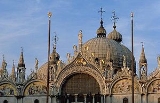
St Mark's Basilica

Encyclopedia
The Patriarchal Cathedral Basilica of Saint Mark (officially known in Italian
as the and commonly known as Saint Mark's Basilica) is the cathedral
church of the Roman Catholic Archdiocese of Venice
, northern Italy
. It is the most famous of the city's churches and one of the best known examples of Byzantine architecture
. It lies at the eastern end of the Piazza San Marco
, adjacent and connected to the Doge's Palace. Originally it was the chapel of the Doge, and has only been the city's cathedral since 1807, when it became the seat of the Patriarch of Venice
, archbishop of the Roman Catholic Archdiocese of Venice
, formerly at San Pietro di Castello
.
For its opulent design, gilded Byzantine
mosaic
s, and its status as a symbol of Venetian wealth and power, from the 11th century on the building has been known by the nickname Chiesa d'Oro (Church of gold).
, when Venetian merchants stole the supposed relics of Mark the Evangelist
from Alexandria
. This was replaced by a new church on its present site in 832; from the same century dates the first St Mark's Campanile
(bell tower). The new church was burned in a rebellion in 976, rebuilt in 978 and again to form the basis of the present basilica
since 1063.
The basilica was consecrated in 1094, the same year in which the body of Saint Mark was supposedly rediscovered in a pillar
by Vitale Faliero
, doge
at the time. The building also incorporates a low tower (now housing St Mark’s Treasure), believed by some to have been part of the original Doge's Palace.
Within the first half of the 13th century the narthex
and the new façade
were constructed, most of the mosaics were completed and the dome
s were covered with higher wooden, lead-covered domes in order to blend in with the Gothic architecture
of the redesigned Doge's Palace.
, capitals
, or frieze
s, taken from some ancient building, to add to the fabric of the basilica. Gradually, the exterior brickwork
became covered with various marble
s and carvings
, some much older than the building itself (see Four Tetrarchs, below).
The last interventions concerned Baptistery and St Isidor’s Chapel (1300s), the carvings on the upper profile of the facade and the Sacristy (1400s), the Zen Chapel (1500s).
This cathedral is a prime example of Gothic architecture due to the fact of it's looks from a distance. It takes on the appearance of what would be in the classification of Gothic.
(patriarch
since 1451), whose cathedral was San Pietro di Castello
. The doge himself appointed for celebrations a special clergy led by the primicerio. The procurators’, an important organ of the Republic of Venice
, were in charge of administration; their seats were the Procuratie
, in St Mark’s Square. All building and restoring works were directed by the protos: great architect
s such as Jacopo Sansovino
and Baldassarre Longhena
had this title. Procurators and proto still exist and accomplish the same tasks for the Patriarchate.
 The exterior of the basilica is divided in three registers: lower, upper, and dome
s.
In the lower register of the façade five round-arched portals
, enveloped by polychrome marble columns, open into the narthex through bronze-fashioned doors. Above the central door round three bas-relief cycles of Romanesque art
. The external cycle frames a 19th century gilded mosaic (Last Judgment) that replaced a damaged one with the same subject (during the centuries many mosaics had to be replaced inside and outside the basilica, but subjects were never changed). Mosaics about St Mark relics’ stories are in the lunette
s of the lateral portals; the first on the left is the only one in the façade preserved from the 13th century.
In the upper register, from the top of ogee arch
es, statues of Theological
and Cardinal Virtues
, four Warrior Saints and St Mark watch over the city. Above the large central window of the façade, under St Mark, the Winged Lion (his symbol) holds the book quoting “Pax Tibi Marce Evangelista Meus” (Peace to you Mark my evangelist) . In the lunettes of the lateral ogee arches are four gilded mosaics renewed in the 17th century. In the center of the balcony the Greek Horses face the square.
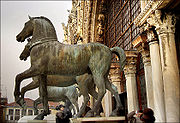 The Horses of Saint Mark
were installed on the basilica in about 1254. They date to Classical Antiquity
; by some accounts they once adorned the Arch of Trajan
. The horses were long displayed at the Hippodrome of Constantinople
, and in 1204 Doge Enrico Dandolo
sent them back to Venice as part of the loot sacked from Constantinople
in the Fourth Crusade
. They were taken to Paris by Napoleon in 1797 but returned to Venice in 1815. After a long restoration, since the 1990s they have been kept in St Mark’s Museum (inside the basilica). The horses now on the facade of the cathedral are bronze replicas.
imposed a new Imperial office structure: a four co-emperor ruling plan called The Tetrarchy
. This porphyry
statue represents the inter-dependence of the four rulers. It was taken from Constantinople, during the Fourth Crusade
in 1204, and set into the south-west corner of the basilica (the above mentioned low tower) at the level of the Piazza San Marco. The missing foot of one of the figures was discovered in Istanbul in the 1960s, where it is still on display.
embraced the western arm of the basilica on the three sides; later the southern part was closed to obtain the Baptistery (14th century) and the Zen Chapel (16th century).
The narthex prepare the visitors’ eyes to the suffused atmosphere of the gilded interior, just like the Old Testament stories represented in its mosaic ceiling prepare to the Gospel of the basilica’s. The main subjects are Genesis and the life of Noah, Abraham, Joseph, Moses. Beside the main portal remain the Evangelists, 11th century mosaics that decorated the entrance to St Mark’s even before the narthex was built.
 The interior is based on a Greek cross, with each arm divided in three naves and emphasized by a dome of its own. This is based on Justinian's Basilica of the Apostles in Constantinople.
The marble floor (12th century, but underwent many restorations) is entirely tessellated in geometric patterns and animal designs. The techniques used were opus sectile
and opus tessellatum
. The lower register of walls and pillars
is completely covered with polychrome marble
slabs. The transition between the lower and the upper register is delimited all around the basilica by passageways which largely substituted the former galleries.
with a crypt
beneath. The presbytery is separated by an altar screen
formed by eight red marble columns crowned with a high Crucifix and statues by Pier Paolo and Jacobello Dalle Masegne, masterpiece of Gothic
sculpture (late 14th century). Behind the screen, marble banisters with Sansovino's bronze statues of the Evangelists and Paliari's of the Four Doctors mark the access to the high altar
, which contains St Mark’s relics. Above the high altar is a canopy (“ciborium
”) on columns decorated with remarkable relieves
; the altarpiece
is the famous Pala d'Oro
(Golden Pall) [1], a masterpiece of Byzantine craftsmanship, originally designed for an antependium. The choir stalls are embellished with inlaying by Fra Sebastiano Schiavone, and above them on both sides are three relieves by Sansovino.
Behind the presbytery are the sacristy and a 15th century church consecrated to St Theodore
(the first patron saint of Venice) where is displayed a painting (Child’s Adoration) by Giovanni Battista Tiepolo
.
s containing gold, bronze, and the greatest variety of stones. The decorated surface is on the whole about 8000 m2. In the most ancient works, both Byzantine and Gothic influences can be recognized, as for example in the Saints from the 11th century between the windows of the apse. In the vault above is a mosaic with Christ Pantocrator
. From the apse towards the entrance (from east to west) one can contemplate the history of Salvation in the domes: the Prophets, the Ascension and the Pentecost (Whitsun). The domes over the transept are called St John’s (stories of St John the Evangelist) and St Leonard’s (with other saints). In the vaults between the domes are represented episodes of Jesus’ life.
As mentioned above, restorations and replacements were often necessary thereafter, and great painters such as Paolo Uccello
, Andrea del Castagno
, Paolo Veronese
, Jacopo Tintoretto and his son Domenico
took part drawing the cartoons. Tiziano and the Padovanino prepared the cartoons for the sacristy, built in the late 15th century. Other remarkable mosaics decorate the Baptistery, the Mascoli Chapel, St Isidor Chapel and the Zen Chapel.
among the composers appointed maestro di cappella at the choir of St Mark's
. The style was first developed by a foreigner, Adrian Willaert
, and was continued by Italian organists and composers: Andrea Gabrieli
, his nephew Giovanni Gabrieli
, and Claudio Monteverdi
. Their music took advantage of the spacious architecture and led to the development of polychoral and antiphonal textures. An example of this technique is found in In Ecclesiis
by Giovanni Gabrieli
Italian language
Italian is a Romance language spoken mainly in Europe: Italy, Switzerland, San Marino, Vatican City, by minorities in Malta, Monaco, Croatia, Slovenia, France, Libya, Eritrea, and Somalia, and by immigrant communities in the Americas and Australia...
as the and commonly known as Saint Mark's Basilica) is the cathedral
Cathedral
A cathedral is a Christian church that contains the seat of a bishop...
church of the Roman Catholic Archdiocese of Venice
Roman Catholic Archdiocese of Venice
The Roman Catholic Archdiocese of Venice is an archdiocese of the Latin Rite of the Roman Catholic church in Italy.The ordinary of the archdiocese is the Patriarch of Venice, who is traditionally created a cardinal in consistory by the Pope...
, northern Italy
Italy
Italy , officially the Italian Republic languages]] under the European Charter for Regional or Minority Languages. In each of these, Italy's official name is as follows:;;;;;;;;), is a unitary parliamentary republic in South-Central Europe. To the north it borders France, Switzerland, Austria and...
. It is the most famous of the city's churches and one of the best known examples of Byzantine architecture
Byzantine architecture
Byzantine architecture is the architecture of the Byzantine Empire. The empire gradually emerged as a distinct artistic and cultural entity from what is today referred to as the Roman Empire after AD 330, when the Roman Emperor Constantine moved the capital of the Roman Empire east from Rome to...
. It lies at the eastern end of the Piazza San Marco
Piazza San Marco
Piazza San Marco , is the principal public square of Venice, Italy, where it is generally known just as "the Piazza". All other urban spaces in the city are called "campi"...
, adjacent and connected to the Doge's Palace. Originally it was the chapel of the Doge, and has only been the city's cathedral since 1807, when it became the seat of the Patriarch of Venice
Patriarch of Venice
The Patriarch of Venice is the ordinary bishop of the Roman Catholic Archdiocese of Venice. The bishop is one of the few Patriarchs in the Latin Rite of the Roman Catholic Church...
, archbishop of the Roman Catholic Archdiocese of Venice
Roman Catholic Archdiocese of Venice
The Roman Catholic Archdiocese of Venice is an archdiocese of the Latin Rite of the Roman Catholic church in Italy.The ordinary of the archdiocese is the Patriarch of Venice, who is traditionally created a cardinal in consistory by the Pope...
, formerly at San Pietro di Castello
San Pietro di Castello
San Pietro di Castello is an island in the Venetian Lagoon, northern Italy, forming part of the Castello sestiere. It is linked to the main islands of Venice by two bridges.-History:...
.
For its opulent design, gilded Byzantine
Byzantine art
Byzantine art is the term commonly used to describe the artistic products of the Byzantine Empire from about the 5th century until the Fall of Constantinople in 1453....
mosaic
Mosaic
Mosaic is the art of creating images with an assemblage of small pieces of colored glass, stone, or other materials. It may be a technique of decorative art, an aspect of interior decoration, or of cultural and spiritual significance as in a cathedral...
s, and its status as a symbol of Venetian wealth and power, from the 11th century on the building has been known by the nickname Chiesa d'Oro (Church of gold).
The building
The first St Mark's was a temporary building in the Doge's Palace, constructed in 828828
Year 828 was a leap year starting on Wednesday of the Julian calendar.- Europe :* Al-Andalus: The city of Merida rises twice in one year against the Umayyad emirate....
, when Venetian merchants stole the supposed relics of Mark the Evangelist
Mark the Evangelist
Mark the Evangelist is the traditional author of the Gospel of Mark. He is one of the Seventy Disciples of Christ, and the founder of the Church of Alexandria, one of the original four main sees of Christianity....
from Alexandria
Alexandria
Alexandria is the second-largest city of Egypt, with a population of 4.1 million, extending about along the coast of the Mediterranean Sea in the north central part of the country; it is also the largest city lying directly on the Mediterranean coast. It is Egypt's largest seaport, serving...
. This was replaced by a new church on its present site in 832; from the same century dates the first St Mark's Campanile
St Mark's Campanile
St Mark's Campanile is the bell tower of St Mark's Basilica in Venice, Italy, located in the Piazza San Marco. It is one of the most recognizable symbols of the city....
(bell tower). The new church was burned in a rebellion in 976, rebuilt in 978 and again to form the basis of the present basilica
Basilica
The Latin word basilica , was originally used to describe a Roman public building, usually located in the forum of a Roman town. Public basilicas began to appear in Hellenistic cities in the 2nd century BC.The term was also applied to buildings used for religious purposes...
since 1063.
The basilica was consecrated in 1094, the same year in which the body of Saint Mark was supposedly rediscovered in a pillar
Column
A column or pillar in architecture and structural engineering is a vertical structural element that transmits, through compression, the weight of the structure above to other structural elements below. For the purpose of wind or earthquake engineering, columns may be designed to resist lateral forces...
by Vitale Faliero
Vitale Faliero
Vitale Faliero Dodoni and usually known in English as Vitale Falier was the 32nd Doge of Venice from 1084 until his death in 1095.He was a member of a noble Venetian family, probably from Fano...
, doge
Doge of Venice
The Doge of Venice , often mistranslated Duke was the chief magistrate and leader of the Most Serene Republic of Venice for over a thousand years. Doges of Venice were elected for life by the city-state's aristocracy. Commonly the person selected as Doge was the shrewdest elder in the city...
at the time. The building also incorporates a low tower (now housing St Mark’s Treasure), believed by some to have been part of the original Doge's Palace.
Within the first half of the 13th century the narthex
Narthex
The narthex of a church is the entrance or lobby area, located at the end of the nave, at the far end from the church's main altar. Traditionally the narthex was a part of the church building, but was not considered part of the church proper...
and the new façade
Facade
A facade or façade is generally one exterior side of a building, usually, but not always, the front. The word comes from the French language, literally meaning "frontage" or "face"....
were constructed, most of the mosaics were completed and the dome
Dome
A dome is a structural element of architecture that resembles the hollow upper half of a sphere. Dome structures made of various materials have a long architectural lineage extending into prehistory....
s were covered with higher wooden, lead-covered domes in order to blend in with the Gothic architecture
Gothic architecture
Gothic architecture is a style of architecture that flourished during the high and late medieval period. It evolved from Romanesque architecture and was succeeded by Renaissance architecture....
of the redesigned Doge's Palace.
The completion
While the basic structure of the building has been much altered, its decoration changed greatly over time. The succeeding centuries, especially the fourteenth, all contributed to its adornment, and seldom did a Venetian vessel return from the Orient without bringing a columnColumn
A column or pillar in architecture and structural engineering is a vertical structural element that transmits, through compression, the weight of the structure above to other structural elements below. For the purpose of wind or earthquake engineering, columns may be designed to resist lateral forces...
, capitals
Capital (architecture)
In architecture the capital forms the topmost member of a column . It mediates between the column and the load thrusting down upon it, broadening the area of the column's supporting surface...
, or frieze
Frieze
thumb|267px|Frieze of the [[Tower of the Winds]], AthensIn architecture the frieze is the wide central section part of an entablature and may be plain in the Ionic or Doric order, or decorated with bas-reliefs. Even when neither columns nor pilasters are expressed, on an astylar wall it lies upon...
s, taken from some ancient building, to add to the fabric of the basilica. Gradually, the exterior brickwork
Brickwork
Brickwork is masonry produced by a bricklayer, using bricks and mortar to build up brick structures such as walls. Brickwork is also used to finish corners, door, and window openings, etc...
became covered with various marble
Marble
Marble is a metamorphic rock composed of recrystallized carbonate minerals, most commonly calcite or dolomite.Geologists use the term "marble" to refer to metamorphosed limestone; however stonemasons use the term more broadly to encompass unmetamorphosed limestone.Marble is commonly used for...
s and carvings
Stone carving
Stone carving is an ancient activity where pieces of rough natural stone are shaped by the controlled removal of stone. Owing to the permanence of the material, evidence can be found that even the earliest societies indulged in some form of stone work....
, some much older than the building itself (see Four Tetrarchs, below).
The last interventions concerned Baptistery and St Isidor’s Chapel (1300s), the carvings on the upper profile of the facade and the Sacristy (1400s), the Zen Chapel (1500s).
This cathedral is a prime example of Gothic architecture due to the fact of it's looks from a distance. It takes on the appearance of what would be in the classification of Gothic.
The key figures
As a "State church", until 1807, the basilica was not subject to the bishopBishop
A bishop is an ordained or consecrated member of the Christian clergy who is generally entrusted with a position of authority and oversight. Within the Catholic Church, Eastern Orthodox, Oriental Orthodox Churches, in the Assyrian Church of the East, in the Independent Catholic Churches, and in the...
(patriarch
Patriarch
Originally a patriarch was a man who exercised autocratic authority as a pater familias over an extended family. The system of such rule of families by senior males is called patriarchy. This is a Greek word, a compound of πατριά , "lineage, descent", esp...
since 1451), whose cathedral was San Pietro di Castello
San Pietro di Castello (church)
The Basilica di San Pietro di Castello , commonly called San Pietro di Castello, is a Roman Catholic minor basilica of the Patriarch of Venice located in the Castello sestiere of the Italian city of Venice. The present building dates from the 16th century, but a church has stood on the site since...
. The doge himself appointed for celebrations a special clergy led by the primicerio. The procurators’, an important organ of the Republic of Venice
Republic of Venice
The Republic of Venice or Venetian Republic was a state originating from the city of Venice in Northeastern Italy. It existed for over a millennium, from the late 7th century until 1797. It was formally known as the Most Serene Republic of Venice and is often referred to as La Serenissima, in...
, were in charge of administration; their seats were the Procuratie
Procuratie
The Procuratie are three connected buildings on St Mark's Square in Venice. They are also connected to St Mark's Clocktower...
, in St Mark’s Square. All building and restoring works were directed by the protos: great architect
Architect
An architect is a person trained in the planning, design and oversight of the construction of buildings. To practice architecture means to offer or render services in connection with the design and construction of a building, or group of buildings and the space within the site surrounding the...
s such as Jacopo Sansovino
Jacopo Sansovino
Jacopo d'Antonio Sansovino was an Italian sculptor and architect, known best for his works around the Piazza San Marco in Venice. Andrea Palladio, in the Preface to his Quattro Libri was of the opinion that Sansovino's Biblioteca Marciana was the best building erected since Antiquity...
and Baldassarre Longhena
Baldassarre Longhena
thumb|250px|Tower of the church [[Santa Maria del Soccorso]], [[Rovigo]].Baldassarre Longhena was an Italian architect, who worked mainly in Venice, where he was one of the greatest exponents of Baroque architecture of the period....
had this title. Procurators and proto still exist and accomplish the same tasks for the Patriarchate.
Exterior
Dome
A dome is a structural element of architecture that resembles the hollow upper half of a sphere. Dome structures made of various materials have a long architectural lineage extending into prehistory....
s.
In the lower register of the façade five round-arched portals
Portal (architecture)
Portal is a general term describing an opening in the walls of a building, gate or fortification, and especially a grand entrance to an important structure. Doors, metal gates or portcullis in the opening can be used to control entry or exit. The surface surrounding the opening may be made of...
, enveloped by polychrome marble columns, open into the narthex through bronze-fashioned doors. Above the central door round three bas-relief cycles of Romanesque art
Romanesque art
Romanesque art refers to the art of Western Europe from approximately 1000 AD to the rise of the Gothic style in the 13th century, or later, depending on region. The preceding period is increasingly known as the Pre-Romanesque...
. The external cycle frames a 19th century gilded mosaic (Last Judgment) that replaced a damaged one with the same subject (during the centuries many mosaics had to be replaced inside and outside the basilica, but subjects were never changed). Mosaics about St Mark relics’ stories are in the lunette
Lunette
In architecture, a lunette is a half-moon shaped space, either filled with recessed masonry or void. A lunette is formed when a horizontal cornice transects a round-headed arch at the level of the imposts, where the arch springs. If a door is set within a round-headed arch, the space within the...
s of the lateral portals; the first on the left is the only one in the façade preserved from the 13th century.
In the upper register, from the top of ogee arch
Arch
An arch is a structure that spans a space and supports a load. Arches appeared as early as the 2nd millennium BC in Mesopotamian brick architecture and their systematic use started with the Ancient Romans who were the first to apply the technique to a wide range of structures.-Technical aspects:The...
es, statues of Theological
Theological virtues
Theological virtues - in theology and Christian philosophy, are the character qualities associated with salvation, resulting from the grace of God, which enlightens human mind.- In the Bible :The three theological virtues are:...
and Cardinal Virtues
Cardinal virtues
In Christian traditionthere are 4 cardinal virtues:*Prudence - able to judge between actions with regard to appropriate actions at a given time*Justice - proper moderation between self-interest and the rights and needs of others...
, four Warrior Saints and St Mark watch over the city. Above the large central window of the façade, under St Mark, the Winged Lion (his symbol) holds the book quoting “Pax Tibi Marce Evangelista Meus” (Peace to you Mark my evangelist) . In the lunettes of the lateral ogee arches are four gilded mosaics renewed in the 17th century. In the center of the balcony the Greek Horses face the square.
The Greek Horses
Horses of Saint Mark
The Triumphal Quadriga or Horses of St Mark's is a set of bronze statues of four horses, originally part of a monument depicting a quadriga , which have been set into the facade of St Mark's Basilica in Venice, northern Italy, since the 13th century.-Origins:The sculptures date from late classical...
were installed on the basilica in about 1254. They date to Classical Antiquity
Classical antiquity
Classical antiquity is a broad term for a long period of cultural history centered on the Mediterranean Sea, comprising the interlocking civilizations of ancient Greece and ancient Rome, collectively known as the Greco-Roman world...
; by some accounts they once adorned the Arch of Trajan
Trajan
Trajan , was Roman Emperor from 98 to 117 AD. Born into a non-patrician family in the province of Hispania Baetica, in Spain Trajan rose to prominence during the reign of emperor Domitian. Serving as a legatus legionis in Hispania Tarraconensis, in Spain, in 89 Trajan supported the emperor against...
. The horses were long displayed at the Hippodrome of Constantinople
Hippodrome of Constantinople
The Hippodrome of Constantinople was a circus that was the sporting and social centre of Constantinople, capital of the Byzantine Empire. Today it is a square named Sultanahmet Meydanı in the Turkish city of Istanbul, with only a few fragments of the original structure surviving...
, and in 1204 Doge Enrico Dandolo
Enrico Dandolo
Enrico Dandolo — anglicised as Henry Dandolo and Latinized as Henricus Dandulus — was the 41st Doge of Venice from 1195 until his death...
sent them back to Venice as part of the loot sacked from Constantinople
Siege of Constantinople (1204)
The Siege of Constantinople occurred in 1204; it destroyed parts of the capital of the Byzantine Empire as it was confiscated by Western European and Venetian Crusaders...
in the Fourth Crusade
Fourth Crusade
The Fourth Crusade was originally intended to conquer Muslim-controlled Jerusalem by means of an invasion through Egypt. Instead, in April 1204, the Crusaders of Western Europe invaded and conquered the Christian city of Constantinople, capital of the Eastern Roman Empire...
. They were taken to Paris by Napoleon in 1797 but returned to Venice in 1815. After a long restoration, since the 1990s they have been kept in St Mark’s Museum (inside the basilica). The horses now on the facade of the cathedral are bronze replicas.
The Tetrarchs
In an attempt to stabilise the Roman Empire after the crisis of the third century, the Emperor DiocletianDiocletian
Diocletian |latinized]] upon his accession to Diocletian . c. 22 December 244 – 3 December 311), was a Roman Emperor from 284 to 305....
imposed a new Imperial office structure: a four co-emperor ruling plan called The Tetrarchy
Tetrarchy
The term Tetrarchy describes any system of government where power is divided among four individuals, but usually refers to the tetrarchy instituted by Roman Emperor Diocletian in 293, marking the end of the Crisis of the Third Century and the recovery of the Roman Empire...
. This porphyry
Porphyry (geology)
Porphyry is a variety of igneous rock consisting of large-grained crystals, such as feldspar or quartz, dispersed in a fine-grained feldspathic matrix or groundmass. The larger crystals are called phenocrysts...
statue represents the inter-dependence of the four rulers. It was taken from Constantinople, during the Fourth Crusade
Fourth Crusade
The Fourth Crusade was originally intended to conquer Muslim-controlled Jerusalem by means of an invasion through Egypt. Instead, in April 1204, the Crusaders of Western Europe invaded and conquered the Christian city of Constantinople, capital of the Eastern Roman Empire...
in 1204, and set into the south-west corner of the basilica (the above mentioned low tower) at the level of the Piazza San Marco. The missing foot of one of the figures was discovered in Istanbul in the 1960s, where it is still on display.
Narthex
Originally, the narthexNarthex
The narthex of a church is the entrance or lobby area, located at the end of the nave, at the far end from the church's main altar. Traditionally the narthex was a part of the church building, but was not considered part of the church proper...
embraced the western arm of the basilica on the three sides; later the southern part was closed to obtain the Baptistery (14th century) and the Zen Chapel (16th century).
The narthex prepare the visitors’ eyes to the suffused atmosphere of the gilded interior, just like the Old Testament stories represented in its mosaic ceiling prepare to the Gospel of the basilica’s. The main subjects are Genesis and the life of Noah, Abraham, Joseph, Moses. Beside the main portal remain the Evangelists, 11th century mosaics that decorated the entrance to St Mark’s even before the narthex was built.
Interior
The marble floor (12th century, but underwent many restorations) is entirely tessellated in geometric patterns and animal designs. The techniques used were opus sectile
Opus sectile
Opus sectile refers to an art technique popularized in the ancient and medieval Roman world where materials were cut and inlaid into walls and floors to make a picture or pattern. Common materials were marble, mother of pearl, and glass. The materials were cut in thin pieces, polished, then trimmed...
and opus tessellatum
Opus tessellatum
Opus tessellatum refers to a type of mosaic made from tesserae. Opus tessellatum is usually used for background consisting of horizontally or vertically arranged lines ....
. The lower register of walls and pillars
Column
A column or pillar in architecture and structural engineering is a vertical structural element that transmits, through compression, the weight of the structure above to other structural elements below. For the purpose of wind or earthquake engineering, columns may be designed to resist lateral forces...
is completely covered with polychrome marble
Marble
Marble is a metamorphic rock composed of recrystallized carbonate minerals, most commonly calcite or dolomite.Geologists use the term "marble" to refer to metamorphosed limestone; however stonemasons use the term more broadly to encompass unmetamorphosed limestone.Marble is commonly used for...
slabs. The transition between the lower and the upper register is delimited all around the basilica by passageways which largely substituted the former galleries.
The presbytery
The eastern arm has a raised presbyteryPresbytery (architecture)
The presbytery is the name for an area in a church building which is reserved for the clergy.In the oldest church it is separated by short walls, by small columns and pilasters in the Renaissance ones; it can also be raised, being reachable by a few steps, usually with railings....
with a crypt
Crypt
In architecture, a crypt is a stone chamber or vault beneath the floor of a burial vault possibly containing sarcophagi, coffins or relics....
beneath. The presbytery is separated by an altar screen
Rood screen
The rood screen is a common feature in late medieval church architecture. It is typically an ornate partition between the chancel and nave, of more or less open tracery constructed of wood, stone, or wrought iron...
formed by eight red marble columns crowned with a high Crucifix and statues by Pier Paolo and Jacobello Dalle Masegne, masterpiece of Gothic
Gothic art
Gothic art was a Medieval art movement that developed in France out of Romanesque art in the mid-12th century, led by the concurrent development of Gothic architecture. It spread to all of Western Europe, but took over art more completely north of the Alps, never quite effacing more classical...
sculpture (late 14th century). Behind the screen, marble banisters with Sansovino's bronze statues of the Evangelists and Paliari's of the Four Doctors mark the access to the high altar
Altar
An altar is any structure upon which offerings such as sacrifices are made for religious purposes. Altars are usually found at shrines, and they can be located in temples, churches and other places of worship...
, which contains St Mark’s relics. Above the high altar is a canopy (“ciborium
Ciborium (architecture)
In ecclesiastical architecture, a ciborium is a canopy or covering supported by columns, freestanding in the sanctuary, that stands over and covers the altar in a basilica or other church. It may also be known by the more general term of baldachin, though ciborium is often considered more correct...
”) on columns decorated with remarkable relieves
Relief
Relief is a sculptural technique. The term relief is from the Latin verb levo, to raise. To create a sculpture in relief is thus to give the impression that the sculpted material has been raised above the background plane...
; the altarpiece
Altarpiece
An altarpiece is a picture or relief representing a religious subject and suspended in a frame behind the altar of a church. The altarpiece is often made up of two or more separate panels created using a technique known as panel painting. It is then called a diptych, triptych or polyptych for two,...
is the famous Pala d'Oro
Pala d'Oro
Pala d’Oro is the high altar retable of the Basilica di San Marco in Venice. It is universally recognized as one of the most refined and accomplished works of Byzantine craftsmanship, with both front and rear sides decorated.-Description and history:The altarpiece consists of two parts...
(Golden Pall) [1], a masterpiece of Byzantine craftsmanship, originally designed for an antependium. The choir stalls are embellished with inlaying by Fra Sebastiano Schiavone, and above them on both sides are three relieves by Sansovino.
Behind the presbytery are the sacristy and a 15th century church consecrated to St Theodore
Theodore of Amasea
See also Theodore StratelatesSaint Theodore of Amasea is one of the two saints called Theodore who are venerated as Warrior Saints and Great Martyrs in the Eastern Orthodox Church. He is also known as Theodore Tiro...
(the first patron saint of Venice) where is displayed a painting (Child’s Adoration) by Giovanni Battista Tiepolo
Giovanni Battista Tiepolo
Giovanni Battista Tiepolo , also known as Gianbattista or Giambattista Tiepolo, was an Italian painter and printmaker from the Republic of Venice...
.
Right transept
On the right of the screen is the platform from which the newly-elected doge appeared. In the left aisle are ’s chapel and the Holy Host altar. Here is the pillar where St Mark’s relics were rediscovered in 1094, as depicted in the interesting mosaics of the right aisle (where the entrance to St Mark’s Treasure is).Left transept
On the left of the screen is the platform for the Holy Scripture reading; on the right aisle are St Peter’s chapel and the Madonna Nicopeia, a venerated Byzantine icon. On the northern side are St Isidor’s chapel and the Mascoli chapel.
Mosaic
The upper order of the interior is completely covered with bright mosaicMosaic
Mosaic is the art of creating images with an assemblage of small pieces of colored glass, stone, or other materials. It may be a technique of decorative art, an aspect of interior decoration, or of cultural and spiritual significance as in a cathedral...
s containing gold, bronze, and the greatest variety of stones. The decorated surface is on the whole about 8000 m2. In the most ancient works, both Byzantine and Gothic influences can be recognized, as for example in the Saints from the 11th century between the windows of the apse. In the vault above is a mosaic with Christ Pantocrator
Christ Pantocrator
In Christian iconography, Christ Pantokrator refers to a specific depiction of Christ. Pantocrator or Pantokrator is a translation of one of many Names of God in Judaism...
. From the apse towards the entrance (from east to west) one can contemplate the history of Salvation in the domes: the Prophets, the Ascension and the Pentecost (Whitsun). The domes over the transept are called St John’s (stories of St John the Evangelist) and St Leonard’s (with other saints). In the vaults between the domes are represented episodes of Jesus’ life.
As mentioned above, restorations and replacements were often necessary thereafter, and great painters such as Paolo Uccello
Paolo Uccello
Paolo Uccello , born Paolo di Dono, was an Italian painter and a mathematician who was notable for his pioneering work on visual perspective in art. Giorgio Vasari in his book Lives of the Artists wrote that Uccello was obsessed by his interest in perspective and would stay up all night in his...
, Andrea del Castagno
Andrea del Castagno
Andrea del Castagno was an Italian painter from Florence, influenced chiefly by Tommaso Masaccio and Giotto di Bondone. His works include frescoes in Sant'Apollonia in Florence and the painted equestrian monument of Niccolò da Tolentino in the Cathedral in Florence...
, Paolo Veronese
Paolo Veronese
Paolo Veronese was an Italian painter of the Renaissance in Venice, famous for paintings such as The Wedding at Cana and The Feast in the House of Levi...
, Jacopo Tintoretto and his son Domenico
Domenico Tintoretto
Domenico Robusti, also known as Domenico Tintoretto, was an Italian painter from Venetian. He grew up under the tutelage of his father, the renowned painter Jacopo Tintoretto.- Apprenticeship :Tintoretto was born at Venice....
took part drawing the cartoons. Tiziano and the Padovanino prepared the cartoons for the sacristy, built in the late 15th century. Other remarkable mosaics decorate the Baptistery, the Mascoli Chapel, St Isidor Chapel and the Zen Chapel.
Music
The spacious interior of the building with its multiple choir lofts was the inspiration for the development of a Venetian polychoral styleVenetian polychoral style
The Venetian polychoral style was a type of music of the late Renaissance and early Baroque eras which involved spatially separate choirs singing in alternation...
among the composers appointed maestro di cappella at the choir of St Mark's
Cappella Marciana
The Cappella Marciana is the modern name for the choir and instrumentalists of St Mark's Basilica, Venice, Italy.- Overview :The masters of the cappella ducale in the 16th and 17th centuries included many of the most notable composers of the Italian baroque...
. The style was first developed by a foreigner, Adrian Willaert
Adrian Willaert
Adrian Willaert was a Flemish composer of the Renaissance and founder of the Venetian School. He was one of the most representative members of the generation of northern composers who moved to Italy and transplanted the polyphonic Franco-Flemish style there....
, and was continued by Italian organists and composers: Andrea Gabrieli
Andrea Gabrieli
Andrea Gabrieli was an Italian composer and organist of the late Renaissance. The uncle of the somewhat more famous Giovanni Gabrieli, he was the first internationally renowned member of the Venetian School of composers, and was extremely influential in spreading the Venetian style in Italy as...
, his nephew Giovanni Gabrieli
Giovanni Gabrieli
Giovanni Gabrieli was an Italian composer and organist. He was one of the most influential musicians of his time, and represents the culmination of the style of the Venetian School, at the time of the shift from Renaissance to Baroque idioms.-Biography:Gabrieli was born in Venice...
, and Claudio Monteverdi
Claudio Monteverdi
Claudio Giovanni Antonio Monteverdi – 29 November 1643) was an Italian composer, gambist, and singer.Monteverdi's work, often regarded as revolutionary, marked the transition from the Renaissance style of music to that of the Baroque period. He developed two individual styles of composition – the...
. Their music took advantage of the spacious architecture and led to the development of polychoral and antiphonal textures. An example of this technique is found in In Ecclesiis
In Ecclesiis
In Ecclesiis is Giovanni Gabrieli's most famous single work. A magnum opus of polychoral techniques, it also epitomises Baroque and Renaissance styles, with its prolific use of pedal points and extended plagal cadences....
by Giovanni Gabrieli