

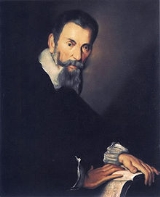
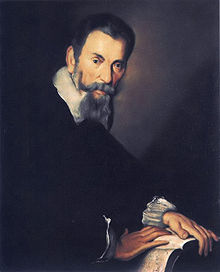
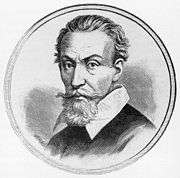
Claudio Monteverdi

Encyclopedia
Viol
The viol is any one of a family of bowed, fretted and stringed musical instruments developed in the mid-late 15th century and used primarily in the Renaissance and Baroque periods. The family is related to and descends primarily from the Renaissance vihuela, a plucked instrument that preceded the...
, and singer.
Monteverdi's work, often regarded as revolutionary, marked the transition from the Renaissance
Renaissance music
Renaissance music is European music written during the Renaissance. Defining the beginning of the musical era is difficult, given that its defining characteristics were adopted only gradually; musicologists have placed its beginnings from as early as 1300 to as late as the 1470s.Literally meaning...
style of music to that of the Baroque
Baroque music
Baroque music describes a style of Western Classical music approximately extending from 1600 to 1760. This era follows the Renaissance and was followed in turn by the Classical era...
period. He developed two individual styles of composition – the heritage of Renaissance polyphony
Polyphony
In music, polyphony is a texture consisting of two or more independent melodic voices, as opposed to music with just one voice or music with one dominant melodic voice accompanied by chords ....
and the new basso continuo technique of the Baroque. Monteverdi wrote one of the earliest operas, L'Orfeo, an innovative work that is still regularly performed. He was recognized as an innovative composer and enjoyed considerable fame in his lifetime.
Life
Claudio Monteverdi was born in 1567 in CremonaCremona
Cremona is a city and comune in northern Italy, situated in Lombardy, on the left bank of the Po River in the middle of the Pianura Padana . It is the capital of the province of Cremona and the seat of the local City and Province governments...
, a town in Northern Italy. His father was Baldassare Monteverdi, a doctor, apothecary and surgeon. He was the oldest of five children. During his childhood, he was taught by Marc'Antonio Ingegneri, the maestro di cappella at the Cathedral of Cremona. The Maestro di capella’s job was to conduct important worship services in accordance with the liturgy books of the Catholic Church. Monteverdi learned about music by being part of the cathedral choir. He also studied at the University of Cremona. His first music was written for publication, including some motet
Motet
In classical music, motet is a word that is applied to a number of highly varied choral musical compositions.-Etymology:The name comes either from the Latin movere, or a Latinized version of Old French mot, "word" or "verbal utterance." The Medieval Latin for "motet" is motectum, and the Italian...
s and sacred madrigals
Madrigal (music)
A madrigal is a secular vocal music composition, usually a partsong, of the Renaissance and early Baroque eras. Traditionally, polyphonic madrigals are unaccompanied; the number of voices varies from two to eight, and most frequently from three to six....
, in 1582 and 1583. His first five publications were: Sacrae cantiunculae, 1582 (collection of miniature motets); Madrigali Spirituali, 1583 (a volume of which only the bass partbook is extant); Canzonette a tre voci, 1584 (a collection of three-voice canzonettes); and the five-part madrigals Book I, 1587, and Book II, 1590. Monteverdi worked for the court of Mantua first as a singer and violist, then as music director. He worked at the court of Vincenzo I of Gonzaga in Mantua
Mantua
Mantua is a city and comune in Lombardy, Italy and capital of the province of the same name. Mantua's historic power and influence under the Gonzaga family, made it one of the main artistic, cultural and notably musical hubs of Northern Italy and the country as a whole...
as a vocalist and viol
Viol
The viol is any one of a family of bowed, fretted and stringed musical instruments developed in the mid-late 15th century and used primarily in the Renaissance and Baroque periods. The family is related to and descends primarily from the Renaissance vihuela, a plucked instrument that preceded the...
player. In 1602, he was working as the court conductor.
In 1599 Monteverdi married the court singer Claudia Cattaneo, who died in September 1607. He and his wife had two boys (Francesco and Massimilino) and one girl (Leonora) – another daughter died shortly after birth.
By 1613, he had moved to the San Marco in Venice where, as conductor, he quickly restored the musical standard of both the choir and the instrumentalists. The musical standard had declined due to the financial mismanagement of his predecessor, Giulio Cesare Martinengo
Giulio Cesare Martinengo
Giulio Cesare Martinengo was an Italian composer and teacher of the late Renaissance and early Baroque Venetian School. He was the predecessor to Claudio Monteverdi at St. Mark's....
. The managers of the basilica were relieved to have such a distinguished musician in charge, as the music had been declining since the death of Giovanni Croce
Giovanni Croce
Giovanni Croce was an Italian composer of the late Renaissance, of the Venetian School...
in 1609.
In 1632, he became a priest.
Viol
The viol is any one of a family of bowed, fretted and stringed musical instruments developed in the mid-late 15th century and used primarily in the Renaissance and Baroque periods. The family is related to and descends primarily from the Renaissance vihuela, a plucked instrument that preceded the...
, and singer.
Monteverdi's work, often regarded as revolutionary, marked the transition from the Renaissance
Renaissance music
Renaissance music is European music written during the Renaissance. Defining the beginning of the musical era is difficult, given that its defining characteristics were adopted only gradually; musicologists have placed its beginnings from as early as 1300 to as late as the 1470s.Literally meaning...
style of music to that of the Baroque
Baroque music
Baroque music describes a style of Western Classical music approximately extending from 1600 to 1760. This era follows the Renaissance and was followed in turn by the Classical era...
period.Halsey, William D., ed. Collier's Encyclopedia. Vol. 16. New York: MacMillan Educational Company, 1991. He developed two individual styles of composition – the heritage of Renaissance polyphony
Polyphony
In music, polyphony is a texture consisting of two or more independent melodic voices, as opposed to music with just one voice or music with one dominant melodic voice accompanied by chords ....
and the new basso continuo technique of the Baroque.Ringer, Mark. Opera's First Master: The Musical Dramas of Claudio Monteverdi. Canada: Amadeus Press, 2006. Monteverdi wrote one of the earliest operas, L'Orfeo, an innovative work that is still regularly performed. He was recognized as an innovative composer and enjoyed considerable fame in his lifetime.
Life
Claudio Monteverdi was born in 1567 in CremonaCremona
Cremona is a city and comune in northern Italy, situated in Lombardy, on the left bank of the Po River in the middle of the Pianura Padana . It is the capital of the province of Cremona and the seat of the local City and Province governments...
, a town in Northern Italy. His father was Baldassare Monteverdi, a doctor, apothecary and surgeon.Halsey, William D., ed. Collier's Encyclopedia. Vol. 16 New York: MacMillan Educational Company, 1991. He was the oldest of five children.Redlich, H. F. Claudio Monteverdi: Life and Work. London: Oxford University Press
Oxford University Press
Oxford University Press is the largest university press in the world. It is a department of the University of Oxford and is governed by a group of 15 academics appointed by the Vice-Chancellor known as the Delegates of the Press. They are headed by the Secretary to the Delegates, who serves as...
, 1952, . During his childhood, he was taught by Marc'Antonio Ingegneri,Redlich, H. F. Claudio Monteverdi: Life and Work. London: Oxford University Press, 1952. the maestro di cappella at the Cathedral of Cremona.Schrade, Leo. Monteverdi: Creator of Modern Music. New York: W. W. Norton & Company, 1950, . The Maestro di capella’s job was to conduct important worship services in accordance with the liturgy books of the Catholic Church.Whenham, John, ed. The Cambridge Companion to Monteverdi. Cambridge: Cambridge University Press
Cambridge University Press
Cambridge University Press is the publishing business of the University of Cambridge. Granted letters patent by Henry VIII in 1534, it is the world's oldest publishing house, and the second largest university press in the world...
, 2007, . Monteverdi learned about music by being part of the cathedral choir. He also studied at the University of Cremona. His first music was written for publication, including some motet
Motet
In classical music, motet is a word that is applied to a number of highly varied choral musical compositions.-Etymology:The name comes either from the Latin movere, or a Latinized version of Old French mot, "word" or "verbal utterance." The Medieval Latin for "motet" is motectum, and the Italian...
s and sacred madrigals
Madrigal (music)
A madrigal is a secular vocal music composition, usually a partsong, of the Renaissance and early Baroque eras. Traditionally, polyphonic madrigals are unaccompanied; the number of voices varies from two to eight, and most frequently from three to six....
, in 1582 and 1583.Schrade, Leo. Monteverdi: Creator of Modern Music. New York: W. W. Norton & Company, 1950. His first five publications were: Sacrae cantiunculae, 1582 (collection of miniature motets); Madrigali Spirituali, 1583 (a volume of which only the bass partbook is extant); Canzonette a tre voci, 1584 (a collection of three-voice canzonettes); and the five-part madrigals Book I, 1587, and Book II, 1590.Halsey, William D., ed. Collier's Encyclopedia. Vol. 16. New York: MacMillan Educational Company, 1991. Monteverdi worked for the court of Mantua first as a singer and violist, then as music director.Kamien Roger, An Appreciation of Music 4th brief edition. Boston: McGraw-Hill, 2002, . He worked at the court of Vincenzo I of Gonzaga in Mantua
Mantua
Mantua is a city and comune in Lombardy, Italy and capital of the province of the same name. Mantua's historic power and influence under the Gonzaga family, made it one of the main artistic, cultural and notably musical hubs of Northern Italy and the country as a whole...
as a vocalist and viol
Viol
The viol is any one of a family of bowed, fretted and stringed musical instruments developed in the mid-late 15th century and used primarily in the Renaissance and Baroque periods. The family is related to and descends primarily from the Renaissance vihuela, a plucked instrument that preceded the...
player. In 1602, he was working as the court conductor.
In 1599 Monteverdi married the court singer Claudia Cattaneo,Whenham, John, and Richard Wistreich, eds. The Cambridge Companion to Monteverdi. Cambridge: Cambridge University Press, 2007. who died in September 1607.Whenham, John, and Richard Wistreich, eds. The Cambridge Companion to Monteverdi. Cambridge: Cambridge University Press, 2007, . He and his wife had two boys (Francesco and Massimilino) and one girl (Leonora) – another daughter died shortly after birth.
By 1613, he had moved to the San Marco in Venice where, as conductor, he quickly restored the musical standard of both the choir and the instrumentalists. The musical standard had declined due to the financial mismanagement of his predecessor, Giulio Cesare Martinengo
Giulio Cesare Martinengo
Giulio Cesare Martinengo was an Italian composer and teacher of the late Renaissance and early Baroque Venetian School. He was the predecessor to Claudio Monteverdi at St. Mark's....
. The managers of the basilica were relieved to have such a distinguished musician in charge, as the music had been declining since the death of Giovanni Croce
Giovanni Croce
Giovanni Croce was an Italian composer of the late Renaissance, of the Venetian School...
in 1609.
In 1632, he became a priest.
Viol
The viol is any one of a family of bowed, fretted and stringed musical instruments developed in the mid-late 15th century and used primarily in the Renaissance and Baroque periods. The family is related to and descends primarily from the Renaissance vihuela, a plucked instrument that preceded the...
, and singer.
Monteverdi's work, often regarded as revolutionary, marked the transition from the Renaissance
Renaissance music
Renaissance music is European music written during the Renaissance. Defining the beginning of the musical era is difficult, given that its defining characteristics were adopted only gradually; musicologists have placed its beginnings from as early as 1300 to as late as the 1470s.Literally meaning...
style of music to that of the Baroque
Baroque music
Baroque music describes a style of Western Classical music approximately extending from 1600 to 1760. This era follows the Renaissance and was followed in turn by the Classical era...
period.Halsey, William D., ed. Collier's Encyclopedia. Vol. 16. New York: MacMillan Educational Company, 1991. He developed two individual styles of composition – the heritage of Renaissance polyphony
Polyphony
In music, polyphony is a texture consisting of two or more independent melodic voices, as opposed to music with just one voice or music with one dominant melodic voice accompanied by chords ....
and the new basso continuo technique of the Baroque.Ringer, Mark. Opera's First Master: The Musical Dramas of Claudio Monteverdi. Canada: Amadeus Press, 2006. Monteverdi wrote one of the earliest operas, L'Orfeo, an innovative work that is still regularly performed. He was recognized as an innovative composer and enjoyed considerable fame in his lifetime.
Life
Claudio Monteverdi was born in 1567 in CremonaCremona
Cremona is a city and comune in northern Italy, situated in Lombardy, on the left bank of the Po River in the middle of the Pianura Padana . It is the capital of the province of Cremona and the seat of the local City and Province governments...
, a town in Northern Italy. His father was Baldassare Monteverdi, a doctor, apothecary and surgeon.Halsey, William D., ed. Collier's Encyclopedia. Vol. 16 New York: MacMillan Educational Company, 1991. He was the oldest of five children.Redlich, H. F. Claudio Monteverdi: Life and Work. London: Oxford University Press
Oxford University Press
Oxford University Press is the largest university press in the world. It is a department of the University of Oxford and is governed by a group of 15 academics appointed by the Vice-Chancellor known as the Delegates of the Press. They are headed by the Secretary to the Delegates, who serves as...
, 1952, . During his childhood, he was taught by Marc'Antonio Ingegneri,Redlich, H. F. Claudio Monteverdi: Life and Work. London: Oxford University Press, 1952. the maestro di cappella at the Cathedral of Cremona.Schrade, Leo. Monteverdi: Creator of Modern Music. New York: W. W. Norton & Company, 1950, . The Maestro di capella’s job was to conduct important worship services in accordance with the liturgy books of the Catholic Church.Whenham, John, ed. The Cambridge Companion to Monteverdi. Cambridge: Cambridge University Press
Cambridge University Press
Cambridge University Press is the publishing business of the University of Cambridge. Granted letters patent by Henry VIII in 1534, it is the world's oldest publishing house, and the second largest university press in the world...
, 2007, . Monteverdi learned about music by being part of the cathedral choir. He also studied at the University of Cremona. His first music was written for publication, including some motet
Motet
In classical music, motet is a word that is applied to a number of highly varied choral musical compositions.-Etymology:The name comes either from the Latin movere, or a Latinized version of Old French mot, "word" or "verbal utterance." The Medieval Latin for "motet" is motectum, and the Italian...
s and sacred madrigals
Madrigal (music)
A madrigal is a secular vocal music composition, usually a partsong, of the Renaissance and early Baroque eras. Traditionally, polyphonic madrigals are unaccompanied; the number of voices varies from two to eight, and most frequently from three to six....
, in 1582 and 1583.Schrade, Leo. Monteverdi: Creator of Modern Music. New York: W. W. Norton & Company, 1950. His first five publications were: Sacrae cantiunculae, 1582 (collection of miniature motets); Madrigali Spirituali, 1583 (a volume of which only the bass partbook is extant); Canzonette a tre voci, 1584 (a collection of three-voice canzonettes); and the five-part madrigals Book I, 1587, and Book II, 1590.Halsey, William D., ed. Collier's Encyclopedia. Vol. 16. New York: MacMillan Educational Company, 1991. Monteverdi worked for the court of Mantua first as a singer and violist, then as music director.Kamien Roger, An Appreciation of Music 4th brief edition. Boston: McGraw-Hill, 2002, . He worked at the court of Vincenzo I of Gonzaga in Mantua
Mantua
Mantua is a city and comune in Lombardy, Italy and capital of the province of the same name. Mantua's historic power and influence under the Gonzaga family, made it one of the main artistic, cultural and notably musical hubs of Northern Italy and the country as a whole...
as a vocalist and viol
Viol
The viol is any one of a family of bowed, fretted and stringed musical instruments developed in the mid-late 15th century and used primarily in the Renaissance and Baroque periods. The family is related to and descends primarily from the Renaissance vihuela, a plucked instrument that preceded the...
player. In 1602, he was working as the court conductor.
In 1599 Monteverdi married the court singer Claudia Cattaneo,Whenham, John, and Richard Wistreich, eds. The Cambridge Companion to Monteverdi. Cambridge: Cambridge University Press, 2007. who died in September 1607.Whenham, John, and Richard Wistreich, eds. The Cambridge Companion to Monteverdi. Cambridge: Cambridge University Press, 2007, . He and his wife had two boys (Francesco and Massimilino) and one girl (Leonora) – another daughter died shortly after birth.
By 1613, he had moved to the San Marco in Venice where, as conductor, he quickly restored the musical standard of both the choir and the instrumentalists. The musical standard had declined due to the financial mismanagement of his predecessor, Giulio Cesare Martinengo
Giulio Cesare Martinengo
Giulio Cesare Martinengo was an Italian composer and teacher of the late Renaissance and early Baroque Venetian School. He was the predecessor to Claudio Monteverdi at St. Mark's....
. The managers of the basilica were relieved to have such a distinguished musician in charge, as the music had been declining since the death of Giovanni Croce
Giovanni Croce
Giovanni Croce was an Italian composer of the late Renaissance, of the Venetian School...
in 1609.
In 1632, he became a priest.Marthaler, Benard L., ed. New Catholic Encyclopedia 2nd ed. Detroit: Thomson Gale, 2003
Viol
The viol is any one of a family of bowed, fretted and stringed musical instruments developed in the mid-late 15th century and used primarily in the Renaissance and Baroque periods. The family is related to and descends primarily from the Renaissance vihuela, a plucked instrument that preceded the...
, and singer.
Monteverdi's work, often regarded as revolutionary, marked the transition from the Renaissance
Renaissance music
Renaissance music is European music written during the Renaissance. Defining the beginning of the musical era is difficult, given that its defining characteristics were adopted only gradually; musicologists have placed its beginnings from as early as 1300 to as late as the 1470s.Literally meaning...
style of music to that of the Baroque
Baroque music
Baroque music describes a style of Western Classical music approximately extending from 1600 to 1760. This era follows the Renaissance and was followed in turn by the Classical era...
period.Halsey, William D., ed. Collier's Encyclopedia. Vol. 16. New York: MacMillan Educational Company, 1991. He developed two individual styles of composition – the heritage of Renaissance polyphony
Polyphony
In music, polyphony is a texture consisting of two or more independent melodic voices, as opposed to music with just one voice or music with one dominant melodic voice accompanied by chords ....
and the new basso continuo technique of the Baroque.Ringer, Mark. Opera's First Master: The Musical Dramas of Claudio Monteverdi. Canada: Amadeus Press, 2006. Monteverdi wrote one of the earliest operas, L'Orfeo, an innovative work that is still regularly performed. He was recognized as an innovative composer and enjoyed considerable fame in his lifetime.
Life
Claudio Monteverdi was born in 1567 in CremonaCremona
Cremona is a city and comune in northern Italy, situated in Lombardy, on the left bank of the Po River in the middle of the Pianura Padana . It is the capital of the province of Cremona and the seat of the local City and Province governments...
, a town in Northern Italy. His father was Baldassare Monteverdi, a doctor, apothecary and surgeon.Halsey, William D., ed. Collier's Encyclopedia. Vol. 16 New York: MacMillan Educational Company, 1991. He was the oldest of five children.Redlich, H. F. Claudio Monteverdi: Life and Work. London: Oxford University Press
Oxford University Press
Oxford University Press is the largest university press in the world. It is a department of the University of Oxford and is governed by a group of 15 academics appointed by the Vice-Chancellor known as the Delegates of the Press. They are headed by the Secretary to the Delegates, who serves as...
, 1952, . During his childhood, he was taught by Marc'Antonio Ingegneri,Redlich, H. F. Claudio Monteverdi: Life and Work. London: Oxford University Press, 1952. the maestro di cappella at the Cathedral of Cremona.Schrade, Leo. Monteverdi: Creator of Modern Music. New York: W. W. Norton & Company, 1950, . The Maestro di capella’s job was to conduct important worship services in accordance with the liturgy books of the Catholic Church.Whenham, John, ed. The Cambridge Companion to Monteverdi. Cambridge: Cambridge University Press
Cambridge University Press
Cambridge University Press is the publishing business of the University of Cambridge. Granted letters patent by Henry VIII in 1534, it is the world's oldest publishing house, and the second largest university press in the world...
, 2007, . Monteverdi learned about music by being part of the cathedral choir. He also studied at the University of Cremona. His first music was written for publication, including some motet
Motet
In classical music, motet is a word that is applied to a number of highly varied choral musical compositions.-Etymology:The name comes either from the Latin movere, or a Latinized version of Old French mot, "word" or "verbal utterance." The Medieval Latin for "motet" is motectum, and the Italian...
s and sacred madrigals
Madrigal (music)
A madrigal is a secular vocal music composition, usually a partsong, of the Renaissance and early Baroque eras. Traditionally, polyphonic madrigals are unaccompanied; the number of voices varies from two to eight, and most frequently from three to six....
, in 1582 and 1583.Schrade, Leo. Monteverdi: Creator of Modern Music. New York: W. W. Norton & Company, 1950. His first five publications were: Sacrae cantiunculae, 1582 (collection of miniature motets); Madrigali Spirituali, 1583 (a volume of which only the bass partbook is extant); Canzonette a tre voci, 1584 (a collection of three-voice canzonettes); and the five-part madrigals Book I, 1587, and Book II, 1590.Halsey, William D., ed. Collier's Encyclopedia. Vol. 16. New York: MacMillan Educational Company, 1991. Monteverdi worked for the court of Mantua first as a singer and violist, then as music director.Kamien Roger, An Appreciation of Music 4th brief edition. Boston: McGraw-Hill, 2002, . He worked at the court of Vincenzo I of Gonzaga in Mantua
Mantua
Mantua is a city and comune in Lombardy, Italy and capital of the province of the same name. Mantua's historic power and influence under the Gonzaga family, made it one of the main artistic, cultural and notably musical hubs of Northern Italy and the country as a whole...
as a vocalist and viol
Viol
The viol is any one of a family of bowed, fretted and stringed musical instruments developed in the mid-late 15th century and used primarily in the Renaissance and Baroque periods. The family is related to and descends primarily from the Renaissance vihuela, a plucked instrument that preceded the...
player. In 1602, he was working as the court conductor.
In 1599 Monteverdi married the court singer Claudia Cattaneo,Whenham, John, and Richard Wistreich, eds. The Cambridge Companion to Monteverdi. Cambridge: Cambridge University Press, 2007. who died in September 1607.Whenham, John, and Richard Wistreich, eds. The Cambridge Companion to Monteverdi. Cambridge: Cambridge University Press, 2007, . He and his wife had two boys (Francesco and Massimilino) and one girl (Leonora) – another daughter died shortly after birth.
By 1613, he had moved to the San Marco in Venice where, as conductor, he quickly restored the musical standard of both the choir and the instrumentalists. The musical standard had declined due to the financial mismanagement of his predecessor, Giulio Cesare Martinengo
Giulio Cesare Martinengo
Giulio Cesare Martinengo was an Italian composer and teacher of the late Renaissance and early Baroque Venetian School. He was the predecessor to Claudio Monteverdi at St. Mark's....
. The managers of the basilica were relieved to have such a distinguished musician in charge, as the music had been declining since the death of Giovanni Croce
Giovanni Croce
Giovanni Croce was an Italian composer of the late Renaissance, of the Venetian School...
in 1609.
In 1632, he became a priest.Marthaler, Benard L., ed. New Catholic Encyclopedia 2nd ed. Detroit: Thomson Gale, 2003
Viol
The viol is any one of a family of bowed, fretted and stringed musical instruments developed in the mid-late 15th century and used primarily in the Renaissance and Baroque periods. The family is related to and descends primarily from the Renaissance vihuela, a plucked instrument that preceded the...
, and singer.
Monteverdi's work, often regarded as revolutionary, marked the transition from the Renaissance
Renaissance music
Renaissance music is European music written during the Renaissance. Defining the beginning of the musical era is difficult, given that its defining characteristics were adopted only gradually; musicologists have placed its beginnings from as early as 1300 to as late as the 1470s.Literally meaning...
style of music to that of the Baroque
Baroque music
Baroque music describes a style of Western Classical music approximately extending from 1600 to 1760. This era follows the Renaissance and was followed in turn by the Classical era...
period.Halsey, William D., ed. Collier's Encyclopedia. Vol. 16. New York: MacMillan Educational Company, 1991. He developed two individual styles of composition – the heritage of Renaissance polyphony
Polyphony
In music, polyphony is a texture consisting of two or more independent melodic voices, as opposed to music with just one voice or music with one dominant melodic voice accompanied by chords ....
and the new basso continuo technique of the Baroque.Ringer, Mark. Opera's First Master: The Musical Dramas of Claudio Monteverdi. Canada: Amadeus Press, 2006. Monteverdi wrote one of the earliest operas, L'Orfeo, an innovative work that is still regularly performed. He was recognized as an innovative composer and enjoyed considerable fame in his lifetime.
Life
Claudio Monteverdi was born in 1567 in CremonaCremona
Cremona is a city and comune in northern Italy, situated in Lombardy, on the left bank of the Po River in the middle of the Pianura Padana . It is the capital of the province of Cremona and the seat of the local City and Province governments...
, a town in Northern Italy. His father was Baldassare Monteverdi, a doctor, apothecary and surgeon.Halsey, William D., ed. Collier's Encyclopedia. Vol. 16 New York: MacMillan Educational Company, 1991. He was the oldest of five children.Redlich, H. F. Claudio Monteverdi: Life and Work. London: Oxford University Press
Oxford University Press
Oxford University Press is the largest university press in the world. It is a department of the University of Oxford and is governed by a group of 15 academics appointed by the Vice-Chancellor known as the Delegates of the Press. They are headed by the Secretary to the Delegates, who serves as...
, 1952, . During his childhood, he was taught by Marc'Antonio Ingegneri,Redlich, H. F. Claudio Monteverdi: Life and Work. London: Oxford University Press, 1952. the maestro di cappella at the Cathedral of Cremona.Schrade, Leo. Monteverdi: Creator of Modern Music. New York: W. W. Norton & Company, 1950, . The Maestro di capella’s job was to conduct important worship services in accordance with the liturgy books of the Catholic Church.Whenham, John, ed. The Cambridge Companion to Monteverdi. Cambridge: Cambridge University Press
Cambridge University Press
Cambridge University Press is the publishing business of the University of Cambridge. Granted letters patent by Henry VIII in 1534, it is the world's oldest publishing house, and the second largest university press in the world...
, 2007, . Monteverdi learned about music by being part of the cathedral choir. He also studied at the University of Cremona. His first music was written for publication, including some motet
Motet
In classical music, motet is a word that is applied to a number of highly varied choral musical compositions.-Etymology:The name comes either from the Latin movere, or a Latinized version of Old French mot, "word" or "verbal utterance." The Medieval Latin for "motet" is motectum, and the Italian...
s and sacred madrigals
Madrigal (music)
A madrigal is a secular vocal music composition, usually a partsong, of the Renaissance and early Baroque eras. Traditionally, polyphonic madrigals are unaccompanied; the number of voices varies from two to eight, and most frequently from three to six....
, in 1582 and 1583.Schrade, Leo. Monteverdi: Creator of Modern Music. New York: W. W. Norton & Company, 1950. His first five publications were: Sacrae cantiunculae, 1582 (collection of miniature motets); Madrigali Spirituali, 1583 (a volume of which only the bass partbook is extant); Canzonette a tre voci, 1584 (a collection of three-voice canzonettes); and the five-part madrigals Book I, 1587, and Book II, 1590.Halsey, William D., ed. Collier's Encyclopedia. Vol. 16. New York: MacMillan Educational Company, 1991. Monteverdi worked for the court of Mantua first as a singer and violist, then as music director.Kamien Roger, An Appreciation of Music 4th brief edition. Boston: McGraw-Hill, 2002, . He worked at the court of Vincenzo I of Gonzaga in Mantua
Mantua
Mantua is a city and comune in Lombardy, Italy and capital of the province of the same name. Mantua's historic power and influence under the Gonzaga family, made it one of the main artistic, cultural and notably musical hubs of Northern Italy and the country as a whole...
as a vocalist and viol
Viol
The viol is any one of a family of bowed, fretted and stringed musical instruments developed in the mid-late 15th century and used primarily in the Renaissance and Baroque periods. The family is related to and descends primarily from the Renaissance vihuela, a plucked instrument that preceded the...
player. In 1602, he was working as the court conductor.
In 1599 Monteverdi married the court singer Claudia Cattaneo,Whenham, John, and Richard Wistreich, eds. The Cambridge Companion to Monteverdi. Cambridge: Cambridge University Press, 2007. who died in September 1607.Whenham, John, and Richard Wistreich, eds. The Cambridge Companion to Monteverdi. Cambridge: Cambridge University Press, 2007, . He and his wife had two boys (Francesco and Massimilino) and one girl (Leonora) – another daughter died shortly after birth.
By 1613, he had moved to the San Marco in Venice where, as conductor, he quickly restored the musical standard of both the choir and the instrumentalists. The musical standard had declined due to the financial mismanagement of his predecessor, Giulio Cesare Martinengo
Giulio Cesare Martinengo
Giulio Cesare Martinengo was an Italian composer and teacher of the late Renaissance and early Baroque Venetian School. He was the predecessor to Claudio Monteverdi at St. Mark's....
. The managers of the basilica were relieved to have such a distinguished musician in charge, as the music had been declining since the death of Giovanni Croce
Giovanni Croce
Giovanni Croce was an Italian composer of the late Renaissance, of the Venetian School...
in 1609.
In 1632, he became a priest.Marthaler, Benard L., ed. New Catholic Encyclopedia 2nd ed. Detroit: Thomson Gale, 2003 L'incoronazione especially is considered a culminating point of Monteverdi's work. It contains tragic, romantic, and comedic scenes (a new development in opera), a more realistic portrayal of the characters, and warmer melodies
Melody
A melody , also tune, voice, or line, is a linear succession of musical tones which is perceived as a single entity...
than previously heard.Arnold, Denis, and Nigel Fortune, eds. The New Monteverdi Companion. London: faber and faber, 1985, . It requires a smaller orchestra, and has a less prominent role for the choir. For a long period of time, Monteverdi's operas were merely regarded as a historical or musical interest. Since the 1960s, The Coronation of Poppea has re-entered the repertoire of major opera companies worldwide.
Monteverdi died in Venice
Venice
Venice is a city in northern Italy which is renowned for the beauty of its setting, its architecture and its artworks. It is the capital of the Veneto region...
on 29 November 1643 and was buried at the church of the Frari.Halsey, William D., ed. Collier's Encyclopedia. Vol. 16.. New York: MacMillan Educational Company, 1991.
Works
Monteverdi's works are split into three categories: madrigals, operas, and church-music.Redlich, H. F. Claudio Monteverdi: Life and Work. London: Oxford University, Press, 1952, .Madrigals
Until the age of forty, Monteverdi worked primarily on madrigalsMadrigal (music)
A madrigal is a secular vocal music composition, usually a partsong, of the Renaissance and early Baroque eras. Traditionally, polyphonic madrigals are unaccompanied; the number of voices varies from two to eight, and most frequently from three to six....
, composing a total of nine books. It took Monteverdi about four years to finish his first book of twenty-one madrigals for five voices. As a whole, the first eight books of madrigals show the enormous development from Renaissance
Renaissance music
Renaissance music is European music written during the Renaissance. Defining the beginning of the musical era is difficult, given that its defining characteristics were adopted only gradually; musicologists have placed its beginnings from as early as 1300 to as late as the 1470s.Literally meaning...
polyphonic
Polyphony
In music, polyphony is a texture consisting of two or more independent melodic voices, as opposed to music with just one voice or music with one dominant melodic voice accompanied by chords ....
music to the monodic
Monody
In poetry, the term monody has become specialized to refer to a poem in which one person laments another's death....
style typical of Baroque
Baroque
The Baroque is a period and the style that used exaggerated motion and clear, easily interpreted detail to produce drama, tension, exuberance, and grandeur in sculpture, painting, literature, dance, and music...
music.
The titles of his Madrigal books are:
- Book 1, 1587: Madrigali a cinque vociShcrade, Leo. Monteverdi: Creator of Modern Music. New York: W. W. Norton & Company, 1950, .
- Book 2, 1590: Il secondo libro de madrigali a cinque voci
- Book 3, 1592: Il terzo libro de madrigali a cinque voci
- Book 4, 1603: Il quarto libro de madrigali a cinque voci
- Book 5, 1605: Il quinto libro de madrigali a cinque voci
- Book 6, 1614: Il sesto libro de madrigali a cinque voci
- Book 7, 1619: Concerto. Settimo libro di madrigaliArnold, Denis. Monteverdi Madrigals. London: Billing and Sons Limited, 1967, .
- Book 8, 1638: Madrigali guerrieri, et amorosi con alcuni opuscoli in genere rappresentativo, che saranno per brevi episodi fra i canti senza gesto.
- Book 9, 1651: Madrigali e canzonette a due e tre voci
The Fifth Madrigal Book
The Fifth Book of Madrigals shows the shift from the late Renaissance style of music to the early Baroque.Ringer, Mark. Opera's First Master: The Musical Dramas of Claudio Monteverdi. Canada: Amadeus Press, 2006. The Quinto Libro (Fifth Book), published in 1605, was at the heart of the controversy between Monteverdi and Giovanni ArtusiGiovanni Artusi
Giovanni Maria Artusi was an Italian theorist, composer, and writer.Artusi was one of the most famous reactionaries in musical history, fiercely condemning the new style developing around 1600, the innovations of which defined the early Baroque era...
. Giovanni Artusi attacked the "crudities" and "license" of the modern style of composing, centering his attacks on madrigals (including Cruda Amarilli, composed around 1600) (See Fabbri, Monteverdi, p. 60) from the fourth book. Monteverdi made his reply in the introduction to the fifth book, with a proposal of the division of musical practice into two streams, which he called prima prattica, and seconda prattica. Prima prattica was described as the previous polyphonic
Polyphony
In music, polyphony is a texture consisting of two or more independent melodic voices, as opposed to music with just one voice or music with one dominant melodic voice accompanied by chords ....
ideal of the sixteenth century, with flowing strict counterpoint
Counterpoint
In music, counterpoint is the relationship between two or more voices that are independent in contour and rhythm and are harmonically interdependent . It has been most commonly identified in classical music, developing strongly during the Renaissance and in much of the common practice period,...
, prepared dissonance
Consonance and dissonance
In music, a consonance is a harmony, chord, or interval considered stable, as opposed to a dissonance , which is considered to be unstable...
, and equality of voices. Seconda prattica used much freer counterpoint with an increasing hierarchy of voices, emphasizing soprano
Soprano
A soprano is a voice type with a vocal range from approximately middle C to "high A" in choral music, or to "soprano C" or higher in operatic music. In four-part chorale style harmony, the soprano takes the highest part, which usually encompasses the melody...
and bass
Bass (voice type)
A bass is a type of male singing voice and possesses the lowest vocal range of all voice types. According to The New Grove Dictionary of Opera, a bass is typically classified as having a range extending from around the second E below middle C to the E above middle C...
. In Prima Prattica the harmony controls the words. In Seconda Prattica the words should be in control of the harmonies. This represented a move towards the new style of monody
Monody
In poetry, the term monody has become specialized to refer to a poem in which one person laments another's death....
. The introduction of continuo
Figured bass
Figured bass, or thoroughbass, is a kind of integer musical notation used to indicate intervals, chords, and non-chord tones, in relation to a bass note...
in many of the madrigals was a further self-consciously modern feature. In addition, the fifth book showed the beginnings of conscious functional tonality.
The Eighth Madrigal Book
Ferdinand II, Holy Roman Emperor
Ferdinand II , a member of the House of Habsburg, was Holy Roman Emperor , King of Bohemia , and King of Hungary . His rule coincided with the Thirty Years' War.- Life :...
, but because of his ill health, his son was made king in December 1636. When the work was first published in 1638 Monteverdi rededicated it to the new King Ferdinand III
Ferdinand III, Holy Roman Emperor
Ferdinand III was Holy Roman Emperor from 15 February 1637 until his death, as well as King of Hungary and Croatia, King of Bohemia and Archduke of Austria.-Life:...
.Denis Arnold and Nigel Fortune
Nigel Fortune
Nigel Cameron Fortune was an English musicologist and political activist. Along with Thurston Dart, Oliver Neighbour, and Stanley Sadie he was one of Britain's leading musicologists of the post-World War II generation...
, Editors. The New Monteverdi Companion. (Boston: Faber and Faber Ltd., 1985), 233. The eighth book includes the so-called Madrigali dei guerrieri et amorosi (Madrigals of War and Love).
The book is divided into sections of War and Love each containing madrigals, a piece in dramatic form (genere rappresentativo), and a ballet. In the Madrigals of War, Monteverdi has organized poetry that describes the pursuits of love through the allegory of war; the hunt for love, and the battle to find love. In the second half of the book, the Madrigals of Love, Monteverdi organized poetry that describes the unhappiness of being in love, unfaithfulness, and ungrateful lovers that feel no shame. In his previous madrigal collections, Monteverdi usually set poetry from one or two poets he was in contact with through the court where he was employed. The Book 8 Madrigals of War and Love represent an overview of the poets he has dealt with throughout his life; the classical poetry of Petrarch, poetry by his contemporaries (Tasso
Torquato Tasso
Torquato Tasso was an Italian poet of the 16th century, best known for his poem La Gerusalemme liberata , in which he depicts a highly imaginative version of the combats between Christians and Muslims at the end of the First Crusade, during the siege of Jerusalem...
, Guarini
Giovanni Battista Guarini
Giovanni Battista Guarini was an Italian poet, dramatist, and diplomat.- Life :He was born in Ferrara, and spent his early life both in Padua and Ferrara, entering the service of Alfonso II d'Este, Duke of Ferrara, in 1567...
, Marino, Rinuccini
Ottavio Rinuccini
Ottavio Rinuccini was an Italian poet, courtier, and opera librettist at the end of the Renaissance and beginning of the Baroque eras...
, Testi and Strozzi
Strozzi
Strozzi is the name of an ancient and noble Florentine family. Palla Strozzi played an important part in the public life of Florence, and founded the first public library in Florence in the monastery of Santa Trinita...
), or anonymous poets that Monteverdi found and adapted to his needs.
Madrigals of War
- Altri canti d’Amor tenero arciero (Let others sing of Love, the tender archer) Anonymous sonnet
- is preceded by a sinfonia introduction that is written for two violins and four viols. The madrigal that follows serves as an introduction to the first half of the collection and as a dedication to Ferdinand III.
- Hor che’l ciel e la terra e’l vento tace (Now that the sky, earth and wind are silent) Sonnet by PetrarchPetrarchFrancesco Petrarca , known in English as Petrarch, was an Italian scholar, poet and one of the earliest humanists. Petrarch is often called the "Father of Humanism"...
,- is the first significant poetic work of the collection in which Monteverdi splits into two sections. In the first section, his poetry introduces the idea of the wars of love, in which he yearns for someone to love him.
- "War is my condition full of anger and grief, and only when thinking of her do I find some peace."
- In the second section, "Thus from a single bright and living fountain" (Cosi sol d’una chiara fonte viva) the symbolism of war continues:
- "One hand alone cures me and wounds me. And, because my suffering never reaches its limits, a thousand times daily I die, and a thousand I am born, so far am I from my salvation."
- is the first significant poetic work of the collection in which Monteverdi splits into two sections. In the first section, his poetry introduces the idea of the wars of love, in which he yearns for someone to love him.
- Gira il nemico insidioso Amore (The insidious enemy, Love, circles the citadel of my heart) CanzonettaCanzonettaIn music, a canzonetta was a popular Italian secular vocal composition which originated around 1560...
by Giulio Strozzi - Se vittorie si belle han le guerre d’amore (If love’s wars have such beautiful victories) madrigal by Fulvio TestiFulvio TestiFulvio Testi was an Italian diplomat and poet. Recognised as one of the main exponents of 17th century Baroque literature, he worked in the service of the d'Este dukes in Modena, for whom he held high office, such as the governorship of Garfagnana...
- Armato il cor d’adamanina fede (My heart armed with adamantine faith) madrigal by Ottavio RinucciniOttavio RinucciniOttavio Rinuccini was an Italian poet, courtier, and opera librettist at the end of the Renaissance and beginning of the Baroque eras...
- Ogni amante e guerrier: nel suo gran regno (Every lover is a warrior: in his great kingdom) madrigal by Ottavio RinucciniOttavio RinucciniOttavio Rinuccini was an Italian poet, courtier, and opera librettist at the end of the Renaissance and beginning of the Baroque eras...
- Ardo, avvampo, mi struggo, ardo: accorrete (I burn, I blaze, I am consumed, I burn; come running) Anonymous Sonnet
- Il Combattimento di Tancredi e ClorindaIl Combattimento di Tancredi e ClorindaIl combattimento di Tancredi e Clorinda is an operatic scena for three voices by Claudio Monteverdi, although many dispute how the piece should be classified. The piece has a libretto drawn from Torquato Tasso's La Gerusalemme Liberata , a Romance set against the backdrop of the First Crusade...
(The Combat of Tancredi and Clorinda) from Torquato Tasso’s Gerusalemme liberata, Canto XII- was originally composed and performed at the home of Girolamo Mocenigo (1624)Paolo FabbriPaolo FabbriPaolo Fabbri is an Italian musicologist and academic. In 1989 he was awarded the Dent Medal. He is best known for his extensive publications on the life and works of Gioachino Rossini, and for a biography of composer Claudio Monteverdi which was first published in the Italian language in Turin in...
, Monteverdi, translated from the Italian by Tim Carter (Cambridge and New York: Cambridge University Press, 1994), 238–39. and includes the dramatic scene in which the orchestra and voices form two separate entities, acting as counterparts. Most likely Monteverdi was inspired to try this arrangement because of the two opposite balconies in San Marco. What made this composition also stand out is the first-time use of string tremoloTremoloTremolo, or tremolando, is a musical term that describes various trembling effects, falling roughly into two types. The first is a rapid reiteration...
(fast repetition of the same tone) and pizzicatoPizzicatoPizzicato is a playing technique that involves plucking the strings of a string instrument. The exact technique varies somewhat depending on the type of stringed instrument....
(plucking strings with fingers) for special effect in dramatic scenes.
- was originally composed and performed at the home of Girolamo Mocenigo (1624)Paolo Fabbri
- Introduzione al ballo e ballo: Volgendo il ciel (Introduction to the ballet, and ballet) Sonnet by Ottavio RinucciniOttavio RinucciniOttavio Rinuccini was an Italian poet, courtier, and opera librettist at the end of the Renaissance and beginning of the Baroque eras...
Madrigals of Love
- Altri canti di Marte e di sua schiera (Let others sing of Mars and of his host) Sonnet by Marino
- the parallel work to Altri canti d amor, it serves as an introduction to the second half of the collection. Like its counterpart, it, too, is preceded by an instrumental sinfonia and contains a dedication to Ferdinand III.
- Vago augelletto che cantando vai (Lovely little bird, who are you singing about) Sonnet by PetrarchPetrarchFrancesco Petrarca , known in English as Petrarch, was an Italian scholar, poet and one of the earliest humanists. Petrarch is often called the "Father of Humanism"...
- Mentre vaga angioletta (While a charming, angelic girl attracts every wellborn soul with her singing) madrigal by GuariniGiovanni Battista GuariniGiovanni Battista Guarini was an Italian poet, dramatist, and diplomat.- Life :He was born in Ferrara, and spent his early life both in Padua and Ferrara, entering the service of Alfonso II d'Este, Duke of Ferrara, in 1567...
- Ardo e scoprir, ahi lasso, io non ardisco (I burn and, alas, I do not have the courage to reveal that burning which I bear hidden in my breast) Anonymous, madrigal
- O sia tranquillo il mare o pien d’orgoglio (Whether the sea be still or swelled with pride) Anonymous, Sonnet
- Ninfa che, scalza il piede e sciolto il crine (Nymph, who with bare feet and hair undone) Anonymous madrigal
- Dolcissimo uscignolo (Sweetest nightingale) madrigal by GuariniGiovanni Battista GuariniGiovanni Battista Guarini was an Italian poet, dramatist, and diplomat.- Life :He was born in Ferrara, and spent his early life both in Padua and Ferrara, entering the service of Alfonso II d'Este, Duke of Ferrara, in 1567...
- Chi vol haver felice e lieto il core (Whoever wishes to have a happy joyful heart) madrigal by GuariniGiovanni Battista GuariniGiovanni Battista Guarini was an Italian poet, dramatist, and diplomat.- Life :He was born in Ferrara, and spent his early life both in Padua and Ferrara, entering the service of Alfonso II d'Este, Duke of Ferrara, in 1567...
- Non Havea Febo ancora: Lamento della ninfa (Phoebus had not yet: The Lament of the Nymph) Canzonetta by RinucciniRinucciniRinuccini is a surname, and may refer to:*Giovanni Battista Rinuccini, an Italian archbishop.*Ottavio Rinuccini an Italian poet and librettist....
- Perche te n fuggi, o Fillide? (Why do you run away, Phyllis?) Anonymous madrigal
- Non partir, ritrosetta (Do not depart, maiden averse to love) Anonymous canzonetta
- Su, Su, Su, pastorelli vezzosi (Come, come, come, charming shepherd lads) Anonymous Canzonetta
- Il Ballo delle ingrate (Entrance and Final ballet of the Ungrateful Women)
- The Ballet of the Ungrateful Women was originally composed for the 1608 wedding of Francesco Gonzaga and was revived in 1628 for a performance in Vienna.Paolo FabbriPaolo FabbriPaolo Fabbri is an Italian musicologist and academic. In 1989 he was awarded the Dent Medal. He is best known for his extensive publications on the life and works of Gioachino Rossini, and for a biography of composer Claudio Monteverdi which was first published in the Italian language in Turin in...
, Monteverdi, translated by Tim Carter (Cambridge and New York: Cambridge University Press, 1994), 238–39.
- The Ballet of the Ungrateful Women was originally composed for the 1608 wedding of Francesco Gonzaga and was revived in 1628 for a performance in Vienna.Paolo Fabbri
The Ninth Madrigal Book
The ninth book of madrigals, published posthumously in 1651, contains lighter pieces such as canzonettaCanzonetta
In music, a canzonetta was a popular Italian secular vocal composition which originated around 1560...
s which were probably composed throughout Monteverdi's lifetime representing both styles.
L'Orfeo
Aria
An aria in music was originally any expressive melody, usually, but not always, performed by a singer. The term is now used almost exclusively to describe a self-contained piece for one voice usually with orchestral accompaniment...
, Lamento, from his second opera L'Arianna have survived. From monody
Monody
In poetry, the term monody has become specialized to refer to a poem in which one person laments another's death....
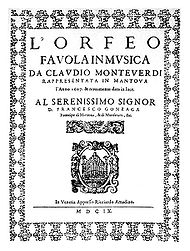
(with melodic lines, intelligible text and placid accompanying music), it was a logical step for Monteverdi to begin composing opera. In 1607, the premiere of his first opera, L'Orfeo, took place in Mantua. L'Orfeo was not the first opera, but the first mature opera, or one that realized all of its potential.Whenham, John. Claudio Monteverdi Orfeo. Cambridge: Cambridge University Press, 1986, . It was normal at that time for composers to create works on demand for special occasions, and this piece was part of the ducal celebrations of carnival
Carnival
Carnaval is a festive season which occurs immediately before Lent; the main events are usually during February. Carnaval typically involves a public celebration or parade combining some elements of a circus, mask and public street party...
.Whenham, John. Claudio Monteverdi Orfeo. Cambridge: Cambrdige University Press, 1986,. (Monteverdi was later to write for the first opera houses supported by ticket sales which opened in Venice). L'Orfeo has dramatic power and lively orchestration
Orchestration
Orchestration is the study or practice of writing music for an orchestra or of adapting for orchestra music composed for another medium...
. L'Orfeo is arguably the first example of a composer assigning specific instruments to parts in operas. It is also one of the first large compositions in which the exact instrumentation of the premiere has come down to us.Whenham, John. Claudio Monteverdi Orfeo. Cambridge: Cambrdige University Press, 1986, . The plot is described in vivid musical pictures and the melodies are linear and clear. With this opera, Monteverdi created an entirely new style of music, the dramma per la musica or musical drama.
L'Arianna
L'Arianna was the second opera written by Claudio Monteverdi. It is one of the most influential and famous specimens of early baroque opera. It was first performed in Mantua in 1608. Its subject matter was the ancient Greek legend of Ariadne and Theseus. During the last years of his life, Monteverdi was often ill. During this time, he composed his two last masterpieces: Il ritorno d'Ulisse in patriaIl ritorno d'Ulisse in patria
Il ritorno d'Ulisse in patria is an opera in a prologue and five acts , set by Claudio Monteverdi to a libretto by Giacomo Badoaro. The opera was first performed at the Teatro Santi Giovanni e Paolo in Venice during the 1639–1640 carnival season...
(The Return of Ulysses, 1640), and the historic opera, L'incoronazione di Poppea, (The Coronation of Poppea, 1642),Redlich, H. F. Claudio Monteveri: Life and Work. London: Oxford University Press, 1952. based on an episode in the life of the Roman
Roman Empire
The Roman Empire was the post-Republican period of the ancient Roman civilization, characterised by an autocratic form of government and large territorial holdings in Europe and around the Mediterranean....
emperor Nero
Nero
Nero , was Roman Emperor from 54 to 68, and the last in the Julio-Claudian dynasty. Nero was adopted by his great-uncle Claudius to become his heir and successor, and succeeded to the throne in 54 following Claudius' death....
. The libretto for Il ritorno d'Ulisse was by Giacomo Badoarro and for L'incoronazione di Poppea by Giovanni Busenello.Halsey, William D., ed. Collier's Encyclopedia. Vol. 16. New York: MacMillan Educational Company 1991.
Vespro della Beata Vergine
Monteverdi's first church music publication was the archaic MassMass (music)
The Mass, a form of sacred musical composition, is a choral composition that sets the invariable portions of the Eucharistic liturgy to music...
In illo tempore to which the Vesper Psalms of 1610 were added. The Vesper Psalms of 1610 are also one of the best examples of early repetition and contrast, with many of the parts having a clear ritornello
Ritornello
A ritornello is a recurring passage in Baroque music for orchestra or chorus. The first or final movement of a solo concerto or aria may be in "ritornello form", in which the ritornello is the opening theme, always played by tutti, which returns in whole or in part and in different keys throughout...
. The published work is on a very grand scale and there has been some controversy as to whether all the movements were intended to be performed in a single service. However, there are various indications of internal unity. In its scope, it foreshadows such summits of Baroque music as Handel
George Frideric Handel
George Frideric Handel was a German-British Baroque composer, famous for his operas, oratorios, anthems and organ concertos. Handel was born in 1685, in a family indifferent to music...
's Messiah
Messiah (Handel)
Messiah is an English-language oratorio composed in 1741 by George Frideric Handel, with a scriptural text compiled by Charles Jennens from the King James Bible and the Book of Common Prayer. It was first performed in Dublin on 13 April 1742, and received its London premiere nearly a year later...
, and J.S. Bach
Johann Sebastian Bach
Johann Sebastian Bach was a German composer, organist, harpsichordist, violist, and violinist whose sacred and secular works for choir, orchestra, and solo instruments drew together the strands of the Baroque period and brought it to its ultimate maturity...
's St Matthew Passion. Each part (there are twenty-five in total) is fully developed in both a musical and dramatic sense – the instrumental textures are used to precise dramatic and emotional effect, in a way that had not been seen before.
- Messa in illo tempore (1610)
- Mass of Thanksgiving (1631)http://www.gramophone.net/Issue/Page/November%201989/138/766560/MONTEVERDI.+Mass+of+Thanksgiving,+Venice+1631.+Taverner+Consort+Taverner+Choir+Taverner+Players++Andrew+Parrott.+EMI+Reflexe+%28E%29+CDS7+498762+%28two+discs,+nas%3A+88+minutes%3A+DOD%29.+Texts+and+translations+included.+Monteverdi%3A+Mass+a+4%E2%80%94Kyrie+Credo+%28Crucifixus+Et+resurrexit+Et+iterum+only%29+Sanctus+Agnus+Dei.+Gloria+a+7.+Ab+aeterno+ordinate+sum+%28Richard+Wistreich,+bass%29.+Salve+Regina+a+2+%28Joseph+Cornwell,+John+Mark+Ainsley,+tens%29.+Fantini%3A+Intrada,+Toccata+e+Sonata+Imperiale+I.+Sonata+lmperiale+II+e+Intrada.+Scarani%3A+Sonata+a+3.+Rovetta%3A+Credo+a+7+%28Et+in+spiritum+sanctum+only%29.+Usper%3A+Sonata+a+8.+Marini%3A+Canzon+quarta.+Plainsong+chant+for+the+Feast+of+S+Maria+della+salute.Mass of Thanksgiving] Gramophone
- Messa a 4 da cappella (1641) (also: Missa in F), part of Selva morale e spiritualeSelva Morale e SpiritualeSelva morale e spirituale is the short title of a collection of sacred music by the Italian composer Claudio Monteverdi, published in Venice in 1640 and 1641. The title translates to "Moral and Spiritual Forest"...
- Messa a 4 v. et salmi a 1–8 v. e parte da cappella & con le litanie della B.V. (Mass for four voices, and Psalms ...) (published posthumously, 1650)
Sacred contrafacta
In 1607, Aquilino CoppiniAquilino Coppini
Aquilino Coppini was an Italian musician and lyricist. While in the service of Cardinal Federico Borromeo, he specialized in creating sacred contrafacta of secular madrigals. His contrafacta are of interest for their concentration on Monteverdi's madrigals and for the form in which he treats the...
published in Milan
Milan
Milan is the second-largest city in Italy and the capital city of the region of Lombardy and of the province of Milan. The city proper has a population of about 1.3 million, while its urban area, roughly coinciding with its administrative province and the bordering Province of Monza and Brianza ,...
his "Musica tolta da i Madrigali di Claudio Monteverde, e d'altri autori … e fatta spirituale" for 5 and 6 voices, in which many of Monteverdi's madrigals (especially from the third, fourth and fifth books) are presented with the original secular texts replaced with sacred Latin
Latin
Latin is an Italic language originally spoken in Latium and Ancient Rome. It, along with most European languages, is a descendant of the ancient Proto-Indo-European language. Although it is considered a dead language, a number of scholars and members of the Christian clergy speak it fluently, and...
contrafacta
Contrafactum
In vocal music, contrafactum refers to "the substitution of one text for another without substantial change to the music"....
carefully prepared by Coppini in order to fit the music in every aspect.
See also
- Compositions by Claudio Monteverdi
- :Category:Operas by Claudio Monteverdi
- The Full Monteverdi (film)The Full Monteverdi (film)The Full Monteverdi is a British film , written and directed by John La Bouchardière and based on his live production of the same name, itself based on Claudio Monteverdi's fourth book of madrigals which, in turn, is a collection of settings of poems by such Italian renaissance poets as Giovanni...
Further reading
- Arnold, Denis (1975). Monteverdi. London, J.M. Dent & Sons Ltd. ISBN 0-460-03155-4
- Arnold, Denis, and Nigel FortuneNigel FortuneNigel Cameron Fortune was an English musicologist and political activist. Along with Thurston Dart, Oliver Neighbour, and Stanley Sadie he was one of Britain's leading musicologists of the post-World War II generation...
(eds.) (1985) The New Monteverdi Companion. Boston: Faber and Faber Ltd. ISBN 978-0571131488 - Bukofzer, ManfredManfred BukofzerManfred Bukofzer was a German-American musicologist and humanist. He studied at Heidelberg University and the Stern conservatory in Berlin, but left Germany in 1933, going to Basle, where he received his doctorate. In 1939 he moved to the United States where he remained, becoming a U.S. citizen...
(1947). Music in the Baroque Era. New York, W.W. Norton & Co. ISBN 0-393-09745-5 - Carter, Tim (1992). Music in Late Renaissance and Early Baroque Italy. Amadeus Press, 1992. ISBN 0-931340-53-5
- Schrade, Leo (1979). Monteverdi. London, Victor Gollancz Ltd. ISBN 0-575-01472-5
- Whenham, John, and Richard Wistreich (eds.) (2007). The Cambridge Companion to Monteverdi. Cambridge Companions to Music. Cambridge and New York: Cambridge University Press. ISBN 0521875250 (cloth) ISBN 0521697980 (pbk)
External links
- English translations of Monteverdi's fourth book of madrigals
- Lauda Jerusalem from Vespro della Beata Vergine as interactive hypermedia at the BinAural Collaborative Hypertext
- Video of several works by Monteverdi performed on original instruments by the ensembleMusical ensembleA musical ensemble is a group of people who perform instrumental or vocal music. In classical music, trios or quartets either blend the sounds of musical instrument families or group together instruments from the same instrument family, such as string ensembles or wind ensembles...
Voices of Music using baroqueBaroqueThe Baroque is a period and the style that used exaggerated motion and clear, easily interpreted detail to produce drama, tension, exuberance, and grandeur in sculpture, painting, literature, dance, and music...
instruments, ornamentation, temperaments, bows, and playing techniques. - Score and audio files of an arrangement of Monteverdi's 'Si dolce e'l tormento'.
- Ilias Chrissochoidis, "The 'Artusi-Monteverdi' Controversy: Background, Content, and Modern Interpretations," British Postgraduate Musicology 6 (2004), online (general introduction suitable for undergraduates).