
All Topics  
Paolo Veronese

 
Paolo Veronese

   Email Print
   Bookmark   Link


Paolo Veronese


Paolo Veronese (1528 – April 19, 1588) was an Italian painter of the Renaissance
Renaissance

The Renaissance was a cultural movement that spanned roughly the 14th to the 17th century, beginning in Italy in the late Middle Ages and later spreading to the rest of Europe....
 in Venice
Venice

Venice is a city in northern Italy, the capital city of the Italian regions Veneto, a population of 271,251 . Together with Padua, Italy, the city is included in the Padua-Venice Metropolitan Area ....
, famous for paintings such as The Wedding at Cana
The Wedding at Cana

The Wedding at Cana is a massive painting by the late-Renaissance or Mannerist Italy painter, Paolo Veronese. It is on display in the Mus?e du Louvre in Paris....
 and The Feast in the House of Levi
The Feast in the House of Levi

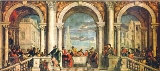
The Feast in the House of Levi is a 1573 painting by Italian painter Paolo Veronese and one of the largest canvases of the 16th century measuring 555 x 1280 cm....
. He adopted the name Paolo Cagliari or Paolo Caliari, and became known as "Veronese" from his birthplace in Verona
Verona

Verona is a city in Veneto, northern Italy, one of the seven provincial capitals in the region. It is one of the main tourist destinations in north-eastern Italy, thanks to its artistic heritage, several annual fairs, shows and operas, such as the lyrical season in the Arena, the ancient amphitheatre built by the Romans....
.

Veronese, Titian
Titian

File:Tizian 090.jpg Tiziano Vecelli or Tiziano Vecellio, born 1473/1490 , died 27 August 1576, better known as Titian , was the leading painter of the 16th-century Venice school of the Italian Renaissance....
, and Tintoretto
Tintoretto

Tintoretto was one of the greatest painters of the Venetian school and probably the last great painter of the Italian Renaissance. For his phenomenal energy in painting he was termed Il Furioso, and his dramatic use of perspectival space and special lighting effects make him a precursor of baroque art....
 constitute the triumvirate of pre-eminent Venetian painters of the late Renaissance (1500s). Veronese is known as a supreme colourist, and for his illusionistic decorations in both fresco and oil.


Discussion
Ask a question about 'Paolo Veronese'
Start a new discussion about 'Paolo Veronese'
Answer questions from other users
Full Discussion Forum


Quotations


I paint my pictures with such judgment as I have and as seems fitting.


Encyclopedia


Paolo Veronese (1528 – April 19, 1588) was an Italian painter of the Renaissance
Renaissance

The Renaissance was a cultural movement that spanned roughly the 14th to the 17th century, beginning in Italy in the late Middle Ages and later spreading to the rest of Europe....
 in Venice
Venice

Venice is a city in northern Italy, the capital city of the Italian regions Veneto, a population of 271,251 . Together with Padua, Italy, the city is included in the Padua-Venice Metropolitan Area ....
, famous for paintings such as The Wedding at Cana
The Wedding at Cana

The Wedding at Cana is a massive painting by the late-Renaissance or Mannerist Italy painter, Paolo Veronese. It is on display in the Mus?e du Louvre in Paris....
 and The Feast in the House of Levi
The Feast in the House of Levi

The Feast in the House of Levi is a 1573 painting by Italian painter Paolo Veronese and one of the largest canvases of the 16th century measuring 555 x 1280 cm....
. He adopted the name Paolo Cagliari or Paolo Caliari, and became known as "Veronese" from his birthplace in Verona
Verona

Verona is a city in Veneto, northern Italy, one of the seven provincial capitals in the region. It is one of the main tourist destinations in north-eastern Italy, thanks to its artistic heritage, several annual fairs, shows and operas, such as the lyrical season in the Arena, the ancient amphitheatre built by the Romans....
.

Veronese, Titian
Titian

File:Tizian 090.jpg Tiziano Vecelli or Tiziano Vecellio, born 1473/1490 , died 27 August 1576, better known as Titian , was the leading painter of the 16th-century Venice school of the Italian Renaissance....
, and Tintoretto
Tintoretto

Tintoretto was one of the greatest painters of the Venetian school and probably the last great painter of the Italian Renaissance. For his phenomenal energy in painting he was termed Il Furioso, and his dramatic use of perspectival space and special lighting effects make him a precursor of baroque art....
 constitute the triumvirate of pre-eminent Venetian painters of the late Renaissance (1500s). Veronese is known as a supreme colourist, and for his illusionistic decorations in both fresco and oil. His most famous works are elaborate narrative cycles, executed in a dramatic and colorful Mannerist
Mannerism

Mannerism is a Art periods of European art which emerged from the later years of the Italian High Renaissance around 1520. It lasted until about 1580 in Italy, when a more Baroque style began to replace it, but continued into the seventeenth century throughout much of Europe....
 style, full of majestic architectural settings and glittering pageantry. His large paintings of biblical feasts executed for the refectories of monasteries in Venice and Verona are especially notable. His brief testimony with the Inquisition is often quoted for its insight into contemporary painting technique.
Paolo Veronese 007

Life and work


Youth

The census in Verona attests that Veronese was born some time in 1528 to a stonecutter named Gabriele, and his wife Catherina. By the age of fourteen Veronese apprenticed with the local master Antonio Badile
Antonio Badile

File:Antonio Badile 01.JPGAntonio Badile was an Italy painter from Verona. He trained with his uncle Francesco Badile. Along with Giovanni Francesco Caroto, Antonio is known as one of the mentors of Paolo Veronese and Giovanni Battista Zelotti; as well as his father-in-law....
, and perhaps with Giovanni Francesco Caroto
Giovanni Francesco Caroto

Giovanni Francesco Caroto was an Italy painter of the Renaissance, active mainly in his native city of Verona.He initially apprenticed under Liberale da Verona , a conservative painter infused with the style of Andrea Mantegna....
. An altarpiece painted by Badile in 1543 includes striking passages that were most likely the work of his fifteen-year-old apprentice; Veronese's precocious gifts soon surpassed the level of the workshop, and by 1544 he was no longer residing with Badile. Though trained in the culture of Mannerism
Mannerism

Mannerism is a Art periods of European art which emerged from the later years of the Italian High Renaissance around 1520. It lasted until about 1580 in Italy, when a more Baroque style began to replace it, but continued into the seventeenth century throughout much of Europe....
 then popular in Parma
Parma

Parma is a city in the Italian region of Emilia-Romagna famous for its architecture and the fine countryside around it. It is the home of the University of Parma, one of the oldest universities in the world....
, he soon developed his own preference for a more radiant palette.

Venice

He then moved briefly to Mantua
Mantua

Mantua is a city in Lombardy, Italy and capital of the Province of Mantua of the same name.Mantua is surrounded on three sides by artificial lakes created during the 12th century....
 in 1548 (where he created fresco
Fresco

Fresco is any of several related painting types, done on plaster on walls or ceilings. The word fresco comes from the Italian word affresco which derives from the adjective fresco , which has Latin origins....
es in that city's Duomo
Duomo

Duomo is a generic Italian language term for a cathedral church. The formal word for a church that is presently a cathedral is cattedrale; a Duomo may be either a present or a former cathedral ....
) before arriving in Venice in 1553. His first Venetian commission was a Sacra Conversazione from San Francesco della Vigna (c.1552). In 1553, he obtained his first state commission, the fresco decoration of the Sala dei Cosiglio dei Dieci (the Hall of the Council of Ten
Council of Ten

The Council of Ten, or simply the Ten, was, from 1310 to 1797, one of the major governing bodies of the Republic of Venice. Although its actions were often secretive, it was generally considered to be fair and effective by the citizens of the Republic....
) and the adjoining Sala dei Tre Capi del Consiglio. He then painted a History of Esther in the ceiling for the church of San Sebastiano. It was his ceiling paintings for San Sebastiano, the Doge's Palace
Doge's Palace

The Doge's Palace is a Gothic architecture palace in Venice. In Italian language it is called the Palazzo Ducale di Venezia. The palace was the residence of the Doge of Venice....
, and the Marciana Library
Biblioteca Marciana

The Biblioteca Nazionale Marciana is a library and Renaissance building in Venice, northern Italy; it is one of the earliest surviving public manuscript depositories in the country, holding one of the greatest classical texts collections in the world....
, (the last for which Titian awarded him a prize), that established him as a master among his Venetian contemporaries. Already these works indicate Veronese's mastery for referencing both the subtle foreshortening of the figures of Correggio and the heroism of those by Michelangelo
Michelangelo

Michelangelo di Lodovico Buonarroti Simoni , commonly known as Michelangelo, was an Italian Renaissance Painting, sculptor, architect, poet, and engineer....
.

Villa Barbaro and refectory paintings

By 1556 Veronese was commissioned to paint the first of his monumental banquet scenes, the Feast in the House of Simon, which would not be concluded until 1570. However, owing to its scattered composition and lack of focus, it was not his most successful refectory mural. In the late 1550s, during a break in his work for San Sebastiano, Veronese decorated the Villa Barbaro
Villa Barbaro

Villa Barbaro, also known as the Villa di Maser, is a large villa at Maser, Italy in the Veneto region of northern Italy. It was designed and built by the Italian architect Andrea Palladio for two of his most important patrons, the brothers Barbaro ....
 in Maser
Maser, Italy

Maser is a comune in the Province of Treviso in the Italy region Veneto, located about 50 km northwest of Venice and about 25 km northwest of Treviso....
, a newly-finished building by the architect Andrea Palladio
Andrea Palladio

Andrea Palladio , was a Republic of Venice architect, widely considered the most influential architect in the Architectural history. He was influenced by Roman and Greek architecture....
. The frescoes were designed to unite humanistic culture with Christian spirituality; wall paintings included portraits of the Barbaro family, and the ceilings opened to blue skies and mythological figures. Veronese's decorations employed complex perspective and trompe l'oeil
Trompe l'oeil

Trompe-l'?il, which can also be spelled without the hyphen in English, is an art technique involving extremely realistic imagery in order to create the optical illusion that the depicted objects appear in three-dimensions, instead of actually being a two-dimensional painting....
, and resulted in a luminescent and inspired visual poetry. The encounter between architect and artist was a triumph.

The Wedding at Cana, painted in 1562-1563, was also a collaboration with Palladio. It was commissioned by the Benedictine monks for the San Giorgio Maggiore Monastery,on a small island across from Saint Marks, in Venise. The contract insisted on the huge size (to cover 66 square meters), and that the quality of pigment and colors should be of premium quality. For example, the contract specified that the blues should contain the precious mineral lapis-lazuli. The contract also specified that the painting should include as many figures as possible. There are three hundred portraits ( including portraits of Titian, Tintoretto, and Veronese himself) staged upon a canvas surface nearly ten metres wide. The scene, taken from the New Testament Book of John, II, 1-11, represents the first miracle performed by Jesus, the making of wine from water, at a marriage in Cana, Galilee. The foreground celebration, a frieze of figures painted in the most shimmering finery, is flanked by two sets of stairs leading back to a terrace, Roman colonnades, and a brilliant sky.

In the refectory paintings, as in The Family of Darius before Alexander (1565-1570), Veronese arranged the architecture to run mostly parallel to the picture plane, accentuating the processional character of the composition. The artist's decorative genius was to recognize that dramatic perspectival effects would have been tiresome in a living room or chapel, and that the narrative of the picture could best be absorbed as a colorful diversion.
Cana1
These paintings offer little in the representation of emotion; rather, they illustrate the carefully composed movement of their subjects along a primarily horizontal axis. Most of all they are about the incandescence of light and color. The exaltation of such visual effects may have been a reflection of the artist's personal well-being, for in 1565 Veronese married Elena Badile, the daughter of his first master, and by whom he would eventually have four sons and a daughter.

The House of Levi

In 1573 Veronese completed the painting which is now known as the Feast in the House of Levi for the rear wall of the refectory of the Basilica di Santi Giovanni e Paolo. The painting was originally intended as a depiction of the Last Supper
Last Supper

In the Christian Gospels, the Last Supper was the last meal Jesus shared with his Twelve Apostles and Disciple before Crucifixion of Jesus. The Last Supper has been the subject of many paintings, perhaps The Last Supper by Leonardo da Vinci....
, designed to replace a canvas by Titian that had been lost in a fire. It measured more than five metres high and over twelve metres wide, depicted another Venetian celebration and was a culmination of his banquet scenes, which this time included not only the Last Supper, but also German soldiers, comic dwarves, and a variety of animals; in short, the exotica which were standard to his narratives. Even as Veronese's use of color attained greater intensity and luminosity, his attention to narrative, human sentiment, and a more subtle and meaningful physical interplay between his figures became evident.

That the subject was indeed a Last Supper, and then some, was not lost on the Inquisition
Inquisition

The term Inquisition can refer to any one of several institutions charged with trying and convicting Christian heresy within the Roman Catholic Church....
. A decade earlier the monks who commissioned the Wedding at Cana had requested that the artist squeeze the maximum number of figures into the painting, but the Counter-Reformation
Counter-Reformation

The Counter-Reformation denotes the period of Roman Catholic Church revival from the pontificate of Pope Pius IV in 1560 to the close of the Thirty Years' War, 1648....
 had since exerted its influence in Venice, and in July of 1573 Veronese was summoned to explain the inclusion of extraneous and indecorous details in the painting. The tone of the hearing itself was cautionary rather than punitive; Veronese explained that "we painters take the same liberties as poets and madmen", and rather than repaint the picture, he simply and pragmatically retitled it to the less sacramental version by which it is known today.

Other works


the Battle of Lepanto By Paolo Veronese
In addition to the ceiling creations and wall paintings, Veronese also produced altarpieces (The Consecration of Saint Nicholas, 1561-2, London's National Gallery
National Gallery, London

The National Gallery in London, founded in 1824, houses a rich collection of over 2,300 paintings dating from the mid-13th century to 1900 in its home on Trafalgar Square....
), paintings on mythological subjects (Venus and Mars, 1578, New York Metropolitan Museum of Art
Metropolitan Museum of Art

The Metropolitan Museum of Art is an art museum located on the eastern edge of Central Park, along what is known as Museum Mile, New York City in New York City, USA....
 ), and portraits (Portrait of a Lady, 1555, Louvre
Louvre

The Louvre Museum , located in Paris, is a historic monument, and a national museum of France. It is a central landmark, located on the Rive Droite of the Seine in the 1st arrondissement of Paris ....
). A significant number of compositional sketches in pen, ink and wash, figure studies in chalk, and chiaroscuro
Chiaroscuro

Chiaroscuro is a term in art for a contrast between light and dark. The term is usually applied to bold contrasts affecting a whole composition, but is also more technically used by artists and art historians for the use of effects representing contrasts of light, not necessarily strong, to achieve a sense of volume in modeling three-di...
 modelli and ricordi
Ricordi

Ricordi may refer to:* Giovanni Ricordi , Italian violinist & publishing-company founder* Giulio Ricordi , Italian publisher & musician* Casa Ricordi, Italian music-publishing company...
 are in circulation. Veronese was one of the first painters whose drawings were sought by collectors during his lifetime.

He headed a family workshop, including his brother Benedetto
Benedetto Caliari

Benedetto Caliari was an Italian painter who was born into a family of artists. Benedetto?s father Gabriele Caliari was a stonecutter. Benedetto?s brother Paolo Caliari is better known as Paolo Veronese....
, sons Carlo
Carlo Caliari

Carlo Caliari was an Italy of the Renaissance period. He is also known as Carletto. He was the youngest son of Paolo Veronese. He was active mainly in Venice, where he worked and inherited the studio of his far more famous father, Paolo Veronese, and later worked along with his uncle, Benedetto Caliari....
 and Gabriele
Gabriele Caliari

Gabriele Caliari was an Italy of the late-Renaissance period. He was the eldest son of Paolo Veronese, was born in 1568, and died of the Plague . He painted few pictures, and devoted himself chiefly to commerce....
, that remained active after his death in Venice in 1588. Among his pupils were his contemporary Giovanni Battista Zelotti
Giovanni Battista Zelotti

Giovanni Battista Zelotti was an Italy Painting of the late Renaissance, active in Venice and her mainland territories.He appears to have been born in Venice, and trained with Antonio Badile and Domenico Riccio, as well as perhaps Titian....
 and later Giovanni Antonio Fasolo
Giovanni Antonio Fasolo

Giovanni Antonio Fasolo was a late Renaissance Italian painter of the Venetian school, active in Vicenza and surroundings.A native of Mandello del Lario, he appears to have trained in the Venice studio of Paolo Veronese....
 and Luigi Benfatto
Luigi Benfatto

Luigi Benfatto was an Italy painter of the late-Renaissance period. He was born at Verona, was the nephew and pupil of Paolo Veronese. He painted Glory of the saint for the church of St....
 (also called dal Friso; 1559-1611).

Assessment

In 1648 Carlo Ridolfi
Carlo Ridolfi

Carlo Ridolfi was an Italy art biographer and painter of the Baroque period....
 wrote of the Feast in the House of Levi that it "gave rein to joy, made beauty majestic, made laughter itself more festive."

A modern assessment of Veronese's achievement is worth quoting at length:

The French had no doubts, as the critic Théophile Gautier
Théophile Gautier

Pierre Jules Th?ophile Gautier was a French poet, dramatist, novelist, journalist, and literary critic.While an ardent defender of Romanticism, Gautier's work is difficult to classify and remains a point of reference for many subsequent literary traditions such as Parnassian poets, Symbolism, decadent movement and Modernism....
 wrote in 1860, that Veronese was the greatest colorist who ever lived--greater than Titian, Rubens, or Rembrandt because he established the harmony of natural tones in place of the modeling in dark and light that remained the method of academic chiaroscuro. Delacroix
Delacroix

Delacroix derives from de la Croix . It may refer to:In people:* Charles-Fran?ois Delacroix, French ambassador to the Netherlands* Eug?ne Delacroix, a French Romantic artist...
 wrote that Veronese made light without violent contrasts, "which we are always told is impossible, and maintained the strength of hue in shadow.


This innovation could not be better described. Veronese's bright outdoor harmonies enlightened and inspired the whole nineteenth century. He was the foundation of modern painting. But whether his style is in fact naturalistic, as the Impressionists thought, or a more subtle and beautiful imaginative invention must remain a question for each age to answer for itself.


Anthology of works

  • St. Anthony Tempted by the Devil (1552-1553) - Oil on canvas, 198 x 151 cm, Musée des Beaux-Arts, Caen
    Caen

    Caen is a commune in France in northwestern France. It is the prefecture of the Calvados Departments of France and the capital of the Basse-Normandie r?gion in France....
  • Zeus ousting the Vices (c. 1553) - Oil on canvas, 650 x 330 cm, Musée du Louvre, Paris
  • St. Mark Crowning the Virtue (c. 1554) - Oil on canvas, 330 x 317 cm, Musée du Louvre, Paris
  • Coronation of the Virgin (1555) - Oil on canvas, San Sebastiano, Venice
  • Portrait of a Woman (c. 1555-1560) - Oil on canvas, 119 x 103 cm, Musée du Louvre, Paris
  • Annunciation (c. 1555) - Oil on canvas, 193 x 291 cm, Uffizi
    Uffizi

    The Uffizi Gallery , one of the oldest and most famous art museums in the world, is housed in the Palazzo degli Uffizi, a palazzo in Florence, Italy, Italy....
    , Florence
    Florence

    Florence is the Capital city of the Italy Regions of Italy of Tuscany and of the provinces of Italy Province of Florence. It is the most populous city in Tuscany and has a population of 364,779 ....
  • Jesus among the Doctors in the Temple (1558) - Oil on canvas, 236 x 430 cm, Museo del Prado
    Museo del Prado

    The Museo del Prado is a museum and art gallery located in Madrid, the capital of Spain. It features one of the world's finest collections of European art, from the 12th century to the early 19th century, based on the former Spanish Royal Collection....
    , Madrid
  • Assumption of the Virgin (c. 1558) - Oil on canvas, 340 x 455 cm, San Giovanni e Paolo, Venice
  • The Marriage at Cana (c. 1560) - Oil on canvas, 207 x 457 cm, Gemäldegalerie, Dresden
  • Portrait of a Man (c. 1560) - Oil on canvas, 120 x 102 cm, Museum of Fine Arts, Budapest
  • Bacchus Giving Wine to Men (1560-1561) - Fresco, Villa Barbaro
    Villa Barbaro

    Villa Barbaro, also known as the Villa di Maser, is a large villa at Maser, Italy in the Veneto region of northern Italy. It was designed and built by the Italian architect Andrea Palladio for two of his most important patrons, the brothers Barbaro ....
    , Maser
  • Giustiniana Giustiniani with Her Nurse (1560-1561) - Fresco, Villa Barbaro
    Villa Barbaro

    Villa Barbaro, also known as the Villa di Maser, is a large villa at Maser, Italy in the Veneto region of northern Italy. It was designed and built by the Italian architect Andrea Palladio for two of his most important patrons, the brothers Barbaro ....
    , Maser
  • Venus and Adonis (after 1561) - Oil on canvas, 123 x 174 cm, Staatliche Kunstsammlungen, Augsburg
    Augsburg

    Augsburg is an Independent City city in the south-west of Bavaria. The College town is home of the Regierungsbezirk Swabia and also of the Swabia and the Augsburg ....
  • Virgin in Glory with Saints (c. 1562) - Oil on canvas, San Sebastiano, Venice
  • St. John the Baptist Preaching (c. 1562) - Oil on canvas, Galleria Borghese
    Galleria Borghese

    The Borghese Gallery in Rome is an art gallery housed in the former Villa Borghese Pinciana, a building that was from the first integral with its gardens, nowadays considered quite separately by tourists as the Villa Borghese gardens....
    , Rome
  • Madonna Enthroned with Saints (c. 1562) - Oil on canvas, 339 x 191 cm, Gallerie dell'Accademia, Venice
  • The Marriage at Cana (1563) - Oil on canvas, 666 x 990 cm, Musée du Louvre, Paris
  • Holy Family and Saints (San Zaccaria Altapiece; 1564) - Oil on canvas, 328 x 188 cm, Gallerie dell'Accademia, Venice
  • Sts. Mark and Marcellian
    Mark and Marcellian

    Saints Mark and Marcellian are venerated as saints. Their cult is sometimes associated with that of Saints Tranquillinus, Martia, Nicostratus, Zoe, Castulus, and Tiburtius and Susanna, but not in the official liturgical books of the Roman Catholic Church, which mentions only Mark and Marcellianus among the saints for June 18....
     Being Led to Martyrdom
    (1565) - Oil on canvas, San Sebastiano, Venice
  • Martyrdom of St. Sebastian (1565) - Oil on canvas, San Sebastiano, Venice
  • The Family of Darius before Alexander (1565-1570) - Oil on canvas, 236.2 x 475.9 cm, National Gallery, London
    National Gallery, London

    The National Gallery in London, founded in 1824, houses a rich collection of over 2,300 paintings dating from the mid-13th century to 1900 in its home on Trafalgar Square....
  • Portrait of Daniele Barbaro
    Portrait of Daniele Barbaro

    The Portrait of Daniele Barbaro is a painting by the Italian Renaissance master Paolo Veronese , belonging to the collection of the Rijksmuseum Amsterdam....
     (1565-1567) - Oil on canvas, 121 x 105.5 cm, Rijksmuseum
    Rijksmuseum

    The Rijksmuseum Amsterdam or Rijksmuseum is a Netherlands national museum in Amsterdam, located on the Museumplein. The museum is dedicated to arts, crafts, and history....
    , Amsterdam
    Amsterdam

    Amsterdam is the Capital of the Netherlands and List of cities in the Netherlands with over 100,000 people of the Netherlands, located in the Provinces of the Netherlands of North Holland in the west of the country....
  • The Allegory of Love: Unfaithfulness (1570) - Oil on canvas, 191 x 191 cm, National Gallery, London
  • The Resurrection of Christ (c. 1570) - Oil on canvas, 136 x 104 cm, Gemäldegalerie, Dresden
  • The Finding of Moses
    The Finding of Moses

    "The Finding of Moses" is a poem by the Irish street poet Zozimus . It describes, in broad Hiberno-English, an event in the early life of Moses recorded in the Old Testament....
    (c. 1570-1575) - Oil on canvas, Kunsthistorisches Museum
    Kunsthistorisches Museum

    The Kunsthistorisches Museum in Vienna, housed in its festive palatial building on Ringstra?e, crowned with an octagonal dome, is one of the premier museums of fine arts and decorative arts in the world....
    , Vienna
  • Portrait of a Sculptor (c. 1750-1585) - Oil on canvas, 110.5 x 89 cm, Metropolitan Museum of Art, New York
  • Battle of Lepanto
    Battle of Lepanto (Veronese)

    The Battle of Lepanto is a painting by Paolo Veronese....
    (c. 1572) - Oil on canvas, 169 x 137 cm,Gallerie dell'Accademia, Venice
  • Feast in the House of Levi (1573) - Oil on canvas, 555 x 1,280 cm, Gallerie dell'Accademia, Venice
  • The Martyrdom of St. Justine (c. 1573) - Oil on canvas, 103 x 113 cm, Uffizi
    Uffizi

    The Uffizi Gallery , one of the oldest and most famous art museums in the world, is housed in the Palazzo degli Uffizi, a palazzo in Florence, Italy, Italy....
    , Florence
  • Ceres Renders Homage to Venice (1575) - Oil on canvas, 309 x 328 cm, Gallerie dell'Accademia, Venice
  • Mystical Marriage of St Catherine (c. 1575) - Oil on canvas, 337 x 241 cm, Gallerie dell'Accademia, Venice
  • The Allegory of Love: Unfaithfulness (c. 1575) - Oil on canvas, 187 x 188 cm, National Gallery, London
  • Venus, Mars and Love with a Horse (c. 1575) - Oil on canvas, 47 x 47 cm, Galleria Sabauda, Turin
    Turín

    Tur?n is a municipality in the Ahuachap?n Department Departments of El Salvador of El Salvador....
  • Pietà (1576-1582) - Oil on canvas, 147 x 115 cm, The Hermitage
    Hermitage Museum

    The State Hermitage Museum in Saint Petersburg, Russia is one of the largest museums in the world, with 3 million works of art , and one of the oldest art gallery and museums of human history and culture in the world....
    , St. Petersburg
  • The Resurrection of Christ (c. 1578) - Oil on canvas, 273 x 156 cm, The Chapel, Chelsea and Westminster Hospital
    Chelsea and Westminster Hospital

    Chelsea and Westminster Hospital is a public hospital located on Fulham Road, in the South Kensington area of London, England....
    , London
  • Mars and Venus United by Love (c. 1578) - Oil on canvas, 205.7 x 161 cm, Metropolitan Museum of Art
    Metropolitan Museum of Art

    The Metropolitan Museum of Art is an art museum located on the eastern edge of Central Park, along what is known as Museum Mile, New York City in New York City, USA....
    , New York
  • Hermes, Herse and Aglaulus (1576-1584) - Oil on canvas, 232.4 x 173 cm, Fitzwillian Museum, Cambridge
    Cambridge

    The city status in the United Kingdom of Cambridge is a College town and the administrative centre of the county of Cambridgeshire, England. It lies about 50 miles north of London....
     
  • The Rape of Europa (1580) - Oil on canvas, 240 x 303 cm, Sala dell'Anticollegio, Doge's Palace
    Doge's Palace

    The Doge's Palace is a Gothic architecture palace in Venice. In Italian language it is called the Palazzo Ducale di Venezia. The palace was the residence of the Doge of Venice....
    , Venice
  • Christ and the Centurion (c. 1580) - Oil on canvas, 99.2 x 130.8 cm, Toledo Museum of Art, Toledo Museum of Art
    Toledo Museum of Art

    The Toledo Museum of Art is an internationally known art gallery located in the Old West End neighborhood of Toledo, Ohio, United States. The museum was founded by Toledo glassmaker Edward Drummond Libbey in 1901, and moved to its present location, a Greek revival building designed by Edward B....
    , Toledo, OH
  • Lucretia
    Lucretia (Veronese)

    Lucretia is a painting by Paolo Veronese from circa 1585.See alsoLucretia...
    (1580s) - Oil on canvas, 109 x 90.5 cm, Kunsthistorisches Museum, Vienna
  • Christ in the Garden Supported by an Angel (c. 1580) - Oil on canvas, 80 x 108 cm, Pinacoteca di Brera, Milan
  • St. Anthony Preaching to the Fish (c. 1580) - Oil on canvas, Galleria Borghese, Rome
  • The Vision of St. Helena (c. 1580) - Oil on canvas, 166 x 134 cm, Pinacoteca Vaticana
  • Allegory of Wisdom and Strength (c. 1580) - Oil on canvas, 214.6 x 167 cm, Frick Collection
    Frick Collection

    The Frick Collection is an art museum located in Manhattan, New York City, United States. It is housed in the former residence of steel magnate Henry Clay Frick, which was designed by Carrere and Hastings and constructed in 1913-1914....
    , New York
  • Judith and Holofernes (c. 1580) - Oil on canvas, 195 x 176 cm, Galleria di Palazzo Rosso, Genoa
    Genoa

    Genoa is a city and an important seaport in northern Italy, the capital of the Province of Genoa and of the region of Liguria. The city has a population of about 610,000 and the urban area has a population of about 900,000....
  • The People of Myra Welcoming St. Nicholas (c. 1582) - Oil on canvas, diameter: 198 cm, Gallerie dell'Accademia, Venice
  • Apotheosis of Venice (1585) - Oil on canvas, 904 x 579 cm, Doge's Palace
    Doge's Palace

    The Doge's Palace is a Gothic architecture palace in Venice. In Italian language it is called the Palazzo Ducale di Venezia. The palace was the residence of the Doge of Venice....
    , Venice
  • The Conversion of Saint Pantaleimon (1587, Venice, Chiesa di San Pantaleone)
  • Portrait of Agostino Barbarigo - Oil on canvas, 60 x 48 cm, Museum of Fine Arts, Budapest
  • Baptism and Temptation of Christ - Oil on canvas, 245 x 450 cm, Pinacoteca di Brera, Milan
  • Portrait of a Venetian Woman (La Bella Nani)- Oil on canvas, 117.3 x 100.8 cm, Alte Pinakothek
    Alte Pinakothek

    The Alte Pinakothek is an art museum situated in the Kunstareal in Munich, Germany. It is one of the oldest galleries of the world housing one of the most famous art museums for the Old Master....
    , Munich
  • Susanna in the Bath - Oil on canvas, 198 x 198 cm, Musée du Louvre, Paris


External links

  • ART VIEW; Homage to a Gentleman of Verona
  • with link to images of many of his paintings
  • - Biographical article in the 1911 Catholic Encyclopedia
    Catholic Encyclopedia

    The Catholic Encyclopedia, also referred to today as the Old Catholic Encyclopedia, is an English language encyclopedia published by The Encyclopedia Press....
  • For a partial transcript of the inquest on the painting, Feast in the House of Levi.