
All Topics  
Bengal Tiger

 
Bengal Tiger

   Email Print
   Bookmark   Link


Bengal Tiger


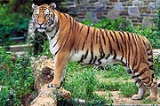
The Bengal tiger, or Royal bengal tiger (Panthera tigris tigris or Panthera tigris bengalensis), is a subspecies
Subspecies

In biology, subspecies is the taxonomic rank immediately subordinate to a species. A subspecies is a taxonomic group which is less distinct than the Common descent or species from which it originates....
 of tiger
Tiger

The tiger is a member of the Felidae family; the largest of the four "big cats" in the genus Panthera. Native to much of eastern and southern Asia, the tiger is an apex predator and an Carnivore#Obligate carnivores....
 primarily found in India
India

India, officially the Republic of India , is a country in South Asia. It is the List of countries and outlying territories by total area country by geographical area, the List of countries by population country, and the most populous liberal democracy in the world....
 and Bangladesh
Bangladesh

, officially the People's Republic of Bangladesh is a country in South Asia. It is bordered by India on all sides except for a small border with Burma to the far southeast and by the Bay of Bengal to the south....
. They are also found in Nepal
Nepal

Nepal , officially the Federal Democratic Republic of Nepal, is a landlocked country in South Asia and is the world's youngest republic. It is bordered to the north by the People's Republic of China, and to the south, east, and west by India....
, Pakistan
Pakistan

Pakistan , officially the Islamic Republic of Pakistan, is a country located in South Asia and borders Central Asia and the Middle East. It has a 1,046 kilometre coastline along the Arabian Sea and Gulf of Oman in the south, and is bordered by Afghanistan and Iran in the west, India in the east and People's Republic of China in th...
, Bhutan
Bhutan

The Kingdom of Bhutan is a landlocked nation in South Asia, located at the eastern end of the Himalaya Mountains and is bordered to the south, east and west by India and to the north by the Tibet Autonomous Region of the People's Republic of China....
, Myanmar
Myanmar

Burma, officially the Union of Myanmar, is the largest country by geographical area in mainland Southeast Asia, or Indochina. The country is bordered by the People's Republic of China on the northeast, Laos on the east, Thailand on the southeast, Bangladesh on the west, India on the northwest, and the Bay of Bengal to the southwest with...
 and southern Tibet
Tibet

Tibet is a Tibetan Plateau in Asia, north of the Himalayas, and the home to the indigenous Tibetan people and its related ethnic groups. With an average elevation of 4,900 metres , it is the highest region on Earth and has in recent decades increasingly been referred to as the "Roof of the World"....
. It has traditionally been considered the second largest subspecies after the Siberian tiger, but Northern Bengal Tigers are often larger than Siberian tigers. So far the heaviest Bengal tigers captured in Nepal for research have been heavier than recently captured Siberian tigers.


Discussion
Ask a question about 'Bengal Tiger'
Start a new discussion about 'Bengal Tiger'
Answer questions from other users
Full Discussion Forum


Recent Posts


Encyclopedia


The Bengal tiger, or Royal bengal tiger (Panthera tigris tigris or Panthera tigris bengalensis), is a subspecies
Subspecies

In biology, subspecies is the taxonomic rank immediately subordinate to a species. A subspecies is a taxonomic group which is less distinct than the Common descent or species from which it originates....
 of tiger
Tiger

The tiger is a member of the Felidae family; the largest of the four "big cats" in the genus Panthera. Native to much of eastern and southern Asia, the tiger is an apex predator and an Carnivore#Obligate carnivores....
 primarily found in India
India

India, officially the Republic of India , is a country in South Asia. It is the List of countries and outlying territories by total area country by geographical area, the List of countries by population country, and the most populous liberal democracy in the world....
 and Bangladesh
Bangladesh

, officially the People's Republic of Bangladesh is a country in South Asia. It is bordered by India on all sides except for a small border with Burma to the far southeast and by the Bay of Bengal to the south....
. They are also found in Nepal
Nepal

Nepal , officially the Federal Democratic Republic of Nepal, is a landlocked country in South Asia and is the world's youngest republic. It is bordered to the north by the People's Republic of China, and to the south, east, and west by India....
, Pakistan
Pakistan

Pakistan , officially the Islamic Republic of Pakistan, is a country located in South Asia and borders Central Asia and the Middle East. It has a 1,046 kilometre coastline along the Arabian Sea and Gulf of Oman in the south, and is bordered by Afghanistan and Iran in the west, India in the east and People's Republic of China in th...
, Bhutan
Bhutan

The Kingdom of Bhutan is a landlocked nation in South Asia, located at the eastern end of the Himalaya Mountains and is bordered to the south, east and west by India and to the north by the Tibet Autonomous Region of the People's Republic of China....
, Myanmar
Myanmar

Burma, officially the Union of Myanmar, is the largest country by geographical area in mainland Southeast Asia, or Indochina. The country is bordered by the People's Republic of China on the northeast, Laos on the east, Thailand on the southeast, Bangladesh on the west, India on the northwest, and the Bay of Bengal to the southwest with...
 and southern Tibet
Tibet

Tibet is a Tibetan Plateau in Asia, north of the Himalayas, and the home to the indigenous Tibetan people and its related ethnic groups. With an average elevation of 4,900 metres , it is the highest region on Earth and has in recent decades increasingly been referred to as the "Roof of the World"....
. It has traditionally been considered the second largest subspecies after the Siberian tiger, but Northern Bengal Tigers are often larger than Siberian tigers. So far the heaviest Bengal tigers captured in Nepal for research have been heavier than recently captured Siberian tigers. It is the most common tiger subspecies, living in a variety of habitats, including grasslands, subtropical and tropical rain forests, scrub forests, wet and dry deciduous forests, and mangroves. The Bengal subspecies P. tigris tigris is the national animal of Bangladesh
Bangladesh

, officially the People's Republic of Bangladesh is a country in South Asia. It is bordered by India on all sides except for a small border with Burma to the far southeast and by the Bay of Bengal to the south....
, while at the species level the Tiger
Tiger

The tiger is a member of the Felidae family; the largest of the four "big cats" in the genus Panthera. Native to much of eastern and southern Asia, the tiger is an apex predator and an Carnivore#Obligate carnivores....
 Panthera tigris is the national animal of India
India

India, officially the Republic of India , is a country in South Asia. It is the List of countries and outlying territories by total area country by geographical area, the List of countries by population country, and the most populous liberal democracy in the world....
 .

Physiology

Male Bengal Tigers measure around 270-290 cm, sometimes up to 310 cm with their tail. The tail of a large male is usually 85-95 cm long. Their weight is normally around 200-220 kg (440-485 pounds), although those in the north of India and Nepal have an average weight of 235 kg (518 lb). Females are considerably smaller, measuring about 250 cm long, a weight of 100-130 kg (220-287 lbs) and reach seldom more than 160 kg (352 lb). Officially, the heaviest Bengal Tiger with confirmed weight was a male of 258.6 kg (570 lbs) and was shot in Northern India in 1938, however the heaviest male captured by scientist at this time has a male of 270 kg (595 lb), tagged in Nepal in 1984. They are able to stay out in cold weather because their skin is able to handle the temperature all over in any kind of weather. It coat is yellow to light orange and the stripes range from dark brown to black, the belly is white and the tail is white with black rings.

Population


Since the early 1990s the tiger population has begun to decline again, due to habitat destruction and large-scale poaching for tiger skins and bones. The Bangladeshi government is trying hard to show the world that the tiger is thriving in Bangladesh, often using controversial techniques like taking molds of paw prints to track tiger populations. It was recently discovered in India that tigers have been wiped out from one of Project Tiger's leading sanctuaries, Sariska.

The current population of wild Bengal tigers in the Indian subcontinent is now estimated to be between 1,300 and 1,500, which is less than half of the previous estimate of 3,000-4,500 tigers. This estimate is based on a state-by-state census conducted in India in 2001.

Habitat losses and the extremely large scale incidences of poaching
Poaching

Poaching is the illegal hunting, fishing or eating of wild plants or animals contrary to local and international Conservation and wildlife management laws....
 are serious threats to species survival. Poachers kill tigers not only for their pelts, but also for body parts used to make various traditional East Asia
East Asia

East Asia is a subregion of Asia that can be defined in either Geography or cultural terms. Geography and geopolitically, it covers about 12,000,000 km?, or about 28 percent of the Asian continent, about 15 percent bigger than the area of Europe, though some categorize Tibet, Xinjiang, and Mongolia as Central Asia....
n medicines. Other factors contributing to their loss are urbanization
Urbanization

Urbanization is the physical growth of rural or natural land into urban areas as a result of population im-migration to an existing urban area....
 and revenge killing. Farmers blame tigers for killing cattle and will shoot them. Poachers also kill tigers for their bones and teeth to make medicines that are alleged to provide the tiger's strength. The hunting for Chinese medicine and fur is the biggest cause of decline of the tigers. In India, retired Indian Army
Indian Army

The Indian Army is the largest branch of the Indian Armed Forces of India and has the responsibility for army military operations. Its primary objectives include defending India from external aggression, maintaining peace and security within the country, patrolling borders and conducting counter-terrorist operations....
 personnel are being recruited to save the Bengal tiger from poaching gangs.

Genetic pollution in wild Bengal tigers

Tara, a hand-reared supposedly Bengal tigress acquired from Twycross Zoo
Twycross Zoo

Twycross Zoo is a large zoo near the village of Twycross on the border of Leicestershire . The zoo was founded in 1963 by Molly Badham and Nathalie Evans....
 in England
England

native_name =|conventional_long_name = England|common_name = England|image_flag = Flag of England.svg|image_coat = England COA.svg|symbol_type = Royal Coat of Arms...
 in July 1976, was trained by Billy Arjan Singh
Billy Arjan Singh

Lieutenant Kunwar "Billy" Arjan Singh is a former hunter turned avid conservationist and author.Kunwar "Billy" Arjan Singh was born in Gorakhpur on 15 August 1917 as the second son of Kunwar Jasbir Singh, CIE , a member of the royal Ahluwalia dynasty of Kapurthala....
 and reintroduced
Reintroduction

Reintroduction is the deliberate release of species into the wild, from captive breeding or relocated from other areas where the species survives....
 to the wild in Dudhwa National Park
Dudhwa National Park

General info Area: 490 km? core, 124 km? bufferEstablished: 1958 as a wildlife sanctuary 1977 as a national park, 1988 as a tiger reserve....
, India
India

India, officially the Republic of India , is a country in South Asia. It is the List of countries and outlying territories by total area country by geographical area, the List of countries by population country, and the most populous liberal democracy in the world....
 with the permission of India’s then Prime Minister Indira Gandhi
Indira Gandhi

Indira Priyadarshini Gandhi was the Prime Minister of the Republic of India for three consecutive terms from 1966 to 1977and for a fourth term from 1980 until her Assassination of Indira Gandhi in 1984, a total of fifteen years....
 in an attempt to prove the experts wrong that zoo-bred hand-reared tigers can ever be released in the wild with success. In the 1990s some tigers from Dudhwa were observed which had the typical appearance of Siberian tigers: white complexion, pale fur, large head and wide stripes. With recent advances in science it was subsequently found that Siberian tiger's gene
Gene

A gene is the basic unit of heredity in a living organism. All living things depend on genes. Genes hold the information to build and maintain their cell and pass genetic trait to offspring....
s have polluted the otherwise pure Bengal tiger gene pool of Dudhwa National Park. It was proved later that Twycross Zoo had been irresponsible and maintained no breeding records and had given India a hybrid Siberian-Bengal Tigress instead. Dudhwa tigers constitute about 1% of India's total wild population, but the possibility exists of this genetic pollution
Genetic pollution

Genetic pollution is undesirable gene flow into wild populations. The term is usually associated with the gene flow from a Genetic engineering organism to a non GE organism; however, conservation biology and conservationists are using it to describe gene flow from a Domestication, feral, Introduced species or invasive species to a Wildlife...
 spreading to other tiger groups; at its worst, this could jeopardize the Bengal tiger as a distinct subspecies
Subspecies

In biology, subspecies is the taxonomic rank immediately subordinate to a species. A subspecies is a taxonomic group which is less distinct than the Common descent or species from which it originates....
.

Re-wilding project in South India

There is a Bengal tiger rewilding project started by John Varty
John Varty

John Varty is a South African conservationist and filmmaker who specializes in Big Cats. JV established Tiger Canyons near the town of Philippolis on the Van der Kloof Lake in the Karoo of South Africa as an experiment to create a free-ranging, self-sustaining tiger population outside Asia....
 in 2000. This project involves bringing captive-bred zoo Bengal tiger cubs, and for them to be trained by their human trainers so that the tigers can regain their predatory instincts. Once they prove that they can sustain themselves in the wild, they would be released into the wilderness to fend for themselves. Their trainers, John Varty
John Varty

John Varty is a South African conservationist and filmmaker who specializes in Big Cats. JV established Tiger Canyons near the town of Philippolis on the Van der Kloof Lake in the Karoo of South Africa as an experiment to create a free-ranging, self-sustaining tiger population outside Asia....
 and Dave Salmoni
Dave Salmoni

Dave Salmoni is a Canada animal trainer, zoologist, a television presenter, and television producer. He has his own production company, Triosphere, which is based in South Africa and specializes in natural history filmmaking....
 (Big Cat trainer and zoologist), have to teach them how to stalk, hunt, and most importantly to associate hunting with food. It is claimed that two Bengal tigers have already succeeded in re-wilding and two more tigers are currently undergoing their re-wilding training. This project is featured by The Discovery Channel as a documentary, "Living With Tigers". It was voted one of the best Discovery Channel documentaries
Documentary film

Documentary film is a broad category of visual expression that is based on the attempt, in one fashion or another, to "document" reality. Although "documentary film" originally referred to movies shot on film stock, it has subsequently expanded to include video and new media productions that can be either direct-to-video or made for a televis...
 in 2003.

A strong criticism about this project is with the chosen cubs
Cubs

Cubs may refer to:*Chicago Cubs, a baseball team of the National League of Major League Baseball**Iowa Cubs, a minor league baseball team of the Pacific Coast League...
. Expert
Expert

An "expert" is someone widely recognized as a reliabilism source of wikt:technique or skill whose faculty for judging or deciding rightly, justly, or wisely is accorded authority and status by their Peer groups or the public in a specific well distinguished domain....
s state that the four tigers (Ron, Julie, Seatao and Shadow) involved in the rewilding project
Project

A project in business and science is a collaborative enterprise, frequently involving research or design, that is carefully planned to achieve a particular aim....
 are not purebred Bengal tigers and should not be used for breeding. The four tigers are not recorded in the Bengal tiger Studbook and should not be deemed as purebred
Purebred

Purebreds, also called purebreeds, are cultivated varieties or cultivars of an animal species, achieved through the process of selective breeding....
 Bengal tigers. Many tigers in the world's zoos are genetically impure and there is no reason to suppose these four are not among them. The 1997 International Tiger Studbook lists the current global captive population
Population

File:Population density.pngIn biology, a population is the collection of inter-breeding organisms of a particular species; in sociology, a collection of human beings....
 of Bengal tigers at 210 tigers. All of the studbook-registered captive population
Population

File:Population density.pngIn biology, a population is the collection of inter-breeding organisms of a particular species; in sociology, a collection of human beings....
 is maintained in Indian zoos, except for one female Bengal tiger in North America. It is important to note that Ron and Julie (2 of the tigers) were bred in the USA and hand-raised at Bowmanville Zoo
Bowmanville zoo

The Bowmanville Zoo is a zoo in Bowmanville, Ontario, Ontario, Canada. It is one of the largest suppliers of animals for Hollywood movies and television programs....
 in Canada
Canada

Canada is a country occupying most of northern North America, extending from the Atlantic Ocean in the east to the Pacific Ocean in the west and northward into the Arctic Ocean....
, while Seatow and Shadow are two tigers bred in South Africa.

The tigers in the Tiger Canyons Project have recently been confirmed to be crossbred Siberian/Bengal tigers. Tigers that are not genetically pure are not allowed to be released into the wild and will not be able to participate in the tiger Species Survival Plan
Species Survival Plan

The American Species Survival Plan or SSP program was developed in 1981 by the Association of Zoos and Aquariums to help ensure the survival of selected species in zoos and aquariums, most of which are threatened or endangered species in the wild....
 which aims to breed genetically pure tiger specimens and individuals. In short, these tigers do not have any genetic value.

The documentary
Documentary

A documentary is a creative work of non-fiction, including:* Documentary film, including television* Radio documentary* Documentary photography...
 has been proven to be a fraud. The Tigers are unable to hunt and film crew chased the prey up against the fence and into the path of the tigers just for the sake of dramatic footage. Cory Meacham, a US-based environmental journalist mentioned that "the film has about as much to do with tiger conservation as a Disney cartoon." In addition, the tigers have not been released - and indeed still reside in a small enclosure under constant watch and with frequent human
Human

A human being, also human or man, is a member of a species of bipedalism primates in the family Hominidae . Mitochondrial DNA evidence indicates that modern humans originated in east Africa about 200,000 years ago....
 contact. The Discovery documentary contains footage which its maker, John Varty, has admitted on affidavit to be false. Conservationists fear that public will be misled in this cynical fashion.

Using technology to save Tigers in India

The WII estimates showed that tiger numbers had fallen in Madhya Pradesh by 61%, Maharashtra by 57%, and Rajasthan by 40%. Compare this with the government's first tiger census; conducted under the Project Tiger initiative, begun in 1973, it counted 1,827 tigers in the country that year. Since then the tiger population saw a steady rise to reach 3,700 tigers in 2002. Use of technology has effectively curtailed the numbers by half.

Tiger scientists in India like Raghu Chundavat and Ulhas Karanth have faced lot of backlash from the forest department. Both these scientists have been for years calling for use of technology in the conservation efforts. For instance, Raghu, in the past, had been involved with radio telemetry, i.e., collaring the tigers. Ulhas has been instrumental in using camera traps. Even the project to map all the forest reserves in India has not been completed yet, though the Ministry of Environment and Forests had sanctioned Rs. 13 million for the same in March 2004.

A recent article written by Shashwat DC and published in the Dataquest Magazine, talks about the issue in complete detail. In the story noted Wildlife expert, George Schaller has been quoted as saying:
"India has to decide whether it wants to keep the tiger or not. It has to decide if it is worthwhile to keep its National Symbol, its icon, representing wildlife. It has to decide if it wants to keep its natural heritage for future generations, a heritage more important than the cultural one, whether we speak of its temples, the Taj Mahal, or others, because once destroyed it cannot be replaced."


External links

  • Research and Conservation of tigers in the largest remaining mangrove forest in the world.
  • no on