

Sambar Deer

Encyclopedia
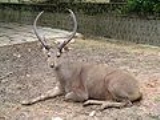
The Sambar is a large deer
native to southern and southeast Asia
. Although it primarily refers to R. unicolor, the name "Sambar" is also sometimes used to refer to the Philippine Deer (called the Philippine Sambar) and the Rusa Deer
(called the Sunda Sambar). The name is also spelled sambur, or sambhur.
s have been used for the species. In general, they attain a height of 102 to 160 cm (40.2 to 63 ) at the shoulder and may weigh as much as 546 kg (1,203.7 lb), though more typically 150 to 320 kg (330.7 to 705.5 lb). Head and body length varies from 1.62 to 2.7 m (5.3 to 8.9 ft), with a 22 to 35 cm (8.7 to 13.8 in) tail. Individuals belonging to western subspecies tend to be larger than those from the east.
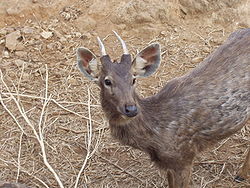
The large, rugged antler
s are typically rusine
, the brow tines being simple and the beams forked at the tip, so that they have only three tine
s. The antlers are typically up to 110 centimetres (43.3 in) long in fully adult individuals. As with most deer, only the males have antlers.
The shaggy coat can be anything from yellowish-brown to dark grey in colour and, while it is usually uniform in colour, some subspecies have chestnut marks on the rump and underparts. Sambar also have a small but dense mane, which tends to be more prominent in males. The tail is relatively long for deer, and is generally black above with a whitish underside.
Adult males and pregnant or lactating females possess an unusual hairless, blood-red spot located about half way down the underside of their throats. This sometimes oozes a white liquid, and is apparently glandular in nature.
(Burma, Thailand
, Indochina
, the Malay Peninsula
), southern China
(including Hainan
Island), Taiwan
, and the islands of Sumatra
and Borneo
in Indonesia
.
Sambar are found in habitats ranging from tropical seasonal forests (tropical dry forests and seasonal moist evergreen forests), subtropical mixed forests (conifers, broadleaf deciduous, and broadleaf evergreen tree species) to tropical rainforest
s. They are seldom found far from water. They are hardy animals, ranging from sea level up to 3500 metres (11,482.9 ft) in places such as eastern Taiwan, Myanmar, and the foothills of the Himalayan Mountains.
Sambar prefer the dense cover of deciduous shrubs and grasses, although the exact nature of this varies enormously with the environment, because of their wide range across southern Asia. Home range sizes are probably equally variable, but have been recorded as 1500 hectares (3,706.6 acre) for males and 300 hectares (741.3 acre) for females in India.
Sambar primarily live in woodland and feed on a wide variety of vegetation, including grasses, foliage, browse, fruit, and water plants, depending on the local habitat. They also consume a great variety of shrubs and trees. They are a favourite prey item for tiger
s and Asiatic lion
s. Anecdotally, the tiger is said to mimic the call of the sambar to deceive it while hunting. They also can be taken by crocodile
s, mostly the sympatric mugger crocodile
s. Leopard
s and dhole
s will take young or sickly deer.
Sambar have been seen congregating in large herds in protected areas such as national parks and reserves in India
, Sri Lanka
, and Thailand
. In Taiwan, sambar, along with sika deer
, have been raised on farms for their antlers, which they drop annually in April to May and are highly prized for use as knife
handles
and as grips
for handgun
s.
. The males live alone for much of the year, and the females live in small herds of up to sixteen individuals. Indeed, in some areas, the average herd consists of only three or four individuals, typically consisting of an adult female, her most recent young, and perhaps a subordinate, immature female. This is an unusual pattern for deer, which more commonly live in larger groups. They often congregate near water, and are good swimmers. Like most deer, sambar are generally quiet, although the males bellow during the rut, and all adults can scream or make short, high-pitched sounds when alarmed. However, they more commonly communicate by scent marking and foot stamping.
Stags will wallow and dig their antlers in urine soaked soil and then rub against tree trunks. Sambars are capable of remarkable bipedalism for a deer species and stags will stand and mark tree branches above them with their antlers. A stag will also mark itself by spraying urine directly in the face with a highly mobile penis. Despite their lack of antlers, female sambar will readily defend their young from most predators, something that is relatively unusual among deer. When confronted by pack-hunting dholes or domestic dogs, a sambar will lower its head with an erect mane and lash at the dogs. Sambars prefer to attack predators in shallow water. Several sambars may form a defensive formation, touching rumps and vocalising loudly at the dogs. When sensing danger a sambar will stamp its feet and make a ringing call known as "pooking" or "belling".
Though they mate and reproduce year-round, sambar calving peaks seasonally. Oestrus lasts around eighteen days. The male establishes a territory from which he attracts nearby females, but he does not establish a harem. The male stomps the ground, creating a bare patch, and often wallows in the mud, perhaps to accentuate the colour of his hair, which is typically darker than that of females. While they have been heard to make a loud coarse bellow, rutting stags are generally not vocal. Large dominant stags will defend non-exclusive territories surrounded by several smaller males which they have bonded and formed alliances with through sparring. When sparring with rival males, sambar lock antlers and push, like other deer, but, uniquely, they also sometimes stand on their hind legs and clash downward into each other in a manner similar to species of goat-antelope. Females also fight on their hind legs and use their forelegs to hit each other in the head.
Courtship is based more on tending bonds rather than males vocally advertising themselves. Females moving widely among breeding territories seeking males to court. When mounting, males do not clasp females. The front legs of the male hang loosely and intromission takes the form of a "copulatory jump".
Gestation probably lasts around eight months, although some studies suggest it may be slightly longer. Normally only one calf is born at a time, although twins have been reported in up to 2% of births. Initially weighing 5 to 8 kg (11 to 17.6 ), the calves are usually not spotted, although in some subspecies there are light spots which disappear not long after birth. The young begin to take solid food at 5 to 14 days, and begin to ruminate after one month. Sambar have lived for up to 28 years in captivity, although it is unlikely that they often survive more than twelve years in the wild.
Fossil sambar are known from the early Pleistocene
, although it is very similar in form to early deer species from the Pliocene
, with less of a resemblance to more modern cervines. The species probably arose in the tropical reaches of southern Asia, and later spread across its current range. Epirusa and Eucladoceros
have both been proposed as possible ancestors of the living species and its closest relatives.
Currently, seven subspecies of sambar are recognised, although many others have been proposed.
Sambar were originally introduced into Victoria at Mount Sugarloaf
in the 1860s, near the present Kinglake National Park, and at Harewood Estate near Tooradin, where they quickly adapted to the Koo Ree Wup coastal ti tree swamps and thereafter spread into the high country, where today the state herd may number as high as 100,000 animals. Later releases were at Ercildoune Estate near Ballarat, Wilsons Promontory and French Island in Western Port. Another release occurred on the Cobourg Peninsula in the Northern Territory.
 In Victoria
, Sambar Deer have been listed as a threat to biodiversity under the Flora and Fauna Guarantee Act (1988) because of their negative impact on biodiversity of native vegetation. The animals feed on some rare and endangered plants. More than 60 plant species have been identified as directly or indirectly threatened
by sambar within Victoria.
Adult male sambar deer can significantly damage plants, removing most branches on some shrubs and sometimes ringbarking trees by thrashing their antlers on shrubs and sapling trees. They also feed on seedlings, fruit or seeds of many plants. They leave territorial marks to advertise their territory.
In 2006/07, a severe wildfire burned over 13,000 km² of Victoria's Alpine National Park and State Forest, and is believed to have killed as many as 20,000 sambar, along with millions of native birds and wildlife.
The spread of sambar has been steady in both NSW and Victoria, with animals being seen on many southern Victorian beaches since 1980, and as far east as Western Port and the outer suburbs of Melbourne.
There is considerable debate about how they should be managed, in particular, conservation groups believe their environmental impact outweighs their social value, although this is contested by hunting organisations who are largely responsible for their management along with State forest managers. They are currently listed as a desired game species, and a game licence is required to hunt them, although some conservation groups want them declared a feral species, due to their impact on native vegetation and biodiversity. The severity of any impact is, of course, dependent on the density of the deer population.
In 2008/2009 nearly 40,000 sambar were removed from public land in Victoria, many from National Parks, by amateur hunters.
Deer
Deer are the ruminant mammals forming the family Cervidae. Species in the Cervidae family include white-tailed deer, elk, moose, red deer, reindeer, fallow deer, roe deer and chital. Male deer of all species and female reindeer grow and shed new antlers each year...
native to southern and southeast Asia
Southeast Asia
Southeast Asia, South-East Asia, South East Asia or Southeastern Asia is a subregion of Asia, consisting of the countries that are geographically south of China, east of India, west of New Guinea and north of Australia. The region lies on the intersection of geological plates, with heavy seismic...
. Although it primarily refers to R. unicolor, the name "Sambar" is also sometimes used to refer to the Philippine Deer (called the Philippine Sambar) and the Rusa Deer
Rusa Deer
The Javan Rusa or Sunda Sambar is a deer native to the islands of Java, Bali and Timor in Indonesia...
(called the Sunda Sambar). The name is also spelled sambur, or sambhur.
Description
The appearance and size of sambar vary widely across their range, which has led to considerable taxonomic confusion in the past; over forty different scientific synonymSynonym (taxonomy)
In scientific nomenclature, a synonym is a scientific name that is or was used for a taxon of organisms that also goes by a different scientific name. For example, Linnaeus was the first to give a scientific name to the Norway spruce, which he called Pinus abies...
s have been used for the species. In general, they attain a height of 102 to 160 cm (40.2 to 63 ) at the shoulder and may weigh as much as 546 kg (1,203.7 lb), though more typically 150 to 320 kg (330.7 to 705.5 lb). Head and body length varies from 1.62 to 2.7 m (5.3 to 8.9 ft), with a 22 to 35 cm (8.7 to 13.8 in) tail. Individuals belonging to western subspecies tend to be larger than those from the east.
The large, rugged antler
Antler
Antlers are the usually large, branching bony appendages on the heads of most deer species.-Etymology:Antler originally meant the lowest tine, the "brow tine"...
s are typically rusine
Rusa (genus)
Rusa is a genus of deer from southern Asia. They have traditionally been included in Cervus, and genetic evidence suggests this may be more appropriate than their present placement in a separate genus....
, the brow tines being simple and the beams forked at the tip, so that they have only three tine
Tine
Tine may have one of the following meanings:*Tine – a 'prong' on a fork or similar implement, or any similar structure*Tine – the biggest dairy producer in Norway...
s. The antlers are typically up to 110 centimetres (43.3 in) long in fully adult individuals. As with most deer, only the males have antlers.
The shaggy coat can be anything from yellowish-brown to dark grey in colour and, while it is usually uniform in colour, some subspecies have chestnut marks on the rump and underparts. Sambar also have a small but dense mane, which tends to be more prominent in males. The tail is relatively long for deer, and is generally black above with a whitish underside.
Adult males and pregnant or lactating females possess an unusual hairless, blood-red spot located about half way down the underside of their throats. This sometimes oozes a white liquid, and is apparently glandular in nature.
Range and ecology
The Sambar inhabits much of southern Asia (as far north as the south-facing slopes of the Himalayan Mountains), mainland Southeast AsiaSoutheast Asia
Southeast Asia, South-East Asia, South East Asia or Southeastern Asia is a subregion of Asia, consisting of the countries that are geographically south of China, east of India, west of New Guinea and north of Australia. The region lies on the intersection of geological plates, with heavy seismic...
(Burma, Thailand
Thailand
Thailand , officially the Kingdom of Thailand , formerly known as Siam , is a country located at the centre of the Indochina peninsula and Southeast Asia. It is bordered to the north by Burma and Laos, to the east by Laos and Cambodia, to the south by the Gulf of Thailand and Malaysia, and to the...
, Indochina
Indochina
The Indochinese peninsula, is a region in Southeast Asia. It lies roughly southwest of China, and east of India. The name has its origins in the French, Indochine, as a combination of the names of "China" and "India", and was adopted when French colonizers in Vietnam began expanding their territory...
, the Malay Peninsula
Malay Peninsula
The Malay Peninsula or Thai-Malay Peninsula is a peninsula in Southeast Asia. The land mass runs approximately north-south and, at its terminus, is the southern-most point of the Asian mainland...
), southern China
Northern and southern China
Northern China and southern China are two approximate regions within China. The exact boundary between these two regions has never been precisely defined...
(including Hainan
Hainan
Hainan is the smallest province of the People's Republic of China . Although the province comprises some two hundred islands scattered among three archipelagos off the southern coast, of its land mass is Hainan Island , from which the province takes its name...
Island), Taiwan
Taiwan
Taiwan , also known, especially in the past, as Formosa , is the largest island of the same-named island group of East Asia in the western Pacific Ocean and located off the southeastern coast of mainland China. The island forms over 99% of the current territory of the Republic of China following...
, and the islands of Sumatra
Sumatra
Sumatra is an island in western Indonesia, westernmost of the Sunda Islands. It is the largest island entirely in Indonesia , and the sixth largest island in the world at 473,481 km2 with a population of 50,365,538...
and Borneo
Borneo
Borneo is the third largest island in the world and is located north of Java Island, Indonesia, at the geographic centre of Maritime Southeast Asia....
in Indonesia
Indonesia
Indonesia , officially the Republic of Indonesia , is a country in Southeast Asia and Oceania. Indonesia is an archipelago comprising approximately 13,000 islands. It has 33 provinces with over 238 million people, and is the world's fourth most populous country. Indonesia is a republic, with an...
.
Sambar are found in habitats ranging from tropical seasonal forests (tropical dry forests and seasonal moist evergreen forests), subtropical mixed forests (conifers, broadleaf deciduous, and broadleaf evergreen tree species) to tropical rainforest
Tropical rainforest
A tropical rainforest is an ecosystem type that occurs roughly within the latitudes 28 degrees north or south of the equator . This ecosystem experiences high average temperatures and a significant amount of rainfall...
s. They are seldom found far from water. They are hardy animals, ranging from sea level up to 3500 metres (11,482.9 ft) in places such as eastern Taiwan, Myanmar, and the foothills of the Himalayan Mountains.
Sambar prefer the dense cover of deciduous shrubs and grasses, although the exact nature of this varies enormously with the environment, because of their wide range across southern Asia. Home range sizes are probably equally variable, but have been recorded as 1500 hectares (3,706.6 acre) for males and 300 hectares (741.3 acre) for females in India.
Sambar primarily live in woodland and feed on a wide variety of vegetation, including grasses, foliage, browse, fruit, and water plants, depending on the local habitat. They also consume a great variety of shrubs and trees. They are a favourite prey item for tiger
Tiger
The tiger is the largest cat species, reaching a total body length of up to and weighing up to . Their most recognizable feature is a pattern of dark vertical stripes on reddish-orange fur with lighter underparts...
s and Asiatic lion
Asiatic Lion
The Asiatic lion also known as the Indian lion, Persian lion and Eurasian Lion is a subspecies of lion. The only place in the wild where the lion is found is in the Gir Forest of Gujarat, India...
s. Anecdotally, the tiger is said to mimic the call of the sambar to deceive it while hunting. They also can be taken by crocodile
Crocodile
A crocodile is any species belonging to the family Crocodylidae . The term can also be used more loosely to include all extant members of the order Crocodilia: i.e...
s, mostly the sympatric mugger crocodile
Mugger Crocodile
The mugger crocodile , also called the Indian, Indus, Persian, or marsh crocodile, is found throughout the Indian subcontinent and the surrounding countries...
s. Leopard
Leopard
The leopard , Panthera pardus, is a member of the Felidae family and the smallest of the four "big cats" in the genus Panthera, the other three being the tiger, lion, and jaguar. The leopard was once distributed across eastern and southern Asia and Africa, from Siberia to South Africa, but its...
s and dhole
Dhole
The dhole is a species of canid native to South and Southeast Asia. It is the only extant member of the genus Cuon, which differs from Canis by the reduced number of molars and greater number of teats...
s will take young or sickly deer.
Sambar have been seen congregating in large herds in protected areas such as national parks and reserves in India
India
India , officially the Republic of India , is a country in South Asia. It is the seventh-largest country by geographical area, the second-most populous country with over 1.2 billion people, and the most populous democracy in the world...
, Sri Lanka
Sri Lanka
Sri Lanka, officially the Democratic Socialist Republic of Sri Lanka is a country off the southern coast of the Indian subcontinent. Known until 1972 as Ceylon , Sri Lanka is an island surrounded by the Indian Ocean, the Gulf of Mannar and the Palk Strait, and lies in the vicinity of India and the...
, and Thailand
Thailand
Thailand , officially the Kingdom of Thailand , formerly known as Siam , is a country located at the centre of the Indochina peninsula and Southeast Asia. It is bordered to the north by Burma and Laos, to the east by Laos and Cambodia, to the south by the Gulf of Thailand and Malaysia, and to the...
. In Taiwan, sambar, along with sika deer
Sika Deer
The Sika Deer, Cervus nippon, also known as the Spotted Deer or the Japanese Deer, is a species of deer native to much of East Asia and introduced to various other parts of the world...
, have been raised on farms for their antlers, which they drop annually in April to May and are highly prized for use as knife
Knife
A knife is a cutting tool with an exposed cutting edge or blade, hand-held or otherwise, with or without a handle. Knives were used at least two-and-a-half million years ago, as evidenced by the Oldowan tools...
handles
Handle (grip)
A handle is a part of, or attachment to, an object that can be moved or used by hand. The design of each type of handle involves substantial ergonomic issues, even where these are dealt with intuitively or by following tradition...
and as grips
Handle (grip)
A handle is a part of, or attachment to, an object that can be moved or used by hand. The design of each type of handle involves substantial ergonomic issues, even where these are dealt with intuitively or by following tradition...
for handgun
Handgun
A handgun is a firearm designed to be held and operated by one hand. This characteristic differentiates handguns as a general class of firearms from long guns such as rifles and shotguns ....
s.
Behavior and life history
Sambar are nocturnal or crepuscularCrepuscular
Crepuscular animals are those that are active primarily during twilight, that is during dawn and dusk. The word is derived from the Latin word crepusculum, meaning "twilight." Crepuscular is, thus, in contrast with diurnal and nocturnal behavior. Crepuscular animals may also be active on a bright...
. The males live alone for much of the year, and the females live in small herds of up to sixteen individuals. Indeed, in some areas, the average herd consists of only three or four individuals, typically consisting of an adult female, her most recent young, and perhaps a subordinate, immature female. This is an unusual pattern for deer, which more commonly live in larger groups. They often congregate near water, and are good swimmers. Like most deer, sambar are generally quiet, although the males bellow during the rut, and all adults can scream or make short, high-pitched sounds when alarmed. However, they more commonly communicate by scent marking and foot stamping.
Stags will wallow and dig their antlers in urine soaked soil and then rub against tree trunks. Sambars are capable of remarkable bipedalism for a deer species and stags will stand and mark tree branches above them with their antlers. A stag will also mark itself by spraying urine directly in the face with a highly mobile penis. Despite their lack of antlers, female sambar will readily defend their young from most predators, something that is relatively unusual among deer. When confronted by pack-hunting dholes or domestic dogs, a sambar will lower its head with an erect mane and lash at the dogs. Sambars prefer to attack predators in shallow water. Several sambars may form a defensive formation, touching rumps and vocalising loudly at the dogs. When sensing danger a sambar will stamp its feet and make a ringing call known as "pooking" or "belling".
Though they mate and reproduce year-round, sambar calving peaks seasonally. Oestrus lasts around eighteen days. The male establishes a territory from which he attracts nearby females, but he does not establish a harem. The male stomps the ground, creating a bare patch, and often wallows in the mud, perhaps to accentuate the colour of his hair, which is typically darker than that of females. While they have been heard to make a loud coarse bellow, rutting stags are generally not vocal. Large dominant stags will defend non-exclusive territories surrounded by several smaller males which they have bonded and formed alliances with through sparring. When sparring with rival males, sambar lock antlers and push, like other deer, but, uniquely, they also sometimes stand on their hind legs and clash downward into each other in a manner similar to species of goat-antelope. Females also fight on their hind legs and use their forelegs to hit each other in the head.
Courtship is based more on tending bonds rather than males vocally advertising themselves. Females moving widely among breeding territories seeking males to court. When mounting, males do not clasp females. The front legs of the male hang loosely and intromission takes the form of a "copulatory jump".
Gestation probably lasts around eight months, although some studies suggest it may be slightly longer. Normally only one calf is born at a time, although twins have been reported in up to 2% of births. Initially weighing 5 to 8 kg (11 to 17.6 ), the calves are usually not spotted, although in some subspecies there are light spots which disappear not long after birth. The young begin to take solid food at 5 to 14 days, and begin to ruminate after one month. Sambar have lived for up to 28 years in captivity, although it is unlikely that they often survive more than twelve years in the wild.
Taxonomy and evolution
Genetic analysis shows that the closest living relative of the sambar is probably the Javan rusa of Indonesia. This is supported by reports that sambar can still interbreed to produce fertile hybrids with this species.Fossil sambar are known from the early Pleistocene
Pleistocene
The Pleistocene is the epoch from 2,588,000 to 11,700 years BP that spans the world's recent period of repeated glaciations. The name pleistocene is derived from the Greek and ....
, although it is very similar in form to early deer species from the Pliocene
Pliocene
The Pliocene Epoch is the period in the geologic timescale that extends from 5.332 million to 2.588 million years before present. It is the second and youngest epoch of the Neogene Period in the Cenozoic Era. The Pliocene follows the Miocene Epoch and is followed by the Pleistocene Epoch...
, with less of a resemblance to more modern cervines. The species probably arose in the tropical reaches of southern Asia, and later spread across its current range. Epirusa and Eucladoceros
Eucladoceros
Eucladoceros or bush-antlered deer is an extinct genus of deer whose fossils have been discovered in Europe, the Middle East and Central Asia.-Description:...
have both been proposed as possible ancestors of the living species and its closest relatives.
Subspecies
The subspecies of sambar in India and Sri Lanka are the largest of the genus with the largest antlers both in size and in body proportions. The South China sambar of Southern China and Mainland Southeast Asia is probably second in terms of size with slightly smaller antlers than the Indian sambar. The Sumatran sambar, that inhabits the Malay Peninsula and Sumatra, and the Bornean sambar seem to have the smallest antlers in proportion to their body size. The Formosan sambar is the smallest Rusa unicolor with antler-body proportions more similar to the South China sambar.Currently, seven subspecies of sambar are recognised, although many others have been proposed.
| Subspecies | Common name | Geographic range |
|---|---|---|
| R. u. boninensis | Bonin Sambar Deer | Bonin Islands (extinct) |
| R. u. brookei | Borneo Borneo Borneo is the third largest island in the world and is located north of Java Island, Indonesia, at the geographic centre of Maritime Southeast Asia.... |
|
| R. u. cambojensis | Indochina Indochina The Indochinese peninsula, is a region in Southeast Asia. It lies roughly southwest of China, and east of India. The name has its origins in the French, Indochine, as a combination of the names of "China" and "India", and was adopted when French colonizers in Vietnam began expanding their territory... and peninsular Malaysia |
|
| R. u. dejeani | South China Sambar Deer | Southern and southwestern China |
| R. u. equina | Malayan Sambar Deer | Sumatra Sumatra Sumatra is an island in western Indonesia, westernmost of the Sunda Islands. It is the largest island entirely in Indonesia , and the sixth largest island in the world at 473,481 km2 with a population of 50,365,538... |
| R. u. hainana | Hainan Sambar Deer | Hainan Island, China |
| R. u. swinhoii | Formosan Sambar Deer Formosan Sambar Deer The Formosan Sambar is a subspecies of sambar found in Taiwan. It is the largest native herbivore there. Its fur color changes with season to provide camouflage, it is yellowish brown in the summer and dark brown in the winter.... |
Taiwan |
| R. u. unicolor | Sri Lankan Sambar Deer Sri lankan Sambar Deer Sri Lankan Sambar Deer is a sub-species of Sambar Deer that lives in Sri Lanka. This subspecies is one of the largest Sambar Deer species with the largest antlers both in size and in body proportions. Large males weight up to 270-280 kg. Sri Lankan Sambar occurs in lowland dry forest, montane forest... |
India, Bangladesh, Sri Lanka |
Introduced animal
Sambar deer are an introduced species in both Australia and New Zealand, as they are in other parts of the world, such as the United States.Australia
In Australia, hunting them is a popular sport. Australian hunting fraternities consider large sambar trophies to be prized. Excessive numbers of Sambar deer also have an impact on native plants, which is of particular concern as they threaten to cause some plant species to become extinct.Sambar were originally introduced into Victoria at Mount Sugarloaf
Mount Sugarloaf
Mount Sugarloaf, also known as Great Sugar Loaf, is a mountain in the lower Hunter Region of New South Wales, Australia, overlooking the cites of Newcastle, Lake Macquarie, Cessnock and Maitland. The summit of the mountain is in the Lake Macquarie suburb of West Wallsend and access to the summit is...
in the 1860s, near the present Kinglake National Park, and at Harewood Estate near Tooradin, where they quickly adapted to the Koo Ree Wup coastal ti tree swamps and thereafter spread into the high country, where today the state herd may number as high as 100,000 animals. Later releases were at Ercildoune Estate near Ballarat, Wilsons Promontory and French Island in Western Port. Another release occurred on the Cobourg Peninsula in the Northern Territory.
Victoria (Australia)
Victoria is the second most populous state in Australia. Geographically the smallest mainland state, Victoria is bordered by New South Wales, South Australia, and Tasmania on Boundary Islet to the north, west and south respectively....
, Sambar Deer have been listed as a threat to biodiversity under the Flora and Fauna Guarantee Act (1988) because of their negative impact on biodiversity of native vegetation. The animals feed on some rare and endangered plants. More than 60 plant species have been identified as directly or indirectly threatened
Threatened species
Threatened species are any speciesg animals, plants, fungi, etc.) which are vulnerable to endangerment in the near future.The World Conservation Union is the foremost authority on threatened species, and treats threatened species not as a single category, but as a group of three categories,...
by sambar within Victoria.
Adult male sambar deer can significantly damage plants, removing most branches on some shrubs and sometimes ringbarking trees by thrashing their antlers on shrubs and sapling trees. They also feed on seedlings, fruit or seeds of many plants. They leave territorial marks to advertise their territory.
In 2006/07, a severe wildfire burned over 13,000 km² of Victoria's Alpine National Park and State Forest, and is believed to have killed as many as 20,000 sambar, along with millions of native birds and wildlife.
The spread of sambar has been steady in both NSW and Victoria, with animals being seen on many southern Victorian beaches since 1980, and as far east as Western Port and the outer suburbs of Melbourne.
There is considerable debate about how they should be managed, in particular, conservation groups believe their environmental impact outweighs their social value, although this is contested by hunting organisations who are largely responsible for their management along with State forest managers. They are currently listed as a desired game species, and a game licence is required to hunt them, although some conservation groups want them declared a feral species, due to their impact on native vegetation and biodiversity. The severity of any impact is, of course, dependent on the density of the deer population.
In 2008/2009 nearly 40,000 sambar were removed from public land in Victoria, many from National Parks, by amateur hunters.