


Signal Corps in the American Civil War

Encyclopedia
Major (United States)
In the United States Army, Air Force, and Marine Corps, major is a field grade military officer rank just above the rank of captain and just below the rank of lieutenant colonel...
Albert J. Myer
Albert J. Myer
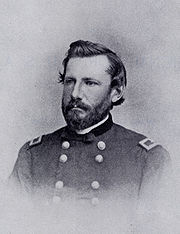
Albert James Myer was a surgeon and United States Army officer. He is known as the father of the U.S. Army Signal Corps, as its first chief signal officer just prior to the American Civil War, the inventor of wig-wag signaling , and also as the father of the U.S...
as its first signal officer just before the war and remains an entity to this day, and the Confederate States Army
Confederate States Army
The Confederate States Army was the army of the Confederate States of America while the Confederacy existed during the American Civil War. On February 8, 1861, delegates from the seven Deep South states which had already declared their secession from the United States of America adopted the...
Signal Corps, a much smaller group of officers and men, using similar organizations and techniques as their Union
Union Army
The Union Army was the land force that fought for the Union during the American Civil War. It was also known as the Federal Army, the U.S. Army, the Northern Army and the National Army...
opponents. Both accomplished tactical and strategic communications for the warring armies, including electromagnetic telegraphy
Telegraphy
Telegraphy is the long-distance transmission of messages via some form of signalling technology. Telegraphy requires messages to be converted to a code which is known to both sender and receiver...
and aerial telegraphy ("wig-wag" signaling). Although both services had an implicit mission of battlefield observation, intelligence gathering, and artillery fire direction from their elevated signal stations, the Confederate Signal Corps also included an explicit espionage function.
The Union Signal Corps, although effective on the battlefield, suffered from political disputes in Washington, D.C.
Washington, D.C.
Washington, D.C., formally the District of Columbia and commonly referred to as Washington, "the District", or simply D.C., is the capital of the United States. On July 16, 1790, the United States Congress approved the creation of a permanent national capital as permitted by the U.S. Constitution....
, particularly in its rivalry with the civilian-led U.S. Military Telegraph Corps
U.S. Military Telegraph Corps
The U.S. Military Telegraph Corps was formed in 1861 following the outbreak of the American Civil War. David Strouse, Samuel M. Brown, Richard O'Brian and David H. Bates, all from the Pennsylvania Railroad Company, were sent to Washington, D.C. to serve in the newly created office. In October of...
. Myer was relieved of his duties as chief signal officer by Secretary of War
United States Secretary of War
The Secretary of War was a member of the United States President's Cabinet, beginning with George Washington's administration. A similar position, called either "Secretary at War" or "Secretary of War," was appointed to serve the Congress of the Confederation under the Articles of Confederation...
Edwin M. Stanton
Edwin M. Stanton
Edwin McMasters Stanton was an American lawyer and politician who served as Secretary of War under the Lincoln Administration during the American Civil War from 1862–1865...
for his attempts to control all electromagnetic telegraphy within the Signal Corps. He was not restored to his role as chief signal officer until after the war.
First chief signal officer
Flag semaphore
Semaphore Flags is the system for conveying information at a distance by means of visual signals with hand-held flags, rods, disks, paddles, or occasionally bare or gloved hands. Information is encoded by the position of the flags; it is read when the flag is in a fixed position...
, which employed two flags, Signal wig-wag required only one, using a binary code to represent each letter of the alphabet or digit. Myer was serving at Fort Duncan
Fort Duncan
Fort Duncan was a U.S. Army post, set up to protect the first U.S. settlement on the Rio Grande near the current town of Eagle Pass, Texas.Fort Duncan was established on March 27, 1849, when Captain Sidney Burbank occupied the site with companies A, B, and F of the First United States Infantry...
, Texas
Texas
Texas is the second largest U.S. state by both area and population, and the largest state by area in the contiguous United States.The name, based on the Caddo word "Tejas" meaning "friends" or "allies", was applied by the Spanish to the Caddo themselves and to the region of their settlement in...
, in 1856 when he wrote to Secretary of War
United States Secretary of War
The Secretary of War was a member of the United States President's Cabinet, beginning with George Washington's administration. A similar position, called either "Secretary at War" or "Secretary of War," was appointed to serve the Congress of the Confederation under the Articles of Confederation...
Jefferson Davis
Jefferson Davis
Jefferson Finis Davis , also known as Jeff Davis, was an American statesman and leader of the Confederacy during the American Civil War, serving as President for its entire history. He was born in Kentucky to Samuel and Jane Davis...
and offered his signaling system to the War Department. Although the chief engineer of the Army, Colonel Joseph G. Totten, supported Myer's proposal, it did not include specific technical details and Davis rejected it. When John B. Floyd
John B. Floyd
John Buchanan Floyd was the 31st Governor of Virginia, U.S. Secretary of War, and the Confederate general in the American Civil War who lost the crucial Battle of Fort Donelson.-Early life:...
replaced Davis as secretary of war in 1857, Totten reintroduced Myer's proposal, and in March 1859, a board of examination was formed in Washington, D.C.
Washington, D.C.
Washington, D.C., formally the District of Columbia and commonly referred to as Washington, "the District", or simply D.C., is the capital of the United States. On July 16, 1790, the United States Congress approved the creation of a permanent national capital as permitted by the U.S. Constitution....
The board, presided over by Lt. Col.
Lieutenant colonel
Lieutenant colonel is a rank of commissioned officer in the armies and most marine forces and some air forces of the world, typically ranking above a major and below a colonel. The rank of lieutenant colonel is often shortened to simply "colonel" in conversation and in unofficial correspondence...
Robert E. Lee
Robert E. Lee
Robert Edward Lee was a career military officer who is best known for having commanded the Confederate Army of Northern Virginia in the American Civil War....
, was not enthusiastic about the proposal, judging it suitable only as a secondary means of communications over short distances, but it did recommend further testing.
Myer began testing in April 1859 at Fort Monroe, Virginia, and then New York Harbor
New York Harbor
New York Harbor refers to the waterways of the estuary near the mouth of the Hudson River that empty into New York Bay. It is one of the largest natural harbors in the world. Although the U.S. Board of Geographic Names does not use the term, New York Harbor has important historical, governmental,...
, West Point, New York
West Point, New York
West Point is a federal military reservation established by President of the United States Thomas Jefferson in 1802. It is a census-designated place located in Town of Highlands in Orange County, New York, United States. The population was 7,138 at the 2000 census...
, and Washington, D.C. One of Myer's principal assistants was Second Lieutenant Edward Porter Alexander
Edward Porter Alexander
Edward Porter Alexander was an engineer, an officer in the U.S. Army, a Confederate general in the American Civil War, and later a railroad executive, planter, and author....
, the future Confederate signal, engineer, and artillery officer. They were able to communicate at distances up to 15 miles and Myer reported to the War Department that the tests had "exceeded anticipation." He recommended that the Army adopt his signaling system and that he should be placed in charge of it.
On March 29, 1860, the United States House of Representatives
United States House of Representatives
The United States House of Representatives is one of the two Houses of the United States Congress, the bicameral legislature which also includes the Senate.The composition and powers of the House are established in Article One of the Constitution...
approved the Army appropriations bill for fiscal year 1861, which included the following amendment:
The United States Senate
United States Senate
The United States Senate is the upper house of the bicameral legislature of the United States, and together with the United States House of Representatives comprises the United States Congress. The composition and powers of the Senate are established in Article One of the U.S. Constitution. Each...
eventually approved the appropriations bill, over the objections of Jefferson Davis, now Senator from Mississippi
Mississippi
Mississippi is a U.S. state located in the Southern United States. Jackson is the state capital and largest city. The name of the state derives from the Mississippi River, which flows along its western boundary, whose name comes from the Ojibwe word misi-ziibi...
, and President
President of the United States
The President of the United States of America is the head of state and head of government of the United States. The president leads the executive branch of the federal government and is the commander-in-chief of the United States Armed Forces....
James Buchanan
James Buchanan
James Buchanan, Jr. was the 15th President of the United States . He is the only president from Pennsylvania, the only president who remained a lifelong bachelor and the last to be born in the 18th century....
signed it into law on June 21, 1860, the date now celebrated as the birthday of the modern U.S. Army Signal Corps. Myer's appointment as the first signal officer with the rank of major was confirmed by the Senate on June 27. However, the appropriations bill provided for no personnel to work for Myer and the Signal Corps as a formal organization would not be authorized until March 1863.
Immediately before the war, Myer was assigned to the Department of New Mexico to test his signals in the field during a campaign against the Navajos
Navajo people
The Navajo of the Southwestern United States are the largest single federally recognized tribe of the United States of America. The Navajo Nation has 300,048 enrolled tribal members. The Navajo Nation constitutes an independent governmental body which manages the Navajo Indian reservation in the...
. In that assignment, he was assisted by Second Lieutenant William J. L. Nicodemus, who would later succeed him as chief signal officer. Field testing proceeded successfully, winning the admiration of Major Edward Canby
Edward Canby
Edward Richard Sprigg Canby was a career United States Army officer and a Union general in the American Civil War, Reconstruction era, and the Indian Wars...
, who became a strong advocate of forming a dedicated Signal Corps; Myer at this time believed that the best approach for staffing signal work would be to train officers across the Army in its disciplines.
War organization

Simon Cameron
Simon Cameron was an American politician who served as United States Secretary of War for Abraham Lincoln at the start of the American Civil War. After making his fortune in railways and banking, he turned to a life of politics. He became a U.S. senator in 1845 for the state of Pennsylvania,...
in August 1861, proposing that a Signal Corps be established with himself, seven assistant signal officers, 40 warrant officers, and 40 signal artificers to serve as line builders and repairmen. He intended that each division of the Army, which he assumed would eventually comprise 500,000 men, would have dedicated aerial and electromagnetic telegraphy support. Congress adjourned without considering the legislation. That fall, Myer, who in addition to being chief signal officer for the Army, served as chief signal officer of the newly formed Army of the Potomac
Army of the Potomac
The Army of the Potomac was the major Union Army in the Eastern Theater of the American Civil War.-History:The Army of the Potomac was created in 1861, but was then only the size of a corps . Its nucleus was called the Army of Northeastern Virginia, under Brig. Gen...
, set up training facilities for detailed officers and men in Fort Monroe and at Red Hill, Georgetown, Washington, D.C.
Georgetown, Washington, D.C.
Georgetown is a neighborhood located in northwest Washington, D.C., situated along the Potomac River. Founded in 1751, the port of Georgetown predated the establishment of the federal district and the City of Washington by 40 years...
His latter training camp remained in operation through the Peninsula Campaign
Peninsula Campaign
The Peninsula Campaign of the American Civil War was a major Union operation launched in southeastern Virginia from March through July 1862, the first large-scale offensive in the Eastern Theater. The operation, commanded by Maj. Gen. George B...
and the rest of 1862, a period in which he continued to lobby with Congress and the Secretary of War, now Edwin M. Stanton
Edwin M. Stanton
Edwin McMasters Stanton was an American lawyer and politician who served as Secretary of War under the Lincoln Administration during the American Civil War from 1862–1865...
, to establish a permanent corps.
Myer's persistence paid off when President Abraham Lincoln
Abraham Lincoln
Abraham Lincoln was the 16th President of the United States, serving from March 1861 until his assassination in April 1865. He successfully led his country through a great constitutional, military and moral crisis – the American Civil War – preserving the Union, while ending slavery, and...
signed a sundry civil appropriations bill on March 3, 1863, which authorized the organization of a Signal Corps during the "present rebellion." It included the position of chief signal officer with the rank of colonel
Colonel (United States)
In the United States Army, Air Force, and Marine Corps, colonel is a senior field grade military officer rank just above the rank of lieutenant colonel and just below the rank of brigadier general...
, a lieutenant colonel
Lieutenant Colonel (United States)
In the United States Army, United States Air Force, and United States Marine Corps, a lieutenant colonel is a field grade military officer rank just above the rank of major and just below the rank of colonel. It is equivalent to the naval rank of commander in the other uniformed services.The pay...
, two major
Major (United States)
In the United States Army, Air Force, and Marine Corps, major is a field grade military officer rank just above the rank of captain and just below the rank of lieutenant colonel...
s, a captain for each corps
Corps
A corps is either a large formation, or an administrative grouping of troops within an armed force with a common function such as Artillery or Signals representing an arm of service...
or military department, and as many lieutenants, not to exceed eight, per corps or department as the president deemed necessary. Each officer was provided one sergeant and six private
Private (rank)
A Private is a soldier of the lowest military rank .In modern military parlance, 'Private' is shortened to 'Pte' in the United Kingdom and other Commonwealth countries and to 'Pvt.' in the United States.Notably both Sir Fitzroy MacLean and Enoch Powell are examples of, rare, rapid career...
s. Myer was appointed to the position of chief signal officer and the rank of colonel by Secretary Stanton on April 29, but his appointment could not be immediately confirmed by the Senate, which was in recess.
Although Myer interpreted his appointment to include control over electromagnetic telegraphy, a rival organization emerged. The U.S. Military Telegraph Corps
U.S. Military Telegraph Corps
The U.S. Military Telegraph Corps was formed in 1861 following the outbreak of the American Civil War. David Strouse, Samuel M. Brown, Richard O'Brian and David H. Bates, all from the Pennsylvania Railroad Company, were sent to Washington, D.C. to serve in the newly created office. In October of...
employed civilian telegraph operators, with supervisors who received military commissions in the Quartermaster Department, under the general management of Anson Stager, a former official of the Western Union Telegraph Company. In February 1862, Lincoln took control of the nation's commercial telegraph lines, which were then used by Stager's organization. Secretary Stanton, a former director and attorney for the Atlantic and Ohio Telegraph Company, understood the technical and strategic importance of telegraphy and located the telegraph office directly next to his own in the War Department. One of his biographers described the operators as Stanton's "little army ... part of his own personal and confidential staff." Myer began a campaign to supersede this organization by proposing the purchase of equipment to form telegraph trains (in the sense of wagon trains, not railroad) in the Signal Corps, to provide mobility for telegraph operators supporting armies on the move. Since he was concerned about the training required for telegraph operators using traditional Morse
Samuel F. B. Morse
Samuel Finley Breese Morse was an American contributor to the invention of a single-wire telegraph system based on European telegraphs, co-inventor of the Morse code, and an accomplished painter.-Birth and education:...
key equipment, he outfitted his trains with a magneto-electric telegraph instrument invented by George W. Beardslee of New York City. When this device suffered from technical limitations, in the autumn of 1862 he advertised in the Army and Navy Official Gazette for trained telegraphers. The War Department informed Myer that his actions were "irregular and improper" and he was removed as chief signal officer on November 10, 1863. All of the Beardslee devices were given to the Military Telegraph Service (which never used them, due to unreliability) and Myer was transferred to Memphis, Tennessee
Memphis, Tennessee
Memphis is a city in the southwestern corner of the U.S. state of Tennessee, and the county seat of Shelby County. The city is located on the 4th Chickasaw Bluff, south of the confluence of the Wolf and Mississippi rivers....
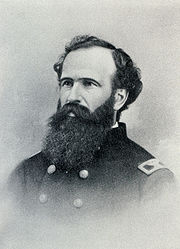
. His replacement as acting chief signal officer was Major William J. L. Nicodemus, his former apprentice. During his exile in the West, Myer's A Manual of Signals: For the Use of Signal Officers in the Field was published in 1864, a work that would remain the basis of signal doctrine for many years.

Aldie, Virginia
Aldie is an unincorporated village located on the John Mosby Highway between Gilbert's Corner and Middleburg in Loudoun County, Virginia. It is located in a gap between the Catoctin Mountain and Bull Run Mountain, through which the Little River flows...
, in the Gettysburg Campaign
Gettysburg Campaign
The Gettysburg Campaign was a series of battles fought in June and July 1863, during the American Civil War. After his victory in the Battle of Chancellorsville, Confederate General Robert E. Lee's Army of Northern Virginia moved north for offensive operations in Maryland and Pennsylvania. The...
and spent eight months in Libby Prison
Libby Prison
Libby Prison was a Confederate Prison at Richmond, Virginia, during the American Civil War. It gained an infamous reputation for the harsh conditions under which prisoners from the Union Army were kept.- Overview :...
before escaping and returning to duty.
The Signal Corps completed its wartime service and was dissolved in August 1865. During its lifetime, 146 officers were commissioned in the corps or were offered commissions. There were 297 acting signal officers appointed, although some were for very brief periods. The total number of enlisted men who served during the war was about 2,500.
Albert Myer was eventually rescued from oblivion. In May 1864, Myer's prewar ally, Edward Canby, selected him to be the signal officer for the Military Division of West Mississippi. Myer served in this position as a major because his confirmation as a colonel had been revoked after his dismissal from Washington. At the end of the Civil War, he was given a brevet
Brevet (military)
In many of the world's military establishments, brevet referred to a warrant authorizing a commissioned officer to hold a higher rank temporarily, but usually without receiving the pay of that higher rank except when actually serving in that role. An officer so promoted may be referred to as being...
promotion to brigadier general
Brigadier general (United States)
A brigadier general in the United States Army, Air Force, and Marine Corps, is a one-star general officer, with the pay grade of O-7. Brigadier general ranks above a colonel and below major general. Brigadier general is equivalent to the rank of rear admiral in the other uniformed...
. On July 28, 1866, reacting to the influence of Lt. Gen.
Lieutenant General (United States)
In the United States Army, the United States Air Force and the United States Marine Corps, lieutenant general is a three-star general officer rank, with the pay grade of O-9. Lieutenant general ranks above major general and below general...
Ulysses S. Grant
Ulysses S. Grant
Ulysses S. Grant was the 18th President of the United States as well as military commander during the Civil War and post-war Reconstruction periods. Under Grant's command, the Union Army defeated the Confederate military and ended the Confederate States of America...
and President
President of the United States
The President of the United States of America is the head of state and head of government of the United States. The president leads the executive branch of the federal government and is the commander-in-chief of the United States Armed Forces....
Andrew Johnson
Andrew Johnson
Andrew Johnson was the 17th President of the United States . As Vice-President of the United States in 1865, he succeeded Abraham Lincoln following the latter's assassination. Johnson then presided over the initial and contentious Reconstruction era of the United States following the American...
, Congress reorganized the Signal Corps and, with the permanent rank of colonel, Myer again became chief signal officer, as of October 30, 1866. His new duties included control of the telegraph service, resolving the dispute that had removed him from his position.
Confederate Signal Corps
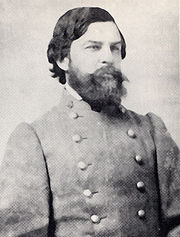
Manassas, Virginia
The City of Manassas is an independent city surrounded by Prince William County and the independent city of Manassas Park in the Commonwealth of Virginia in the United States. Its population was 37,821 as of 2010. Manassas also surrounds the county seat for Prince William County but that county...
. He became the chief engineer and signal officer of the (Confederate) Army of the Potomac
Army of the Potomac (Confederate)
The Confederate Army of the Potomac, whose name was short-lived, was the command under Brig. Gen. P.G.T. Beauregard in the early days of the American Civil War. Its only major combat action was the First Battle of Bull Run. Afterwards, the Army of the Shenandoah was merged into the Army of the...
on June 3. After becoming the chief ordnance officer for the Army of Northern Virginia
Army of Northern Virginia
The Army of Northern Virginia was the primary military force of the Confederate States of America in the Eastern Theater of the American Civil War, as well as the primary command structure of the Department of Northern Virginia. It was most often arrayed against the Union Army of the Potomac...
, Alexander retained his position as signal officer, but his other duties took precedence.
Although the Confederate Signal Corps would never achieve a distinct branch identity to the extent that the Union version did, the Confederate Congress authorized its establishment as a separate organization, attached to the Adjutant and Inspector General's Department, on April 19, 1862, a year before the U.S. Congress did so. The first chief signal officer was Captain William Norris
William Norris (Confederate signal officer)
William Norris of Maryland was the Chief Signal Officer of the Confederate States Army and Chief of the Signal Bureau in Richmond. He is often confused with Dr. William S. Morris, president of the wartime Southern Telegraph Company...
, a Maryland lawyer then a civilian volunteer on the staff of Maj. Gen. John B. Magruder
John B. Magruder
John Bankhead Magruder was a career military officer who served in the armies of three nations. He was a U.S. Army officer in the Mexican-American War, a Confederate general during the American Civil War, and a postbellum general in the Imperial Mexican Army...
.
The corps under Norris was organized to consist of one major, 10 captains, 20 lieutenants, 20 sergeants, and 1500 men detailed from all branches of the service. A signal officer was authorized for the staff at each corps and division. The Confederate Signal Corps perform duties and utilized equipment very similar to their Northern counterparts, with some exceptions. Electric telegraphy was not used in tactical battlefield communications due to shortages of telegraph wire and trained operators. Their aerial telegraphy was performed with similar flags, but with slightly modified codes and movements from the Myer methods. Unlike the Union Signal Corps, however, the Confederate Signal Corps also was chartered to conduct espionage for the South. (Both services provided valuable battlefield intelligence, and sometimes artillery fire direction, from their elevated observation points, but the Confederate corpsmen performed undercover missions behind enemy lines as well.) Acting as the Secret Service of the Confederacy, the corps administered the Secret Line, an information network that ran between Richmond
Richmond, Virginia
Richmond is the capital of the Commonwealth of Virginia, in the United States. It is an independent city and not part of any county. Richmond is the center of the Richmond Metropolitan Statistical Area and the Greater Richmond area...
and the North and extended into Canada
Canada
Canada is a North American country consisting of ten provinces and three territories. Located in the northern part of the continent, it extends from the Atlantic Ocean in the east to the Pacific Ocean in the west, and northward into the Arctic Ocean...
. It is because of its clandestine nature that much of the work of the Confederate Signal Corps is lost to history. Many of its records were burned in the fall of Richmond and in a subsequent fire at Norris's home, which claimed his personal papers.
Wig-wag signaling
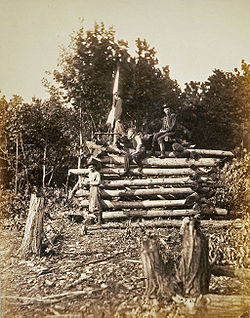
Wig-wag signaling was performed during daylight with a single flag tied to a hickory staff constructed in four-foot jointed sections. Flags were generally made of cotton, linen, or another lightweight fabric and were issued in the following sizes:| Flag size (feet) | Flag background color | Center color | Center size (inches) |
|---|---|---|---|
| 6 x 6 | white | red | 24 x 24 | 6 x 6 | black | white | 24 x 24 | 4 x 4 | white | red | 16 x 16 | 4 x 4 | black | white | 16 x 16 | 4 x 4 | red | white | 16 x 16 | 2 x 2 | white | red | 8 x 8 | 2 x 2 | red | white | 8 x 8 |
The 4-foot flags with white backgrounds, mounted on 12 foot staffs, were most often used, although 2-foot flags were used when the flagman wanted to avoid enemy attention. Red flags were generally used at sea. For nighttime signaling, torches were copper cylinders, 18 inches long and 1.5 inches in diameter with a cotton wick.
Myer's "General Service Code
General Service Code
General Service Code is a code that was used during the American Civil War. The code uses one flag or two torches.The flags come in three color schemes: a red square in the middle of a white background, white on black, or black on white. The flag that is used at any time depends on the...
" for wig-wag signaling, standardized in 1864, was also known as the "four element" code because all of the characters transmitted were composed of from one to four flag motions. (Myer's original method from the 1850s was called a "two element code" because elements were described only in terms of movement from the vertical position.) The flagman took a position facing the station to receive the message and signaled digits "1" through "5" as follows:
- Wave the flag from the vertical position to the ground at the left of the flagman, returning immediately to the vertical position.
- Wave the flag from the vertical position to the ground at the right of the flagman, returning immediately to the vertical position.
- Wave the flag from the ground on the right to the ground on the left of the flagman, returning immediately to the vertical position. The signal "3" always followed a "2" or "4."
- Wave the flag from the ground on the left to the ground on the right of the flagman, returning immediately to the vertical position. The signal "4" always followed a "1" or "3."
- Wave the flag directly in front of the flagman to the ground, returning immediately to the vertical position.
Codes for the alphabet, digits, and some special characters were as follows for the Union Signal Corps:
| A - 11 | F - 1114 | K - 1434 | P - 2343 | U - 223 | Z - 1111 | 1 - 14223 | 6 - 23111 | B - 1423 | G - 1142 | L - 114 | Q - 2342 | V - 2311 | & - 2222 | 2 - 23114 | 7 - 22311 | C - 234 | H - 231 | M - 2314 | R - 142 | W - 2234 | tion - 2223 | 3 - 11431 | 8 - 22223 | D - 111 | I - 2 | N - 22 | S - 143 | X - 1431 | ing - 1143 | 4 - 11143 | 9 - 22342 | E - 23 | J - 2231 | O - 14 | T - 1 | Y - 222 | ed - 1422 | 5 - 11114 | 0 - 11111 |
Waving the flag continuously from left to right was used to attract attention and to indicate that signaling was about to start. Other special sequences of digits were:
| 5 | End of word | 55 | End of sentence | 555 | End of message | 11, 11, 11, 5 | "I understand" | 11, 11, 11, 555 | "Cease signaling" | 234, 234, 234, 5 | "Repeat" | 143434, 5 | "Error" |
Telegraph train and the Beardslee telegraph
For its first use in combat, during the 1862 Peninsula Campaign
Peninsula Campaign
The Peninsula Campaign of the American Civil War was a major Union operation launched in southeastern Virginia from March through July 1862, the first large-scale offensive in the Eastern Theater. The operation, commanded by Maj. Gen. George B...
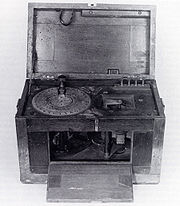
, the Rogers train substituted a new telegraph instrument, the Beardslee Patent Magneto-Electric Field Telegraph Machine, invented by George W. Beardslee of New York. This instrument required no battery, using instead a hand-cranked generator, but it was also based on a dial indicator. The Beardslee telegraph was housed in a wooden chest with handles and weighed about 100 pounds. It had two significant technical deficiencies, however. Its generator could not produce enough electricity to transmit signals more than about 5 to 8 miles. More seriously, there was a tendency for the sending and receiving index pointers to get out of synchronization, hopelessly garbling transmitted messages. Broken machines had to be sent back to New York City for repair. It was these deficiencies that led Myer to his decision to use traditional Morse key technology and attempt to hire trained telegraphers, a decision that led Secretary Stanton to dismiss him as chief signal officer. All of the telegraph train assets of the Signal Corps were turned over to the Military Telegraph Service, but they did not use the Beardslee telegraph due to its unreliability. At their peak of usage in 1863, there were 30 telegraph trains in the field.
Ciphers

Cipher disk
A cipher disk is an enciphering and deciphering tool developed in 1470 by the Italian architect and author Leon Battista Alberti. He constructed a device, consisting of two concentric circular plates mounted one on top of the other...
, a simple device that allowed the encryption of text. Two concentric discs were inscribed with letters and their numerical equivalents. The sending and receiving party had to agree on the specific alignment between the two discs, ensuring that both parties had identical alignment. To encipher a message, the signal officer selected an "adjustment letter" on the inner disc and then made this letter correspond with a preselected numerical code or "key number" on the outer disc. The signal officer would typically give the key numbers to the flagmen without revealing the plain text version of the message. Although this method of encryption was primitive by modern standards, there is no record that the Confederates ever deciphered a Union message that had been processed in this manner. A more complex system in which four concentric discs were used was invented by Sergeant Francis M. Metcalf and modified by Captain Lemuel B. Norton, but it did not receive widespread adoption.
First Bull Run

First Battle of Bull Run
First Battle of Bull Run, also known as First Manassas , was fought on July 21, 1861, in Prince William County, Virginia, near the City of Manassas...
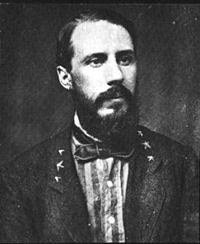
, Confederate Capt. Edward Porter Alexander
Edward Porter Alexander
Edward Porter Alexander was an engineer, an officer in the U.S. Army, a Confederate general in the American Civil War, and later a railroad executive, planter, and author....
made history by transmitting the first message in combat using signal flags over a long distance. Stationed atop "Signal Hill" in Manassas, Alexander saw Union
Union Army
The Union Army was the land force that fought for the Union during the American Civil War. It was also known as the Federal Army, the U.S. Army, the Northern Army and the National Army...
troop movements and signaled to the brigade under Col. Nathan "Shanks" Evans
Nathan George Evans
Nathan George "Shanks" Evans was a captain in the 2nd U.S. Cavalry who became a brigadier general in the Confederate States Army during the American Civil War.-Biography:...
, "Look out for your left, your position is turned", which meant that they were in danger of being attacked on their left flank. Upon receiving a similar message, Gens. Beauregard and Joseph E. Johnston
Joseph E. Johnston
Joseph Eggleston Johnston was a career U.S. Army officer, serving with distinction in the Mexican-American War and Seminole Wars, and was also one of the most senior general officers in the Confederate States Army during the American Civil War...
sent timely reinforcements that turned the tide of battle in the Confederates' favor.
On the Union side, Albert Myer attempted to deploy a military observation balloon at Manassas, bringing along 20 troops from the 26th Pennsylvania Infantry because of the lack of Signal Corps personnel that early in the war. Because of the haste of these untrained men, the balloon was damaged after a collision with a tree and could not be used for the battle.
Fredericksburg
At the Battle of FredericksburgBattle of Fredericksburg
The Battle of Fredericksburg was fought December 11–15, 1862, in and around Fredericksburg, Virginia, between General Robert E. Lee's Confederate Army of Northern Virginia and the Union Army of the Potomac, commanded by Maj. Gen. Ambrose E. Burnside...
in December 1862, significant use of the Beardslee telegraph made it possible for Maj. Gen. Ambrose E. Burnside to communicate with the Army through the fog and smoke from the burning town. On December 13, the main day of the battle, signal corpsmen extended a line across the Rappahannock River
Rappahannock River
The Rappahannock River is a river in eastern Virginia, in the United States, approximately in length. It traverses the entire northern part of the state, from the Blue Ridge Mountains in the west, across the Piedmont, to the Chesapeake Bay, south of the Potomac River.An important river in American...
into the town of Fredericksburg while under fire and Burnside was able to communicate with both of his grand division commanders and his supply base, 7.5 miles away.
Chancellorsville
During the Battle of Chancellorsville in May 1863, the performance of the Beardslee telegraph was so poor that Albert Myer soon decided to replace it. The campaign got off to a bad start because the chief signal officer of the Army of the Potomac, Captain Samuel T. Cushing, was kept in the dark about the plans of Maj. Gen. Joseph HookerJoseph Hooker
Joseph Hooker was a career United States Army officer, achieving the rank of major general in the Union Army during the American Civil War. Although he served throughout the war, usually with distinction, Hooker is best remembered for his stunning defeat by Confederate General Robert E...
and he could not arrange his signal assets in advance. As the Army advanced, Cushing had insufficient wire on hand and was forced to use untested wire that had been left in the field, supported by iron lances, since Fredericksburg. On April 29, as the Army prepared to cross the Rapidan River
Rapidan River
The Rapidan River, flowing through north-central Virginia in the United States, is the largest tributary of the Rappahannock River. The two rivers converge just west of the city of Fredericksburg...
, the Beardslee telegraph did not work, probably due to excessive wire length. Captain Frederick E. Beardslee, son of the inventor, was sent to make repairs. He found that the machine had been hit by lightning and was operating erratically. That evening a telegraph reached headquarters from the Ford on the Rapidan at 10:30 p.m., but it was marked (incorrectly) as originating at 5:30 p.m. Maj. Gen. Daniel Butterfield
Daniel Butterfield
Daniel Adams Butterfield was a New York businessman, a Union General in the American Civil War, and Assistant U.S. Treasurer in New York. He is credited with composing the bugle call Taps and was involved in the Black Friday gold scandal in the Grant administration...
, Chief of Staff of the Army of the Potomac, told Cushing that he was not going to wake the commanding general for any telegram that was five hours late; his repose was "worth more than the commissions of a dozen signal officers." The inadequate wires and the unreliable telegraph caused persistent problems and kept General Hooker isolated from his forces in the Wilderness. On May 1, operators of the U.S. Military Telegraph Service were ordered to replace the Signal Corps Beardslee operators.
It was also at Chancellorsville that a major change happened in Union signal security. Butterfield was concerned about Confederate interception of aerial telegraphy signals, but he used this as an advantage, ordering deceptive messages to be transmitted early in the campaign to mask the Union Army's true intentions. Since the Union signal corpsmen could routinely decipher Confederate messages, Butterfield was able to confirm that his bogus messages had been received. It was after these incidents that the Union began deploying the cipher disc devices and improving the security of their messages.
Gettysburg

Battle of Gettysburg
The Battle of Gettysburg , was fought July 1–3, 1863, in and around the town of Gettysburg, Pennsylvania. The battle with the largest number of casualties in the American Civil War, it is often described as the war's turning point. Union Maj. Gen. George Gordon Meade's Army of the Potomac...
featured the Union Signal Corps in its role of observing the battlefield. The chief signal officer of the Army of the Potomac, Captain Lemuel B. Norton, had field telegraph trains at his disposal, but did not deploy them. On July 1, 1863, a Union signal officer, Lt. Aaron B. Jerome, ascended the cupola of the Lutheran Theological Seminary
Lutheran Theological Seminary at Gettysburg
The Lutheran Theological Seminary at Gettysburg is America's oldest Lutheran seminary and a site of 1863 Battle of Gettysburg military engagements.-History:...
and the courthouse steeple to observe the enemy's approach and reported to Maj. Gen. Oliver O. Howard
Oliver O. Howard
Oliver Otis Howard was a career United States Army officer and a Union general in the American Civil War...
. On July 2, the Confederate corps under Lt. Gen. James Longstreet
James Longstreet
James Longstreet was one of the foremost Confederate generals of the American Civil War and the principal subordinate to General Robert E. Lee, who called him his "Old War Horse." He served under Lee as a corps commander for many of the famous battles fought by the Army of Northern Virginia in the...
attempted to maneuver into position for an attack on the Union left flank. They were forced into a lengthy counter march, delaying their attack, when they spotted the presence of the Union signal station on Little Round Top
Little Round Top
Little Round Top is the smaller of two rocky hills south of Gettysburg, Pennsylvania. It was the site of an unsuccessful assault by Confederate troops against the Union left flank on July 2, 1863, the second day of the Battle of Gettysburg....
mountain and knew that their approach would be reported. During the Confederate assault, the fighting was so heavy that the signal station had to be abandoned until the following day. A plaque commemorating the U.S. Army Signal Corps' contribution to the battle is mounted today on a boulder near the peak of Little Round Top. On July 3, before Pickett's Charge
Pickett's Charge
Pickett's Charge was an infantry assault ordered by Confederate Gen. Robert E. Lee against Maj. Gen. George G. Meade's Union positions on Cemetery Ridge on July 3, 1863, the last day of the Battle of Gettysburg during the American Civil War. Its futility was predicted by the charge's commander,...
, artillery fire against the Union line was so intense that the signalmen could not use their flags. Captain Edward C. Pierce, a signal officer attached to the VI Corps
VI Corps (ACW)
The VI Corps was a corps of the Union Army during the American Civil War.-Formation:The corps was organized as the Sixth Provisional Corps on May 18, 1862, by uniting Maj. Gen. William B. Franklin's Division, which had just arrived on the Virginia Peninsula, with Maj. Gen. William F. Smith's...
, acted as a mounted courier to Maj. Gen. George G. Meade's headquarters, despite warnings that he would never make it alive through the firing.
Further reading
- Plum, William Rattle The Military Telegraph During the Civil War in the United States: With an Exposition of Ancient and Modern Means of Communication, and of the Federal and Confederate Cipher Systems; Also a Running Account of the War Between the States. (Vol. 1, Vol. 2). New York: Jansen, McClurg & Company, 1882.