


Edward Canby

Encyclopedia
Edward Richard Sprigg Canby (November 9, 1817 – April 11, 1873) was a career United States Army
officer and a Union
general in the American Civil War
, Reconstruction era, and the Indian Wars
. He was the only United States general to be killed during the latter wars, and he died when assassinated at a peace talk with the Modoc
in Northern California
.
, to Israel T. and Elizabeth (Piatt) Canby. He attended Wabash College
, but transferred to the United States Military Academy
, from which he graduated in 1839. He was commissioned a second lieutenant in the 2nd U.S. Infantry
and served as the regimental adjutant.
Although often referred to as Edward Canby, a biographer has suggested that he was known as "Richard" during childhood and to some friends for most of his life. He was called "Sprigg" by fellow cadets at West Point, but during most of his career, he was generally referred to as E.R.S. Canby, sometimes signing his name "Ed.R.S. Canby."
at Crawfordsville, Indiana
, August 1, 1839. She came from a family of three sisters and a brother, with whom she remained close. The Canbys had several children together.
in Florida
and saw combat during the Mexican-American War, where he received three brevet
promotions, including to major
for Contreras
and Churubusco
, and lieutenant colonel
for Belén Gates. He also served at various posts, including Upstate New York
and in the adjutant general's office in California
from 1849 until 1851, covering the period of the territory's transition to statehood.
Against his wishes, he was assigned to what was supposed to be the civilian post of custodian of the California Archives from March 1850 until he left California in April 1851. The Archives included records of Spanish
and Mexican
governments in California, as well as Mission
records and land titles. Evidently, Canby had some knowledge of the Spanish language, which was extremely useful as the government was trying to unravel land titles. (The Filson Historical Society in Louisville, Kentucky
holds what appears to be a document written in Canby's hand in Spanish, in which he identifies himself as "Edwardo [sic] Ricardo S. Canby.")
Canby served in Wyoming
and Utah
(then both part of the Utah Territory
) during the Utah War
(1857–1858). During this period, he served on the panel of judges for the court martial of Captain Henry Hopkins Sibley
. Sibley was acquitted. Subsequently, Canby wrote an endorsement for a teepee-like army tent
which Sibley had adapted from the American Indian style.
Both officers were later assigned to New Mexico
, where in 1860 Canby coordinated a campaign against the Navaho, commanding Sibley in a futile attempt to capture and punish Navajo for "depredations" against the livestock
of settlers. The campaign ended in frustration, with Canby and Sibley rarely sighting Navajo raiders. Usually they saw the Navajo at a distance and never got close to them.
, Canby commanded Fort Defiance
, New Mexico Territory
. He was promoted to colonel
of the 19th U.S. Infantry on May 14, 1861, and the following month commanded the Department of New Mexico
. His former assistant Sibley resigned to join the Confederate Army. Although subsequently defeated by Confederate
Brigadier General Sibley in February 1862 at the Battle of Valverde
, Canby and his troops eventually forced the Confederates to retreat to Texas
after the Union
strategic victory at the Battle of Glorieta Pass
.
Immediately following this battle, Canby was promoted to brigadier general on March 31, 1862. Recombining the forces he had earlier divided, Canby set off in pursuit of the retreating Confederate army, but he soon gave up the chase and allowed them to reach Texas
. Shortly after the failure of the Confederate invasion of northern New Mexico, Canby was relieved of his command by Gen. James H. Carleton and reassigned to the east.
Canby's achievement in New Mexico had largely been in his planning an overall defensive strategy. He and his opponent, Sibley, both had limited resources. Though Canby was a little better supplied, he saw that defending the entire territory from every possible attack would stretch his forces too thinly. Realizing that Sibley had to attack along a river, especially since New Mexico was in the middle of a long drought
, Canby made the best use of his forces by defending against only two possible scenarios: an attack along the Rio Grande
and an attack by way of the Pecos
and Canadian
rivers. He could easily shift the latter defensive force to protect Fort Union if the enemy attacked by way of the Rio Grande, which they did. Canby persuaded the governors of both New Mexico and Colorado
to raise volunteer units to supplement regular Federal troops; the Colorado troops proved helpful at both Valverde
and Glorieta
. In spite of occasional superior soldiering by Confederate troops and junior commanders, Sibley's sluggishness and vacillation in executing a plan with high risk led to an almost inevitable Confederate collapse.
After a period of clerical duty, Canby was assigned as "commanding general of the city and harbor of New York
" on July 17, 1863. This assignment followed the New York Draft Riots
by ethnic Irish against blacks, which caused numerous deaths and extensive property damage. He served until November 9, reviving the draft, and overseeing a prisoner of war camp in New York Harbor
. He then went to work in the office of the Secretary of War, unofficially describing himself in correspondence as an "Assistant Adjutant General." Looking back on Canby's record, a 20th-century adjutant general, Edward F. Witsell, described Canby's position as "similar to that of an Assistant to the Secretary of the Army."
In May 1864, Canby was promoted to major general
and relieved Nathaniel P. Banks of his command at Simmesport
, Louisiana
. He next was assigned to the Midwest, where he commanded the Military Division of Western Mississippi
. He was wounded in the upper thigh by a guerrilla while aboard the gunboat USS Cricket on the White River
in Arkansas
near Little Island on November 6, 1864. Canby commanded the Union forces assigned to conduct the campaign against Mobile
, Alabama
in the spring of 1865. This culminated in the Battle of Fort Blakely
, which led to the fall of Mobile in April 1865. Canby accepted the surrender of the Confederate forces under General Richard Taylor
in Citronelle
, on May 4, 1865, and those under General Edmund Kirby Smith
west of the Mississippi River on May 26, 1865.
Canby was generally regarded as a great administrator, but he was criticized as a soldier. Ulysses S. Grant
thought him not aggressive enough. At one time, Grant sent Canby an order to "destroy [the enemy's] railroads, machine-shops, &c." Ten days later, Grant reprimanded him for requesting men and materials to build railroads. "I wrote... urging you to... destroy railroads, machine-shops, &c., not to build them," Grant said. Canby could be a destroyer but appeared to prefer the role of builder. Today, he might be considered a "policy wonk" because he was expert in policy and law. If someone had a question about army regulations or Constitutional law
affecting the military, Canby was the man to see. Grant came to appreciate this in peace time, once complaining vigorously when President Andrew Johnson
proposed to assign Canby away from the capital where Grant considered him irreplaceable.
John D. Winters
in The Civil War in Louisiana (1963) writes that Canby "lacked the social amenities" of Banks and appeared to most people as stern and taciturn." Winters quotes Treasury agent George S. Denison of New Orleans
:
Canby's father had once owned slaves. Some of Canby's cousins fought for the Confederacy, and one was taken prisoner of war
. The man's father wrote to Canby asking the general to use his influence to parole his son, but Canby declined, responding that he did not feel entitled to use his influence to benefit family members. Later, when Canby was a military governor during Reconstruction, he declined to favor relatives who had become carpetbagger
s in his jurisdiction.
from 1864 to May 1866. He was next assigned as commander of the Department of Washington, which consisted of Delaware
, Maryland
, the District of Columbia, and Alexandria and Fairfax
counties in Virginia, from June 1866 until August 1867. He was assigned to the command of the Second Military District
, comprising North
and South Carolina
. In August 1868, he briefly resumed command in Washington
.
He was assigned to the Fifth Military District
in November, where he focused primarily on the reconstruction of Texas. He left Texas for Virginia
, the First Military District
, in April 1869, serving there until July 1870. Each of these postings occurred during Reconstruction and put Canby at the center of conflicts between Republican
s and Democrat
s, whites and blacks, state and federal governments. New state legislatures were writing constitutions, and the social climate was highly volatile, with insurgent attacks against freedmen and Republicans on the rise in numerous areas. Many of his districts had Ku Klux Klan chapters, which the US government was not able to suppress until the early 1870s. Canby sometimes alienated one side or the other and often both. Charles W. Ramsdell called Canby "vigorous and firm, but just." Even political opponents, such as Jonathan Worth
, governor of North Carolina, admitted that Canby was sincere and honest.
. He soon faced problems with the Modoc tribe, who had traditionally lived in Northern California
. Forced to remove to a reservation in Oregon
which they had to share with their traditional enemies, the Klamath tribe, they had pleaded with the US government to return to California. When the US refused, the Modoc left the reservation and returned illegally. In 1872, the US Army went to fight against them to force them back and the Modoc War
broke out. The Modoc, entrenched in Captain Jack's Stronghold
south of Tule Lake
, resisted army attacks and fought US forces to a stalemate
.
 General Canby had received conflicting orders from Washington as to whether to make peace or war on the Modoc. As war was not working, the US government authorized a peace commission and assigned Canby a key position on it. There were many lines of communication between the Modoc and whites. At one point, someone told the Modoc leader Captain Jack that the governor of Oregon intended to hang
nine Modoc, apparently without trial, as soon as they surrendered. The Modoc broke off scheduled talks; Canby was angered by the rumors and their action, as he believed that his federal authority trumped the governor's and made the threat irrelevant. Canby had no intention of allowing the Modoc to be punished without a trial.
On April 11, 1873, after months of false starts and aborted meetings, Canby went to another parley, unarmed and with some hope of final resolution. Judge Elijah Steele
of Yreka, California
wrote later that when he warned Canby that the Modoc were volatile and he was at risk, Canby replied, "I believe you are right, Mr. Steele, and I shall regard your advice, but it would not be very well for the general in command to be afraid to go where the peace commissioners would venture." The peace talks were held midway between the army encampment and Captain Jack's stronghold near Tule Lake. It was discovered later that two members of Canby's party brought concealed weapons and Modoc warriors were also armed.
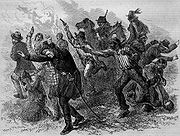 According to Jeff C. Riddle, the Modoc son of the US interpreter and the author of Indian History of the Modoc War (1914), the Modoc had plotted before the meeting to kill Canby and the other commissioners, as they believed peace was not possible. They were determined to "fight until we die." (He was the son of Winema and Frank Riddle.) Captain Jack had been reluctant to agree to the killings, believing it "coward's work," but was pressured by other warriors to agree. He insisted on being given another chance to ask Canby to "give us a home in our country." When Canby said he did not have the authority to make such a promise, Captain Jack attacked the general. With Ellen's Man, one of his lieutenants, he shot Canby twice in the head and cut his throat. The Modoc also killed Reverend Eleazar Thomas, a peace commissioner, and wounded others in the party. Canby was the only general to be killed during the Indian Wars
.
 The killing of Canby, and the Great Sioux War, undermined public confidence in President Grant's peace policy, according to the historian Robert Utley. There was growing public sentiment for full defeat of the American Indians.
After memorial services were performed on the West Coast
, Canby's body was returned to Indiana
and buried in Crown Hill Cemetery
, Indianapolis, Indiana
on May 23, 1873. At least four Union generals attended his funeral there: William Tecumseh Sherman
, Philip Sheridan
, Lew Wallace
, and Irvin McDowell
, and the latter two served among the pall bearers. A reporter noted that, although the funeral procession was generally reserved, "more than once, expressions of hatred toward the Modoc" marred the silence.
United States Army
The United States Army is the main branch of the United States Armed Forces responsible for land-based military operations. It is the largest and oldest established branch of the U.S. military, and is one of seven U.S. uniformed services...
officer and a Union
Union Army
The Union Army was the land force that fought for the Union during the American Civil War. It was also known as the Federal Army, the U.S. Army, the Northern Army and the National Army...
general in the American Civil War
American Civil War
The American Civil War was a civil war fought in the United States of America. In response to the election of Abraham Lincoln as President of the United States, 11 southern slave states declared their secession from the United States and formed the Confederate States of America ; the other 25...
, Reconstruction era, and the Indian Wars
Indian Wars
American Indian Wars is the name used in the United States to describe a series of conflicts between American settlers or the federal government and the native peoples of North America before and after the American Revolutionary War. The wars resulted from the arrival of European colonizers who...
. He was the only United States general to be killed during the latter wars, and he died when assassinated at a peace talk with the Modoc
Modoc
The Modoc are a Native American people who originally lived in the area which is now northeastern California and central Southern Oregon. They are currently divided between Oregon and Oklahoma. The latter are a federally recognized tribe, the Modoc Tribe of Oklahoma...
in Northern California
Northern California
Northern California is the northern portion of the U.S. state of California. The San Francisco Bay Area , and Sacramento as well as its metropolitan area are the main population centers...
.
Early life
Canby was born in Piatt's Landing, KentuckyPiatt's Landing, Kentucky
Piatt's Landing was an early nineteenth century riverboat and ferry landing on the Ohio River in Boone County, Kentucky. It is located near Route 338 almost due west of downtown Union. The landing and Winnfield Cottage, which no longer exists, were built by Robert Piatt, the grandfather of Civil...
, to Israel T. and Elizabeth (Piatt) Canby. He attended Wabash College
Wabash College
Wabash College is a small, private, liberal arts college for men, located in Crawfordsville, Indiana. Along with Hampden-Sydney College and Morehouse College, Wabash is one of only three remaining traditional all-men's liberal arts colleges in the United States.-History:Wabash College was founded...
, but transferred to the United States Military Academy
United States Military Academy
The United States Military Academy at West Point is a four-year coeducational federal service academy located at West Point, New York. The academy sits on scenic high ground overlooking the Hudson River, north of New York City...
, from which he graduated in 1839. He was commissioned a second lieutenant in the 2nd U.S. Infantry
2nd Infantry Regiment (United States)
The 2nd Infantry Regiment is an infantry regiment in the United States Army. It has served the United States for more than two hundred years. It is the third oldest regiment in the US Army with a Lineage date of 1808 and a history extending back to 1791...
and served as the regimental adjutant.
Although often referred to as Edward Canby, a biographer has suggested that he was known as "Richard" during childhood and to some friends for most of his life. He was called "Sprigg" by fellow cadets at West Point, but during most of his career, he was generally referred to as E.R.S. Canby, sometimes signing his name "Ed.R.S. Canby."
Marriage and family
He married Louisa HawkinsLouisa Hawkins Canby
Louisa Hawkins Canby was nicknamed the “Angel of Santa Fe” in 1862 for her compassion toward sick, wounded, and freezing Confederate soldiers at Santa Fe, New Mexico. Mrs. Canby was the wife of Union Brig. Gen...
at Crawfordsville, Indiana
Crawfordsville, Indiana
Crawfordsville is a city in Union Township, Montgomery County, Indiana, United States. As of the 2010 census, the city had a population of 15,915. The city is the county seat of Montgomery County...
, August 1, 1839. She came from a family of three sisters and a brother, with whom she remained close. The Canbys had several children together.
Early military career
During his early career, Canby served in the Second Seminole WarSeminole Wars
The Seminole Wars, also known as the Florida Wars, were three conflicts in Florida between the Seminole — the collective name given to the amalgamation of various groups of native Americans and Black people who settled in Florida in the early 18th century — and the United States Army...
in Florida
Florida
Florida is a state in the southeastern United States, located on the nation's Atlantic and Gulf coasts. It is bordered to the west by the Gulf of Mexico, to the north by Alabama and Georgia and to the east by the Atlantic Ocean. With a population of 18,801,310 as measured by the 2010 census, it...
and saw combat during the Mexican-American War, where he received three brevet
Brevet (military)
In many of the world's military establishments, brevet referred to a warrant authorizing a commissioned officer to hold a higher rank temporarily, but usually without receiving the pay of that higher rank except when actually serving in that role. An officer so promoted may be referred to as being...
promotions, including to major
Major (United States)
In the United States Army, Air Force, and Marine Corps, major is a field grade military officer rank just above the rank of captain and just below the rank of lieutenant colonel...
for Contreras
Battle of Contreras
The Battle of Contreras, also known as the Battle of Padierna, took place during August 19–20, 1847, in the final encounters of the Mexican-American War. In the Battle of Churubusco, fighting continued the following day.-Background:...
and Churubusco
Battle of Churubusco
The Battle of Churubusco took place on August 20, 1847, in the immediate aftermath of the Battle of Contreras during the Mexican-American War. After defeating the Mexican army at Churubusco, the U.S. Army was only 5 miles away from Mexico City, the capital of the nation...
, and lieutenant colonel
Lieutenant Colonel (United States)
In the United States Army, United States Air Force, and United States Marine Corps, a lieutenant colonel is a field grade military officer rank just above the rank of major and just below the rank of colonel. It is equivalent to the naval rank of commander in the other uniformed services.The pay...
for Belén Gates. He also served at various posts, including Upstate New York
Upstate New York
Upstate New York is the region of the U.S. state of New York that is located north of the core of the New York metropolitan area.-Definition:There is no clear or official boundary between Upstate New York and Downstate New York...
and in the adjutant general's office in California
California
California is a state located on the West Coast of the United States. It is by far the most populous U.S. state, and the third-largest by land area...
from 1849 until 1851, covering the period of the territory's transition to statehood.
Against his wishes, he was assigned to what was supposed to be the civilian post of custodian of the California Archives from March 1850 until he left California in April 1851. The Archives included records of Spanish
Spanish people
The Spanish are citizens of the Kingdom of Spain. Within Spain, there are also a number of vigorous nationalisms and regionalisms, reflecting the country's complex history....
and Mexican
Mexican people
Mexican people refers to all persons from Mexico, a multiethnic country in North America, and/or who identify with the Mexican cultural and/or national identity....
governments in California, as well as Mission
Mission (Christian)
Christian missionary activities often involve sending individuals and groups , to foreign countries and to places in their own homeland. This has frequently involved not only evangelization , but also humanitarian work, especially among the poor and disadvantaged...
records and land titles. Evidently, Canby had some knowledge of the Spanish language, which was extremely useful as the government was trying to unravel land titles. (The Filson Historical Society in Louisville, Kentucky
Louisville, Kentucky
Louisville is the largest city in the U.S. state of Kentucky, and the county seat of Jefferson County. Since 2003, the city's borders have been coterminous with those of the county because of a city-county merger. The city's population at the 2010 census was 741,096...
holds what appears to be a document written in Canby's hand in Spanish, in which he identifies himself as "Edwardo [sic] Ricardo S. Canby.")
Canby served in Wyoming
Wyoming
Wyoming is a state in the mountain region of the Western United States. The western two thirds of the state is covered mostly with the mountain ranges and rangelands in the foothills of the Eastern Rocky Mountains, while the eastern third of the state is high elevation prairie known as the High...
and Utah
Utah
Utah is a state in the Western United States. It was the 45th state to join the Union, on January 4, 1896. Approximately 80% of Utah's 2,763,885 people live along the Wasatch Front, centering on Salt Lake City. This leaves vast expanses of the state nearly uninhabited, making the population the...
(then both part of the Utah Territory
Utah Territory
The Territory of Utah was an organized incorporated territory of the United States that existed from September 9, 1850, until January 4, 1896, when the final extent of the territory was admitted to the Union as the State of Utah....
) during the Utah War
Utah War
The Utah War, also known as the Utah Expedition, Buchanan's Blunder, the Mormon War, or the Mormon Rebellion was an armed confrontation between LDS settlers in the Utah Territory and the armed forces of the United States government. The confrontation lasted from May 1857 until July 1858...
(1857–1858). During this period, he served on the panel of judges for the court martial of Captain Henry Hopkins Sibley
Henry Hopkins Sibley
Henry Hopkins Sibley was a brigadier general during the American Civil War, leading the Confederate States Army in the New Mexico Territory. His attempt to gain control of trails to California was defeated at the Battle of Glorieta Pass...
. Sibley was acquitted. Subsequently, Canby wrote an endorsement for a teepee-like army tent
Tent
A tent is a shelter consisting of sheets of fabric or other material draped over or attached to a frame of poles or attached to a supporting rope. While smaller tents may be free-standing or attached to the ground, large tents are usually anchored using guy ropes tied to stakes or tent pegs...
which Sibley had adapted from the American Indian style.
Both officers were later assigned to New Mexico
New Mexico
New Mexico is a state located in the southwest and western regions of the United States. New Mexico is also usually considered one of the Mountain States. With a population density of 16 per square mile, New Mexico is the sixth-most sparsely inhabited U.S...
, where in 1860 Canby coordinated a campaign against the Navaho, commanding Sibley in a futile attempt to capture and punish Navajo for "depredations" against the livestock
Livestock
Livestock refers to one or more domesticated animals raised in an agricultural setting to produce commodities such as food, fiber and labor. The term "livestock" as used in this article does not include poultry or farmed fish; however the inclusion of these, especially poultry, within the meaning...
of settlers. The campaign ended in frustration, with Canby and Sibley rarely sighting Navajo raiders. Usually they saw the Navajo at a distance and never got close to them.
Civil War
At the start of the Civil WarAmerican Civil War
The American Civil War was a civil war fought in the United States of America. In response to the election of Abraham Lincoln as President of the United States, 11 southern slave states declared their secession from the United States and formed the Confederate States of America ; the other 25...
, Canby commanded Fort Defiance
Fort Defiance, Arizona
Fort Defiance is a census-designated place in Apache County, Arizona, United States. The population was 4,061 at the 2000 census.- History :...
, New Mexico Territory
New Mexico Territory
thumb|right|240px|Proposed boundaries for State of New Mexico, 1850The Territory of New Mexico was an organized incorporated territory of the United States that existed from September 9, 1850, until January 6, 1912, when the final extent of the territory was admitted to the Union as the State of...
. He was promoted to colonel
Colonel (United States)
In the United States Army, Air Force, and Marine Corps, colonel is a senior field grade military officer rank just above the rank of lieutenant colonel and just below the rank of brigadier general...
of the 19th U.S. Infantry on May 14, 1861, and the following month commanded the Department of New Mexico
Department of New Mexico
The Department of New Mexico was a department of the United States Army during the mid-19th century. At first a part of the Department of the West, it was created as an independent department following the breakup of that Division into various departments during the Civil War...
. His former assistant Sibley resigned to join the Confederate Army. Although subsequently defeated by Confederate
Confederate States of America
The Confederate States of America was a government set up from 1861 to 1865 by 11 Southern slave states of the United States of America that had declared their secession from the U.S...
Brigadier General Sibley in February 1862 at the Battle of Valverde
Battle of Valverde
The Battle of Valverde, or the Battle of Valverde Ford from February 20 to February 21, 1862, was fought near the town of Valverde at a ford of Valverde Creek in Confederate Arizona, in what is today the state of New Mexico. It was a major Confederate success in the New Mexico Campaign of the...
, Canby and his troops eventually forced the Confederates to retreat to Texas
Texas
Texas is the second largest U.S. state by both area and population, and the largest state by area in the contiguous United States.The name, based on the Caddo word "Tejas" meaning "friends" or "allies", was applied by the Spanish to the Caddo themselves and to the region of their settlement in...
after the Union
Union (American Civil War)
During the American Civil War, the Union was a name used to refer to the federal government of the United States, which was supported by the twenty free states and five border slave states. It was opposed by 11 southern slave states that had declared a secession to join together to form the...
strategic victory at the Battle of Glorieta Pass
Battle of Glorieta Pass
The Battle of Glorieta Pass, fought from March 26 to 28, 1862 in northern New Mexico Territory, was the decisive battle of the New Mexico Campaign during the American Civil War. Dubbed the "Gettysburg of the West" by some historians, it was intended as the killer blow by Confederate forces to break...
.
Immediately following this battle, Canby was promoted to brigadier general on March 31, 1862. Recombining the forces he had earlier divided, Canby set off in pursuit of the retreating Confederate army, but he soon gave up the chase and allowed them to reach Texas
Texas
Texas is the second largest U.S. state by both area and population, and the largest state by area in the contiguous United States.The name, based on the Caddo word "Tejas" meaning "friends" or "allies", was applied by the Spanish to the Caddo themselves and to the region of their settlement in...
. Shortly after the failure of the Confederate invasion of northern New Mexico, Canby was relieved of his command by Gen. James H. Carleton and reassigned to the east.
Canby's achievement in New Mexico had largely been in his planning an overall defensive strategy. He and his opponent, Sibley, both had limited resources. Though Canby was a little better supplied, he saw that defending the entire territory from every possible attack would stretch his forces too thinly. Realizing that Sibley had to attack along a river, especially since New Mexico was in the middle of a long drought
Drought
A drought is an extended period of months or years when a region notes a deficiency in its water supply. Generally, this occurs when a region receives consistently below average precipitation. It can have a substantial impact on the ecosystem and agriculture of the affected region...
, Canby made the best use of his forces by defending against only two possible scenarios: an attack along the Rio Grande
Rio Grande
The Rio Grande is a river that flows from southwestern Colorado in the United States to the Gulf of Mexico. Along the way it forms part of the Mexico – United States border. Its length varies as its course changes...
and an attack by way of the Pecos
Pecos River
The headwaters of the Pecos River are located north of Pecos, New Mexico, United States, at an elevation of over 12,000 feet on the western slope of the Sangre de Cristo mountain range in Mora County. The river flows for through the eastern portion of that state and neighboring Texas before it...
and Canadian
Canadian River
The Canadian River is the longest tributary of the Arkansas River. It is about long, starting in Colorado and traveling through New Mexico, the Texas Panhandle, and most of Oklahoma....
rivers. He could easily shift the latter defensive force to protect Fort Union if the enemy attacked by way of the Rio Grande, which they did. Canby persuaded the governors of both New Mexico and Colorado
Colorado
Colorado is a U.S. state that encompasses much of the Rocky Mountains as well as the northeastern portion of the Colorado Plateau and the western edge of the Great Plains...
to raise volunteer units to supplement regular Federal troops; the Colorado troops proved helpful at both Valverde
Battle of Valverde
The Battle of Valverde, or the Battle of Valverde Ford from February 20 to February 21, 1862, was fought near the town of Valverde at a ford of Valverde Creek in Confederate Arizona, in what is today the state of New Mexico. It was a major Confederate success in the New Mexico Campaign of the...
and Glorieta
Glorieta, New Mexico
Glorieta is a census-designated place in Santa Fe County, New Mexico, United States. It is part of the Santa Fe, New Mexico Metropolitan Statistical Area. The population was 859 at the 2000 census...
. In spite of occasional superior soldiering by Confederate troops and junior commanders, Sibley's sluggishness and vacillation in executing a plan with high risk led to an almost inevitable Confederate collapse.
After a period of clerical duty, Canby was assigned as "commanding general of the city and harbor of New York
New York City
New York is the most populous city in the United States and the center of the New York Metropolitan Area, one of the most populous metropolitan areas in the world. New York exerts a significant impact upon global commerce, finance, media, art, fashion, research, technology, education, and...
" on July 17, 1863. This assignment followed the New York Draft Riots
New York Draft Riots
The New York City draft riots were violent disturbances in New York City that were the culmination of discontent with new laws passed by Congress to draft men to fight in the ongoing American Civil War. The riots were the largest civil insurrection in American history apart from the Civil War itself...
by ethnic Irish against blacks, which caused numerous deaths and extensive property damage. He served until November 9, reviving the draft, and overseeing a prisoner of war camp in New York Harbor
New York Harbor
New York Harbor refers to the waterways of the estuary near the mouth of the Hudson River that empty into New York Bay. It is one of the largest natural harbors in the world. Although the U.S. Board of Geographic Names does not use the term, New York Harbor has important historical, governmental,...
. He then went to work in the office of the Secretary of War, unofficially describing himself in correspondence as an "Assistant Adjutant General." Looking back on Canby's record, a 20th-century adjutant general, Edward F. Witsell, described Canby's position as "similar to that of an Assistant to the Secretary of the Army."
In May 1864, Canby was promoted to major general
Major general (United States)
In the United States Army, United States Marine Corps, and United States Air Force, major general is a two-star general-officer rank, with the pay grade of O-8. Major general ranks above brigadier general and below lieutenant general...
and relieved Nathaniel P. Banks of his command at Simmesport
Simmesport, Louisiana
Simmesport is a town in Avoyelles Parish, Louisiana, United States. The population was 2,239 at the 2000 census.During the American Civil War, Union General Nathaniel P. Banks was superseded in command by E.R.S. Canby. General Ulysses S. Grant had sought Banks' removal for months, but U.S....
, Louisiana
Louisiana
Louisiana is a state located in the southern region of the United States of America. Its capital is Baton Rouge and largest city is New Orleans. Louisiana is the only state in the U.S. with political subdivisions termed parishes, which are local governments equivalent to counties...
. He next was assigned to the Midwest, where he commanded the Military Division of Western Mississippi
Mississippi
Mississippi is a U.S. state located in the Southern United States. Jackson is the state capital and largest city. The name of the state derives from the Mississippi River, which flows along its western boundary, whose name comes from the Ojibwe word misi-ziibi...
. He was wounded in the upper thigh by a guerrilla while aboard the gunboat USS Cricket on the White River
White River (Arkansas)
The White River is a 722-mile long river that flows through the U.S. states of Arkansas and Missouri.-Course:The source of the White River is in the Boston Mountains of northwest Arkansas, in the Ozark-St. Francis National Forest southeast of Fayetteville...
in Arkansas
Arkansas
Arkansas is a state located in the southern region of the United States. Its name is an Algonquian name of the Quapaw Indians. Arkansas shares borders with six states , and its eastern border is largely defined by the Mississippi River...
near Little Island on November 6, 1864. Canby commanded the Union forces assigned to conduct the campaign against Mobile
Mobile, Alabama
Mobile is the third most populous city in the Southern US state of Alabama and is the county seat of Mobile County. It is located on the Mobile River and the central Gulf Coast of the United States. The population within the city limits was 195,111 during the 2010 census. It is the largest...
, Alabama
Alabama
Alabama is a state located in the southeastern region of the United States. It is bordered by Tennessee to the north, Georgia to the east, Florida and the Gulf of Mexico to the south, and Mississippi to the west. Alabama ranks 30th in total land area and ranks second in the size of its inland...
in the spring of 1865. This culminated in the Battle of Fort Blakely
Battle of Fort Blakely
-Sources:**-External links:*...
, which led to the fall of Mobile in April 1865. Canby accepted the surrender of the Confederate forces under General Richard Taylor
Richard Taylor (general)
Richard Taylor was a Confederate general in the American Civil War. He was the son of United States President Zachary Taylor and First Lady Margaret Taylor.-Early life:...
in Citronelle
Citronelle, Alabama
Citronelle is a city in Mobile County, Alabama, United States. At the 2000 census the population was 3,659. It is included in the Mobile metropolitan statistical area.-History:This was long part of the territory of thousands of years of indigenous peoples...
, on May 4, 1865, and those under General Edmund Kirby Smith
Edmund Kirby Smith
Edmund Kirby Smith was a career United States Army officer and educator. He served as a general in the Confederate States Army during the American Civil War, notable for his command of the Trans-Mississippi Department of the Confederacy after the fall of Vicksburg.After the conflict ended Smith...
west of the Mississippi River on May 26, 1865.
Canby was generally regarded as a great administrator, but he was criticized as a soldier. Ulysses S. Grant
Ulysses S. Grant
Ulysses S. Grant was the 18th President of the United States as well as military commander during the Civil War and post-war Reconstruction periods. Under Grant's command, the Union Army defeated the Confederate military and ended the Confederate States of America...
thought him not aggressive enough. At one time, Grant sent Canby an order to "destroy [the enemy's] railroads, machine-shops, &c." Ten days later, Grant reprimanded him for requesting men and materials to build railroads. "I wrote... urging you to... destroy railroads, machine-shops, &c., not to build them," Grant said. Canby could be a destroyer but appeared to prefer the role of builder. Today, he might be considered a "policy wonk" because he was expert in policy and law. If someone had a question about army regulations or Constitutional law
Constitutional law
Constitutional law is the body of law which defines the relationship of different entities within a state, namely, the executive, the legislature and the judiciary....
affecting the military, Canby was the man to see. Grant came to appreciate this in peace time, once complaining vigorously when President Andrew Johnson
Andrew Johnson
Andrew Johnson was the 17th President of the United States . As Vice-President of the United States in 1865, he succeeded Abraham Lincoln following the latter's assassination. Johnson then presided over the initial and contentious Reconstruction era of the United States following the American...
proposed to assign Canby away from the capital where Grant considered him irreplaceable.
John D. Winters
John D. Winters
John David Winters was a historian at Louisiana Tech University in Ruston, Louisiana, best known for his definitive and award-winning study, The Civil War in Louisiana, still in print, published in 1963 and released in paperback in 1991.-Background:Winters was born to John David Winters, Sr...
in The Civil War in Louisiana (1963) writes that Canby "lacked the social amenities" of Banks and appeared to most people as stern and taciturn." Winters quotes Treasury agent George S. Denison of New Orleans
New Orleans, Louisiana
New Orleans is a major United States port and the largest city and metropolitan area in the state of Louisiana. The New Orleans metropolitan area has a population of 1,235,650 as of 2009, the 46th largest in the USA. The New Orleans – Metairie – Bogalusa combined statistical area has a population...
:
"General Canby is very active, but his work makes no great show as yet, because it is conducted too quietly and without ostentation. Canby is a tall man of thoughtful and kind face - speaks little and to the point - thoroughly a soldier and his manner is very modest and unassuming and sometimes even embarrassed."
Canby's father had once owned slaves. Some of Canby's cousins fought for the Confederacy, and one was taken prisoner of war
Prisoner of war
A prisoner of war or enemy prisoner of war is a person, whether civilian or combatant, who is held in custody by an enemy power during or immediately after an armed conflict...
. The man's father wrote to Canby asking the general to use his influence to parole his son, but Canby declined, responding that he did not feel entitled to use his influence to benefit family members. Later, when Canby was a military governor during Reconstruction, he declined to favor relatives who had become carpetbagger
Carpetbagger
Carpetbaggers was a pejorative term Southerners gave to Northerners who moved to the South during the Reconstruction era, between 1865 and 1877....
s in his jurisdiction.
Post-war assignments
After the war, Canby served as commander of various military departments during Reconstruction, as the government tried to manage dramatic social changes while securing peace. He commanded LouisianaLouisiana
Louisiana is a state located in the southern region of the United States of America. Its capital is Baton Rouge and largest city is New Orleans. Louisiana is the only state in the U.S. with political subdivisions termed parishes, which are local governments equivalent to counties...
from 1864 to May 1866. He was next assigned as commander of the Department of Washington, which consisted of Delaware
Delaware
Delaware is a U.S. state located on the Atlantic Coast in the Mid-Atlantic region of the United States. It is bordered to the south and west by Maryland, and to the north by Pennsylvania...
, Maryland
Maryland
Maryland is a U.S. state located in the Mid Atlantic region of the United States, bordering Virginia, West Virginia, and the District of Columbia to its south and west; Pennsylvania to its north; and Delaware to its east...
, the District of Columbia, and Alexandria and Fairfax
Fairfax County, Virginia
Fairfax County is a county in Virginia, in the United States. Per the 2010 Census, the population of the county is 1,081,726, making it the most populous jurisdiction in the Commonwealth of Virginia, with 13.5% of Virginia's population...
counties in Virginia, from June 1866 until August 1867. He was assigned to the command of the Second Military District
Second Military District
The Second Military District existed in the American South during the Reconstruction era that followed the American Civil War included North and South Carolina. Originally commanded by General Daniel E. Sickles, after his removal by President Andrew Johnson on August 26, 1867, General Edward Canby...
, comprising North
North Carolina
North Carolina is a state located in the southeastern United States. The state borders South Carolina and Georgia to the south, Tennessee to the west and Virginia to the north. North Carolina contains 100 counties. Its capital is Raleigh, and its largest city is Charlotte...
and South Carolina
South Carolina
South Carolina is a state in the Deep South of the United States that borders Georgia to the south, North Carolina to the north, and the Atlantic Ocean to the east. Originally part of the Province of Carolina, the Province of South Carolina was one of the 13 colonies that declared independence...
. In August 1868, he briefly resumed command in Washington
Washington, D.C.
Washington, D.C., formally the District of Columbia and commonly referred to as Washington, "the District", or simply D.C., is the capital of the United States. On July 16, 1790, the United States Congress approved the creation of a permanent national capital as permitted by the U.S. Constitution....
.
He was assigned to the Fifth Military District
Fifth Military District
The 5th Military District was a temporary administrative unit of the United States set up during the Reconstruction period following the American Civil War. It included Texas, from Brazos Santiago Harbor, , at the Mexican border, north to Louisiana. General Philip Sheridan served as its first...
in November, where he focused primarily on the reconstruction of Texas. He left Texas for Virginia
Virginia
The Commonwealth of Virginia , is a U.S. state on the Atlantic Coast of the Southern United States. Virginia is nicknamed the "Old Dominion" and sometimes the "Mother of Presidents" after the eight U.S. presidents born there...
, the First Military District
First Military District
The First Military District existed in the American South during the Reconstruction era that followed the American Civil War included Virginia. The district was commanded by General John Schofield....
, in April 1869, serving there until July 1870. Each of these postings occurred during Reconstruction and put Canby at the center of conflicts between Republican
Republican Party (United States)
The Republican Party is one of the two major contemporary political parties in the United States, along with the Democratic Party. Founded by anti-slavery expansion activists in 1854, it is often called the GOP . The party's platform generally reflects American conservatism in the U.S...
s and Democrat
Democratic Party (United States)
The Democratic Party is one of two major contemporary political parties in the United States, along with the Republican Party. The party's socially liberal and progressive platform is largely considered center-left in the U.S. political spectrum. The party has the lengthiest record of continuous...
s, whites and blacks, state and federal governments. New state legislatures were writing constitutions, and the social climate was highly volatile, with insurgent attacks against freedmen and Republicans on the rise in numerous areas. Many of his districts had Ku Klux Klan chapters, which the US government was not able to suppress until the early 1870s. Canby sometimes alienated one side or the other and often both. Charles W. Ramsdell called Canby "vigorous and firm, but just." Even political opponents, such as Jonathan Worth
Jonathan Worth
Jonathan Worth was the 39th Governor of the U.S. state of North Carolina from 1865 to 1868, during the early years of Reconstruction.-Early life:...
, governor of North Carolina, admitted that Canby was sincere and honest.
Final assignment and death
In August 1872, Canby was posted to command the Pacific NorthwestPacific Northwest
The Pacific Northwest is a region in northwestern North America, bounded by the Pacific Ocean to the west and, loosely, by the Rocky Mountains on the east. Definitions of the region vary and there is no commonly agreed upon boundary, even among Pacific Northwesterners. A common concept of the...
. He soon faced problems with the Modoc tribe, who had traditionally lived in Northern California
Northern California
Northern California is the northern portion of the U.S. state of California. The San Francisco Bay Area , and Sacramento as well as its metropolitan area are the main population centers...
. Forced to remove to a reservation in Oregon
Oregon
Oregon is a state in the Pacific Northwest region of the United States. It is located on the Pacific coast, with Washington to the north, California to the south, Nevada on the southeast and Idaho to the east. The Columbia and Snake rivers delineate much of Oregon's northern and eastern...
which they had to share with their traditional enemies, the Klamath tribe, they had pleaded with the US government to return to California. When the US refused, the Modoc left the reservation and returned illegally. In 1872, the US Army went to fight against them to force them back and the Modoc War
Modoc War
The Modoc War, or Modoc Campaign , was an armed conflict between the Native American Modoc tribe and the United States Army in southern Oregon and northern California from 1872–1873. The Modoc War was the last of the Indian Wars to occur in California or Oregon...
broke out. The Modoc, entrenched in Captain Jack's Stronghold
Captain Jack's Stronghold
Captain Jack's Stronghold, named for Modoc chief Captain Jack, is a part of Lava Beds National Monument.The stronghold can be accessed from the Perez turnoff, off Highway 139 between Tulelake and Canby, California....
south of Tule Lake
Tule Lake
Tule Lake is an intermittent lake covering an area of , long and across, in northeastern Siskiyou County and northwestern Modoc County in California, along the border with Oregon.-Geography:Tule Lake is fed by the Lost River...
, resisted army attacks and fought US forces to a stalemate
Stalemate
Stalemate is a situation in chess where the player whose turn it is to move is not in check but has no legal moves. A stalemate ends the game in a draw. Stalemate is covered in the rules of chess....
.
Hanging
Hanging is the lethal suspension of a person by a ligature. The Oxford English Dictionary states that hanging in this sense is "specifically to put to death by suspension by the neck", though it formerly also referred to crucifixion and death by impalement in which the body would remain...
nine Modoc, apparently without trial, as soon as they surrendered. The Modoc broke off scheduled talks; Canby was angered by the rumors and their action, as he believed that his federal authority trumped the governor's and made the threat irrelevant. Canby had no intention of allowing the Modoc to be punished without a trial.
On April 11, 1873, after months of false starts and aborted meetings, Canby went to another parley, unarmed and with some hope of final resolution. Judge Elijah Steele
Elijah Steele
Elijah Steele an early Northern California pioneer, jurist, legislator and Indian agent. Born near Albany, New York, Steele was raised in Oswego. After reading law in the office of Grant and Allen, he was admitted to the New York bar in 1840. He moved west in 1841, practicing law in both Illinois...
of Yreka, California
Yreka, California
Yreka is the county seat of Siskiyou County, California, United States. The population was 7,765 at the 2010 census, up from 7,290 at the 2000 census.- History:...
wrote later that when he warned Canby that the Modoc were volatile and he was at risk, Canby replied, "I believe you are right, Mr. Steele, and I shall regard your advice, but it would not be very well for the general in command to be afraid to go where the peace commissioners would venture." The peace talks were held midway between the army encampment and Captain Jack's stronghold near Tule Lake. It was discovered later that two members of Canby's party brought concealed weapons and Modoc warriors were also armed.
Indian Wars
American Indian Wars is the name used in the United States to describe a series of conflicts between American settlers or the federal government and the native peoples of North America before and after the American Revolutionary War. The wars resulted from the arrival of European colonizers who...
.
Aftermath
Following Canby's death, national outrage was expressed against the Modoc. Eastern newspapers called for blood vengeance, except for one in Georgia, which headlined the story: "Captain Jack and Warriors Revenge the South By Murdering General Canby, One of Her Greatest Oppressors." E.C. Thomas, son of the murdered peace commissioner, recognized the inevitability of reprisals for the killings, but said: "To be sure, peace will come through war, but not by extermination." Eventually, Captain Jack (Kintpuash), Boston Charley, Schonchin John and Black Jim were tried for murder, convicted, and executed on October 3, 1873. The surviving Modoc were sent to reservations.After memorial services were performed on the West Coast
West Coast of the United States
West Coast or Pacific Coast are terms for the westernmost coastal states of the United States. The term most often refers to the states of California, Oregon, and Washington. Although not part of the contiguous United States, Alaska and Hawaii do border the Pacific Ocean but can't be included in...
, Canby's body was returned to Indiana
Indiana
Indiana is a US state, admitted to the United States as the 19th on December 11, 1816. It is located in the Midwestern United States and Great Lakes Region. With 6,483,802 residents, the state is ranked 15th in population and 16th in population density. Indiana is ranked 38th in land area and is...
and buried in Crown Hill Cemetery
Crown Hill Cemetery
Crown Hill Cemetery, located at 700 West 38th Street in Indianapolis, is the third largest non-governmental cemetery in the United States at . It contains of paved road, over 150 species of trees and plants, over 185,000 graves, and services roughly 1,500 burials per year. It sits on the highest...
, Indianapolis, Indiana
Indianapolis, Indiana
Indianapolis is the capital of the U.S. state of Indiana, and the county seat of Marion County, Indiana. As of the 2010 United States Census, the city's population is 839,489. It is by far Indiana's largest city and, as of the 2010 U.S...
on May 23, 1873. At least four Union generals attended his funeral there: William Tecumseh Sherman
William Tecumseh Sherman
William Tecumseh Sherman was an American soldier, businessman, educator and author. He served as a General in the Union Army during the American Civil War , for which he received recognition for his outstanding command of military strategy as well as criticism for the harshness of the "scorched...
, Philip Sheridan
Philip Sheridan
Philip Henry Sheridan was a career United States Army officer and a Union general in the American Civil War. His career was noted for his rapid rise to major general and his close association with Lt. Gen. Ulysses S...
, Lew Wallace
Lew Wallace
Lewis "Lew" Wallace was an American lawyer, Union general in the American Civil War, territorial governor and statesman, politician and author...
, and Irvin McDowell
Irvin McDowell
Irvin McDowell was a career American army officer. He is best known for his defeat in the First Battle of Bull Run, the first large-scale battle of the American Civil War.-Early life:...
, and the latter two served among the pall bearers. A reporter noted that, although the funeral procession was generally reserved, "more than once, expressions of hatred toward the Modoc" marred the silence.
Legacy and honors
- 1871, he was awarded an honorary degree by Wesleyan UniversityWesleyan UniversityWesleyan University is a private liberal arts college founded in 1831 and located in Middletown, Connecticut. According to the Carnegie Foundation for the Advancement of Teaching, Wesleyan is the only Baccalaureate College in the nation that emphasizes undergraduate instruction in the arts and...
of Middletown, ConnecticutMiddletown, ConnecticutMiddletown is a city located in Middlesex County, Connecticut, along the Connecticut River, in the central part of the state, 16 miles south of Hartford. In 1650, it was incorporated as a town under its original Indian name, Mattabeseck. It received its present name in 1653. In 1784, the central...
. - 1880s, Canby's CrossCanby's CrossCanby's Cross is located in Lava Beds National Monument, about 3 miles south of Tule Lake, and 5 miles south-southwest of the town of Tulelake, California. It was erected to commemorate General Canby's death at a peace gathering...
was erected in his honor near the site of the peace talks, in the area later designated as the Lava Beds National MonumentLava Beds National MonumentLava Beds National Monument is located in northeastern California, in Siskiyou and Modoc Counties. The Monument lies on the northeastern flank of the Medicine Lake Volcano, with the largest total area covered by a volcano in the Cascade Range....
. - The towns of CanbyCanby, OregonCanby is a city in Clackamas County, Oregon, United States. The population was 15,829 at the 2010 census. It is located on Oregon Route 99E, two miles northeast of Barlow.-History:...
in Clackamas County, OregonClackamas County, OregonClackamas County is a county located in the U.S. state of Oregon. The county was named after the Native Americans living in the area, the Clackamas Indians, who were part of the Chinookan people. As of 2010, the population was 375,992...
, CanbyCanby, MinnesotaAs of the census of 2000, there are 1,903 people, 842 households, and 453 families residing in the city. The population density is 876.5 people per square mile . There are 918 housing units at an average density of 422.8 per square mile...
in Yellow Medicine County, MinnesotaYellow Medicine County, Minnesota-External links:***...
, and CanbyCanby, CaliforniaCanby is a census-designated place in Modoc County, California. It is located west of Alturas, at an elevation of 4314 feet . It had a population of 315 at the 2010 census. The ZIP Code is 96015...
in Modoc County, CaliforniaModoc County, CaliforniaModoc County is a county located in the far northeast corner of the U.S. state of California, bounded by the state of Oregon to the north and the state of Nevada to the east. As of the 2010 census, its population was 9,686, up from 9,449 at the 2000 census. The current county seat is Alturas, the...
, are named for him. - Canby, Oregon, celebrates annual General Canby Days over July 4th weekend, with activities including a pancake breakfast, car show, paradeParadeA parade is a procession of people, usually organized along a street, often in costume, and often accompanied by marching bands, floats or sometimes large balloons. Parades are held for a wide range of reasons, but are usually celebrations of some kind...
and music.
See also
- List of American Civil War generals