

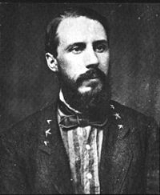
Edward Porter Alexander

Encyclopedia
Edward Porter Alexander (May 26, 1835 – April 28, 1910) was an engineer, an officer in the U.S. Army
, a Confederate
general in the American Civil War
, and later a railroad executive, planter, and author.
Alexander is best known as the officer in charge of the massive artillery bombardment preceding Pickett's Charge
on the third day of the Battle of Gettysburg
, but he is also noted for his early use of signal and observation balloon
intelligence in combat and is well regarded for his postwar memoirs and analyses of the war.
, the sixth of eight children of Adam Leopold Alexander and Sarah Hillhouse Gilbert Alexander. He became the brother-in-law of Alexander R. Lawton and Jeremy F. Gilmer. He graduated from the United States Military Academy
at West Point
in 1857, third in his class of 38 cadets, and was brevetted
a second lieutenant of Engineers. He briefly taught engineering and fencing at the academy before he was ordered to report to Brig. Gen.
Albert Sidney Johnston
for the Utah War
expedition. The mission was terminated before he reached Johnston and Alexander returned to West Point, where he participated in a number of weapons' experiments and worked as an assistant to Major Albert J. Myer
, the first U.S. Army Signal Officer
and the inventor of the "wig-wag" signal flag, or "aerial telegraphy", code. He was promoted to second lieutenant on October 10, 1858.
Alexander met Bettie Mason of Virginia in 1859 and married her on April 3, 1860. They would eventually have six children: Bessie Mason (born 1861), Edward Porter II and Lucy Roy (twins, born 1863), an unnamed girl (1865, died in infancy prior to naming), Adam Leopold (1867), and William Mason (1868). Alexander's final assignment for the U.S. Army was in the Washington Territory
at Fort Steilacoom
and at Alcatraz Island
near San Francisco, California
.
of his home state of Georgia, Alexander resigned his U.S. Army commission on May 1, 1861, to join the Confederate Army as a captain of engineers. While organizing and training new recruits to form a Confederate signal service, he was ordered to report to Brig. Gen. P.G.T. Beauregard
at Manassas Junction, Virginia
. He became the Chief Engineer and Signal Officer of the (Confederate) Army of the Potomac on June 3. At the First Battle of Bull Run
, he made history by transmitting the first message in combat using signal flags over a long distance. Stationed atop "Signal Hill" in Manassas, Alexander saw Union
troop movements and signaled to the brigade under Col. Nathan "Shanks" Evans
, "Look out for your left, your position is turned", which meant that they were in danger of being attacked on their left flank. Upon receiving a similar message, Gens. Beauregard and Joseph E. Johnston
sent timely reinforcements that turned the tide of battle in the Confederates' favor.
Alexander was promoted to major
on July 1 and lieutenant colonel
on December 31, 1861. During much of this period he was chief of ordnance in (what would eventually be called) the Army of Northern Virginia
under Johnston, and was also active in signal work and intelligence gathering, dealing extensively with spies operating around Washington, D.C.
During the early days of the Peninsula Campaign
of 1862, Alexander continued as chief of ordnance under Johnston, although he managed to participate in combat at the Battle of Williamsburg
and was commended by Maj. Gen. James Longstreet
for his actions there. When Gen. Robert E. Lee
assumed command of the army, Alexander pre-positioned ordnance for Lee's offensive in the Seven Days Battles
. He continued his intelligence gathering by volunteering to go up in a hot air balloon
at Gaines' Mill
on June 27, ascending several times and returning with valuable intelligence regarding the position of the Union Army. Alexander continued in ordnance for the Northern Virginia Campaign
(Second Bull Run
) and the Maryland Campaign
(Antietam
). Alexander barely missed capture by Federal cavalry under Col. Benjamin F. "Grimes" Davis
that had escaped from Harpers Ferry
during the Maryland Campaign; over 40 of Longstreet's 80 ammunition wagons were captured.
Porter Alexander is best known as an artilleryman who played a prominent role in many of the important battles of the war. He served in different artillery capacities for Longstreet's First Corps
of the Army of Northern Virginia and he started this role on November 7, 1862, leaving Lee's staff to command the battalion that was the corps' artillery reserve. He was promoted to colonel on December 5. He was instrumental in arranging the artillery in defense of Marye's Heights at the Battle of Fredericksburg
in December 1862, which proved to be the decisive factor in the Confederate victory. While the rest of Longstreet's corps was located around Suffolk, Virginia
, Alexander accompanied Stonewall Jackson
on his flanking march at the Battle of Chancellorsville
in May 1863, and his artillery placements in Hazel Grove at Chancellorsville proved decisive.
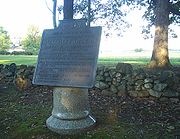 Alexander's most famous engagement was on July 3, 1863, at the Battle of Gettysburg
, during which he was in command of the artillery for Longstreet's corps. On that day, he was effectively in control of the artillery for the full army (despite Brig. Gen. William N. Pendleton
's formal role as chief of artillery under Lee). He conducted a massive two-hour bombardment, arguably the largest in the war, using between 150 and 170 guns against the Union position on Cemetery Ridge
. Unfortunately, the poor quality of the Confederate fuses delayed the planned detonation of many of the shells, and a number of the guns were not properly ranged, so that the rear areas sustained more damage than the front lines. General Longstreet effectively put Alexander in charge of launching Maj. Gen. George Pickett
on his famous charge, putting the young colonel under enormous pressure to determine whether the Union artillery defenses had been effectively suppressed. Alexander would blame Lee for the defeat at Gettysburg, writing in 1901: "Never, never, never did Gen. Lee himself bollox [sic] a fight as he did this."
for the Battle of Chickamauga
. He personally arrived too late to participate in the battle, but served as Longstreet's chief of artillery in the subsequent Knoxville Campaign
and in the Department of East Tennessee in early 1864. He returned with the corps to Virginia for the remainder of the war, now with the rank of brigadier general (as of February 26, 1864). He served in all the battles of the Overland Campaign
and when Lt. Gen. Ulysses S. Grant
slipped around Lee's army to cross the James River
and assault Petersburg
, Alexander was able to move his guns quickly through the lines and had them in place to repel the main attack.
During the Siege of Petersburg
, Alexander had to adapt his artillery tactics to trench warfare, including experimentation with various types of mortars. He became convinced that the Union forces were attempting to tunnel under the Confederate lines, but before he was able to act on this, he was wounded in the shoulder by a sharpshooter. As he departed on medical leave to Georgia, he informed Gen. Lee of his suspicion and unsuccessful attempts were made to locate the tunneling activity. The resulting Battle of the Crater
caught the Confederates by surprise, although it ended in a significant Union defeat. Alexander returned to the Army in February 1865 and supervised the defenses of Richmond
along the James River. He retreated along with Lee's army in the Appomattox Campaign
.
At Appomattox Court House
, it was Alexander who made the famous proposal to Robert E. Lee that the army disperse, rather than surrendering. Lee rebuked him, and Alexander later wrote about regretting his suggestion. Although this incident is sometimes described as a proposal for "guerrilla war," Alexander describes in his memoir, Fighting for the Confederacy, the proposed alternative to surrender as "the army may be ordered to scatter in the woods & bushes & either to rally upon Gen. Johnston in North Carolina, or to make their way, each man to his own state, with his arms, & to report to his governor."
ian Army. Finding that he no longer desired the Georgia plantation life of his youth, he taught mathematics at the University of South Carolina
in Columbia
, and then served in executive positions with the Charlotte, Columbia, and Augusta Railroad (executive superintendent), the Savannah and Memphis Railroad (president), and the Louisville and Nashville Railroad (president). He became friends with Grover Cleveland
and spent many hours duck hunting. In May 1897, President Cleveland sent Alexander to be the arbiter of a boundary dispute between Nicaragua
and Costa Rica
, in preparation for a possible canal to be dug across Central America
. He spent two years surveying and supervising the boundary, completed the work to the great acclaim of the two governments, and returned to the U.S. in October 1899. His wife Bettie became ill while he was in Nicaragua and she died on November 20, 1899. In October 1901, Alexander married Mary Mason, his first wife's niece.
Alexander was a respected author following the war. He wrote many magazine articles and two major books: Military Memoirs of a Confederate: A Critical Narrative (published in 1907) and Fighting for the Confederacy: The Personal Recollections of General Edward Porter Alexander (posthumous, 1989). Unlike such Confederate officers as Jubal Early
and William Pendleton, he eschewed the bitter Lost Cause
theories of why the South was doomed to fail, given the overwhelming superiority of the North. Most historians consider Alexander's memoirs to be one of the most objective and sharpest resources written by a person involved in the Civil War. Historian David Eicher
called Fighting for the Confederacy "a superb personal narrative with a good deal of analysis of Lee's operations ... Dramatic and revealing, an important source on the general, his fellow officers, and the Army of Northern Virginia." His other books include Railway Practice (1887) and Catterel, Ratterel (Doggerel) (1888).
Alexander died in Savannah, Georgia
, and is buried in Magnolia Cemetery, Augusta, Georgia
.
in Michael Shaara
's 1974 Pulitzer Prize
–winning novel, The Killer Angels
. In the 1993 film adaptation of the novel, Gettysburg, he is portrayed by actor James Patrick Stuart
, who reprised the role in the prequel
Gods and Generals
.
Alexander also appears in Harry Turtledove's
alternate history novel How Few Remain
and is portrayed in Ann Rinaldi's 1993 book In My Father's House as "Alex."
United States Army
The United States Army is the main branch of the United States Armed Forces responsible for land-based military operations. It is the largest and oldest established branch of the U.S. military, and is one of seven U.S. uniformed services...
, a Confederate
Confederate States Army
The Confederate States Army was the army of the Confederate States of America while the Confederacy existed during the American Civil War. On February 8, 1861, delegates from the seven Deep South states which had already declared their secession from the United States of America adopted the...
general in the American Civil War
American Civil War
The American Civil War was a civil war fought in the United States of America. In response to the election of Abraham Lincoln as President of the United States, 11 southern slave states declared their secession from the United States and formed the Confederate States of America ; the other 25...
, and later a railroad executive, planter, and author.
Alexander is best known as the officer in charge of the massive artillery bombardment preceding Pickett's Charge
Pickett's Charge
Pickett's Charge was an infantry assault ordered by Confederate Gen. Robert E. Lee against Maj. Gen. George G. Meade's Union positions on Cemetery Ridge on July 3, 1863, the last day of the Battle of Gettysburg during the American Civil War. Its futility was predicted by the charge's commander,...
on the third day of the Battle of Gettysburg
Battle of Gettysburg
The Battle of Gettysburg , was fought July 1–3, 1863, in and around the town of Gettysburg, Pennsylvania. The battle with the largest number of casualties in the American Civil War, it is often described as the war's turning point. Union Maj. Gen. George Gordon Meade's Army of the Potomac...
, but he is also noted for his early use of signal and observation balloon
History of Military Ballooning
Balloons were the first mechanisms used in air warfare. Their role was strictly recognized for reconnaissance purposes. They provided humans with the first available method of elevating themselves well over the battlefield to obtain the proverbial "birds-eye view." They were an early instrument of...
intelligence in combat and is well regarded for his postwar memoirs and analyses of the war.
Early life and career
Alexander, known to his friends as Porter, was born in Washington, GeorgiaWashington, Georgia
Washington is a city in Wilkes County, Georgia, United States. The population was 4,295 at the 2000 census. The city is the county seat of Wilkes County...
, the sixth of eight children of Adam Leopold Alexander and Sarah Hillhouse Gilbert Alexander. He became the brother-in-law of Alexander R. Lawton and Jeremy F. Gilmer. He graduated from the United States Military Academy
United States Military Academy
The United States Military Academy at West Point is a four-year coeducational federal service academy located at West Point, New York. The academy sits on scenic high ground overlooking the Hudson River, north of New York City...
at West Point
West Point, New York
West Point is a federal military reservation established by President of the United States Thomas Jefferson in 1802. It is a census-designated place located in Town of Highlands in Orange County, New York, United States. The population was 7,138 at the 2000 census...
in 1857, third in his class of 38 cadets, and was brevetted
Brevet (military)
In many of the world's military establishments, brevet referred to a warrant authorizing a commissioned officer to hold a higher rank temporarily, but usually without receiving the pay of that higher rank except when actually serving in that role. An officer so promoted may be referred to as being...
a second lieutenant of Engineers. He briefly taught engineering and fencing at the academy before he was ordered to report to Brig. Gen.
Brigadier general (United States)
A brigadier general in the United States Army, Air Force, and Marine Corps, is a one-star general officer, with the pay grade of O-7. Brigadier general ranks above a colonel and below major general. Brigadier general is equivalent to the rank of rear admiral in the other uniformed...
Albert Sidney Johnston
Albert Sidney Johnston
Albert Sidney Johnston served as a general in three different armies: the Texas Army, the United States Army, and the Confederate States Army...
for the Utah War
Utah War
The Utah War, also known as the Utah Expedition, Buchanan's Blunder, the Mormon War, or the Mormon Rebellion was an armed confrontation between LDS settlers in the Utah Territory and the armed forces of the United States government. The confrontation lasted from May 1857 until July 1858...
expedition. The mission was terminated before he reached Johnston and Alexander returned to West Point, where he participated in a number of weapons' experiments and worked as an assistant to Major Albert J. Myer
Albert J. Myer
Albert James Myer was a surgeon and United States Army officer. He is known as the father of the U.S. Army Signal Corps, as its first chief signal officer just prior to the American Civil War, the inventor of wig-wag signaling , and also as the father of the U.S...
, the first U.S. Army Signal Officer
Signal Corps in the American Civil War
The Signal Corps in the American Civil War comprised two organizations: the U.S. Army Signal Corps, which began with the appointment of Major Albert J...
and the inventor of the "wig-wag" signal flag, or "aerial telegraphy", code. He was promoted to second lieutenant on October 10, 1858.
Alexander met Bettie Mason of Virginia in 1859 and married her on April 3, 1860. They would eventually have six children: Bessie Mason (born 1861), Edward Porter II and Lucy Roy (twins, born 1863), an unnamed girl (1865, died in infancy prior to naming), Adam Leopold (1867), and William Mason (1868). Alexander's final assignment for the U.S. Army was in the Washington Territory
Washington Territory
The Territory of Washington was an organized incorporated territory of the United States that existed from February 8, 1853, until November 11, 1889, when the final extent of the territory was admitted to the Union as the State of Washington....
at Fort Steilacoom
Fort Steilacoom
For the adjacent park, see Fort Steilacoom ParkFort Steilacoom was founded by the U.S. Army in 1849 near Lake Steilacoom. It was among the first military fortifications built by the U.S. north of the Columbia River in what was to become Washington...
and at Alcatraz Island
Alcatraz Island
Alcatraz Island is an island located in the San Francisco Bay, offshore from San Francisco, California, United States. Often referred to as "The Rock" or simply "Traz", the small island was developed with facilities for a lighthouse, a military fortification, a military prison, and a Federal...
near San Francisco, California
San Francisco, California
San Francisco , officially the City and County of San Francisco, is the financial, cultural, and transportation center of the San Francisco Bay Area, a region of 7.15 million people which includes San Jose and Oakland...
.
Civil War service
After learning of the secessionSecession
Secession is the act of withdrawing from an organization, union, or especially a political entity. Threats of secession also can be a strategy for achieving more limited goals.-Secession theory:...
of his home state of Georgia, Alexander resigned his U.S. Army commission on May 1, 1861, to join the Confederate Army as a captain of engineers. While organizing and training new recruits to form a Confederate signal service, he was ordered to report to Brig. Gen. P.G.T. Beauregard
P. G. T. Beauregard
Pierre Gustave Toutant Beauregard was a Louisiana-born American military officer, politician, inventor, writer, civil servant, and the first prominent general of the Confederate States Army during the American Civil War. Today he is commonly referred to as P. G. T. Beauregard, but he rarely used...
at Manassas Junction, Virginia
Manassas, Virginia
The City of Manassas is an independent city surrounded by Prince William County and the independent city of Manassas Park in the Commonwealth of Virginia in the United States. Its population was 37,821 as of 2010. Manassas also surrounds the county seat for Prince William County but that county...
. He became the Chief Engineer and Signal Officer of the (Confederate) Army of the Potomac on June 3. At the First Battle of Bull Run
First Battle of Bull Run
First Battle of Bull Run, also known as First Manassas , was fought on July 21, 1861, in Prince William County, Virginia, near the City of Manassas...
, he made history by transmitting the first message in combat using signal flags over a long distance. Stationed atop "Signal Hill" in Manassas, Alexander saw Union
Union Army
The Union Army was the land force that fought for the Union during the American Civil War. It was also known as the Federal Army, the U.S. Army, the Northern Army and the National Army...
troop movements and signaled to the brigade under Col. Nathan "Shanks" Evans
Nathan George Evans
Nathan George "Shanks" Evans was a captain in the 2nd U.S. Cavalry who became a brigadier general in the Confederate States Army during the American Civil War.-Biography:...
, "Look out for your left, your position is turned", which meant that they were in danger of being attacked on their left flank. Upon receiving a similar message, Gens. Beauregard and Joseph E. Johnston
Joseph E. Johnston
Joseph Eggleston Johnston was a career U.S. Army officer, serving with distinction in the Mexican-American War and Seminole Wars, and was also one of the most senior general officers in the Confederate States Army during the American Civil War...
sent timely reinforcements that turned the tide of battle in the Confederates' favor.
Alexander was promoted to major
Major (United States)
In the United States Army, Air Force, and Marine Corps, major is a field grade military officer rank just above the rank of captain and just below the rank of lieutenant colonel...
on July 1 and lieutenant colonel
Lieutenant Colonel (United States)
In the United States Army, United States Air Force, and United States Marine Corps, a lieutenant colonel is a field grade military officer rank just above the rank of major and just below the rank of colonel. It is equivalent to the naval rank of commander in the other uniformed services.The pay...
on December 31, 1861. During much of this period he was chief of ordnance in (what would eventually be called) the Army of Northern Virginia
Army of Northern Virginia
The Army of Northern Virginia was the primary military force of the Confederate States of America in the Eastern Theater of the American Civil War, as well as the primary command structure of the Department of Northern Virginia. It was most often arrayed against the Union Army of the Potomac...
under Johnston, and was also active in signal work and intelligence gathering, dealing extensively with spies operating around Washington, D.C.
Washington, D.C.
Washington, D.C., formally the District of Columbia and commonly referred to as Washington, "the District", or simply D.C., is the capital of the United States. On July 16, 1790, the United States Congress approved the creation of a permanent national capital as permitted by the U.S. Constitution....
During the early days of the Peninsula Campaign
Peninsula Campaign
The Peninsula Campaign of the American Civil War was a major Union operation launched in southeastern Virginia from March through July 1862, the first large-scale offensive in the Eastern Theater. The operation, commanded by Maj. Gen. George B...
of 1862, Alexander continued as chief of ordnance under Johnston, although he managed to participate in combat at the Battle of Williamsburg
Battle of Williamsburg
The Battle of Williamsburg, also known as the Battle of Fort Magruder, took place on May 5, 1862, in York County, James City County, and Williamsburg, Virginia, as part of the Peninsula Campaign of the American Civil War...
and was commended by Maj. Gen. James Longstreet
James Longstreet
James Longstreet was one of the foremost Confederate generals of the American Civil War and the principal subordinate to General Robert E. Lee, who called him his "Old War Horse." He served under Lee as a corps commander for many of the famous battles fought by the Army of Northern Virginia in the...
for his actions there. When Gen. Robert E. Lee
Robert E. Lee
Robert Edward Lee was a career military officer who is best known for having commanded the Confederate Army of Northern Virginia in the American Civil War....
assumed command of the army, Alexander pre-positioned ordnance for Lee's offensive in the Seven Days Battles
Seven Days Battles
The Seven Days Battles was a series of six major battles over the seven days from June 25 to July 1, 1862, near Richmond, Virginia during the American Civil War. Confederate General Robert E. Lee drove the invading Union Army of the Potomac, commanded by Maj. Gen. George B. McClellan, away from...
. He continued his intelligence gathering by volunteering to go up in a hot air balloon
Hot air balloon
The hot air balloon is the oldest successful human-carrying flight technology. It is in a class of aircraft known as balloon aircraft. On November 21, 1783, in Paris, France, the first untethered manned flight was made by Jean-François Pilâtre de Rozier and François Laurent d'Arlandes in a hot air...
at Gaines' Mill
Battle of Gaines' Mill
The Battle of Gaines's Mill, sometimes known as the First Battle of Cold Harbor or the Battle of Chickahominy River, took place on June 27, 1862, in Hanover County, Virginia, as the third of the Seven Days Battles of the American Civil War...
on June 27, ascending several times and returning with valuable intelligence regarding the position of the Union Army. Alexander continued in ordnance for the Northern Virginia Campaign
Northern Virginia Campaign
The Northern Virginia Campaign, also known as the Second Bull Run Campaign or Second Manassas Campaign, was a series of battles fought in Virginia during August and September 1862 in the Eastern Theater of the American Civil War. Confederate General Robert E...
(Second Bull Run
Second Battle of Bull Run
The Second Battle of Bull Run or Second Manassas was fought August 28–30, 1862, as part of the American Civil War. It was the culmination of an offensive campaign waged by Confederate Gen. Robert E. Lee's Army of Northern Virginia against Union Maj. Gen...
) and the Maryland Campaign
Maryland Campaign
The Maryland Campaign, or the Antietam Campaign is widely considered one of the major turning points of the American Civil War. Confederate Gen. Robert E. Lee's first invasion of the North was repulsed by Maj. Gen. George B...
(Antietam
Battle of Antietam
The Battle of Antietam , fought on September 17, 1862, near Sharpsburg, Maryland, and Antietam Creek, as part of the Maryland Campaign, was the first major battle in the American Civil War to take place on Northern soil. It was the bloodiest single-day battle in American history, with about 23,000...
). Alexander barely missed capture by Federal cavalry under Col. Benjamin F. "Grimes" Davis
Benjamin Franklin Davis
Benjamin Franklin "Grimes" Davis was an American military officer who served in Indian wars, and then led Union cavalry in the American Civil War before dying in combat...
that had escaped from Harpers Ferry
Battle of Harpers Ferry
The Battle of Harpers Ferry was fought September 12–15, 1862, as part of the Maryland Campaign of the American Civil War. As Gen. Robert E. Lee's Confederate army invaded Maryland, a portion of his army under Maj. Gen. Thomas J...
during the Maryland Campaign; over 40 of Longstreet's 80 ammunition wagons were captured.
Porter Alexander is best known as an artilleryman who played a prominent role in many of the important battles of the war. He served in different artillery capacities for Longstreet's First Corps
First Corps, Army of Northern Virginia
The First Corps, Army of Northern Virginia was a military unit fighting for the Confederate States of America in the American Civil War. It was formed in early 1861 and served until the spring of 1865, mostly in the Eastern Theater. The corps was commanded by James Longstreet for much of its...
of the Army of Northern Virginia and he started this role on November 7, 1862, leaving Lee's staff to command the battalion that was the corps' artillery reserve. He was promoted to colonel on December 5. He was instrumental in arranging the artillery in defense of Marye's Heights at the Battle of Fredericksburg
Battle of Fredericksburg
The Battle of Fredericksburg was fought December 11–15, 1862, in and around Fredericksburg, Virginia, between General Robert E. Lee's Confederate Army of Northern Virginia and the Union Army of the Potomac, commanded by Maj. Gen. Ambrose E. Burnside...
in December 1862, which proved to be the decisive factor in the Confederate victory. While the rest of Longstreet's corps was located around Suffolk, Virginia
Suffolk, Virginia
Suffolk is the largest city by area in Virginia, United States, and is located in the Hampton Roads metropolitan area. As of the 2010 census, the city had a total population of 84,585. Its median household income was $57,546.-History:...
, Alexander accompanied Stonewall Jackson
Stonewall Jackson
ຄຽשת״ׇׂׂׂׂ֣|birth_place= Clarksburg, Virginia |death_place=Guinea Station, Virginia|placeofburial=Stonewall Jackson Memorial CemeteryLexington, Virginia|placeofburial_label= Place of burial|image=...
on his flanking march at the Battle of Chancellorsville
Battle of Chancellorsville
The Battle of Chancellorsville was a major battle of the American Civil War, and the principal engagement of the Chancellorsville Campaign. It was fought from April 30 to May 6, 1863, in Spotsylvania County, Virginia, near the village of Chancellorsville. Two related battles were fought nearby on...
in May 1863, and his artillery placements in Hazel Grove at Chancellorsville proved decisive.
Gettysburg cannonade
Battle of Gettysburg
The Battle of Gettysburg , was fought July 1–3, 1863, in and around the town of Gettysburg, Pennsylvania. The battle with the largest number of casualties in the American Civil War, it is often described as the war's turning point. Union Maj. Gen. George Gordon Meade's Army of the Potomac...
, during which he was in command of the artillery for Longstreet's corps. On that day, he was effectively in control of the artillery for the full army (despite Brig. Gen. William N. Pendleton
William N. Pendleton
William Nelson Pendleton was an American teacher, Episcopal priest, and soldier. He served as a Confederate general during the American Civil War, noted for his position as Gen. Robert E. Lee's chief of artillery for most of the conflict...
's formal role as chief of artillery under Lee). He conducted a massive two-hour bombardment, arguably the largest in the war, using between 150 and 170 guns against the Union position on Cemetery Ridge
Cemetery Ridge
Cemetery Ridge is a geographic feature in Gettysburg National Military Park south of the town of Gettysburg, Pennsylvania, that figured prominently in the Battle of Gettysburg, July 1 to July 3, 1863. It formed a primary defensive position for the Union Army during the battle, roughly the center of...
. Unfortunately, the poor quality of the Confederate fuses delayed the planned detonation of many of the shells, and a number of the guns were not properly ranged, so that the rear areas sustained more damage than the front lines. General Longstreet effectively put Alexander in charge of launching Maj. Gen. George Pickett
George Pickett
George Edward Pickett was a career United States Army officer who became a general in the Confederate States Army during the American Civil War...
on his famous charge, putting the young colonel under enormous pressure to determine whether the Union artillery defenses had been effectively suppressed. Alexander would blame Lee for the defeat at Gettysburg, writing in 1901: "Never, never, never did Gen. Lee himself bollox [sic] a fight as he did this."
Longstreet's Chief of Artillery
Alexander accompanied the First Corps to northern Georgia in the fall of 1863 to reinforce Gen. Braxton BraggBraxton Bragg
Braxton Bragg was a career United States Army officer, and then a general in the Confederate States Army—a principal commander in the Western Theater of the American Civil War and later the military adviser to Confederate President Jefferson Davis.Bragg, a native of North Carolina, was...
for the Battle of Chickamauga
Battle of Chickamauga
The Battle of Chickamauga, fought September 19–20, 1863, marked the end of a Union offensive in southeastern Tennessee and northwestern Georgia called the Chickamauga Campaign...
. He personally arrived too late to participate in the battle, but served as Longstreet's chief of artillery in the subsequent Knoxville Campaign
Knoxville Campaign
The Knoxville Campaign was a series of American Civil War battles and maneuvers in East Tennessee during the fall of 1863. Union forces under Maj. Gen. Ambrose Burnside occupied Knoxville, Tennessee, and Confederate forces under Lt. Gen. James Longstreet were detached from Gen...
and in the Department of East Tennessee in early 1864. He returned with the corps to Virginia for the remainder of the war, now with the rank of brigadier general (as of February 26, 1864). He served in all the battles of the Overland Campaign
Overland Campaign
The Overland Campaign, also known as Grant's Overland Campaign and the Wilderness Campaign, was a series of battles fought in Virginia during May and June 1864, in the American Civil War. Lt. Gen. Ulysses S. Grant, general-in-chief of all Union armies, directed the actions of the Army of the...
and when Lt. Gen. Ulysses S. Grant
Ulysses S. Grant
Ulysses S. Grant was the 18th President of the United States as well as military commander during the Civil War and post-war Reconstruction periods. Under Grant's command, the Union Army defeated the Confederate military and ended the Confederate States of America...
slipped around Lee's army to cross the James River
James River (Virginia)
The James River is a river in the U.S. state of Virginia. It is long, extending to if one includes the Jackson River, the longer of its two source tributaries. The James River drains a catchment comprising . The watershed includes about 4% open water and an area with a population of 2.5 million...
and assault Petersburg
Petersburg, Virginia
Petersburg is an independent city in Virginia, United States located on the Appomattox River and south of the state capital city of Richmond. The city's population was 32,420 as of 2010, predominantly of African-American ethnicity...
, Alexander was able to move his guns quickly through the lines and had them in place to repel the main attack.
During the Siege of Petersburg
Siege of Petersburg
The Richmond–Petersburg Campaign was a series of battles around Petersburg, Virginia, fought from June 9, 1864, to March 25, 1865, during the American Civil War...
, Alexander had to adapt his artillery tactics to trench warfare, including experimentation with various types of mortars. He became convinced that the Union forces were attempting to tunnel under the Confederate lines, but before he was able to act on this, he was wounded in the shoulder by a sharpshooter. As he departed on medical leave to Georgia, he informed Gen. Lee of his suspicion and unsuccessful attempts were made to locate the tunneling activity. The resulting Battle of the Crater
Battle of the Crater
The Battle of the Crater was a battle of the American Civil War, part of the Siege of Petersburg. It took place on July 30, 1864, between the Confederate Army of Northern Virginia, commanded by General Robert E. Lee and the Union Army of the Potomac, commanded by Major General George G. Meade The...
caught the Confederates by surprise, although it ended in a significant Union defeat. Alexander returned to the Army in February 1865 and supervised the defenses of Richmond
Richmond, Virginia
Richmond is the capital of the Commonwealth of Virginia, in the United States. It is an independent city and not part of any county. Richmond is the center of the Richmond Metropolitan Statistical Area and the Greater Richmond area...
along the James River. He retreated along with Lee's army in the Appomattox Campaign
Appomattox Campaign
The Appomattox Campaign was a series of battles fought March 29 – April 9, 1865, in Virginia that culminated in the surrender of Confederate General Robert E...
.
At Appomattox Court House
Appomattox Court House
The Appomattox Courthouse is the current courthouse in Appomattox, Virginia built in 1892. It is located in the middle of the state about three miles northwest of the Appomattox Court House National Historical Park, once known as Clover Hill - home of the original Old Appomattox Court House...
, it was Alexander who made the famous proposal to Robert E. Lee that the army disperse, rather than surrendering. Lee rebuked him, and Alexander later wrote about regretting his suggestion. Although this incident is sometimes described as a proposal for "guerrilla war," Alexander describes in his memoir, Fighting for the Confederacy, the proposed alternative to surrender as "the army may be ordered to scatter in the woods & bushes & either to rally upon Gen. Johnston in North Carolina, or to make their way, each man to his own state, with his arms, & to report to his governor."
Later life: mathematics, railroads, and writing
After the surrender, Alexander briefly toyed with joining the BrazilBrazil
Brazil , officially the Federative Republic of Brazil , is the largest country in South America. It is the world's fifth largest country, both by geographical area and by population with over 192 million people...
ian Army. Finding that he no longer desired the Georgia plantation life of his youth, he taught mathematics at the University of South Carolina
University of South Carolina
The University of South Carolina is a public, co-educational research university located in Columbia, South Carolina, United States, with 7 surrounding satellite campuses. Its historic campus covers over in downtown Columbia not far from the South Carolina State House...
in Columbia
Columbia, South Carolina
Columbia is the state capital and largest city in the U.S. state of South Carolina. The population was 129,272 according to the 2010 census. Columbia is the county seat of Richland County, but a portion of the city extends into neighboring Lexington County. The city is the center of a metropolitan...
, and then served in executive positions with the Charlotte, Columbia, and Augusta Railroad (executive superintendent), the Savannah and Memphis Railroad (president), and the Louisville and Nashville Railroad (president). He became friends with Grover Cleveland
Grover Cleveland
Stephen Grover Cleveland was the 22nd and 24th president of the United States. Cleveland is the only president to serve two non-consecutive terms and therefore is the only individual to be counted twice in the numbering of the presidents...
and spent many hours duck hunting. In May 1897, President Cleveland sent Alexander to be the arbiter of a boundary dispute between Nicaragua
Nicaragua
Nicaragua is the largest country in the Central American American isthmus, bordered by Honduras to the north and Costa Rica to the south. The country is situated between 11 and 14 degrees north of the Equator in the Northern Hemisphere, which places it entirely within the tropics. The Pacific Ocean...
and Costa Rica
Costa Rica
Costa Rica , officially the Republic of Costa Rica is a multilingual, multiethnic and multicultural country in Central America, bordered by Nicaragua to the north, Panama to the southeast, the Pacific Ocean to the west and the Caribbean Sea to the east....
, in preparation for a possible canal to be dug across Central America
Central America
Central America is the central geographic region of the Americas. It is the southernmost, isthmian portion of the North American continent, which connects with South America on the southeast. When considered part of the unified continental model, it is considered a subcontinent...
. He spent two years surveying and supervising the boundary, completed the work to the great acclaim of the two governments, and returned to the U.S. in October 1899. His wife Bettie became ill while he was in Nicaragua and she died on November 20, 1899. In October 1901, Alexander married Mary Mason, his first wife's niece.
Alexander was a respected author following the war. He wrote many magazine articles and two major books: Military Memoirs of a Confederate: A Critical Narrative (published in 1907) and Fighting for the Confederacy: The Personal Recollections of General Edward Porter Alexander (posthumous, 1989). Unlike such Confederate officers as Jubal Early
Jubal Anderson Early
Jubal Anderson Early was a lawyer and Confederate general in the American Civil War. He served under Stonewall Jackson and then Robert E. Lee for almost the entire war, rising from regimental command to lieutenant general and the command of an infantry corps in the Army of Northern Virginia...
and William Pendleton, he eschewed the bitter Lost Cause
Lost Cause of the Confederacy
The Lost Cause is the name commonly given to an American literary and intellectual movement that sought to reconcile the traditional white society of the U.S. South to the defeat of the Confederate States of America in the American Civil War of 1861–1865...
theories of why the South was doomed to fail, given the overwhelming superiority of the North. Most historians consider Alexander's memoirs to be one of the most objective and sharpest resources written by a person involved in the Civil War. Historian David Eicher
David J. Eicher
David John Eicher is an American editor, writer, and popularizer of astronomy and space. He has been editor-in-chief of Astronomy magazine since 2002...
called Fighting for the Confederacy "a superb personal narrative with a good deal of analysis of Lee's operations ... Dramatic and revealing, an important source on the general, his fellow officers, and the Army of Northern Virginia." His other books include Railway Practice (1887) and Catterel, Ratterel (Doggerel) (1888).
Alexander died in Savannah, Georgia
Savannah, Georgia
Savannah is the largest city and the county seat of Chatham County, in the U.S. state of Georgia. Established in 1733, the city of Savannah was the colonial capital of the Province of Georgia and later the first state capital of Georgia. Today Savannah is an industrial center and an important...
, and is buried in Magnolia Cemetery, Augusta, Georgia
Augusta, Georgia
Augusta is a consolidated city in the U.S. state of Georgia, located along the Savannah River. As of the 2010 census, the Augusta–Richmond County population was 195,844 not counting the unconsolidated cities of Hephzibah and Blythe.Augusta is the principal city of the Augusta-Richmond County...
.
In popular media
Alexander plays an important role in the description of Pickett's ChargePickett's Charge
Pickett's Charge was an infantry assault ordered by Confederate Gen. Robert E. Lee against Maj. Gen. George G. Meade's Union positions on Cemetery Ridge on July 3, 1863, the last day of the Battle of Gettysburg during the American Civil War. Its futility was predicted by the charge's commander,...
in Michael Shaara
Michael Shaara
Michael Shaara was an American writer of science fiction, sports fiction, and historical fiction. He was born to Italian immigrant parents in Jersey City, New Jersey, graduated from Rutgers University in 1951, and served as a sergeant in the 82nd Airborne division...
's 1974 Pulitzer Prize
Pulitzer Prize
The Pulitzer Prize is a U.S. award for achievements in newspaper and online journalism, literature and musical composition. It was established by American publisher Joseph Pulitzer and is administered by Columbia University in New York City...
–winning novel, The Killer Angels
The Killer Angels
The Killer Angels is a historical novel by Michael Shaara that was awarded the Pulitzer Prize for Fiction in 1975. The book tells the story of four days of the Battle of Gettysburg in the American Civil War: June 30, 1863, as the troops of both the Union and the Confederacy move into battle around...
. In the 1993 film adaptation of the novel, Gettysburg, he is portrayed by actor James Patrick Stuart
James Patrick Stuart
James Patrick Stuart is an English-American stage, film and television actor.-Theater:His early career began on stage, where his work received recognition.-Television:...
, who reprised the role in the prequel
Prequel
A prequel is a work that supplements a previously completed one, and has an earlier time setting.The widely recognized term was a 20th-century neologism, and a portmanteau from pre- and sequel...
Gods and Generals
Gods and Generals (film)
Gods and Generals is a 2003 American film based on the novel Gods and Generals by Jeffrey Shaara. It depicts events that take place prior to those shown in the 1993 film Gettysburg, which was based on The Killer Angels, a novel by Shaara's father, Michael...
.
Alexander also appears in Harry Turtledove's
Harry Turtledove
Harry Norman Turtledove is an American novelist, who has produced works in several genres including alternate history, historical fiction, fantasy and science fiction.- Life :...
alternate history novel How Few Remain
How Few Remain
How Few Remain is a 1997 alternate history novel by Harry Turtledove. It is the first part of the Southern Victory Series saga, which depicts a world in which the Confederacy won the American Civil War. The book received the Sidewise Award for Alternate History in 1997, and was also nominated for...
and is portrayed in Ann Rinaldi's 1993 book In My Father's House as "Alex."
See also
- List of American Civil War generals
Further reading
- Klein, Maury. Edward Porter Alexander. Athens: University of Georgia Press, 1971. ISBN 0-318-77984-6.
External links
- Inventory of the Edward Porter Alexander Papers, 1852-1910, in the Southern Historical CollectionSouthern Historical CollectionThe Southern Historical Collection is a repository of distinct archival collections at the University of North Carolina at Chapel Hill which document the culture and history of the American South...
, UNC-Chapel HillUniversity of North Carolina at Chapel HillThe University of North Carolina at Chapel Hill is a public research university located in Chapel Hill, North Carolina, United States... - Photographs of Alexander