

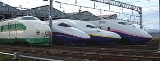
Shinkansen

Encyclopedia
High-speed rail
High-speed rail is a type of passenger rail transport that operates significantly faster than the normal speed of rail traffic. Specific definitions by the European Union include for upgraded track and or faster for new track, whilst in the United States, the U.S...
way lines in Japan
Japan
Japan is an island nation in East Asia. Located in the Pacific Ocean, it lies to the east of the Sea of Japan, China, North Korea, South Korea and Russia, stretching from the Sea of Okhotsk in the north to the East China Sea and Taiwan in the south...
operated by four Japan Railways Group companies. Starting with the Tōkaidō Shinkansen in 1964, the network has expanded to currently consist of 2387.7 km (1,483.7 mi) of lines with maximum speeds of 240–300 km/h (149.1–186.4 ), 283.5 km (176.2 mi) of Mini-shinkansen (MINI BULLET TRAIN) with a maximum speed of 130 km/h (80.8 mph) and 10.3 km (6.4 mi) of spur lines with Shinkansen services. The network presently links most major cities on the islands of Honshu
Honshu
is the largest island of Japan. The nation's main island, it is south of Hokkaido across the Tsugaru Strait, north of Shikoku across the Inland Sea, and northeast of Kyushu across the Kanmon Strait...
and Kyushu
Kyushu
is the third largest island of Japan and most southwesterly of its four main islands. Its alternate ancient names include , , and . The historical regional name is referred to Kyushu and its surrounding islands....
, with construction of a link to the northern island of Hokkaido underway and plans to increase speeds on the Tōhoku Shinkansen
Tohoku Shinkansen
The is a Japanese high-speed Shinkansen rail line, connecting Tokyo with Aomori in Aomori Prefecture for a total length of 674 km, Japan's longest Shinkansen line. It runs through the more sparsely populated Tōhoku region of Japan's main island Honshu. It has two spur lines, Yamagata...
up to 320 km/h (199 mph). Test runs have reached 443 km/h (275.3 mph) for conventional rail in 1996, and up to a world record
Land speed record for railed vehicles
Determination of the fastest rail vehicle in the world varies depending on the definition of "rail".Official absolute world record for conventional train is held by the French TGV...
581 km/h (361 mph) for maglev
Maglev train
Maglev , is a system of transportation that uses magnetic levitation to suspend, guide and propel vehicles from magnets rather than using mechanical methods, such as friction-reliant wheels, axles and bearings...
trainsets in 2003.
Shinkansen literally means new trunk line, referring to the tracks, but the name is widely used inside and outside Japan to refer to the trains as well as the system as a whole. The name , initially used for Hikari
Hikari (Shinkansen)
is the name of a high-speed train service running on the Tōkaidō and Sanyō Shinkansen "bullet train" lines in Japan. Slower than the Nozomi but faster than the Kodama, the Hikari is the fastest train service on the Tōkaidō and Sanyō Shinkansen that is covered in the Japan Rail Pass.-History:Before...
trains, was retired in 1972 but is still used in English-language announcements and signage.
The Tōkaidō Shinkansen is the world's busiest high-speed rail line. Carrying 151 million passengers a year (March 2008), it has transported more passengers (over 4 billion, network over 6 billion) than any other high speed line in the world. Between Tokyo and Osaka, the two largest metropolises in Japan, up to thirteen trains per hour with sixteen cars each (1,323 seats capacity) run in each direction with a minimum headway of three minutes between trains. Though largely a long-distance transport system, the Shinkansen also serves commuters who travel to work in metropolitan areas from outlying cities.
History

Standard gauge
The standard gauge is a widely-used track gauge . Approximately 60% of the world's existing railway lines are built to this gauge...
or broad gauge
Broad gauge
Broad-gauge railways use a track gauge greater than the standard gauge of .- List :For list see: List of broad gauges, by gauge and country- History :...
rail system had more upgrade potential.
Among the key people credited with the construction of the first Shinkansen are – Hideo Shima
Hideo Shima
was a Japanese engineer and the driving force behind the building of the first bullet train .Shima was born in Osaka in 1901, and educated at the Tokyo Imperial University, where he studied engineering...
, the Chief Engineer, and Shinji Sogo
Shinji Sogō
was the fourth president of the Japan National Railways and is credited with the creation of the first "bullet train" - the Tōkaidō Shinkansen.Shinji Sogo graduated from the Faculty of Law at Tokyo Imperial University in 1909, and joined the Railway Agency...
, the first President of Japan National Railways (JNR) who managed to persuade politicians to back the plan. Other significant people responsible for its technical development were – Tadanao Miki, Tadashi Matsudaira, and Hajime Kawanabe based at the Railway Technology Research Institute (RTRI), part of JNR. They were responsible for much of the technical development of the first line - the Tokaido Shinkansen. All three had worked on aircraft design during World War II
World War II
World War II, or the Second World War , was a global conflict lasting from 1939 to 1945, involving most of the world's nations—including all of the great powers—eventually forming two opposing military alliances: the Allies and the Axis...
.
Early proposals
The popular English name bullet train is a literal translation of the Japanese term dangan ressha , a nickname given to the project while it was initially being discussed in the 1930s. The name stuck because of the original 0 Series Shinkansen0 Series Shinkansen
The trains were the first Shinkansen trainsets built to run on Japan's new Tōkaidō Shinkansen high-speed line which opened in 1964. The last remaining trainsets were withdrawn in 2008.-History:...
's resemblance to a bullet and its high speed.
The Shinkansen name was first formally used in 1940 for a proposed standard gauge passenger and freight line between Tokyo and Shimonoseki that would have used steam and electric locomotives with a top speed of 200 km/h (124.3 mph). Over the next three years, the Ministry of Railways drew up more ambitious plans to extend the line to Beijing (through a tunnel to Korea
Japan-Korea Undersea Tunnel
The Japan–Korea Undersea Tunnel is a proposed tunnel project to connect Japan with Republic of Korea via an undersea tunnel crossing the Korea Strait using the strait islands of Iki and Tsushima, a straight-line distance of approximately at its shortest.The proposal, under discussion...
) and even Singapore
Singapore
Singapore , officially the Republic of Singapore, is a Southeast Asian city-state off the southern tip of the Malay Peninsula, north of the equator. An island country made up of 63 islands, it is separated from Malaysia by the Straits of Johor to its north and from Indonesia's Riau Islands by the...
, and build connections to the Trans-Siberian Railway
Trans-Siberian Railway
The Trans-Siberian Railway is a network of railways connecting Moscow with the Russian Far East and the Sea of Japan. It is the longest railway in the world...
and other trunk lines in Asia. These plans were abandoned in 1943 as Japan's position in World War II worsened. However, some construction did commence on the line; several tunnels on the present-day Shinkansen date to the war-era project.
Construction
Tokaido Main Line
The is the busiest trunk line of the Japan Railways Group , connecting Tōkyō and Kōbe stations. It is long, not counting its many freight feeder lines around the major cities...
along with the reconstruction of Japanese industry and economy. By the mid-1950s the Tōkaidō Line was operating at full capacity, and the Ministry of Railways decided to revisit the Shinkansen project. In 1957, Odakyu Electric Railway
Odakyu Electric Railway
, or OER, is a major railway company based in Tokyo, Japan best known for its Romancecar series of limited express trains from Tokyo to Odawara, Enoshima, Tama New Town, and Hakone....
introduced its 3000 series SE "Romancecar"
Odakyu 3000 series SE
The or SE , later becoming SSE , was a "Romancecar" EMU operated by the Odakyu Electric Railway in the Tokyo area of Japan...
train, setting a world speed record of 145 km/h (90 mph) for a narrow gauge train. This train gave designers the confidence that they could safely build an even faster standard gauge train. Thus the first Shinkansen, the 0 series, was built on the success of the Romancecar.
In 1950s, it was widely believed that railways would soon be outdated and replaced by air travel and highways as in America and many countries in Europe. However, Shinji Sogo
Shinji Sogō
was the fourth president of the Japan National Railways and is credited with the creation of the first "bullet train" - the Tōkaidō Shinkansen.Shinji Sogo graduated from the Faculty of Law at Tokyo Imperial University in 1909, and joined the Railway Agency...
, President of Japan National Railways, insisted strongly on the possibility of high-speed rail
High-speed rail
High-speed rail is a type of passenger rail transport that operates significantly faster than the normal speed of rail traffic. Specific definitions by the European Union include for upgraded track and or faster for new track, whilst in the United States, the U.S...
, and the Shinkansen project was implemented.
Government approval came in December 1958, and construction of the first segment of the Tōkaidō Shinkansen between Tokyo and Osaka
Osaka
is a city in the Kansai region of Japan's main island of Honshu, a designated city under the Local Autonomy Law, the capital city of Osaka Prefecture and also the biggest part of Keihanshin area, which is represented by three major cities of Japan, Kyoto, Osaka and Kobe...
started in April 1959. The cost of constructing the Shinkansen was at first estimated at nearly 200 billion yen, which was raised in the form of a government loan, railway bonds and a low-interest loan of US$80 million from the World Bank
World Bank
The World Bank is an international financial institution that provides loans to developing countries for capital programmes.The World Bank's official goal is the reduction of poverty...
. Initial cost estimates, however, had been deliberately understated and the actual figures were nearly double at about 400 billion yen. As the budget shortfall became clear in 1963, Sogo resigned to take responsibility.
A test facility for rolling stock, now part of the line, opened in Odawara in 1962.
Initial success
The Tōkaidō Shinkansen began service on 1 October 1964, in time for the Tokyo Olympics1964 Summer Olympics
The 1964 Summer Olympics, officially known as the Games of the XVIII Olympiad, was an international multi-sport event held in Tokyo, Japan in 1964. Tokyo had been awarded with the organization of the 1940 Summer Olympics, but this honor was subsequently passed to Helsinki because of Japan's...
. The conventional Limited Express service took six hours and 40 minutes from Tokyo to Osaka, but the Shinkansen made the trip in just four hours, shortened to three hours and ten minutes by 1965. It enabled day trips between Tokyo and Osaka, the two largest metropolises in Japan, changed the style of business and life of Japanese people significantly, and increased new traffic demand. The service was an immediate success, reaching the 100 million passenger mark in less than three years on 13 July 1967, and one billion passengers in 1976. Sixteen-car trains were introduced for Expo '70
Expo '70
was a World's Fair held in Suita, Osaka, Japan between March 15 and September 13, 1970. The theme of the Expo was "Progress and Harmony for Mankind." In Japanese Expo '70 is often referred to as Ōsaka Banpaku...
in Osaka. With an average of 23,000 passengers per hour per direction in 1992, the Tōkaidō Shinkansen is the world's busiest high-speed rail line.
The first Shinkansen trains, the 0 series
0 Series Shinkansen
The trains were the first Shinkansen trainsets built to run on Japan's new Tōkaidō Shinkansen high-speed line which opened in 1964. The last remaining trainsets were withdrawn in 2008.-History:...
, ran at speeds of up to 210 km/h (130 mph), later increased to 220 km/h (137 mph). The last of these trains, with their classic bullet-nosed appearance, were retired on 30 November 2008. A driving car from one of the 0 series trains is now in the British National Railway Museum
National Railway Museum
The National Railway Museum is a museum in York forming part of the British National Museum of Science and Industry and telling the story of rail transport in Britain and its impact on society. It has won many awards, including the European Museum of the Year Award in 2001...
in York
York
York is a walled city, situated at the confluence of the Rivers Ouse and Foss in North Yorkshire, England. The city has a rich heritage and has provided the backdrop to major political events throughout much of its two millennia of existence...
, England.
Network expansion
Hiroshima
is the capital of Hiroshima Prefecture, and the largest city in the Chūgoku region of western Honshu, the largest island of Japan. It became best known as the first city in history to be destroyed by a nuclear weapon when the United States Army Air Forces dropped an atomic bomb on it at 8:15 A.M...
and Fukuoka
Fukuoka, Fukuoka
is the capital city of Fukuoka Prefecture and is situated on the northern shore of the island of Kyushu in Japan.Voted number 14 in a 2010 poll of the World's Most Livable Cities, Fukuoka is praised for its green spaces in a metropolitan setting. It is the most populous city in Kyushu, followed by...
(the Sanyō Shinkansen
Sanyō Shinkansen
The is a line of the Japanese Shinkansen high-speed rail network, connecting Shin-Ōsaka in Osaka with Hakata Station in Fukuoka, the two largest cities in western Japan...
), which was completed in 1975.
Prime Minister Kakuei Tanaka
Kakuei Tanaka
was a Japanese politician and the 64th and 65th Prime Minister of Japan from 7 July 1972 to 22 December 1972 and from 22 December 1972 to 9 December 1974 respectively...
was an ardent supporter of the Shinkansen, and his government proposed an extensive network paralleling most existing trunk lines. Two new lines, the Tōhoku Shinkansen
Tohoku Shinkansen
The is a Japanese high-speed Shinkansen rail line, connecting Tokyo with Aomori in Aomori Prefecture for a total length of 674 km, Japan's longest Shinkansen line. It runs through the more sparsely populated Tōhoku region of Japan's main island Honshu. It has two spur lines, Yamagata...
and Jōetsu Shinkansen
Joetsu Shinkansen
The is a high-speed railway line connecting Tokyo and Niigata, Japan, via the Tōhoku Shinkansen, operated by the East Japan Railway Company .-History:The program was initiated in 1971 by Niigata-born prime minister Tanaka Kakuei...
, were built following this plan. Many other planned lines were delayed or scrapped entirely as Japan National Railways slid into debt throughout the late '70s, largely because of the high cost of building the Shinkansen network. By the early 1980s, the company was practically insolvent, leading to its privatization in 1987.
Development of the Shinkansen continued despite this setback, however. Several new train models followed the first, each generally with its own distinctive appearance. Shinkansen trains now run regularly at speeds up to 300 km/h (186 mph), placing them alongside the French TGV
TGV
The TGV is France's high-speed rail service, currently operated by SNCF Voyages, the long-distance rail branch of SNCF, the French national rail operator....
, Italian TAV
Treno Alta Velocità
Treno Alta Velocità SpA is special purpose entity owned by RFI for the planning and construction of a high-speed network in Italy.-Purpose:...
, Spanish AVE
AVE
Alta Velocidad Española is a service of high-speed rail in Spain operated by Renfe, the Spanish national railway company, at speeds of up to . The name is literally translated from Spanish as "Spanish High Speed", but also a play on the word , meaning "bird".AVE trains run on a network of...
, and German ICE
InterCityExpress
The Intercity-Express or ICE is a system of high-speed trains predominantly running in Germany and neighbouring countries. It is the highest service category offered by DB Fernverkehr and is the flagship of Deutsche Bahn...
among the fastest trains in the world.
Since 1970, development has also been underway for the Chūō Shinkansen
Chuo Shinkansen
The is a planned maglev line connecting Tokyo, Nagoya, and Osaka, Japan. The only part of the line that exists is the Yamanashi test track, which is currently being extended from 18.4 km to 42.8 km. The line is proposed to connect Tokyo and Nagoya in the first stage in 40 minutes, and eventually...
, a planned maglev
Maglev train
Maglev , is a system of transportation that uses magnetic levitation to suspend, guide and propel vehicles from magnets rather than using mechanical methods, such as friction-reliant wheels, axles and bearings...
line from Tokyo to Osaka. On 2 December 2003, the 3-car maglev trainset JR-Maglev MLX01
JR-Maglev
JR-Maglev is a magnetic levitation train system developed by the Central Japan Railway Company and Railway Technical Research Institute . JR-Maglev MLX01 is one of the latest designs of a series of Maglev trains in development in Japan since the 1970s...
reached a world speed record
Land speed record for railed vehicles
Determination of the fastest rail vehicle in the world varies depending on the definition of "rail".Official absolute world record for conventional train is held by the French TGV...
of 581 km/h (361 mph).
Japan celebrated 40 years of high-speed rail in 2004, with the Tōkaidō Shinkansen line alone having carried 4.16 billion passengers. According to Japanrail.com, the website for companies that operate Shinkansen, the network has carried over 6 billion passengers.
Technology
To enable high-speed operation, Shinkansen uses advanced technologies compared with conventional rail, and it achieved not only high speed but also a high standard of safety and comfort. Its success has influenced other railways in the world and the importance and advantage of high-speed railHigh-speed rail
High-speed rail is a type of passenger rail transport that operates significantly faster than the normal speed of rail traffic. Specific definitions by the European Union include for upgraded track and or faster for new track, whilst in the United States, the U.S...
has consequently been revalued.
Routing
Shinkansen routes are completely separate from conventional rail lines (except Mini-shinkansenMini-shinkansen
is the name given to the concept of converting narrow gauge railway lines to standard gauge for use by Shinkansen train services in Japan. Two mini-shinkansen routes have been constructed: the Yamagata Shinkansen and Akita Shinkansen.-Concept:...
which goes through to conventional lines). Consequently, Shinkansen is not affected by slower local or freight trains and has the capacity to operate many high-speed trains punctually.
The lines have been built without road crossings at grade
Level crossing
A level crossing occurs where a railway line is intersected by a road or path onone level, without recourse to a bridge or tunnel. It is a type of at-grade intersection. The term also applies when a light rail line with separate right-of-way or reserved track crosses a road in the same fashion...
.Tracks are strictly off-limits with penalties against trespassing strictly regulated by law. It uses tunnels and viaducts to go through and over obstacles rather than around them, with a minimum curve radius of 4,000 meters (2,500 meters on the oldest Tōkaidō Shinkansen).
Track
The Shinkansen uses 1,435 mm standard gaugeStandard gauge
The standard gauge is a widely-used track gauge . Approximately 60% of the world's existing railway lines are built to this gauge...
in contrast to the 1,067 mm
Cape gauge
Cape gauge is a track gauge of between the inside of the rail heads and is classified as narrow gauge. It has installations of around .The gauge was first used by Norwegian engineer Carl Abraham Pihl and the first line was opened in 1862.- Nomenclature :...
narrow gauge of older lines. Continuous welded rail and Swingnose crossing
Swingnose crossing
A swingnose crossing or moveable point frog is a device used at a railway turnout to eliminate the gap at the common crossing which can cause damage and noise.- Fixed crossing :...
are employed, eliminating gaps at turnouts and crossings. Long rails are used, joined by expansion joints to minimize gauge fluctuation due to thermal elongation and shrinkage.
A combination of ballasted
Track ballast
Track ballast forms the trackbed upon which railway sleepers or railroad ties are laid. It is packed between, below, and around the ties. It is used to facilitate drainage of water, to distribute the load from the railroad ties, and also to keep down vegetation that might interfere with the track...
and slab track are used, with slab track exclusively employed on concrete bed sections such as viaducts and tunnels. Slab track is significantly more cost-effective in tunnel sections, since the lower track height reduces the cross-sectional area of the tunnel, thereby reducing construction costs by up to 30%.
Signal system
The Shinkansen employs an ATCAutomatic Train Control
Automatic Train Control is a train protection system for railways, ensuring the safe and smooth operation of trains on ATC-enabled lines. Its main advantages include making possible the use of cab signalling instead of track-side signals and the use of smooth deceleration patterns in lieu of the...
(Automatic Train Control) system, eliminating the need for trackside signals. It uses a comprehensive system of Automatic Train Protection
Automatic Train Protection
Automatic Train Protection in Great Britain refers to either of two implementations of a train protection system installed in some trains in order to help prevent collisions through a driver's failure to observe a signal or speed restriction...
. Centralized traffic control
Centralized traffic control
Centralized traffic control is a form of railway signalling that originated in North America and centralizes train routing decisions that were previously carried out by local signal operators or the train crews themselves. The system consists of a centralized train dispatcher's office that...
manages all train operations, and all tasks relating to train movement, track, station and schedule are networked and computerized.
Electricity
Shinkansen uses a 25,000 V ACAlternating current
In alternating current the movement of electric charge periodically reverses direction. In direct current , the flow of electric charge is only in one direction....
overhead power supply (20,000 V AC on Mini-shinkansen
Mini-shinkansen
is the name given to the concept of converting narrow gauge railway lines to standard gauge for use by Shinkansen train services in Japan. Two mini-shinkansen routes have been constructed: the Yamagata Shinkansen and Akita Shinkansen.-Concept:...
lines), to overcome the limitations of the 1,500 V Direct current
Direct current
Direct current is the unidirectional flow of electric charge. Direct current is produced by such sources as batteries, thermocouples, solar cells, and commutator-type electric machines of the dynamo type. Direct current may flow in a conductor such as a wire, but can also flow through...
used on the existing electrified narrow-gauge system. Power is distributed along the axles of the train to reduce the heavy axle loads under single power cars.
Trains
Shinkansen trains are electric multiple unitElectric multiple unit
An electric multiple unit or EMU is a multiple unit train consisting of self-propelled carriages, using electricity as the motive power. An EMU requires no separate locomotive, as electric traction motors are incorporated within one or a number of the carriages...
style, offering high acceleration and deceleration, and reduced damage to the track because of lighter vehicles. The coaches are air-sealed to ensure stable air pressure when entering tunnels at high speed.
Punctuality
The Shinkansen is very reliable thanks to several factors, including its near-total separation from slower traffic. In 2003, JR Central reported that the Shinkansen's average arrival time was within six seconds of the scheduled time. This includes all natural and human accidents and errors and was calculated over roughly 160,000 Shinkansen trips completed. The previous record, from 1997, was 18 seconds.Traction
The Shinkansen has used the electric multiple unitElectric multiple unit
An electric multiple unit or EMU is a multiple unit train consisting of self-propelled carriages, using electricity as the motive power. An EMU requires no separate locomotive, as electric traction motors are incorporated within one or a number of the carriages...
configuration from the outset, with the 0 Series Shinkansen
0 Series Shinkansen
The trains were the first Shinkansen trainsets built to run on Japan's new Tōkaidō Shinkansen high-speed line which opened in 1964. The last remaining trainsets were withdrawn in 2008.-History:...
having 100% motored axles. Other railway manufacturers have traditionally been reluctant to use distributed traction configurations: - Talgo
Talgo
Talgo is a Spanish manufacturer of railway vehicles. It is best known for a design of articulated railway passenger cars in which the wheels are mounted in pairs, but not joined by an axle, and being between rather than underneath the individual coaches...
has persisted with the locomotive
Locomotive
A locomotive is a railway vehicle that provides the motive power for a train. The word originates from the Latin loco – "from a place", ablative of locus, "place" + Medieval Latin motivus, "causing motion", and is a shortened form of the term locomotive engine, first used in the early 19th...
configuration with the AVE Class 102
AVE Class 102
The AVE Class 102 or S-102S-102 denotes 'Serie 102 de RENFE', the 1xx series is used for fixed passenger consists, such as electrical multiple units is a class of AVE high-speed trains for the Spanish state-run railway company RENFE...
and plans to continue with it for the Talgo AVRIL
Talgo AVRIL
Talgo AVRIL is the codename given to a high-speed train that Talgo is currently developing. It stands for "Alta Velocidad Rueda Independiente Ligero" .-Details:...
on account of the fact that it is not possible to motor bogies used as part of the Talgo Pendular system. On the other hand, significant engineering desirability exists for the electric multiple unit configuration in Japan. A greater proportion of motored axles results in higher acceleration, meaning that the Shinkansen does not lose so much time if stopping frequently: - Shinkansen lines have more stops in proportion to their lengths than high-speed lines elsewhere in the world.
Safety record
During the Shinkansen's 45-year, nearly 7 billion-passenger history, there have been no passenger fatalities due to derailments or collisions, despite frequent earthquakes and typhoons. Injuries and a single fatality have been caused by doors closing on passengers or their belongings; attendants are employed at platforms to prevent such accidents. There have, however, been suicides by passengers jumping both from and in front of moving trains.The only derailment of a Shinkansen train in passenger service occurred during the Chūetsu Earthquake
2004 Chuetsu earthquake
The occurred at 5:56 p.m. on Saturday, October 23, 2004 . The Japan Meteorological Agency has named it the Heisei 16 Niigata Prefecture Chuetsu Earthquake or The Mid Niigata Prefecture Earthquake of 2004...
on 23 October 2004. Eight of ten cars of the Toki No. 325 train on the Jōetsu Shinkansen
Joetsu Shinkansen
The is a high-speed railway line connecting Tokyo and Niigata, Japan, via the Tōhoku Shinkansen, operated by the East Japan Railway Company .-History:The program was initiated in 1971 by Niigata-born prime minister Tanaka Kakuei...
derailed near Nagaoka Station
Nagaoka Station
is a train station located in Nagaoka, Niigata, Japan.The station opened on June 16, 1898.- Lines :*East Japan Railway Company**Jōetsu Shinkansen**Shin'etsu Main Line**Jōetsu Line- Adjacent stations :-External links:*...
in Nagaoka
Nagaoka, Niigata
is a city located in the central part of Niigata Prefecture, Japan. It is the second largest city in the prefecture, behind the capital city of Niigata...
, Niigata
Niigata Prefecture
is a prefecture of Japan located on the island of Honshū on the coast of the Sea of Japan. The capital is the city of Niigata. The name "Niigata" literally means "new lagoon".- History :...
. There were no casualties among the 154 passengers. In the event of an earthquake, an earthquake detection system can bring the train to a stop very quickly. A new anti-derailment device was installed after detailed analysis of the derailment.
Economics
The Shinkansen has had a significant effect on Japan's business, economy, society, environment and culture. The time savings alone from switching from a conventional to a high-speed network have been estimated at 400 million hours, an economic impact of per year. Shinkansen connectivity has rejuvenated rural towns such as KakegawaKakegawa, Shizuoka
is a city in western Shizuoka Prefecture, Japan. As of 2010, the city had an estimated population of 117,858 and a population density of 444 persons per km². The total area was 265.63 km².-Geography:...
that would otherwise be too distant from major cities.
However, the vast construction costs of the Shinkansen network, particularly the later, less profitable lines often driven more by political interference than actual demand, imposed vast debt servicing costs on JNR that, by 1971, made JNR unprofitable even before depreciation. JNR's Shinkansen-fueled debt eventually ballooned to and was an instrumental factor in the company's eventual privatization and breakup. The privatized JRs eventually paid a total of only to acquire JNR's Shinkansen network.
Environmental impact
Travelling Tokyo-Osaka by Shinkansen produces only around 16% of the carbon dioxideCarbon dioxide
Carbon dioxide is a naturally occurring chemical compound composed of two oxygen atoms covalently bonded to a single carbon atom...
of the equivalent journey by car, a savings of 15,000 tons of per year. This will help save the atmosphere and reduce global warming.
Noise pollution
Noise pollutionNoise pollution
Noise pollution is excessive, displeasing human, animal or machine-created environmental noise that disrupts the activity or balance of human or animal life...
concerns mean that increasing speed is becoming more difficult. In Japan, the population density is high and there have been severe protests against noise pollution of Shinkansen, and now the Shinkansen noise is regulated less than 70 dB
Decibel
The decibel is a logarithmic unit that indicates the ratio of a physical quantity relative to a specified or implied reference level. A ratio in decibels is ten times the logarithm to base 10 of the ratio of two power quantities...
in residential area.
Hence, improvement and reduction of pantograph
Pantograph (rail)
A pantograph for rail lines is a hinged electric-rod device that collects electric current from overhead lines for electric trains or trams. The pantograph typically connects to a one-wire line, with the track acting as the ground wire...
, weight saving of cars, and construction of noise barrier
Noise barrier
A noise barrier is an exterior structure designed to protect sensitive land uses from noise pollution...
s and other measures have been implemented. Current research is primarily aimed at reducing operational noise, particularly the tunnel boom
Tunnel boom
Tunnel boom is a phenomenon similar to a sonic boom that occurs at the exit of a high-speed train tunnel. The effect occurs because a train moving at high speed compresses and displaces a great deal of air; normally this air is pushed away harmlessly in all directions. However, when the train...
phenomenon caused when trains exit tunnels at high speed.
Earthquake
Because of the risk of earthquakes, Urgent Earthquake Detection and Alarm System (UrEDAS) (earthquake warning systemEarthquake warning system
An earthquake warning system is a system of accelerometers, communication, computers, and alarms that is devised for regional notification of a substantial earthquake while it is in progress...
) was introduced in 1992. It enables automatic braking of bullet trains in the case of large earthquakes.
Heavy snow
The Tōkaidō Shinkansen often experiences heavy snow in the area around Maibara StationMaibara Station
is a train station in Maibara, Shiga Prefecture, Japan. It is the southern terminus of the West Japan Railway Company Hokuriku Main Line, and the boundary of control between JR West and JR Central over the Tōkaidō Main Line....
in winter. Trains have to reduce speed, which can disrupt the timetable. Sprinkler systems were later installed, but delays of 10 to 20 minutes still occur during snowy weather. Along the route of the Jōetsu Shinkansen
Joetsu Shinkansen
The is a high-speed railway line connecting Tokyo and Niigata, Japan, via the Tōhoku Shinkansen, operated by the East Japan Railway Company .-History:The program was initiated in 1971 by Niigata-born prime minister Tanaka Kakuei...
, winter snow can be very heavy, with snow depths of two to three metres, so the line is equipped with stronger sprinklers and slab track, to mitigate the effects of deep snow.
Ridership
| Tokaido Line | Tohoku Line | Sanyo Line | Joetsu Line | Nagano Line | Kyushu Line | Entire Network | |
|---|---|---|---|---|---|---|---|
| 2007 | 151.32 | 84.83 | 64.43 | 38.29 | 10.13 | 4.18 | 353.18 |
Latest cumulative figures for Tokaido Line are 4.9 billion passengers (as of November 2010)
Future
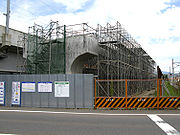
Speed increases
E5 seriesE5 Series Shinkansen
The is a Japanese Shinkansen high-speed train type operated by East Japan Railway Company on Tōhoku Shinkansen services since 5 March 2011. A total of 59 10-car sets are on order, with three sets in service in time for the start of new Hayabusa services to Shin-Aomori in March...
trains, capable of up to 320 km/h (198.8 mph) (initially limited to 300 km/h), were introduced on the Tōhoku Shinkansen from 5 March 2011. Extensive trials using the Fastech 360
FASTECH 360
Fastech 360 is the name given to a pair of former experimental high-speed trains developed by East Japan Railway Company to test technology for the next-generation Shinkansen rolling stock. The name is a portmanteau of Fast, Technology, and 360 km/h , the target operational speed for production...
test trains has shown that operation at 360 km/h (224 mph) is not currently feasible because of problems of noise pollution
Noise pollution
Noise pollution is excessive, displeasing human, animal or machine-created environmental noise that disrupts the activity or balance of human or animal life...
, overhead wire wear, and braking distances. Operation at speeds of up to 320 km/h between and on this route is expected to allow journey times of around 3 hours for trains from Tokyo to Shin-Aomori (a distance of approximately 675 km (419.4 mi)).
Line extension
Two extensions are currently under construction: Nagano to will open by 2014, and Shin-Aomori to Hakodate (through the Seikan TunnelSeikan Tunnel
The Seikan Tunnel is a railway tunnel in Japan, with a long portion under the seabed. Track level is about below seabed and below sea level. It travels beneath the Tsugaru Strait—connecting Aomori Prefecture on the Japanese island of Honshu and the island of Hokkaido—as part of the Kaikyo Line...
) by 2015. There are also long-term plans to extend the network, including a new Hokkaido Shinkansen
Hokkaido Shinkansen
The is a high-speed rail line currently under construction between Aomori and Hokkaido through the Seikan Tunnel. Construction started in May 2005, and the initial Shin-Aomori to Shin-Hakodate section is projected to open in 2015. There are long-term plans to extend the line to Sapporo...
from Hakodate to , a branch of the Kyushu Shinkansen to , and a link from Kanazawa back to Osaka, although none of these are likely to be completed by 2020.
The Narita Shinkansen
Narita Shinkansen
The was a planned high-speed Shinkansen line proposed to connect Narita International Airport with Tokyo Station. The project was abandoned, although parts of the planned route are used by the Keisei Narita Airport Line ....
project to connect Tokyo to Narita International Airport
Narita International Airport
is an international airport serving the Greater Tokyo Area of Japan. It is located east of Tokyo Station and east-southeast of Narita Station in the city of Narita, and the adjacent town of Shibayama....
, initiated in the 1970s but halted in 1983 after landowner protests, has been officially cancelled and removed from the Basic Plan governing Shinkansen construction. Parts of its planned right-of-way were utilized by the Narita Sky Access Line which opened in 2010. Although the Sky Access Line uses standard-gauge track, it was not built to Shinkansen specifications and there are no plans to convert it into a full Shinkansen line.
Maglev
The CEO of JR Central announced plans to have the maglev Chūō ShinkansenChuo Shinkansen
The is a planned maglev line connecting Tokyo, Nagoya, and Osaka, Japan. The only part of the line that exists is the Yamanashi test track, which is currently being extended from 18.4 km to 42.8 km. The line is proposed to connect Tokyo and Nagoya in the first stage in 40 minutes, and eventually...
operating from Tokyo to (366 km (227.4 mi)) by 2025. Following the shortest route (through the Japanese Alps
Japanese Alps
The is a series of mountain ranges in Japan that bisect the main island of Honshū. The name was coined by William Gowland, the "Father of Japanese Archaeology," and later popularized by Reverend Walter Weston , an English missionary for whom a memorial plaque is located at Kamikochi, a tourist...
), JR Central estimates that it will take 40 minutes to run from Tokyo to Nagoya. However, Nagano Prefecture
Nagano Prefecture
is a prefecture of Japan located in the Chūbu region of the island of Honshū. The capital is the city of Nagano.- History :Nagano was formerly known as the province of Shinano...
prefers a routing that swings north to serve the city of Chino
Chino, Nagano
is a city located in Nagano, Japan.As of 2003, the city has an estimated population of 55,902 and the density of 209.83 persons per km². The total area is 266.41 km².The city was founded on August 1, 1958.- Geography :*mountain**Mount Yatsugatake...
and either Ina
Ina, Nagano
is a city located in Nagano, Japan.The city was founded on March 31, 2006 when the old city of Ina merged with the town of Takatō and the village of Hase, both from Kamiina District, to form the new city of Ina.-Surrounding municipalities:*Nagano Prefecture...
or . However, this will increase both the travel time (from Tokyo to Nagoya) and the cost of construction.
Maglev trains have been doing test runs on the Yamanashi test track since 1997, running at speeds of over 500 km/h (310.7 mph). Because of this extensive testing, maglev technology is almost ready for public usage.
Gauge Change Train
Experiments are taking place with a Gauge Change TrainGauge Change Train
The Gauge Change Train or is the name given to a Japanese project started in 1994 to develop a high-speed train with variable gauge axles to allow inter-running between the standard gauge Shinkansen network, and the narrow gauge provincial network....
to enable direct operation between standard-gauge Shinkansen and narrow-gauge conventional lines; this could be useful for the Kyūshū Shinkansen
Kyushu Shinkansen
The ' is a Japanese high-speed railway line between the Japanese cities of Fukuoka and Kagoshima in Kyushu, running parallel to the existing Kagoshima Main Line and operated by the Kyushu Railway Company . The southern 127 km opened on 13 March 2004...
branch to and other conventional lines. Future implementation awaits practical operational tests.
List of Shinkansen lines
The main Shinkansen lines are:| Line | Start | End | Length | Operator | Opened | Annual Passengers |
|---|---|---|---|---|---|---|
| Tōkaidō Shinkansen | Tokyo Tokyo Station is a train station located in the Marunouchi business district of Chiyoda, Tokyo, Japan, near the Imperial Palace grounds and the Ginza commercial district.... |
Shin-Osaka Shin-Osaka Station is a train station in Yodogawa-ku, Osaka, Japan. It is the western terminus of the Tōkaidō Shinkansen, and the eastern terminus of the Sanyō Shinkansen. The lines are physically joined, and many trains offer through service.... |
515.4 km | JR Central Central Japan Railway Company The is the main railway company operating in the Chūbu region of central Japan. It is officially abbreviated in English as JR Central and in Japanese as . Its headquarters are located in the JR Central Towers in Nakamura-ku, Nagoya, Aichi Prefecture.The company's operational hub is Nagoya Station... |
1964 | 151,320,000 |
| Sanyō Shinkansen Sanyō Shinkansen The is a line of the Japanese Shinkansen high-speed rail network, connecting Shin-Ōsaka in Osaka with Hakata Station in Fukuoka, the two largest cities in western Japan... |
Shin-Osaka Shin-Osaka Station is a train station in Yodogawa-ku, Osaka, Japan. It is the western terminus of the Tōkaidō Shinkansen, and the eastern terminus of the Sanyō Shinkansen. The lines are physically joined, and many trains offer through service.... |
Hakata Hakata Station Hakata Station , located in Hakata-ku, is the main railway terminal of the city of Fukuoka, Japan. It is the largest and busiest station on Kyūshū, and is a gateway to other cities in Kyūshū for travellers from Honshū. The Sanyō Shinkansen from Osaka ends at this station... |
553.7 km | JR West West Japan Railway Company , also referred to as , is one of the Japan Railways Group companies and operates in western Honshū. It has its headquarters in Kita-ku, Osaka.-History:... |
1972–1975 | 63,432,000 |
| Tōhoku Shinkansen Tohoku Shinkansen The is a Japanese high-speed Shinkansen rail line, connecting Tokyo with Aomori in Aomori Prefecture for a total length of 674 km, Japan's longest Shinkansen line. It runs through the more sparsely populated Tōhoku region of Japan's main island Honshu. It has two spur lines, Yamagata... |
Tokyo Tokyo Station is a train station located in the Marunouchi business district of Chiyoda, Tokyo, Japan, near the Imperial Palace grounds and the Ginza commercial district.... |
Shin-Aomori Shin-Aomori Station is a railway station on the East Japan Railway Company northern Ōu Main Line located in the city of Aomori, Aomori Prefecture, Japan. It is 480.6 rail kilometers from the southern terminus of the Ōu Main Line at Fukushima Station... |
674.9 km | JR East East Japan Railway Company is the largest passenger railway company in the world and one of the seven Japan Railways Group companies. The company name is officially abbreviated as JR East in English, and as in Japanese. The company's headquarters are in Yoyogi, Shibuya, Tokyo.... |
1982–2010 | 84,833,000 |
| Jōetsu Shinkansen Joetsu Shinkansen The is a high-speed railway line connecting Tokyo and Niigata, Japan, via the Tōhoku Shinkansen, operated by the East Japan Railway Company .-History:The program was initiated in 1971 by Niigata-born prime minister Tanaka Kakuei... |
Ōmiya Omiya Station (Saitama) is a railway station in Ōmiya-ku, Saitama, Japan. It is a major interchange station for the East Japan Railway Company .-JR East:* Tōhoku Shinkansen* Akita Shinkansen* Yamagata Shinkansen* Jōetsu Shinkansen* Nagano Shinkansen... |
Niigata Niigata Station is a train station operated by East Japan Railway Company in Chūō-ku, Niigata, Japan. It opened on May 3, 1904.The station is at the centre of Niigata city, the largest city on the Sea of Japan coast in Honshū... |
269.5 km | 1982 | 38,294,000 | |
| Nagano Shinkansen Nagano Shinkansen The is a Shinkansen high-speed rail line operated by East Japan Railway Company between Takasaki and Nagano in Japan. It opened on 1 October 1997, connecting Tokyo and Nagano in time for the 1998 Winter Olympics held in Nagano... (Hokuriku Shinkansen Hokuriku Shinkansen The is a high-speed Shinkansen rail line under construction in Japan. The first section, between and , currently called the Nagano Shinkansen, opened on 1 October 1997.-Future:... ) |
Takasaki Takasaki Station is a train station located in Yashimachō, Takasaki, Gunma Prefecture Japan. This station is used by East Japan Railway , Japan Freight Railway and Jōshin Dentetsu.-Lines:*East Japan Railway Company **Jōetsu Shinkansen... |
Nagano Nagano Station is a railway station in the city of Nagano in Nagano Prefecture, Japan.This station is used by East Japan Railway , Japan Freight Railway and Nagano Electric Railway .-Lines:*East Japan Railway Company... |
117.4 km | 1997 | 10,135,000 | |
| Kyūshū Shinkansen Kyushu Shinkansen The ' is a Japanese high-speed railway line between the Japanese cities of Fukuoka and Kagoshima in Kyushu, running parallel to the existing Kagoshima Main Line and operated by the Kyushu Railway Company . The southern 127 km opened on 13 March 2004... |
Hakata Hakata Station Hakata Station , located in Hakata-ku, is the main railway terminal of the city of Fukuoka, Japan. It is the largest and busiest station on Kyūshū, and is a gateway to other cities in Kyūshū for travellers from Honshū. The Sanyō Shinkansen from Osaka ends at this station... |
Kagoshima-Chūō Kagoshima-Chuo Station is the main railway station in Kagoshima, Japan. It is the southern terminus of the Kyūshū Shinkansen and is located on the Kagoshima Main Line, and Ibusuki-Makurazaki Line... |
256.8 km | JR Kyushu | 2004–2011 | 4,184,000 Kyushu Railway Company The , also referred to as , is one of the constituent companies of Japan Railways Group . It operates intercity rail services in Kyushu, Japan and the JR Kyushu Jet Ferry Beetle hydrofoil service across the Tsushima Strait between Fukuoka and Busan, South Korea.When Japan Railways was divided in... |
Two further lines, known as Mini-shinkansen
Mini-shinkansen
is the name given to the concept of converting narrow gauge railway lines to standard gauge for use by Shinkansen train services in Japan. Two mini-shinkansen routes have been constructed: the Yamagata Shinkansen and Akita Shinkansen.-Concept:...
, have also been constructed by upgrading existing sections of line:
- Yamagata ShinkansenYamagata ShinkansenThe is a Mini-shinkansen route in Japan, operated by East Japan Railway Company . It provides service between Tokyo and Shinjō in Yamagata Prefecture over the tracks of the Tōhoku Shinkansen and the Ōu Main Line....
(FukushimaFukushima Station (Fukushima)is a railway station located in the city of Fukushima, Fukushima, Japan.-Lines:*JR East**Tōhoku Shinkansen**Yamagata Shinkansen**Tōhoku Main Line**Ōu Main Line*AbukumaExpress** Abukuma Express Line*Fukushima Transportation** Iizaka Line-Layout:...
– ShinjōShinjo Stationis a JR East railway station located in Shinjō, Yamagata, Japan.-History:*1903-06-11: Station begins operation.*1913-12-07: Ōu Line service towards Ōmagari is started.*1915-11-01: Ōu Line service towards Fukushima is started....
) - Akita ShinkansenAkita ShinkansenThe is a Mini-shinkansen high-speed rail line in Japan. Serving the Kantō and Tōhoku Regions of the country, it links Tokyo and Akita in Akita prefecture with direct service. From Tokyo to Morioka in Iwate prefecture, it operates on the Tōhoku Shinkansen tracks. From there to Ōmagari, it uses the...
(MoriokaMorioka StationMorioka Station is a railway station located in Morioka, Iwate Prefecture, Japan.-History:The station was opened on November 1, 1890, by Japan's first private railway company, Nippon Tetsudō.-Station layout:...
– AkitaAkita Stationis a railway station in Akita, Akita, Japan, operated by the East Japan Railway Company .-Platforms:- Limited express trains :* Komachi * Tsugaru * Inaho * Akebono * Nihonkai -Surrounding area:...
)
There are two standard-gauge lines not technically classified as Shinkansen lines but with Shinkansen services:
- Hakata Minami LineHakata Minami LineThe is an 8.5 km railway line in Fukuoka Prefecture, Japan, connecting Hakata Station in Fukuoka with Hakata-Minami Station in Kasuga. It is operated by the West Japan Railway Company .-Service:...
(HakataHakata StationHakata Station , located in Hakata-ku, is the main railway terminal of the city of Fukuoka, Japan. It is the largest and busiest station on Kyūshū, and is a gateway to other cities in Kyūshū for travellers from Honshū. The Sanyō Shinkansen from Osaka ends at this station...
– Hakata-MinamiHakata-Minami Stationis a railway station located in Kasuga, Fukuoka, Japan. The station is operated by West Japan Railway Company .-Lines:The station is served by the Hakata-Minami Line from Hakata Station, and forms the only station on this 8.5 km line...
) - Gala-Yuzawa LineGala-Yuzawa LineThe is the unofficial name for a railway branch line in Yuzawa, Niigata, Japan, operated by East Japan Railway Company .The standard gauge line is a short branch line that extends from Echigo-Yuzawa Station on the Jōetsu Shinkansen to Gala-Yuzawa Station, but is officially classified as a branch...
– technically a branch of the Jōetsu LineJoetsu LineThe is a major rail line in Japan. Part of the JR East system, it runs from Takasaki Station in Takasaki, Gunma Prefecture, to Miyauchi Station in Nagaoka, Niigata Prefecture, linking the northwestern Kantō region and the Sea of Japan coast of the Chūbu region...
– (Echigo-YuzawaEchigo-Yuzawa Stationis a train station operated by East Japan Railway Company , located in the resort town of Yuzawa in Niigata Prefecture, Japan. Facilities at the station include souvenir shopping and eating facilities, as well as a sake-themed attraction complete with an indoor onsen bath.-Lines:Echigo-Yuzawa...
– Gala-YuzawaGala-Yuzawa Stationis a seasonal railway station located in Yuzawa, Niigata, Japan. The station is operated by East Japan Railway Company .-Lines:The station is served by the Gala-Yuzawa Line from Echigo-Yuzawa Station, and forms the only station on this 1.8 km branch line. Services are classed as "Limited express",...
)
Future lines
Many Shinkansen lines were proposed during the boom of the early 1970s but have yet to be constructed. These are called or planned Shinkansen. One of these lines, the Narita ShinkansenNarita Shinkansen
The was a planned high-speed Shinkansen line proposed to connect Narita International Airport with Tokyo Station. The project was abandoned, although parts of the planned route are used by the Keisei Narita Airport Line ....
to Narita Airport
Narita International Airport
is an international airport serving the Greater Tokyo Area of Japan. It is located east of Tokyo Station and east-southeast of Narita Station in the city of Narita, and the adjacent town of Shibayama....
, was officially cancelled, but a few remain under development.
- Hokuriku ShinkansenHokuriku ShinkansenThe is a high-speed Shinkansen rail line under construction in Japan. The first section, between and , currently called the Nagano Shinkansen, opened on 1 October 1997.-Future:...
extension to KanazawaKanazawa, Ishikawais the capital city of Ishikawa Prefecture, Japan.-Geography, climate, and population:Kanazawa sits on the Sea of Japan, bordered by the Japan Alps, Hakusan National Park and Noto Peninsula National Park. The city sits between the Sai and Asano rivers. Its total area is 467.77 km².Kanazawa's...
is under construction and will open by 2014. Between Hakusan Depot near Kanazawa and Tsuruga, only Fukui StationFukui Station (Fukui)is a JR West and Echizen Railway train station located in the city of Fukui, Fukui Prefecture, Japan.Fukui-Ekimae Station on the Fukui Railway Fukubu Line is located approximately 150 meters to the west.- JR Fukui Station :...
is under construction. The complete extension of the line to OsakaOsakais a city in the Kansai region of Japan's main island of Honshu, a designated city under the Local Autonomy Law, the capital city of Osaka Prefecture and also the biggest part of Keihanshin area, which is represented by three major cities of Japan, Kyoto, Osaka and Kobe...
is planned, but the route between TsurugaTsuruga Stationis a JR West railway station in Tsuruga, Fukui, Japan. It is located on the Hokuriku Main Line, Obama Line. The station is operating normally, but the platforms and station entrance are currently under construction...
and Shin-ŌsakaShin-Osaka Stationis a train station in Yodogawa-ku, Osaka, Japan. It is the western terminus of the Tōkaidō Shinkansen, and the eastern terminus of the Sanyō Shinkansen. The lines are physically joined, and many trains offer through service....
is not yet determined. - Kyushu Shinkansen branch from Shin-TosuTosu, Sagais a city located in the east part of Saga Prefecture on the island of Kyūshū, Japan.-Overview:Tosu is one of the major transportation hubs of Kyūshū. Its main train station is Tosu Station which connects the Nagasaki Main Line and the Kagoshima Main Line. There is also a junction connecting the...
to Nagasaki, known as the or , started construction in 2008. The branch will, at least initially, be built as a narrow-gauge Super TokkyūSuper Tokkyuis the name given to the concept of building new high-speed narrow gauge railway lines in Japan to extend the shinkansen network of high-speed lines.-Concept:...
track that can be upgraded to full Shinkansen operation later. - Hokkaido ShinkansenHokkaido ShinkansenThe is a high-speed rail line currently under construction between Aomori and Hokkaido through the Seikan Tunnel. Construction started in May 2005, and the initial Shin-Aomori to Shin-Hakodate section is projected to open in 2015. There are long-term plans to extend the line to Sapporo...
from Shin-AomoriShin-Aomori Stationis a railway station on the East Japan Railway Company northern Ōu Main Line located in the city of Aomori, Aomori Prefecture, Japan. It is 480.6 rail kilometers from the southern terminus of the Ōu Main Line at Fukushima Station...
to Shin-Hakodate is under construction and will open by 2015. A further extension of the line from Shin-Hakodate to SapporoSapporo Stationis a train station located in Kita-ku and Chūō-ku, Sapporo, Hokkaidō, Japan. It is served by Hakodate Main Line and other lines of Hokkaido Railway Company , and is also connected to the Sapporo Subway. The JR Hokkaido part is in Kita-ku while the Sapporo Subway part is in Chūō-ku.Sapporo Station...
is under development. - Chuo ShinkansenChuo ShinkansenThe is a planned maglev line connecting Tokyo, Nagoya, and Osaka, Japan. The only part of the line that exists is the Yamanashi test track, which is currently being extended from 18.4 km to 42.8 km. The line is proposed to connect Tokyo and Nagoya in the first stage in 40 minutes, and eventually...
(Tokyo–Nagoya–Osaka) is a planned maglev line. The Central Japan Railway CompanyCentral Japan Railway CompanyThe is the main railway company operating in the Chūbu region of central Japan. It is officially abbreviated in English as JR Central and in Japanese as . Its headquarters are located in the JR Central Towers in Nakamura-ku, Nagoya, Aichi Prefecture.The company's operational hub is Nagoya Station...
has announced a 2025 target date, but aside from a short test section, construction has not started.
The following lines were also proposed in the 1973 plan, but have subsequently been shelved indefinitely.: Oshamanbe–Muroran–Sapporo: Toyama–Niigata–Aomori: Fukushima–Yamagata–Akita
-
- Fukushima–Yamagata exists as the Yamagata ShinkansenYamagata ShinkansenThe is a Mini-shinkansen route in Japan, operated by East Japan Railway Company . It provides service between Tokyo and Shinjō in Yamagata Prefecture over the tracks of the Tōhoku Shinkansen and the Ōu Main Line....
, but as a "Mini Shinkansen" upgrade of existing track, it does not meet the requirements of the Basic Plan.: Nagoya–Tsuruga: Osaka–Tottori–Matsue–Shimonoseki: Okayama–Matsue: Osaka–Tokushima–Takamatsu–Matsuyama–Ōita: Okayama–Kōchi–Matsuyama: Fukuoka–Ōita–Miyazaki–Kagoshima: Ōita–Kumamoto
- Fukushima–Yamagata exists as the Yamagata Shinkansen
In addition, the Basic Plan specified that the Jōetsu Shinkansen should start from Shinjuku
Shinjuku Station
is a train station located in Shinjuku and Shibuya wards in Tokyo, Japan.Serving as the main connecting hub for rail traffic between central Tokyo and its western suburbs on inter-city rail, commuter rail and metro lines, the station was used by an average of 3.64 million people per day in 2007,...
, not Tokyo Station
Tokyo Station
is a train station located in the Marunouchi business district of Chiyoda, Tokyo, Japan, near the Imperial Palace grounds and the Ginza commercial district....
, which would require building an additional 30 km of track between Shinjuku and Ōmiya. While no construction work was ever started, land along the proposed track, including an underground section leading to Shinjuku Station, remains reserved. If capacity on the current Tokyo–Ōmiya section proves insufficient once the Hokkaidō and Hokuriku Shinkansen are operational, construction of the Shinjuku–Ōmiya link may be restarted.
In December 2009, transport minister Seiji Maehara
Seiji Maehara
is a Japanese politician who has been a member of the House of Representatives of Japan since 1993. He was the leader of the Democratic Party of Japan from 2005 to 2006, and later served as Minister of Land, Infrastructure, Transport and Tourism and Minister of Foreign Affairs under the cabinets...
proposed a bullet train link to Haneda Airport, using an existing spur that connects the Tōkaidō Shinkansen to a train depot. JR Central called the plan "unrealistic" due to tight train schedules on the existing line, but reports said that Maehara wished to continue discussions on the idea.
List of Shinkansen train models
Trains can be up to sixteen cars long. With each car measuring 25 m (82 ft) in length, the longest trains are 400 m (1/4 mile) end to end. Stations are similarly long to accommodate these trains. Some of Japan's high-speed maglev trains are considered Shinkansen, while other slower maglev trains (such as the LinimoLinimo
, formally the is a magnetic levitation train line in Aichi, Japan, near the city of Nagoya. While primarily built to serve the Expo 2005 fair site, the line is still operating to serve the local community.Linimo is owned and operated by...
maglev train line serving local community near the city of Nagoya in Aichi, Japan) are intended as alternatives to conventional urban rapid transit
Rapid transit
A rapid transit, underground, subway, elevated railway, metro or metropolitan railway system is an electric passenger railway in an urban area with a high capacity and frequency, and grade separation from other traffic. Rapid transit systems are typically located either in underground tunnels or on...
systems.
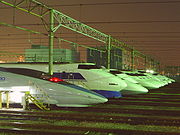
Tōkaidō and Sanyō Shinkansen
- 0 series0 Series ShinkansenThe trains were the first Shinkansen trainsets built to run on Japan's new Tōkaidō Shinkansen high-speed line which opened in 1964. The last remaining trainsets were withdrawn in 2008.-History:...
: The first Shinkansen trains, entering service in 1964, and withdrawn in 2008. Maximum operating speed was 220 km/h (137 mph). More than 3,200 cars were built. - 100 series100 Series ShinkansenThe is a Japanese Shinkansen high-speed train type built between 1984 and 1991 for the Tōkaidō Shinkansen and Sanyō Shinkansen high-speed lines. The earliest units have now been withdrawn from service, and the series was retired from the Tōkaidō Shinkansen line in September 2003...
: Entered service in 1985, and featured bilevel cars with restaurant car and compartments. Maximum operating speed is 230 km/h (143 mph). Now used only on Sanyō Shinkansen Kodama services. - 300 series300 Series ShinkansenThe is a Japanese high-speed Shinkansen train type introduced in 1992 on the Tōkaidō and Sanyō Shinkansen lines, initially for use on the fastest Nozomi services, being capable of...
: Entered service in 1992, initially on Nozomi services with maximum operating speed of 270 km/h (168 mph). - 500 series500 Series ShinkansenThe is a Shinkansen high-speed train type operated by West Japan Railway Company on the Tōkaidō Shinkansen and Sanyō Shinkansen lines in Japan. They were designed to be capable of although they currently operate at a maximum of in service...
: Introduced on Nozomi services in 1997, with an operating speed of 300 km/h (186 mph). Since 2008, some sets have been shortened from 16 to 8 cars for use on Sanyō Shinkansen Kodama services - 700 series700 Series ShinkansenThe is a Japanese Shinkansen high-speed train type built between 1997 and 2006, and entering service in 1999. Originally designated as "N300", they formed the next generation of shinkansen vehicles jointly designed by JR Central and JR West for use on both Tōkaidō and Sanyō Shinkansen...
: Introduced in 1999, with maximum operating speed of 285 km/h (177 mph). Now widely used on Nozomi, Hikari, and Kodama services - N700 seriesN700 Series ShinkansenThe is a Japanese Shinkansen high-speed train with tilting capability developed jointly by JR Central and JR West for use on the Tōkaidō and Sanyō Shinkansen lines, and also operated by JR Kyushu on the Kyushu Shinkansen line....
: The most recently introduced type on the Tōkaidō and Sanyō Shinkansen, in service since 2007, with a maximum operating speed of 300 km/h (186 mph).
Kyushu Shinkansen
- 800 series800 Series ShinkansenThe is a Japanese Shinkansen high-speed train type operated by JR Kyushu on the Kyushu Shinkansen high-speed rail line. Built by Hitachi, the trains were introduced on the Tsubame services from March 2004....
: In service since 2004 on Tsubame services, with a maximum speed 260 km/h (162 mph). - N700-7000/8000 series In service since March 2011 on MizuhoMizuho (train)The is a limited-stop shinkansen service operated between Shin-Ōsaka and Kagoshima in Japan since 12 March 2011, following the completion of the Kyūshū Shinkansen.-History:...
and SakuraSakura (train)The is a high-speed shinkansen service operated between and Kagoshima in Japan since 12 March 2011. It was formerly a limited express sleeper train service operated by JR Kyushu, which ran from to and in Kyūshū, Japan...
services with a maximum speed of 300 km/h (186 mph).
Tōhoku, Jōetsu, and Nagano Shinkansen
- 200 series200 Series ShinkansenThe is a Shinkansen high-speed train type introduced by Japan National Railways for the Tōhoku Shinkansen and Jōetsu Shinkansen high-speed rail lines in Japan, and currently operated by East Japan Railway Company . They actually predate the 100 series trains, having been built between 1980 and 1986...
: The first type introduced on the TōhokuTohoku ShinkansenThe is a Japanese high-speed Shinkansen rail line, connecting Tokyo with Aomori in Aomori Prefecture for a total length of 674 km, Japan's longest Shinkansen line. It runs through the more sparsely populated Tōhoku region of Japan's main island Honshu. It has two spur lines, Yamagata...
, and Jōetsu ShinkansenJoetsu ShinkansenThe is a high-speed railway line connecting Tokyo and Niigata, Japan, via the Tōhoku Shinkansen, operated by the East Japan Railway Company .-History:The program was initiated in 1971 by Niigata-born prime minister Tanaka Kakuei...
in 1982. Maximum speed is 240 km/h (149 mph). Some are still in operation as 10-car sets - E1 seriesE1 Series ShinkansenThe is a Shinkansen high-speed train type operated by East Japan Railway Company in Japan since 1994. They were the first double-deck trains built for Japan's Shinkansen...
: BilevelBilevel carThe bilevel car or double-decker coach is a type of rail car that has two levels of passenger accommodation, as opposed to one, increasing passenger capacity ....
12-car trains in service since 1994 with maximum speed of 240 km/h (149 mph). - E2 seriesE2 Series ShinkansenThe is a Japanese high-speed Shinkansen train type operated by East Japan Railway Company on the Tōhoku and Nagano Shinkansen high-speed lines in Japan since 1997. They are formed in 8- and 10-car sets. The 8-car sets are used on the Nagano Shinkansen, and the 10-car sets on Tōhoku Shinkansen...
: In service since 1997 with maximum speed of 275 km/h (171 mph). - E4 seriesE4 Series ShinkansenThe is a high-speed shinkansen train type operated by East Japan Railway Company in Japan. They were the second series of completely bi-level Shinkansen trainsets to be built in Japan . They operate on the Tōhoku and Jōetsu Shinkansen, and occasionally on the Nagano Shinkansen...
: BilevelBilevel carThe bilevel car or double-decker coach is a type of rail car that has two levels of passenger accommodation, as opposed to one, increasing passenger capacity ....
8-car trains in service since 1997 with maximum speed of 240 km/h (149 mph). - E5 seriesE5 Series ShinkansenThe is a Japanese Shinkansen high-speed train type operated by East Japan Railway Company on Tōhoku Shinkansen services since 5 March 2011. A total of 59 10-car sets are on order, with three sets in service in time for the start of new Hayabusa services to Shin-Aomori in March...
: In service since March 2011 with a maximum speed of 300 km/h (186 mph).
Yamagata and Akita Shinkansen
- 400 series400 Series ShinkansenThe was a Japanese Shinkansen high-speed train type operated by East Japan Railway Company between 1992 and 2010 on Tsubasa services on Japan's first Mini-shinkansen line, the Yamagata Shinkansen branch from the main Tōhoku Shinkansen....
: The first Mini-shinkansenMini-shinkansenis the name given to the concept of converting narrow gauge railway lines to standard gauge for use by Shinkansen train services in Japan. Two mini-shinkansen routes have been constructed: the Yamagata Shinkansen and Akita Shinkansen.-Concept:...
type, introduced in 1992 on Yamagata ShinkansenYamagata ShinkansenThe is a Mini-shinkansen route in Japan, operated by East Japan Railway Company . It provides service between Tokyo and Shinjō in Yamagata Prefecture over the tracks of the Tōhoku Shinkansen and the Ōu Main Line....
Tsubasa services. Withdrawn in April 2010. - E3 seriesE3 Series ShinkansenThe is a Japanese Shinkansen high-speed train type built for Komachi services which commenced on 3 June 1997, coinciding with opening of the new Akita Shinkansen 'mini-shinkansen' line, a regular narrow-gauge line between Morioka and Akita upgraded to . Later versions of the E3 series were also...
: Introduced in 1997 on Akita ShinkansenAkita ShinkansenThe is a Mini-shinkansen high-speed rail line in Japan. Serving the Kantō and Tōhoku Regions of the country, it links Tokyo and Akita in Akita prefecture with direct service. From Tokyo to Morioka in Iwate prefecture, it operates on the Tōhoku Shinkansen tracks. From there to Ōmagari, it uses the...
Komachi and Yamagata ShinkansenYamagata ShinkansenThe is a Mini-shinkansen route in Japan, operated by East Japan Railway Company . It provides service between Tokyo and Shinjō in Yamagata Prefecture over the tracks of the Tōhoku Shinkansen and the Ōu Main Line....
Tsubasa services. - E6 seriesE6 Series ShinkansenThe is a Japanese Shinkansen high-speed train type on order by East Japan Railway Company for use on Komachi 'mini-shinkansen' services on the Tōhoku Shinkansen and Akita Shinkansen from Tokyo to Akita commencing in March 2013. The new 7-car trains will operate in conjunction with newly...
(On order): Scheduled to be introduced in 2013 Akita Shinkansen Komachi services, with maximum speed 320 km/h (199 mph).
Taiwan High Speed Rail
- 700T series700T Series ShinkansenThe THSR 700T is high-speed electric multiple unit trainset derived from the Japanese Shinkansen family for Taiwan High Speed Rail , Taiwan's high-speed rail line. The THSR 700T is based primary on the 700 Series Shinkansen, with the "T" referring to Taiwan...
(Taiwan High Speed RailTaiwan High Speed RailTaiwan High Speed Rail is a high-speed rail line that runs approximately along the west coast of the Republic of China from the national capital of Taipei to the southern city of Kaohsiung...
, a.k.a. Taiwan Shinkansen): The first Shinkansen type exported outside Japan. 12-car trains based on 700 series700 Series ShinkansenThe is a Japanese Shinkansen high-speed train type built between 1997 and 2006, and entering service in 1999. Originally designated as "N300", they formed the next generation of shinkansen vehicles jointly designed by JR Central and JR West for use on both Tōkaidō and Sanyō Shinkansen...
entered service in 2007, with maximum speed of 300 km/h (186 mph).
Experimental trains
- Class 1000Class 1000 Shinkansenwas the classification given to the two prototype Japanese Shinkansen trains built for high-speed testing ahead of the opening of the Tōkaidō Shinkansen in 1964.-Set A:# 1001 built by Kisha, seating capacity 56 , DT9002 bogies...
- 1961 - Class 951Class 951 ShinkansenThe was an experimental Japanese Shinkansen train built to test the technology for future high-speed trains operating at speeds of up to following the opening of the Tōkaidō Shinkansen in 1964.-Formation:# 951-1 built by Kawasaki Sharyo, seating capacity 40...
- 1969 - Class 961Class 961 ShinkansenThe was a 6-car experimental Japanese Shinkansen train built in 1973.-Design:The Class 961 train was developed to test new technology and design features to be incorporated in future high-speed trains for use on the planned Tōhoku Shinkansen and Jōetsu Shinkansen routes in the north-east of Japan...
- 1973 - Class 962Class 962 ShinkansenThe was a 6-car Japanese Shinkansen train built in 1979 as the prototype for the new trains to be operated on the Tōhoku Shinkansen and Jōetsu Shinkansen routes.-Design:...
- 1979 - 500-900 series "WIN350"WIN350"WIN350" was the name given to the 6-car experimental Shinkansen train developed in 1992 by the West Japan Railway Company in Japan to test technology to be incorporated in next-generation shinkansen trains expected to operate at speeds of from 1994...
- 1992 - Class 952/953 "STAR21"STAR21"STAR21" was the name given to the 9-car experimental Shinkansen train developed in 1992 by the East Japan Railway Company in Japan to test technology to be incorporated in next-generation shinkansen trains operating at speeds of or higher...
- 1992 - Class 955 "300X"300X"300X" was the name given to the 6-car experimental Shinkansen train developed in 1994 by the Central Japan Railway Company in Japan to test technology to be incorporated in future shinkansen trains operating at speeds of or higher.-Design:...
- 1994 - Class E954 "Fastech 360S" - 2004
- Class E955 "Fastech 360Z" - 2005
Maglev trains
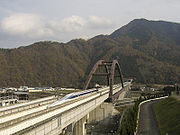
- LSM200 – 1972
- ML100 – 1972
- ML100A – 1975
- ML-500 – 1977
- ML-500R – 1979
- MLU001 – 1981
- MLU002 – 1987
- MLU002N – 1993
- MLX01 – 1996
- MLX01-901 – 2002
Maintenance vehicles
- 911 Type diesel locomotiveLocomotiveA locomotive is a railway vehicle that provides the motive power for a train. The word originates from the Latin loco – "from a place", ablative of locus, "place" + Medieval Latin motivus, "causing motion", and is a shortened form of the term locomotive engine, first used in the early 19th...
- 912 Type diesel locomotive
- DD18 Type diesel locomotive
- DD19 Type diesel locomotive
- 941 Type (rescue train)
- 921 Type (track inspection car)
- 922 Type (Doctor YellowDoctor Yellowis the nickname for the high-speed test trains that are used on the Japanese Shinkansen dedicated express passenger train routes.The trains have special equipment on board to monitor the condition of the track and overhead wire, including special instrumented bogies and observation blisters.The...
sets T1, T2, T3) - 923 Type (Doctor Yellow sets T4, T5)
- 925 Type (Doctor Yellow sets S1, S2)
- E926 Type (East i)
List of types of Shinkansen services
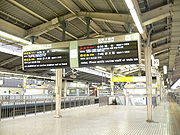
Tōkaidō Sanyō and Kyushu Shinkansen
- Nozomi (のぞみ) (fast, Tokaido and Sanyo)
- Hikari (ひかり) (semi-fast,Tokaido and Sanyo)
- Hikari Rail Star (ひかりレールスター) (semi fast,Sanyo)
- Kodama (こだま) (local,Tokaido and Sanyo)
- SakuraSakura (train)The is a high-speed shinkansen service operated between and Kagoshima in Japan since 12 March 2011. It was formerly a limited express sleeper train service operated by JR Kyushu, which ran from to and in Kyūshū, Japan...
(さくら) (semi-fast, Sanyo and Kyushu) - MizuhoMizuho (train)The is a limited-stop shinkansen service operated between Shin-Ōsaka and Kagoshima in Japan since 12 March 2011, following the completion of the Kyūshū Shinkansen.-History:...
(みずほ) (fast, Sanyo and Kyushu) - Tsubame (つばめ) (local, Kyushu)
Tōhoku, Yamagata and Akita Shinkansen
- HayabusaHayabusa (train)The is a new high-speed Shinkansen service operated by East Japan Railway Company between Tokyo and in Japan since 5 March 2011. The name was formerly used for a limited express sleeping car service operated by JR Kyushu, which ran from Tokyo to , and was discontinued in March 2009.-Service...
(はやぶさ) (fast, Tohoku ,using only series E5) - Hayate (はやて) (fast excluding part, Tohoku)
- Yamabiko / Max Yamabiko (やまびこ)
- Nasuno / Max Nasuno (なすの)
- AobaAoba (train)is the name of an all-stations service that operated until 1997 on the Tōhoku Shinkansen in Japan.-History:The name Aoba was first used from 20 November 1945 on an service between Ueno in Tokyo and Sendai on the Tōhoku Main Line...
(あおば) (discontinued) - Komachi (こまち) (Akita)
- Tsubasa (つばさ) (Yamagata)
Jōetsu Shinkansen
- Toki / Max TokiToki (train)is the name of a train service operating on the Jōetsu Shinkansen in Japan.-History:The name Toki was first introduced on 10 June 1962 for limited express services operating between Ueno in Tokyo and Niigata on the Jōetsu Line...
(とき) - Tanigawa / Max TanigawaTanigawa (train)is the name of a train service operated by the East Japan Railway Company on the Jōetsu Shinkansen in Japan.-History:The name Tanigawa was first introduced on 15 November 1982 for limited express services operating between Ueno in Tokyo and Minakami on the Jōetsu Line.From 1 October 1997, the...
(たにがわ) - Asahi / Max AsahiAsahi (train)is the name of a limited-stop train service that operated until 2002 on the Jōetsu Shinkansen in Japan.-Operations:The Asahi shinkansen services ran approximately hourly, with two down services permitted to operate at 275 km/h in the tunnel section between Jōmō-Kōgen and Urasa using specially...
(あさひ) (discontinued)
Speed records
Source:| km/h (mph) | Train | Location | Date | Comments |
|---|---|---|---|---|
| 200 (124.3) | Class 1000 Shinkansen Class 1000 Shinkansen was the classification given to the two prototype Japanese Shinkansen trains built for high-speed testing ahead of the opening of the Tōkaidō Shinkansen in 1964.-Set A:# 1001 built by Kisha, seating capacity 56 , DT9002 bogies... |
Kamonomiya test track in Odawara Odawara, Kanagawa is a city located in western Kanagawa Prefecture, Japan. As of 2010, the city had an estimated population of 198,466 with a population density of 1,740 persons per km² . The total area was .-Geography:... , now part of Tōkaidō Shinkansen |
31 October 1962 | |
| 256 (159.1) | Class 1000 Shinkansen | Kamonomiya test track | 30 March 1963 | Former world speed record Land speed record for railed vehicles Determination of the fastest rail vehicle in the world varies depending on the definition of "rail".Official absolute world record for conventional train is held by the French TGV... for EMU Electric multiple unit An electric multiple unit or EMU is a multiple unit train consisting of self-propelled carriages, using electricity as the motive power. An EMU requires no separate locomotive, as electric traction motors are incorporated within one or a number of the carriages... trains. |
| 286 (177.7) | Class 951 Shinkansen Class 951 Shinkansen The was an experimental Japanese Shinkansen train built to test the technology for future high-speed trains operating at speeds of up to following the opening of the Tōkaidō Shinkansen in 1964.-Formation:# 951-1 built by Kawasaki Sharyo, seating capacity 40... |
Sanyō Shinkansen Sanyō Shinkansen The is a line of the Japanese Shinkansen high-speed rail network, connecting Shin-Ōsaka in Osaka with Hakata Station in Fukuoka, the two largest cities in western Japan... |
24 February 1972 | Former world speed record for EMU trains. |
| 319.0 (198.2) | Class 961 Shinkansen Class 961 Shinkansen The was a 6-car experimental Japanese Shinkansen train built in 1973.-Design:The Class 961 train was developed to test new technology and design features to be incorporated in future high-speed trains for use on the planned Tōhoku Shinkansen and Jōetsu Shinkansen routes in the north-east of Japan... |
Oyama Oyama, Tochigi is a city in Tochigi Prefecture, Japan.As April 1, 2011, the city has an estimated population of 163,954, with 62,714 households, and a population density of 955.39 persons per km²... test track, now part of Tōhoku Shinkansen Tohoku Shinkansen The is a Japanese high-speed Shinkansen rail line, connecting Tokyo with Aomori in Aomori Prefecture for a total length of 674 km, Japan's longest Shinkansen line. It runs through the more sparsely populated Tōhoku region of Japan's main island Honshu. It has two spur lines, Yamagata... |
7 December 1979 | Former world speed record for EMU trains. |
| 325.7 (202.4) | 300 series 300 Series Shinkansen The is a Japanese high-speed Shinkansen train type introduced in 1992 on the Tōkaidō and Sanyō Shinkansen lines, initially for use on the fastest Nozomi services, being capable of... |
Tōkaidō Shinkansen | 28 February 1991 | |
| 336.0 (208.8) | 400 series 400 Series Shinkansen The was a Japanese Shinkansen high-speed train type operated by East Japan Railway Company between 1992 and 2010 on Tsubasa services on Japan's first Mini-shinkansen line, the Yamagata Shinkansen branch from the main Tōhoku Shinkansen.... |
Jōetsu Shinkansen Joetsu Shinkansen The is a high-speed railway line connecting Tokyo and Niigata, Japan, via the Tōhoku Shinkansen, operated by the East Japan Railway Company .-History:The program was initiated in 1971 by Niigata-born prime minister Tanaka Kakuei... |
26 March 1991 | |
| 345.0 (214.4) | 400 series 400 Series Shinkansen The was a Japanese Shinkansen high-speed train type operated by East Japan Railway Company between 1992 and 2010 on Tsubasa services on Japan's first Mini-shinkansen line, the Yamagata Shinkansen branch from the main Tōhoku Shinkansen.... |
Jōetsu Shinkansen | 19 September 1991 | |
| 345.8 (214.9) | 500-900 series "WIN350" WIN350 "WIN350" was the name given to the 6-car experimental Shinkansen train developed in 1992 by the West Japan Railway Company in Japan to test technology to be incorporated in next-generation shinkansen trains expected to operate at speeds of from 1994... |
Sanyō Shinkansen Sanyō Shinkansen The is a line of the Japanese Shinkansen high-speed rail network, connecting Shin-Ōsaka in Osaka with Hakata Station in Fukuoka, the two largest cities in western Japan... |
6 August 1992 | |
| 350.4 (217.7) | 500-900 series "WIN350" | Sanyō Shinkansen | 8 August 1992 | |
| 352.0 (218.7) | Class 952/953 "STAR21" STAR21 "STAR21" was the name given to the 9-car experimental Shinkansen train developed in 1992 by the East Japan Railway Company in Japan to test technology to be incorporated in next-generation shinkansen trains operating at speeds of or higher... |
Jōetsu Shinkansen Joetsu Shinkansen The is a high-speed railway line connecting Tokyo and Niigata, Japan, via the Tōhoku Shinkansen, operated by the East Japan Railway Company .-History:The program was initiated in 1971 by Niigata-born prime minister Tanaka Kakuei... |
30 October 1992 | |
| 425.0 (264.1) | Class 952/953 "STAR21" | Jōetsu Shinkansen | 21 December 1993 | |
| 426.6 (265.1) | Class 955 "300X" 300X "300X" was the name given to the 6-car experimental Shinkansen train developed in 1994 by the Central Japan Railway Company in Japan to test technology to be incorporated in future shinkansen trains operating at speeds of or higher.-Design:... |
Tōkaidō Shinkansen | 11 July 1996 | |
| 443.0 (275.3) | Class 955 "300X" | Tōkaidō Shinkansen | 26 July 1996 |
Competition with air
Compared with air transport, the Shinkansen has several advantages, including scheduling frequency and flexibility, punctual operation, comfortable seats, and convenient city-center terminals.The Shinkansen system and airlines often compete with each other for the business of city-to-city domestic travelers. If the Shinkansen connects two cities in less than three hours, most passengers choose the Shinkansen, but if it takes more than four hours by Shinkansen, the majority choose air. Some examples are as follows.
- Tokyo - Nagoya (342 km), Tokyo – Sendai (325 km), Tokyo – Hanamaki (Morioka) (496 km), Tokyo – Niigata (300 km): Once there was air service between these cities, but it was abolished after Shinkansen service started. Shinkansen runs between these cities in about two hours or less.
- Tokyo – Osaka (515 km): Shinkansen is dominant because of fast (2 hours and 30 minutes) and frequent service (up to every 10 minutes by Nozomi); however, air travel has a certain share (about 20 – 30 percent) because of the availability of discount fares.
- Tokyo – Okayama (676 km), Tokyo - Hiroshima (821 km): Shinkansen and air travel are mostly even in popularity. The Shinkansen takes about three to four hours and there are Nozomi trains every 30 minutes, but airlines may provide cheaper fares, attracting many passengers.
- Tokyo – Fukuoka (1,069 km): The Shinkansen takes about five hours even with the fastest Nozomi, and most people choose air. Fukuoka (Itatsuke) Airport is near to the CBD - TenjinTenjin, Fukuokarefers to the downtown area of Fukuoka City, Japan. It is located in Central ward....
, and Fukuoka City SubwayFukuoka City SubwayThe serves Fukuoka, Japan. It consists of three subway lines, the Kūkō, or Airport Line, the Hakozaki Line and the Nanakuma Line).The lines are operated by the . Unlike most other public operators in Japan, the company only operates subways without any bus lines....
Line 1 connects the Airport and Tenjin, via Hakata Station. - Osaka – Fukuoka (554 km): One of the most competitive sections. The Shinkansen takes about two and half hours by Nozomi, and JR West operates its own Hikari Rail Star trains twice an hour, taking about 2 hours and 40 minutes between the two cities.
Shinkansen technology outside Japan


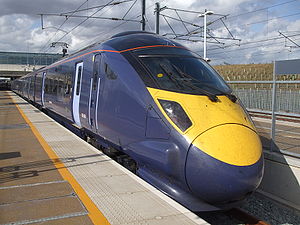
Taiwan
Taiwan High Speed RailTaiwan High Speed Rail
Taiwan High Speed Rail is a high-speed rail line that runs approximately along the west coast of the Republic of China from the national capital of Taipei to the southern city of Kaohsiung...
operates 700T Series
700T Series Shinkansen
The THSR 700T is high-speed electric multiple unit trainset derived from the Japanese Shinkansen family for Taiwan High Speed Rail , Taiwan's high-speed rail line. The THSR 700T is based primary on the 700 Series Shinkansen, with the "T" referring to Taiwan...
sets built by Kawasaki Heavy Industries
Kawasaki Heavy Industries
is an international corporation based in Japan. It has headquarters in both Chūō-ku, Kobe and Minato, Tokyo.The company is named after its founder Shōzō Kawasaki and has no connection with the city of Kawasaki, Kanagawa....
.
China
The China Railways CRH2China Railways CRH2
The CRH2 is one of the high-speed train models in China. Originally, the CRH2 was a modified E2-1000 Series Shinkansen design from Japan with the license purchased from a consortium formed of Kawasaki Heavy Industries, Mitsubishi Electric Corporation, and Hitachi, and represents the second...
EMU
Multiple unit
The term multiple unit or MU is used to describe a self-propelled carriages capable of coupling with other units of the same or similar type and still being controlled from one driving cab. The term is commonly used to denote passenger trainsets consisting of more than one carriage...
, built by CSR Sifang Loco & Rolling stocks corporation, with the license purchased from a consortium formed of Kawasaki Heavy Industries, Mitsubishi Electric Corporation, and Hitachi
Hitachi, Ltd.
is a Japanese multinational conglomerate headquartered in Marunouchi 1-chome, Chiyoda, Tokyo, Japan. The company is the parent of the Hitachi Group as part of the larger DKB Group companies...
, is based on the E2-1000 Series
E2 Series Shinkansen
The is a Japanese high-speed Shinkansen train type operated by East Japan Railway Company on the Tōhoku and Nagano Shinkansen high-speed lines in Japan since 1997. They are formed in 8- and 10-car sets. The 8-car sets are used on the Nagano Shinkansen, and the 10-car sets on Tōhoku Shinkansen...
design.
United Kingdom
Class 395British Rail Class 395
British Rail Class 395 is a dual-voltage electric multiple unit used by train operating company Southeastern for its services along High Speed 1 and onwards to the Kent coast. The trains were built in Japan by Hitachi and shipped to the United Kingdom to operate new high speed domestic services...
EMUs were built by Hitachi based on Shinkansen technology for use on high-speed commuter services in Britain on the High Speed 1 line.
Brazil
Japan is currently promoting its Shinkansen technology to the Government of BrazilBrazil
Brazil , officially the Federative Republic of Brazil , is the largest country in South America. It is the world's fifth largest country, both by geographical area and by population with over 192 million people...
for use on the planned high-speed rail link system set to link Rio de Janeiro, São Paulo and Campinas
Rio–São Paulo High-speed rail
Rio–São Paulo high-speed rail is a planned high-speed rail project to connect Brazil's two largest cities: São Paulo and Rio de Janeiro. While originally planned to be operational by 2014, in time for the 20th FIFA World Cup to be held in Brazil, at a cost of $9 billion, as of February 2010...
. On 14 November 2008, Japanese Prime Minister Taro Aso
Taro Aso
was the 92nd Prime Minister of Japan serving from September 2008 to September 2009, and was defeated in the August 2009 election.He has served in the House of Representatives since 1979. He was Minister for Foreign Affairs from 2005 to 2007, and was Secretary-General of the LDP briefly in 2007 and...
and Brazilian President Luiz Inácio Lula da Silva
Luiz Inácio Lula da Silva
Luiz Inácio Lula da Silva , known popularly as Lula, served as the 35th President of Brazil from 2003 to 2010.A founding member of the Workers' Party , he ran for President three times unsuccessfully, first in the 1989 election. Lula achieved victory in the 2002 election, and was inaugurated as...
talked about this rail project. President Lula asked a consortium of Japanese companies to participate in the bidding process. Prime Minister Aso concurred on the bilateral cooperation to improve rail infrastructure in Brazil, including the Rio-São Paulo-Campinas high-speed rail line. The Japanese consortium includes the Ministry of Land, Infrastructure, Transport and Tourism, Mitsui & Co.
Mitsui & Co.
Mitsui & Co., also known as Mitsui Bussan, is one of the largest sogo shosha in Japan, and also part of the Mitsui Group. Its business area covers energy, machinery, chemicals, food, textile, logistics, finance, and more.- History :...
, Mitsubishi Heavy Industries
Mitsubishi Heavy Industries
, or MHI, is a Japanese company. It is one of the core companies of Mitsubishi Group.-History:In 1870 Yataro Iwasaki, the founder of Mitsubishi took a lease of Government-owned Nagasaki Shipyard. He named it Nagasaki Shipyard & Machinery Works, and started the shipbuilding business on a full scale...
, Kawasaki Heavy Industries
Kawasaki Heavy Industries
is an international corporation based in Japan. It has headquarters in both Chūō-ku, Kobe and Minato, Tokyo.The company is named after its founder Shōzō Kawasaki and has no connection with the city of Kawasaki, Kanagawa....
and Toshiba
Toshiba
is a multinational electronics and electrical equipment corporation headquartered in Tokyo, Japan. It is a diversified manufacturer and marketer of electrical products, spanning information & communications equipment and systems, Internet-based solutions and services, electronic components and...
.
United States and Canada
- The U.S. Federal Railroad AdministrationFederal Railroad AdministrationThe Federal Railroad Administration is an agency in the United States Department of Transportation. The agency was created by the Department of Transportation Act of 1966...
is in talks with a number of countries with high-speed rail, notably Japan, France and Spain. On 16 May 2009, FRA Deputy Chief Karen Rae expressed hope that Japan would offer its technical expertise to Canada and the United States. Transportation Secretary Ray LaHoodRay LaHoodRaymond H. "Ray" LaHood is a Republican politician from Illinois who is currently the United States Secretary of Transportation, having served since 2009. Previously, he represented the Illinois's 18th congressional district in the U.S. House of Representatives for seven terms .-Early life and...
indicated interest in test riding the Japanese Shinkansen in 2009.
- On 1 June 2009, the Chairman of Central Japan Railway CompanyCentral Japan Railway CompanyThe is the main railway company operating in the Chūbu region of central Japan. It is officially abbreviated in English as JR Central and in Japanese as . Its headquarters are located in the JR Central Towers in Nakamura-ku, Nagoya, Aichi Prefecture.The company's operational hub is Nagoya Station...
, Yoshiyuki Kasai, announced plans to export both the N-700N700 Series ShinkansenThe is a Japanese Shinkansen high-speed train with tilting capability developed jointly by JR Central and JR West for use on the Tōkaidō and Sanyō Shinkansen lines, and also operated by JR Kyushu on the Kyushu Shinkansen line....
high speed train system and the JR-MaglevJR-MaglevJR-Maglev is a magnetic levitation train system developed by the Central Japan Railway Company and Railway Technical Research Institute . JR-Maglev MLX01 is one of the latest designs of a series of Maglev trains in development in Japan since the 1970s...
to international export markets, including the United States and Canada.
Vietnam
Vietnam RailwaysVietnam Railways
The railway system in Vietnam is operated by the state-owned Vietnam Railways . The principal route is the thousand-mile single track North-South Railway line, running between Hanoi and Ho Chi Minh City. This was built at the metre gauge in the 1880s during the French colonial rule...
is considering the use of Shinkansen technology for a high-speed rail link between the capital Hanoi
Hanoi
Hanoi , is the capital of Vietnam and the country's second largest city. Its population in 2009 was estimated at 2.6 million for urban districts, 6.5 million for the metropolitan jurisdiction. From 1010 until 1802, it was the most important political centre of Vietnam...
and the southern commercial hub of Ho Chi Minh City
Ho Chi Minh City
Ho Chi Minh City , formerly named Saigon is the largest city in Vietnam...
, according to the Nihon Keizai Shimbun
Nihon Keizai Shimbun
is one of the largest media corporations in Japan. Nikkei specializes in publishing financial, business and industry news. Its main news publications include:* Nihon Keizai Shimbun , a leading economic newspaper....
, citing an interview with Chief Executive Officer Nguyen Huu Bang. The Vietnamese government had already given basic approval for the Shinkansen system, although it still required financing and formal consent from the prime minister. Funding for the $56 billion-project remained riddled with uncertainties, the report said, with Hanoi seeking Japanese Official Development Assistance
Official development assistance
Official development assistance is a term compiled by the Development Assistance Committee of the Organisation for Economic Co-operation and Development to measure aid. The DAC first compiled the term in 1969. It is widely used by academics and journalists as a convenient indicator of...
and funds from the World Bank
World Bank
The World Bank is an international financial institution that provides loans to developing countries for capital programmes.The World Bank's official goal is the reduction of poverty...
and Asian Development Bank
Asian Development Bank
The Asian Development Bank is a regional development bank established on 22 August 1966 to facilitate economic development of countries in Asia...
. The 1560 kilometres (969.3 mi) line would replace the current colonial-era rail line. Vietnam
Vietnam
Vietnam – sometimes spelled Viet Nam , officially the Socialist Republic of Vietnam – is the easternmost country on the Indochina Peninsula in Southeast Asia. It is bordered by China to the north, Laos to the northwest, Cambodia to the southwest, and the South China Sea –...
hopes to launch the high-speed trains by 2020 and plans to start by building three sections, including a 90-kilometre stretch between the central coastal cities of Da Nang
Da Nang
Đà Nẵng , occasionally Danang, is a major port city in the South Central Coast of Vietnam, on the coast of the South China Sea at the mouth of the Han River. It is the commercial and educational center of Central Vietnam; its well-sheltered, easily accessible port and its location on the path of...
and Huế
Hue
Hue is one of the main properties of a color, defined technically , as "the degree to which a stimulus can be describedas similar to or different from stimuli that are described as red, green, blue, and yellow,"...
, seen as potentially most profitable. Vietnam Railways began dispatching engineers to Central Japan Railway Company
Central Japan Railway Company
The is the main railway company operating in the Chūbu region of central Japan. It is officially abbreviated in English as JR Central and in Japanese as . Its headquarters are located in the JR Central Towers in Nakamura-ku, Nagoya, Aichi Prefecture.The company's operational hub is Nagoya Station...
for technical training.
External links
- Biting the Bullet: What we can learn from the Shinkansen, discussion paper by Christopher Hood in the electronic journal of contemporary japanese studies, 23 May 2001
- Encyclopaedia Britannica Shinkansen
- East meets West, a story of how the Shinkansen brought Tokyo and OsakaOsakais a city in the Kansai region of Japan's main island of Honshu, a designated city under the Local Autonomy Law, the capital city of Osaka Prefecture and also the biggest part of Keihanshin area, which is represented by three major cities of Japan, Kyoto, Osaka and Kobe...
closer together. - Bullet on wheels, a travel report by Vinod Jacob 19 August 2005
- Information on the N700 Shinkansen from railway-technology.com
- NYT Obituary (20 March 1998)- Hideo Shima, a Designer of Japan's Bullet Train, Is Dead at 96