


Tokyo Station

Encyclopedia
is a train station
located in the Marunouchi
business district of Chiyoda
, Tokyo
, Japan
, near the Imperial Palace
grounds and the Ginza
commercial district.
It is the main intercity rail terminal in Tokyo, the busiest station in Japan in terms of number of trains per day (over 3,000), and the fifth-busiest in Eastern Japan in terms of passenger throughput. It is the starting point and terminus for most of Japan's Shinkansen
(high-speed rail
lines), and is served by many local and regional commuter lines of Japan Railways
, as well as the Tokyo Metro
network.
The station is linked by underground passageways to the Ōtemachi
underground (subway) station complex served by the Tōzai
, Chiyoda, Hanzōmon
and Mita
lines.
It is also possible to walk to the Nijūbashimae
, Hibiya
, Yūrakuchō
, Ginza
, and Higashi-ginza Station
s completely underground (the last a distance of over 2 km), but these stations can usually be reached more quickly by train.
Tōkyō Station is also a major intercity bus terminal, with regular midday service to several cities in the Kantō region
and overnight service to the Kansai and Tōhoku region
s.
s serving 20 tracks, raised above street level running in a north-south direction. The main concourse runs east-west below the platforms.
The Shinkansen lines are on the east (or Yaesu
) side of the station, along with a multi-story Daimaru
department store.
Underground are the two Sōbu/Yokosuka line platforms serving four tracks (five stories below ground level) to the west of the station; the two Keiyō line platforms serving four tracks are four stories below ground some hundreds of meters to the south of the main station with moving sidewalks to serve connecting passengers.
The whole complex is linked by an extensive system of underground passageways which merge with surrounding commercial buildings and shopping centres.
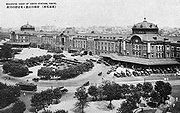 In 1889, a Tokyo municipal committee drew up plans for an elevated railway line connecting the Tōkaidō Main Line
terminal at Shinbashi
to the Nippon Railway (now Tōhoku Main Line) terminal at Ueno
. The Imperial Diet
resolved in 1896 to construct a new station on this line called , located directly in front of the gardens of the Imperial Palace.
Construction was delayed due to the outbreak of the First Sino-Japanese War
and Russo-Japanese War
, but finally commenced in 1908. The three-story station building was designed by architect Tatsuno Kingo
(who also designed Manseibashi Station
and the nearby Bank of Japan
building) as a restrained celebration of Japan's costly victory in the Russo-Japanese War. The building is often rumored to be fashioned after Amsterdam
's main station
, although there is little evidence to support the opinion. Terunobu Fujimori
, a scholar of Western architecture, denies the rumor, having studied Tatsuno's styles as well as the building itself.
Tōkyō Station opened on December 18, 1914 with four platforms—two serving electric trains (current Yamanote/Keihin-Tohoku Line platforms) and two serving non-electric trains (current Tōkaidō Line platforms). The Chūō Main Line
extension to the station was completed in 1919 and originally stopped at the platform now used by northbound Yamanote/Keihin-Tōhoku trains. During this early era, the station only had gates on the Marunouchi side, with the north side serving as an exit and the south side serving as an entrance.
In 1921, Prime Minister
Hara Takashi
was assassinated at the south gates. The Yaesu side of the station opened in 1929.
Much of the station was destroyed in two B-29 firebombings on May 25 and June 25, 1945. These bombings shattered the impressive glass domes. The station was quickly rebuilt within the year, but simple angular roofs were built in place of the domes, and the restored building was only two stories tall instead of three.
The Yaesu side was also rebuilt following the war, but the rebuilt structure was damaged by fire in 1949, and the Yaesu side was then significantly upgraded with a contemporary exterior and large Daimaru department store. The new Yaesu side facilities opened in 1953, including two new platforms for Tokaido Main Line services (now used by Shinkansen trains). Two more platforms opened in 1964 to accommodate the first Shinkansen services. The Yaesu side was partially rebuilt again in 1991 to accommodate the Shinkansen extension from Ueno.
The station complex is presently being redeveloped. The Marunouchi side will be restored to pre-war condition and the surrounding area converted into a broad plaza extending into a walkway toward the Imperial Palace, with space for bus and taxi ranks: this construction is scheduled for completion in fiscal 2011. On the Yaesu side, the current multi-story exterior will be replaced by a much lower structure with a large canopy covering outdoor waiting and loading areas, and twin high-rise towers at each end. This project is due for completion in 2013.
and Narita
.
A JR East project will extend the services of the Utsunomiya Line
, the Takasaki Line
, and the Jōban Line
to Tōkyō Station by constructing the Tōhoku Jūkan Line
Train station
A train station, also called a railroad station or railway station and often shortened to just station,"Station" is commonly understood to mean "train station" unless otherwise qualified. This is evident from dictionary entries e.g...
located in the Marunouchi
Marunouchi
Marunouchi is a commercial district of Tokyo located in Chiyoda between Tokyo Station and the Imperial Palace. The name, meaning "inside the circle", derives from its location within the palace's outer moat...
business district of Chiyoda
Chiyoda, Tokyo
is one of the 23 special wards in central Tokyo, Japan. In English, it is called Chiyoda ward. As of October 2007, the ward has an estimated population of 45,543 and a population density of 3,912 people per km², making it by far the least populated of the special wards...
, Tokyo
Tokyo
, ; officially , is one of the 47 prefectures of Japan. Tokyo is the capital of Japan, the center of the Greater Tokyo Area, and the largest metropolitan area of Japan. It is the seat of the Japanese government and the Imperial Palace, and the home of the Japanese Imperial Family...
, Japan
Japan
Japan is an island nation in East Asia. Located in the Pacific Ocean, it lies to the east of the Sea of Japan, China, North Korea, South Korea and Russia, stretching from the Sea of Okhotsk in the north to the East China Sea and Taiwan in the south...
, near the Imperial Palace
Kokyo
is the main residence of the Emperor of Japan. It is a large park-like area located in the Chiyoda area of Tokyo close to Tokyo Station and contains several buildings including the main palace , the emperor left Kyoto Imperial Palace for Tokyo...
grounds and the Ginza
Ginza
is a district of Chūō, Tokyo, located south of Yaesu and Kyōbashi, west of Tsukiji, east of Yūrakuchō and Uchisaiwaichō, and north of Shinbashi.It is known as an upscale area of Tokyo with numerous department stores, boutiques, restaurants and coffeehouses. Ginza is recognized as one of the most...
commercial district.
It is the main intercity rail terminal in Tokyo, the busiest station in Japan in terms of number of trains per day (over 3,000), and the fifth-busiest in Eastern Japan in terms of passenger throughput. It is the starting point and terminus for most of Japan's Shinkansen
Shinkansen
The , also known as THE BULLET TRAIN, is a network of high-speed railway lines in Japan operated by four Japan Railways Group companies. Starting with the Tōkaidō Shinkansen in 1964, the network has expanded to currently consist of of lines with maximum speeds of , of Mini-shinkansen with a...
(high-speed rail
High-speed rail
High-speed rail is a type of passenger rail transport that operates significantly faster than the normal speed of rail traffic. Specific definitions by the European Union include for upgraded track and or faster for new track, whilst in the United States, the U.S...
lines), and is served by many local and regional commuter lines of Japan Railways
Japan Railways
The Japan Railways Group, more commonly known as , consists of seven for-profit companies that took over most of the assets and operations of the government-owned Japanese National Railways on April 1, 1987...
, as well as the Tokyo Metro
Tokyo Metro
is one of two rapid transit systems making up the Tokyo subway system, the other being Toei. It is the most used subway system in the world in terms of annual passenger rides.-Organization:...
network.
Lines
The following lines pass through or terminate at Tōkyō Station:- East Japan Railway CompanyEast Japan Railway Companyis the largest passenger railway company in the world and one of the seven Japan Railways Group companies. The company name is officially abbreviated as JR East in English, and as in Japanese. The company's headquarters are in Yoyogi, Shibuya, Tokyo....
- Chūō LineChuo Main LineThe , commonly called the Chūō Line, is one of the major trunk railway lines in Japan. It runs between Tokyo and Nagoya, although it is the slowest direct railway connection between the two cities; the coastal Tōkaidō Main Line is slightly faster, while the Tōkaidō Shinkansen is the fastest rail...
- Keihin-Tōhoku LineKeihin-Tohoku LineThe , is a railway line in Japan which connects the cities of Saitama, Kawaguchi, Tokyo, Kawasaki, and Yokohama. It is part of the East Japan Railway Company network. The line's name is derived from the characters for , and the...
- Keiyō LineKeiyo LineThe is a railway line connecting Tokyo and Chiba, Japan, running mainly along the edge of Tokyo Bay. It is operated by the East Japan Railway Company .It provides the main rail access to the Tokyo Disney Resort and the Makuhari Messe exhibition center...
- Sōbu Line (Rapid)Sobu Line (Rapid)The is a railway service on the Sōbu Main Line in Tokyo and Chiba Prefecture, Japan. It connects in Chūō, Tokyo and in Chūō-ku, Chiba via the cities of Ichikawa, Funabashi, and Narashino...
(including Narita ExpressNarita Express, abbreviated as N'EX, is a limited express train service operated since 1991 by East Japan Railway Company , serving Narita International Airport from various Greater Tokyo Area stations. Services are approximately half-hourly in the mornings and evenings, and hourly through the middle of the day...
service) - Tōkaidō Main LineTokaido Main LineThe is the busiest trunk line of the Japan Railways Group , connecting Tōkyō and Kōbe stations. It is long, not counting its many freight feeder lines around the major cities...
- Yamanote LineYamanote LineThe is commuter rail loop line in Tokyo, Japan, operated by East Japan Railway Company . It is one of Tokyo's busiest and most important lines, connecting most of Tokyo's major stations and urban centres, including the Yūrakuchō/Ginza area, Shibuya, Shinjuku, and Ikebukuro, with all but two of its...
- Yokosuka LineYokosuka LineThe is a railway line in Japan operated by the East Japan Railway Company .The Yokosuka Line connects in Chūō, Tokyo and in Yokosuka, Kanagawa...
- Tōhoku ShinkansenTohoku ShinkansenThe is a Japanese high-speed Shinkansen rail line, connecting Tokyo with Aomori in Aomori Prefecture for a total length of 674 km, Japan's longest Shinkansen line. It runs through the more sparsely populated Tōhoku region of Japan's main island Honshu. It has two spur lines, Yamagata...
- Yamagata ShinkansenYamagata ShinkansenThe is a Mini-shinkansen route in Japan, operated by East Japan Railway Company . It provides service between Tokyo and Shinjō in Yamagata Prefecture over the tracks of the Tōhoku Shinkansen and the Ōu Main Line....
- Akita ShinkansenAkita ShinkansenThe is a Mini-shinkansen high-speed rail line in Japan. Serving the Kantō and Tōhoku Regions of the country, it links Tokyo and Akita in Akita prefecture with direct service. From Tokyo to Morioka in Iwate prefecture, it operates on the Tōhoku Shinkansen tracks. From there to Ōmagari, it uses the...
- Jōetsu ShinkansenJoetsu ShinkansenThe is a high-speed railway line connecting Tokyo and Niigata, Japan, via the Tōhoku Shinkansen, operated by the East Japan Railway Company .-History:The program was initiated in 1971 by Niigata-born prime minister Tanaka Kakuei...
- Nagano ShinkansenNagano ShinkansenThe is a Shinkansen high-speed rail line operated by East Japan Railway Company between Takasaki and Nagano in Japan. It opened on 1 October 1997, connecting Tokyo and Nagano in time for the 1998 Winter Olympics held in Nagano...
- Chūō Line
- Central Japan Railway CompanyCentral Japan Railway CompanyThe is the main railway company operating in the Chūbu region of central Japan. It is officially abbreviated in English as JR Central and in Japanese as . Its headquarters are located in the JR Central Towers in Nakamura-ku, Nagoya, Aichi Prefecture.The company's operational hub is Nagoya Station...
- Tokyo MetroTokyo Metrois one of two rapid transit systems making up the Tokyo subway system, the other being Toei. It is the most used subway system in the world in terms of annual passenger rides.-Organization:...
The station is linked by underground passageways to the Ōtemachi
Otemachi Station (Tokyo)
is a station on the Tokyo Metro and Toei Subway in Chiyoda, Tokyo, Japan. It is served by five lines, more than any other station on the Tokyo underground network...
underground (subway) station complex served by the Tōzai
Tokyo Metro Tozai Line
The is a rapid transit line owned and operated by Tokyo Metro located in Tokyo and Chiba Prefecture, Japan. Its name literally means East-West Line. The line runs between Nakano Station in Nakano, Tokyo and Nishi-Funabashi Station in Funabashi, Chiba...
, Chiyoda, Hanzōmon
Tokyo Metro Hanzomon Line
The is a subway line owned and operated by Tokyo Metro located in Tokyo, Japan.-Overview:The 16.8 km line serves the wards of Shibuya, Minato, Chiyoda, Chūō, Kōtō and Sumida. Hanzōmon Line trains run through onto the Tōkyū Den-en-toshi Line from Shibuya Station and the Tōbu Isesaki Line from...
and Mita
Toei Mita Line
The is a subway line of the Tokyo Metropolitan Bureau of Transportation network in Tokyo, Japan. The line runs between Nishi-Takashimadaira in Itabashi and Meguro in Shinagawa. Trains continue with direct service into the Meguro Line of Tokyu Corporation for...
lines.
It is also possible to walk to the Nijūbashimae
Nijubashimae Station
is an underground railway station in Chiyoda, Tokyo, Japan, operated by Tokyo Metro.-Station layout:-Adjacent stations:-See also:...
, Hibiya
Hibiya Station
is an underground railway station in the Hibiya district of Chiyoda, Tokyo, Japan, operated by Tokyo Metro and Toei.-Lines:* Tokyo Metro Chiyoda Line * Tokyo Metro Hibiya Line * Toei Mita Line...
, Yūrakuchō
Yurakucho Station
is a train station located in Chiyoda, Tokyo, Japan.- History :The elevated JR station opened on June 25, 1910. The metro station opened on October 30, 1974.-Lines:Yūrakuchō is served by the following lines:*Tokyo Metro**Yūrakuchō Line...
, Ginza
Ginza Station
is a metro station in Chūō, Tokyo, Japan, serving the Ginza commercial district. It is the fourth-busiest Tokyo Metro station after Ikebukuro, Kita-senju and Ōtemachi.- History :...
, and Higashi-ginza Station
Higashi-ginza Station
is a subway station on the Toei Asakusa Line, operated by the Tokyo Metropolitan Bureau of Transportation, and on the Tokyo Metro Hibiya Line. The Hibiya Line station is subtitled Kabukiza-mae. The station is located in Ginza, Chūō, Tokyo, Japan. Its numbers are A-11 and H-09.-Location:The station...
s completely underground (the last a distance of over 2 km), but these stations can usually be reached more quickly by train.
Tōkyō Station is also a major intercity bus terminal, with regular midday service to several cities in the Kantō region
Kanto region
The is a geographical area of Honshu, the largest island of Japan. The region includes the Greater Tokyo Area and encompasses seven prefectures: Gunma, Tochigi, Ibaraki, Saitama, Tokyo, Chiba, and Kanagawa. Within its boundaries, slightly more than 40 percent of the land area is the Kantō Plain....
and overnight service to the Kansai and Tōhoku region
Tohoku region
The is a geographical area of Japan. The region occupies the northeastern portion of Honshu, the largest island of Japan. The region consists of six prefectures : Akita, Aomori, Fukushima, Iwate, Miyagi and Yamagata....
s.
Layout
The main station facade on the western side of the station is brick-built, surviving from the time when the station opened in 1914. The main station consists of 10 island platformIsland platform
An island platform is a station layout arrangement where a single platform is positioned between two tracks within a railway station, tram stop or transitway interchange...
s serving 20 tracks, raised above street level running in a north-south direction. The main concourse runs east-west below the platforms.
The Shinkansen lines are on the east (or Yaesu
Yaesu
is a neighborhood in Chūō, Tokyo, Japan, located north of Ginza, west of Nihonbashi and Kyōbashi, and adjacent to the east side of Tokyo Station. The Yaesu exit, which faces Nihonbashi, is recent and primarily provides access to the Shinkansen platforms.-History:...
) side of the station, along with a multi-story Daimaru
Daimaru
is a Japanese department stores chain, principally located in the Kansai region of Japan. The chain is operated by Daimaru Matsuzakaya Department Stores, a subsidiary of J. Front Retailing...
department store.
Underground are the two Sōbu/Yokosuka line platforms serving four tracks (five stories below ground level) to the west of the station; the two Keiyō line platforms serving four tracks are four stories below ground some hundreds of meters to the south of the main station with moving sidewalks to serve connecting passengers.
The whole complex is linked by an extensive system of underground passageways which merge with surrounding commercial buildings and shopping centres.
Ground platforms
Shinkansen platforms
Yokosuka/Sōbu platforms
Keiyō platforms
Tokyo Metro platforms
History
Tokaido Main Line
The is the busiest trunk line of the Japan Railways Group , connecting Tōkyō and Kōbe stations. It is long, not counting its many freight feeder lines around the major cities...
terminal at Shinbashi
Shiodome Station (JNR)
was a freight train station of the Japanese National Railways in Minato, Tokyo, Japan. The freight terminal was originally named and served as the first railway terminal of Tokyo between 1872 and 1914.-History:...
to the Nippon Railway (now Tōhoku Main Line) terminal at Ueno
Ueno Station
is a major railway station inTokyo's Taitō ward. It is the station used to reach the Ueno district and Ueno Park -- which contains Tokyo National Museum, The National Museum of Western Art, Ueno Zoo, Tokyo National University of Fine Arts and Music and other famous cultural facilities...
. The Imperial Diet
Diet of Japan
The is Japan's bicameral legislature. It is composed of a lower house, called the House of Representatives, and an upper house, called the House of Councillors. Both houses of the Diet are directly elected under a parallel voting system. In addition to passing laws, the Diet is formally...
resolved in 1896 to construct a new station on this line called , located directly in front of the gardens of the Imperial Palace.
Construction was delayed due to the outbreak of the First Sino-Japanese War
First Sino-Japanese War
The First Sino-Japanese War was fought between Qing Dynasty China and Meiji Japan, primarily over control of Korea...
and Russo-Japanese War
Russo-Japanese War
The Russo-Japanese War was "the first great war of the 20th century." It grew out of rival imperial ambitions of the Russian Empire and Japanese Empire over Manchuria and Korea...
, but finally commenced in 1908. The three-story station building was designed by architect Tatsuno Kingo
Tatsuno Kingo
was a Japanese architect born in Karatsu, Saga Prefecture, Kyushu.He studied in Japan at the Imperial College of Engineering where he was one of the first to graduate in 1879 under British architect Josiah Conder. He visited England and worked in the office of William Burges in 1881-2. He taught...
(who also designed Manseibashi Station
Manseibashi Station
can refer to two closed train stations all in Chiyoda, Tokyo, Japan. One was a railway station on the Japanese Government Railways Chūō Main Line and the other was a subway station in the Tokyo Subway network....
and the nearby Bank of Japan
Bank of Japan
is the central bank of Japan. The Bank is often called for short. It has its headquarters in Chuo, Tokyo.-History:Like most modern Japanese institutions, the Bank of Japan was founded after the Meiji Restoration...
building) as a restrained celebration of Japan's costly victory in the Russo-Japanese War. The building is often rumored to be fashioned after Amsterdam
Amsterdam
Amsterdam is the largest city and the capital of the Netherlands. The current position of Amsterdam as capital city of the Kingdom of the Netherlands is governed by the constitution of August 24, 1815 and its successors. Amsterdam has a population of 783,364 within city limits, an urban population...
's main station
Amsterdam Centraal
' is the central station of Amsterdam. It is one of the main railway hubs of the Netherlands and is used by 250,000 passengers a day, excluding transferring passengers. It is also the starting point of Amsterdam Metro lines 51, 53, and 54. The station building of Amsterdam Centraal was designed by...
, although there is little evidence to support the opinion. Terunobu Fujimori
Terunobu Fujimori
is a Japanese architect and architectural historian.During the 1970s and 80s he made studies of the city about early Western buildings and unusual occurrences and did not turn to architecture until he was in his forties...
, a scholar of Western architecture, denies the rumor, having studied Tatsuno's styles as well as the building itself.
Tōkyō Station opened on December 18, 1914 with four platforms—two serving electric trains (current Yamanote/Keihin-Tohoku Line platforms) and two serving non-electric trains (current Tōkaidō Line platforms). The Chūō Main Line
Chuo Main Line
The , commonly called the Chūō Line, is one of the major trunk railway lines in Japan. It runs between Tokyo and Nagoya, although it is the slowest direct railway connection between the two cities; the coastal Tōkaidō Main Line is slightly faster, while the Tōkaidō Shinkansen is the fastest rail...
extension to the station was completed in 1919 and originally stopped at the platform now used by northbound Yamanote/Keihin-Tōhoku trains. During this early era, the station only had gates on the Marunouchi side, with the north side serving as an exit and the south side serving as an entrance.
In 1921, Prime Minister
Prime Minister of Japan
The is the head of government of Japan. He is appointed by the Emperor of Japan after being designated by the Diet from among its members, and must enjoy the confidence of the House of Representatives to remain in office...
Hara Takashi
Hara Takashi
was a Japanese politician and the 19th Prime Minister of Japan from 29 September 1918 to 4 November 1921. He was also called Hara Kei informally. He was the first commoner appointed to the office of prime minister of Japan...
was assassinated at the south gates. The Yaesu side of the station opened in 1929.
Much of the station was destroyed in two B-29 firebombings on May 25 and June 25, 1945. These bombings shattered the impressive glass domes. The station was quickly rebuilt within the year, but simple angular roofs were built in place of the domes, and the restored building was only two stories tall instead of three.
The Yaesu side was also rebuilt following the war, but the rebuilt structure was damaged by fire in 1949, and the Yaesu side was then significantly upgraded with a contemporary exterior and large Daimaru department store. The new Yaesu side facilities opened in 1953, including two new platforms for Tokaido Main Line services (now used by Shinkansen trains). Two more platforms opened in 1964 to accommodate the first Shinkansen services. The Yaesu side was partially rebuilt again in 1991 to accommodate the Shinkansen extension from Ueno.
The station complex is presently being redeveloped. The Marunouchi side will be restored to pre-war condition and the surrounding area converted into a broad plaza extending into a walkway toward the Imperial Palace, with space for bus and taxi ranks: this construction is scheduled for completion in fiscal 2011. On the Yaesu side, the current multi-story exterior will be replaced by a much lower structure with a large canopy covering outdoor waiting and loading areas, and twin high-rise towers at each end. This project is due for completion in 2013.
Proposed developments
There are plans to build a spur from the nearby Toei Asakusa Line, which would provide Tokyo Station a second direct connection to the subway network, and also possibly provide faster connections from the station to Tokyo's airports, HanedaTokyo International Airport
, commonly known as , is one of the two primary airports that serve the Greater Tokyo Area in Japan. It is located in Ōta, Tokyo, south of Tokyo Station....
and Narita
Narita International Airport
is an international airport serving the Greater Tokyo Area of Japan. It is located east of Tokyo Station and east-southeast of Narita Station in the city of Narita, and the adjacent town of Shibayama....
.
A JR East project will extend the services of the Utsunomiya Line
Utsunomiya Line
The is the name given to a 159.9 kilometre section of the Tōhoku Main Line between Ueno Station in Tokyo and Kuroiso Station in Nasushiobara, Tochigi, Japan...
, the Takasaki Line
Takasaki Line
The is a Japanese railway line which runs between Ōmiya Station in Saitama, Saitama Prefecture and Takasaki Station in Takasaki, Gunma Prefecture. It is owned and operated by the East Japan Railway Company ....
, and the Jōban Line
Joban Line
The is a railway line in Japan operated by East Japan Railway Company . It begins at Nippori Station in Taitō, Tokyo and follows the Pacific coasts of Chiba, Ibaraki, and Fukushima Prefectures before the line officially ends at Iwanuma Station in Iwanuma, Miyagi...
to Tōkyō Station by constructing the Tōhoku Jūkan Line
Tōhoku Jūkan Line
The , also known as Tōhoku Through Line, is a construction project of East Japan Railway Company to build a railway linking Ueno Station and Tokyo Station in order to extend the services of the Utsunomiya Line, the Takasaki Line, and the Jōban Line to Tokyo Station. The project began on 30 May 2008...
Adjacent stations
See also
- Transportation in Greater TokyoTransportation in Greater TokyoThe transport network in Greater Tokyo includes public and private rail and highway networks; airports for international, domestic, and general aviation; buses; motorcycle delivery services, walking, bicycling, and commercial shipping. While the nexus is in the central part of Tokyo, every part of...
- List of development projects in Tokyo