
All Topics  
Multiple unit

 
Multiple Unit

   Email Print
   Bookmark   Link


Multiple unit


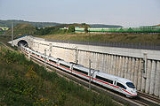
The term multiple unit or MU is used to describe a self-propelling train unit capable of coupling with other units of the same or similar type and still being controlled from one cab. The term is commonly used to denote passenger trainsets that consist of more than one carriage, but single self-propelling carriages, or railcar
Railcar

A railcar is a self-propelled Rail transport vehicle designed to transport passengers. The term "railcar" is usually used in reference to a train consisting of a single Coach , with a driver's cab at one or both ends....
s, can be referred to as multiple units if capable of operating with other units.

Multiple units are of three main types:

History and description
Multiple unit operation was made possible by the development of multiple-unit train control
Multiple-unit train control

Multiple-unit train control, sometimes referred to simply as multiple-unit or MU, is a method of simultaneously controlling all the traction equipment in a train, whether it be a number of Self-powered car cars or a set of locomotives, from a single location....
 by the American
United States

The United States of America is a Federal government constitutional republic comprising U.S. state and a federal district. The country is situated mostly in central North America, where its Contiguous United States and Washington, D.C., the Capital districts and territories, lie between the Pacific Ocean and Atlantic Oceans, Borders of the U...
 inventor
Inventor

An inventor is a person who creates or discovers a new method, form, device or other useful means. The word inventor comes form the latin verb invenire, invent-, to find....
 Franklin J. Sprague
Frank J. Sprague

Frank Julian Sprague was an United States Navy and inventor who contributed to the development of the electric motor, railway electrification system, and elevator....
.


Discussion
Ask a question about 'Multiple unit'
Start a new discussion about 'Multiple unit'
Answer questions from other users
Full Discussion Forum


Recent Posts


Encyclopedia


Am73
The term multiple unit or MU is used to describe a self-propelling train unit capable of coupling with other units of the same or similar type and still being controlled from one cab. The term is commonly used to denote passenger trainsets that consist of more than one carriage, but single self-propelling carriages, or railcar
Railcar

A railcar is a self-propelled Rail transport vehicle designed to transport passengers. The term "railcar" is usually used in reference to a train consisting of a single Coach , with a driver's cab at one or both ends....
s, can be referred to as multiple units if capable of operating with other units.

Multiple units are of three main types:
  • Electric multiple unit
    Electric multiple unit

    An electric multiple unit or EMU is a multiple unit train consisting of many carriages using electricity as the motive power....
     (EMU)
  • Diesel multiple unit
    Diesel multiple unit

    A diesel multiple unit or DMU is a multiple unit train consisting of multiple carriages powered by one or more on-board diesel engines....
     (DMU)
  • Diesel electric multiple units
    Diesel multiple unit

    A diesel multiple unit or DMU is a multiple unit train consisting of multiple carriages powered by one or more on-board diesel engines....
     (DEMU)


History and description


Multiple unit operation was made possible by the development of multiple-unit train control
Multiple-unit train control

Multiple-unit train control, sometimes referred to simply as multiple-unit or MU, is a method of simultaneously controlling all the traction equipment in a train, whether it be a number of Self-powered car cars or a set of locomotives, from a single location....
 by the American
United States

The United States of America is a Federal government constitutional republic comprising U.S. state and a federal district. The country is situated mostly in central North America, where its Contiguous United States and Washington, D.C., the Capital districts and territories, lie between the Pacific Ocean and Atlantic Oceans, Borders of the U...
 inventor
Inventor

An inventor is a person who creates or discovers a new method, form, device or other useful means. The word inventor comes form the latin verb invenire, invent-, to find....
 Franklin J. Sprague
Frank J. Sprague

Frank Julian Sprague was an United States Navy and inventor who contributed to the development of the electric motor, railway electrification system, and elevator....
. This allowed electrically
Electricity

Electricity is a general term that encompasses a variety of phenomena resulting from the presence and flow of electric charge. These include many easily recognizable phenomena such as lightning and static electricity, but in addition, less familiar concepts such as the electromagnetic field and electromagnetic induction....
-powered rapid transit
Rapid transit

A rapid transit, subway, underground, elevated railway or metro system is an railway electrification system public transport rail transport in an urban area with high capacity and frequency, and which is grade separation from other traffic....
 trains to be operated from a single driving position.

The first successful test of an MU on a working rapid transit system was in Chicago
Chicago

Chicago is the largest city in the U.S. state of Illinois and the Midwestern United States, as well as the List of United States cities by population city in the United States with more than 2.8 million residents....
, on the South Side "L", now part of the CTA
Chicago Transit Authority

Chicago Transit Authority, also known as CTA, is the operator of public transport within the Chicago, Illinois. It is the second largest transit system in the United States and fourth largest in North America....
 Green Line.

Most MUs are powered either by a diesel engine
Diesel engine

A diesel engine is an internal combustion engine which operates using the diesel cycle . Diesel engines have the highest thermal efficiency compared to any internal combustion or external combustion engine....
 driving the wheels through a gearbox or hydraulic transmission (DMU
Diesel multiple unit

A diesel multiple unit or DMU is a multiple unit train consisting of multiple carriages powered by one or more on-board diesel engines....
), or by traction motors, receiving their power through a live rail or overhead wire
Overhead lines

Overhead lines or overhead wires are used to transmit electrical energy to trams, trolleybuses or trains at a distance from the energy supply point....
 (EMU). Diesel electric multiple units
Demu

Demu may refer to:*D?mu, a village in France*Diesel-electric Multiple Unit *DEMU, Diesel and Electric Modellers United, a UK railway modelling group...
 (DEMUs) have a diesel engine that drives a generator producing electricity to drive traction motors in a similar fashion to a diesel-electric locomotive
Diesel locomotive

A Diesel locomotive is a type of railroad locomotive in which the prime mover is a Diesel engine. Several types of Diesel locomotive have been developed, the principal distinction being in the means by which the prime mover's mechanical power is conveyed to the driving wheels ....
.

A multiple unit trainset has the same power and traction components as a locomotive
Locomotive

A locomotive is a Rail transport vehicle that provides the motive power for a train. The word originates from the Latin language loco - "from a place", Ablative case of locus, "place" + Medieval Latin motivus, "causing motion", and is a shortened form of the term locomotive engine,....
, but instead of the components concentrating in one carbody, they are spread out on each car that makes up the set. Therefore these cars can only propel themselves when they are part of the set; thus making them semi-permanently coupled. For example, a DMU might have one car carry the prime mover
Prime mover (locomotive)

In locomotives, the prime mover is the source of power for propulsion. The term is generally used when discussing any locomotive powered by an internal combustion engine....
 and traction motor
Traction motor

A traction motor is a type of electric motor used to power the driving wheels of a vehicle such as a railroad locomotive, electrical Multiple unit train , a tram, or an automobile....
s, and another the engine for head end power
Head end power

Head end power or electric train supply is a rail transport term for the electrical power distribution system on a passenger train. The power source, usually a locomotive at the front or ?head? of a train or a generator car, generates all the electricity used for lighting, electrical and other "hotel" needs....
 generation; an EMU might have one car carry the pantograph
Pantograph (rail)

A pantograph is a device that collects electric current from overhead lines for electric trains or trams. The term stems from the resemblance to Pantograph for copying writing and drawings....
 and transformer
Transformer

A transformer is a device that transfers electrical energy from one electrical network to another through inductive coupling conductors — the transformer's coils or "windings"....
, and another car carry the traction motors.

Virtually all rapid transit
Rapid transit

A rapid transit, subway, underground, elevated railway or metro system is an railway electrification system public transport rail transport in an urban area with high capacity and frequency, and which is grade separation from other traffic....
 rolling stock, such as ones used in subway systems, are multiple unit trainsets, usually EMUs. Many high-speed rail
High-speed rail

High-speed rail is a type of passenger rail transport that operates significantly faster than the normal speed of rail traffic. Specific definitions include 200 km/h and faster ? depending on whether the track is upgraded or new ? by the European Union, and above 90 mph by the United States Federal Railroad Administration, but...
 rolling stocks are also multiple unit trainsets, such as the Japan
Japan

Japan is an island country in East Asia. Located in the Pacific Ocean, it lies to the east of the Sea of Japan, People's Republic of China, North Korea, South Korea and Russia, stretching from the Sea of Okhotsk in the north to the East China Sea and Taiwan in the south....
ese Shinkansen
Shinkansen

File:JR East Shinkansen lineup 200 E2 E4 E1 Niigata Depot 20071100.JPGThe is a network of high-speed railway lines in Japan operated by four Japan Railways Group companies....
 and the German
Germany

Germany , officially the Federal Republic of Germany , is a country in Central Europe. It is bordered to the north by the North Sea, Denmark, and the Baltic Sea; to the east by Poland and the Czech Republic; to the south by Austria and Switzerland; and to the west by France, Luxembourg, Belgium, and the Netherlands....
 ICE 3
Siemens Velaro

Siemens Velaro is a family of Germany high-speed rail multiple units. They are based on Deutsche Bahn's ICE 3 high-speed trains. Unlike the ICE 3, the Velaro is a full Siemens product....
 high-speed trains
High-speed rail

High-speed rail is a type of passenger rail transport that operates significantly faster than the normal speed of rail traffic. Specific definitions include 200 km/h and faster ? depending on whether the track is upgraded or new ? by the European Union, and above 90 mph by the United States Federal Railroad Administration, but...
.

Multiple units vs. locomotives


Advantages


En57 Units Poznan
Multiple units have several advantages over locomotive-hauled trains:

  • Energy efficiency — MUs are more energy efficient than locomotive-hauled trains. They are more nimble, especially on grades, as much more of the train's weight (sometimes all of it) is carried on power-driven wheels, rather than suffer the dead weight of unpowered hauled coaches. In addition, they have a lower weight-per-seat value than locomotive-hauled trains since they do not have a bulky locomotive that does not itself carry passengers but contributes to the total weight of the train. This is particularly important for train services that have frequent stops, since the energy consumed for accelerating the train increases significantly with an increase in weight.


  • Higher acceration rate — Because of the energy efficiency and lower weight per-seat value, MUs generally have higher acceration ability than locomotive type trains and favored in urban trains and subways to stop stations frequently.


  • No need to turn locomotive — Most MUs have cabs at both ends, resulting in quicker turnaround times, reduced crewing costs, and enhanced safety. The faster turnaround time and the reduced size (due to higher frequencies) as compared to large locomotive
    Locomotive

    A locomotive is a Rail transport vehicle that provides the motive power for a train. The word originates from the Latin language loco - "from a place", Ablative case of locus, "place" + Medieval Latin motivus, "causing motion", and is a shortened form of the term locomotive engine,....
    -hauled trains, has made the MU a major part of suburban commuter rail services in many countries. MUs are also used by most rapid transit
    Rapid transit

    A rapid transit, subway, underground, elevated railway or metro system is an railway electrification system public transport rail transport in an urban area with high capacity and frequency, and which is grade separation from other traffic....
     systems. However it is necessary to note that this is no longer a problem for locomotive hauled trains due to increasingly widespread usage of push-pull trains.


  • Makeup can be changed mid journey — MUs may usually be quickly made up or separated into sets of varying lengths. Several multiple units may run as a single train, then be broken at a junction point into smaller trains for different destinations.


  • Reliability — Due to having multiple engines the failure of one engine does not prevent the train from continuing its journey. A locomotive drawn train
    Train

    A train is a connected series of vehicles that move along a track to rail transport from one place to another. The track usually consists of two rail tracks, but might also be a monorail or magnetic levitation train guideway....
     typically only has one power unit whose failure will disable the train. Some locomotive hauled trains may contain more than one power unit and thus be able to continue at reduced speed after the failure of one.


  • Safety — Multiple units normally have completely independent braking systems on all cars meaning the failure of the brakes on one car does not prevent the brakes from operating on the other cars.


  • Axle load — Multiple units have lighter axle loads, allowing operation on lighter tracks, where locomotives are banned. Another side effect of this is reduced track wear, as traction forces can be provided through many axles, rather than just the four or six of a locomotive


  • Easy and quick driving — Multiple units generally have rigid couplers instead of the flexible ones on locomotive hauled trains. That means, brakes or throttle can be more quickly applied without excessive amount of jerk experienced in passenger coaches.


  • Allowance for accurate performance calculations for timetabling purposes - In a locomotive - hauled train, if number of cars is increased in order to meet the demand, acceleration and braking performance drops. This calls for the necessity that, the performance calculations are to be done taking the heaviest train composition into account. This may sometimes lead some trains in off- peak periods to be overpowered with respect to the required performance. But when two or more multiple units are coupled; train performance remains almost unchanged. However it is necessary to note that in loco hauled train compositions this problem can be solved by using more powerful locomotives when train is longer.


Disadvantages


Multiple Units do have some disadvantages as compared to locomotive hauled trains:

  • Maintenance - It may be easier to maintain one locomotive than many self-propelled cars.


  • Safety - In the past it was often safer to locate the train's power systems away from passengers. This was particularly the case for steam locomotives, but still has some relevance for other power sources. A head on collision involving a multiple-unit (with passengers potentially right at the front of the train) is likely to result in more casualties than one with a locomotive (where the locomotive would act as a 'crumple zone').


  • Easy replacement of motive power - Should a locomotive fail, it is easily replaced. Failure of a multiple unit train-set will often require a whole new train or time-consuming switching.


  • Efficiency - Idle trains do not waste expensive motive power resources. Separate locomotives mean that the costly motive power assets can be moved around as needed.


  • Gangways - It is difficult to have gangways between coupled sets, and still retain an aerodynamic leading front end. Because of this fact, generally there is no passage between coupled sets.


  • Flexibility - Large locomotives can be substituted for small locomotives where the gradients of the route become steeper and more power is needed. Also, different types of passenger cars (such as reclining-seats, compartment cars, couchettes, sleepers, restaurant cars, buffet cars etc.) can be easily added to or removed from a locomotive hauled train. However, it is not so easy for a multiple unit since individual cars can be attached or detached only in a maintenance facility. This also allows a loco - hauled train to be flexible in terms of number of cars. Cars can be removed or added one by one, but in multiple units two or more units have to be coupled. This is not so flexible.


  • Crew resources - When two or more multiple units are coupled; since there would be no passage between them, crew(i.e ticket inspectors) should be present in all of them. This leads to higher crew costs and lower utilization of crew resources. In a locomotive - hauled train, one single crew can serve all the train regardless of the number of cars in the train unless limits of individual workload are not exceeded.


  • Buffet or restaurant cars - If presence of buffet or restaurant cars is a necessity; it may create a problem when two or more multiple units are coupled together. If there is no passage between the coupled sets, then buffets and restaurants should be present in all the sets individually. This reduces efficiency. In a locomotive - hauled train, one single buffet or restaurant can serve the entire train regardless of number of cars in the train, until its serving capacity is exceeded.


  • Noise and vibration - The passenger environment of a multiple unit is often noticeably noisier than that of a locomotive-hauled train, due to the presence of underfloor machinery. The same applies to vibration. This is a particular problem with DMU
    Diesel multiple unit

    A diesel multiple unit or DMU is a multiple unit train consisting of multiple carriages powered by one or more on-board diesel engines....
    s.


  • Obsolescence cycles - Separating the motive power from the payload-carrying cars means that either can be replaced when obsolete without affecting the other.


Features


It is not necessary for every single car in an MU set to be motorized. Therefore MU cars can be motor units or trailer units. Instead of motors, trailing units can contain some supplemental equipment such as air compressors, batteries, etc.

In some MU trains, every car is equipped with a driving console, and other controls necessary to operate the train. Therefore every car can be used as a cab car whether it is motorised or not, if on the end of the train. This is the case with NJ Transit Arrows, Metro-North Railroad
Metro-North Railroad

The Metro-North Commuter Railroad , trading as MTA Metro-North Railroad, or, more commonly, Metro-North, is a suburban Regional rail service that is run and managed by the Metropolitan Transportation Authority , an New York State public benefit corporations of New York State....
 (New York) EMUs. However, other EMUs can be driven/controlled only from dedicated Cab cars. Among such EMUs are the former Russian ER2, ER9
ER9 electric trainset

For servicing suburban commuter lines, electrified on 25 kV, AC, the Railcar Manufacturing Plant of Riga produced ER9, then ER9p electric trainsets in the 1966-1975 period....
, German classes 423-426, etc.

Well-known examples of MUs are the Japanese Shinkansen
Shinkansen

File:JR East Shinkansen lineup 200 E2 E4 E1 Niigata Depot 20071100.JPGThe is a network of high-speed railway lines in Japan operated by four Japan Railways Group companies....
 and the last generation German ICE
InterCityExpress

File:ICE 3 Fahlenbach.jpgThe Intercity-Express ? in Austria and Switzerland: InterCityExpress ; abbreviation: ICE ? is a system of high-speed rail predominantly running in Germany and neighbouring countries....
. Most trains in the Netherlands
Netherlands

The Netherlands is a country that is part of the Kingdom of the Netherlands. It is a parliamentary democratic constitutional monarchy. The Netherlands is located in North-West Europe, and bordered by the North Sea to the north and west, Belgium to the south, and Germany to the east....
 and Japan
Japan

Japan is an island country in East Asia. Located in the Pacific Ocean, it lies to the east of the Sea of Japan, People's Republic of China, North Korea, South Korea and Russia, stretching from the Sea of Okhotsk in the north to the East China Sea and Taiwan in the south....
 are MUs, making them suitable for use in areas of high population density. A new high-speed MU, the AGV
Automotrice à grande vitesse

File:AGV Innotrans 2008.JPGThe AGV is an Alstom train intended as the successor to France?s TGV high-speed trains; the name stands for automotrice ? grande vitesse, or ?high-speed self-propelled carriage?....
, was unveiled by France's Alstom
Alstom

Alstom is a large France multinational company list of conglomerates which holds interests in the electricity generation and transport markets....
 on February 5th, 2008. It has a claimed service speed of 360 km/h.

By country


Ireland

Dart 8306 00
In the Republic of Ireland
Republic of Ireland

Ireland is an Island country in north-western Europe. The modern Sovereignty state occupies about five-sixths of the island of Ireland, which was partitioned by the British on 3 May 1921....
 the railway operator Iarnród Éireann
Iarnród Éireann

Iarnr?d ?ireann is the national railway system operator of Republic of Ireland. Established on 2 February 1987, it is a subsidiary of C?ras Iompair ?ireann ....
 has purchased a number of new DMUs since 1993 to replace older locomotives and carriages.

Japan

In Japan, most passenger train vehicles including high-speed Shinkansen
Shinkansen

File:JR East Shinkansen lineup 200 E2 E4 E1 Niigata Depot 20071100.JPGThe is a network of high-speed railway lines in Japan operated by four Japan Railways Group companies....
 are Multiple unit type except small numbers of overnight sleeper trains and very few passenger trains are now locomotive type. Well over 90 per cent of passenger trains are currently MU type.

Japan is the country of high-population density and large number of railway passengers in relatively small urban area, and frequent operation of short distance train has been required. Therefore, high acceleration ability and quick turnaround times of MU has advantage and be developed in this country.

Most long distance trains in Japan had been operated by locomotive type till 1950s, but utilizing and enhancing the technology of short distance urban MU trains, long distance express MU type vehicles were developed and widely introduced since mid 1950s, and resulted in the development of MU type high-speed train, Shinkansen
Shinkansen

File:JR East Shinkansen lineup 200 E2 E4 E1 Niigata Depot 20071100.JPGThe is a network of high-speed railway lines in Japan operated by four Japan Railways Group companies....
 in 1964. Later on, locomotive type trains has been regarded slow and inefficient, and significantly decreased in Japan.

Russia


Elektrichka () is an informal word for elektropoezd , a Soviet
Soviet Union

The Union of Soviet Socialist Republics was a Constitution of the Soviet Union socialist state that existed in Eurasia from 1922 to 1991.The name is a translation of the , romanization of Russian Soyuz Sovetskikh Sotsialisticheskikh Respublik, abbreviated ????, SSSR....
 or post-Soviet regional (mostly suburban) electrical multiple unit passenger train
Train

A train is a connected series of vehicles that move along a track to rail transport from one place to another. The track usually consists of two rail tracks, but might also be a monorail or magnetic levitation train guideway....
. Elektrichkas are widespread in Russia
Russia

Russia , or the Russian Federation , is a list of countries spanning more than one continent country extending over much of northern Eurasia....
, Ukraine
Ukraine

Ukraine is a country in Eastern Europe. It is bordered by Russia to the east; Belarus to the north; Poland, Slovakia, and Hungary to the west; Romania and Moldova to the southwest; and the Black Sea and Sea of Azov to the south....
 and some other countries of the former Soviet Union. The first elektrichka ride occurred in August 1929 between Moscow
Moscow

Moscow is the capital and the largest types of inhabited localities in Russia of the Russian Federation. It is also the largest European cities and metropolitan areas, with the Moscow metropolitan area ranking among the largest urban areas in the world....
 and Mytishchi
Mytishchi

Mytishchi , the fifth-largest types of inhabited localities in Russia in Moscow Oblast, Russia, lies to the north-east of Russia's capital Moscow , on the Yauza River and the Moscow – Yaroslavl railroad....
.

United Kingdom

In Northern Ireland
Northern Ireland

conventional_long_name = Northern Ireland|native_name= Tuaisceart ?ireannNorlin Airlann|motto =|image_map = Europe location N-IRL2.png...
 the majority of passenger services have been operated by diesel multiple units since the mid-1950s under the tenure of both the Ulster Transport Authority
Ulster Transport Authority

The Ulster Transport Authority ran rail and bus transport in Northern Ireland from 1948 until 1966.The UTA was formed by the 1948 Transport Act , which merged the Northern Ireland Road Transport Board and the Belfast and County Down Railway ....
 (1948-1966) and Northern Ireland Railways
Northern Ireland Railways

NI Railways, also known as Northern Ireland Railways and for a brief period of time, Ulster Transport Railways , is the railway operator in Northern Ireland....
 (since 1967). In the UK the use of modern diesel multiple units was pioneered in Northern Ireland, although a number of other railway companies also experimented with early DMUs (including the Great Western and the London Midland Scottish).

United States and Canada

Budd Rdc
Most long-distance trains in North America are locomotive-hauled. However, commuters, rapid transit
Rapid transit

A rapid transit, subway, underground, elevated railway or metro system is an railway electrification system public transport rail transport in an urban area with high capacity and frequency, and which is grade separation from other traffic....
, and light rail
Light rail

Light rail or light rail transit is a form of urban rail transit public transportation that generally has a lower capacity and lower speed than Passenger_rail_terminology#Heavy_rail and rapid transit systems, but higher capacity and higher speed than street-running tram systems....
 operations make extensive use of MUs. Most electrically powered trains are MUs. The Southeastern Pennsylvania Transportation Authority (SEPTA) Regional Rail Division uses EMUs almost exclusively - the exception being some of its peak express service. New Jersey Transit
New Jersey Transit

The New Jersey Transit Corporation is a statewide public transportation system serving the U.S. state of New Jersey, United States, and Orange County, New York and Rockland County, New York counties in New York....
 service on the Northeast Corridor
Northeast Corridor

The Northeast Corridor is the busiest passenger railroad line in the United States by ridership and service frequency. The route is fully electrified and serves a BosWash from Washington, D.C., in the south through Baltimore, Maryland, Wilmington, Delaware, Philadelphia, Trenton, New Jersey, Newark, New Jersey, New York City, New Haven, Con...
 is split between electric locomotives and EMUs.

M2, M4, M6 and future M8 EMUs which operate on the New Haven Line
New Haven Line (Metro-North)

Metro-North Railroad New Haven Line runs from New Haven, Connecticut southwest to Woodlawn, New York on the Harlem Line, where New Haven Line trains continue south to Grand Central Terminal in Manhattan....
 of Metro-North Railroad
Metro-North Railroad

The Metro-North Commuter Railroad , trading as MTA Metro-North Railroad, or, more commonly, Metro-North, is a suburban Regional rail service that is run and managed by the Metropolitan Transportation Authority , an New York State public benefit corporations of New York State....
, are “dual mode” meaning they can draw power from either the third rail or from overhead lines
Overhead lines

Overhead lines or overhead wires are used to transmit electrical energy to trams, trolleybuses or trains at a distance from the energy supply point....
. This allows operation under the wires between Pelham, NY
Pelham (Metro-North station)

The Pelham Metro-North Railroad station serves passengers who wish to travel to or from Pelham, New York, via the New Haven Line . The station is one mile west of the point where the New Haven Line joins the Northeast Corridor and just east of the end of third-rail power and start of overhead catenary power....
 and New Haven, CT
Union Station (New Haven)

Union Station is the main railroad passenger station in New Haven, Connecticut. Designed by noted architect Cass Gilbert, the Beaux-Arts architecture Union Station opened in 1918 after the previous Union Station was destroyed by fire....
, a section of track owned by Metro North but shared with Amtrak's Northeast Corridor service, and on third rail between Pelham and Grand Central Terminal
Grand Central Terminal

Grand Central Terminal ? often popularly called Grand Central Station or simply Grand Central ? is a Train station#Terminus at 42nd Street and Park Avenue in Midtown Manhattan in New York City....
. EMUs are used on AMT
Agence métropolitaine de transport

The Agence m?tropolitaine de transport or is the umbrella organization that plans, integrates, and coordinates public transportation services across Canada's Greater Montreal Region, including the Island of Montreal, Laval, Quebec , and communities along both the North Shore of the Rivi?re des Mille-?les and the South Shore of the Saint...
's Montreal/Deux-Montagnes line
Deux-Montagnes Line (AMT)

he Deux-Montagnes line is a Commuter rail in North America line operated in the Greater Montreal, Quebec, Canada area, by the Agence m?tropolitaine de transport, or AMT, , the umbrella organization that plans, integrates, and coordinates public transport services across this region....
.

DMUs are less common, partly because new light rail operations are almost entirely electric, with many commuter routes already electrified, and also because of the difficulties posed by Federal Railway Administration rules limiting their use on shared passenger/freight corridors. When the Budd RDC was developed following World War II, it was adopted for many secondary passenger routes in the United States (especially on the Boston and Maine Railroad
Boston and Maine Railroad

The Boston and Maine Corporation , known as the Boston and Maine Railroad until 1964, was the dominant railroad of the northern New England region of the United States for a century....
) and Canada. These operations generally survived longer in Canada, but several were abandoned in the VIA Rail
VIA Rail

Via Rail Canada is an independent Crown corporation offering intercity passenger rail transport services in Canada.Via Rail Canada operates 480 trains in eight Canada Provinces of Canada over a network of of track spanning the country from the Atlantic Ocean to the Pacific Ocean, and from the Great Lakes to Hudson Bay....
 cutbacks of the early 1990s. One that survives is The Mahalat
Malahat, British Columbia

Malahat or The Malahat refers to an unincorporated district, region, highway, passenger train, and First Nations tribe located on the western side of Saanich Inlet on southern Vancouver Island, British Columbia, Canada....
 on Vancouver Island.

DMUs are used on the RiverLINE in New Jersey. Currently Colorado Railcar
Colorado Railcar

Colorado Railcar was a manufacturer of railroad railroad car, railcars and diesel multiple unit commuter vehicles. Both products came in single- and double-level versions....
 is demonstrating an FRA Crash Compliant DMU in the United States. NJ Transit has experimented with this DMU on the Princeton Branch
Princeton Branch

The Princeton Branch is a commuter rail line and service owned and operated by New Jersey Transit in the U.S. state of New Jersey. The line is a short branch of the Northeast Corridor Line, running from northwest to with no intermediate stops....
 line. In August 2006 it was announced that Amtrak wants the State of Vermont to experiment with DMUs on the state-subsidized Vermonter line from New Haven north to St. Albans
St. Albans, Vermont

Places named St. Albans, Vermont:*St. Albans , Vermont, town in Franklin County, Vermont*St. Albans , Vermont, city in Franklin County, Vermont ...
 to replace the less efficient diesel locomotive trainsets currently used.

Freight multiple units


A new concept is to use the multiple unit idea for freight traffic, such as carrying containers or for trains used for maintenance. The Japanese M250 series
M250 series

The M250 Series Super Rail Cargo is freight electric multiple unit operated by JR Freight in Japan. It entered service in 2004 with the objective of reducing emissions and carrying general freight for small package forwarders ....
 train has four front and end carriages are EMUs, and has been operating since March 2004. The German CargoSprinter
CargoSprinter

The CargoSprinter is a multiple unit freight car;it could also be thought of as a container lorry that runs on rails.Built by the German company Windhoff GmbH, it is in effect a self-propelled flatcar for containerizations....
 have been used in three countries since 2003.

See also


  • Rail terminology
    Rail terminology

    Rail terminology is a form of technical terminology. The difference between the American term railroad and the British term railway is the most obvious trans-Atlantic difference in rail terminology ....
  • Pacer (train)
    Pacer (train)

    Pacer is the operational name of the British Rail Class British Rail Class 140, British Rail Class 141, British Rail Class 142, British Rail Class 143 and British Rail Class 144 diesel multiple unit railbuses, built between 1984 and 1987....
     units.
  • Railcar
    Railcar

    A railcar is a self-propelled Rail transport vehicle designed to transport passengers. The term "railcar" is usually used in reference to a train consisting of a single Coach , with a driver's cab at one or both ends....
  • Hybrid locomotive
    Hybrid locomotive

    A hybrid train is a rail vehicle or train that uses an on-board rechargeable energy storage system , placed between the power source and the traction transmission system connected to the wheels....