


Centralized traffic control

Encyclopedia
Railway signalling
Railway signalling is a system used to control railway traffic safely, essentially to prevent trains from colliding. Being guided by fixed rails, trains are uniquely susceptible to collision; furthermore, trains cannot stop quickly, and frequently operate at speeds that do not enable them to stop...
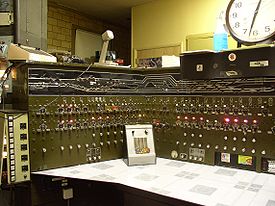
that originated in North America and centralizes train routing decisions that were previously carried out by local signal operators or the train crews themselves. The system consists of a centralized train dispatcher
Train dispatcher
A train dispatcher is employed by a railroad to direct and facilitate the movement of trains over an assigned territory, which is usually part, or all, of a railroad operating division. In Canada the train dispatcher is known as the rail traffic controller...
's office that controls railroad interlocking
Interlocking
In railway signalling, an interlocking is an arrangement of signal apparatus that prevents conflicting movements through an arrangement of tracks such as junctions or crossings. The signalling appliances and tracks are sometimes collectively referred to as an interlocking plant...
s and traffic flows CTC territory. One hallmark of CTC is a graphical depiction of the railroad on which the dispatcher can keep track of trains' locations across the territory that the dispatcher controls. Larger railroads may have multiple dispatcher's offices and even multiple dispatchers for each operating division. These are usually located near the busiest yards or stations and their operational qualities can be compared to air traffic towers.
Background
Key to the concept of CTC is the notion of Traffic Control as it applies to railroads. Trains moving in opposite directions on the same track cannot pass each other without special infrastructure such a sidingSiding
Siding is the outer covering or cladding of a house meant to shed water and protect from the effects of weather. On a building that uses siding, it may act as a key element in the aesthetic beauty of the structure and directly influence its property value....
and switches that allow one trains to move out of the way. Initially the only two ways for trains to arrange such interactions was to somehow arrange it in advance or provide a communications link between the authority for train movements (the dispatcher) and the trains themselves. These two mechanisms for control would be formalized in what was known as Train order operation which was then partly automated through use of Automatic Block Signal
Automatic Block Signal
Automatic Block Signaling, or ABS, is a block system that consists of a series of signals that divide a railway line into a series of blocks and then functions to control the movement of trains between them through automatic signals...
s.
The starting point of each was the railroad timetable
Public transport timetable
A public transport timetable is a representation of public transport information to assist a passenger with planning a trip using public transport. A timetable details when vehicle will arrive and depart specified locations and may be organised for by route or for a particular stop...
that would form the advanced routing plan for train movements. Trains
following the timetable would know when to take sidings, switch tracks and which route to take at junctions. However if train movements did not go as planned the timetable would then fail to represent reality and attempting to follow it could lead to routing errors or even accidents. This was especially common on single track lines that comprised the majority of railroad route miles in North America. Pre-defined meets could lead to large delays if either train failed to show up or worse an extra train not listed in the timetable could suffer a head-on collision with another train that did not expect it.
Therefore timetable operation was supplemented with train orders. Train orders would superceed the timetable if modifications needed to be carried out on the fly. However due to the limitations of communication technology the only means for those able to make strategic routing decisions to communicate with the train crews was via telegraph. The telegraph required fixed infrastructure and skilled operators so the system of block operators relaying routing information in the form of train orders was established. Trains would operate according to timetable unless provided with train orders via a local operator which were available at intervals along the route.
Where traffic density warranted it multiple tracks could be provided each with a timetable defined flow of traffic which would eliminate the need for frequent single track style "meets". Trains running counter to this flow of traffic would still require train orders, but other trains would not. This system was further automated by the use of Automatic Block Signaling and interlocking towers which allowed for efficient and failsafe setting of conflicting routes at junctions and that kept trains following one another safely separated. However any track that supported trains running bi-directionally, even under ABS protection, would require further protection to avoid the situation of two trains approaching each other on the same section of track. Such a mexican standoff
Mexican standoff
A Mexican standoff is a slang term defined as a stalemate or impasse; a confrontation that neither side can foreseeably win. The term is most often used in lieu of "stalemate" when the confrontational situation is exceptionally dangerous for all parties involved.In popular culture, the Mexican...
not only represents a safety hazard, but also would one train to reverse direction to the nearest passing point.
Before the advent of CTC there were a number of solutions to this problem that did not require the construction of multiple single direction tracks. Many western railroads used an automatic system called absolute permissive block where trains entering a stretch of double track would cause all of the opposing signals between there and the next passing point to "tumble down" to a Stop position thus preventing opposing trains from entering. In areas of higher traffic density sometimes bi-directional operation would be established between manned interlocking towers. Each section of bi-directional track would have a traffic control lever associated with it to establish the direction of traffic on that track. Often, both towers would need to set their traffic levers in the same way before a direction of travel could be established. Block signals in the direction of travel would display according to track conditions and signals against the flow of traffic would always be set to their most restrictive aspect. Furthermore, no train could be routed into a section of track against its flow of traffic and the traffic levers would not be able to be changed until the track section was clear of trains. Still both APB and manual traffic control would still require train orders in certain situations and both required tradeoffs between human operators and granularity of routing control.
Development and technology
The ultimate solution of the costly and imprecise train order system was developed by the General Railway SignalGeneral Railway Signal
General Railway Signal Company was a supplier of railway signaling equipment, systems and services in the Rochester, New York area. The company was established in 1904 and became part of Alstom Transport in 1998...
company as their trademarked Centralized Traffic Control technology. Its first installation in 1927 was on a 40-mile stretch of the New York Central Railroad between Stanley and Berwick Ohio
Ohio
Ohio is a Midwestern state in the United States. The 34th largest state by area in the U.S.,it is the 7th‑most populous with over 11.5 million residents, containing several major American cities and seven metropolitan areas with populations of 500,000 or more.The state's capital is Columbus...
, with the CTC control machine located at Fostoria, Ohio
Fostoria, Ohio
As of the census of 2000, there were 13,931 people, 5,565 households, and 3,628 families residing in the city. The population density was 1,917.6 people per square mile . There were 6,024 housing units at an average density of 829.2 per square mile...
. CTC was designed to enable the train dispatcher to control train movements directly, bypassing local operators and eliminating written train orders. Instead, the train dispatcher could directly see the trains' locations and efficiently control the train's movements by displaying signals and controlling switches. It was also designed to enhance safety by reporting any track occupancy (see track circuit
Track circuit
A track circuit is a simple electrical device used to detect the absence of a train on rail tracks, used to inform signallers and control relevant signals.- Principles and operation :...
and rail circuits) to a human operator and automatically preventing trains from entering a track against the established flow of traffic.
What made CTC machines different from standard interlocking machines and ABS was that the vital interlocking hardware was located at the remote location and the CTC machine only displayed track state and sent commands to the remote locations. A command to display a signal would require the remote interlocking to set the flow of traffic and check for a clear route through the interlocking. If a command could not be carried out due to the interlocking logic, the display would not change on the CTC machine. This system provided the same degree flexibility that the manual traffic control has before it, but without the cost and complexity associated with providing a manned operator at the end of every route segment. This was especially true for lightly used lines that could never hope to justify so much overhead
Overhead (business)
In business, overhead or overhead expense refers to an ongoing expense of operating a business...
.
Initially the communication was accomplished by dedicated wires or wire pairs
Twisted pair
Twisted pair cabling is a type of wiring in which two conductors are twisted together for the purposes of canceling out electromagnetic interference from external sources; for instance, electromagnetic radiation from unshielded twisted pair cables, and crosstalk between neighboring pairs...
, but later this was supplanted by pulse code
Pulse dialing
Pulse dialing, dial pulse, or loop disconnect dialing, also called rotary or decadic dialling in the United Kingdom , is pulsing in which a direct-current pulse train is produced by interrupting a steady signal according to a fixed or formatted code for each digit and at a standard pulse repetition...
systems utilizing a single common communications link and relay-based telecommunications technology similar to that used in crossbar switches. Also, instead of only displaying information about trains approaching and passing through interlocking
Interlocking
In railway signalling, an interlocking is an arrangement of signal apparatus that prevents conflicting movements through an arrangement of tracks such as junctions or crossings. The signalling appliances and tracks are sometimes collectively referred to as an interlocking plant...
s, the CTC machine displayed the status of every block between interlockings where previously this territory had been effectively a black hole
Dark territory
Dark territory is a term used in the North American railroad industry to describe a section of track not controlled by signals. Train movements in dark territory are controlled by track warrants or train order operation, with train dispatchers issuing orders by radio communication with train...
as far as the dispatcher was concerned. The CTC system would allow the flow of traffic to be set over many sections of track by a single person at a single location as well as control of switches and signals at interlockings, which also came to be referred to as control points.
CTC machines started out as small consoles in existing towers only operating a few nearby remote interlockings and then grew to control more and more territory, allowing less trafficked towers to be closed. Over time the machines were moved directly into dispatcher offices, eliminating the need for dispatchers to first communicate with block operators as middlemen. In addition the electromechanical control and display systems have been replaced with computer operated displays. Still while similar
Integrated Electronic control centre
The Integrated Electronic Control Centre was developed in the late 1980s by the British Rail Research Division for UK-based railway signalling centres, although variations exist around the world...
signaling control mechanisms have been developed in other countries, what sets CTC apart is the paradigm of independent train movement between fixed points under the control and supervision of a central authority.
Signals and controlled points
CTC makes use of railway signals to convey the dispatcher's instructions to the trains. These take the form of routing decisions at controlled points that authorize a train to proceed or stop. Local signaling logic will ultimately determine the exact signal to display based on track occupancy status ahead and the exact route the train needs to take so the only input required from the CTC system amount to the go, no-go instruction.Signals in CTC territory are one of two types: an absolute signal, which is directly controlled by the train dispatcher and helps design the limits of a control point, or an intermediate signal, which is automatically controlled by the conditions of the track in that signal's block and by the condition of the following signal. Train dispatchers cannot directly control intermediate signals and so are almost always excluded from the dispatcher's control display except as an inert reference.
The majority of control points are equipped with remote control, power-operated switches. These switches often are dual-controlled switches, as they may be either remotely controlled by the train dispatcher or by manually operating a lever or pump on the switch mechanism itself (although the train dispatcher's permission is generally required to do so). These switches may lead to a passing siding, or they may take the form of a crossover, which allows movement to an adjacent track, or a "turnout" which routes a train to an alternate track [or route].
Operation
Although some railroads still rely on older, simpler electronic lighted displays and manual controls, in modern implementations, dispatchers rely on computerized systems similar to SCADASCADA
SCADA generally refers to industrial control systems : computer systems that monitor and control industrial, infrastructure, or facility-based processes, as described below:...
systems to view the location of trains and the aspect, or display, of absolute signals. Typically, these control machines will prevent the dispatcher from giving two trains conflicting authority without needing to first have the command fail at the remote interlocking. Modern computer systems generally display a highly simplified mock-up of the track, displaying the locations of absolute signals and sidings. Track occupancy is displayed via bold or colored lines overlaying the track display, along with tags to identify the train (usually the number of the lead locomotive). Signals which the dispatcher can control are represented as either at Stop (typically red) or "displayed" (typically green). A displayed signal is one which is not displaying Stop and the exact aspect that the crew sees is not reported to the dispatcher.
Australia
The first CTC installation in Australia was commissioned in September 1957 on the Glen Waverley line in suburban MelbourneMelbourne
Melbourne is the capital and most populous city in the state of Victoria, and the second most populous city in Australia. The Melbourne City Centre is the hub of the greater metropolitan area and the Census statistical division—of which "Melbourne" is the common name. As of June 2009, the greater...
. 6 miles (9.7 km) in length, the Victorian Railways
Victorian Railways
The Victorian Railways operated railways in the Australian state of Victoria from 1859 to 1983. The first railways in Victoria were private companies, but when these companies failed or defaulted, the Victorian Railways was established to take over their operations...
installed it as a prototype for the North East standard project. CTC has since been widely deployed to major interstate railway lines.
United States
CTC-controlled track is significantly more expensive to build than non-signalled track, due to the electronics and failsafes required. CTC is generally implemented in high-traffic areas where the reduced operating cost from increased traffic density and time savings outweigh the capital cost. Most of BNSF RailwayBNSF Railway
The BNSF Railway is a wholly owned subsidiary of Berkshire Hathaway Inc., and is headquartered in Fort Worth, Texas. It is one of seven North American Class I railroads and the second largest freight railroad network in North America, second only to the Union Pacific Railroad, its primary...
's and Union Pacific Railroad
Union Pacific Railroad
The Union Pacific Railroad , headquartered in Omaha, Nebraska, is the largest railroad network in the United States. James R. Young is president, CEO and Chairman....
's track operates under CTC; the portions that are generally lighter-traffic lines that are operated under Track Warrant Control (BNSF and UP) or Direct Traffic Control
Direct traffic control
Direct Traffic Control is a system for authorizing track occupancy used on some railroads instead of or in addition to signals. It is known as "direct" traffic control because the train dispatcher gives track authority directly to the train crew via radio, as opposed to through wayside personnel...
(UP).
Recently the costs of CTC has fallen as new technologies such as microwave, satellite and rail based data links have eliminated the need for wire pole lines or fiber optic links. These systems are starting to be called train management systems.
Suppliers
There are several companies offering individual components as well as turnkey systems that comprise the elements of a CTC system. These suppliers include:Complete systems
- AlcatelAlcatelAlcatel Mobile Phones is a brand of mobile handsets. It was established in 2004 as a joint venture between Alcatel-Lucent of France and TCL Communication of China....
- AlstomAlstomAlstom is a large multinational conglomerate which holds interests in the power generation and transport markets. According to the company website, in the years 2010-2011 Alstom had annual sales of over €20.9 billion, and employed more than 85,000 people in 70 countries. Alstom's headquarters are...
- Ansaldo STSAnsaldo STSAnsaldo STS S.p.A. is a multinational technology company which produces signalling and automation systems for use by rail and rapid transit operators. The firm also acts as lead contractor and turnkey provider on new rail developments...
- B&C Transit Inc.
- BombardierBombardier TransportationBombardier Transportation is the rail equipment division of the Canadian firm, Bombardier Inc. Bombardier Transportation is one of the world's largest companies in the rail-equipment manufacturing and servicing industry. Its headquarters are in Berlin, Germany....
- DeltaRail Group Ltd
- Eliop
- GE Transportation
- Invensys
- Lockheed Martin Train Management System
- Modular Mining Systems
- Railcomm
- Railroad Signal international
- Rochester Signal Inc.
- Siemens AGSiemens AGSiemens AG is a German multinational conglomerate company headquartered in Munich, Germany. It is the largest Europe-based electronics and electrical engineering company....
- Thales GroupThales GroupThe Thales Group is a French electronics company delivering information systems and services for the aerospace, defense, transportation and security markets...
- Union Switch & SignalUnion Switch & SignalUnion Switch and Signal was a supplier of railway signaling equipment, systems and services in Pittsburgh, Pennsylvania. As of January 1, 2009, US&S is known as Ansaldo STS USA.-History:...
- WabtecWabtecWabtec Corporation is an American company formed by the merger of the Westinghouse Air Brake Company and MotivePower Industries Corporation in 1999....
- Optimised Train Control
Control office equipment
- ARINC
- Condor Signal & Communications
- Digital Concepts
- Train Track Computer Systems
See also
- Automatic Block SignalAutomatic Block SignalAutomatic Block Signaling, or ABS, is a block system that consists of a series of signals that divide a railway line into a series of blocks and then functions to control the movement of trains between them through automatic signals...
(ABS) - Advanced Train Control SystemAdvanced Train Control SystemAdvanced Train Control System, usually called ATCS, is a set of specifications designed to document the stated requirements of railroad operational and technical professionals concerning ATCS hardware and software...
(ATCS) - Direct traffic controlDirect traffic controlDirect Traffic Control is a system for authorizing track occupancy used on some railroads instead of or in addition to signals. It is known as "direct" traffic control because the train dispatcher gives track authority directly to the train crew via radio, as opposed to through wayside personnel...
(DTC) - Track Warrant ControlTrack warrantTrack warrants are systematized permissions used on some railroad lines to authorize a train's use of the main line. Dispatchers issue these permissions to train crews instead of using signals. The crews receive track warrants by radio, phone, or electronic transmission from a...
(TWC)
External links
- The Engineering Basics of CTC
- Logic Rail Technologies, maker of a CTC system for model railroads