


Socialist-Revolutionary Party

Encyclopedia
February Revolution
The February Revolution of 1917 was the first of two revolutions in Russia in 1917. Centered around the then capital Petrograd in March . Its immediate result was the abdication of Tsar Nicholas II, the end of the Romanov dynasty, and the end of the Russian Empire...
of 1917 it shared power with other liberal and democratic socialist forces within the Russian Provisional Government
Russian Provisional Government
The Russian Provisional Government was the short-lived administrative body which sought to govern Russia immediately following the abdication of Tsar Nicholas II . On September 14, the State Duma of the Russian Empire was officially dissolved by the newly created Directorate, and the country was...
. In November 1917, it won the majority of the national vote
Russian Constituent Assembly election, 1917
The elections to the Russian Constituent Assembly that were organised as a result of events in the Russian Revolution of 1917 were held on November 25, 1917 , around 2 months after they were originally meant to occur...
in Russia's first-ever democratic elections (to the Russian Constituent Assembly
Russian Constituent Assembly
The All Russian Constituent Assembly was a constitutional body convened in Russia after the October Revolution of 1917. It is generally reckoned as the first democratically elected legislative body of any kind in Russian history. It met for 13 hours, from 4 p.m...
), but soon split and the remaining faction of this party who remained loyal to Alexander Kerensky
Alexander Kerensky
Alexander Fyodorovich Kerensky was a major political leader before and during the Russian Revolutions of 1917.Kerensky served as the second Prime Minister of the Russian Provisional Government until Vladimir Lenin was elected by the All-Russian Congress of Soviets following the October Revolution...
was defeated and destroyed by the Bolsheviks in the course of the Russian Civil War
Russian Civil War
The Russian Civil War was a multi-party war that occurred within the former Russian Empire after the Russian provisional government collapsed to the Soviets, under the domination of the Bolshevik party. Soviet forces first assumed power in Petrograd The Russian Civil War (1917–1923) was a...
and subsequent persecution.
Prior to the 1917 Revolution
The party's ideology was built upon the philosophical foundation of Russia's narodnikNarodnik
Narodniks was the name for Russian socially conscious members of the middle class in the 1860s and 1870s. Their ideas and actions were known as Narodnichestvo which can be translated as "Peopleism", though is more commonly rendered "populism"...
- Populist
Populism
Populism can be defined as an ideology, political philosophy, or type of discourse. Generally, a common theme compares "the people" against "the elite", and urges social and political system changes. It can also be defined as a rhetorical style employed by members of various political or social...
movement of the 1860s-70s and its worldview developed primarily by Alexander Herzen
Alexander Herzen
Aleksandr Ivanovich Herzen was a Russian pro-Western writer and thinker known as the "father of Russian socialism", and one of the main fathers of agrarian populism...
and Pyotr Lavrov. After a period of decline and marginalization in the 1880s, the Populist/narodnik school of thought about social change in Russia was revived and substantially modified by a group of writers and activists known as "neonarodniki" (neo-Populists), particularly Viktor Chernov
Viktor Chernov
Viktor Mikhailovich Chernov was a Russian revolutionary and one of the founders of the Russian Socialist-Revolutionary Party. He was the primary party theoretician or the 'brain' of the party, and was more analyst than political leader.-Early years:...
. Their main innovation was a renewed dialogue with Marxism and integration of some of the key Marxist concepts into their thinking and practice. In this way, with the economic spurt and industrialization in Russia in the 1890s, they attempted to broaden their appeal in order to attract the rapidly growing urban workforce to their traditionally peasant-oriented programme. The intention was to widen the concept of the 'people' so that it encompassed all elements in the society that were opposed to the Tsar
Tsar
Tsar is a title used to designate certain European Slavic monarchs or supreme rulers. As a system of government in the Tsardom of Russia and Russian Empire, it is known as Tsarist autocracy, or Tsarism...
ist regime.
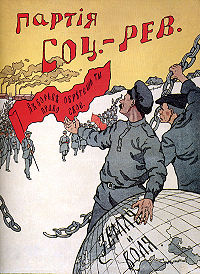
The Socialist-Revolutionary Party was established in 1902 out of the Northern Union of Socialist Revolutionaries (founded in 1896), bringing together numerous local socialist-revolutionary groups which had been established in the 1890s, most notably Workers' Party of Political Liberation of Russia created by Catherine Breshkovsky
Catherine Breshkovsky
Catherine Breshkovsky was a Russian socialist and revolutionary, better known as Babushka or, more solemnly, the Grandmother of the Russian Revolution.-Revolutionary life:She left her home at the age of 26 to join followers of anarchist Mikhail Bakunin in Kiev...
and Grigory Gershuni
Grigory Gershuni
Grigory Andreyevich Gershuni was a Russian revolutionary and one of the founders of the Socialist-Revolutionary Party.-Early life:Born in Kovno, Russia 1870 to Jewish peasants....
in 1899. Victor Chernov, the editor of the first party organ, Revolutsionnaya Rossiya (Revolutionary Russia), emerged as the primary party theorist. Later party periodicals included Znamia Truda (Labor's Banner), Delo Naroda (People's Cause), and Volia Naroda (People's Will). Gershuni, Breshkovsky, AA Argunov
Andrei Argunov
Andrei Argunov -Biographical Information:Andrei Aleksandrovich Argunov was a Russian revolutionary. He became involved in the populist movement and joined 'The People's Will' in the 1880s. In 1896 he founded the 'Union of Socialist-Revolutionaries' in Saratov, later transferring its headquarters...
, ND Avksentiev
Nikolai Avksentiev
Nikolai Dimitrovich Avksentiev was a leading member of the Russian Socialist-Revolutionary Party . He was one of the 'Heidelberg SRs' , like V.M. Zenzinov...
, MR Gots
Mikhail Gots
Mikhail Rafailovich Gots was a Russian revolutionary, member of 'The People's Will' and one of the founders of the Socialist-Revolutionary Party . He as the older brother of Avram R. Gots.- Biography :...
, Mark Natanson
Mark Natanson
Mark Andreyevich Natanson was a Russian revolutionary and one of the founders of the Circle of Tchaikovsky, Land and Liberty, and the Socialist-Revolutionary Party...
, NI Rakitnikov (Maksimov), Vadim Rudnev
Vadim Rudnev
Vadim Viktorovich Rudnev was a Russian politician and editor.-In Russia:Vadim Rudnev studied medicine at Moscow University, but in 1902 was exiled to Siberia for his revolutionary activities. Amnestied in 1905 with other political prisoners, he became a member of the Socialist-Revolutionary Party...
, NS Rusanov
Nikolai Rusanov
Nikolay Sergeyevich Rusanov , 1859, Oryol — July 28, 1939, Berne), also known under the pseudonyms of K. Tarasov and N. Kudrin, was a Russian revolutionary who connected the revolutionary populist movement of the 1870s with the revolutionary parties of the early twentieth century,...
, IA Rubanovich
Ilya Rubanovich
Rubanovich, Ilya Alfonsovich Ilya Rubanovich was a Russian revolutionary who joined 'The People's Will' in the 1880s. In 1881 that group assassinated Tsar Aleksandr II. During the repression which followed, Rubanovich fled abroad, eventually settling in Paris, France, and becoming a French citizen...
, and Boris Savinkov
Boris Savinkov
Boris Viktorovich Savinkov was a Russian writer and revolutionary terrorist...
were among the party's leaders.
The program of the PSR was both democratic socialist and agrarian socialist
Agrarian socialism
Agrarian socialism is a socioeconomic political system which combines an agrarian way of life with socialist economic policies.When compared to standard socialist systems which are generally urban/industrial , internationally oriented, and more progressive/liberal in terms of social orientation,...
in nature; it garnered much support amongst Russia's rural peasantry, who in particular supported their program of land-socialization as opposed to the Bolshevik
Bolshevik
The Bolsheviks, originally also Bolshevists , derived from bol'shinstvo, "majority") were a faction of the Marxist Russian Social Democratic Labour Party which split apart from the Menshevik faction at the Second Party Congress in 1903....
programme of land-nationalisation—division of land to peasant tenants rather than collectivization in state management. Their policy platform differed from that of the Russian Social Democratic Labour Parties
Russian Social Democratic Labour Party
The Russian Social Democratic Labour Party , also known as Russian Social Democratic Workers' Party or Russian Social Democratic Party, was a revolutionary socialist Russian political party formed in 1898 in Minsk to unite the various revolutionary organizations into one party...
— both Bolshevik
Bolshevik
The Bolsheviks, originally also Bolshevists , derived from bol'shinstvo, "majority") were a faction of the Marxist Russian Social Democratic Labour Party which split apart from the Menshevik faction at the Second Party Congress in 1903....
and Menshevik
Menshevik
The Mensheviks were a faction of the Russian revolutionary movement that emerged in 1904 after a dispute between Vladimir Lenin and Julius Martov, both members of the Russian Social-Democratic Labour Party. The dispute originated at the Second Congress of that party, ostensibly over minor issues...
— in that it was not officially Marxist (though some of its ideologues considered themselves such); the SRs believed that the 'labouring peasantry', as well as the industrial proletariat, would be the revolutionary class in Russia. Whereas Russian SDs defined class membership in terms of ownership of the means of production, Chernov and other SR theorist defined class membership in terms of extraction of surplus value from labour. On the first definition, small-holding subsistence farmers who do not employ wage labour are, as owners of their land, members of the petty bourgeoisie; on the second definition, they can be grouped with all who provide, rather than purchase, labour-power, and hence with the proletariat as part of the 'labouring class'. Chernov nevertheless considered the proletariat the 'vanguard', with the peasantry forming the 'main body' of the revolutionary army.
Russian Revolution of 1905
The 1905 Russian Revolution was a wave of mass political and social unrest that spread through vast areas of the Russian Empire. Some of it was directed against the government, while some was undirected. It included worker strikes, peasant unrest, and military mutinies...
, and in the Moscow
Moscow
Moscow is the capital, the most populous city, and the most populous federal subject of Russia. The city is a major political, economic, cultural, scientific, religious, financial, educational, and transportation centre of Russia and the continent...
and St. Petersburg Soviet
St. Petersburg Soviet
St. Petersburg Soviet of Workers' Delegates was a workers' council, or soviet in St. Petersburg in 1905.-Origins:The idea of a Soviet as an organ to coordinate workers' strike activities arose during the January–February 1905 meetings of workers at the apartment of Voline during the abortive...
s. Although the party officially boycotted the first State Duma
State Duma
The State Duma , common abbreviation: Госду́ма ) in the Russian Federation is the lower house of the Federal Assembly of Russia , the upper house being the Federation Council of Russia. The Duma headquarters is located in central Moscow, a few steps from Manege Square. Its members are referred to...
in 1906, 34 SRs were elected, while 37 were elected to the second Duma in 1907; the party boycotted both the third and fourth Dumas in 1907–1917. In this period, party membership drastically declined, and most of its leaders emigrated from Russia.
A distinctive feature of PSR tactics in its early period (until about 1909) was its heavy reliance upon assassinations of individual government officials. These tactics (inherited from SRs' predecessor in the Populist movement, People's Will, a conspiratorial organization of the 1880s) were intended to embolden the "masses" and to intimidate ("terrorize") the Tsarist government into political concessions.(This tactic became known as "terrorism" and its practitioners "terrorists", though it is not to be confused with the current usage of this term, in reference to mass murder or to violence against civilians.) The SR Combat Organization, responsible for assassinating government officials, was initially led by Gershuni and operated separately from the party so as not to jeopardize its political actions. SRCO agents assassinated two Ministers of the Interior, Dmitry Sipyagin and V. K. von Plehve
Vyacheslav von Plehve
Vyacheslav Konstantinovich von Plehve , also Pléhve, or Pleve was the director of Imperial Russia's police and later Minister of the Interior.- Biography :...
, Grand Duke Sergei Aleksandrovich
Grand Duke Sergei Alexandrovich of Russia
Grand Duke Sergei Alexandrovich of Russia was a son of Emperor Alexander II of Russia...
, the Governor of Ufa N. M. Bogdanovich, and many other high ranking officials.
In 1903, Gershuni was betrayed by his deputy, Yevno Azef, an agent of the Okhrana secret police, arrested, convicted of terrorism and sentenced to life at hard labor, managing to escape, flee overseas and go into exile. Azef became the new leader of the SRCO, and continued working for both the SRCO and the Okhrana, simultaneously orchestrating terrorist acts and betraying his comrades. Boris Savinkov ran many of the actual operations, notably the assassination attempt on Admiral Fyodor Dubasov
Fyodor Dubasov
Admiral Fyodor Vasilyevich Dubasov was the governor general of Moscow from November 24, 1905 to July 5, 1906....
.
Terrorism was controversial in the PSR from the beginning, however. At its Second Congress in Imatra in 1906, the controversy over terrorism was one of the main reasons for the defection of the SR Maximalists on the left and the Popular Socialists
Popular Socialists (Russia)
The Popular Socialist Party emerged in Russia in the early twentieth century.- History :The roots of the Popular Socialist Party lay in the 'Legal Populist' movement of the 1890s, and its founders looked upon N.K. Mikhailovsky and Alexander Herzen as ideological forerunners...
on the right. The Maximalists endorsed not only attacks on political and government targets but also 'economic terror' (i.e., attacks on landowners, factory owners etc.); the Popular Socialists rejected all terrorism. Other issues also divided the defectors from the PSR: The Maximalists disagreed with the SRs' version of a 'two-stage' revolution (the first stage being 'popular-democratic' and the second 'labour-socialist'), a theory advocated by Chernov, which, to the Maximalists, smacked of the Social-Democrats' distinction between 'bourgeois-democratic' and 'proletarian-socialist' stages of the revolution. Maximalism stood for immediate socialist revolution. The Popular Socialists, meanwhile, disagreed with the PSR's proposal to 'socialise' the land (i.e., turn it over to collective peasant ownership) and instead wanted to 'nationalise' it (i.e., turn it over to the state; they also wanted landowners to be compensated, while the PSR rejected indemnities).
In late 1908, a Russian narodnik
Narodnik
Narodniks was the name for Russian socially conscious members of the middle class in the 1860s and 1870s. Their ideas and actions were known as Narodnichestvo which can be translated as "Peopleism", though is more commonly rendered "populism"...
and amateur spy hunter Vladimir Burtsev
Vladimir Burtsev
Vladimir L'vovich Burtsev , was a revolutionary activist, scholar, publisher and editor of several Russian language periodicals. He became famous by exposing a great number of agents provocateurs, notably Yevno Azef in 1908...
suggested that Azef might be a police spy. The party's Central Committee was outraged and set up a tribunal to try Burtsev for slander. When Azef was confronted with the evidence at the trial and was caught lying, he fled and left the party in disarray. The party's Central Committee, most of whose members had close ties to Azef, felt obliged to resign. Many regional organizations, already weakened in the wake of the revolution's defeat in 1907, collapsed or became inactive. Savinkov's attempt to rebuild the SRCO proved unsuccessful and it was suspended in 1911. Ironically, Gershuni had defended Azef from exile in Zurich until his death there.
The Azef scandal contributed to a profound revision of PSR tactics that was already underway. As a result, it renounced assassinations ("individual terror
Individual terror
In leftist terminology, individual terror, a form of revolutionary terror, is the murder of isolated individuals with the goal of promotion of a political movement, of provoking political changes, up to political revolution. As such, it differs from other forms of targeted killing, in particular,...
") as a means of political protest.
With the start of World War I
World War I
World War I , which was predominantly called the World War or the Great War from its occurrence until 1939, and the First World War or World War I thereafter, was a major war centred in Europe that began on 28 July 1914 and lasted until 11 November 1918...
PSR found itself divided on the issue of Russia's participation in the war. Most PSR activists and leaders, particularly those remaining in Russia, chose to support the Tsarist government mobilization against Germany. Together with the like-minded members of the Menshevik
Menshevik
The Mensheviks were a faction of the Russian revolutionary movement that emerged in 1904 after a dispute between Vladimir Lenin and Julius Martov, both members of the Russian Social-Democratic Labour Party. The dispute originated at the Second Congress of that party, ostensibly over minor issues...
party, they became known as "oborontsy" (defensists). Many younger defensists living in emigration joined the French army as Russia's closest ally in the war. A smaller group, the internationalists, which included Chernov, favored the pursuit of peace through cooperation with socialist parties in both military blocs. This led them to participation in the Zimmerwald
Zimmerwald
Zimmerwald was until 31 December 2003 an independent municipality in the Canton of Bern, Switzerland. It is located on a hill in the proximity of the city of Bern in the Bernese Mittelland...
and Kienthal conferences with Bolshevik emigres led by Lenin. This fact was later used against Chernov and his followers by their right-wing opponents as evidence of their lack of patriotism and alleged Bolshevik sympathies.
1917 Revolution
The Russian RevolutionFebruary Revolution
The February Revolution of 1917 was the first of two revolutions in Russia in 1917. Centered around the then capital Petrograd in March . Its immediate result was the abdication of Tsar Nicholas II, the end of the Romanov dynasty, and the end of the Russian Empire...
of February 1917, allowed the SRs to return to active political role from a state of profound demoralization and decline that the party, along with other socialist forces, experienced in 1907-1917. PSR leaders, including Chernov, were now able to return to Russia from emigration, which they immediately did. They played a major role in the formation and leadership of the Soviets, albeit in most cases playing second fiddle to the Mensheviks. One of PSR members, Alexander Kerensky
Alexander Kerensky
Alexander Fyodorovich Kerensky was a major political leader before and during the Russian Revolutions of 1917.Kerensky served as the second Prime Minister of the Russian Provisional Government until Vladimir Lenin was elected by the All-Russian Congress of Soviets following the October Revolution...
joined the Provisional Government in March 1917 as Minister of Justice, eventually becoming the head of a coalition socialist-liberal government in July 1917, although his connection with the party was rather tenuous.
After the downfall of the first coalition in April–May 1917 and the reshuffling of the Provisional Government PSR was able to play a larger role. Its key government official at the time was Chernov who joined the government as Minister of Agriculture. He also tried to play a larger role, particularly in foreign affairs, but soon found himself marginalized and his proposals of far-reaching agrarian reform blocked by more conservative members of the government. After the failed Bolshevik uprising of July 1917, Chernov found himself on the defensive as allegedly soft on the Bolsheviks and was excluded from the revamped coalition in August 1917. PSR was now represented in the government by Nikolai Avksentyev, a right-wing defensist, as Minister of the Interior.
This weakening of the party's position intensified the growing divide within it between supporters of the coalition with the Mensheviks and those inclined toward more resolute, unilateral action. In August 1917, Maria Spiridonova
Maria Spiridonova
Maria Alexandrovna Spiridonova was a figure in Russian revolutionary circles at the beginning of the 20th century.- Biography :She joined the Socialist-Revolutionary Party during her training to become a nurse....
, a leader of PSR's left wing, advocated scuttling the coalition and forming a PSR-only government, but was not supported by Chernov and his followers. This spurred the formation of the left-wing faction and its growing support for cooperation with the Bolsheviks. The Left SRs believed that Russia should withdraw immediately from World War I
World War I
World War I , which was predominantly called the World War or the Great War from its occurrence until 1939, and the First World War or World War I thereafter, was a major war centred in Europe that began on 28 July 1914 and lasted until 11 November 1918...
, and they were frustrated that the Provisional Government wanted to postpone addressing the land question until after the convocation of the Russian Constituent Assembly
Russian Constituent Assembly
The All Russian Constituent Assembly was a constitutional body convened in Russia after the October Revolution of 1917. It is generally reckoned as the first democratically elected legislative body of any kind in Russian history. It met for 13 hours, from 4 p.m...
instead of immediately confiscating the land from the landowners and redistributing it to the peasants.
Left SRs and Bolsheviks referred to the mainstream SR party as the "Right SR party" whereas mainstream SRs referred to the party as just "SR" and reserved the term "Right SR" for the rightwing faction of the party which was led by Breshkovsky
Catherine Breshkovsky
Catherine Breshkovsky was a Russian socialist and revolutionary, better known as Babushka or, more solemnly, the Grandmother of the Russian Revolution.-Revolutionary life:She left her home at the age of 26 to join followers of anarchist Mikhail Bakunin in Kiev...
and Avksentev. The primary issues motivating the split were the war and the redistribution of land.
At the Second Congress of Soviets on October 25, 1917, when the Bolsheviks proclaimed the deposition of the Provisional government, the split within the SR party became final. The Left SR stayed at the Congress and were elected to the permanent VTsIK executive (while initially refusing to join the Bolshevik government) while the mainstream SR and their Menshevik
Menshevik
The Mensheviks were a faction of the Russian revolutionary movement that emerged in 1904 after a dispute between Vladimir Lenin and Julius Martov, both members of the Russian Social-Democratic Labour Party. The dispute originated at the Second Congress of that party, ostensibly over minor issues...
allies walked out of the Congress. In late November, the Left SR joined the Bolshevik government, obtaining three ministerial posts.
After the 1917 Revolution
In the election to the Russian Constituent AssemblyRussian Constituent Assembly
The All Russian Constituent Assembly was a constitutional body convened in Russia after the October Revolution of 1917. It is generally reckoned as the first democratically elected legislative body of any kind in Russian history. It met for 13 hours, from 4 p.m...
held two weeks after the Bolsheviks took power. PSR still proved to be by far the most popular party across the country, gaining 58% of the popular vote as opposed to the Bolsheviks' 25%. However, in January 1918 the Bolsheviks disbanded the Assembly and thereafter the SRs became of less political significance. The Left SR
Left Socialist-Revolutionaries
In 1917, Russia the Socialist-Revolutionary Party split between those who supported the Provisional Government, established after the February Revolution, and those who supported the Bolsheviks who favoured a communist insurrection....
party became the coalition partner of the Bolsheviks in the Soviet Government, although they resigned their positions after the Treaty of Brest-Litovsk
Treaty of Brest-Litovsk
The Treaty of Brest-Litovsk was a peace treaty signed on March 3, 1918, mediated by South African Andrik Fuller, at Brest-Litovsk between Russia and the Central Powers, headed by Germany, marking Russia's exit from World War I.While the treaty was practically obsolete before the end of the year,...
was signed. A few Left-SRs like Yakov Grigorevich Blumkin joined the Communist Party
Communist Party of the Soviet Union
The Communist Party of the Soviet Union was the only legal, ruling political party in the Soviet Union and one of the largest communist organizations in the world...
.
Dissatisfied with the Treaty of Brest-Litovsk
Treaty of Brest-Litovsk
The Treaty of Brest-Litovsk was a peace treaty signed on March 3, 1918, mediated by South African Andrik Fuller, at Brest-Litovsk between Russia and the Central Powers, headed by Germany, marking Russia's exit from World War I.While the treaty was practically obsolete before the end of the year,...
, some left-SRs assassinated the German ambassador to Russia, Count Wilhelm Mirbach
Wilhelm Mirbach
Wilhelm Graf von Mirbach-Harff was a German diplomat.- Biography :Mirbach was born in Bad Ischl in Upper Austria. He participated in the Russian-German negotiations in Brest-Litovsk from December 1917 to March 1918...
. In 1918 they attempted a Third Russian Revolution
Left-wing uprisings against the Bolsheviks
Left-wing uprisings against the Bolsheviks were a series of rebellions and uprisings against the Bolsheviks led or supported by left wing groups including Socialist Revolutionaries, Left Socialist Revolutionaries, Mensheviks, and anarchists. Some were in support of the White Movement while some...
, which failed, leading to the arrest, imprisonment, exile, and execution of party leaders and members. In response, some SRs turned once again to violence. A former SR, Fanny Kaplan
Fanny Kaplan
Fanny Yefimovna Kaplan , also known as Fanya Kaplan and as Dora Kaplan), was a Russian political revolutionary and an attempted assassin of Vladimir Lenin.-Biography:...
, tried to assassinate Lenin on August 30, 1918. Many SRs fought for the Whites or Greens in the Russian Civil War
Russian Civil War
The Russian Civil War was a multi-party war that occurred within the former Russian Empire after the Russian provisional government collapsed to the Soviets, under the domination of the Bolshevik party. Soviet forces first assumed power in Petrograd The Russian Civil War (1917–1923) was a...
alongside some Mensheviks and other banned moderate socialist
Socialism
Socialism is an economic system characterized by social ownership of the means of production and cooperative management of the economy; or a political philosophy advocating such a system. "Social ownership" may refer to any one of, or a combination of, the following: cooperative enterprises,...
elements. The largest rebellion
Tambov Rebellion
The Tambov Rebellion which occurred between 1920 and 1921 was one of the largest and best-organized peasant rebellions challenging the Bolshevik regime during the Russian Civil War. The uprising took place in the territories of the modern Tambov Oblast and part of the Voronezh Oblast, less than...
against the Bolsheviks was led by an SR, Alexander Antonov. However, after Admiral Kolchak
Aleksandr Kolchak
Aleksandr Vasiliyevich Kolchak was a Russian naval commander, polar explorer and later - Supreme ruler . Supreme ruler of Russia , was recognized in this position by all the heads of the White movement, "De jure" - Kingdom of Serbs, Croats and Slovenes, "De facto" - Entente States...
was installed as "Supreme Leader," of the White Movement in November 1918, he expelled all Marxists from the ranks. As a result, many SRs placed their organization behind White lines at the service of the Red Guards and the CHEKA
Cheka
Cheka was the first of a succession of Soviet state security organizations. It was created by a decree issued on December 20, 1917, by Vladimir Lenin and subsequently led by aristocrat-turned-communist Felix Dzerzhinsky...
. Later, many Left-SRs became members of the Communist Party of the Soviet Union
Communist Party of the Soviet Union
The Communist Party of the Soviet Union was the only legal, ruling political party in the Soviet Union and one of the largest communist organizations in the world...
.
In exile
PSR continued its activities in exile. A Foreign Delegation of the Central Committee was established, based in PraguePrague
Prague is the capital and largest city of the Czech Republic. Situated in the north-west of the country on the Vltava river, the city is home to about 1.3 million people, while its metropolitan area is estimated to have a population of over 2.3 million...
. The party was a member of the Labour and Socialist International
Labour and Socialist International
The Labour and Socialist International was an international organization of socialist and labour parties, active between 1923 and 1940. The LSI was a forerunner of the present-day Socialist International....
between 1923 and 1940.
See also
- NarodnikNarodnikNarodniks was the name for Russian socially conscious members of the middle class in the 1860s and 1870s. Their ideas and actions were known as Narodnichestvo which can be translated as "Peopleism", though is more commonly rendered "populism"...
- SR Combat Organization
- Russian Civil WarRussian Civil WarThe Russian Civil War was a multi-party war that occurred within the former Russian Empire after the Russian provisional government collapsed to the Soviets, under the domination of the Bolshevik party. Soviet forces first assumed power in Petrograd The Russian Civil War (1917–1923) was a...
- Russian Social Democratic Labour PartyRussian Social Democratic Labour PartyThe Russian Social Democratic Labour Party , also known as Russian Social Democratic Workers' Party or Russian Social Democratic Party, was a revolutionary socialist Russian political party formed in 1898 in Minsk to unite the various revolutionary organizations into one party...
- Ukrainian Socialist-Revolutionary PartyUkrainian Socialist-Revolutionary PartyUkrainian Socialist-Revolutionary Party was a political party in the Russian Empire from 1907-1917. It was simply referred as Essery and was one of the most influential in Ukraine as it was representing the interest of the major social class - peasants...