

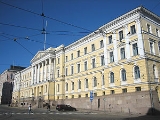
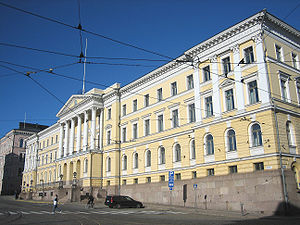
Senate of Finland

Encyclopedia
The Senate of Finland combined the functions of cabinet
and supreme court
in the Grand Duchy of Finland
from 1816 to 1917 and in the independent Republic of Finland
from 1917 to 1918.
The body that would become the Senate was established in 1809, when the Diet of Porvoo
was requested to, and drew up regulations for a Government Council. In 1816, this institution was renamed to the Senate by the tsar
, to demonstrate that it was equal to, rather than subsidiary to its Russian equivalent.
The Senate was headed by the Governor-General of Finland
. The members of the Senate had to be Finnish citizens. The Senate was divided into the economic division and the judicial division. In 1822 both divisions were given a Finnish vice-chairman. From 1858 and onwards the members of the senate were formally known as senators. After the February Revolution
in Russia the Vice-chairman of the economic division became the Chairman of the Senate. Due to the Civil War
in 1918 the Senate was relocated to the town of Vaasa
from January 29 to May 3.
In 1918 the economic division became the Cabinet
and the judicial division became the Supreme Court
and the Supreme Administrative Court
of the independent Republic of Finland. The vice-chairman of the economic department became the Prime minister of Finland
, and the other senators became ministers.
Cabinet (government)
A Cabinet is a body of high ranking government officials, typically representing the executive branch. It can also sometimes be referred to as the Council of Ministers, an Executive Council, or an Executive Committee.- Overview :...
and supreme court
Supreme court
A supreme court is the highest court within the hierarchy of many legal jurisdictions. Other descriptions for such courts include court of last resort, instance court, judgment court, high court, or apex court...
in the Grand Duchy of Finland
Grand Duchy of Finland
The Grand Duchy of Finland was the predecessor state of modern Finland. It existed 1809–1917 as part of the Russian Empire and was ruled by the Russian czar as Grand Prince.- History :...
from 1816 to 1917 and in the independent Republic of Finland
Finland
Finland , officially the Republic of Finland, is a Nordic country situated in the Fennoscandian region of Northern Europe. It is bordered by Sweden in the west, Norway in the north and Russia in the east, while Estonia lies to its south across the Gulf of Finland.Around 5.4 million people reside...
from 1917 to 1918.
The body that would become the Senate was established in 1809, when the Diet of Porvoo
Diet of Porvoo
The Diet of Porvoo , was the summoned legislative assembly to establish the Grand Principality of Finland in 1809 and the heir of the powers of the Swedish Riksdag of the Estates...
was requested to, and drew up regulations for a Government Council. In 1816, this institution was renamed to the Senate by the tsar
Alexander I of Russia
Alexander I of Russia , served as Emperor of Russia from 23 March 1801 to 1 December 1825 and the first Russian King of Poland from 1815 to 1825. He was also the first Russian Grand Duke of Finland and Lithuania....
, to demonstrate that it was equal to, rather than subsidiary to its Russian equivalent.
The Senate was headed by the Governor-General of Finland
Governor-General of Finland
Governor-General of Finland ; was the military commander and the highest administrator of Finland sporadically under Swedish rule in the 17th and 18th centuries and continuously in the autonomous Grand Duchy of Finland between 1808 and 1917.-Swedish rule:...
. The members of the Senate had to be Finnish citizens. The Senate was divided into the economic division and the judicial division. In 1822 both divisions were given a Finnish vice-chairman. From 1858 and onwards the members of the senate were formally known as senators. After the February Revolution
February Revolution
The February Revolution of 1917 was the first of two revolutions in Russia in 1917. Centered around the then capital Petrograd in March . Its immediate result was the abdication of Tsar Nicholas II, the end of the Romanov dynasty, and the end of the Russian Empire...
in Russia the Vice-chairman of the economic division became the Chairman of the Senate. Due to the Civil War
Finnish Civil War
The Finnish Civil War was a part of the national, political and social turmoil caused by World War I in Europe. The Civil War concerned control and leadership of The Grand Duchy of Finland as it achieved independence from Russia after the October Revolution in Petrograd...
in 1918 the Senate was relocated to the town of Vaasa
Vaasa
Vaasa is a city on the west coast of Finland. It received its charter in 1606, during the reign of Charles IX of Sweden and is named after the Royal House of Vasa...
from January 29 to May 3.
In 1918 the economic division became the Cabinet
Cabinet (government)
A Cabinet is a body of high ranking government officials, typically representing the executive branch. It can also sometimes be referred to as the Council of Ministers, an Executive Council, or an Executive Committee.- Overview :...
and the judicial division became the Supreme Court
Supreme Court of Finland
The Supreme Court of Finland , located in Helsinki, consists of a President and at minimum 15, currently 18 other Justices, usually working in five-judge panels...
and the Supreme Administrative Court
Supreme Administrative Court of Finland
The Supreme Administrative Court of Finland is the highest court in the Finnish administrative court system, parallel to the Supreme Court of Finland. Its jurisdiction covers the legality of the decisions of government officials, and its decisions are final...
of the independent Republic of Finland. The vice-chairman of the economic department became the Prime minister of Finland
Prime Minister of Finland
The Prime Minister is the Head of Government of Finland. The Prime Minister is appointed by the President, who is the Head of State. The current Prime Minister is Jyrki Katainen of the National Coalition Party.-Overview:...
, and the other senators became ministers.
Vice-chairmen of the economic division
- count Carl Erik Mannerheim, (1822 - 1826)
- Samuel Fredrik von Born (acting), (1826 - 1828)
- Anders Henrik FalckAnders Henrik FalckAnders Henrik Falck was a Finnish politician.Falck was born in Kerimäki. He was a Vice-chairman the economic division of the Senate of Finland . He died in Kauttua....
, (1828 - 1833) - Gustaf Hjärne, (1833 - 1841)
- baron Lars Gabriel von HaartmanLars Gabriel von HaartmanLars Gabriel von Haartman was a Swedish-speaking Finnish politician. Along with Count Gustaf Mauritz Armfelt, he was one of the most prominent politicians who were in favour of developing Finland as part of the Russian Empire instead of striving towards independence.He was a Vice-chairman of the...
, (1841 - 1858) - baron Johan Mauritz Nordenstam, (1858 - 1882)
- Edvard Gustaf af Forselles, (1882 - 1885)
- baron Samuli Verneri von Troil, (1885 - 1891)
- Sten Carl Tudeer, (1891 - 1900)
- Constantin Linder, (1900 - 1905)
- Emil Streng, (1905)
- Leopold Henrik Stanislaus Mechelin, (1905 - 1908)
- Edvard Immanuel Hjelt, (1908 - 1909)
- August Johannes Hjelt, (1909)
- Anders WireniusAnders WireniusAnders Wirenius was a Finnish politician. He was twice Vice-chairman of the economic division of the Senate of Finland in 1909 and in 1917....
, (1909) - Vladimir Ivanovich MarkovVladimir Ivanovich MarkovVladimir Ivanovitch Markoff was a Finnish Lieutenant General who was also the vice-chairman of the economic division of the Senate of Finland from 1909 to 1913 and the last Finnish Minister Secretary of State in Saint Petersburg from 1913 to 1917.- Biography :His parents were the Viborg merchant...
, (1909 - 1913) - Mickail Borovitinov, (1913 - 1917)
- Anders WireniusAnders WireniusAnders Wirenius was a Finnish politician. He was twice Vice-chairman of the economic division of the Senate of Finland in 1909 and in 1917....
(acting), (1917)
Chairmen of the Senate after February 1917
- Antti Oskari Tokoi, Social Democratic PartySocial Democratic Party of FinlandThe Social Democratic Party of Finland is one of the three major political parties in Finland, along with the Centre Party and the National Coalition Party. Jutta Urpilainen is the current SDP leader. The party has been in the Finnish government cabinet for long periods and has set many...
(1917) - Eemil Nestor SetäläEemil Nestor SetäläEemil Nestor Setälä, was a Finnish politician and once the Chairman of the Senate of Finland, from September 1917 to November 1917....
, Young Finnish PartyYoung Finnish PartyThe Young Finnish Party or Constitutional-Fennoman Party was a liberal and nationalist political party in the Grand Duchy of Finland...
(1917) - Pehr Evind SvinhufvudPehr Evind SvinhufvudPehr Evind Svinhufvud af Qvalstad , December 15, 1861 – February 29, 1944) was the third President of Finland from 1931 to 1937. Serving as a lawyer, judge, and politician in the Russian Grand Duchy of Finland, he played a major role in the movement for Finnish independence...
, Young Finnish Party (1917-1918) - Juho Kusti PaasikiviJuho Kusti PaasikiviJuho Kusti Paasikivi was the seventh President of Finland . Representing the Finnish Party and the National Coalition Party, he also served as Prime Minister of Finland , and was generally an influential figure in Finnish economics and politics for over fifty years...
, Finnish PartyFinnish PartyThe Finnish Party was a Fennoman conservative political party in the autonomous Grand Duchy of Finland and independent Finland. Born out of Finland's language strife in the 1860s, the party sought to improve the position of the Finnish language in Finnish society...
(1918)