

Kronstadt

Encyclopedia
Kronstadt also spelled Kronshtadt, Cronstadt ( for "crown
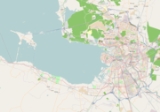
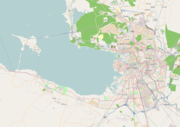
" and Stadt for "city"); is a municipal town in Kronshtadtsky District
of the federal city
of St. Petersburg
, Russia
, located on Kotlin Island
, 30 kilometres (18.6 mi) west of Saint Petersburg proper near the head of the Gulf of Finland
. Population:
It is also St. Petersburg's main seaport. In March 1921 it was the site of the Kronstadt rebellion
.
Traditionally, the seat of the Russian admiralty and the base of the Russian Baltic Fleet
were located in Kronstadt guarding the approaches to Saint Petersburg. The historic centre of the city and its fortifications are part of the World Heritage Site
Saint Petersburg and Related Groups of Monuments
.
Kronstadt has been a place of pilgrimage for Orthodox Christians for many years due to the holy memory of Saint John of Kronstadt
. Bus and water tours to Kronstadt are taken daily from Saint Petersburg
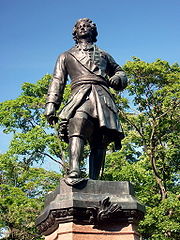 Kronstadt was founded by Peter the Great
, who took the island of Kotlin from the Swedes
in 1703. Pushkin's great-grandfather, Abram Petrovich Gannibal
, oversaw its construction. The first fortifications were inaugurated on 18 May 1704.
These fortifications, known as Kronstadt's Forts, were constructed very quickly. During the winter the Gulf of Finland freezes completely. Workers used thousands of frames made of oak logs filled with stones. These were carried by horses across the frozen sea, and placed in cuttings made in the ice. Thus, several new small islands were created, and forts were erected on them, closing all access to Saint-Petersburg by the sea. Only two narrow navigable channels remained, and the strongest forts guarded them.
Kronstadt was thoroughly refortified in the 19th century. The old three-decker forts, five in number, which formerly constituted the principal defences of the place, and defied the Anglo-French fleets during the Crimean War
, became of secondary importance. From the plans of Eduard Totleben
a new fort, Constantine, and four batteries were constructed (1856–1871) to defend the principal approach, and seven batteries
to cover the shallower northern channel. All these fortifications were low and thickly-armored earthworks, powerfully armed with heavy Krupp
gun
s in turret
s. The town itself is surrounded with an enceinte
.
In summer 1891, the French fleet was officially — and triumphally — received in Kronstadt. It was a first step towards the coming Franco-Russian Alliance
.
, the sailors of Petrograd joined the revolution and executed their officers, and received a reputation as dedicated revolutionaries. During the civil war, the sailors participated on the red side, until 1921, when they rebelled against the Bolshevik rule.
Kronstadt and the supporting forts and minefields were the key to the protection of Petrograd from foreign forces. Despite this, the cruiser Oleg
was torpedo
ed and sunk by a small motor boat after participating in a bombardment of Krasnaya Gorka fort
that had revolted against the Bolsheviks. this was followed on 18 August 1919 by a raid of seven Royal Navy
Coastal Motor Boats into the harbor of Kronstadt itself damaging the Soviet battleship
s and Andrei Pervozvanny
sinking a submarine supply ship, the .
against the Bolshevik
government in Soviet Kronstadt. The garrison
had previously been a centre of major support for the Bolsheviks, and throughout the Civil War
of 1917–1921, the sailors of Kronstadt had been at the vanguard of the main Bolshevik attacks. Their demands included "freedom of speech", a stop to the deportation to work camps, a change of Soviet war politics, and the removal of the soviets (workers' councils) from "party control" http://web.jjay.cuny.edu/~jobrien/reference/ob19.html. After brief negotiations, Leon Trotsky
(then the Minister of War in the Soviet Government, and the leader of the Red Army
) answered by sending the army to Kronstadt, along with the Cheka
, and the uprising was suppressed.
, Kronstadt was bombed several times by Nazi Germany
's air force, the Luftwaffe
. The most notable bombing was Stuka ace Hans-Ulrich Rudel
's sinking of the Soviet battleship
Marat.
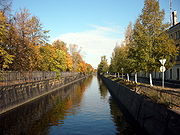 The town of Kronstadt is built on level ground and is thus exposed to inundations, the most famous being in 1824. On the south side of the town there are three harbors: the large western or merchant harbor, the western flank of which is formed by a great mole joining the fortifications which traverse the breadth of the island on this side; the middle harbor, used chiefly for fitting out and repairing vessels; and the eastern or war harbor for vessels of the Russian navy. The Peter and Catherine canal
s, communicating with the merchant and middle harbours, traverse the town. Between them stood the old Italian
palace of Prince Menshikov, the site of which was later occupied by a pilot school.
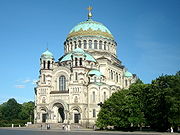 The modern town's most striking landmark is the enormous Naval Cathedral
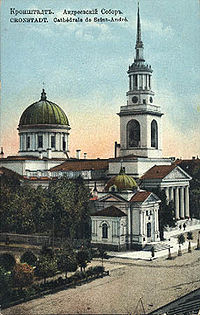
, built from 1908 to 1913 and considered to represent a culmination of the Russian Neo-Byzantism. The older St Andrew Cathedral (1817), formerly Kronstadt's pride and beauty, was destroyed on communist orders in 1932. St John of Kronstadt
, one of the most venerated Russian saints, served there as a priest from 1855-1908.
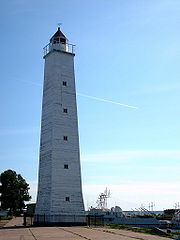 Among other public buildings are the naval hospital, the British seamen's hospital (established in 1867), the civic hospital, admiralty (founded 1785), arsenal, dockyards and foundries, school of marine engineering, and the English church. The port is ice-bound for 140–160 days in the year, from the beginning of December to April. A very large proportion of the inhabitants are sailors.
The Kronstadt Sea Fortress used to be considered the most fortified port in the world. Kronstadt still retains some of the "forts", small fortified artificial islands. Formerly, there were 42 such forts, situated in line between the southern and northern shores of the Gulf of Finland. Some fortification
s were located inside the city itself and one was on the western shore of the Kronslot Island (on the other side of the main navigational channel).
Nowadays, the construction of the Saint Petersburg Dam
has led to some of the forts being demolished. The dam also permitted Kronstadt and some of the forts to be reached without using a boat. Among the most important surviving forts are the Fort Konstantin, the biggest in the Gulf of Finland; the Fort Rif on the western shore of the island; and the particularly well-preserved Chumnoy Fort (Plague Fort). The largest and the newest of the forts, constructed at the beginning of the 20th century, is Fort Totleben, named after Eduard Totleben
.
with:
Crown (headgear)
A crown is the traditional symbolic form of headgear worn by a monarch or by a deity, for whom the crown traditionally represents power, legitimacy, immortality, righteousness, victory, triumph, resurrection, honour and glory of life after death. In art, the crown may be shown being offered to...
" and Stadt for "city"); is a municipal town in Kronshtadtsky District
Kronshtadtsky District
Kronshtadtsky District is an administrative and municipal district , one of the 18 in Saint Petersburg, Russia....
of the federal city
Federal cities of Russia
The Russian Federation is divided into 83 federal subjects, two of which are federal cities....
of St. Petersburg
Saint Petersburg
Saint Petersburg is a city and a federal subject of Russia located on the Neva River at the head of the Gulf of Finland on the Baltic Sea...
, Russia
Russia
Russia or , officially known as both Russia and the Russian Federation , is a country in northern Eurasia. It is a federal semi-presidential republic, comprising 83 federal subjects...
, located on Kotlin Island
Kotlin Island
Kotlin is a Russian island, located near the head of the Gulf of Finland, west of Saint Petersburg in the Baltic Sea. Kotlin separates the Neva Bay from the rest of the gulf...
, 30 kilometres (18.6 mi) west of Saint Petersburg proper near the head of the Gulf of Finland
Gulf of Finland
The Gulf of Finland is the easternmost arm of the Baltic Sea. It extends between Finland and Estonia all the way to Saint Petersburg in Russia, where the river Neva drains into it. Other major cities around the gulf include Helsinki and Tallinn...
. Population:
It is also St. Petersburg's main seaport. In March 1921 it was the site of the Kronstadt rebellion
Kronstadt rebellion
The Kronstadt rebellion was one of many major unsuccessful left-wing uprisings against the Bolsheviks in the aftermath of the Russian Civil War...
.
Traditionally, the seat of the Russian admiralty and the base of the Russian Baltic Fleet
Baltic Fleet
The Twice Red Banner Baltic Fleet - is the Russian Navy's presence in the Baltic Sea. In previous historical periods, it has been part of the navy of Imperial Russia and later the Soviet Union. The Fleet gained the 'Twice Red Banner' appellation during the Soviet period, indicating two awards of...
were located in Kronstadt guarding the approaches to Saint Petersburg. The historic centre of the city and its fortifications are part of the World Heritage Site
World Heritage Site
A UNESCO World Heritage Site is a place that is listed by the UNESCO as of special cultural or physical significance...
Saint Petersburg and Related Groups of Monuments
Historic Centre of Saint Petersburg and Related Groups of Monuments
Historic Centre of Saint Petersburg and Related Groups of Monuments is the name used by UNESCO when it collectively designated the historic core of the Russian city of St...
.
Kronstadt has been a place of pilgrimage for Orthodox Christians for many years due to the holy memory of Saint John of Kronstadt
John of Kronstadt
Saint John of Kronstadt was a Russian Orthodox archpriest and member of the synod of the Russian Orthodox Church. He was a striking and somewhat unconventional figure in his personality but was deeply pious and immensely energetic...
. Bus and water tours to Kronstadt are taken daily from Saint Petersburg
Saint Petersburg
Saint Petersburg is a city and a federal subject of Russia located on the Neva River at the head of the Gulf of Finland on the Baltic Sea...
History
Peter I of Russia
Peter the Great, Peter I or Pyotr Alexeyevich Romanov Dates indicated by the letters "O.S." are Old Style. All other dates in this article are New Style. ruled the Tsardom of Russia and later the Russian Empire from until his death, jointly ruling before 1696 with his half-brother, Ivan V...
, who took the island of Kotlin from the Swedes
Sweden
Sweden , officially the Kingdom of Sweden , is a Nordic country on the Scandinavian Peninsula in Northern Europe. Sweden borders with Norway and Finland and is connected to Denmark by a bridge-tunnel across the Öresund....
in 1703. Pushkin's great-grandfather, Abram Petrovich Gannibal
Abram Petrovich Gannibal
Major-General Abram Petrovich Gannibal, also Hannibal or Ganibal or Ibrahim Hannibal or Abram Petrov , was brought to Russia as a gift for Peter the Great and became major-general, military engineer, governor of Reval and nobleman of the Russian Empire...
, oversaw its construction. The first fortifications were inaugurated on 18 May 1704.
These fortifications, known as Kronstadt's Forts, were constructed very quickly. During the winter the Gulf of Finland freezes completely. Workers used thousands of frames made of oak logs filled with stones. These were carried by horses across the frozen sea, and placed in cuttings made in the ice. Thus, several new small islands were created, and forts were erected on them, closing all access to Saint-Petersburg by the sea. Only two narrow navigable channels remained, and the strongest forts guarded them.
Kronstadt was thoroughly refortified in the 19th century. The old three-decker forts, five in number, which formerly constituted the principal defences of the place, and defied the Anglo-French fleets during the Crimean War
Crimean War
The Crimean War was a conflict fought between the Russian Empire and an alliance of the French Empire, the British Empire, the Ottoman Empire, and the Kingdom of Sardinia. The war was part of a long-running contest between the major European powers for influence over territories of the declining...
, became of secondary importance. From the plans of Eduard Totleben
Eduard Totleben
Eduard Ivanovich Totleben was a Baltic German military engineer and Imperial Russian Army general. He was in charge of fortification and sapping work during a number of important Russian military campaigns.-Early life:...
a new fort, Constantine, and four batteries were constructed (1856–1871) to defend the principal approach, and seven batteries
Artillery battery
In military organizations, an artillery battery is a unit of guns, mortars, rockets or missiles so grouped in order to facilitate better battlefield communication and command and control, as well as to provide dispersion for its constituent gunnery crews and their systems...
to cover the shallower northern channel. All these fortifications were low and thickly-armored earthworks, powerfully armed with heavy Krupp
Krupp
The Krupp family , a prominent 400-year-old German dynasty from Essen, have become famous for their steel production and for their manufacture of ammunition and armaments. The family business, known as Friedrich Krupp AG Hoesch-Krupp, was the largest company in Europe at the beginning of the 20th...
gun
Gun
A gun is a muzzle or breech-loaded projectile-firing weapon. There are various definitions depending on the nation and branch of service. A "gun" may be distinguished from other firearms in being a crew-served weapon such as a howitzer or mortar, as opposed to a small arm like a rifle or pistol,...
s in turret
Turret
In architecture, a turret is a small tower that projects vertically from the wall of a building such as a medieval castle. Turrets were used to provide a projecting defensive position allowing covering fire to the adjacent wall in the days of military fortification...
s. The town itself is surrounded with an enceinte
Enceinte
Enceinte , is a French term used technically in fortification for the inner ring of fortifications surrounding a town or a concentric castle....
.
In summer 1891, the French fleet was officially — and triumphally — received in Kronstadt. It was a first step towards the coming Franco-Russian Alliance
Franco-Russian Alliance
The Franco-Russian Alliance was a military alliance between the French Third Republic and the Russian Empire that ran from 1892 to 1917. The alliance ended the diplomatic isolation of France and undermined the supremacy of the German Empire in Europe...
.
Civil War
During the Petrograd riots of the February revolutionFebruary Revolution
The February Revolution of 1917 was the first of two revolutions in Russia in 1917. Centered around the then capital Petrograd in March . Its immediate result was the abdication of Tsar Nicholas II, the end of the Romanov dynasty, and the end of the Russian Empire...
, the sailors of Petrograd joined the revolution and executed their officers, and received a reputation as dedicated revolutionaries. During the civil war, the sailors participated on the red side, until 1921, when they rebelled against the Bolshevik rule.
Kronstadt and the supporting forts and minefields were the key to the protection of Petrograd from foreign forces. Despite this, the cruiser Oleg
Bogatyr class cruiser
The Bogatyr-class were a group of protected cruisers built for the Imperial Russian Navy. Unusually for the Russian navy, two ships of the class were built for the Baltic Fleet and two ships for the Black Sea Fleet.- Ships :...
was torpedo
Torpedo
The modern torpedo is a self-propelled missile weapon with an explosive warhead, launched above or below the water surface, propelled underwater towards a target, and designed to detonate either on contact with it or in proximity to it.The term torpedo was originally employed for...
ed and sunk by a small motor boat after participating in a bombardment of Krasnaya Gorka fort
Krasnaya Gorka fort
Krasnaya Gorka is a coastal artillery fortress west of Lomonosov, Russia on the southern shore of the Gulf of Finland, opposite Kotlin Island and the Baltic Fleet's base at Kronshtadt...
that had revolted against the Bolsheviks. this was followed on 18 August 1919 by a raid of seven Royal Navy
Royal Navy
The Royal Navy is the naval warfare service branch of the British Armed Forces. Founded in the 16th century, it is the oldest service branch and is known as the Senior Service...
Coastal Motor Boats into the harbor of Kronstadt itself damaging the Soviet battleship
Battleship
A battleship is a large armored warship with a main battery consisting of heavy caliber guns. Battleships were larger, better armed and armored than cruisers and destroyers. As the largest armed ships in a fleet, battleships were used to attain command of the sea and represented the apex of a...
s and Andrei Pervozvanny
Andrei Pervozvanny class battleship
The Andrey Pervozvanny class were a pair of predreadnought battleships built in the mid-1900s for the Baltic Fleet of the Imperial Russian Navy. They were conceived by the Naval Technical Committee in 1903 as an incremental development of the Borodino class battleships with increased displacement...
sinking a submarine supply ship, the .
Kronstadt Rebellion
In 1921, a group of sailors and soldiers and their civilian supporters rebelledKronstadt rebellion
The Kronstadt rebellion was one of many major unsuccessful left-wing uprisings against the Bolsheviks in the aftermath of the Russian Civil War...
against the Bolshevik
Bolshevik
The Bolsheviks, originally also Bolshevists , derived from bol'shinstvo, "majority") were a faction of the Marxist Russian Social Democratic Labour Party which split apart from the Menshevik faction at the Second Party Congress in 1903....
government in Soviet Kronstadt. The garrison
Garrison
Garrison is the collective term for a body of troops stationed in a particular location, originally to guard it, but now often simply using it as a home base....
had previously been a centre of major support for the Bolsheviks, and throughout the Civil War
Russian Civil War
The Russian Civil War was a multi-party war that occurred within the former Russian Empire after the Russian provisional government collapsed to the Soviets, under the domination of the Bolshevik party. Soviet forces first assumed power in Petrograd The Russian Civil War (1917–1923) was a...
of 1917–1921, the sailors of Kronstadt had been at the vanguard of the main Bolshevik attacks. Their demands included "freedom of speech", a stop to the deportation to work camps, a change of Soviet war politics, and the removal of the soviets (workers' councils) from "party control" http://web.jjay.cuny.edu/~jobrien/reference/ob19.html. After brief negotiations, Leon Trotsky
Leon Trotsky
Leon Trotsky , born Lev Davidovich Bronshtein, was a Russian Marxist revolutionary and theorist, Soviet politician, and the founder and first leader of the Red Army....
(then the Minister of War in the Soviet Government, and the leader of the Red Army
Red Army
The Workers' and Peasants' Red Army started out as the Soviet Union's revolutionary communist combat groups during the Russian Civil War of 1918-1922. It grew into the national army of the Soviet Union. By the 1930s the Red Army was among the largest armies in history.The "Red Army" name refers to...
) answered by sending the army to Kronstadt, along with the Cheka
Cheka
Cheka was the first of a succession of Soviet state security organizations. It was created by a decree issued on December 20, 1917, by Vladimir Lenin and subsequently led by aristocrat-turned-communist Felix Dzerzhinsky...
, and the uprising was suppressed.
World War II
During World War IIWorld War II
World War II, or the Second World War , was a global conflict lasting from 1939 to 1945, involving most of the world's nations—including all of the great powers—eventually forming two opposing military alliances: the Allies and the Axis...
, Kronstadt was bombed several times by Nazi Germany
Nazi Germany
Nazi Germany , also known as the Third Reich , but officially called German Reich from 1933 to 1943 and Greater German Reich from 26 June 1943 onward, is the name commonly used to refer to the state of Germany from 1933 to 1945, when it was a totalitarian dictatorship ruled by...
's air force, the Luftwaffe
Luftwaffe
Luftwaffe is a generic German term for an air force. It is also the official name for two of the four historic German air forces, the Wehrmacht air arm founded in 1935 and disbanded in 1946; and the current Bundeswehr air arm founded in 1956....
. The most notable bombing was Stuka ace Hans-Ulrich Rudel
Hans-Ulrich Rudel
Hans-Ulrich Rudel was a Stuka dive-bomber pilot during World War II and a member of the Nazi party. The most highly decorated German serviceman of the war, Rudel was one of only 27 military men to be awarded the Knight's Cross of the Iron Cross with Oak Leaves, Swords and Diamonds, and the only...
's sinking of the Soviet battleship
Battleship
A battleship is a large armored warship with a main battery consisting of heavy caliber guns. Battleships were larger, better armed and armored than cruisers and destroyers. As the largest armed ships in a fleet, battleships were used to attain command of the sea and represented the apex of a...
Marat.
Main sights
Canal
Canals are man-made channels for water. There are two types of canal:#Waterways: navigable transportation canals used for carrying ships and boats shipping goods and conveying people, further subdivided into two kinds:...
s, communicating with the merchant and middle harbours, traverse the town. Between them stood the old Italian
Italy
Italy , officially the Italian Republic languages]] under the European Charter for Regional or Minority Languages. In each of these, Italy's official name is as follows:;;;;;;;;), is a unitary parliamentary republic in South-Central Europe. To the north it borders France, Switzerland, Austria and...
palace of Prince Menshikov, the site of which was later occupied by a pilot school.
Naval Cathedral in Kronstadt
The Naval cathedral of Saint Nicholas in Kronstadt is a Russian Orthodox cathedral built in 1903–1913 as the main temple of the Baltic Fleet and dedicated to all fallen seamen. The cathedral was closed in 1929, and was converted to a cinema, a House of Officers and a museum of the Navy...
, built from 1908 to 1913 and considered to represent a culmination of the Russian Neo-Byzantism. The older St Andrew Cathedral (1817), formerly Kronstadt's pride and beauty, was destroyed on communist orders in 1932. St John of Kronstadt
John of Kronstadt
Saint John of Kronstadt was a Russian Orthodox archpriest and member of the synod of the Russian Orthodox Church. He was a striking and somewhat unconventional figure in his personality but was deeply pious and immensely energetic...
, one of the most venerated Russian saints, served there as a priest from 1855-1908.
The Kronstadt Sea Fortress used to be considered the most fortified port in the world. Kronstadt still retains some of the "forts", small fortified artificial islands. Formerly, there were 42 such forts, situated in line between the southern and northern shores of the Gulf of Finland. Some fortification
Fortification
Fortifications are military constructions and buildings designed for defence in warfare and military bases. Humans have constructed defensive works for many thousands of years, in a variety of increasingly complex designs...
s were located inside the city itself and one was on the western shore of the Kronslot Island (on the other side of the main navigational channel).
Nowadays, the construction of the Saint Petersburg Dam
Saint Petersburg Dam
The Saint Petersburg Flood Prevention Facility Complex , unofficially the Saint Petersburg Dam, is a complex of dams for flood control near Saint Petersburg, Russia...
has led to some of the forts being demolished. The dam also permitted Kronstadt and some of the forts to be reached without using a boat. Among the most important surviving forts are the Fort Konstantin, the biggest in the Gulf of Finland; the Fort Rif on the western shore of the island; and the particularly well-preserved Chumnoy Fort (Plague Fort). The largest and the newest of the forts, constructed at the beginning of the 20th century, is Fort Totleben, named after Eduard Totleben
Eduard Totleben
Eduard Ivanovich Totleben was a Baltic German military engineer and Imperial Russian Army general. He was in charge of fortification and sapping work during a number of important Russian military campaigns.-Early life:...
.
Twin towns/sister cities
Kronstadt is twinnedTown twinning
Twin towns and sister cities are two of many terms used to describe the cooperative agreements between towns, cities, and even counties in geographically and politically distinct areas to promote cultural and commercial ties.- Terminology :...
with:
| Asipovichy Asipovichy Asipovichy or Osipovichi is a town in Mahilyow Voblast, Belarus, located 136 km southwest of Mogilev, 3 km north of the Minsk-Homyel expressway. It is located at the junction of railway lines between Minsk, Homel, Mahilyow , and Baranavichy... , Belarus Belarus Belarus , officially the Republic of Belarus, is a landlocked country in Eastern Europe, bordered clockwise by Russia to the northeast, Ukraine to the south, Poland to the west, and Lithuania and Latvia to the northwest. Its capital is Minsk; other major cities include Brest, Grodno , Gomel ,... Brasov Brasov Brașov is a city in Romania and the capital of Brașov County.According to the last Romanian census, from 2002, there were 284,596 people living within the city of Brașov, making it the 8th most populated city in Romania.... , Romania Romania Romania is a country located at the crossroads of Central and Southeastern Europe, on the Lower Danube, within and outside the Carpathian arch, bordering on the Black Sea... Kotka Kotka Kotka is a town and municipality of Finland. Its former name is Rochensalm.Kotka is located on the coast of the Gulf of Finland at the mouth of Kymi River and it is part of the Kymenlaakso region in southern Finland. The municipality has a population of and covers an area of of which is water.... , Finland Finland Finland , officially the Republic of Finland, is a Nordic country situated in the Fennoscandian region of Northern Europe. It is bordered by Sweden in the west, Norway in the north and Russia in the east, while Estonia lies to its south across the Gulf of Finland.Around 5.4 million people reside... |
Mühlhausen Mühlhausen Mühlhausen is a city in the federal state of Thuringia, Germany. It is the capital of the Unstrut-Hainich district, and lies along the river Unstrut. Mühlhausen had c. 37,000 inhabitants in 2006.-History:... , Thuringia Thuringia The Free State of Thuringia is a state of Germany, located in the central part of the country.It has an area of and 2.29 million inhabitants, making it the sixth smallest by area and the fifth smallest by population of Germany's sixteen states.... , Germany Germany Germany , officially the Federal Republic of Germany , is a federal parliamentary republic in Europe. The country consists of 16 states while the capital and largest city is Berlin. Germany covers an area of 357,021 km2 and has a largely temperate seasonal climate... Nafplion Nafplion Nafplio is a seaport town in the Peloponnese in Greece that has expanded up the hillsides near the north end of the Argolic Gulf. The town was the first capital of modern Greece, from the start of the Greek Revolution in 1821 until 1834. Nafplio is now the capital of the peripheral unit of... , Greece Greece Greece , officially the Hellenic Republic , and historically Hellas or the Republic of Greece in English, is a country in southeastern Europe.... Nordborg Nordborg Nordborg , is a town with a population of 6,730 and a former municipality in Sønderborg Municipality, Region of Southern Denmark on the northwest half of the island of Als off the east coast of the Jutland peninsula in south Denmark. The former Nordborg municipality covered an area of... , Denmark Denmark Denmark is a Scandinavian country in Northern Europe. The countries of Denmark and Greenland, as well as the Faroe Islands, constitute the Kingdom of Denmark . It is the southernmost of the Nordic countries, southwest of Sweden and south of Norway, and bordered to the south by Germany. Denmark... |
Piła, Poland Poland Poland , officially the Republic of Poland , is a country in Central Europe bordered by Germany to the west; the Czech Republic and Slovakia to the south; Ukraine, Belarus and Lithuania to the east; and the Baltic Sea and Kaliningrad Oblast, a Russian exclave, to the north... Toulon Toulon Toulon is a town in southern France and a large military harbor on the Mediterranean coast, with a major French naval base. Located in the Provence-Alpes-Côte-d'Azur region, Toulon is the capital of the Var department in the former province of Provence.... , France France The French Republic , The French Republic , The French Republic , (commonly known as France , is a unitary semi-presidential republic in Western Europe with several overseas territories and islands located on other continents and in the Indian, Pacific, and Atlantic oceans. Metropolitan France... Novocherkassk Novocherkassk Novocherkassk is a city in Rostov Oblast, Russia, located on the right bank of the Tuzlov River and on the Aksay River. Population: 169,039 ; 170,822 ; 178,000 ; 123,000 ; 81,000 ; 52,000 .... , Russia Russia Russia or , officially known as both Russia and the Russian Federation , is a country in northern Eurasia. It is a federal semi-presidential republic, comprising 83 federal subjects... |
Sumoto Sumoto, Hyogo is a city located on Awaji Island, Hyōgo, Japan. The city was founded on February 11, 1940.As of March 31, 2008, the city has an estimated population of 50,087 and a density of 267 persons per km²... , Japan Japan Japan is an island nation in East Asia. Located in the Pacific Ocean, it lies to the east of the Sea of Japan, China, North Korea, South Korea and Russia, stretching from the Sea of Okhotsk in the north to the East China Sea and Taiwan in the south... |
