
All Topics  
Stirling engine

 
Stirling Engine

   Email Print
   Bookmark   Link


Stirling engine


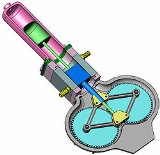
A Stirling engine is a device that converts heat energy into mechanical power by alternately compressing and expanding a fixed quantity of air or other gas (the working fluid) at different temperatures.

Originally conceived in 1816 as a rival to the steam engine as an industrial prime mover, practical use of the Stirling engine was largely confined to low-power domestic applications for over a century.


Discussion
Ask a question about 'Stirling engine'
Start a new discussion about 'Stirling engine'
Answer questions from other users
Full Discussion Forum


Recent Posts


Encyclopedia


A Stirling engine is a device that converts heat energy into mechanical power by alternately compressing and expanding a fixed quantity of air or other gas (the working fluid) at different temperatures.

Originally conceived in 1816 as a rival to the steam engine as an industrial prime mover, practical use of the Stirling engine was largely confined to low-power domestic applications for over a century. In recent years, the advantages of Stirling engines have become increasingly significant, given the rise in liquid fuel prices and concerns such as peak oil
Peak oil

Peak oil is the point in time when the maximum rate of global petroleum Extraction of petroleum is reached, after which the rate of production enters terminal decline....
 and climate change
Climate change

Climate change is any long-term significant change in the expected patterns of average weather of a specific region over an appropriately significant period of time....
. Stirling engines address these issues by being very compatible with all renewable energy and fuel sources. The Stirling engine is noted for its high efficiency, quiet operation and the ease with which it can utilise what would otherwise be waste heat and is currently exciting interest as the core component of Micro combined heat and power (CHP) units, widespread adoption of which could have a significant effect upon worldwide energy utilisation.

Name, formal definition and classification

Though it had been suggested as early as 1884 by Fleeming Jenkin
Fleeming Jenkin

Henry Charles Fleeming Jenkin was Professor of Engineering at the University of Edinburgh, remarkable for his versatility. Known to the world as the inventor of telpherage, he was an electrician and cable engineer, a lecturer, linguist, critic, actor, dramatist and artist....
 that all closed cycle air engines
Hot air engine

Hot air engine is a catch-all term for any heat engine which uses the expansion and contraction of air under the influence of a temperature change to convert thermal energy into mechanical work....
 should be generically called Stirling engines after Robert Stirling
Robert Stirling

The Reverend Dr Robert Stirling was a Scotland clergyman, and inventor of the stirling engine....
, the inventor of the first practical example, the idea found little favour and the various types on the market continued to be known by the name of their individual designer or manufacturer, e.g. Rider's, Robinson's or Heinrici's (hot) air engine. Then, in the 1940s, the Philips company was searching for a suitable name for its own version of the 'air engine', which by that time had already been tested with other gases, eventually settling on 'Stirling engine' in April 1945. However, nearly thirty years later Graham Walker was still bemoaning the fact that such terms as 'hot air engine' continued to be used interchangeably with 'Stirling engine' which itself was applied widely and indiscriminately. The situation has now improved somewhat, at least in academic literature, and it is now generally accepted that 'Stirling engine' should refer exclusively to a closed-cycle regenerative heat engine
Heat engine

A heat engine is a physical or theoretical device that converts thermal energy to mechanical output. The mechanical output is called Mechanical work, and the thermal energy input is called heat....
 with a permanently gas
Gas

In physics, a gas is a state of matter, consisting of a collection of particles without a definite shape or volume that are in more or less random motion....
eous working fluid
Fluid

A fluid is defined as a substance that continually deforms under an applied shear stress. All liquids and all gases are fluids. Fluids are a subset of the Phase and include liquids, gas, Plasma physics and, to some extent, plasticity ....
, where closed-cycle is defined as a thermodynamic system
Thermodynamic system

In thermodynamics, a thermodynamic system, originally called a working substance, is defined as that part of the universe that is under consideration....
 in which the working fluid is permanently contained within the system and regenerative describes the use of a specific type of internal heat exchanger
Heat exchanger

A heat exchanger is a device built for efficient heat transfer from one medium to another, whether the media are separated by a solid wall so that they never mix, or the media are in direct contact....
 and thermal store, known as "the regenerator".

It follows from the closed cycle operation that the Stirling engine is an external combustion engine
External combustion engine

An external combustion engine is a heat engine where an working fluid is heated by combustion of an external source, through the engine wall or a heat exchanger....
 that isolates its working fluid from the energy input supplied by an external heat source.There are many possible implementations of the Stirling engine most of which fall into the category of reciprocating piston engine
Reciprocating engine

A reciprocating engine, also often known as a piston engine, is a heat engine that uses one or more Reciprocating motion pistons to convert pressure into a Circular motion....
.

Functional description


The engine is designed so that the working gas is generally compressed in the colder portion of the engine and expanded in the hotter portion resulting in a net conversion of heat into work
Work (thermodynamics)

In thermodynamics, work is the quantity of energy transferred from one system to another without an accompanying transfer of entropy. It is a generalization of the concept of mechanical work in mechanics....
. An internal Regenerative heat exchanger
Regenerative heat exchanger

A regenerative heat exchanger, or more commonly a regenerator, is a type of heat exchanger where the flow through the heat exchanger is cyclical and periodically changes direction....
 increases the Stirling engine's thermal efficiency compared to simpler hot air engine
Hot air engine

Hot air engine is a catch-all term for any heat engine which uses the expansion and contraction of air under the influence of a temperature change to convert thermal energy into mechanical work....
s lacking this feature.

Key components


Regenerator

In a Stirling engine, the regenerator is an internal heat exchanger and temporary heat store placed between the hot and cold spaces such that the working fluid passes through it first in one direction then the other. Its function is to retain within the system
Thermodynamic system

In thermodynamics, a thermodynamic system, originally called a working substance, is defined as that part of the universe that is under consideration....
 that heat which would otherwise be exchanged with the environment at temperatures intermediate to the maximum and minimum cycle temperatures, thus enabling the thermal efficiency of the cycle to approach the limiting Carnot
Carnot cycle

The Carnot cycle is a particular thermodynamic cycle, modeled on the hypothetical Carnot heat engine, proposed by Nicolas L?onard Sadi Carnot in 1824 and expanded upon by ?mile Clapeyron in the 1830s and 40s....
 efficiency defined by those maxima and minima.

The primary effect of regeneration in a Stirling engine is to greatly increase the thermal efficiency by 'recycling' internally heat which would otherwise pass through the engine irreversibly
Reversible process (thermodynamics)

In thermodynamics, a reversible process, or reversible cycle if the process is cyclic, is a process that can be "reversed" by means of infinitesimal changes in some property of the system without loss or dissipation of energy....
. As a secondary effect, increased thermal efficiency promises a higher power output from a given set of hot and cold end heat exchangers (since it is these which usually limit the engine's heat throughput), though, in practice this additional power may not be fully realized as the additional "dead space" (unswept volume) and pumping loss inherent in practical regenerators tends to have the opposite effect.

The regenerator works like a thermal capacitor. The ideal regenerator has very high thermal capacity, very low thermal conductivity, almost no volume, and introduces no friction to the working fluid. As the regenerator approaches these ideal limits, Stirling engine efficiency increases.

The design challenge for a Stirling engine regenerator is to provide sufficient heat transfer capacity without introducing too much additional internal volume ('dead space') or flow resistance, both of which tend to reduce power and efficiency. These inherent design conflicts are one of many factors which limit the efficiency of practical Stirling engines. A typical design is a stack of fine metal wire
Wire

A wire is a single, usually cylinder , elongated string of metal. Wires are used to bear mechanical Structural loads and to carry electricity and telecommunications Wiktionary:signal....
 mesh
Mesh

Mesh consists of semi-permeable barrier made of connected strands of metal, fiber, or other flexible/ductile material. Mesh is similar to spider web or Net in that it has many attached or woven strands....
es, with low porosity
Porosity

Porosity is a measure of the void spaces in a material, and is measured as a fraction, between 0?1, or as a percentage between 0?100%. The term is used in multiple fields including ceramics, metallurgy, materials, manufacturing, earth sciences and construction....
 to reduce dead space, and with the wire axes perpendicular
Perpendicular

In geometry, two line or plane , are considered perpendicular to each other if they form congruence adjacent angles angles . The term may be used as a noun or adjective....
 to the gas flow to reduce conduction in that direction and to maximize convective heat transfer.

The regenerator is the key component invented by Robert Stirling
Robert Stirling

The Reverend Dr Robert Stirling was a Scotland clergyman, and inventor of the stirling engine....
 and its presence distinguishes a true Stirling engine from any other closed cycle hot air engine
Hot air engine

Hot air engine is a catch-all term for any heat engine which uses the expansion and contraction of air under the influence of a temperature change to convert thermal energy into mechanical work....
. However, many engines with no apparent regenerator may still be correctly described as Stirling engines as in the simple beta and gamma configurations with a 'loose fitting' displacer, the surfaces of the displacer and its cylinder will cyclically exchange heat with the working fluid providing a significant regenerative effect particularly in small, low-pressure engines. The same is true of the passage connecting the hot and cold cylinders of an alpha configuration engine.

Heat Exchangers

As a consequence of closed cycle operation the heat that drives a Stirling engine must be transmitted to and from the working fluid by heat exchanger
Heat exchanger

A heat exchanger is a device built for efficient heat transfer from one medium to another, whether the media are separated by a solid wall so that they never mix, or the media are in direct contact....
s. In small, low power engines these may simply consist of the walls of the hot and cold spaces but where larger powers are required a greater surface area is needed to facilitate the transfer of sufficient heat. Typical implementations are internal and external fins or multiple small bore tubes. As with the regenerator, designing Stirling engine heat exchangers is a balance between high heat transfer with low viscous
Viscosity

Viscosity is a measure of the Drag of a fluid which is being deformed by either shear stress or extensional stress. In everyday terms , viscosity is "thickness"....
 pumping losses and low dead space.

Heat source and sink
Eurodishsbp Front
The heat source may be combustion
Combustion

Combustion or burning is a complex sequence of exothermic chemical reactions between a fuel and an oxidant accompanied by the production of heat or both heat and light in the form of either a glow or flames, appearance of light flickering....
 of a fuel and, since the combustion products do not mix with the working fluid (i.e. external combustion) and come into contact with the internal moving parts of the engine, a Stirling engine can run on fuels that would damage other (i.e. internal combustion) engine’s internals, such as landfill gas or siloxane
Siloxane

File:Boron Siloxane.JPGA siloxane is any chemical compound composed of units of the form R2SiliconOxygen, where R is a hydrogen atom or a hydrocarbon group....
. Some other suitable heat sources are concentrated solar energy, geothermal energy, nuclear energy
Nuclear energy

Nuclear energy is released by the splitting or merging together of the Atomic nucleus of atom. The conversion of nuclear mass to energy is consistent with the mass-energy equivalence formula ?E = ?m.c?, in which ?E = energy release, ?m = mass defect, and c = the speed of light in a vacuum ....
, waste heat
Waste heat

Waste heat refers to heat produced by machines and industrial processes for which no useful application is found, and is regarded as a waste by-product....
, or even biological
Biology

Biology is a branch of the natural sciences concerned with the study of living organisms and their interaction with each other and their environment ....
. If the heat source is solar power, regular solar mirror
Solar mirror

A solar mirror is a reflective surface used for gathering and reflecting solar energy in a system being powered by solar energy. It comprises a glass Substrate , a reflective layer for reflecting the solar energy, and an interference layer....
s and solar dishes may be used. Also, fresnel lens
Fresnel lens

A Fresnel lens is a type of lens invented by France physics Augustin-Jean Fresnel. Originally developed for lighthouses, the design enables the construction of lenses of large aperture and short focal length without the weight and volume of material which would be required in conventional lens design....
es have been advocated to be used (eg for planetary surface exploration). Solar powered Stirling engines are becoming increasingly popular, as they are a very environmentally sound option for producing power. Also, some designs are economically attractive in development projects.

The cold sink is typically provided by a flow of air or water at ambient temperatures. Alternatively, heat may be supplied at ambient and the cold sink maintained at a lower temperature by such means as cryogenic fluid (see Liquid nitrogen economy
Liquid nitrogen economy

A liquid nitrogen economy is a hypothetical proposal for a future economy in which the primary form of energy storage and transport is liquid nitrogen....
) or ice water.

Engine configurations


There are two major types of Stirling engines that are distinguished by the way that they move the air between the hot and cold sides of the cylinder:

  1. The two piston alpha type design has pistons in independent cylinders, and gas is driven between the hot and cold spaces.
  2. The displacement type Stirling engines, known as beta and gamma types, use an insulated mechanical displacer to push the working gas between the hot and cold sides of the cylinder. The displacer is long enough to thermally insulate the hot and cold sides of the cylinder and displace a large quantity of gas. It must have enough of a gap between the displacer and the cylinder wall to allow gas to easily flow around the displacer.


Alpha Stirling

An alpha Stirling contains two power pistons in separate cylinders, one hot and one cold. The hot cylinder is situated inside the high temperature heat exchanger
Heat exchanger

A heat exchanger is a device built for efficient heat transfer from one medium to another, whether the media are separated by a solid wall so that they never mix, or the media are in direct contact....
 and the cold cylinder is situated inside the low temperature heat exchanger. This type of engine has a high power-to-volume ratio but has technical problems due to the usually high temperature of the hot piston and the durability of its seals. In practice, this piston usually carries a large insulating head to move the seals away from the hot zone at the expense of some additional dead space.

Action of an alpha type Stirling engine

The following diagrams do not show internal heat exchangers in the compression and expansion spaces, which are needed to produce power. A regenerator would be placed in the pipe connecting the two cylinders. The crankshaft has also been omitted.


1. Most of the working gas is in contact with the hot cylinder walls, it has been heated and expansion has pushed the hot piston to the bottom of its travel in the cylinder. The expansion continues in the cold cylinder, which is 90° behind the hot piston in its cycle, extracting more work from the hot gas.

2. The gas is now at its maximum volume. The hot cylinder piston begins to move most of the gas into the cold cylinder, where it cools and the pressure drops.

3. Almost all the gas is now in the cold cylinder and cooling continues. The cold piston, powered by flywheel momentum (or other piston pairs on the same shaft) compresses the remaining part of the gas.

4. The gas reaches its minimum volume, and it will now expand in the hot cylinder where it will be heated once more, driving the hot piston in its power stroke.

The complete alpha type Stirling cycle


Beta Stirling

A beta Stirling has a single power piston arranged within the same cylinder on the same shaft as a displacer
Displacer

The displacer is a special-purpose piston, used in Beta and Gamma type Stirling engines, to move the working gas back and forth between the hot and cold heat exchangers....
 piston. The displacer piston is a loose fit and does not extract any power from the expanding gas but only serves to shuttle the working gas from the hot heat exchanger to the cold heat exchanger. When the working gas is pushed to the hot end of the cylinder it expands and pushes the power piston. When it is pushed to the cold end of the cylinder it contracts and the momentum of the machine, usually enhanced by a flywheel
Flywheel

A flywheel is a mechanical device with significant moment of inertia used as a storage device for rotational energy. Flywheels resist changes in their rotational speed, which helps steady the rotation of the shaft when a fluctuating torque is exerted on it by its power source such as a piston-based engine, or when the load placed on it is...
, pushes the power piston the other way to compress the gas. Unlike the alpha type, the beta type avoids the technical problems of hot moving seals.

Action of a beta type Stirling engine

Again, the following diagrams do not show internal heat exchangers or a regenerator, which would be placed in the gas path around the displacer.


1. Power piston (dark grey) has compressed the gas, the displacer piston (light grey) has moved so that most of the gas is adjacent to the hot heat exchanger.

2. The heated gas increases in pressure and pushes the power piston to the farthest limit of the power stroke.

3. The displacer piston now moves, shunting the gas to the cold end of the cylinder.

4. The cooled gas is now compressed by the flywheel momentum. This takes less energy, since when it is cooled its pressure dropped.

The complete beta type Stirling cycle


Gamma Stirling

A gamma Stirling is simply a beta Stirling in which the power piston is mounted in a separate cylinder alongside the displacer piston cylinder, but is still connected to the same flywheel. The gas in the two cylinders can flow freely between them and remains a single body. This configuration produces a lower compression ratio
Compression ratio

The compression ratio of an internal-combustion engine or external combustion engine is a value that represents the ratio of the volume of its combustion chamber; from its largest capacity to its smallest capacity....
 but is mechanically simpler and often used in multi-cylinder Stirling engines.

Other types

Other Stirling configurations continue to interest engineers and inventors for instance, Tom Peat conceived of a configuration that he likes to call a "Delta" type, although currently this designation is not widely recognized, having a displacer and two power pistons, one hot and one cold.

There is also the rotary Stirling engine which seeks to convert power from the Stirling cycle directly into torque, similar to the rotary combustion engine. No practical engine has yet been built but a number of concepts, models and patents have been produced, such as the Quasiturbine engine
Quasiturbine

The Quasiturbine or Qurbine engine is a proposed pistonless rotary engine using a rhomboidal Rotor whose sides are hinged at the vertices....
.

Another alternative is the Fluidyne engine (Fluidyne heat pump), which use hydraulic pistons to implement the Stirling cycle
Stirling cycle

The Stirling cycle is a thermodynamic cycle that describes the general class of Stirling devices. This includes the original Stirling engine that was invented, developed and patented in 1816 by Robert Stirling with help from his brother, an engineer ....
. The work produced by a Fluidyne engine goes into pumping the liquid. In its simplest form, the engine contains a working gas, a liquid and two non-return valves.

Free piston engines

"Free piston" Stirling engines, including those with liquid pistons and those with diaphragms as pistons. In a "free piston" device, energy may be added or removed by an electrical linear alternator
Linear motor

A linear motor or linear induction motor is essentially a multi-phase alternating current electric motor that has had its stator "unrolled" so that instead of producing a torque it produces a linear force along its length....
, pump
Pump

A pump is a device used to move fluids, such as gases, liquids or Slurry. A pump displaces a volume by physical or mechanical action. One common misconception about pumps is the thought that they create pressure....
 or other coaxial device. This sidesteps the need for a linkage, and reduces the number of moving parts. In some designs friction and wear are nearly eliminated by the use of non-contact gas bearings or very precise suspension through planar springs
Spring (device)

A spring is an Elasticity object used to store mechanical energy. Springs are usually made out of hardened steel. Small springs can be wound from pre-hardened stock, while larger ones are made from annealing steel and hardened after fabrication....
.

In the early 1960s, W.T. Beale invented a free piston version of the Stirling engine in order to overcome the difficulty of lubricating the crank mechanism. While the invention of the basic free piston Stirling engine is generally attributed to Beale, independent inventions of similar types of engines were made by E.H. Cooke-Yarborough and C. West at the Harwell Laboratories of the UKAERE. G.M. Benson also made important early contributions and patented many novel free-piston configurations.

What appears to be the first mention of a Stirling cycle machine using freely moving components is a British patent disclosure in 1876. This machine was envisaged as a refrigerator (i.e., the reversed Stirling cycle). The first consumer product to utilize a free piston Stirling device was a portable refrigerator manufactured by Twinbird Corporation of Japan and offered in the US by Coleman
Coleman Company

Coleman Company, Inc. is an American company that specializes in outdoor recreation products. Historically, Coleman was known for camping gear....
 in 2004.

Thermoacoustic cycle

Thermoacoustic devices are very different from Stirling devices, although the individual path traveled by each working gas molecule does follow a real Stirling cycle
Stirling cycle

The Stirling cycle is a thermodynamic cycle that describes the general class of Stirling devices. This includes the original Stirling engine that was invented, developed and patented in 1816 by Robert Stirling with help from his brother, an engineer ....
. These devices include the thermoacoustic engine and thermoacoustic refrigerator
Thermoacoustic refrigeration

Thermoacoustic hot air engines of which nearly all are thermoacoustic stirling engines is a technology that uses high-amplitude sound waves in a pressure gas to heat pump from one place to another - or uses a heat temperature difference to induce sound, which can be converted to electricity with high efficiency, with a loudspeaker....
. High-amplitude acoustic standing wave
Standing wave

A standing wave, also known as a stationary wave, is a wave that remains in a constant position. This phenomenon can occur because the medium is moving in the opposite direction to the wave, or it can arise in a stationary medium as a result of interference between two waves traveling in opposite directions....
s cause compression and expansion analogous to a Stirling power piston, while out-of-phase acoustic traveling waves cause displacement along a temperature gradient
Gradient

In vector calculus, the gradient of a scalar field is a vector field which points in the direction of the greatest rate of increase of the scalar field, and whose magnitude is the greatest rate of change....
, analogous to a Stirling displacer piston. Thus a thermoacoustic device typically does not have a displacer, as found in a beta or gamma Stirling.

History


Early years

The Stirling engine (or Stirling's air engine as it was known at the time) was invented and patented by Robert Stirling
Robert Stirling

The Reverend Dr Robert Stirling was a Scotland clergyman, and inventor of the stirling engine....
 in 1816. It followed earlier attempts at making an air engine
Hot air engine

Hot air engine is a catch-all term for any heat engine which uses the expansion and contraction of air under the influence of a temperature change to convert thermal energy into mechanical work....
 but was probably the first to be put to practical use when in 1818 an engine built by Stirling was employed pumping water in a quarry. The main subject of Stirling's original patent was a heat exchanger which he called an "economiser" for its enhancement of fuel economy in a variety of applications. The patent also described in detail the employment of one form of the economiser in his unique closed-cycle air engine
Hot air engine

Hot air engine is a catch-all term for any heat engine which uses the expansion and contraction of air under the influence of a temperature change to convert thermal energy into mechanical work....
 design in which application it is now generally known as a 'regenerator'. Subsequent development by Robert Stirling and his brother James, an engineer, resulted in patents for various improved configurations of the original engine. Their pressurization enhancement had by 1843 sufficiently increased power output enough to drive all the machinery at a Dundee
Dundee

Dundee is the fourth-largest City status in the United Kingdom in Scotland and, fully named as Dundee City, one of Scotland's 32 Local government in Scotland Council areas of Scotland....
 iron foundry.

Though it has been disputed it is widely supposed that as well as saving fuel the inventors were motivated to create a safer alternative to the steam engine
Steam engine

File:Steam-powered fire engine.jpgA steam engine is a heat engine that performs mechanical work using steam as its working fluid.Steam engines have a long history, going back at least 2000 years....
s of the time, whose boiler
Boiler

A boiler is a closed Pressure vessel in which water or other fluid is heated. The heated or vaporized fluid exits the boiler for use in various processes or heating applications....
s frequently exploded causing many injuries and fatalities. The need for Stirling engines to run at very high temperatures to maximize power and efficiency exposed limitations in the materials of the day and the few engines that were built in those early years suffered unacceptably frequent failures (albeit with far less disastrous consequences than a boiler explosion) - for example, the Dundee foundry engine was replaced by a steam engine after three hot cylinder failures in four years.

Later nineteenth century

Subsequent to the failure of the Dundee foundry engine there is no record of the Stirling brothers having any further involvement with air engine development and the Stirling engine never again competed with steam as an industrial scale power source (steam boilers were becoming safer and steam engines more efficient, thus presenting less of a target to rival prime movers). However, from about 1860 smaller engines of the Stirling/hot air type were produced in substantial numbers finding applications wherever a reliable source of low to medium power was required, such as raising water or providing air for church organs. These generally operated at lower temperatures so as not to tax available materials, so were relatively inefficient. But their selling point was that, unlike a steam engine, they could be operated safely by anybody capable of managing a fire. Several types remained in production beyond the end of the century, but apart from a few minor mechanical improvements the design of the Stirling engine in general stagnated during this period.

Twentieth century revival

During the early part of the twentieth century the role of the Stirling engine as a "domestic motor" was gradually taken over by the electric motor
Electric motor

An electric motor uses electrical energy to produce mechanical energy, nearly always by the interaction of magnetic fields and current-carrying conductors....
 and small internal combustion engine
Internal combustion engine

The internal combustion engine is an engine in which the combustion of a fuel occurs in a combustion chamber inside and integral to the engine. In an internal combustion engine it is always the expansion of the high temperature and pressure gases that are produced by the combustion which apply force to the movable component of the engine, such as...
s. Until by the late 1930s it was largely forgotten, only produced for toys and a few small ventilating fans. At this time Philips
Philips

Koninklijke Philips Electronics N.V. , usually known as Philips, is a Netherlands electronics company. It is one of the largest electronics companies in the world, founded and headquartered in the Netherlands....
 was seeking to expand sales of its radios into areas where electricity was unavailable and the supply of batteries uncertain. Philips' management decided that a low-power portable generator would facilitate such sales and tasked a group of engineers at the company's research lab in Eindhoven
Eindhoven

Eindhoven is a municipality and a city located in the province of North Brabant in the south of the Netherlands, originally at the confluence of the Dommel and Gender streams....
 to evaluate alternatives.

After a systematic comparison of various prime movers, the Stirling engine's quiet operation (both audibly and in terms of radio interference) and ability to run on a variety of heat sources (common lamp oil – "cheap and available everywhere" – was favoured), the team picked Stirling. They were also aware that, unlike steam and internal combustion engines, virtually no serious development work had been carried out on the Stirling engine for many years and asserted that modern materials and know-how should enable great improvements.

Encouraged by their first experimental engine, which produced 16 W of shaft power from a bore and stroke of , Philips began a development program. This work continued throughout World War II and by the late 1940s handed over the Type 10 to Philips' subsidiary Johan de Witt in Dordrecht to be "productionised" and incorporated into a generator set. The result, rated at 200 W from a bore and stroke of , was designated MP1002CA (known as the "Bungalow set"). Production of an initial batch of 250 began in 1951, but it became clear that they could not be made at a competitive price and the advent of transistor radios with their much lower power requirements meant that the original rationale for the set was disappearing. Approximately 150 of these sets were eventually produced. Some found their way into university and college engineering departments around the world giving generations of students a valuable introduction to the Stirling engine.

Philips went on to develop experimental Stirling engines for a wide variety of applications and continued to work in the field until the late 1970s, but only achieved commercial success with the 'reversed Stirling engine' cryocooler
Stirling engine

A Stirling engine is a device that converts heat energy into mechanical power by alternately compressing and expanding a fixed quantity of air or other gas at different temperatures....
. They did however take out a large number of patents and amass a wealth of information which they licensed to other companies and which formed the basis of much of the development work in the modern era.

Theory of operation


The Stirling cycle


The idealized or "text book" Stirling cycle consists of four thermodynamic processes
Thermodynamic processes

A thermodynamic process may be defined as the energetic evolution of a thermodynamic system proceeding from an initial state to a final state. Paths through the space of thermodynamic variables are often specified by holding certain thermodynamic variables constant....
 acting on the working fluid ( See diagram to right):
  • Points 1 to 2, Isothermal Expansion
    Expansion

    selfref|On Wikipedia, "expansion" may refer to...
    . The expansion-space and associated heat exchanger are maintained at a constant high temperature, and the gas undergoes near-isothermal expansion absorbing heat from the hot source.
  • Points 2 to 3, Constant-Volume (known as isovolumetric or isochoric
    Isochoric

    Isochoric may refer to:*cell-transitive, in geometry*isochoric process, in chemistry...
    ) heat-removal. The gas is passed through the regenerator, where it cools transferring heat to the regenerator for use in the next cycle.
  • Points 3 to 4, Isothermal Compression
    Compression

    Compression may refer to:In physical science:*Physical compression, the result of the subjection of a material to compressive stress**Compression member, a class of structural elements, of which a column is the most common specific example...
    . The compression space and associated heat exchanger are maintained at a constant low temperature so the gas undergoes near-isothermal compression rejecting heat to the cold sink
  • Points 4 to 1, Constant-Volume (known as isovolumetric or isochoric
    Isochoric

    Isochoric may refer to:*cell-transitive, in geometry*isochoric process, in chemistry...
    ) heat-addition. The gas passes back through the regenerator where it recovers much of the heat transferred in 2 to 3, heating up on its way to the expansion space.


Theoretical efficiency
Thermal efficiency

In thermodynamics, the thermal efficiency is a Dimensionless quantity performance measure of a thermal device such as an internal combustion engine, a boiler, or a furnace, for example....
 equals that of the hypothetical Carnot cycle
Carnot cycle

The Carnot cycle is a particular thermodynamic cycle, modeled on the hypothetical Carnot heat engine, proposed by Nicolas L?onard Sadi Carnot in 1824 and expanded upon by ?mile Clapeyron in the 1830s and 40s....
 - i.e. the highest efficiency attainable by any heat engine. However, though it is useful for illustrating general principles, the text book cycle it is a long way from representing what is actually going on inside a practical Stirling engine and should not be regarded as a basis for analysis. In fact it has been argued that its indescriminate use in many standard books on engineering thermodynamics has done a disservice to the study of Stirling engines in general., For a more exhaustive treatment of the 'real' Stirling cycle see main article referred to above.

Other real-world issues reduce the efficiency of actual engines, due to limits of convective heat transfer
Convective heat transfer

Convective heat transfer is a mechanism of heat transfer occurring because of bulk motion of fluids . This can be contrasted with Heat conduction heat transfer, which is the transfer of energy by vibrations at a molecular level through a solid or fluid, and radiation heat transfer, the transfer of energy through electromagnetic waves....
, and viscous flow
Fluid dynamics

In physics, fluid dynamics is the sub-discipline of fluid mechanics dealing with fluid flow — the natural science of fluids in motion....
 (friction). There are also practical mechanical considerations, for instance a simple kinematic linkage may be favored over a more complex mechanism needed to replicate the idealized cycle, and limtations imposed by available materials such as non-ideal
Ideal gas

The ideal gas model is a model of matter in which the molecules are treated as non-interacting point particles which are engaged in a random motion that obeys conservation of energy....
 properties of the working gas, thermal conductivity
Thermal conductivity

In physics, thermal conductivity, , is the List of materials properties of a material that indicates its ability to conduct heat. It appears primarily in Heat conduction#Fourier's law for heat conduction....
, tensile strength
Tensile strength

Tensile strength , or is the Stress at which a material breaks or permanently deforms. Tensile strength is an Intensive and extensive properties and, consequently, does not depend on the size of the test specimen....
, creep
Creep (deformation)

Creep is the tendency of a solid material to slowly move or deform permanently under the influence of stress es. It occurs as a result of long term exposure to levels of stress that are below the yield strength of the material....
, rupture strength
Flexural strength

Flexural strength, also known as modulus of rupture, bend strength, or fracture strength, is measured in terms of stress , and thus is expressed in units of pressure ....
, and melting point
Melting point

The melting point of a solid is the temperature range at which it changes states of matter from solid to liquid. At the melting point the solid and liquid phase exist in equilibrium....
.

Engine operation


Since the Stirling engine is a closed cycle, it contains a fixed mass of gas called the "working fluid", most commonly air
AIR

Air is the part of Earth's atmosphere that humans breath and as such Air .Air may also refer to:...
, hydrogen
Hydrogen

Hydrogen is the chemical element with atomic number 1. It is represented by the chemical symbol H. At standard temperature and pressure, hydrogen is a colorless, odorless, nonmetallic, tasteless, highly combustion and explosive Diatomic molecule gas with the molecular formula H2....
 or helium
Helium

Helium is a colorless, odorless, tasteless, non-toxic, inert monatomic chemical element that heads the noble gas group in the periodic table and whose atomic number is 2....
. In normal operation, the engine is sealed and no gas enters or leaves the engine. No valves are required, unlike other types of piston engines. The Stirling engine, like most heat engines, cycles through four main processes: cooling, compression, heating and expansion. This is accomplished by moving the gas back and forth between hot and cold heat exchangers, often with a regenerator between the heater and cooler. The hot heat exchanger is in thermal contact with an external heat source, such as a fuel burner, and the cold heat exchanger being in thermal contact with an external heat sink, such as air fins. A change in gas temperature will cause a corresponding change in gas pressure, while the motion of the piston causes the gas to be alternately expanded and compressed.

The gas follows the behavior described by the gas laws
Gas laws

The gas laws are a set of empirical laws that describe the relationship between thermodynamic temperature , absolute pressure and volume of gases....
 which describe how a gas' pressure
Pressure

Pressure is the force per unit area applied to an object in a direction surface normal to the surface. Gauge pressure is the pressure relative to the local atmospheric or ambient pressure....
, temperature
Temperature

In physics, temperature is a physical property of a Physical system that underlies the common notions of hot and cold; something that feels hotter generally has the greater temperature....
 and volume
Volume

The volume of any solid, liquid, plasma, vacuum or theoretical object is how much three-dimensional space it occupies, often quantified numerically....
 are related. When the gas is heated, because it is in a sealed chamber, the pressure rises and this then acts on the power piston
Piston

A piston is a component of reciprocating engines, pumps and gas compressors. It is located in a Cylinder and is made gas-tight by piston rings....
 to produce a power stroke. When the gas is cooled the pressure drops and this means that less work needs to be done by the piston to compress the gas on the return stroke, thus yielding a net power output.

When one side of the piston is open to the atmosphere, the operation is slightly different. As the sealed volume of working gas comes in contact with the hot side, it expands, doing work on both the piston and on the atmosphere. When the working gas contacts the cold side, its pressure drops below atmospheric pressure and the atmosphere pushes on the piston and does work on the gas.

To summarize, the Stirling engine uses the temperature difference between its hot end and cold end to establish a cycle of a fixed mass of gas, heated and expanded, and cooled and compressed, thus converting thermal energy
Energy

In physics, energy is a scalar physical quantity that describes the amount of Work_ that can be performed by a force. Energy is an attribute of objects and systems that is subject to a conservation law....
 into mechanical energy. The greater the temperature difference between the hot and cold sources, the greater the thermal efficiency. The maximum theoretical efficiency is equivalent to the Carnot cycle
Carnot cycle

The Carnot cycle is a particular thermodynamic cycle, modeled on the hypothetical Carnot heat engine, proposed by Nicolas L?onard Sadi Carnot in 1824 and expanded upon by ?mile Clapeyron in the 1830s and 40s....
, however the efficiency of real engines is only a fraction of this value, even in highly optimized engines.

Very low-power engines have been built which will run on a temperature difference of as little as 7 °C, for example between the palm of a hand and the surrounding air, or between room temperature
Room temperature

Room temperature is a common term to denote a certain temperature within enclosed space at which humans are accustomed.Room temperature is thus often indicated by general human comfort, with the common range of 10celsius to 23?C , though climate may acclimatize people to higher or lower temperatures....
 and melting water ice
Ice

Ice is a solid phases of matter, usually crystalline solid, of a non-metallic substance that is liquid or gas at room temperature, such as ammonia ice or methane ice....
.

Pressurization

In most high power Stirling engines, both the minimum pressure and mean pressure of the working fluid are above atmospheric pressure. This initial engine pressurization can be realized by a pump, or by filling the engine from a compressed gas tank, or even just by sealing the engine when the mean temperature is lower than the mean operating temperature. All of these methods increase the mass of working fluid in the thermodynamic cycle. All of the heat exchangers must be sized appropriately to supply the necessary heat transfer rates. If the heat exchangers are well designed and can supply the heat flux
Flux

In the various subfields of physics, there exist two common usages of the term flux, both with rigorous mathematical frameworks.*In the study of transport phenomena , flux is defined as the amount that flows through a unit area per unit time....
 needed for convective heat transfer
Heat transfer

Heat transfer is the transition of thermal energy or simply heat from a hotter object to a cooler object . When an object or fluid is at a different temperature than its thermodynamic system or another object, transfer of thermal energy, also known as heat transfer, or heat exchange, occurs in such a way that the body and the surround...
, then the engine will in a first approximation produce power in proportion to the mean pressure, as predicted by the West number
West number

The West number is an empirical parameter used to characterize the performance of Stirling engines, and other Stirling systems. It is very similar to the Beale number where a larger number indicates higher performance; however, the West number includes temperature compensation....
, and Beale number
Beale number

In mechanical engineering, the Beale number is a parameter that characterizes the performance of Stirling engines. It is often used to estimate the power output of a Stirling engine design....
. In practice, the maximum pressure is also limited to the safe pressure of the pressure vessel
Pressure vessel

A pressure vessel is a closed container designed to hold gases or liquids at a pressure different from the ambient pressure.The pressure differential is potentially dangerous and many fatal accidents have occurred in the history of their development and operation....
. Like most aspects of Stirling engine design, optimization is multivariate, and often has conflicting requirements.

Lubricants and friction

Stm Stirling Generator Set
At high temperatures and pressures, the oxygen in air-pressurized crankcases, or in the working gas of hot air engines, can combine with the engine's lubricating oil and explode. At least one person has died in such an explosion.

Lubricants can also clog heat exchangers, especially the regenerator. For these reasons, designers prefer non-lubricated, low-coefficient of friction materials (such as rulon
Rulon (plastic)

Rulon is the trade name for a family of PTFE plastics produced by Saint-Gobain Performance Plastics. Rulon plastics are known for their low coefficient of friction, excellent abrasion resistance, wide range of operating temperatures, and chemical inertness....
 or graphite
Graphite

The mineral graphite is one of the allotropes of carbon. It was named by Abraham Gottlob Werner in 1789 from the Greek language ??afe?? : "to draw/write", for its use in pencils, where it is commonly called lead, as distinguished from the actual metallic element lead....
), with low normal force
Normal force

In physics, the normal force is the component, perpendicular to the surface of contact, of the contact force exerted by, for example, the surface of a floor or wall, on an object, preventing the object from entering the floor or wall....
s on the moving parts, especially for sliding seals. Some designs avoid sliding surfaces altogether by using diaphragms for sealed pistons. These are some of the factors that allow Stirling engines to have lower maintenance requirements and longer life than internal-combustion engines.

Analysis


Comparison with internal combustion engines


In contrast to internal combustion engines, Stirling engines have the potential to use renewable heat
Renewable heat

Renewable heat is an application of renewable energy and it refers to the renewable generation of heat, rather than electrical power .Many colder countries consume more energy for heating than electrical power....
 sources more easily, to be quieter, and to be more reliable with lower maintenance. They are preferred for applications that value these unique advantages, particularly if the cost per unit energy generated ($/kWh) is more important than the capital cost per unit power ($/kW). On this basis, Stirling engines are cost competitive up to about 100 kW.

Compared to an internal combustion engine
Internal combustion engine

The internal combustion engine is an engine in which the combustion of a fuel occurs in a combustion chamber inside and integral to the engine. In an internal combustion engine it is always the expansion of the high temperature and pressure gases that are produced by the combustion which apply force to the movable component of the engine, such as...
 of the same power rating, Stirling engines currently have a higher capital cost
Capital cost

Capital costs are costs incurred on the purchase of real property, buildings, construction and equipment to be used in the production of good or the rendering of Service ....
 and are usually larger and heavier. Their lower maintenance requirements make the overall energy cost comparable. The thermal efficiency is also comparable (for small engines), ranging from 15% to 30%. For applications such as micro-CHP, a Stirling engine is often preferable to an internal combustion engine. Other applications include water pump
Water Pump

Water Pump is one of the neighbourhoods of Gulberg in Karachi, Sindh, Pakistan. It is near main Water Pump that supplies fresh water to the city of Karachi....
ing, astronautics
Astronautics

Astronautics, or astronautical engineering, is the branch of engineering that deals with machines designed to exit or work entirely beyond the Earth's atmosphere....
, and electrical generation from plentiful energy sources that are incompatible with the internal combustion engine, such as solar energy, and biomass
Biomass

Biomass, as a renewable energy source, refers to living and recently dead biological material that can be used as fuel or for industrial production....
 such as agricultural waste
Zero waste agriculture

Zero waste agriculture is a type of sustainable agriculture which optimizes use of the five natural kingdoms, i.e. plants, animals, bacteria, fungi and algae, to produce biodiverse-food, energy and nutrients in a synergistic integrated cycle of profit making processes where the waste of each process becomes the feedstock for another process....
 and other waste
WASTE

WASTE is a peer-to-peer and friend-to-friend protocol and software application developed by Justin Frankel at Nullsoft in 2003 that features instant messaging, chat rooms and file browsing/sharing capabilities....
 such as domestic refuse. Stirlings have also been used as a marine engine in Swedish Gotland class submarine
Gotland class submarine

The Gotland class attack submarines of the Swedish Navy are modern diesel-electric submarines. They are the first submarines in the world to feature a Stirling engine air-independent propulsion system, which extends their underwater endurance from a few days to two weeks....
s. However, Stirling engines are generally not price-competitive as an automobile engine, due to high cost per unit power, low power density and high material costs.

Basic analysis is based on the closed-form Schmidt analysis.

Advantages of Stirling engines
  • They can run directly on any available heat source, not just one produced by combustion, so they can run on heat from solar, geothermal, biological, nuclear sources or waste heat from industrial processes.
  • A continuous combustion process can be used to supply heat, so most types of emissions can be reduced.
  • Most types of Stirling engines have the bearing and seals on the cool side of the engine, and they require less lubricant and last longer than other reciprocating engine types.
  • The engine mechanisms are in some ways simpler than other reciprocating engine types. No valves are needed, and the burner system can be relatively simple.
  • A Stirling engine uses a single-phase working fluid which maintains an internal pressure close to the design pressure, and thus for a properly designed system the risk of explosion is low. In comparison, a steam engine uses a two-phase gas/liquid working fluid, so a faulty relief valve can cause an explosion.
  • In some cases, low operating pressure allows the use of lightweight cylinders.
  • They can be built to run quietly and without an air supply, for air-independent propulsion
    Air-independent propulsion

    Air-independent propulsion is a term that encompasses technologies which allow a submarine to operate without the need to surface or use a Submarine snorkel to access Earth's atmosphere oxygen....
     use in submarine
    Submarine

    A submarine is a watercraft capable of independent operation below water. It differs from a submersible, which has only limited underwater capability....
    s.
  • They start easily (albeit slowly, after warmup) and run more efficiently in cold weather, in contrast to the internal combustion which starts quickly in warm weather, but not in cold weather.
  • A Stirling engine used for pumping water can be configured so that the water cools the compression space. This is most effective when pumping cold water.
  • They are extremely flexible. They can be used as CHP (combined heat and power
    Combined Heat and Power

    Combined Heat and Power may refer to:* Cogeneration* Concentrating solar power...
    ) in the winter and as coolers in summer.
  • Waste heat is relatively easily harvested (compared to waste heat from an internal combustion engine) making Stirling engines useful for dual-output heat and power systems.


Disadvantages of Stirling engines

Size and cost issues
  • Stirling engine designs require heat exchanger
    Heat exchanger

    A heat exchanger is a device built for efficient heat transfer from one medium to another, whether the media are separated by a solid wall so that they never mix, or the media are in direct contact....
    s for heat input and for heat output, and these must contain the pressure of the working fluid, where the pressure is proportional to the engine power output. In addition, the expansion-side heat exchanger is often at very high temperature, so the materials must resist the corrosive effects of the heat source, and have low creep (deformation)
    Creep (deformation)

    Creep is the tendency of a solid material to slowly move or deform permanently under the influence of stress es. It occurs as a result of long term exposure to levels of stress that are below the yield strength of the material....
    . Typically these material requirements substantially increase the cost of the engine. The materials and assembly costs for a high temperature heat exchanger typically accounts for 40% of the total engine cost.
  • All thermodynamic cycles require large temperature differentials for efficient operation. In an external combustion engine, the heater temperature always equals or exceeds the expansion temperature. This means that the metallurgical requirements for the heater material are very demanding. This is similar to a Gas turbine
    Gas turbine

    A gas turbine, also called a combustion turbine, is a rotary engine that extracts energy from a flow of combustion gas. It has an upstream compressor coupled to a downstream turbine, and a combustion chamber in-between....
    , but is in contrast to a Otto engine
    Otto engine

    The Otto engine was a large stationary single-cylinder internal combustion engine four-stroke engine designed by Nicolaus Otto. It was a low-RPM machine, and only fired occasionally since it was a hit and miss engine....
     or Diesel engine
    Diesel engine

    A diesel engine is an internal combustion engine which operates using the diesel cycle . Diesel engines have the highest thermal efficiency compared to any internal combustion or external combustion engine....
    , where the expansion temperature can far exceed the metallurgical limit of the engine materials, because the input heat source is not conducted through the engine, so engine materials operate closer to the average temperature of the working gas.
  • Dissipation of waste heat is especially complicated because the coolant temperature is kept as low as possible to maximize thermal efficiency. This increases the size of the radiators, which can make packaging difficult. Along with materials cost, this has been one of the factors limiting the adoption of Stirling engines as automotive prime movers. For other applications such as ship propulsion
    Ship

    A ship is a large watercraft that floats on water. Ships are generally distinguished from boats based on size. Ships may be found on lakes, seas, and rivers and they allow for a variety of activities, such as the ferry or cargo ships, fishing, cruise ship, Coast guard, and warship....
     and stationary microgeneration
    Microgeneration

    Microgeneration is the generation of zero or low-carbon heat and power by individuals, small businesses and communities to meet their own needs....
     systems using combined heat and power
    Cogeneration

    Cogeneration is the use of a heat engine or a power station to simultaneously generate both electricity and useful heat.Conventional power plants emit the heat created as a by-product of electricity generation into the environment through cooling towers, flue gas, or by other means....
     (CHP) high power density is not required.


Power and torque issues
  • Stirling engines, especially those that run on small temperature differentials, are quite large for the amount of power that they produce (i.e., they have low specific power
    Specific power

    In engineering, the term specific power can refer to power either per unit of mass, volume or area, although power per unit of volume is more formally known as power density, and power per unit area as surface power density....
    ). This is primarily due to the heat transfer coefficient of gaseous convection which limits the heat flux
    Heat flux

    Heat flux or thermal flux, sometimes also referred to as heat flux density or heat flow rate intensity is a flow of energy per unit of area per unit of time....
     that can be attained in a typical cold heat exchanger to about 500 W/(m·K), and in a hot heat exchanger to about 500–5000 W/(m·K). Compared to internal combustion engines, this makes it more challenging for the engine designer to transfer heat into and out of the working gas. Increasing the temperature differential and/or pressure allows Stirling engines to produce more power, assuming the heat exchangers are designed for the increased heat load, and can deliver the convected heat flux necessary.
  • A Stirling engine cannot start instantly; it literally needs to "warm up". This is true of all external combustion engines, but the warm up time may be shorter for Stirlings than for others of this type such as steam engine
    Steam engine

    File:Steam-powered fire engine.jpgA steam engine is a heat engine that performs mechanical work using steam as its working fluid.Steam engines have a long history, going back at least 2000 years....
    s. Stirling engines are best used as constant speed engines.
  • Power output of a Stirling tends to be constant and to adjust it can sometimes require careful design and additional mechanisms. Typically, changes in output are achieved by varying the displacement of the engine (often through use of a swashplate
    Swashplate

    A swashplate is a device used in mechanical engineering to translate the motion of a rotating shaft into reciprocating motion. Conversely it can translate a reciprocating motion into a rotating one and can be used to replace the crankshaft in engine designs....
     crankshaft
    Crankshaft

    The crankshaft, sometimes casually abbreviated to crank , is the part of an engine which translates reciprocation linear piston motion into rotation....
     arrangement), or by changing the quantity of working fluid, or by altering the piston/displacer phase angle, or in some cases simply by altering the engine load. This property is less of a drawback in hybrid electric propulsion or "base load" utility generation where constant power output is actually desirable.


Gas choice issues
The used gas should have a low heat capacity, so that a given amount of transferred heat leads to a large increase in pressure. Considering this issue, Helium would be the best gas because of its very low heat capacity. Air is a viable working fluid, but the oxygen in a highly pressurized air engine can cause fatal accidents caused by lubricating oil explosions. Following one such accident Philips pioneered the use of other gases to avoid such risk of explosions.
  • Hydrogen
    Hydrogen

    Hydrogen is the chemical element with atomic number 1. It is represented by the chemical symbol H. At standard temperature and pressure, hydrogen is a colorless, odorless, nonmetallic, tasteless, highly combustion and explosive Diatomic molecule gas with the molecular formula H2....
    's low viscosity
    Viscosity

    Viscosity is a measure of the Drag of a fluid which is being deformed by either shear stress or extensional stress. In everyday terms , viscosity is "thickness"....
     and high thermal conductivity
    Thermal conductivity

    In physics, thermal conductivity, , is the List of materials properties of a material that indicates its ability to conduct heat. It appears primarily in Heat conduction#Fourier's law for heat conduction....
     make it the most powerful working gas, primarily because the engine can run faster than with other gases. However, due to hydrogen bonding, and given the high diffusion rate associated with this low molecular weight gas, particularly at high temperatures, H2 will leak through the solid metal of the heater. Diffusion through carbon steel is too high to be practical, but may be acceptably low for metals such as aluminum, or even stainless steel. Certain ceramics also greatly reduce diffusion. Hermetic pressure vessel seals are necessary to maintain pressure inside the engine without replacement of lost gas. For HTD engines, auxiliary systems may need to be added to maintain high pressure working fluid. These systems can be a gas storage bottle or a gas generator. Hydrogen can be generated by electrolysis
    Electrolysis

    In chemistry and manufacturing, electrolysis is a method of separating Chemical bond chemical compound by passing an electric current through them....
     of water, the action of steam on red hot carbon-based fuel, by gasification of hydrocarbon fuel, or by the reaction of acid
    Acid

    An acid is traditionally considered any chemical compound that, when dissolved in water, gives a solution with a hydrogen ion Activity greater than in pure water, i.e....
     on metal. Hydrogen can also cause the embrittlement
    Hydrogen embrittlement

    Hydrogen embrittlement is the process by which various metals, most importantly high-strength steel, become brittle and crack following exposure to hydrogen....
     of metals. Hydrogen is a flammable gas, which is a safety concern, although the quantity used is very small, and it is arguably safer than other commonly used flammable gases.
  • Most technically advanced Stirling engines, like those developed for United States government labs, use helium
    Helium

    Helium is a colorless, odorless, tasteless, non-toxic, inert monatomic chemical element that heads the noble gas group in the periodic table and whose atomic number is 2....
     as the working gas, because it functions close to the efficiency and power density of hydrogen with fewer of the material containment issues. Helium is inert
    Inert gas

    An inert gas is any gas that is not reactive with elements.Like the noble gases an inert gas is not necessarily elemental and are often compound gases....
    , which removes all risk of flammability, both real and perceived. Helium is relatively expensive, and must be supplied as bottled gas. One test showed hydrogen to be 5% (absolute) more efficient than helium (24% relatively) in the GPU-3 Stirling engine. The researcher Allan Organ demonstrated that a well-designed air engine is theoretically just as efficient as a helium or hydrogen engine, but helium and hydrogen engines are several times more powerful per unit volume.
  • Some engines use air
    AIR

    Air is the part of Earth's atmosphere that humans breath and as such Air .Air may also refer to:...
     or nitrogen
    Nitrogen

    Nitrogen is a chemical element that has the symbol N and atomic number 7 and atomic mass 14.00674?. Elemental nitrogen is a colorless, odorless, tasteless and mostly inert diatomic gas at standard conditions, constituting 78% by volume of Earth's atmosphere....
     as the working fluid. These gases have much lower power density (which increases engine costs), but they are more convenient to use and they minimize the problems of gas containment and supply (which decreases costs). The use of compressed air
    Compressed air

    Compressed air is air which is kept under a certain pressure, usually greater than that of the atmosphere. In Europe 10 % of all electricity used by industry is used to produce compressed air....
     in contact with flammable materials or substances such as lubricating oil, introduces an explosion hazard, because compressed air contains a high partial pressure
    Partial pressure

    In a mixture of ideal gases, each gas has a partial pressure which is the pressure which the gas would have if it alone occupied the volume. The total pressure of a gas mixture is the sum of the partial pressures of each individual gas in the mixture....
     of oxygen
    Oxygen

    Oxygen no O2 produced; 2) O2 produced, but absorbed in oceans & seabed rock; 3) O2 starts to gas out of the oceans, but is absorbed by land surfaces and formation of ozone layer; 4-5) O2 sinks filled and the gas accumulates]]...
    . However, oxygen can be removed from air through an oxidation reaction or bottled nitrogen can be used, which is nearly inert and very safe.
  • Other possible lighter-than-air gases include: methane
    Methane

    Methane is a chemical compound with the molecular formula . It is the simplest alkane, and the principal component of natural gas. Methane's bond angles are 109.5 degrees....
    , and ammonia
    Ammonia

    Ammonia is a chemical compound with the chemical formula nitrogenhydrogen. It is normally encountered as a gas with a characteristic pungent odor....
    .


Applications


Heating and cooling

If supplied with mechanical power, a Stirling engine can function in reverse as a heat pump
Heat pump

A heat pump is a machine or device that moves heat from one location to another location using mechanical work. Most heat pump technology moves heat from a low temperature heat source to a higher temperature heat sink....
 for heating or cooling. Experiments have been performed using wind power driving a Stirling cycle
Stirling cycle

The Stirling cycle is a thermodynamic cycle that describes the general class of Stirling devices. This includes the original Stirling engine that was invented, developed and patented in 1816 by Robert Stirling with help from his brother, an engineer ....
 heat pump for domestic heating and air conditioning. In the late 1930s, the Philips Corporation of the Netherlands successfully utilized the Stirling cycle in cryogenic applications.

Combined heat and power

Power plants on the electric grid use fuel to produce electricity
Electricity

Electricity is a general term that encompasses a variety of phenomena resulting from the presence and flow of electric charge. These include many easily recognizable phenomena such as lightning and static electricity, but in addition, less familiar concepts such as the electromagnetic field and electromagnetic induction....
, however there are large quantities of waste heat produced which often go unused. In other situations, high-grade fuel is burned at high temperature for a low temperature application. According to the second law of thermodynamics
Second law of thermodynamics

The second law of thermodynamics is an expression of the universal law of increasing entropy, stating that the entropy of an isolated system which is not in Thermodynamic equilibrium will tend to increase over time, approaching a maximum value at equilibrium....
, a heat engine can generate power from this temperature difference. In a CHP system, the high temperature primary heat enters the Stirling engine heater, then some of the energy is converted to mechanical power in the engine, and the rest passes through to the cooler, where it exits at a low temperature. The "waste" heat actually comes from engine's main cooler, and possibly from other sources such as the exhaust of the burner, if there is one.

In a combined heat and power
Cogeneration

Cogeneration is the use of a heat engine or a power station to simultaneously generate both electricity and useful heat.Conventional power plants emit the heat created as a by-product of electricity generation into the environment through cooling towers, flue gas, or by other means....
 (CHP) system, mechanical or electrical power is generated in the usual way, however, the waste heat given off by the engine is used to supply a secondary heating application. This can be virtually anything that uses low temperature heat. It is often a pre-existing energy use, such as commercial space heating, residential water heating, or an industrial process.

The power produced by the engine can be used to run an industrial or agricultural process, which in turn creates biomass waste refuse that can be used as free fuel for the engine, thus reducing waste removal costs. The overall process can be efficient and cost effective.

WhisperGen, a New Zealand
New Zealand

New Zealand is an island country in the south-western Pacific Ocean comprising two main landmasses , and numerous Islands of New Zealand, most notably Stewart Island/Rakiura and the Chatham Islands....
 firm with offices in Christchurch
Christchurch

Christchurch is the largest city in the South Island of New Zealand, and the country's second-largest Urban areas of New Zealand. It is midway down the South Island's east coast, just north of Banks Peninsula which itself, since 2006, lies within the formal limits of Christchurch....
, has developed an "AC Micro Combined Heat and Power" Stirling cycle engine. These microCHP
MicroCHP

Micro combined heat and power or microCHP is an extension of the now well established idea of cogeneration to the single/multi family home or small office building....
 units are gas-fired central heating boilers which sell unused power back into the electricity grid. WhisperGen announced in 2004 that they were producing 80,000 units for the residential market in the United Kingdom
United Kingdom

The United Kingdom of Great Britain and Northern Ireland, commonly known as the United Kingdom , the UK or Britain,is a sovereign state located off the northwestern coast of continental Europe....
. A 20 unit trial in Germany started in 2006. It is claimed that this form of microgeneration is the most cost effective method of reducing CO2 emissions.,

Solar power generation

Placed at the focus of a parabolic mirror a Stirling engine can convert solar energy
Solar power

Solar energy is the radiant light and heat from the Sun that has been harnessed by humans since ancient history using a range of ever-evolving technologies....
 to electricity with an efficiency better than non-concentrated photovoltaic cells, and comparable to Concentrated Photo Voltaics. On August 11, 2005, Southern California Edison
Southern California Edison

Southern California Edison , the largest subsidiary of Edison International , is the primary electricity supply company for much of Southern California....
 announced an agreement to purchase solar power
Solar power

Solar energy is the radiant light and heat from the Sun that has been harnessed by humans since ancient history using a range of ever-evolving technologies....
ed Stirling engines from Stirling Energy Systems
Stirling Energy Systems

Stirling Energy Systems is a Phoenix, Arizona-based company which develops equipment for utility-scale renewable energy power plants and distributed electrical generating systems....
 over a twenty year period and in quantity (20,000 units) sufficient to generate 500 MW of electricity. These systems, on a 4,500 acre (19 km2) solar farm, will use mirrors to direct and concentrate sunlight onto the engines which will in turn drive generators.

Stirling cryocoolers

Any Stirling engine will also work in reverse as a heat pump
Heat pump

A heat pump is a machine or device that moves heat from one location to another location using mechanical work. Most heat pump technology moves heat from a low temperature heat source to a higher temperature heat sink....
; when a motion is applied to the shaft, a temperature difference appears between the reservoirs. The essential mechanical components of a Stirling cryocooler are identical to a Stirling engine. In both the engine and the heat pump, heat flows from the expansion space to the compression space; however, input work is required in order for heat to flow against a thermal gradient, specifically when the compression space is hotter than the expansion space. The external side of the expansion-space heat exchanger may be placed inside a thermally insulated compartment such as a vacuum flask. Heat is in effect pumped out of this compartment, through the working gas of the cryocooler and into the compression space. The compression space will be above ambient temperature, and so heat will flow out into the environment.

One of their modern uses is in cryogenics
Cryogenics

In physics, cryogenics is the study of the production of very low temperature and the behavior of materials at those temperatures. Rather than the familiar temperature scales of Fahrenheit and Celsius, cryogenicists use the Kelvin scales....
, and to a lesser extent, refrigeration
Refrigeration

Refrigeration is the process of removing heat from an enclosed space, or from a substance, and moving it to a place where it is unobjectionable....
. At typical refrigeration temperatures, Stirling coolers are generally not economically competitive with the less expensive mainstream Rankine
Rankine cycle

The Rankine cycle is a Thermodynamics cycle which converts heat into work. The heat is supplied externally to a closed loop, which usually uses water as the working fluid....
 cooling systems, even though they are typically 20% more energy efficient. However, below about -40 ° to -30 °C, Rankine cooling is not effective because there are no suitable refrigerants with boiling points this low. Stirling cryocoolers are able to "lift" heat down to -200 °C (73 K), which is sufficient to liquefy air
AIR

Air is the part of Earth's atmosphere that humans breath and as such Air .Air may also refer to:...
 (oxygen
Oxygen

Oxygen no O2 produced; 2) O2 produced, but absorbed in oceans & seabed rock; 3) O2 starts to gas out of the oceans, but is absorbed by land surfaces and formation of ozone layer; 4-5) O2 sinks filled and the gas accumulates]]...
, nitrogen
Nitrogen

Nitrogen is a chemical element that has the symbol N and atomic number 7 and atomic mass 14.00674?. Elemental nitrogen is a colorless, odorless, tasteless and mostly inert diatomic gas at standard conditions, constituting 78% by volume of Earth's atmosphere....
 and argon
Argon

Argon is a chemical element designated by the symbol Ar. Argon has atomic number 18 and is the third element in group 18 of the periodic table ....
). They can go as low as 40–60 K, depending on the particular design. Cryocoolers for this purpose are more or less competitive with other cryocooler technologies. The coefficient of performance
Coefficient of performance

or COP , of a heat pump is the ratio of the change in heat at the "output" to the supplied work: where* is the change in heat at the heat reservoir of interest, and...
 at cryogenic temperatures is typically 0.04–0.05 (corresponding to a 4–5% efficiency). Empirically, the devices show a linear trend, where typically the , where Tc is the cryogenic temperature. At these temperatures, solid materials have lower values for specific heat, so the regenerator must be made out of unexpected materials, such as cotton
Cotton

Cotton is a soft, staple fiber that grows in a form known as a boll around the seeds of the cotton plant a shrub native to tropical and subtropical regions around the world, including the Americas, India and Africa....
.

The first Stirling cycle cryocooler was developed at Philips
Philips

Koninklijke Philips Electronics N.V. , usually known as Philips, is a Netherlands electronics company. It is one of the largest electronics companies in the world, founded and headquartered in the Netherlands....
 in the 1950s and commercialized in such places as liquid air
Liquid air

Liquid air is air that has been cooled to very low temperatures so that it has condensed to a liquid. At room temperature, it must be kept in a Dewar flask....
 production plants. The Philips Cryogenics business evolved until it was split off in 1990 to form the Stirling Cryogenics & Refrigeration BV, The Netherlands. This company is still active in the development and manufacturing of Stirling cryocoolers and cryogenic cooling systems.

A wide variety of smaller size Stirling cryocoolers are commercially available for tasks such as the cooling of electronic sensors and sometimes microprocessors. For this application, Stirling cryocoolers are the highest performance technology available, due to their ability to lift heat efficiently at very low temperatures. They are silent, vibration-free, and can be scaled down to small sizes, and have very high reliability and low maintenance. As of 2008, cryocoolers are considered to be the only commercially successful Stirling devices.

Heat pump

A Stirling heat pump
Heat pump

A heat pump is a machine or device that moves heat from one location to another location using mechanical work. Most heat pump technology moves heat from a low temperature heat source to a higher temperature heat sink....
 is very similar to a Stirling cryocooler, the main difference being that it usually operates at room temperature and its principal application to date is to pump heat from the outside of a building to the inside, thus cheaply heating it.

As with any other Stirling device, heat flows from the expansion space to the compression space; however, in contrast to the Stirling engine, the expansion space is at a lower temperature than the compression space, so instead of producing work, an input of mechanical work is required by the system (in order to satisfy the second law of thermodynamics
Second law of thermodynamics

The second law of thermodynamics is an expression of the universal law of increasing entropy, stating that the entropy of an isolated system which is not in Thermodynamic equilibrium will tend to increase over time, approaching a maximum value at equilibrium....
). When the mechanical work for the heat pump is provided by a second Stirling engine, then the overall system is called a "heat-driven heatpump".

The expansion side of the heat pump is thermally coupled to the heat source, which is often the external environment. The compression side of the Stirling device is placed in the environment to be heated, for example a building, and heat is "pumped" into it. Typically there will be thermal insulation
Thermal insulation

The term thermal insulation can refer to materials used to reduce the rate of heat transfer, or the methods and processes used to reduce heat transfer....
 between the two sides so there will be a temperature rise inside the insulated space.

Heat pumps are by far the most energy-efficient types of heating systems. Stirling heat pumps also often have a higher coefficient of performance
Coefficient of performance

or COP , of a heat pump is the ratio of the change in heat at the "output" to the supplied work: where* is the change in heat at the heat reservoir of interest, and...
 than conventional heat pumps. To date, these systems have seen limited commercial use; however, use is expected to increase along with market demand for energy conservation, and adoption will likely be accelerated by technological refinements.

Marine engines

The Swedish shipbuilder Kockums
Kockums

Kockums Aktiebolag is a shipyard in Malm?, Sweden owned by the German shipyard HDW in Kiel. HDW itself is a subsidiary of the German ThyssenKrupp Marine Systems....
 has built 8 successful Stirling powered submarines since the late 1980s. They carry compressed oxygen to allow fuel combustion whilst submerged which provides heat for the Stirling engine. They are currently used on submarines of the Gotland
Gotland class submarine

The Gotland class attack submarines of the Swedish Navy are modern diesel-electric submarines. They are the first submarines in the world to feature a Stirling engine air-independent propulsion system, which extends their underwater endurance from a few days to two weeks....
 and Södermanland
Södermanland class submarine

The Sweden S?dermanland class of diesel-electric submarines consist of the HMS S?dermanland and HMS ?sterg?tland . These two submarines were originally launched as V?sterg?tland class submarines in 1987 and 1990, and have been relaunched as a new class after extensive modernization 2003 and 2004 by Kockums AB....
 classes. They are the first submarines in the world to feature a Stirling engine
Stirling engine

A Stirling engine is a device that converts heat energy into mechanical power by alternately compressing and expanding a fixed quantity of air or other gas at different temperatures....
 air-independent propulsion
Air-independent propulsion

Air-independent propulsion is a term that encompasses technologies which allow a submarine to operate without the need to surface or use a Submarine snorkel to access Earth's atmosphere oxygen....
 (AIP) system, which extends their underwater endurance from a few days to two weeks. This capability has previously only been available with nuclear powered submarine
Submarine

A submarine is a watercraft capable of independent operation below water. It differs from a submersible, which has only limited underwater capability....
s.

Nuclear power

There is a potential for nuclear-powered Stirling engines in electric power generation plants. Replacing the steam turbines of nuclear power plants with Stirling engines might simplify the plant, yield greater efficiency, and reduce the radioactive byproducts. A number of breeder reactor designs use liquid sodium as coolant. If the heat is to be employed in a steam plant, a water/sodium heat exchanger is required, which raises some concern as sodium reacts violently with water. A Stirling engine eliminates the need for water anywhere in the cycle.

United States government labs have developed a modern Stirling engine design known as the Stirling Radioisotope Generator
Stirling Radioisotope Generator

The Stirling radioisotope generator is based on a Stirling engine powered by a large radioisotope heater unit. The hot end of the Stirling converter reaches high temperature and heated helium drives the piston, heat being rejected at the cold end of the engine....
 for use in space exploration. It is designed to generate electricity for deep space probes on missions lasting decades. The engine uses a single displacer to reduce moving parts and uses high energy acoustics to transfer energy. The heat source is a dry solid nuclear fuel slug and the heat sink is space itself.

Automotive engines

It is often claimed that the Stirling engine has too low a power/weight ratio, too high a cost, and too long a starting time for automotive applications. They also have complex and expensive heat exchangers. A Stirling cooler must reject twice as much heat as an Otto engine
Otto engine

The Otto engine was a large stationary single-cylinder internal combustion engine four-stroke engine designed by Nicolaus Otto. It was a low-RPM machine, and only fired occasionally since it was a hit and miss engine....
 or Diesel engine
Diesel engine

A diesel engine is an internal combustion engine which operates using the diesel cycle . Diesel engines have the highest thermal efficiency compared to any internal combustion or external combustion engine....
 radiator. The heater must be made of stainless steel, exotic alloy or ceramic to support high heater temperatures needed for high power density, and to contain hydrogen gas that is often used in automotive Stirlings to maximize power. The main difficulties involved in using the Stirling engine in an automotive application are startup time, acceleration response, shutdown time, and weight, not all of which have ready-made solutions. However, a modified Stirling engine has been recently introduced that uses concepts taken from a patented internal-combustion engine with a sidewall combustion chamber(U.S. patent 7,387,093) that promises to overcome the deficient power-density and specific-power problems, as well as the slow acceleration-response problem inherent in all Stirling engines.

At least two automobiles exclusively powered by Stirling engines were developed by NASA
NASA

The National Aeronautics and Space Administration is an agency of the Federal government of the United States, responsible for the nation's public list of space agencies....
, as well as earlier projects by the Ford Motor Company
Ford Motor Company

The Ford Motor Company is an United States multinational corporation and the world's List of automobile manufacturers#World Motor Vehicle Production by Manufacturer based on worldwide vehicle sales, following Toyota, General Motors, and Volkswagen Group....
 and the American Motor Company. The NASA vehicles were designed by contractors and designated MOD I and MOD II. The MOD II replaced the normal spark-ignition engine in a 1985 4-door Chevrolet Celebrity
Chevrolet Celebrity

The Chevrolet Celebrity was a mid-size car built by the Chevrolet division of General Motors. The Celebrity was introduced in 1981 for the 1982 model year....
 Notchback
Notchback

Notchback is a form of car body style; in different parts of the world the precise definition varies. The term is common in the United States where it refers to the typical "3-box" design of sedan s....
. In the 1986 MOD II Design Report (Appendix A) the results show that highway gas mileage was increased from 40 to 58 mpg and urban mileage from 26 to 33 mpg with no change in vehicle gross weight. Startup time in the NASA vehicle maxed out at 30 seconds, while Ford's research vehicle used an internal electric heater to jump-start the vehicle started in only a few seconds.

Electric vehicles

Many people believe that Stirling engines as part of a hybrid electric drive
Hybrid vehicle drivetrain

Hybrid Vehicles are vehicles with two or more power sources in the drivetrain. There are many different types of hybrid vehicles, although only the gasoline-electric hybrid is currently commercially available....
 system can bypass all of the perceived design challenges or disadvantages of a non-hybrid Stirling automobile.

In November 2007, a prototype hybrid car
Hybrid vehicle

File:HondaInsight.jpgA hybrid vehicle is a vehicle that uses two or more distinct power sources to move the vehicle . The term most commonly refers to hybrid electric vehicles , which combine an internal combustion engine and one or more electric motors....
 using solid biofuel
Biofuel

Biofuel is defined as solid, liquid or gaseous fuel derived from relatively recently dead biological material and is distinguished from fossil fuels, which are petroleum#formation....
 and a Stirling engine was announced by the Precer project in Sweden.

The Manchester Union Leader reports that Dean Kamen
Dean Kamen

Dean L. Kamen is an United States entrepreneur and inventor from New Hampshire. Born in Rockville Centre, New York, he attended Worcester Polytechnic Institute, but dropped out before graduating....
 has developed a series plug-in hybrid car using a Ford Think. DEKA
DEKA

DEKA Research & Development Corporation is a company based in New Hampshire founded in 1982 by Dean Kamen, consisting of nearly 200 engineers, technicians, and support staff....
, Kamen's technology company in the Manchester Millyard, has recently demonstrated an electric car, the DEKA Revolt, that can go approximately on a single charge of its lithium battery
Lithium battery

Lithium batteries are disposable Battery that have lithium metal or lithium compounds as an anode. Depending on the design and chemical compounds used, lithium cells can produce voltages from 1.5 V to about 3.7 V, twice the voltage of an ordinary zinc-carbon battery or alkaline battery....
.

Aircraft engines

Stirling engines may hold theoretical promise as aircraft engines, if high power density and low cost can be achieved. They are quieter, less polluting, gain efficiency with altitude due to lower ambient temperatures, are more reliable due to fewer parts and the absence of an ignition system, produce much less vibration (airframes last longer) and safer, less explosive fuels may be used. However, the Stirling engine often has low power density compared to the commonly used Otto engine
Otto engine

The Otto engine was a large stationary single-cylinder internal combustion engine four-stroke engine designed by Nicolaus Otto. It was a low-RPM machine, and only fired occasionally since it was a hit and miss engine....
 and Brayton cycle
Brayton cycle

The Brayton cycle is a thermodynamic cycle that describes the workings of the gas turbine engine, basis of the jet engine and others. It is named after George Brayton , the American engineer who developed it, although it was originally proposed and patented by Englishman John Barber in 1791....
 gas turbine. This issue has been a point of contention in automobiles, and this performance characteristic is even more critical in aircraft engines.

Low temperature difference engines


A low temperature difference (Low Delta T, or LTD) Stirling engine will run on any low temperature differential, for example the difference between the palm of a hand and room temperature or room temperature and an ice cube. Usually they are designed in a gamma configuration, for simplicity, and without a regenerator. They are typically unpressurized, running at pressure close to 1 atmosphere
Atmosphere (unit)

The standard atmosphere is an international reference pressure defined as 101,325 Pascal and formerly used as unit of pressure . For practical purposes it has been replaced by the Bar which is 100,000 Pa....
. The power produced is less than 1 W, and they are intended for demonstration purposes only. They are sold as toys and educational models.

Other recent applications


Acoustic Stirling Heat Engine

Los Alamos National Laboratory has developed an "Acoustic Stirling Heat Engine" with no moving parts. It converts heat into intense acoustic power which (quoted from given source) "can be used directly in acoustic refrigerators or pulse-tube refrigerators to provide heat-driven refrigeration with no moving parts, or ... to generate electricity via a linear alternator or other electro-acoustic power transducer".

MicroCHP

WhisperGen, a New Zealand based company has developed stirling engines that can be powered by natural gas or diesel. Recently an agreement has been signed with Mondragon Corporación Cooperativa
Mondragón Cooperative Corporation

The Mondrag?n Corporation is a group of manufacturing, financial and retail companies based in the Basque Country and extended over the rest of Spain and abroad....
, a Spanish firm, to produce WhisperGen's microCHP and make them available for the domestic market in Europe. Some time ago E.ON UK
E.ON UK

E.ON UK is an energy company in the United Kingdom and a subsidiary of E.ON, the world's largest investor-owned power and gas company. As Powergen it was listed on the London Stock Exchange and was once a constituent of the FTSE 100 Index but since January 2002 has been owned by by E.ON....
 announced a similar initiative for the UK. Stirling engines would supply the client with hot water, space heating and a surplus electric power that could be fed back into the electric grid.

However the preliminary results of an Energy Saving Trust review of the performance of the WhisperGen microCHP units suggested that their advantages were marginal at best in most homes. However another author shows that that Stirling engined microgeneration is the most cost effective of various microgeneration technologies in terms of reducing CO2.

Chip cooling

MSI (Taiwan) recently developed a miniature Stirling engine cooling system for personal computer chips
Northbridge (computing)

The northbridge, also known as a memory controller hub or an integrated memory controller in Intel systems , is one of the two chips in the core logic chipset on a PC motherboard, the other being the Southbridge ....
 that use the waste heat from the chip to drive a fan.

Other

Think Nordic
Think Nordic

Think Global is an electric car company located in Aurskog-H?land, Norway, manufacturing cars under the TH!NK brand. The TH!NK city is one of the world?s only two crash-tested and highway-certified electric cars , with the Tesla Roadster being the other....
, an electric car company in Norway, is working with inventor Dean Kamen
Dean Kamen

Dean L. Kamen is an United States entrepreneur and inventor from New Hampshire. Born in Rockville Centre, New York, he attended Worcester Polytechnic Institute, but dropped out before graduating....
 on plans to install Stirling engines in the Think City, an otherwise all-electric vehicle announced in 2007.

Dean Kamen has also developed a water distillation
Distillation

Distillation is a method of separation process mixtures based on differences in their Volatility in a boiling liquid mixture. Distillation is a unit operation, or a physical separation process, and not a chemical reaction....
, cogeneration
Cogeneration

Cogeneration is the use of a heat engine or a power station to simultaneously generate both electricity and useful heat.Conventional power plants emit the heat created as a by-product of electricity generation into the environment through cooling towers, flue gas, or by other means....
 system optionally based on a Stirling engine electric generator for both electrical and heat input. The unit is patented with other patents pending.

See also

  • Thermomechanical generator
    Thermomechanical generator

    The Harwell TMG Stirling engine, an abbreviation for "Thermo-Mechanical Generator", was invented in 1967 by E. H. Cooke-Yarborough at the Harwell Labs of the United Kingdom Atomic Energy Authority....
  • Beale Number
    Beale number

    In mechanical engineering, the Beale number is a parameter that characterizes the performance of Stirling engines. It is often used to estimate the power output of a Stirling engine design....
  • West Number
    West number

    The West number is an empirical parameter used to characterize the performance of Stirling engines, and other Stirling systems. It is very similar to the Beale number where a larger number indicates higher performance; however, the West number includes temperature compensation....
  • Schmidt number
    Schmidt number

    Schmidt number is a dimensionless number defined as the ratio of momentum diffusion and mass diffusivity, and is used to characterize fluid flows in which there are simultaneous momentum and mass diffusion convection processes....
  • Fluidyne engine
  • Stirling radioisotope generator
    Stirling Radioisotope Generator

    The Stirling radioisotope generator is based on a Stirling engine powered by a large radioisotope heater unit. The hot end of the Stirling converter reaches high temperature and heated helium drives the piston, heat being rejected at the cold end of the engine....
  • Distributed generation
    Distributed generation

    Distributed generation, also called on-site generation, dispersed generation, embedded generation, decentralized generation, decentralized energy or distributed energy, generates electricity from many small energy sources....


Bibliography


Further reading


  • R.C. Belaire (1977). "Device for decreasing the start-up time for stirling engines", . Granted to Ford Motor Company, 15 November 1977.


External links

  • I. Urieli (2008).