

Southern Ireland

Encyclopedia
Southern Ireland was a short-lived autonomous region of the United Kingdom
established on 3 May 1921 and dissolved on 6 December 1922.
Southern Ireland was established under the Government of Ireland Act 1920
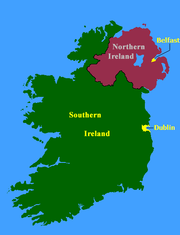
together with its sister region, Northern Ireland
. It was envisaged that Southern Ireland would have the following institutions:
It was also envisaged that Southern Ireland would share the following institutions with Northern Ireland
:
The Parliament
, although legally established, never functioned (for example, it never passed an Act). The House of Commons of Southern Ireland met just once with only four members present. No Government of Southern Ireland was ever established either. The Council of Ireland
was to be established "[w]ith a view to the eventual establishment of a Parliament for the whole of Ireland", but it never came into being. The notable exception to the failure of the institutions of Southern Ireland was its courts, all of which functioned.
politics since the 1880s, namely the conflicting demands of Irish unionists
and nationalists
. Nationalists wanted a form of home rule
, believing that Ireland
was poorly served by the Government in Westminster
and its Irish Executive in Dublin Castle
. Unionists feared that a nationalist government in Dublin would discriminate against Protestants
and would impose tariffs that would unduly hit the north-eastern counties of Ireland (these counties all being located within the province of Ulster
), which were not only predominantly Protestant but also the only industrial
area on an island whose economy was largely agricultural
. Unionists imported arms and assorted weapons from Germany
and established the Ulster Volunteer Force
(the UVF) to prevent Home Rule in Ulster
. In response to this, nationalists also imported arms and set up the Irish Volunteers
. Partition
, which was introduced by the Government of Ireland Act, was intended as a temporary solution, allowing Northern Ireland
and Southern Ireland to be governed separately as regions of the United Kingdom of Great Britain and Ireland
. Ironically, one of those most opposed to this partition settlement was the leader of Irish unionism, Dublin-born Sir Edward Carson
, who felt that it was wrong to divide Ireland in two. He felt this would badly affect the position of southern and western unionists.
had been proclaimed by the parliament known as Dáil Éireann, formed by Sinn Féin
MPs
elected from Ireland in the United Kingdom general election in 1918. The first general election to the House of Commons of Southern Ireland in 1921 was used by Sinn Féin to produce a new Dáil: the Second Dáil
. Sinn Féin won 124 of the 128 seats, all without contest. (The other four were won by Dublin Unionists.) When the new Parliament of Southern Ireland was called into session in June 1921, only the four Unionist members of the House of Commons of Southern Ireland, and a handful of appointed senators, turned up in the Royal College of Science
in Dublin, where the meeting was scheduled to take place.
 The Anglo-Irish Treaty
was approved for the Irish side on 14 January 1922 by "a meeting summoned for the purpose [of approving the Treaty] of the members elected to sit in the House of Commons of Southern Ireland",
The Treaty did not say that the Treaty was to be approved by the House of Commons of Southern Ireland rather than by the House of Commons as such. The difference is subtle but was fully grasped by those who entered the Treaty. Hence, when that "meeting" was convened, it was convened by Arthur Griffith
in his capacity as "Chairman of the Irish Delegation of Plenipotentiaries" (who had signed the Treaty). Notably, it was not convened by Viscount FitzAlan
, the Lord Lieutenant of Ireland
, who, under the Government of Ireland Act 1920
, was the office-holder with the entitlement to convene a meeting of the House of Commons of Southern Ireland.
The Provisional Government of Southern Ireland
envisaged under the Treaty was constituted on 14 January 1922 at the above-mentioned meeting of members of the Parliament elected for constituencies in Southern Ireland. It took up office two days later when Michael Collins
became Chairman of the Provisional Government. Collins took charge of Dublin Castle at a ceremony attended by Lord FitzAlan. The new Government was not an institution of Southern Ireland as envisaged under the Government of Ireland Act. Instead, it was a Government established under the Anglo-Irish Treaty and legislation which implemented it.
Southern Ireland was never a "state". Its constitutional roots remained the Acts of Union
, two complementary Acts, one passed by the Parliament of Great Britain
, the other by the Parliament of Ireland
.
On 27 May 1922 (some months before the establishment of the Irish Free State
) Lord FitzAlan, as Lord Lieutenant of Ireland, in accordance with the Irish Free State (Agreement) Act 1922
formally dissolved the Parliament of Southern Ireland and by proclamation called "a Parliament to be known as and styled the Provisional Parliament". From that date, the Parliament of Southern Ireland itself ceased to exist. With the establishment of the Irish Free State
on 6 December 1922 under the terms of the Treaty, Southern Ireland ceased to exist.
United Kingdom
The United Kingdom of Great Britain and Northern IrelandIn the United Kingdom and Dependencies, other languages have been officially recognised as legitimate autochthonous languages under the European Charter for Regional or Minority Languages...
established on 3 May 1921 and dissolved on 6 December 1922.
Southern Ireland was established under the Government of Ireland Act 1920
Government of Ireland Act 1920
The Government of Ireland Act 1920 was the Act of the Parliament of the United Kingdom which partitioned Ireland. The Act's long title was "An Act to provide for the better government of Ireland"; it is also known as the Fourth Home Rule Bill or as the Fourth Home Rule Act.The Act was intended...
together with its sister region, Northern Ireland
Northern Ireland
Northern Ireland is one of the four countries of the United Kingdom. Situated in the north-east of the island of Ireland, it shares a border with the Republic of Ireland to the south and west...
. It was envisaged that Southern Ireland would have the following institutions:
- a Parliament of Southern IrelandParliament of Southern IrelandThe Parliament of Southern Ireland was a home rule legislature set up by the British Government during the Irish War of Independence under the Fourth Home Rule Bill...
, consisting of the KingMonarchy of the United KingdomThe monarchy of the United Kingdom is the constitutional monarchy of the United Kingdom and its overseas territories. The present monarch, Queen Elizabeth II, has reigned since 6 February 1952. She and her immediate family undertake various official, ceremonial and representational duties...
, the Senate of Southern Ireland, and the House of Commons of Southern Ireland; - a Government of Southern Ireland;
- the Supreme Court of Judicature of Southern Ireland;
- the Court of Appeal in Southern Ireland; and
- His Majesty's High Court of Justice in Southern Ireland.
It was also envisaged that Southern Ireland would share the following institutions with Northern Ireland
Northern Ireland
Northern Ireland is one of the four countries of the United Kingdom. Situated in the north-east of the island of Ireland, it shares a border with the Republic of Ireland to the south and west...
:
- the Lord Lieutenant of IrelandLord Lieutenant of IrelandThe Lord Lieutenant of Ireland was the British King's representative and head of the Irish executive during the Lordship of Ireland , the Kingdom of Ireland and the United Kingdom of Great Britain and Ireland...
; - a Council of IrelandCouncil of IrelandThe Council of Ireland may refer to one of two councils, one established in the 1920s, the other in the 1970s.-Council of Ireland :...
; and - a High Court of Appeal for Ireland.
The Parliament
Parliament
A parliament is a legislature, especially in those countries whose system of government is based on the Westminster system modeled after that of the United Kingdom. The name is derived from the French , the action of parler : a parlement is a discussion. The term came to mean a meeting at which...
, although legally established, never functioned (for example, it never passed an Act). The House of Commons of Southern Ireland met just once with only four members present. No Government of Southern Ireland was ever established either. The Council of Ireland
Council of Ireland
The Council of Ireland may refer to one of two councils, one established in the 1920s, the other in the 1970s.-Council of Ireland :...
was to be established "[w]ith a view to the eventual establishment of a Parliament for the whole of Ireland", but it never came into being. The notable exception to the failure of the institutions of Southern Ireland was its courts, all of which functioned.
Home Rule
The Government of Ireland Act, also known as the Fourth Home Rule Act, was intended to provide a solution to the problem that had bedevilled IrishPolitics of Ireland
In Ireland there are two countries, Northern Ireland and the Republic of Ireland. The politics of these are managed separately but share a common history of Ireland. Respective articles are as follows:*Politics of the Republic of Ireland...
politics since the 1880s, namely the conflicting demands of Irish unionists
Unionism in Ireland
Unionism in Ireland is an ideology that favours the continuation of some form of political union between the islands of Ireland and Great Britain...
and nationalists
Irish nationalism
Irish nationalism manifests itself in political and social movements and in sentiment inspired by a love for Irish culture, language and history, and as a sense of pride in Ireland and in the Irish people...
. Nationalists wanted a form of home rule
Devolution
Devolution is the statutory granting of powers from the central government of a sovereign state to government at a subnational level, such as a regional, local, or state level. Devolution can be mainly financial, e.g. giving areas a budget which was formerly administered by central government...
, believing that Ireland
Ireland
Ireland is an island to the northwest of continental Europe. It is the third-largest island in Europe and the twentieth-largest island on Earth...
was poorly served by the Government in Westminster
Parliament of the United Kingdom
The Parliament of the United Kingdom of Great Britain and Northern Ireland is the supreme legislative body in the United Kingdom, British Crown dependencies and British overseas territories, located in London...
and its Irish Executive in Dublin Castle
Dublin Castle
Dublin Castle off Dame Street, Dublin, Ireland, was until 1922 the fortified seat of British rule in Ireland, and is now a major Irish government complex. Most of it dates from the 18th century, though a castle has stood on the site since the days of King John, the first Lord of Ireland...
. Unionists feared that a nationalist government in Dublin would discriminate against Protestants
Protestantism
Protestantism is one of the three major groupings within Christianity. It is a movement that began in Germany in the early 16th century as a reaction against medieval Roman Catholic doctrines and practices, especially in regards to salvation, justification, and ecclesiology.The doctrines of the...
and would impose tariffs that would unduly hit the north-eastern counties of Ireland (these counties all being located within the province of Ulster
Ulster
Ulster is one of the four provinces of Ireland, located in the north of the island. In ancient Ireland, it was one of the fifths ruled by a "king of over-kings" . Following the Norman invasion of Ireland, the ancient kingdoms were shired into a number of counties for administrative and judicial...
), which were not only predominantly Protestant but also the only industrial
Industry
Industry refers to the production of an economic good or service within an economy.-Industrial sectors:There are four key industrial economic sectors: the primary sector, largely raw material extraction industries such as mining and farming; the secondary sector, involving refining, construction,...
area on an island whose economy was largely agricultural
Agriculture
Agriculture is the cultivation of animals, plants, fungi and other life forms for food, fiber, and other products used to sustain life. Agriculture was the key implement in the rise of sedentary human civilization, whereby farming of domesticated species created food surpluses that nurtured the...
. Unionists imported arms and assorted weapons from Germany
German Empire
The German Empire refers to Germany during the "Second Reich" period from the unification of Germany and proclamation of Wilhelm I as German Emperor on 18 January 1871, to 1918, when it became a federal republic after defeat in World War I and the abdication of the Emperor, Wilhelm II.The German...
and established the Ulster Volunteer Force
Ulster Volunteer Force (1912)
The Ulster Volunteers were a unionist militia founded in 1912 to block Home Rule for Ireland. In 1913 they were organised into the Ulster Volunteer Force, with many of its members enlisting with the 36th Division at the outbreak of World War I...
(the UVF) to prevent Home Rule in Ulster
Ulster
Ulster is one of the four provinces of Ireland, located in the north of the island. In ancient Ireland, it was one of the fifths ruled by a "king of over-kings" . Following the Norman invasion of Ireland, the ancient kingdoms were shired into a number of counties for administrative and judicial...
. In response to this, nationalists also imported arms and set up the Irish Volunteers
Irish Volunteers
The Irish Volunteers was a military organisation established in 1913 by Irish nationalists. It was ostensibly formed in response to the formation of the Ulster Volunteers in 1912, and its declared primary aim was "to secure and maintain the rights and liberties common to the whole people of Ireland"...
. Partition
Partition of Ireland
The partition of Ireland was the division of the island of Ireland into two distinct territories, now Northern Ireland and the Republic of Ireland . Partition occurred when the British Parliament passed the Government of Ireland Act 1920...
, which was introduced by the Government of Ireland Act, was intended as a temporary solution, allowing Northern Ireland
Northern Ireland
Northern Ireland is one of the four countries of the United Kingdom. Situated in the north-east of the island of Ireland, it shares a border with the Republic of Ireland to the south and west...
and Southern Ireland to be governed separately as regions of the United Kingdom of Great Britain and Ireland
United Kingdom of Great Britain and Ireland
The United Kingdom of Great Britain and Ireland was the formal name of the United Kingdom during the period when what is now the Republic of Ireland formed a part of it....
. Ironically, one of those most opposed to this partition settlement was the leader of Irish unionism, Dublin-born Sir Edward Carson
Edward Carson, Baron Carson
Edward Henry Carson, Baron Carson PC, PC , Kt, QC , often known as Sir Edward Carson or Lord Carson, was a barrister, judge and politician from Ireland...
, who felt that it was wrong to divide Ireland in two. He felt this would badly affect the position of southern and western unionists.
1921 general election
In reality, however, while Northern Ireland did become a functioning entity, with a parliament and executive that existed until 1972, Southern Ireland never did. An Irish republicIrish Republic
The Irish Republic was a revolutionary state that declared its independence from Great Britain in January 1919. It established a legislature , a government , a court system and a police force...
had been proclaimed by the parliament known as Dáil Éireann, formed by Sinn Féin
Sinn Féin
Sinn Féin is a left wing, Irish republican political party in Ireland. The name is Irish for "ourselves" or "we ourselves", although it is frequently mistranslated as "ourselves alone". Originating in the Sinn Féin organisation founded in 1905 by Arthur Griffith, it took its current form in 1970...
MPs
Member of Parliament
A Member of Parliament is a representative of the voters to a :parliament. In many countries with bicameral parliaments, the term applies specifically to members of the lower house, as upper houses often have a different title, such as senate, and thus also have different titles for its members,...
elected from Ireland in the United Kingdom general election in 1918. The first general election to the House of Commons of Southern Ireland in 1921 was used by Sinn Féin to produce a new Dáil: the Second Dáil
Second Dáil
The Second Dáil was Dáil Éireann as it convened from 16 August 1921 until 8 June 1922. From 1919–1922 Dáil Éireann was the revolutionary parliament of the self-proclaimed Irish Republic. The Second Dáil consisted of members elected in 1921...
. Sinn Féin won 124 of the 128 seats, all without contest. (The other four were won by Dublin Unionists.) When the new Parliament of Southern Ireland was called into session in June 1921, only the four Unionist members of the House of Commons of Southern Ireland, and a handful of appointed senators, turned up in the Royal College of Science
Government Buildings
Government Buildings is a large Edwardian building enclosing a quadrangle on Merrion Street in Dublin, Ireland, in which several key offices of the government of Ireland are located...
in Dublin, where the meeting was scheduled to take place.
Treaty and Free State
Anglo-Irish Treaty
The Anglo-Irish Treaty , officially called the Articles of Agreement for a Treaty Between Great Britain and Ireland, was a treaty between the Government of the United Kingdom of Great Britain and Ireland and representatives of the secessionist Irish Republic that concluded the Irish War of...
was approved for the Irish side on 14 January 1922 by "a meeting summoned for the purpose [of approving the Treaty] of the members elected to sit in the House of Commons of Southern Ireland",
The Treaty did not say that the Treaty was to be approved by the House of Commons of Southern Ireland rather than by the House of Commons as such. The difference is subtle but was fully grasped by those who entered the Treaty. Hence, when that "meeting" was convened, it was convened by Arthur Griffith
Arthur Griffith
Arthur Griffith was the founder and third leader of Sinn Féin. He served as President of Dáil Éireann from January to August 1922, and was head of the Irish delegation at the negotiations in London that produced the Anglo-Irish Treaty of 1921.-Early life:...
in his capacity as "Chairman of the Irish Delegation of Plenipotentiaries" (who had signed the Treaty). Notably, it was not convened by Viscount FitzAlan
Edmund FitzAlan-Howard, 1st Viscount FitzAlan of Derwent
Edmund Bernard FitzAlan-Howard, 1st Viscount FitzAlan of Derwent KG, PC , known as Lord Edmund Talbot between 1876 and 1921, was a British Conservative politician and the last Lord Lieutenant of Ireland.-Background:...
, the Lord Lieutenant of Ireland
Lord Lieutenant of Ireland
The Lord Lieutenant of Ireland was the British King's representative and head of the Irish executive during the Lordship of Ireland , the Kingdom of Ireland and the United Kingdom of Great Britain and Ireland...
, who, under the Government of Ireland Act 1920
Government of Ireland Act 1920
The Government of Ireland Act 1920 was the Act of the Parliament of the United Kingdom which partitioned Ireland. The Act's long title was "An Act to provide for the better government of Ireland"; it is also known as the Fourth Home Rule Bill or as the Fourth Home Rule Act.The Act was intended...
, was the office-holder with the entitlement to convene a meeting of the House of Commons of Southern Ireland.
The Provisional Government of Southern Ireland
Provisional Government of Southern Ireland
The provisional Government of Southern Ireland was the provisional government for the administration of Southern Ireland between 16 January 1922 and 6 December 1922. The government was effectively a transitional administration for the period between the ratifying of the Anglo-Irish Treaty and the...
envisaged under the Treaty was constituted on 14 January 1922 at the above-mentioned meeting of members of the Parliament elected for constituencies in Southern Ireland. It took up office two days later when Michael Collins
Michael Collins (Irish leader)
Michael "Mick" Collins was an Irish revolutionary leader, Minister for Finance and Teachta Dála for Cork South in the First Dáil of 1919, Director of Intelligence for the IRA, and member of the Irish delegation during the Anglo-Irish Treaty negotiations. Subsequently, he was both Chairman of the...
became Chairman of the Provisional Government. Collins took charge of Dublin Castle at a ceremony attended by Lord FitzAlan. The new Government was not an institution of Southern Ireland as envisaged under the Government of Ireland Act. Instead, it was a Government established under the Anglo-Irish Treaty and legislation which implemented it.
Southern Ireland was never a "state". Its constitutional roots remained the Acts of Union
Act of Union 1800
The Acts of Union 1800 describe two complementary Acts, namely:* the Union with Ireland Act 1800 , an Act of the Parliament of Great Britain, and...
, two complementary Acts, one passed by the Parliament of Great Britain
Parliament of Great Britain
The Parliament of Great Britain was formed in 1707 following the ratification of the Acts of Union by both the Parliament of England and Parliament of Scotland...
, the other by the Parliament of Ireland
Parliament of Ireland
The Parliament of Ireland was a legislature that existed in Dublin from 1297 until 1800. In its early mediaeval period during the Lordship of Ireland it consisted of either two or three chambers: the House of Commons, elected by a very restricted suffrage, the House of Lords in which the lords...
.
On 27 May 1922 (some months before the establishment of the Irish Free State
Irish Free State
The Irish Free State was the state established as a Dominion on 6 December 1922 under the Anglo-Irish Treaty, signed by the British government and Irish representatives exactly twelve months beforehand...
) Lord FitzAlan, as Lord Lieutenant of Ireland, in accordance with the Irish Free State (Agreement) Act 1922
Irish Free State (Agreement) Act 1922
The Irish Free State Act 1922 was an Act of the British Parliament passed on 31 March 1922. It gave the force of law to the Anglo-Irish Treaty, which was scheduled to the Act.-Main provisions:...
formally dissolved the Parliament of Southern Ireland and by proclamation called "a Parliament to be known as and styled the Provisional Parliament". From that date, the Parliament of Southern Ireland itself ceased to exist. With the establishment of the Irish Free State
Irish Free State
The Irish Free State was the state established as a Dominion on 6 December 1922 under the Anglo-Irish Treaty, signed by the British government and Irish representatives exactly twelve months beforehand...
on 6 December 1922 under the terms of the Treaty, Southern Ireland ceased to exist.
See also
- Northern IrelandNorthern IrelandNorthern Ireland is one of the four countries of the United Kingdom. Situated in the north-east of the island of Ireland, it shares a border with the Republic of Ireland to the south and west...
- Southern Unionists