


United States Court of Appeals for the Ninth Circuit

Encyclopedia
Case citation
Case citation is the system used in many countries to identify the decisions in past court cases, either in special series of books called reporters or law reports, or in a 'neutral' form which will identify a decision wherever it was reported...
s, 9th Cir.) is a U.S. federal court with appellate jurisdiction
Appellate jurisdiction
Appellate jurisdiction is the power of the Supreme Court to review decisions and change outcomes of decisions of lower courts. Most appellate jurisdiction is legislatively created, and may consist of appeals by leave of the appellate court or by right...
over the district courts
United States district court
The United States district courts are the general trial courts of the United States federal court system. Both civil and criminal cases are filed in the district court, which is a court of law, equity, and admiralty. There is a United States bankruptcy court associated with each United States...
in the following districts
United States federal judicial district
For purposes of the federal judicial system, Congress has divided the United States into judicial districts. There are 94 federal judicial districts, including at least one district in each state, the District of Columbia and Puerto Rico...
:
- District of AlaskaUnited States District Court for the District of AlaskaThe United States District Court for the District of Alaska is the Federal district court whose jurisdiction is the state of Alaska. Offices are located in Anchorage, Fairbanks, Juneau, Ketchikan, and Nome...
- District of ArizonaUnited States District Court for the District of ArizonaThe United States District Court for the District of Arizona is the federal district court whose jurisdiction is the state of Arizona. Court is held in the cities of Phoenix, Tucson, Flagstaff, Yuma, and Prescott. The district was created on June 20, 1910, by 36 Stat. 557...
- Central District of CaliforniaUnited States District Court for the Central District of CaliforniaThe United States District Court for the Central District of California serves over 18 million people in southern and central California, making it the largest federal judicial district by population...
- Eastern District of CaliforniaUnited States District Court for the Eastern District of CaliforniaThe U.S. District Court for the Eastern District of California is composed of six divisions.The Bakersfield division has jurisdiction over certain cases in Inyo and Kern counties and on federal lands and National Parks...
- Northern District of CaliforniaUnited States District Court for the Northern District of CaliforniaThe United States District Court for the Northern District of California is the federal United States district court whose jurisdiction comprises following counties of California: Alameda, Contra Costa, Del Norte, Humboldt, Lake, Marin, Mendocino, Monterey, Napa, San Benito, San Francisco, San...
- Southern District of CaliforniaUnited States District Court for the Southern District of CaliforniaThe United States District Court for the Southern District of California is the federal district court whose jurisdiction comprises the following counties in California: Imperial and San Diego. In terms of filed indictments, it is one of the busiest criminal districts in the United States...
- District of HawaiiUnited States District Court for the District of HawaiiThe United States District Court for the District of Hawaii is the principal trial court of the United States Federal Court System in the state of Hawaii. It is located at the Prince Kuhio Federal Building in downtown Honolulu, fronting the Aloha Tower and Honolulu Harbor. The court hears both...
- District of IdahoUnited States District Court for the District of IdahoThe United States District Court for the District of Idaho is the Federal district court whose jurisdiction comprises the state of Idaho...
- District of MontanaUnited States District Court for the District of MontanaThe United States District Court for the District of Montana is the United States District Court whose jurisdiction is the state of Montana...
- District of NevadaUnited States District Court for the District of NevadaThe United States District Court for the District of Nevada is the Federal district court whose jurisdiction is the state of Nevada. The court has locations in Las Vegas and Reno....
- District of OregonUnited States District Court for the District of OregonThe United States District Court for the District of Oregon is the Federal district court whose jurisdiction comprises the state of Oregon. It was created in 1859 when the state was admitted to the Union...
- Eastern District of WashingtonUnited States District Court for the Eastern District of WashingtonThe United States District Court for the Eastern District of Washington is the Federal district court whose jurisdiction comprises the following counties of the state of Washington: Adams, Asotin, Benton, Chelan, Columbia, Douglas, Ferry, Franklin, Garfield, Grant, Kittitas, Klickitat, Lincoln,...
- Western District of WashingtonUnited States District Court for the Western District of WashingtonThe United States District Court for the Western District of Washington is the Federal district court whose jurisdiction comprises the following counties of the state of Washington: Clallam, Clark, Cowlitz, Grays Harbor, Island, Jefferson, King, Kitsap, Lewis, Mason, Pacific, Pierce, San Juan,...
It also has appellate jurisdiction over the following territorial courts
United States territorial court
The United States territorial courts are tribunals established in territories of the United States by the United States Congress, pursuant to its power under Article Four of the United States Constitution, the Territorial Clause...
:
- District Court of GuamDistrict Court of GuamThe District Court of Guam is a United States territorial court with jurisdiction over the Territory of Guam. It sits in the capital, Hagåtña....
- District of the Northern Mariana Islands
Headquartered in San Francisco
San Francisco, California
San Francisco , officially the City and County of San Francisco, is the financial, cultural, and transportation center of the San Francisco Bay Area, a region of 7.15 million people which includes San Jose and Oakland...
, California
California
California is a state located on the West Coast of the United States. It is by far the most populous U.S. state, and the third-largest by land area...
, the Ninth Circuit is by far the largest of the thirteen courts of appeals
United States court of appeals
The United States courts of appeals are the intermediate appellate courts of the United States federal court system...
, with 29 active judgeships. The court's regular meeting places are Seattle
Seattle, Washington
Seattle is the county seat of King County, Washington. With 608,660 residents as of the 2010 Census, Seattle is the largest city in the Northwestern United States. The Seattle metropolitan area of about 3.4 million inhabitants is the 15th largest metropolitan area in the country...
at the William K. Nakamura Courthouse, Portland
Portland, Oregon
Portland is a city located in the Pacific Northwest, near the confluence of the Willamette and Columbia rivers in the U.S. state of Oregon. As of the 2010 Census, it had a population of 583,776, making it the 29th most populous city in the United States...
at the Pioneer Courthouse
Pioneer Courthouse
The Pioneer Courthouse is a federal courthouse in Portland, Oregon, United States. Built beginning in 1869, the structure is the oldest federal building in the Pacific Northwest, and the second oldest west of the Mississippi River. Along with Pioneer Courthouse Square, it serves as the center of...
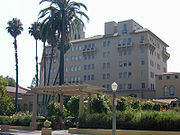
, San Francisco at the James R. Browning U.S. Court of Appeals Building, and Pasadena
Pasadena, California
Pasadena is a city in Los Angeles County, California, United States. Although famous for hosting the annual Rose Bowl football game and Tournament of Roses Parade, Pasadena is the home to many scientific and cultural institutions, including the California Institute of Technology , the Jet...
at the Richard H. Chambers U.S. Court of Appeals, but panels of the court occasionally travel to hear cases in other locations within its territorial jurisdiction. Although the judges travel around the circuit, the court arranges its hearings so that cases from the northern region of the circuit are heard in Seattle or Portland, cases from southern California are heard in Pasadena, and cases from northern California, Nevada, Arizona, and Hawaii are heard in San Francisco. For lawyers who must come and present their cases to the court in person, this administrative grouping of cases helps to reduce the time and cost of travel.
History and background
| Year | Jurisdiction | Total population | Pop. as % of nat'l pop. | Number of active judgeships |
|---|---|---|---|---|
| 1891 | CA, ID, MT, NV, OR, WA | 2,087,000 | 3.3% | 2 |
| 1900 | CA, HI, ID, MT, NV, OR, WA | 2,798,000 | 3.7% | 3 |
| 1920 | AZ, CA, HI, ID, MT, NV, OR, WA | 7,415,000 | 6.7% | 3 |
| 1940 | AZ, CA, HI, ID, MT, NV, OR, WA | 11,881,000 | 9.0% | 7 |
| 1960 | AK, AZ, CA, GU, HI, ID, MT, NV, OR, WA | 22,607,000 | 12.6% | 9 |
| 1980 | AK, AZ, CA, GU, HI, ID, MP, MT, NV, OR, WA | 37,170,000 | 16.4% | 23 |
| 2000 | AK, AZ, CA, GU, HI, ID, MP, MT, NV, OR, WA | 54,575,000 | 19.3% | 28 |
| 2007 | AK, AZ, CA, GU, HI, ID, MP, MT, NV, OR, WA | 60,400,000 | 19.9% | 28 |
| 2009 | AK, AZ, CA, GU, HI, ID, MP, MT, NV, OR, WA | 61,403,307 | 19.72% | 29 |
The large size of the current court is due to the fact that both the population of the western states
Western United States
.The Western United States, commonly referred to as the American West or simply "the West," traditionally refers to the region comprising the westernmost states of the United States. Because the U.S. expanded westward after its founding, the meaning of the West has evolved over time...
and the geographic jurisdiction of the Ninth Circuit have increased dramatically since Congress
United States Congress
The United States Congress is the bicameral legislature of the federal government of the United States, consisting of the Senate and the House of Representatives. The Congress meets in the United States Capitol in Washington, D.C....
, in 1891, created the United States Court of Appeals for the Ninth Circuit. The court was originally granted appellate jurisdiction over federal district courts in California
California
California is a state located on the West Coast of the United States. It is by far the most populous U.S. state, and the third-largest by land area...
, Idaho
Idaho
Idaho is a state in the Rocky Mountain area of the United States. The state's largest city and capital is Boise. Residents are called "Idahoans". Idaho was admitted to the Union on July 3, 1890, as the 43rd state....
, Montana
Montana
Montana is a state in the Western United States. The western third of Montana contains numerous mountain ranges. Smaller, "island ranges" are found in the central third of the state, for a total of 77 named ranges of the Rocky Mountains. This geographical fact is reflected in the state's name,...
, Nevada
Nevada
Nevada is a state in the western, mountain west, and southwestern regions of the United States. With an area of and a population of about 2.7 million, it is the 7th-largest and 35th-most populous state. Over two-thirds of Nevada's people live in the Las Vegas metropolitan area, which contains its...
, Oregon
Oregon
Oregon is a state in the Pacific Northwest region of the United States. It is located on the Pacific coast, with Washington to the north, California to the south, Nevada on the southeast and Idaho to the east. The Columbia and Snake rivers delineate much of Oregon's northern and eastern...
, and Washington. As new states and territories were added to the federal judicial hierarchy in the twentieth century, many of those in the West were placed in the Ninth Circuit: the newly acquired territory of Hawaii
Hawaii
Hawaii is the newest of the 50 U.S. states , and is the only U.S. state made up entirely of islands. It is the northernmost island group in Polynesia, occupying most of an archipelago in the central Pacific Ocean, southwest of the continental United States, southeast of Japan, and northeast of...
in 1900, Arizona
Arizona
Arizona ; is a state located in the southwestern region of the United States. It is also part of the western United States and the mountain west. The capital and largest city is Phoenix...
upon its accession to statehood in 1912, the then-territory of Alaska
Alaska
Alaska is the largest state in the United States by area. It is situated in the northwest extremity of the North American continent, with Canada to the east, the Arctic Ocean to the north, and the Pacific Ocean to the west and south, with Russia further west across the Bering Strait...
in 1948, Guam
Guam
Guam is an organized, unincorporated territory of the United States located in the western Pacific Ocean. It is one of five U.S. territories with an established civilian government. Guam is listed as one of 16 Non-Self-Governing Territories by the Special Committee on Decolonization of the United...
in 1951, and the Commonwealth of the Northern Mariana Islands (CNMI) in 1977. In 1979, the Ninth Circuit became the first federal judicial circuit to set up a Bankruptcy Appellate Panel
Bankruptcy Appellate Panel
A Bankruptcy Appellate Panel is a group of judges of the United States bankruptcy courts who are appointed to hear appeals from certain bankruptcy cases under the supervision of the United States courts of appeals....
.
Personality rights
"Personality rights" is a common or casual reference to the proper term of art "Right of Publicity". The Right of Publicity can be defined simply as the right of an individual to control the commercial use of his or her name, image, likeness or other unequivocal aspects of one's identity...
case involving Wheel of Fortune star Vanna White
Vanna White
Vanna White is an American television personality and film actress best known as the hostess of Wheel of Fortune since 1982.-Early life:...
, Circuit Judge Alex Kozinski
Alex Kozinski
Alex Kozinski is Chief Judge of the United States Court of Appeals for the Ninth Circuit, an essayist, and a judicial commentator.-Biography:...
sardonically noted that “[f]or better or worse, we are the Court of Appeals for the Hollywood Circuit.” Judges from more remote parts of the circuit note the contrast between legal issues confronted by populous states such as California and those confronted by rural states such as Alaska, Idaho, and Montana. Judge Andrew J. Kleinfeld, who maintains his chambers in Fairbanks, Alaska
Fairbanks, Alaska
Fairbanks is a home rule city in and the borough seat of the Fairbanks North Star Borough in the U.S. state of Alaska.Fairbanks is the largest city in the Interior region of Alaska, and second largest in the state behind Anchorage...
, wrote in a 1998 letter: “Much federal law is not national in scope…. It is easy to make a mistake construing these laws when unfamiliar with them, as we often are, or not interpreting them regularly, as we never do.”
Many scholars and jurists, like Judge Kleinfeld, cite regional differences between states in the circuit, as well as the practical, procedural, and substantive difficulties in administering a court of this size, as reasons why Congress should split the Ninth Circuit into two or more smaller circuit courts. Opponents of such a move claim that the court is functioning smoothly from an administrative standpoint, and that the real problem is not that the circuit is too large, but that Congress has not created enough judgeships to handle the court's workload. Opponents also point out that over half of the Ninth Circuit's cases come from the state of California, and thus dividing the Circuit would result in whichever portion included California being dominated by cases from a single state. Moreover, many who advocate the preservation of the current Ninth Circuit see politics as a motivating factor in the split movement. They claim that by implementing a scheme that isolates California from the other states in the circuit, the effect of a split will be to dilute the power of judges who have handed down rulings that have angered social conservatives.
Political liberalism
According to the most current count, the Ninth Circuit has the highest percentage of active judges appointed by DemocraticDemocratic Party (United States)
The Democratic Party is one of two major contemporary political parties in the United States, along with the Republican Party. The party's socially liberal and progressive platform is largely considered center-left in the U.S. political spectrum. The party has the lengthiest record of continuous...
presidents, with 59%. Until 2003, this percentage was much higher; a political stalemate over judicial nominations subsequently kept several vacancies on the court for several years. Nevertheless, such a percentage is not extreme in relation to the other Circuits. 82% of the active judges on the Eighth Circuit were appointed by Republicans and eight circuits have partisan appointment ratios that are more skewed than the Ninth's.
Critics try to explain the court's perceived liberal bias by reference to its relatively high proportion of Democratic appointees. Such critics often point to 2002's Newdow v. U.S. Congress,
Elk Grove Unified School District v. Newdow
Newdow v. United States Congress, Elk Grove Unified School District, et al., 542 U.S. 1 , was a lawsuit originally filed in 2000 which led to a 2002 ruling by the United States Court of Appeals for the Ninth Circuit that the words "under God" in the Pledge of Allegiance are an endorsement of...
in which the court declared that a public school district in Elk Grove, California
Elk Grove, California
Elk Grove is a city in Sacramento County, California, located just south of the state capital of Sacramento. It is part of the Sacramento–Arden-Arcade–Roseville Metropolitan Statistical Area. As of the 2010 census, the population of the city is 153,015...
, could not lead students in recitation of the Pledge of Allegiance
Pledge of Allegiance
The Pledge of Allegiance of the United States is an expression of loyalty to the federal flag and the republic of the United States of America, originally composed by Christian Socialist Francis Bellamy in 1892 and formally adopted by Congress as the pledge in 1942...
(as then constituted); the pledge's inclusion of the words "under God," the court held, violated the Establishment Clause. The case was brought by Michael Newdow
Michael Newdow
Michael Arthur Newdow is an American attorney and emergency medicine physician. He is best known for his efforts to have recitations of the current version of the Pledge of Allegiance in public schools in the United States declared unconstitutional because of its inclusion of the phrase "under God"...
, an atheist who felt that the daily recitation of the Pledge in his daughter's school violated her First Amendment right to be free from government establishment of religion. In a 2–1 decision, a Ninth Circuit panel held for Newdow, stating that “[t]he text of the official Pledge, codified in federal law, impermissibly takes a position with respect to the purely religious question of the existence and identity of God.” The majority opinion was written by Alfred T. Goodwin, who was appointed to the court by Richard Nixon
Richard Nixon
Richard Milhous Nixon was the 37th President of the United States, serving from 1969 to 1974. The only president to resign the office, Nixon had previously served as a US representative and senator from California and as the 36th Vice President of the United States from 1953 to 1961 under...
, a Republican.
In 2004, the United States Supreme Court reversed the Ninth Circuit's decision. However, the majority opinion did not reach the substantive issue of whether the Pledge violated the Establishment Clause, instead holding that Newdow, who did not have primary custody of his daughter (the child's mother, whom Newdow never married, had custody), did not have standing
Standing (law)
In law, standing or locus standi is the term for the ability of a party to demonstrate to the court sufficient connection to and harm from the law or action challenged to support that party's participation in the case...
to litigate the claim in federal court. Chief Justice William Rehnquist
William Rehnquist
William Hubbs Rehnquist was an American lawyer, jurist, and political figure who served as an Associate Justice on the Supreme Court of the United States and later as the 16th Chief Justice of the United States...
and Justices Sandra Day O'Connor
Sandra Day O'Connor
Sandra Day O'Connor is an American jurist who was the first female member of the Supreme Court of the United States. She served as an Associate Justice from 1981 until her retirement from the Court in 2006. O'Connor was appointed by President Ronald Reagan in 1981...
and Clarence Thomas
Clarence Thomas
Clarence Thomas is an Associate Justice of the Supreme Court of the United States. Succeeding Thurgood Marshall, Thomas is the second African American to serve on the Court....
disagreed with the majority's opinion of Newdow's standing, but concurred in the judgment, making this a unanimous decision reversing the Ninth Circuit. Thomas wrote that the Ninth Circuit's opinion was “a persuasive reading of (Supreme Court) precedent,” but then attacked the precedent, particularly Lee v. Weisman
Lee v. Weisman
Lee v. Weisman, 505 U.S. 577 , was a United States Supreme Court decision regarding school prayer. It was the first major school prayer case decided by the Rehnquist Court. It involved prayers led by religious authority figures at public school graduation ceremonies...
. Rehnquist and O'Connor disagreed with the Ninth Circuit's interpretation of the precedent.
Indeed, while the Ninth Circuit had long been instrumental in striking new legal ground, particularly in the areas of immigration law
Immigration law
Immigration law refers to national government policies which control the phenomenon of immigration to their country.Immigraton law, regarding foreign citizens, is related to nationality law, which governs the legal status of people, in matters such as citizenship...
and prisoner rights, it was the Newdow decision that galvanized criticism against what conservatives saw as “judicial activism
Judicial activism
Judicial activism describes judicial ruling suspected of being based on personal or political considerations rather than on existing law. It is sometimes used as an antonym of judicial restraint. The definition of judicial activism, and which specific decisions are activist, is a controversial...
.” Reaction to the decision by prominent political leaders, especially those in the House and Senate, was passionate. President George W. Bush
George W. Bush
George Walker Bush is an American politician who served as the 43rd President of the United States, from 2001 to 2009. Before that, he was the 46th Governor of Texas, having served from 1995 to 2000....
, through his spokesman Ari Fleischer
Ari Fleischer
On May 19, 2003, he announced that he would resign during the summer, citing a desire to spend more time with his wife and to work in the private sector...
, called the ruling “ridiculous,” while Senator Charles Grassley called it “crazy and outrageous.” Even mainstream Democrats attacked the decision, with House minority leader Richard Gephardt calling it “poorly thought out.” Criticisms of the Newdow decision were not limited to the substantive law considered by the judges who heard the case; they also attacked the legitimacy and political independence of the court itself. The result was a renewed focus on the Ninth Circuit's caseload and a targeted effort by congressional Republicans to minimize the impact of such decisions.
Another hotly contested case considered by the Ninth Circuit arose from the enactment of a California law permitting the cultivation and use of marijuana
Cannabis (drug)
Cannabis, also known as marijuana among many other names, refers to any number of preparations of the Cannabis plant intended for use as a psychoactive drug or for medicinal purposes. The English term marijuana comes from the Mexican Spanish word marihuana...
for medicinal purposes. In Raich v. Ashcroft, 352 F.3d 1222
Case citation
Case citation is the system used in many countries to identify the decisions in past court cases, either in special series of books called reporters or law reports, or in a 'neutral' form which will identify a decision wherever it was reported...
(9th Cir. 2003), rev'd sub nom. Gonzales v. Raich, 545 U.S. 1 (2005), a cancer
Cancer
Cancer , known medically as a malignant neoplasm, is a large group of different diseases, all involving unregulated cell growth. In cancer, cells divide and grow uncontrollably, forming malignant tumors, and invade nearby parts of the body. The cancer may also spread to more distant parts of the...
patient sued the federal government, seeking to prevent it from seizing her supply of medical marijuana under the federal Controlled Substances Act
Controlled Substances Act
The Controlled Substances Act was enacted into law by the Congress of the United States as Title II of the Comprehensive Drug Abuse Prevention and Control Act of 1970. The CSA is the federal U.S. drug policy under which the manufacture, importation, possession, use and distribution of certain...
. The United States argued that it had the right to enforce its drug laws against Raich notwithstanding the California statute. Raich argued that since the marijuana was grown within California, had never left the state's borders, and was not part of any economic transaction, Congress had no constitutional authority to regulate her cultivation and use of marijuana. In holding for Raich, the Ninth Circuit adhered to two landmark Supreme Court cases, United States v. Lopez
United States v. Lopez
United States v. Alfonso Lopez, Jr., was the first United States Supreme Court case since the New Deal to set limits to Congress's power under the Commerce Clause of the United States Constitution.-Background:...
, 514 U.S. 549
Case citation
Case citation is the system used in many countries to identify the decisions in past court cases, either in special series of books called reporters or law reports, or in a 'neutral' form which will identify a decision wherever it was reported...
(1995), and United States v. Morrison
United States v. Morrison
United States v. Morrison, is a United States Supreme Court decision which held that parts of the Violence Against Women Act of 1994 were unconstitutional because they exceeded congressional power under the Commerce Clause and under section 5 of the Fourteenth Amendment to the Constitution.-...
, 529 U.S. 598
Case citation
Case citation is the system used in many countries to identify the decisions in past court cases, either in special series of books called reporters or law reports, or in a 'neutral' form which will identify a decision wherever it was reported...
(2000), which had substantially restricted Congress's authority to regulate “noneconomic” activity under the guise of the Commerce Clause
Commerce Clause
The Commerce Clause is an enumerated power listed in the United States Constitution . The clause states that the United States Congress shall have power "To regulate Commerce with foreign Nations, and among the several States, and with the Indian Tribes." Courts and commentators have tended to...
to the United States Constitution
United States Constitution
The Constitution of the United States is the supreme law of the United States of America. It is the framework for the organization of the United States government and for the relationship of the federal government with the states, citizens, and all people within the United States.The first three...
. In a 6–3 decision, the Supreme Court disagreed with this analysis, adhering instead to a 1942 case, Wickard v. Filburn
Wickard v. Filburn
Wickard v. Filburn, 317 U.S. 111 , was a U.S. Supreme Court decision that recognized the power of the federal government to regulate economic activity. A farmer, Roscoe Filburn, was growing wheat for on-farm consumption. The U.S...
, 317 U.S. 111
Case citation
Case citation is the system used in many countries to identify the decisions in past court cases, either in special series of books called reporters or law reports, or in a 'neutral' form which will identify a decision wherever it was reported...
(1942), in which the Court held that cultivation of wheat for personal consumption could be subject to a federal production quota even though the crop never entered the stream of commerce. Interestingly, the three dissenters—voting to uphold the Ninth Circuit—were Chief Justice William H. Rehnquist and Justice Clarence Thomas
Clarence Thomas
Clarence Thomas is an Associate Justice of the Supreme Court of the United States. Succeeding Thurgood Marshall, Thomas is the second African American to serve on the Court....
, considered to be two of the most conservative members of the Court, as well as Justice Sandra Day O'Connor
Sandra Day O'Connor
Sandra Day O'Connor is an American jurist who was the first female member of the Supreme Court of the United States. She served as an Associate Justice from 1981 until her retirement from the Court in 2006. O'Connor was appointed by President Ronald Reagan in 1981...
, considered to be the swing vote on the Court at the time. The Raich litigation illustrates that although the result of the Ninth Circuit's decision pleased political liberals opposed to tough federal drug laws, the legal analysis employed by the court was faithful to the principles of federalism
Federalism
Federalism is a political concept in which a group of members are bound together by covenant with a governing representative head. The term "federalism" is also used to describe a system of the government in which sovereignty is constitutionally divided between a central governing authority and...
and thus wholly “conservative” from a legal perspective.
On the other hand, not every Supreme Court reversal of a Ninth Circuit decision has come in a case where the appellate judges ruled in favor of a group championed by political liberals. In Kyllo v. United States
Kyllo v. United States
Kyllo v. United States, , held that the use of a thermal imaging device from a public vantage point to monitor the radiation of heat from a person's home was a "search" within the meaning of the Fourth Amendment, and thus required a warrant...
, , the Supreme Court reversed a decision of the Ninth Circuit in favor of the government. The Ninth Circuit had ruled that evidence of a marijuana-growing operation obtained without a warrant by means of a thermal imaging device could be introduced at a criminal trial because the Fourth Amendment did not recognize an expectation of privacy in radiation emanating from a private home. The Supreme Court reversed because a person's home is a place where he has always had an expectation of privacy, such that the search at issue required a warrant.
Size of the court
In addition to concerns over its legal doctrine, critics of the Ninth Circuit claim there are several adverse consequences of its large size. Chief among these is the Ninth Circuit's unique rules concerning the composition of an en bancEn banc
En banc, in banc, in banco or in bank is a French term used to refer to the hearing of a legal case where all judges of a court will hear the case , rather than a panel of them. It is often used for unusually complex cases or cases considered to be of greater importance...
court. In other circuits, en banc courts are composed of all active circuit judges, plus (depending on the rules of the particular court) any senior judges who took part in the original panel decision. By contrast, in the Ninth Circuit it is impractical for twenty-eight or more judges to take part in a single oral argument and deliberate on a decision en masse. The court thus provides for a “limited en banc” review of a randomly-selected 11 judge panel. This means that en banc reviews may not actually reflect the views of the majority of the court, and indeed may not include any of the three judges involved in the decision being reviewed in the first place. The result, according to detractors, is a high risk of intracircuit conflicts of law where different groupings of judges end up delivering contradictory opinions. This is said to cause uncertainty in the district courts and within the bar. However, en banc review is a relatively rare occurrence in all circuits and Ninth Circuit rules do provide for full en banc review in limited circumstances. All currently proposed splits would leave at least one circuit with 21 judges, only two fewer than the 23 that the Ninth Circuit had when the limited en banc procedure was first adopted; in other words, after a split at least one of the circuits would still be utilizing limited en banc courts.
In March 2007, Justices Anthony Kennedy
Anthony Kennedy
Anthony McLeod Kennedy is an Associate Justice of the United States Supreme Court, having been appointed by President Ronald Reagan in 1988. Since the retirement of Sandra Day O'Connor, Kennedy has often been the swing vote on many of the Court's politically charged 5–4 decisions...
and Clarence Thomas
Clarence Thomas
Clarence Thomas is an Associate Justice of the Supreme Court of the United States. Succeeding Thurgood Marshall, Thomas is the second African American to serve on the Court....
testified before a House Appropriations subcommittee that the consensus among the justices of the Supreme Court of the United States
Supreme Court of the United States
The Supreme Court of the United States is the highest court in the United States. It has ultimate appellate jurisdiction over all state and federal courts, and original jurisdiction over a small range of cases...
was that the Ninth Circuit was too large and unwieldy and should be split.
Ninth Circuit split proposals
The following are the most prominent of the several existing or former proposals that have been considered by congressional leaders, legislative commissions, and interest groups.Ninth Circuit Court of Appeals Reorganization Act of 1993, H.R. 3654: This proposal from Rep Michael Kopetski (D-OR) would have created a unique state-splitting circuit. Under his proposal, the new Twelfth Circuit would consist of the states of Arizona
Arizona
Arizona ; is a state located in the southwestern region of the United States. It is also part of the western United States and the mountain west. The capital and largest city is Phoenix...
, Nevada
Nevada
Nevada is a state in the western, mountain west, and southwestern regions of the United States. With an area of and a population of about 2.7 million, it is the 7th-largest and 35th-most populous state. Over two-thirds of Nevada's people live in the Las Vegas metropolitan area, which contains its...
, and the southern half of California (Central and Southern Districts), headquartered in Pasadena, California
Pasadena, California
Pasadena is a city in Los Angeles County, California, United States. Although famous for hosting the annual Rose Bowl football game and Tournament of Roses Parade, Pasadena is the home to many scientific and cultural institutions, including the California Institute of Technology , the Jet...
. The Ninth Circuit would have retained the remainder (Northern and Eastern Districts) of California, and the remaining current Ninth Circuit jurisdictions of Alaska
Alaska
Alaska is the largest state in the United States by area. It is situated in the northwest extremity of the North American continent, with Canada to the east, the Arctic Ocean to the north, and the Pacific Ocean to the west and south, with Russia further west across the Bering Strait...
, Washington, Oregon
Oregon
Oregon is a state in the Pacific Northwest region of the United States. It is located on the Pacific coast, with Washington to the north, California to the south, Nevada on the southeast and Idaho to the east. The Columbia and Snake rivers delineate much of Oregon's northern and eastern...
, Idaho
Idaho
Idaho is a state in the Rocky Mountain area of the United States. The state's largest city and capital is Boise. Residents are called "Idahoans". Idaho was admitted to the Union on July 3, 1890, as the 43rd state....
, Montana
Montana
Montana is a state in the Western United States. The western third of Montana contains numerous mountain ranges. Smaller, "island ranges" are found in the central third of the state, for a total of 77 named ranges of the Rocky Mountains. This geographical fact is reflected in the state's name,...
, Hawaii
Hawaii
Hawaii is the newest of the 50 U.S. states , and is the only U.S. state made up entirely of islands. It is the northernmost island group in Polynesia, occupying most of an archipelago in the central Pacific Ocean, southwest of the continental United States, southeast of Japan, and northeast of...
, and the Territorial courts of Guam
Guam
Guam is an organized, unincorporated territory of the United States located in the western Pacific Ocean. It is one of five U.S. territories with an established civilian government. Guam is listed as one of 16 Non-Self-Governing Territories by the Special Committee on Decolonization of the United...
and the Northern Mariana Islands
Northern Mariana Islands
The Northern Mariana Islands, officially the Commonwealth of the Northern Mariana Islands , is a commonwealth in political union with the United States, occupying a strategic region of the western Pacific Ocean. It consists of 15 islands about three-quarters of the way from Hawaii to the Philippines...
. This proposal was largely based on the earlier Hruska Commission Report, which recommended essentially the same split. The central advantage of the plan is that it would have evenly divided the caseload of the current Ninth Circuit in half, and evenly split the then-authorized 28 judgeships in half as well. The central disadvantages were that California would be subject to two possibly contradictory Circuits (no state has ever been split between two Circuits), and conversely, California would still make up the majority of the caseload and judgeships in both newly created districts, thus eliminating a prime incentive of Ninth Circuit split advocates; namely, to remove their state from the influence of California.
Commission on Structural Alternatives for the Federal Courts of Appeals, Final Report, Dec. 18, 1998: The Commission found that splitting the Ninth Circuit would be “impractical and … unnecessary.” However, it recommended that the circuit be divided into three “adjudicative divisions” each of which would hear appeals from specific regions. A fourth at-large “circuit division” would be invoked solely to resolve conflicts of law arising within a particular division. This proposal would also abolish circuit-wide en banc or limited en banc circuit panels, instead creating en banc panels from each of the three regions as necessary.
Ninth Circuit Court of Appeals of Reorganization Act of 2003, S. 562: This proposal would split the Ninth Circuit into two, with California and Nevada being retained by the new Ninth Circuit and the remaining Ninth Circuit jurisdictions being assigned to a new Twelfth Circuit. The bill would create ten new judgeships, with 25 being retained by the Ninth Circuit and 13 being assigned to the Twelfth Circuit. Each current Ninth Circuit judge would be assigned to a new circuit based on the location of his or her duty station. This proposal was co-sponsored by seven Republican Senators from Alaska, Montana, Idaho, Oklahoma, and Oregon. After a hearing by the Senate Judiciary Subcommittee on Administrative Oversight and the Courts on April 7, 2004, no vote was held.
Ninth Circuit Court of Appeals Judgeship and Reorganization Act of 2003, H.R. 2723: This proposal would split the Ninth Circuit into two, with Arizona, California and Nevada being retained by the new Ninth Circuit and the remaining Ninth Circuit jurisdictions being assigned to a new Twelfth Circuit. The bill would create five permanent and two temporary judgeships, all to be retained by the new Ninth Circuit. The temporary judgeships would terminate upon the existence of a vacancy ten years or more after passage of the act. Each current Ninth Circuit judge would be assigned to a new circuit based on the location of his or her duty station. This proposal was co-sponsored by Republican congressmen from Washington, Idaho, Oregon, and Washington. After a hearing by the House Judiciary Subcommittee on Courts, the Internet, and Intellectual Property on October 21, 2003, no vote was held. This bill was reintroduced in the 109th Congress as H.R. 212, the Ninth Circuit Court of Appeals Judgeship and Reorganization Act of 2005.
Ninth Circuit Judgeship and Reorganization Act of 2004, S. 878: This proposal would create two new circuits, the Twelfth and Thirteenth. The Ninth Circuit would retain California, Hawaii, Guam, and the CNMI. The Twelfth Circuit would contain Arizona, Nevada, Idaho, and Montana. The Thirteenth Circuit would contain Alaska, Oregon, and Washington. The Act would provide that existing judges be assigned to new circuits based on the location of their duty stations, after which the number of active judgeships in the new Ninth Circuit would be increased to nineteen. This bill was reintroduced in the 109th Congress as the Ninth Circuit Judgeship and Reorganization Act of 2005, H.R. 211, co-sponsored by House Majority Leader Tom DeLay
Tom DeLay
Thomas Dale "Tom" DeLay is a former member of the United States House of Representatives, representing Texas's 22nd congressional district from 1984 until 2006. He was Republican Party House Majority Leader from 2003 to 2005, when he resigned because of criminal money laundering charges in...
and the same Republican Congressmen who had sponsored the Ninth Circuit Court of Appeals Judgeship and Reorganization Act of 2003.
The Circuit Court of Appeals Restructuring and Modernization Act of 2005, S. 1845: This proposal would split the Ninth Circuit into two, with California, Hawaii, Guam, and the Northern Mariana Islands being retained by the Ninth Circuit, and the remaining Ninth Circuit jurisdictions being assigned to new Twelfth Circuit. It would create five permanent and two temporary judgeships, all retained by the new Ninth Circuit. The temporary judgeships would terminate upon the existence of a vacancy ten years or more after passage of the act. Each current Ninth Circuit judge would be assigned to a new circuit based on the location of his or her duty station. The proposal was co-sponsored by nine Republican senators from Alaska, Arizona, Montana, Nevada, Idaho, Oklahoma, and Oregon, including the same group of senators that had sponsored S. 562 in the previous Congress. It would seem to have superseded S. 1296, which is similar in the states assigned to each new circuit and the number of judgeships in each new circuit; every sponsor of S. 1296 also sponsored S. 1845.
Circuit Court of Appeals Restructuring and Modernization Act of 2007, S. 525: This proposal would amend Title 28, United States Code, to provide for the appointment of additional Federal circuit judges and to divide the Ninth Judicial Circuit of the United States into 2 circuits. The proposed split would be the Ninth Circuit (to be composed of California, Guam, Hawaii, and the Northern Mariana Islands) and the Twelfth Circuit (to be composed of Alaska, Arizona, Idaho, Montana, Nevada, Oregon, and Washington). It was referred to the Senate Judiciary Committee on Feb. 8, 2007.
Current composition of the court
, the judges on the court are:Vacancies and pending nominations
| Seat | Seat last held by | Vacancy reason | Date of vacancy | Nominee | Nomination(s) |
|---|---|---|---|---|---|
| 5 | Stephen S. Trott Stephen S. Trott Stephen S. Trott is a Senior Circuit Judge for the United States Court of Appeals for the Ninth Circuit. Trott was nominated for this position by President Ronald Reagan on August 9, 1987 after the seat held by Joseph Tyree Sneed, III became vacant... |
Senior Status Senior status Senior status is a form of semi-retirement for United States federal judges, and judges in some state court systems. After federal judges have reached a certain combination of age and years of service on the federal courts, they are allowed to assume senior status... |
December 31, 2004 | —— | —— |
| 7 | Pamela Ann Rymer Pamela Ann Rymer Pamela Ann Rymer was a United States federal judge.Born in Knoxville, Tennessee, Rymer earned an A.B. from Vassar College in 1961 and an LL.B. from Stanford Law School in 1964. She was Director of Political Research and Analysis for the Goldwater for President Committee in 1964... |
Death | September 21, 2011 | Paul J. Watford Paul J. Watford Paul Jeffrey Watford is a litigator and currently a nominee to a federal judgeship. On October 17, 2011 President Barack Obama nominated Watford to a federal judicial seat on the United States Court of Appeals for the Ninth Circuit.... |
October 17, 2011 |
| 12 | Andrew Jay Kleinfeld | Senior Status Senior status Senior status is a form of semi-retirement for United States federal judges, and judges in some state court systems. After federal judges have reached a certain combination of age and years of service on the federal courts, they are allowed to assume senior status... |
June 12, 2010 | Morgan Christen Morgan Christen Morgan Brenda Christen is an associate justice on the Alaska Supreme Court and a current federal judicial nominee to a seat on the United States Court of Appeals for the Ninth Circuit. Christen was appointed to the Alaska high court on March 4, 2009 by Governor Sarah Palin to replace outgoing... |
May 18, 2011 |
| 15 | Mary M. Schroeder Mary M. Schroeder Mary M. Schroeder is a judge on the United States Court of Appeals for the Ninth Circuit.- Education :She received her B.A. from Swarthmore in 1962 and her J.D. from the University of Chicago in 1965, one of six women in her class... |
Senior Status Senior status Senior status is a form of semi-retirement for United States federal judges, and judges in some state court systems. After federal judges have reached a certain combination of age and years of service on the federal courts, they are allowed to assume senior status... |
January 1, 2012 (announced) | Andrew D. Hurwitz Andrew D. Hurwitz Andrew D. Hurwitz is a Phoenix, Arizona attorney currently serving as Vice Chief Justice of the Arizona Supreme Court. He also has been nominated to serve as a judge on the United States Court of Appeals for the Ninth Circuit. He is a native of Boonton, New Jersey and a graduate of Boonton High... |
November 2, 2011 |
| 29 | New Seat | Open | January 21, 2009 | Jacqueline H. Nguyen | September 22, 2011 |
List of former judges
Chief judges
Succession of seats
See also
- Courts of CaliforniaCourts of CaliforniaCourts of California include:State courts of California*Supreme Court of California**California Courts of Appeal ***Superior Courts of California Federal courts located in California...
- Ninth Circuit appointment history
External links
- United States Court of Appeals for the Ninth Circuit
- This website includes links to the court's published and unpublishedNon-publicationNon-publication of opinions, or Unpublished opinions, are those decisions of courts that are not available for citation as precedent because the judges making the opinion deem the case as having less precedential value....
opinions, court-specific rules of appellate procedure, and general operating procedures.
- This website includes links to the court's published and unpublished
- Ninth Circuit Library
- Recent opinions from FindLaw
- Federal Judicial Center
- “The Ninth Circuit Court of Appeals: To Split Or Not To Split?” (article in WSJ)
- Disposition of Supreme Court decisions on certiorari or appeal from state and territory supreme courts, and from federal courts of appeals, 1950-2006