
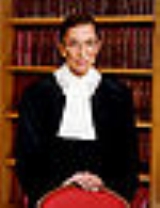
Ruth Joan Bader Ginsburg (born March 15, 1933) is an
Associate JusticeAssociate Justices of the Supreme Court of the United States are the members of the Supreme Court of the United States other than the Chief Justice of the United States...
of the
Supreme Court of the United StatesThe Supreme Court of the United States is the highest court in the United States. It has ultimate appellate jurisdiction over all state and federal courts, and original jurisdiction over a small range of cases...
. Ginsburg was appointed by President
Bill ClintonWilliam Jefferson "Bill" Clinton is an American politician who served as the 42nd President of the United States from 1993 to 2001. Inaugurated at age 46, he was the third-youngest president. He took office at the end of the Cold War, and was the first president of the baby boomer generation...
and took the oath of office on August 10, 1993. She is the second female justice (after
Sandra Day O'ConnorSandra Day O'Connor is an American jurist who was the first female member of the Supreme Court of the United States. She served as an Associate Justice from 1981 until her retirement from the Court in 2006. O'Connor was appointed by President Ronald Reagan in 1981...
) and the first Jewish female justice.
She is generally viewed as belonging to the liberal wing of the Court. Ginsburg spent a considerable portion of her career as an advocate for the
equal citizenship status of women and menWomen's rights are entitlements and freedoms claimed for women and girls of all ages in many societies.In some places these rights are institutionalized or supported by law, local custom, and behaviour, whereas in others they may be ignored or suppressed...
as a constitutional principle. She advocated as a volunteer lawyer for the
American Civil Liberties UnionThe American Civil Liberties Union is a U.S. non-profit organization whose stated mission is "to defend and preserve the individual rights and liberties guaranteed to every person in this country by the Constitution and laws of the United States." It works through litigation, legislation, and...
and was a member of its board of directors and one of its general counsel in the 1970s. She was a professor at
Rutgers School of Law—NewarkRutgers School of Law–Newark is the oldest of three law schools in the U.S. state of New Jersey. It is located at the S.I. Newhouse Center for Law and Justice, at 123 Washington Street, in downtown Newark...
and
Columbia Law SchoolColumbia Law School, founded in 1858, is one of the oldest and most prestigious law schools in the United States. A member of the Ivy League, Columbia Law School is one of the professional graduate schools of Columbia University in New York City. It offers the J.D., LL.M., and J.S.D. degrees in...
. In 1980, President
Jimmy CarterJames Earl "Jimmy" Carter, Jr. is an American politician who served as the 39th President of the United States and was the recipient of the 2002 Nobel Peace Prize, the only U.S. President to have received the Prize after leaving office...
appointed her to the
U.S. Court of Appeals for the District of Columbia CircuitThe United States Court of Appeals for the District of Columbia Circuit known informally as the D.C. Circuit, is the federal appellate court for the U.S. District Court for the District of Columbia. Appeals from the D.C. Circuit, as with all the U.S. Courts of Appeals, are heard on a...
.
Early life and education
Born in
BrooklynBrooklyn is the most populous of New York City's five boroughs, with nearly 2.6 million residents, and the second-largest in area. Since 1896, Brooklyn has had the same boundaries as Kings County, which is now the most populous county in New York State and the second-most densely populated...
, New York, Ruth Joan Bader was the second daughter of Nathan and Celia (
née Amster) Bader. The family nicknamed her "Kiki". They belonged to the
East Midwood Jewish CenterEast Midwood Jewish Center is a Conservative synagogue located at 1625 Ocean Avenue, Midwood, Brooklyn, New York City.Organized in 1924, the congregation's Renaissance revival building typified the large multi-purpose synagogue centers being built at the time, and was from the 1990s until 2010 the...
, where she took her religious confirmation seriously. At age thirteen, Ruth acted as the "camp
rabbiIn Judaism, a rabbi is a teacher of Torah. This title derives from the Hebrew word רבי , meaning "My Master" , which is the way a student would address a master of Torah...
" at a Jewish
summer programSummer camp is a supervised program for children or teenagers conducted during the summer months in some countries. Children and adolescents who attend summer camp are known as campers....
at Camp Che-Na-Wah in
MinervaMinerva is a town in Essex County, New York, United States. The population was 796 at the 2000 census. The town is named after Minerva, goddess of wisdom.The Town of Minerva is located in the southwest corner of the county...
, New York.
Her mother took an active role in her education, taking her to the library often. Bader attended
James Madison High SchoolJames Madison High School is a public high school located at 3787 Bedford Avenue, in the Madison section of Brooklyn, New York, and educates grades 9 through 12. It is part of Region 6 in the New York City Department of Education...
, whose law program later dedicated a courtroom in her honor. Her older sister died when she was very young. Her mother struggled with cancer throughout Ruth's high school years and died the day before her graduation.
She graduated from
Cornell UniversityCornell University is an Ivy League university located in Ithaca, New York, United States. It is a private land-grant university, receiving annual funding from the State of New York for certain educational missions...
in
IthacaThe city of Ithaca, is a city in upstate New York and the county seat of Tompkins County, as well as the largest community in the Ithaca-Tompkins County metropolitan area...
, New York, with a Bachelor of Arts degree in government on June 23, 1954, and that fall enrolled at
Harvard Law SchoolHarvard Law School is one of the professional graduate schools of Harvard University. Located in Cambridge, Massachusetts, it is the oldest continually-operating law school in the United States and is home to the largest academic law library in the world. The school is routinely ranked by the U.S...
, where she was one of only nine women in a class of more than five hundred. When her husband took a job in New York City, she transferred to
Columbia Law SchoolColumbia Law School, founded in 1858, is one of the oldest and most prestigious law schools in the United States. A member of the Ivy League, Columbia Law School is one of the professional graduate schools of Columbia University in New York City. It offers the J.D., LL.M., and J.S.D. degrees in...
and became the first woman to be on two major
law reviewA law review is a scholarly journal focusing on legal issues, normally published by an organization of students at a law school or through a bar association...
s, the
Harvard Law ReviewThe Harvard Law Review is a journal of legal scholarship published by an independent student group at Harvard Law School.-Overview:According to the 2008 Journal Citation Reports, the Review is the most cited law review and has the second-highest impact factor in the category "law" after the...
and the
Columbia Law ReviewThe Columbia Law Review is a law review edited and published by students at Columbia Law School. In addition to articles, the journal regularly publishes scholarly essays and student notes. It was founded in 1901 by Joseph E. Corrigan and John M. Woolsey, who served as the review's first...
. In 1959, she earned her law degree at Columbia and tied for first in her class. In 2009 she was awarded an honorary Doctor of Laws degree from
Willamette UniversityWillamette University is an American private institution of higher learning located in Salem, Oregon. Founded in 1842, it is the oldest university in the Western United States. Willamette is a member of the Annapolis Group of colleges, and is made up of an undergraduate College of Liberal Arts and...
, in 2010 she was awarded an honorary Doctor of Laws degree from
Princeton UniversityPrinceton University is a private research university located in Princeton, New Jersey, United States. The school is one of the eight universities of the Ivy League, and is one of the nine Colonial Colleges founded before the American Revolution....
, and in 2011 she was awarded an honorary Doctor of Laws degree from
Harvard UniversityHarvard University is a private Ivy League university located in Cambridge, Massachusetts, United States, established in 1636 by the Massachusetts legislature. Harvard is the oldest institution of higher learning in the United States and the first corporation chartered in the country...
.
Early career
In 1960, despite a strong recommendation from the
deanIn academic administration, a dean is a person with significant authority over a specific academic unit, or over a specific area of concern, or both...
of Harvard Law School, Justice
Felix FrankfurterFelix Frankfurter was an Associate Justice of the United States Supreme Court.-Early life:Frankfurter was born into a Jewish family on November 15, 1882, in Vienna, Austria, then part of the Austro-Hungarian Empire in Europe. He was the third of six children of Leopold and Emma Frankfurter...
turned down Ginsburg for a clerkship position because she was a woman. Later that year, Ginsburg began a
clerkshipA law clerk or a judicial clerk is a person who provides assistance to a judge in researching issues before the court and in writing opinions. Law clerks are not court clerks or courtroom deputies, who are administrative staff for the court. Most law clerks are recent law school graduates who...
for Judge Edmund L. Palmieri of the
U.S. District Court for the Southern District of New YorkThe United States District Court for the Southern District of New York is a federal district court. Appeals from the Southern District of New York are taken to the United States Court of Appeals for the Second Circuit The United States District Court for the Southern District of New York (in case...
.
From 1961 to 1963 she was a research associate and then associate director of the Columbia Law School Project on International Procedure, learning
SwedishSwedish is a North Germanic language, spoken by approximately 10 million people, predominantly in Sweden and parts of Finland, especially along its coast and on the Åland islands. It is largely mutually intelligible with Norwegian and Danish...
to co-author a book on
judicial procedureDue process is the legal code that the state must venerate all of the legal rights that are owed to a person under the principle. Due process balances the power of the state law of the land and thus protects individual persons from it...
in Sweden. Ginsburg conducted extensive research for her book at the University of Lund in Sweden.
She was a professor of law at Rutgers from 1963 to 1972. In 1970, she co-founded the
Women's Rights Law ReporterThe Women's Rights Law Reporter is a journal of legal scholarship published by an independent student group at Rutgers School of Law—Newark. The journal provides a forum for exploring law and public policy relating to women’s rights and gender. The journal is published quarterly...
, the first
law journalA law review is a scholarly journal focusing on legal issues, normally published by an organization of students at a law school or through a bar association...
in the U.S. to focus exclusively on women's rights. From 1972 until 1980, she taught at Columbia, where she became the first
tenureTenure commonly refers to life tenure in a job and specifically to a senior academic's contractual right not to have his or her position terminated without just cause.-19th century:...
d woman and co-authored the first law school
casebookA casebook is a type of textbook used primarily by students in law schools. Rather than simply laying out the legal doctrine in a particular area of study, a casebook contains excerpts from legal cases in which the law of that area was applied. It is then up to the student to analyze the language...
on sex discrimination. She also taught in
Tulane University Law SchoolTulane University Law School is the law school of Tulane University. It is located on Tulane's Uptown campus in New Orleans, Louisiana. Established in 1847, it is the 12th oldest law school in the United States....
's summer-abroad program. In 1977, she became a fellow at the
Center for Advanced Study in the Behavioral SciencesThe Center for Advanced Study in the Behavioral Sciences is an American interdisciplinary research body in Stanford, California focusing on the social sciences and humanities . Fellows are elected in a closed process, to spend a period of residence at the Center, released from other duties...
at
Stanford UniversityThe Leland Stanford Junior University, commonly referred to as Stanford University or Stanford, is a private research university on an campus located near Palo Alto, California. It is situated in the northwestern Santa Clara Valley on the San Francisco Peninsula, approximately northwest of San...
.
In 1972, Ginsburg co-founded the Women's Rights Project at the
American Civil Liberties UnionThe American Civil Liberties Union is a U.S. non-profit organization whose stated mission is "to defend and preserve the individual rights and liberties guaranteed to every person in this country by the Constitution and laws of the United States." It works through litigation, legislation, and...
(ACLU) and, in 1973, she became the ACLU's General Counsel. As the chief litigator for the Women's Rights Project, she briefed and argued several landmark cases in front of the Supreme Court, such as
Reed v. ReedReed v. Reed, , was an Equal Protection case in the United States in which the Supreme Court ruled that the administrators of estates cannot be named in a way that discriminates between sexes. After the death of their adopted son, Sally and Cecil Reed sought to be named the administrator of their...
, 404 U.S. 71 (1971), wherein the Court extended the protections of the
Equal Protection ClauseThe Equal Protection Clause, part of the Fourteenth Amendment to the United States Constitution, provides that "no state shall ... deny to any person within its jurisdiction the equal protection of the laws"...
to women for the first time. She also argued
Frontiero v. RichardsonFrontiero v. Richardson, , was an Equal Protection case in which the Supreme Court decided that benefits given by the United States military to the family of service members cannot be given out differently because of gender....
, 411 U.S. 677 (1973) and
Weinberger v. WiesenfeldWeinberger v. Wiesenfeld, 420 U.S. 636 , was a decision by the United States Supreme Court, which unanimously held that the gender-based distinction under of the Social Security Act of 1935—which permitted widows but not widowers to collect special benefits while caring for minor children—violated...
, 420 U.S. 636 (1975), which supported the ultimate development and application of the
intermediate scrutinyIntermediate scrutiny, in U.S. constitutional law, is the second level of deciding issues using judicial review. The other levels are typically referred to as rational basis review and strict scrutiny ....
Equal Protection standard of review for legal classifications based on sex. She attained a reputation as a skilled oral advocate, and her work directly led to the end of gender discrimination in many areas of the law.
Her last case as a lawyer before the Court was 1978's
Duren v. MissouriDuren v. Missouri 439 U.S. 357 , was a United States Supreme Court decision related to the Sixth Amendment. Ruth Bader Ginsburg, who later became a Supreme Court Justice herself, argued for Duren in what became her last case before the Supreme Court as an attorney...
, which challenged laws and practices making
jury dutyJury duty is service as a juror in a legal proceeding. When a person is called for jury duty in the United States, that service is usually not optional: one must attend or face strict penalties. Employers are not allowed to fire an employee simply for being called to jury duty...
voluntary for women in that state. Ginsburg viewed optional jury duty as a message that women's service was unnecessary to important government functions. At the end of Ginsburg's oral presentation, then-Associate Justice
William RehnquistWilliam Hubbs Rehnquist was an American lawyer, jurist, and political figure who served as an Associate Justice on the Supreme Court of the United States and later as the 16th Chief Justice of the United States...
asked Ginsburg, "You won't settle for putting
Susan B. AnthonySusan Brownell Anthony was a prominent American civil rights leader who played a pivotal role in the 19th century women's rights movement to introduce women's suffrage into the United States. She was co-founder of the first Women's Temperance Movement with Elizabeth Cady Stanton as President...
on the new dollar, then?" Ginsburg, being cautious, did not respond to his question.
Judicial career
U.S. Court of Appeals
President
Jimmy CarterJames Earl "Jimmy" Carter, Jr. is an American politician who served as the 39th President of the United States and was the recipient of the 2002 Nobel Peace Prize, the only U.S. President to have received the Prize after leaving office...
appointed Ginsburg to the
U.S. Court of Appeals for the District of Columbia CircuitThe United States Court of Appeals for the District of Columbia Circuit known informally as the D.C. Circuit, is the federal appellate court for the U.S. District Court for the District of Columbia. Appeals from the D.C. Circuit, as with all the U.S. Courts of Appeals, are heard on a...
on April 14, 1980, to the seat of recently deceased judge
Harold LeventhalHarold Leventhal was a United States federal judge.Leventhal was born in New York City, New York. He received an A.B. from Columbia University in 1934. He received an LL.B. from Columbia Law School in 1936. He was a law clerk to U.S. Supreme Court justices Harlan Fiske Stone and Stanley Forman Reed...
. She served there for thirteen years, until joining the Supreme Court. During her 13-year tenure on the D.C. Circuit, Ginsburg made 57 hires for law clerk, intern, and secretary positions. At her Supreme Court confirmation hearing, it was revealed that none of those hired had been African-Americans, a fact for which Ginsburg (an "aggressive support[er] [of] disparate-impact statistics as evidence of intentional discrimination") was sharply criticized.
Nomination and confirmation
President
Bill ClintonWilliam Jefferson "Bill" Clinton is an American politician who served as the 42nd President of the United States from 1993 to 2001. Inaugurated at age 46, he was the third-youngest president. He took office at the end of the Cold War, and was the first president of the baby boomer generation...
nominated her as an Associate Justice of the Supreme Court on June 14, 1993, to fill the seat vacated by retiring Justice
Byron WhiteByron Raymond "Whizzer" White won fame both as a football halfback and as an associate justice of the Supreme Court of the United States. Appointed to the court by President John F. Kennedy in 1962, he served until his retirement in 1993...
. Ginsburg was recommended to Clinton by then-U.S.
Attorney GeneralThe United States Attorney General is the head of the United States Department of Justice concerned with legal affairs and is the chief law enforcement officer of the United States government. The attorney general is considered to be the chief lawyer of the U.S. government...
Janet RenoJanet Wood Reno is a former Attorney General of the United States . She was nominated by President Bill Clinton on February 11, 1993, and confirmed on March 11...
.
During her subsequent
testimonyIn law and in religion, testimony is a solemn attestation as to the truth of a matter. All testimonies should be well thought out and truthful. It was the custom in Ancient Rome for the men to place their right hand on a Bible when taking an oath...
before the
U.S. SenateThe United States Senate is the upper house of the bicameral legislature of the United States, and together with the United States House of Representatives comprises the United States Congress. The composition and powers of the Senate are established in Article One of the U.S. Constitution. Each...
Judiciary CommitteeThe United States Senate Committee on the Judiciary is a standing committee of the United States Senate, of the United States Congress. The Judiciary Committee, with 18 members, is charged with conducting hearings prior to the Senate votes on confirmation of federal judges nominated by the...
as part of the confirmation hearings, she refused to answer questions regarding her personal views on most issues or how she would adjudicate certain hypothetical situations as a Supreme Court Justice. A number of Senators on the committee came away frustrated, with unanswered questions about how Ginsburg planned to make the transition from an advocate for causes she personally held dear, to a justice on the Supreme Court. Despite this, Ginsburg refused to discuss her beliefs about the limits and proper role of
jurisprudenceJurisprudence is the theory and philosophy of law. Scholars of jurisprudence, or legal theorists , hope to obtain a deeper understanding of the nature of law, of legal reasoning, legal systems and of legal institutions...
, saying, "Were I to rehearse here what I would say and how I would reason on such questions, I would act injudiciously".
At the same time, Ginsburg did answer questions relating to some potentially controversial issues. For instance, she affirmed her belief in a constitutional right to privacy, and explicated at some length on her personal judicial philosophy and thoughts regarding gender equality. The U.S. Senate confirmed her by a 96-to-3 vote and she took her judicial oath on August 10, 1993.
Supreme Court jurisprudence
Ginsburg characterizes her performance on the Court as a cautious approach to adjudication, and argued in a speech shortly before her nomination to the Court that "[m]easured motions seem to me right, in the main, for constitutional as well as common law adjudication. Doctrinal limbs too swiftly shaped, experience teaches, may prove unstable." Ginsburg has urged that the Court allow for dialogue with elected branches, while others argue that would inevitably lead to politicizing the Court.
Although Ginsburg has consistently supported abortion rights and joined in the Court's opinion striking down
Nebraska'sNebraska is a state on the Great Plains of the Midwestern United States. The state's capital is Lincoln and its largest city is Omaha, on the Missouri River....
partial-birth abortion law in
Stenberg v. CarhartStenberg v. Carhart, 530 U.S. 914 , is a case heard by the Supreme Court of the United States dealing with a Nebraska law which made performing partial-birth abortion illegal, except where necessary to save the life of the mother. Nebraska physicians who performed the procedure contrary to the law...
she has criticized the Court's ruling in
Roe v. WadeRoe v. Wade, , was a controversial landmark decision by the United States Supreme Court on the issue of abortion. The Court decided that a right to privacy under the due process clause in the Fourteenth Amendment to the United States Constitution extends to a woman's decision to have an abortion,...
as terminating a nascent, democratic movement to liberalize abortion laws which might have built a more durable consensus in support of abortion rights. She discussed her views on abortion rights and sexual equality in a 2009
New York TimesThe New York Times is an American daily newspaper founded and continuously published in New York City since 1851. The New York Times has won 106 Pulitzer Prizes, the most of any news organization...
interview, in which she said regarding abortion that "[t]he basic thing is that the government has no business making that choice for a woman." One statement she made during the interview ("Frankly, I had thought at the time Roe was decided, there was concern about population growth and particularly growth in populations that we don't want to have too many of.") was criticized by conservative commentator
Michael GersonMichael John Gerson is an op-ed columnist for The Washington Post, a Policy Fellow with the ONE Campaign, and a former senior fellow at the Council on Foreign Relations. He served as President George W...
as reflecting an "attitude . . . that abortion is economically important to a 'woman of means' and useful in reducing the number of social undesirables."
Ginsburg has also been an advocate for using foreign law and norms to shape U.S. law in judicial opinions, in contrast to the
textualistTextualism is a formalist theory of statutory interpretation, holding that a statute's ordinary meaning should govern its interpretation, as opposed to inquiries into non-textual sources such as the intention of the legislature in passing the law, the problem it was intended to remedy, or...
views of her colleagues
Chief JusticeThe Chief Justice of the United States is the head of the United States federal court system and the chief judge of the Supreme Court of the United States. The Chief Justice is one of nine Supreme Court justices; the other eight are the Associate Justices of the Supreme Court of the United States...
John G. Roberts, Justice
Antonin ScaliaAntonin Gregory Scalia is an American jurist who serves as an Associate Justice of the Supreme Court of the United States. As the longest-serving justice on the Court, Scalia is the Senior Associate Justice...
, Justice
Clarence ThomasClarence Thomas is an Associate Justice of the Supreme Court of the United States. Succeeding Thurgood Marshall, Thomas is the second African American to serve on the Court....
and Justice
Samuel AlitoSamuel Anthony Alito, Jr. is an Associate Justice of the U.S. Supreme Court. He was nominated by President George W. Bush and has served on the court since January 31, 2006....
. Despite their fundamental differences, Ginsburg considers Scalia her closest colleague on the Court, and they often dine and attend the opera together.
Notable cases
- United States v. Virginia
United States v. Virginia, , is a case in which the Supreme Court of the United States struck down the Virginia Military Institute's long-standing male-only admission policy in a 7-1 decision...
, Court Opinion. Virginia Military InstituteThe Virginia Military Institute , located in Lexington, Virginia, is the oldest state-supported military college and one of six senior military colleges in the United States. Unlike any other military college in the United States—and in keeping with its founding principles—all VMI students are...
's male-only admission policy violated the Equal Protection ClauseThe Equal Protection Clause, part of the Fourteenth Amendment to the United States Constitution, provides that "no state shall ... deny to any person within its jurisdiction the equal protection of the laws"...
of the Fourteenth AmendmentThe Fourteenth Amendment to the United States Constitution was adopted on July 9, 1868, as one of the Reconstruction Amendments.Its Citizenship Clause provides a broad definition of citizenship that overruled the Dred Scott v...
.
- United States v. O'Hagan, Court Opinion
- Olmstead v. L.C., Court Opinion
- Friends of the Earth, Inc. v. Laidlaw Environmental Services, Inc.
Friends of the Earth, Inc. et al. v. Laidlaw Environmental Services, Inc., 528 U.S. 167 , was a United States Supreme Court case that addressed the law regarding standing to sue and mootness....
, Court Opinion
- Bush v. Gore
Bush v. Gore, , is the landmark United States Supreme Court decision on December 12, 2000, that effectively resolved the 2000 presidential election in favor of George W. Bush. Only eight days earlier, the United States Supreme Court had unanimously decided the closely related case of Bush v...
, Dissenting
- Eldred v. Ashcroft
Eldred v. Ashcroft, was a court case in the United States challenging the constitutionality of the 1998 Sonny Bono Copyright Term Extension Act...
, Court Opinion
- Exxon Mobil Corp. v. Saudi Basic Industries Corp.
Exxon Mobil Corp. v. Saudi Basic Industries Corp., 544 U.S. 280 , is a case in which the Supreme Court of the United States clarified the Rooker-Feldman doctrine and its relation to preclusion and concurrent jurisdiction.-Facts & Procedural Posture:...
, Court Opinion
- Ledbetter v. Goodyear Tire & Rubber Co.
Ledbetter v. Goodyear Tire & Rubber Co., 550 U.S. 618 , is an employment discrimination decision of the Supreme Court of the United States. Justice Alito held for the five-justice majority that employers cannot be sued under Title VII of the Civil Rights Act over race or gender pay discrimination...
, Dissenting
- Gonzales v. Carhart
Gonzales v. Carhart, 550 U.S. 124 , is a United States Supreme Court case that upheld the Partial-Birth Abortion Ban Act of 2003. The case reached the high court after U.S. Attorney General Alberto Gonzales appealed a ruling of the United States Court of Appeals for the Eighth Circuit in favor of...
, Dissenting
- Ricci v. DeStefano
Ricci v. DeStefano, 129 S. Ct. 2658, 2671, 174 L. Ed. 2d 490 is a decision by the Supreme Court of the United States arising from a lawsuit brought against the city of New Haven, Connecticut by twenty city firefighters alleging that the city discriminated against them with regard to promotions...
, 129 S. Ct. 2658 (2009) Dissenting
Ginsburg Precedent
More than a decade passed between the two successive terms in which Ginsburg and
Stephen BreyerStephen Gerald Breyer is an Associate Justice of the U.S. Supreme Court. Appointed by President Bill Clinton in 1994, and known for his pragmatic approach to constitutional law, Breyer is generally associated with the more liberal side of the Court....
were appointed and the date another justice left the Court. By that time, both the
CongressThe United States Congress is the bicameral legislature of the federal government of the United States, consisting of the Senate and the House of Representatives. The Congress meets in the United States Capitol in Washington, D.C....
and the
White HouseThe White House is the official residence and principal workplace of the president of the United States. Located at 1600 Pennsylvania Avenue NW in Washington, D.C., the house was designed by Irish-born James Hoban, and built between 1792 and 1800 of white-painted Aquia sandstone in the Neoclassical...
had switched to
RepublicanThe Republican Party is one of the two major contemporary political parties in the United States, along with the Democratic Party. Founded by anti-slavery expansion activists in 1854, it is often called the GOP . The party's platform generally reflects American conservatism in the U.S...
control. When O'Connor announced her retirement in the summer of 2005, with Chief Justice Rehnquist's death a few months later, both sides began to squabble about just what kinds of questions President
George W. BushGeorge Walker Bush is an American politician who served as the 43rd President of the United States, from 2001 to 2009. Before that, he was the 46th Governor of Texas, having served from 1995 to 2000....
's nominees would be expected to answer. The debate heated up when hearings for Roberts began in September 2005. Republicans used an argument they called the "Ginsburg Precedent", which centered on Ginsburg's confirmation hearings. In those hearings, she did not answer questions involving matters such as
abortionAbortion is defined as the termination of pregnancy by the removal or expulsion from the uterus of a fetus or embryo prior to viability. An abortion can occur spontaneously, in which case it is usually called a miscarriage, or it can be purposely induced...
, gay rights,
separation of church and stateThe concept of the separation of church and state refers to the distance in the relationship between organized religion and the nation state....
, and disability rights. Only one witness testified against Ginsburg at her confirmation hearings, and the hearings lasted only four days.
In a September 28, 2005, speech at
Wake Forest UniversityWake Forest University is a private, coeducational university in the U.S. state of North Carolina, founded in 1834. The university received its name from its original location in Wake Forest, north of Raleigh, North Carolina, the state capital. The Reynolda Campus, the university's main campus, is...
, Ginsburg said that Roberts' refusal to answer questions during his Senate confirmation hearings on some cases was "unquestionably right". Democrats had taken issue with Roberts' refusal to answer certain questions, saying Ginsburg had made her views very clear, even if she did not comment on some specific matters, and that because of her lengthy tenure as a judge, many of her legal opinions were already available for review.
During Roberts' confirmation hearings, Senators
Joe BidenJoseph Robinette "Joe" Biden, Jr. is the 47th and current Vice President of the United States, serving under President Barack Obama...
(Delaware),
Orrin HatchOrrin Grant Hatch is the senior United States Senator for Utah and is a member of the Republican Party. Hatch served as the chairman or ranking member of the Senate Judiciary Committee from 1993 to 2005...
(Utah), and Roberts himself brought up Ginsburg's hearings several times as they argued over what questions she answered and what Roberts was expected to answer. The precedent was again cited several times during the confirmation hearings for Justice
Samuel AlitoSamuel Anthony Alito, Jr. is an Associate Justice of the U.S. Supreme Court. He was nominated by President George W. Bush and has served on the court since January 31, 2006....
.
1997 vice-presidential inauguration
Ginsburg administered, at his request, Vice President
Al GoreAlbert Arnold "Al" Gore, Jr. served as the 45th Vice President of the United States , under President Bill Clinton. He was the Democratic Party's nominee for President in the 2000 U.S. presidential election....
's
oath of officeAn oath of office is an oath or affirmation a person takes before undertaking the duties of an office, usually a position in government or within a religious body, although such oaths are sometimes required of officers of other organizations...
to a second term during the
second presidential inauguration of ClintonJanuary 20, 1997 signified both the second inauguration of Bill Clinton as President of the United States as well as being the last inauguration of a president in the 20th century. Born August 19, 1946 in the town of Hope, Arkansas, Bill Clinton had a long career in law before his first...
on January 20, 1997.
Personal life
A few days after graduating from Cornell, Ruth Bader married
Martin D. GinsburgMartin David Ginsburg was an internationally renowned taxation law expert. He was Professor of Law at Georgetown University Law Center in Washington, D.C. and of counsel to the law firm Fried, Frank, Harris, Shriver & Jacobson....
, later an internationally prominent tax lawyer, and then (after they moved from New York to Washington DC, upon her accession to the D.C. Circuit) professor of law at
Georgetown University Law CenterGeorgetown University Law Center is the law school of Georgetown University, located in Washington, D.C.. Established in 1870, the Law Center offers J.D., LL.M., and S.J.D. degrees in law...
. Their daughter
JaneJane C. Ginsburg is the Morton L. Janklow Professor of Literary and Artistic Property Law at the Columbia Law School. She also directs the law school's Kernochan Center For Law, Media and the Arts....
(born 1955) is a professor at
Columbia Law SchoolColumbia Law School, founded in 1858, is one of the oldest and most prestigious law schools in the United States. A member of the Ivy League, Columbia Law School is one of the professional graduate schools of Columbia University in New York City. It offers the J.D., LL.M., and J.S.D. degrees in...
, and their son
James Steven GinsburgJames Steven Ginsburg is an American music producer. He is the founder, producer and president of Cedille Records, a classical label, which launched in 1989 when Ginsburg was a student at the University of Chicago.-Biography:...
(born 1965) is founder and president of
Cedille Records#REDIRECTCedille Records is the independent record label of TheChicago Classical Recording Foundation.-Company History:In 1989, James Ginsburg founded Cedille Records, as a...
, a
classical-musicClassical music is the art music produced in, or rooted in, the traditions of Western liturgical and secular music, encompassing a broad period from roughly the 11th century to present times...
recording company based in
ChicagoChicago is the largest city in the US state of Illinois. With nearly 2.7 million residents, it is the most populous city in the Midwestern United States and the third most populous in the US, after New York City and Los Angeles...
, Illinois. After the birth of their daughter, her husband was diagnosed with
testicular cancerTesticular cancer is cancer that develops in the testicles, a part of the male reproductive system.In the United States, between 7,500 and 8,000 diagnoses of testicular cancer are made each year. In the UK, approximately 2,000 men are diagnosed each year. Over his lifetime, a man's risk of...
. During this period, Ginsburg attended class and took notes for both of them; typed her husband's papers to his dictation; and cared for their daughter and her sick husband – all while making the
Harvard Law Review. They celebrated their 56th wedding anniversary on June 23, 2010. Martin Ginsburg died of complications from metastatic cancer on June 27, 2010.
Some Supreme Court justices and other prominent figures attend the
Red MassA Red Mass is a Mass celebrated annually in the Catholic Church for judges, attorneys, law school professors, students, and government officials...
held every fall in Washington, D.C. at the
Cathedral of St. Matthew the ApostleThe Cathedral of St. Matthew the Apostle in Washington D.C., most commonly known as St. Matthew's Cathedral, is the seat of the Archbishop of the Roman Catholic Archdiocese of Washington. As St...
. Ginsburg explained her reason for no longer attending: "I went one year, and I will never go again, because this sermon was outrageously anti-abortion," Ginsburg said in the book
Stars of David: Prominent Jews Talk About Being Jewish by Abigail Pogrebin. "Even the Scalias – although they're much of that persuasion – were embarrassed for me."
Illness
Ginsburg was diagnosed with
colon cancerColorectal cancer, commonly known as bowel cancer, is a cancer caused by uncontrolled cell growth , in the colon, rectum, or vermiform appendix. Colorectal cancer is clinically distinct from anal cancer, which affects the anus....
in 1999 and underwent surgery followed by chemotherapy and
radiation therapyRadiation therapy , radiation oncology, or radiotherapy , sometimes abbreviated to XRT or DXT, is the medical use of ionizing radiation, generally as part of cancer treatment to control malignant cells.Radiation therapy is commonly applied to the cancerous tumor because of its ability to control...
. During the process, she did not miss a day on the bench. On February 5, 2009, she again underwent surgery related to
pancreatic cancerPancreatic cancer refers to a malignant neoplasm of the pancreas. The most common type of pancreatic cancer, accounting for 95% of these tumors is adenocarcinoma, which arises within the exocrine component of the pancreas. A minority arises from the islet cells and is classified as a...
. Ginsburg's tumor was discovered at an early stage. Ginsburg was released from a New York hospital, eight days after the surgery and heard oral arguments again four days later.
On September 24, 2009, Ginsburg was hospitalized for lightheadedness following an outpatient treatment for iron deficiency and was released the following day.
Future plans
With the retirement of
John Paul StevensJohn Paul Stevens served as an Associate Justice of the Supreme Court of the United States from December 19, 1975 until his retirement on June 29, 2010. At the time of his retirement, he was the oldest member of the Court and the third-longest serving justice in the Court's history...
in 2010, Ginsburg became, at 77 years of age, the eldest justice on the Court. Despite rumors she would retire as a result of old age, poor health, and the death of her husband, she denied she was planning to step down. In an August 2010 interview, Ginsburg stated that the Court's work was helping her cope with the death of her husband and suggested she would serve until at least 2012 when a painting that used to hang in her office is due to be returned to her. She also expressed a wish to emulate Justice
Louis BrandeisLouis Dembitz Brandeis ; November 13, 1856 – October 5, 1941) was an Associate Justice on the Supreme Court of the United States from 1916 to 1939.He was born in Louisville, Kentucky, to Jewish immigrant parents who raised him in a secular mode...
, who retired at 82, an age that Ginsburg would attain in 2015.
Recognition
In 2009,
ForbesForbes is an American publishing and media company. Its flagship publication, the Forbes magazine, is published biweekly. Its primary competitors in the national business magazine category are Fortune, which is also published biweekly, and Business Week...
named her among the
100 Most Powerful WomenStarting in 2004, Forbes magazine has made a list of the 100 most powerful women in the world. It is edited by editor Mary Ellen Egan, and based on visibility and economic impact...
.
See also
External links
|-
|-