


War on Drugs

Encyclopedia
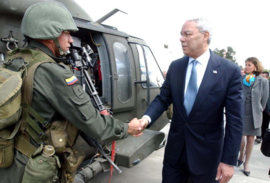
Prohibition (drugs)
The prohibition of drugs through sumptuary legislation or religious law is a common means of attempting to prevent drug use. Prohibition of drugs has existed at various levels of government or other authority from the Middle Ages to the present....
and foreign military aid
Military aid
Military aid is aid which is used to assist an ally in its defense efforts, or to assist a poor country in maintaining control over its own territory. Many countries receive military aid to help with counter-insurgency efforts...
and military intervention being undertaken by the United States government, with the assistance of participating countries, intended to both define and reduce the illegal drug trade
Illegal drug trade
The illegal drug trade is a global black market, dedicated to cultivation, manufacture, distribution and sale of those substances which are subject to drug prohibition laws. Most jurisdictions prohibit trade, except under license, of many types of drugs by drug prohibition laws.A UN report said the...
. This initiative includes a set of drug policies of the United States
Drug policy of the United States
Drug use has increased in all categories since prohibition except that opium use is at a fraction of its peak level. The big decline in use of opium started already after the Harrison Act of 1914. Use of heroin peaked between 1969 and 1971, cocaine, between 1987 and 1989 and marijuana between 1978...
that are intended to discourage the production, distribution, and consumption of illegal psychoactive drug
Psychoactive drug
A psychoactive drug, psychopharmaceutical, or psychotropic is a chemical substance that crosses the blood–brain barrier and acts primarily upon the central nervous system where it affects brain function, resulting in changes in perception, mood, consciousness, cognition, and behavior...
s. The term "War on Drugs" was first used by President Richard Nixon
Richard Nixon
Richard Milhous Nixon was the 37th President of the United States, serving from 1969 to 1974. The only president to resign the office, Nixon had previously served as a US representative and senator from California and as the 36th Vice President of the United States from 1953 to 1961 under...
in 1971.
On May 13, 2009, Gil Kerlikowske
Gil Kerlikowske
Richard Gil Kerlikowske is the current Director of the Office of National Drug Control Policy, a position generally referred to as the United States "Drug Czar". He assumed office on May 7, 2009....
, the current Director of the Office of National Drug Control Policy
Office of National Drug Control Policy
The White House Office of National Drug Control Policy , a former cabinet level component of the Executive Office of the President of the United States, was established in 1989 by the Anti-Drug Abuse Act of 1988...
(ONDCP), signaled that although it did not plan to significantly alter drug enforcement policy, the Obama administration
Presidency of Barack Obama
The Presidency of Barack Obama began at noon EST on January 20, 2009 when he became the 44th President of the United States. Obama was a United States Senator from Illinois at the time of his victory over Arizona Senator John McCain in the 2008 presidential election...
would not use the term "War on Drugs," as he claims it is "counter-productive". ONDCP's view is that "drug addiction is a disease that can be successfully prevented and treated... making drugs more available will make it harder to keep our communities healthy and safe."(2011)
One of the alternatives that Mr Kerlikowske has showcased is Sweden's Drug Control Policies
Drug policy of Sweden
The Drug policy of Sweden is one of zero tolerance, including cannabis, focusing on prevention, treatment, and control, aiming to reduce both the supply of and demand for illegal drugs. Enforcement is in the form of widespread drug testing, and penalties ranging from rehabilitation treatment and...
that combine balanced public health approach and opposition to drug legalization. The prevalence rates for cocaine use in Sweden are barely one-fifth of European neighbors such as the United Kingdom and Spain.
In June 2011 the self-appointed Global Commission on Drug Policy
Global Commission on Drug Policy
The Global Commission on Drug Policy was a 19-person panel which issued an assessment in 2011 of the global war against drugs, saying "it's an abject disaster" according to one report. The emphasis in drug policy on harsh law enforcement over four decades has not accomplished its goal of banishing...
released a critical report on the War on Drugs, declaring "The global war on drugs has failed, with devastating consequences for individuals and societies around the world. Fifty years after the initiation of the UN Single Convention on Narcotic Drugs, and years after President Nixon launched the US government’s war on drugs, fundamental reforms in national and global drug control policies are urgently needed." The report was immediately criticized by organizations that oppose a general legalization of drugs.
History
Although Nixon coined the term "War on Drugs" when he first used it in 1971, the policies that his administration implemented as part of the Comprehensive Drug Abuse Prevention and Control Act of 1970Comprehensive Drug Abuse Prevention and Control Act of 1970
The Comprehensive Drug Abuse Prevention and Control Act of 1970, Pub. L. No. 91-513, 84 Stat. 1236 , is a United States federal law that, with subsequent modifications, requires the pharmaceutical industry to maintain physical security and strict record keeping for certain types of drugs...
were a continuation of drug prohibition policies in the U.S., which started in 1914. Less well known today is that the Nixon Administration also repealed the federal 2-10 year mandatory minimum sentences for possession of marijuana and started federal demand reduction programs and drug treatment programs. Robert DuPont, the "Drug czar" in the Nixon Administration, stated it would be more accurate to say that Nixon ended, rather than launched, the "war on drugs". DuPont also argued that it was the proponents of drug legalization that popularized the term "war on drugs".
The first U.S. law that restricted the distribution and use of certain drugs was the Harrison Narcotics Tax Act
Harrison Narcotics Tax Act
The Harrison Narcotics Tax Act was a United States federal law that regulated and taxed the production, importation, and distribution of opiates...
of 1914. The first local laws came as early as 1860.
In 1920, the United States passed the National Prohibition Act along with the 18th Amendment
Eighteenth Amendment to the United States Constitution
The Eighteenth Amendment of the United States Constitution established Prohibition in the United States. The separate Volstead Act set down methods of enforcing the Eighteenth Amendment, and defined which "intoxicating liquors" were prohibited, and which were excluded from prohibition...
, which prohibited the sale, manufacture, and transportation of alcohol for consumption on a national level.
In 1930, the Federal Bureau of Narcotics
Federal Bureau of Narcotics
The Federal Bureau of Narcotics was an agency of the United States Department of the Treasury. Established in the Department of the Treasury by an act of June 14, 1930 consolidating the functions of the Federal Narcotics Control Board and the Narcotic Division...
was created. Established in the Department of the Treasury by an act of June 14, 1930 (46 Stat. 585)
In 1933 the federal prohibition for alcohol was repealed.
In 1935 the president Franklin D. Roosevelt
Franklin D. Roosevelt
Franklin Delano Roosevelt , also known by his initials, FDR, was the 32nd President of the United States and a central figure in world events during the mid-20th century, leading the United States during a time of worldwide economic crisis and world war...
, publicly supported the adoption of the Uniform State Narcotic Drug Act
Uniform State Narcotic Drug Act
The National Conference of Commissioners on Uniform State Laws developed the Uniform State Narcotic Drug Act in 1934 due to the lack of restrictions in the Harrison Act of 1914...
. The New York Times
The New York Times
The New York Times is an American daily newspaper founded and continuously published in New York City since 1851. The New York Times has won 106 Pulitzer Prizes, the most of any news organization...
used the headline ROOSEVELT ASKS NARCOTIC WAR AID
In 1937, the Marijuana Transfer Tax Act was passed. In 1936 the Federal Bureau of Narcotics (FBN) noticed an increase of reports of people smoking marijuana, which further increased in 1937. The Bureau drafted a legislative plan for Congress, seeking a new law that would place marijuana and its distribution directly under federal control, and the head of the FBN, Harry J. Anslinger
Harry J. Anslinger
Harry Jacob Anslinger held office as the Assistant Prohibition Commissioner in the Bureau of Prohibition, before being appointed as the first Commissioner of the U.S. Treasury Department's Federal Bureau of Narcotics on August 12, 1930.Anslinger held office an unprecedented 32 years in his role...
, ran a campaign against marijuana.

Hemp
Hemp is mostly used as a name for low tetrahydrocannabinol strains of the plant Cannabis sativa, of fiber and/or oilseed varieties. In modern times, hemp has been used for industrial purposes including paper, textiles, biodegradable plastics, construction, health food and fuel with modest...
were used as a source for marijuana dealers. The total production of hemp fiber in the U.S. had in 1933 decreased to around 500 tons/year; then, cultivation of hemp began to increase 1934–1935, but still at very low volume compared with other fibers. Several scholars have claimed that the goal was to destroy the hemp industry, largely as an effort of businessmen Andrew Mellon, Randolph Hearst, and the Du Pont family
Du Pont family
The Du Pont family is an American family descended from Pierre Samuel du Pont de Nemours . The son of a Paris watchmaker and a member of a Burgundian noble family, he and his sons, Victor Marie du Pont and Eleuthère Irénée du Pont, emigrated to the United States in 1800 and used the resources of...
. These scholars argue that with the invention of the decorticator
Decorticator
A decorticator is a machine for stripping the skin, bark, or rind off nuts, wood, plant stalks, grain, etc., in preparation for further processing....
, hemp became a very cheap substitute for the paper pulp that was used in the newspaper industry. These scholars believe that Hearst felt that this was a threat to his extensive timber
Timber
Timber may refer to:* Timber, a term common in the United Kingdom and Australia for wood materials * Timber, Oregon, an unincorporated community in the U.S...
holdings. The claims that hemp could have been a successful substitute for wood pulp have been based on an incorrect government report in 1916 that concluded that hemp hurds, broken parts of the inner core of the hemp stem, were a suitable source for paper production. This has not been confirmed by later research, as hemp hurds are not reported to be a good enough substitute. In 2003 were 95% of the hemp hurds in European Union
European Union
The European Union is an economic and political union of 27 independent member states which are located primarily in Europe. The EU traces its origins from the European Coal and Steel Community and the European Economic Community , formed by six countries in 1958...
used for animal bedding, almost 5% were used as building material. Mellon, United States Secretary of the Treasury
United States Secretary of the Treasury
The Secretary of the Treasury of the United States is the head of the United States Department of the Treasury, which is concerned with financial and monetary matters, and, until 2003, also with some issues of national security and defense. This position in the Federal Government of the United...
and the wealthiest man in America, had invested heavily in the DuPont
DuPont
E. I. du Pont de Nemours and Company , commonly referred to as DuPont, is an American chemical company that was founded in July 1802 as a gunpowder mill by Eleuthère Irénée du Pont. DuPont was the world's third largest chemical company based on market capitalization and ninth based on revenue in 2009...
's new synthetic fiber, nylon
Nylon
Nylon is a generic designation for a family of synthetic polymers known generically as polyamides, first produced on February 28, 1935, by Wallace Carothers at DuPont's research facility at the DuPont Experimental Station...
, and considered its success to depend on its replacement of the traditional resource, hemp. See also Hemp#Paper.
On October 27, 1970, the Nixon
Richard Nixon
Richard Milhous Nixon was the 37th President of the United States, serving from 1969 to 1974. The only president to resign the office, Nixon had previously served as a US representative and senator from California and as the 36th Vice President of the United States from 1953 to 1961 under...
administration implemented the Comprehensive Drug Abuse Prevention and Control Act of 1970
Comprehensive Drug Abuse Prevention and Control Act of 1970
The Comprehensive Drug Abuse Prevention and Control Act of 1970, Pub. L. No. 91-513, 84 Stat. 1236 , is a United States federal law that, with subsequent modifications, requires the pharmaceutical industry to maintain physical security and strict record keeping for certain types of drugs...
.
In 1971. Two congressmen released an explosive report on the growing heroin epidemic among U.S. servicemen in Vietnam; ten to fifteen percent of the servicemen were addicted to heroin, and the Nixon administration coined the term War on Drugs.
In 1973, the Drug Enforcement Administration
Drug Enforcement Administration
The Drug Enforcement Administration is a federal law enforcement agency under the United States Department of Justice, tasked with combating drug smuggling and use within the United States...
was created to replace the Bureau of Narcotics and Dangerous Drugs
Bureau of Narcotics and Dangerous Drugs
The Bureau of Narcotics and Dangerous Drugs was a predecessor agency of the Drug Enforcement Administration . It was formed as a subsidiary of the United States Department of Justice in 1968, combining the Bureau of Narcotics and Bureau of Drug Abuse Control The Bureau of Narcotics and Dangerous...
.
As early as 1982, Vice President George H. W. Bush and his aides began pushing for the involvement of the CIA and U.S. military in drug interdiction efforts.
The Office of National Drug Control Policy
Office of National Drug Control Policy
The White House Office of National Drug Control Policy , a former cabinet level component of the Executive Office of the President of the United States, was established in 1989 by the Anti-Drug Abuse Act of 1988...
(ONDCP) was originally established by the National Narcotics Leadership Act of 1988, which mandated a national anti-drug media campaign for youth, which would later become the National Youth Anti-Drug Media Campaign
National Youth Anti-Drug Media Campaign
The National Youth Anti-Drug Media Campaign is a current domestic government propaganda campaign in the United States conducted by the Office of National Drug Control Policy within the Executive Office of the President of the United States with the goal to "influence the attitudes of the public...
. The director of ONDCP is commonly known as the Drug czar
Drug Czar
Drug Czar is an informal name for the person who directs drug-control policies in the United States, following the U.S. use of the 'czar' term. The 'drug czar' title was first published in a 1982 news story by United Press International which reported that “Senators... voted 62–34 to establish a...
, and it was first implemented in 1989 under President George H. W. Bush
George H. W. Bush
George Herbert Walker Bush is an American politician who served as the 41st President of the United States . He had previously served as the 43rd Vice President of the United States , a congressman, an ambassador, and Director of Central Intelligence.Bush was born in Milton, Massachusetts, to...
, and raised to cabinet-level status by Bill Clinton
Bill Clinton
William Jefferson "Bill" Clinton is an American politician who served as the 42nd President of the United States from 1993 to 2001. Inaugurated at age 46, he was the third-youngest president. He took office at the end of the Cold War, and was the first president of the baby boomer generation...
in 1993. These activities subsequently funded by the Treasury and General Government Appropriations Act of 1998 formally creating the National Youth Anti-Drug Media Campaign. The Drug-Free Media Campaign Act of 1998 codified the campaign at .
"The War On Drugs Has Failed", said a self-appointed 19-member commission on June 2, 2011, including former Uited Nations Secretary General Kofi Annan, Mexico's former President Ernesto Zedillo, Brazil's ex-President Fernando Henrique Cardoso and former Colombian President Cesar Gaviria, as well as the former U.S. Federal Reserve chairman Paul Volcker and the current Prime Minister of Greece, George Papandreou. The panel also featured prominent Latin American writers Carlos Fuentes and Mario Vargas Llosa, the EU's former foreign policy chief Javier Solana, and George Schultz, a former U.S. Secretary of State. Rafael Lemaitre, ONDCP Communications Director, issued a response the same day stating that President Obama's policy on drugs is a marked departure from previous approaches to drug policy. U.S. Surgeon General
Surgeon General
Surgeon General may refer to:* Surgeon-General * Surgeon General of the United States* State Surgeon General* Surgeon General of the United States Army* Surgeon General of the United States Navy...
Regina Benjamin
Regina Benjamin
Vice Admiral Regina Marcia Benjamin, USPHS is an American physician who serves as the 18th Surgeon General of the United States. Dr. Benjamin previously directed a nonprofit primary care medical clinic in Bayou La Batre, Alabama and served on the Board of Trustees for the Morehouse School of...
also released the first ever National Prevention Strategy. Two weeks later, former President Jimmy Carter
Jimmy Carter
James Earl "Jimmy" Carter, Jr. is an American politician who served as the 39th President of the United States and was the recipient of the 2002 Nobel Peace Prize, the only U.S. President to have received the Prize after leaving office...
wrote an op-ed
Op-ed
An op-ed, abbreviated from opposite the editorial page , is a newspaper article that expresses the opinions of a named writer who is usually unaffiliated with the newspaper's editorial board...
in The New York Times
The New York Times
The New York Times is an American daily newspaper founded and continuously published in New York City since 1851. The New York Times has won 106 Pulitzer Prizes, the most of any news organization...
explicitly endorsing the commission's initiative. The U.S. federal government spent over $15 billion in 2010 on the War on Drugs, a rate of about $500 per second.
Arrests and incarceration
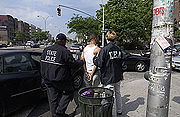
In 2008, 1.5 million Americans were arrested for drug offenses. 500,000 were imprisoned.
In the 1980s, while the number of arrests for all crimes was rising 28%, the number of arrests for drug offenses rose 126%. Among the prisoners, drug offenders made up the same percentage of State prisoners in both 1997 and 2004 (21%). The percentage of Federal prisoners serving time for drug offenses declined from 63% in 1997 to 55% in 2004. The US Department of Justice, reporting on the effects of state initiatives, has stated that, from 1990 through 2000. "the increasing number of drug offenses accounted for 27% of the total growth among black inmates, 7% of the total growth among Hispanic inmates, and 15% of the growth among white inmates." In addition to prison or jail, the United States provides for the deportation of many non-citizens convicted of drug offenses.
Federal and state policies also impose collateral consequences
Collateral consequences of criminal charges
Collateral consequences of criminal conviction, commonly referred to as the "Four C's" are the additional civil state penalties, mandated by statute, that attach to criminal convictions. They are not part of the direct consequences of criminal conviction, such as incarceration, fines, and/or...
on those convicted of drug offenses, such as denial of public benefits or licenses, that are not applicable to those convicted of other types of crime.
Marijuana constitutes almost half of all drug arrests, and between 1990–2002, out of the overall drug arrests, 82% of the increase was for marijuana. In 2004, approximately 12.7% of state prisoners and 12.4% of Federal prisoners were serving time for a marijuana-related offense.
The practice of imposing longer prison sentences on repeat offenders is common in many countries, but the Three strike laws in the U.S., which mandate 25 year imprisonment and became implemented in many states in the 1990s, is very extreme in comparison with most countries in Europe. During the first 9 years after Nixon coined the expression War on Drugs, the statistics show only a minor increase of the number of imprisoned, which implies that some other factor than the declaration of "war" is the primary contributor to the rate of incarceration.
Sentencing disparities
In 1986, the U.S. Congress passed laws that created a 100 to 1 sentencing disparity for the possession or trafficking of crackCrack cocaine
Crack cocaine is the freebase form of cocaine that can be smoked. It may also be termed rock, hard, iron, cavvy, base, or just crack; it is the most addictive form of cocaine. Crack rocks offer a short but intense high to smokers...
when compared to penalties for trafficking of powder cocaine
Cocaine
Cocaine is a crystalline tropane alkaloid that is obtained from the leaves of the coca plant. The name comes from "coca" in addition to the alkaloid suffix -ine, forming cocaine. It is a stimulant of the central nervous system, an appetite suppressant, and a topical anesthetic...
, which had been widely criticized as discriminatory against minorities, mostly blacks, who were more likely to use crack than powder cocaine. This 100:1 ratio had been required under federal law since 1986. Persons convicted in federal court of possession of 5 grams of crack cocaine received a minimum mandatory sentence of 5 years in federal prison. On the other hand, possession of 500 grams of powder cocaine carries the same sentence. In 2010, the Fair Sentencing Act
Fair Sentencing Act
The Fair Sentencing Act of 2010 was an Act of Congress signed into law by U.S. President Barack Obama on August 3, 2010. Similar bills were introduced in several U.S. Congresses before its passage in 2010...
cut the sentencing disparity to 18:1.
Crime statistics show that in 1999 the United States blacks
African American
African Americans are citizens or residents of the United States who have at least partial ancestry from any of the native populations of Sub-Saharan Africa and are the direct descendants of enslaved Africans within the boundaries of the present United States...
were far more likely to be targeted by law enforcement for drug crimes, and received much stiffer penalties and sentences than non-minorities. Those same statistics also show that such events were far more likely to take place in areas with high minority crime: low income housing neighborhoods, city projects etc.
Statistics from 1998 show that there were wide racial disparities in arrests, prosecutions, sentencing and deaths. African-American drug users made up for 35% of drug arrests, 55% of convictions, and 74% of people sent to prison for drug possession crimes. Nationwide African-Americans were sent to state prisons for drug offenses 13 times more often than other races, even though they only supposedly comprised 13% of regular drug users.
Foreign policy and covert military activities
Some scholars have indicated that the phrase War on Drugs is propagandaPropaganda
Propaganda is a form of communication that is aimed at influencing the attitude of a community toward some cause or position so as to benefit oneself or one's group....
cloaking an extension of earlier military or paramilitary operations. Others have argued that large amounts of "drug war
War as metaphor
The use of war as metaphor is a literary trope of long-standing. An example is the Culture War in the United States. In Metaphors We Live By, George Lakoff and Mark Johnson describe Jimmy Carter's application of "war" as metaphor for the energy crisis of 1974.In discussing the morality of the use...
" foreign aid money, training, and equipment actually goes to fighting leftist insurgencies and is often provided to groups who themselves are involved in large-scale narco-trafficking, such as corrupt members of the Colombian military.
Operation Intercept
One of the first anti-drug efforts in the realm of foreign policy was President Nixon'sRichard Nixon
Richard Milhous Nixon was the 37th President of the United States, serving from 1969 to 1974. The only president to resign the office, Nixon had previously served as a US representative and senator from California and as the 36th Vice President of the United States from 1953 to 1961 under...
Operation Intercept
Operation Intercept
Operation Intercept was an anti-drug measure announced by President Nixon on at 2:30pm on Sunday, September 21, 1969, resulting in a near shutdown of border crossings between the Mexico and the United States...
, announced in September 1969, targeted at reducing the amount of cannabis entering the United States from Mexico
Mexico
The United Mexican States , commonly known as Mexico , is a federal constitutional republic in North America. It is bordered on the north by the United States; on the south and west by the Pacific Ocean; on the southeast by Guatemala, Belize, and the Caribbean Sea; and on the east by the Gulf of...
. The effort began with an intense inspection crackdown that resulted in an almost shutdown of cross-border traffic. Because the burden on border crossings was controversial in border states, the effort only lasted twenty days.
Operation Just Cause
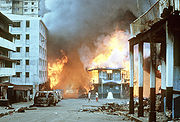
Panama
Panama , officially the Republic of Panama , is the southernmost country of Central America. Situated on the isthmus connecting North and South America, it is bordered by Costa Rica to the northwest, Colombia to the southeast, the Caribbean Sea to the north and the Pacific Ocean to the south. The...
as part of Operation Just Cause, which involved 25,000 American troops. Gen. Manuel Noriega
Manuel Noriega
Manuel Antonio Noriega Moreno is a Panamanian politician and soldier. He was military dictator of Panama from 1983 to 1989.The 1989 invasion of Panama by the United States removed him from power; he was captured, detained as a prisoner of war, and flown to the United States. Noriega was tried on...
, head of the government of Panama, had been giving military assistance to Contra groups
Contras
The contras is a label given to the various rebel groups opposing Nicaragua's FSLN Sandinista Junta of National Reconstruction government following the July 1979 overthrow of Anastasio Somoza Debayle's dictatorship...
in Nicaragua
Nicaragua
Nicaragua is the largest country in the Central American American isthmus, bordered by Honduras to the north and Costa Rica to the south. The country is situated between 11 and 14 degrees north of the Equator in the Northern Hemisphere, which places it entirely within the tropics. The Pacific Ocean...
at the request of the U.S. which, in exchange, allowed him to continue his drug trafficking activities, which they had known about since the 1960s. When the Drug Enforcement Administration
Drug Enforcement Administration
The Drug Enforcement Administration is a federal law enforcement agency under the United States Department of Justice, tasked with combating drug smuggling and use within the United States...
(DEA) tried to indict Noriega in 1971, the CIA
Central Intelligence Agency
The Central Intelligence Agency is a civilian intelligence agency of the United States government. It is an executive agency and reports directly to the Director of National Intelligence, responsible for providing national security intelligence assessment to senior United States policymakers...
prevented them from doing so. The CIA, which was then directed by future president George H. W. Bush
George H. W. Bush
George Herbert Walker Bush is an American politician who served as the 41st President of the United States . He had previously served as the 43rd Vice President of the United States , a congressman, an ambassador, and Director of Central Intelligence.Bush was born in Milton, Massachusetts, to...
, provided Noriega with hundreds of thousands of dollars per year as payment for his work in Latin America., When CIA pilot Eugene Hasenfus
Eugene Hasenfus
Eugene H. Hasenfus is a United States citizen who was alleged by Nicaragua Sandinista authorities to be employed by the U.S...
was shot down over Nicaragua by the Sandinistas, documents aboard the plane revealed many of the CIA's activities in Latin America, and the CIA's connections with Noriega became a public relations
Public relations
Public relations is the actions of a corporation, store, government, individual, etc., in promoting goodwill between itself and the public, the community, employees, customers, etc....
"liability" for the U.S. government, which finally allowed the DEA to indict him for drug trafficking, after decades of allowing his drug operations to proceed unchecked. Operation Just Cause, whose purpose was to capture Noriega, killed numerous Panamanian civilians; Noriega found temporary asylum in the Papal Nuncio, and surrendered to U.S. soldiers on January 3, 1990. He was sentenced by a court in Miami to 45 years in prison.
Plan Colombia
Plan Colombia
The term Plan Colombia is most often used to refer to U.S. legislation aimed at curbing drug smuggling and combating a left-wing insurgency by supporting different activities in Colombia....
program, the United States government currently provides hundreds of millions of dollars per year of military aid
Military aid
Military aid is aid which is used to assist an ally in its defense efforts, or to assist a poor country in maintaining control over its own territory. Many countries receive military aid to help with counter-insurgency efforts...
, training, and equipment to Colombia
Colombia
Colombia, officially the Republic of Colombia , is a unitary constitutional republic comprising thirty-two departments. The country is located in northwestern South America, bordered to the east by Venezuela and Brazil; to the south by Ecuador and Peru; to the north by the Caribbean Sea; to the...
, to fight left-wing guerrillas such as the Revolutionary Armed Forces of Colombia
Revolutionary Armed Forces of Colombia
The Revolutionary Armed Forces of Colombia – People's Army is a Marxist–Leninist revolutionary guerrilla organization based in Colombia which is involved in the ongoing Colombian armed conflict, currently involved in drug dealing and crimes against the civilians..FARC-EP is a peasant army which...
(FARC-EP), which has been accused of being involved in drug trafficking.
Private U.S. corporations have signed contracts to carry out anti-drug activities as part of Plan Colombia. DynCorp, the largest private company involved, was among those contracted by the State Department, while others signed contracts with the Defense Department.
Colombian military personnel have received extensive counterinsurgency training from U.S. military and law enforcement agencies, including the School of Americas (SOA). Author Grace Livingstone has stated that more Colombian SOA graduates have been implicated in human rights abuses than currently known SOA graduates from any other country. All of the commanders of the brigades highlighted in a 2001 Human Rights Watch
Human Rights Watch
Human Rights Watch is an international non-governmental organization that conducts research and advocacy on human rights. Its headquarters are in New York City and it has offices in Berlin, Beirut, Brussels, Chicago, Geneva, Johannesburg, London, Los Angeles, Moscow, Paris, San Francisco, Tokyo,...
report on Colombia were graduates of the SOA, including the III brigade in Valle del Cauca, where the 2001 Alto Naya Massacre occurred. US-trained officers have been accused of being directly or indirectly involved in many atrocities during the 1990s, including the Massacre of Trujillo
Massacre of Trujillo
The Massacre of Trujillo was a series of murders perpetrated between 1988 and 1994 in the town of Trujillo, Valle del Cauca Department in southwestern Colombia by paramilitaries and the Cali Cartel with the complicity of active members of the Colombian military and police.Some 245 to 342 people,...
and the 1997 Mapiripán Massacre
Mapiripán Massacre
The Mapiripán Massacre was a massacre of civilians that took place in Mapiripán, Meta Department, Colombia. The massacre was carried out from July 15 to July 20, 1997, by the United Self-Defense Forces of Colombia , an outlawed right-wing paramilitary group backed by elements of the government.On...
. US military schools and manuals have been training Latin American officers in Colombia and in the region at large since the 1960s, and have taught students to target civilian supporters of the guerrillas.
In 2000, the Clinton administration initially waived all but one of the human rights conditions attached to Plan Colombia, considering such aid as crucial to national security at the time.
The efforts of U.S. and Colombian governments have been criticized for focusing on fighting leftist guerrillas in southern regions without applying enough pressure on right-wing paramilitaries and continuing drug smuggling operations in the north of the country. Human Rights Watch, congressional committees and other entities have documented the existence of connections between members of the Colombian military and the AUC
United Self-Defense Forces of Colombia
The United Self-Defense Forces of Colombia was created as an umbrella organization of regional far-right...
, which the U.S. government has listed as a terrorist group, and that Colombian military personnel have committed human rights abuses which would make them ineligible for U.S. aid under current laws.
In 2010, the Washington Office on Latin America
Washington Office on Latin America
The Washington Office on Latin America is an American non-governmental organization whose stated goal is to promote human rights, democracy and social and economic justice in Latin America and the Caribbean....
concluded that both Plan Colombia and the Colombian government's security strategy "came at a high cost in lives and resources, only did part of the job, are yielding diminishing returns and have left important institutions weaker."
Merida Initiative
The Mérida InitiativeMérida Initiative
The Mérida Initiative is a security cooperation agreement between the United States and the government of Mexico and the countries of Central America, with the declared aim of combating the threats of drug trafficking, transnational organized crime and money laundering...
is a security cooperation approved on June 30, 2008, between the United States and the government of Mexico and the countries of Central America
Central America
Central America is the central geographic region of the Americas. It is the southernmost, isthmian portion of the North American continent, which connects with South America on the southeast. When considered part of the unified continental model, it is considered a subcontinent...
, with the aim of combating the threats of drug trafficking and transnational crime. The Mérida Initiative appropriated $1.4 billion in a three year commitment (2008–2010) to the Mexican government for military and law enforcement training and equipment, as well as technical advice and training to strengthen the national justice systems. No weapons are included in the plan.
Aerial herbicide application
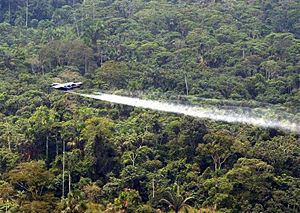
Environmental consequences resulting from aerial fumigation have been criticized as detrimental to some of the world's most fragile ecosystems; the same aerial fumigation practices are further credited with causing health problems in local populations.
Many Latin American farmers say that the fumigation programs are destroying their food crops, and that they are starving as a result.
Public support and opposition
The War on Drugs has been a highly contentious issue since its inception.A poll on October 2, 2008, found that three in four Americans believed that the War On Drugs was failing.
Critics claim a large number of unnecessary deaths and imprisonments, increased levels of violent crime and gang activity, wasted government funds, violation of civil liberties, lack of public support, illegality of current drug policies, environmental destruction from drug eradication programs, lack of effectiveness, and a number of other issues.
Supporters claim that the War on Drugs is effective, protects families and communities, makes people more productive, social conditions are better as a result of it, and a number of other issues.
Cyclic creation of permanent underclass
Thus, some authors maintain that the War on Drugs has resulted in the creation of a permanent underclass of people who have few educational or job opportunities, often as a result of being punished for drug offenses which in turn have resulted from attempts to earn a living in spite of having no education or job opportunities.
Costs to taxpayers
A 2008 study by Harvard economist Jeffrey A. Miron has estimated that legalizing drugs would inject $76.8 billion a year into the U.S. economy — $44.1 billion from law enforcement savings, and at least $32.7 billion in tax revenue ($6.7 billion from marijuana, $22.5 billion from cocaine and heroin, remainder from other drugs).Low taxation in Central American countries has been credited with weakening the region's response in dealing with drug traffickers. Many cartels, especially Los Zetas
Los Zetas
Los Zetas is the second most powerful drug cartel in Mexico and considered by the U.S. Drug Enforcement Administration as the most violent drug cartel and paramilitary enforcement group in Mexico...
have taken advantage of the limited resources of these nations. 2010 tax revenue in El Salvador
El Salvador
El Salvador or simply Salvador is the smallest and the most densely populated country in Central America. The country's capital city and largest city is San Salvador; Santa Ana and San Miguel are also important cultural and commercial centers in the country and in all of Central America...
, Guatemala
Guatemala
Guatemala is a country in Central America bordered by Mexico to the north and west, the Pacific Ocean to the southwest, Belize to the northeast, the Caribbean to the east, and Honduras and El Salvador to the southeast...
, and Honduras
Honduras
Honduras is a republic in Central America. It was previously known as Spanish Honduras to differentiate it from British Honduras, which became the modern-day state of Belize...
, composed just 13.53% of GDP. As a comparison, in Chile
Chile
Chile ,officially the Republic of Chile , is a country in South America occupying a long, narrow coastal strip between the Andes mountains to the east and the Pacific Ocean to the west. It borders Peru to the north, Bolivia to the northeast, Argentina to the east, and the Drake Passage in the far...
and the U.S., taxes were 18.6% and 26.9% of GDP respectively. Additionally, many Central American tax codes are highly regressive and emphasize indirect, Value Added Taxes (VATs) on good purchased, which disproportionately affect the less fortunate. Essentially, those with more money are taxed pretty much equally on the goods they purchase. However, direct taxes on income are very hard to enforce and in some cases tax evasion is seen as a national pastime.
Impact on growers
The status of coca and coca growers has become an intense political issue in several countries, including ColombiaColombia
Colombia, officially the Republic of Colombia , is a unitary constitutional republic comprising thirty-two departments. The country is located in northwestern South America, bordered to the east by Venezuela and Brazil; to the south by Ecuador and Peru; to the north by the Caribbean Sea; to the...
and particularly Bolivia
Bolivia
Bolivia officially known as Plurinational State of Bolivia , is a landlocked country in central South America. It is the poorest country in South America...
, where the president, Evo Morales
Evo Morales
Juan Evo Morales Ayma , popularly known as Evo , is a Bolivian politician and activist, currently serving as the 80th President of Bolivia, a position that he has held since 2006. He is also the leader of both the Movement for Socialism party and the cocalero trade union...
, a former coca growers' union leader, has promised to legalise the traditional cultivation and use of coca.
The coca eradication policy has been criticised for its negative impact on the livelihood of coca growers in South America
South America
South America is a continent situated in the Western Hemisphere, mostly in the Southern Hemisphere, with a relatively small portion in the Northern Hemisphere. The continent is also considered a subcontinent of the Americas. It is bordered on the west by the Pacific Ocean and on the north and east...
. In many areas of South America the coca leaf has traditionally been chewed and used in tea and for religious, medicinal and nutritional purposes by locals. For this reason many insist that the illegality of traditional coca cultivation is unjust. In many areas the US government and military has forced the eradication of coca without providing for any meaningful alternate crop for farmers, and has additionally destroyed many of their food or market crops, leaving them starving and destitute.
U.S. government involvement in drug trafficking
The CIA, DEA, State Department, and several other U.S. government agencies have been implicated in various drug trafficking enterprises, which were used to fund illegal covert activities in several nations.CIA and Contra cocaine trafficking
A lawsuit filed in 1986 by two journalists represented by the Christic InstituteChristic Institute
The Christic Institute was a public interest law firm founded in 1980 by Daniel Sheehan, his wife, Sara Nelson and their partner, William J. Davis, who was a Jesuit priest. Its headquarters were based in Washington, D.C. with several offices in other major United States cities, such as San...
showed that the Central Intelligence Agency
Central Intelligence Agency
The Central Intelligence Agency is a civilian intelligence agency of the United States government. It is an executive agency and reports directly to the Director of National Intelligence, responsible for providing national security intelligence assessment to senior United States policymakers...
(CIA) and other parties were engaged in criminal acts, including financing the purchase of arms with the proceeds of cocaine sales.
Senator John Kerry
John Kerry
John Forbes Kerry is the senior United States Senator from Massachusetts, the 10th most senior U.S. Senator and chairman of the Senate Foreign Relations Committee. He was the presidential nominee of the Democratic Party in the 2004 presidential election, but lost to former President George W...
's 1988 U.S. Senate Committee on Foreign Relations report on Contra drug links concludes that members of the U.S. State Department "who provided support for the Contras are involved in drug trafficking... and elements of the Contras themselves knowingly receive financial and material assistance from drug traffickers." The report further states that "the Contra drug links include... payments to drug traffickers by the U.S. State Department of funds authorized by the Congress for humanitarian assistance to the Contras, in some cases after the traffickers had been indicted by federal law enforcement agencies on drug charges, in others while traffickers were under active investigation by these same agencies."
In 1996, journalist Gary Webb
Gary Webb
Gary Webb was a Pulitzer prize-winning American investigative journalist.Webb was best known for his 1996 "Dark Alliance" series of articles written for the San Jose Mercury News and later published as a book...
published reports in the San Jose Mercury News
San Jose Mercury News
The San Jose Mercury News is a daily newspaper in San Jose, California. On its web site, however, it calls itself Silicon Valley Mercury News. The paper is owned by MediaNews Group...
, and later in his book Dark Alliance, detailing how Contras
Contras
The contras is a label given to the various rebel groups opposing Nicaragua's FSLN Sandinista Junta of National Reconstruction government following the July 1979 overthrow of Anastasio Somoza Debayle's dictatorship...
, with the assistance of the U.S. government had distributed crack cocaine
Crack cocaine
Crack cocaine is the freebase form of cocaine that can be smoked. It may also be termed rock, hard, iron, cavvy, base, or just crack; it is the most addictive form of cocaine. Crack rocks offer a short but intense high to smokers...
into Los Angeles
Los Ángeles
Los Ángeles is the capital of the province of Biobío, in the commune of the same name, in Region VIII , in the center-south of Chile. It is located between the Laja and Biobío rivers. The population is 123,445 inhabitants...
to fund weapons purchases.
Webb's premise regarding the US Government connection was initially attacked at the time by the corporate media. It is now widely accepted that Webb's main assertion of government "knowledge of drug operations, and collaboration with and protection of known drug traffickers" was correct. In 1998, CIA Inspector General
Inspector General
An Inspector General is an investigative official in a civil or military organization. The plural of the term is Inspectors General.-Bangladesh:...
Frederick Hitz
Frederick Hitz
Frederick Porter Hitz is an author and former Inspector General of the Central Intelligence Agency .Hitz graduated from Princeton University and the Harvard School of Law.Hitz entered the CIA in 1967 as an operations officer...
published a two-volume report that while seemingly refuting Webb's claims of knowledge and collaboration in its conclusions did not deny them in its body. Hitz went on to admit CIA improprieties in the affair in testimony to a House congressional committee. Mainstream media has since reversed its position on Webb's work acknowledging his contribution to exposing a scandal it had ignored.
Heroin trafficking operations of the CIA, U.S. Navy and Sicilian Mafia
During World War II, the United States NavyUnited States Navy
The United States Navy is the naval warfare service branch of the United States Armed Forces and one of the seven uniformed services of the United States. The U.S. Navy is the largest in the world; its battle fleet tonnage is greater than that of the next 13 largest navies combined. The U.S...
, concerned that strikes
Strike action
Strike action, also called labour strike, on strike, greve , or simply strike, is a work stoppage caused by the mass refusal of employees to work. A strike usually takes place in response to employee grievances. Strikes became important during the industrial revolution, when mass labour became...
and labor disputes in U.S. eastern shipping ports would disrupt wartime logistics
Logistics
Logistics is the management of the flow of goods between the point of origin and the point of destination in order to meet the requirements of customers or corporations. Logistics involves the integration of information, transportation, inventory, warehousing, material handling, and packaging, and...
, released the mobster Lucky Luciano
Lucky Luciano
Charlie "Lucky" Luciano was an Italian mobster born in Sicily. Luciano is considered the father of modern organized crime in the United States for splitting New York City into five different Mafia crime families and the establishment of the first commission...
from prison, and collaborated with him to help the mafia take control of those ports. Labor union members were terrorized and murdered as a means of preventing labor unrest and ensuring smooth shipping of supplies to Europe.
In order to prevent Communist
Italian Communist Party
The Italian Communist Party was a communist political party in Italy.The PCI was founded as Communist Party of Italy on 21 January 1921 in Livorno, by seceding from the Italian Socialist Party . Amadeo Bordiga and Antonio Gramsci led the split. Outlawed during the Fascist regime, the party played...
party members from being elected in Italy
Italy
Italy , officially the Italian Republic languages]] under the European Charter for Regional or Minority Languages. In each of these, Italy's official name is as follows:;;;;;;;;), is a unitary parliamentary republic in South-Central Europe. To the north it borders France, Switzerland, Austria and...
following World War II
World War II
World War II, or the Second World War , was a global conflict lasting from 1939 to 1945, involving most of the world's nations—including all of the great powers—eventually forming two opposing military alliances: the Allies and the Axis...
, the CIA worked closely with the Sicilian Mafia, protecting them and assisting in their worldwide heroin smuggling operations in exchange for the mafia's assistance with assassinating, torturing, and beating leftist political organizers.
CIA/KMT opium smuggling operations
To provide covert funds for the KuomintangKuomintang
The Kuomintang of China , sometimes romanized as Guomindang via the Pinyin transcription system or GMD for short, and translated as the Chinese Nationalist Party is a founding and ruling political party of the Republic of China . Its guiding ideology is the Three Principles of the People, espoused...
(KMT) forces loyal to Generalissimo Chiang Kai-Shek
Chiang Kai-shek
Chiang Kai-shek was a political and military leader of 20th century China. He is known as Jiǎng Jièshí or Jiǎng Zhōngzhèng in Mandarin....
, who were fighting the Chinese communists under Mao Zedong
Mao Zedong
Mao Zedong, also transliterated as Mao Tse-tung , and commonly referred to as Chairman Mao , was a Chinese Communist revolutionary, guerrilla warfare strategist, Marxist political philosopher, and leader of the Chinese Revolution...
, the CIA helped the KMT smuggle opium from China and Burma to Bangkok, Thailand by providing airplanes owned by one of their front businesses, Air America.
Efficiency
During the early to mid-1990s, the Clinton administration ordered and funded a major cocaine policy study, again by RAND. The Rand Drug Policy Research Center study concluded that $3 billion should be switched from federal and local law enforcement to treatment. The report said that treatment is the cheapest way to cut drug use, stating that drug treatment is twenty-three times more effective than the supply-side "war on drugs".
The National Research Council
United States National Research Council
The National Research Council of the USA is the working arm of the United States National Academies, carrying out most of the studies done in their names.The National Academies include:* National Academy of Sciences...
Committee on Data and Research for Policy on Illegal Drugs published its findings on the efficacy of the drug war. The NRC Committee found that existing studies on efforts to address drug usage and smuggling, from U.S. military operations to eradicate coca fields in Colombia, to domestic drug treatment centers, have all been inconclusive, if the programs have been evaluated at all: "The existing drug-use monitoring systems are strikingly inadequate to support the full range of policy decisions that the nation must make.... It is unconscionable for this country to continue to carry out a public policy of this magnitude and cost without any way of knowing whether and to what extent it is having the desired effect." The study, though not ignored by the press, was ignored by top-level policymakers, leading Committee Chair Charles Manski to conclude, as one observer notes, that "the drug war has no interest in its own results."
During alcohol prohibition
Prohibition in the United States
Prohibition in the United States was a national ban on the sale, manufacture, and transportation of alcohol, in place from 1920 to 1933. The ban was mandated by the Eighteenth Amendment to the Constitution, and the Volstead Act set down the rules for enforcing the ban, as well as defining which...
, the period from 1920 to 1933, alcohol use initially fell but began to increase as early as 1922. It has been extrapolated that even if prohibition had not been repealed in 1933, alcohol consumption would have quickly surpassed pre-prohibition levels . One argument against the War on Drugs is that it uses similar measures as Prohibition and is no more effective.
In the six years from 2000–2006, the USA spent $4.7 billion on Plan Colombia
Plan Colombia
The term Plan Colombia is most often used to refer to U.S. legislation aimed at curbing drug smuggling and combating a left-wing insurgency by supporting different activities in Colombia....
, an effort to eradicate coca production in Colombia. The main result of this effort was to shift coca production into more remote areas and force other forms of adaptation. The overall acreage cultivated for coca in Colombia at the end of the six years was found to be the same, after the U.S. Drug Czar's office announced a change in measuring methodology in 2005 and included new areas in its surveys. Cultivation in the neighboring countries of Peru and Bolivia actually increased.
Similar lack of efficacy is observed in some other countries pursuing similar policies. In 1994, 28.5% of Canadians reported having consumed illicit drugs in their life; by 2004, that figure had risen to 45%. 73% of the $368 million spent by the Canadian government on targeting illicit drugs in 2004–2005 went toward law enforcement rather than treatment, prevention or harm reduction.
Richard Davenport-Hines
Richard Davenport-Hines
Richard Davenport-Hines is a British historian and literary biographer, best known for his biography of the poet W. H. Auden....
, in his book The Pursuit of Oblivion, criticized the efficacy of the War on Drugs by pointing out that
Alberto Fujimori
Alberto Fujimori
Alberto Fujimori Fujimori served as President of Peru from 28 July 1990 to 17 November 2000. A controversial figure, Fujimori has been credited with the creation of Fujimorism, uprooting terrorism in Peru and restoring its macroeconomic stability, though his methods have drawn charges of...
, president of Peru
Peru
Peru , officially the Republic of Peru , is a country in western South America. It is bordered on the north by Ecuador and Colombia, on the east by Brazil, on the southeast by Bolivia, on the south by Chile, and on the west by the Pacific Ocean....
from 1990–2000, described U.S. foreign drug policy as "failed" on grounds that "for 10 years, there has been a considerable sum invested by the Peruvian government and another sum on the part of the American government, and this has not led to a reduction in the supply of coca leaf offered for sale. Rather, in the 10 years from 1980 to 1990, it grew 10-fold."
At least 500 economists, including Nobel Laureates Milton Friedman
Milton Friedman
Milton Friedman was an American economist, statistician, academic, and author who taught at the University of Chicago for more than three decades...
, George Akerlof
George Akerlof
George Arthur Akerlof is an American economist and Koshland Professor of Economics at the University of California, Berkeley. He won the 2001 Nobel Prize in Economics George Arthur Akerlof (born June 17, 1940) is an American economist and Koshland Professor of Economics at the University of...
and Vernon L. Smith
Vernon L. Smith
Vernon Lomax Smith is professor of economics at Chapman University's Argyros School of Business and Economics and School of Law in Orange, California, a research scholar at George Mason University Interdisciplinary Center for Economic Science, and a Fellow of the Mercatus Center, all in Arlington,...
, have noted that reducing the supply of marijuana without reducing the demand causes the price, and hence the profits of marijuana sellers, to go up, according to the laws of supply and demand. The increased profits encourage the producers to produce more drugs despite the risks, providing a theoretical explanation for why attacks on drug supply have failed to have any lasting effect. The aforementioned economists published an open letter to President George W. Bush
George W. Bush
George Walker Bush is an American politician who served as the 43rd President of the United States, from 2001 to 2009. Before that, he was the 46th Governor of Texas, having served from 1995 to 2000....
stating "We urge...the country to commence an open and honest debate about marijuana prohibition... At a minimum, this debate will force advocates of current policy to show that prohibition has benefits sufficient to justify the cost to taxpayers, foregone tax revenues and numerous ancillary consequences that result from marijuana prohibition."
The declaration from the World Forum Against Drugs, 2008 state that a balanced policy of drug abuse prevention, education,
treatment, law enforcement, research, and supply reduction provides the most effective platform to reduce drug abuse and its associated harms and call on governments to consider demand reduction
Demand reduction
Demand reduction refers to efforts aimed at reducing public desire for illegal and illicit drugs. This drug policy is in contrast to the reduction of drug supply, but the two policies are often implemented together...
as one of their first priorities in the fight against drug abuse.
Despite over $7 billion spent annually towards arresting and prosecuting nearly 800,000 people across the country for marijuana offenses in 2005 (FBI Uniform Crime Reports), the federally-funded Monitoring the Future Survey reports about 85% of high school seniors find marijuana "easy to obtain." That figure has remained virtually unchanged since 1975, never dropping below 82.7% in three decades of national surveys. The Drug Enforcement Administration
Drug Enforcement Administration
The Drug Enforcement Administration is a federal law enforcement agency under the United States Department of Justice, tasked with combating drug smuggling and use within the United States...
states that the number of users of marijuana in the U.S. declined between 2000 and 2005,, though usage rates remain higher than they were in the 1990s according to the NSDUH.
ONDCP stated in April 2011 that there has been a 46 percent drop in cocaine use among young adults over the past five years, and a 65 percent drop in the rate of people testing positive for cocaine in the workplace since 2006. At the same time, a 2007 study found that up to 35% of college undergraduates used stimulants not prescribed to them.
Legality
The legality of the War on Drugs has been challenged on six main grounds in the US.- It is argued that drug prohibition, as presently implemented, violates the substantive due processSubstantive due processSubstantive due process is one of the theories of law through which courts enforce limits on legislative and executive powers and authority...
doctrine in that its benefits do not justify the encroachments on rights that are supposed to be guaranteed by the FifthFifth Amendment to the United States ConstitutionThe Fifth Amendment to the United States Constitution, which is part of the Bill of Rights, protects against abuse of government authority in a legal procedure. Its guarantees stem from English common law which traces back to the Magna Carta in 1215...
and FourteenthFourteenth Amendment to the United States ConstitutionThe Fourteenth Amendment to the United States Constitution was adopted on July 9, 1868, as one of the Reconstruction Amendments.Its Citizenship Clause provides a broad definition of citizenship that overruled the Dred Scott v...
Amendments to the U.S. Constitution. On July 27, 2011, U.S. District Judge Mary S. Scriven ruled that Florida's legislation purporting to eliminate intent as an element of the crime of drug possession was unconstitutional. Commentators explained the ruling in terms of due process. - Freedom of religious conscience legally allows some, for example, members of the Native American ChurchNative American ChurchNative American Church, a religious denomination which practices Peyotism or the Peyote religion, originated in the U.S. state of Oklahoma, and is the most widespread indigenous religion among Native Americans in the United States...
, to use peyotePeyoteLophophora williamsii , better known by its common name Peyote , is a small, spineless cactus with psychoactive alkaloids, particularly mescaline.It is native to southwestern Texas and Mexico...
with definite spiritual or religious motives, but the Free Exercise Clause of the First AmendmentFree Exercise Clause of the First AmendmentThe Free Exercise Clause is the accompanying clause with the Establishment Clause of the First Amendment to the United States Constitution. The Establishment Clause and the Free Exercise Clause together read:...
implies no requirement for someone to be affiliated to an official church - therefore leaving some ambiguity. - It has been argued that the Commerce ClauseCommerce ClauseThe Commerce Clause is an enumerated power listed in the United States Constitution . The clause states that the United States Congress shall have power "To regulate Commerce with foreign Nations, and among the several States, and with the Indian Tribes." Courts and commentators have tended to...
means that the power to regulate drug use should be state law not federal law. - The inequity of prosecuting the war on certain drugs but not alcohol or tobacco has also been called into question. Prohibition of alcohol required the 18th Amendment to the Constitution. It has been argued that prohibition of marijuana would also require an amendment to the Constitution, but no such amendment has been made.
- It is argued that the reverse burden of proof in drug-possession cases is incompatible with the rule of lawRule of lawThe rule of law, sometimes called supremacy of law, is a legal maxim that says that governmental decisions should be made by applying known principles or laws with minimal discretion in their application...
in that the power to convict is effectively taken from the courts and given to those who are willing to plant evidence. - Regardless of the legality itself of the war on drugs, there have been accusations of inequality in the prosecution of that war, claiming it disproportionately targets certain regimes and ethnic groups.
Alternatives
Several authors believe that the United States’ federal and state governments have chosen the wrong method to combat the distribution of drugs. By financing domestic law enforcement (which includes activities focused on the criminal justice system, such as the courts, police, and prosecution) in favor of treatment (which includes helping users become drug-free through in-patient and out-patient counseling and other services), the government has focused on punishment rather than prevention. In addition, by making drugs illegal rather than regulating them, the War on Drugs creates a highly profitable black market. Jefferson FishJefferson Fish
Jefferson M. Fish is a professor emeritus of psychology at St. John's University in New York City, where he previously served as Chair of the Department of Psychology and as Director of the PhD Program in Clinical Psychology....
has edited scholarly collections of articles offering a wide variety of public health based and rights based alternative drug policies.
In the year 2000, the United States drug-control budget reached 18.4 billion dollars, nearly half of which was spent financing law enforcement while only one sixth was spent on treatment. In the year 2003, 53 percent of the requested drug control budget was for enforcement, 29 percent for treatment, and 18 percent for prevention. The state of New York, in particular, designated 17 percent of its budget towards substance-abuse-related spending. Of that, a mere one percent was put towards prevention, treatment, and research.
In a survey taken by Substance Abuse and Mental Heath Services Administration (SAMHSA), it was found that substance abusers that remain in treatment longer are less likely to resume their former drug habits. Of the people that were studied, 66 percent were cocaine users. After experiencing long-term in-patient treatment, only 22 percent returned to the use of cocaine. Treatment had reduced the number of cocaine abusers by two-thirds. By spending the majority of its money on law enforcement, the federal government had underestimated the true value of drug-treatment facilities and their benefit towards reducing the number of addicts in the U.S.
In 2004 the Federal Government issued the National Drug Control Strategy. It supported programs designed to expand treatment options, enhance treatment delivery, and improve treatment outcomes. For example, the Strategy provided SAMHSA with a $100.6 million grant to put towards their Access to Recovery (ATR) initiative. ATR is a program that provides checks to addicts to provide them with the means to acquire clinical treatment. The project’s goals are to expand capacity, support client choice, and increase the array of faith-based and community based providers for clinical treatment and recovery support services. The ATR program will also provide a more flexible array of services based on the individual’s treatment needs.
The 2004 Strategy additionally declared a significant 32 million dollar raise in the Drug Courts Program, which provides drug offenders with alternatives to incarceration. As a substitute for imprisonment, drug courts identify substance-abusing offenders and place them under strict court monitoring and community supervision, as well as provide them with long-term treatment services. According to a report issued by the National Drug Court Institute, drug courts have a wide array of benefits, with only 16.4 percent of the nation’s drug court graduates are rearrested and charged with a felony within one year of completing the program. Additionally, enrolling an addict in a drug court program costs much less than incarcerating one in prison. According to the Bureau of Prisons, the fee to cover the average cost of incarceration for Federal inmates in 2006 was $24,440. The annual cost of receiving treatment in a drug court program ranges from $900 to $3,500. Drug courts in New York State alone saved $2.54 million in incarceration costs.
See also
- List of wars on concepts
- Prison-industrial complexPrison-industrial complex"Prison–industrial complex" is a term used to attribute the rapid expansion of the US inmate population to the political influence of private prison companies and businesses that supply goods and services to government prison agencies. The term is analogous to the military–industrial complex that...
Covert activities and foreign policy
- Golden CrescentGolden CrescentThe Golden Crescent is the name given to one of Asia's two principal areas of illicit opium production, located at the crossroads of Central, South, and Western Asia...
- Golden TriangleGolden Triangle (Southeast Asia)The Golden Triangle is one of Asia's two main illicit opium-producing areas. It is an area of around that overlaps the mountains of four countries of Southeast Asia: Burma, Vietnam, Laos, and Thailand. Along with Afghanistan in the Golden Crescent and Pakistan, it has been one of the most...
- Iran Contra
- Military Cooperation with Civilian Law Enforcement Agencies ActMilitary Cooperation with Civilian Law Enforcement Agencies ActThe Military Cooperation with Civilian Law Enforcement Agencies Act is a United States federal law enacted in 1981 that allowed the military of the United States to cooperate with law enforcement...
- Opium War
- Paramilitarism in ColombiaParamilitarism in ColombiaParamilitarism in Colombia refers to the origins and activities of far right-wing paramilitary groups in Colombia during the 20th century.Right-wing paramilitary groups are the parties considered to be most responsible for human rights violations in Colombia during the later half of the current...
- Plan ColombiaPlan ColombiaThe term Plan Colombia is most often used to refer to U.S. legislation aimed at curbing drug smuggling and combating a left-wing insurgency by supporting different activities in Colombia....
- UMOPARUMOPARThe Unidad Móvil Policial para Áreas Rurales , a subsidiary of the Special Antinarcotics Force of the Bolivian National Police was created in 1987 and is a Bolivian anti-narcotics and counterinsurgency force which was founded by, and is funded, advised,...
- Air Bridge Denial ProgramAir Bridge Denial ProgramStarting in the 1990s the Central Intelligence Agency has operated an anti-narcotics program in Colombia and Peru called Air Bridge Denial . The ABD program targeted drug traffickers that transport illicit drugs through the air by forcing down suspicious aircraft, using lethal force if necessary...
Government agencies and laws
- Continuing Criminal EnterpriseContinuing Criminal EnterpriseThe Continuing Criminal Enterprise Statute is a United States federal law that targets large-scale drug traffickers who are responsible for long-term and elaborate drug conspiracies...
- Marijuana Control, Regulation, and Education ActMarijuana Control, Regulation, and Education ActThe Marijuana Control, Regulation, and Education Act, also known as California Assembly Bill 390 and later Assembly Bill 2254 , is the first bill ever introduced to regulate the sale and use of marijuana in the U.S. state of California...
- Office of National Drug Control PolicyOffice of National Drug Control PolicyThe White House Office of National Drug Control Policy , a former cabinet level component of the Executive Office of the President of the United States, was established in 1989 by the Anti-Drug Abuse Act of 1988...
- United Nations Drug Control Programme
Organizations opposing prohibition
- Drug Policy AllianceDrug Policy AllianceThe Drug Policy Alliance is a New York City-based non-profit organization, led by executive director Ethan Nadelmann, with the principal goal of ending the American "War on Drugs"...
- Marijuana Policy ProjectMarijuana Policy ProjectThe Marijuana Policy Project, or MPP, is the largest organization working solely on marijuana policy reform in the United States in terms of its budget, number of members, and staff...
- Law Enforcement Against ProhibitionLaw Enforcement Against ProhibitionLaw Enforcement Against Prohibition is a non-profit, international, educational organization comprising former and current police officers, government agents and other law enforcement agents who oppose the current War on Drugs. LEAP was founded on March 16, 2002...
- NORML
- November CoalitionNovember CoalitionThe November Coalition is a non-profit grassroots organization, founded in 1997, which fights against the War on Drugs and for the rights of the prisoners incarcerated as the effect of that war. It publishes a bulletin called Razor Wire.-Tyrone Brown:...
- Students for Sensible Drug PolicyStudents for Sensible Drug PolicyStudents for Sensible Drug Policy is an international non-profit advocacy and education organization based in Washington D.C., with offices in both Washington D.C. and San Francisco, CA...
- Transform Drug Policy FoundationTransform Drug Policy FoundationThe Transform Drug Policy Foundation is a registered non-profit charity based in the United Kingdom working in the field of drug policy and law reform. TDPF began as an independent campaign group called 'Transform, the campaign for a just and effective drug policy', and was set up in 1996 by its...
(United Kingdom) - Beckley FoundationBeckley FoundationThe Beckley Foundation is a charitable trust that promotes health orientated cost effective harm reductive drug policy reform. It also investigates consciousness and its modulation from a multidisciplinary perspective working in collaboration with world renowned scientists. The Foundation is based...
(United Kindom)
Organizations opposing drug legalization
- Drug Free America FoundationDrug Free America FoundationThe Drug Free America Foundation or DFAF is a 501 non-profit organization that currently describes itself as "committed to developing, promoting and sustaining global strategies, policies and laws that will reduce illegal drug use, drug addiction, drug-related injury and death." The organization...
- Partnership for a Drug-Free AmericaPartnership for a Drug-Free AmericaThe Partnership for a Drug-Free America is a non-profit organization that helps parents prevent, intervene in and find treatment for drug and alcohol use by their children...
- World Federation Against DrugsWorld Federation Against DrugsWorld Federation Against Drugs is a multilateral community of non-governmental organisations and individuals. Founded in 2009, the aim of WFAD is to work for a drug-free world...
Further reading
- The strength of the wolf: the secret history of America's war on drugs by Douglas Valentine
- Federal narcotics laws and the war on drugs: money down a rat hole by Thomas C. Rowe
- Cocaine: An Unauthorized Biography by Dominic Streatfeild
- "The Drug War Revisited", Eric Schneider, Berfrois, 2 November 2011
Research papers
- Wasted in the War on Drugs report by Citizens Against Government WasteCitizens Against Government WasteCitizens Against Government Waste is a 501 non-profit organization in the United States. It functions as a think-tank, 'government watchdog', and advocacy group for fiscally conservative causes...
Government and NGO reports
- National Drug Threat Assessment 2009 from the United States Department of JusticeUnited States Department of JusticeThe United States Department of Justice , is the United States federal executive department responsible for the enforcement of the law and administration of justice, equivalent to the justice or interior ministries of other countries.The Department is led by the Attorney General, who is nominated...
- War On Drugs: Legislation in the 108th Congress and Related Developments, a 2003 report from the Congressional Research ServiceCongressional Research ServiceThe Congressional Research Service , known as "Congress's think tank", is the public policy research arm of the United States Congress. As a legislative branch agency within the Library of Congress, CRS works exclusively and directly for Members of Congress, their Committees and staff on a...
via the State DepartmentUnited States Department of StateThe United States Department of State , is the United States federal executive department responsible for international relations of the United States, equivalent to the foreign ministries of other countries...
website - The Report of the Canadian Government Commission of Inquiry into the Non-Medical Use of Drugs—1972
External links
- Narco News -- news site focusing on drug war in Latin America
- Drug War Facts
- Drug War Distortions
- Major Studies of Drugs and Drug Policy Full text of major government commission reports on the drug laws from around the world over the last 100 years
- Historical Research on the Drug War Full text of numerous full histories of the drug war and thousands of original historical documents
- Cato Institute Drug Prohibition Research
- Drug War Victims
- Anti-DrugWar.org
News
- Jean Friedman-Rudovsky "Juarez's children: Drugs, death, and fear" Miami New Times, Sept. 9, 2010
Video and films
- The Prison Industrial Complex -- a War on Drugs Documentary
- The War on Drugs is the subject of the 2007 documentary film "The War on Drugs"
- The War on Drugs is the subject of the 2007 documentary film "American Drug War"
- The War on Drugs is covered in the 2006 documentary film "Cocaine Cowboys"
- The Damage Done -- Another documentary film