
| |
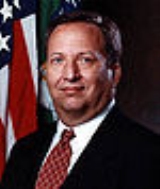
Lawrence Henry "Larry" Summers (born November 30, 1954) is an American economist and the head of the White House's National Economic Council for President Barack Obama.
Summers is the Charles W. Eliot University Professor at Harvard University's Kennedy School of Government. He is the 1993 recipient of the John Bates Clark Medal for his work in several fields of economics and was Secretary of the Treasury for the last year and a half of the Bill Clinton administration. Summers also served as the 27th President of Harvard University from 2001 to 2006.

Discussion
Ask a question about 'Lawrence Summers'
Start a new discussion about 'Lawrence Summers'
Answer questions from other users
|
Quotations
I think the economic logic behind dumping a load of toxic waste in the lowest wage country is impeccable and we should face up to it.
I've always thought that under-populated countries in Africa are vastly under-polluted, their air quality is probably vastly inefficiently low compared to Los Angeles or Mexico City.

Encyclopedia
Lawrence Henry "Larry" Summers (born November 30, 1954) is an American economist and the head of the White House's National Economic Council for President Barack Obama.
Summers is the Charles W. Eliot University Professor at Harvard University's Kennedy School of Government. He is the 1993 recipient of the John Bates Clark Medal for his work in several fields of economics and was Secretary of the Treasury for the last year and a half of the Bill Clinton administration. Summers also served as the 27th President of Harvard University from 2001 to 2006. Summers resigned as Harvard's president in the wake of controversy over a talk in which he speculated that women may have lesser aptitude for work in the highest levels of math and science. Summers has been criticized by some liberals for the centrist economic policies he advocated as Treasury Secretary and in later writings.
Family and education
Born in New Haven, Connecticut, on November 30, 1954, Summers is the son of two economists, Robert Summers and Anita Summers, who are both professors at the University of Pennsylvania, as well as the nephew of two Nobel laureates in economics: Paul Samuelson (sibling of Robert Summers, who, following an older brother's example, changed the family name from Samuelson to Summers) and Kenneth Arrow (Anita Summers's brother). He spent most of his childhood in Penn Valley, Pennsylvania, a suburb of Philadelphia, where he attended Harriton High School.
At age 16, he entered the Massachusetts Institute of Technology (MIT), where he originally intended to study physics but soon switched to economics (S.B., 1975). He was also an active member of the MIT debating team. He attended Harvard University as a graduate student (Ph.D., 1982), where he studied under conservative economist Martin Feldstein. In 1983, at age 28, Summers became one of the youngest tenured professors in Harvard's history. Summers has three children (older twin daughters Ruth and Pamela and son Harry) by his first wife, Victoria Perry. In December 2005, Summers married English professor Elisa New, who had three daughters from a previous marriage. He currently owns two houses, one in D.C. and one in Brookline, Massachusetts.
Career
Academic economist
As a researcher, Summers has made important contributions in many areas of economics, primarily public finance, labor economics, financial economics, and macroeconomics. Some of Summers' early papers concluded that corporate and capital gains taxes are an inefficient form of taxation. Cutting the capital gains tax rate, Summers found, could help the economy grow. Later, while working in the Reagan and Clinton White Houses, Summers was able to lobby successfully for cuts in both corporate and capital gains tax cuts. One of Summers' prominent findings in labor economics is that unemployment insurance and welfare payments are a major contributor to unemployment, and therefore should be scaled back.
Summers has also worked in international economics, economic demography, economic history, and development economics. His work generally emphasizes the analysis of empirical economic data in order to answer well-defined questions (for example: Does saving respond to after-tax interest rates? Are the returns from stocks and stock portfolios predictable?, Are most of those who receive unemployment benefits only transitorily unemployed?, etc.) For his work he received the John Bates Clark Medal in 1993 from the American Economic Association. In 1987 he was the first social scientist to win the Alan T. Waterman Award from the National Science Foundation. Summers is also a member of the National Academy of Sciences.
Public official
Summers was on the staff of the Council of Economic Advisers under President Reagan from 1982-1983. He also served as an economic adviser to the Dukakis Presidential campaign in 1988.
Chief Economist at the World Bank
Summers left Harvard in 1991 and served as Chief Economist for the World Bank until 1993. In December 1991, while at the World Bank, Summers signed a memo written by staff economist Lant Pritchett. The memo apparently argued that free trade would not necessarily benefit the environment in developing countries. An aside to the memo, leaked to the press, said that "I think the economic logic behind dumping a load of toxic waste in the lowest wage country is impeccable and we should face up to that . . . I've always thought that under-populated countries in Africa are vastly underpolluted."
Service in the Clinton administration
In 1993 Summers was appointed Undersecretary for International Affairs and later in the United States Department of the Treasury under the Clinton administration. In 1995, he was promoted to Deputy Secretary of the Treasury under his long-time political mentor Robert Rubin. In 1999, he succeeded Rubin as Secretary of the Treasury.
Much of Summers's tenure at the Treasury Department was focused on international economic issues. He was deeply involved in Clinton administration's effort to bail out Mexico and Russia when those nations had currency crises. Summers forced the Korean government to raise its interest rates and balance its budget in the midst of a recession, policies criticized by liberal economists such as Paul Krugman and Joseph Stiglitz. According to the book The Chastening, by Paul Blustein, during this crisis, Summers, along with Paul Wolfowitz, pushed for regime change in Indonesia.
As Treasury Secretary, Summers led the Clinton administration's opposition to tax cuts proposed by the Republican Congress in 1999. Also during his stint in the Clinton administration, Summers was successful in pushing for capital gains tax cuts.
During the California energy crisis of 2000, then-Treasury Secretary Summers teamed with Alan Greenspan and Enron executive Kenneth Lay to lecture California Governor Gray Davis on the causes of the crisis, explaining that the problem was excessive government regulation. Under the advice of Kenneth Lay, Summers urged Davis to relax California's environmental standards in order to reassure the markets.
President of Harvard
He left the Treasury in 2001 and returned to Harvard as its 27th President, serving from July 2001 until June 2006. He was Harvard's first Jewish president, and received praise from Harvard's Jewish community for his support.
A number of his decisions at Harvard attracted public controversy.
Cornel West affair
In an October 2001 meeting, Summers criticized African American Studies department head Cornel West for missing three weeks of classes to work on the Bill Bradley presidential campaign, and complained that West was contributing to grade inflation. Summers also said that West's rap album was an embarrassment to the university, and that West needed to do more scholarly work. West denied the accusations. West, who later called Summers both "uninformed" and "an unprincipled power player" in describing this encounter in his book Democracy Matters (2004), subsequently returned to Princeton University, where he taught prior to Harvard University.
Differences between the sexes
In January 2005, Summers described, at a Conference on Diversifying the Science & Engineering Workforce sponsored by the National Bureau of Economic Research, the different ways of explaining why there were more men than women in high-end science and engineering positions. He gave the three main hypotheses in the following order: that more men than women were willing to make the commitment in terms of time and flexibility demanded by high-powered jobs, that there were differences in the intrinsic abilities of men and women (more specifically, men's higher variance in aptitude, abilities or preferences relevant to science and engineering), and that the discrepancy was due to discrimination or socialization. He also stated his view that the order given reflected the relative importance of each of the three hypotheses. An attendee made Summers' remarks public, and an intense response followed in the national news media and on Harvard's campus.
Summers' opposition and support at Harvard
On March 15, 2005, members of the Harvard Faculty of Arts and Sciences, which instructs graduate students in GSAS and undergraduates in Harvard College, passed 218–185 a motion of "lack of confidence" in the leadership of Summers, with 18 abstentions. A second motion that offered a milder censure of the president passed 253 to 137, also with 18 abstentions.
The members of the Harvard Corporation, the University's highest governing body, are in charge of the selection of the president and issued statements strongly supporting Summers.
FAS faculty were not unanimous in their comments on Summers. Influential psychologist Steven Pinker defended the legitimacy of Summers' January remarks. When asked if Summers' remarks were "within the pale of legitimate academic discourse," Pinker responded "Good grief, shouldn’t everything be within the pale of legitimate academic discourse, as long as it is presented with some degree of rigor? That’s the difference between a university and a madrassa. [...] There is certainly enough evidence for the hypothesis to be taken seriously."
Summers had stronger support among Harvard College students than among the college faculty. One poll by the Harvard Crimson indicated that students opposed his resignation by a three-to-one margin, with 57% of responding students opposing his resignation and 19% supporting it.
In July 2005, the only African-American board member of Harvard Corporation, Conrad K. Harper, resigned saying he was angered both by the university president's comments about women and by Summers being given a salary increase. (Some reports suggest Harper's support of Summers may have first started to erode earlier because of the Cornel West controversy.) The resignation letter to the president said, "I could not and cannot support a raise in your salary, ... I believe that Harvard's best interests require your resignation."
During Summers' tenure, many Harvard alumni responded by writing letters and declining to donate in response to the various controversies. After the Harvard Corporation accepted Summers' resignation, some pledged contributions were canceled but other contributions were made in celebration of his resignation. Some donors were disappointed by the Harvard Corporation's failure to stand up to the college faculty but some donors were impressed by the decision. Ultimately, there has been no consensus amongst the alumni, students or faculty of Harvard University regarding Summers' tenure. Despite the negative controversies that his conduct and words often created, Summers led some initiatives at Harvard that have continued to benefit the University.
Support of economist Andrei Shleifer
Harvard and Andrei Shleifer, a close friend and protege of Summers, settled a $26M lawsuit by the U.S. government over the conflict of interest Shleifer had while advising Russia's privatisation program. Summers' continued support for Shleifer strengthened Summers' unpopularity with other professors:
"I’ve been a member of this Faculty for over 45 years, and I am no longer easily shocked," is how Frederick H. Abernathy, the McKay professor of mechanical engineering, began his biting comments about the Shleifer case at Tuesday’s fiery Faculty meeting. But, Abernathy continued, "I was deeply shocked and disappointed by the actions of this University" in the Shleifer affair.
In an 18,000-word article in Institutional Investor (January, 2006), the magazine detailed Shleifer’s alleged efforts to use his inside knowledge of and sway over the Russian economy in order to make lucrative personal investments, all while leading a Harvard group, advising the Russian government, that was under contract with the U.S. The article suggests that Summers shielded his fellow economist from disciplinary action by the University. Summers' friendship with Shleifer was well known by the Corporation when it selected him to succeed Rudenstine and Summers recused himself from all proceedings with Shleifer, whose case was actually handled by an independent committee led by Derek Bok.
Resignation as Harvard President
On February 21, 2006, Summers announced his intention to step down at the end of the school year effective June 30, 2006. Former University President Derek Bok acted as Interim President while the University conducted a search for a replacement which ended with the naming of Drew Gilpin Faust on February 11, 2007. After a one year sabbatical, Summers subsequently accepted the University's invitation to serve as the Charles W. Eliot University Professor, one of twenty select University-wide professorships, with offices in the Kennedy School of Government and the Harvard Business School. He also joined the D. E. Shaw Group in October 2006 as a part-time managing director.
Summers also has been authoring a column for the Financial Times.
Post-Harvard career
, on left, discusses with a group in the White House, including Larry Summers on far right (back to camera)]]
On October 19, 2006, he became a part-time managing director of the investment and technology development firm D. E. Shaw & Co.
Upon the death of his hero, libertarian economist Milton Friedman, Summers wrote an Op-Ed in The New York Times entitled "The Great Liberator" arguing that "any honest Democrat will admit that we are now all Friedmanites." Summers wrote that while Friedman made real contributions to monetary policy, his real contribution was "in convincing people of the importance of allowing free markets to operate."
Henry Kissinger once said that Larry Summers should "be given a White House post in which he was charged with shooting down or fixing bad ideas."
In 2006 he was a member of the Panel of Eminent Persons which reviewed the work of the United Nations Conference on Trade and Development.
He is currently the director of the White House National Economic Council.
Criticism of Summers While at NEC In January 2009, as the Obama Administration tried to pass a fiscal stimulus bill, Oregon Democratic Representative Peter DeFazio criticized Summers, saying that he thought that President Obama is "ill-advised by Larry Summers. Larry Summers hates infrastructure." . DeFazio, along with liberal economists including Paul Krugman and Joseph Stiglitz, has argued that more of the stimulus should be spent on infrastructure, while Summers has supported tax cuts.
Relations between Summers, President Obama's top economic adviser, and former Fed Chairman Paul Volcker have also been strained recently, as Volcker has accused Summers of delaying the effort to organize a panel of outside economic advisers, and has cut Volcker out of White House meetings and has not shown interest in collaborating on policy solutions to the current economic crisis.
Summers has recently come under fire for accepting perks from Citigroup, including free rides on its corporate Jet last summer. According to the Wall Street Journal, Larry Summers called Chris Dodd asking him to remove caps on executive pay at firms who have received stimulus money, including Citigroup.
External links
|