

.gif)
Pike (weapon)

Encyclopedia
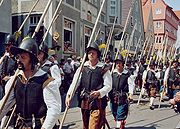
Pole weapon
A pole weapon or polearm is a close combat weapon in which the main fighting part of the weapon is placed on the end of a long shaft, typically of wood, thereby extending the user's effective range. Spears, glaives, poleaxes, halberds, and bardiches are all varieties of polearms...
, a very long thrusting spear
Spear
A spear is a pole weapon consisting of a shaft, usually of wood, with a pointed head.The head may be simply the sharpened end of the shaft itself, as is the case with bamboo spears, or it may be made of a more durable material fastened to the shaft, such as flint, obsidian, iron, steel or...
used extensively by infantry
Infantry
Infantrymen are soldiers who are specifically trained for the role of fighting on foot to engage the enemy face to face and have historically borne the brunt of the casualties of combat in wars. As the oldest branch of combat arms, they are the backbone of armies...
both for attacks on enemy foot soldiers and as a counter-measure against cavalry
Cavalry
Cavalry or horsemen were soldiers or warriors who fought mounted on horseback. Cavalry were historically the third oldest and the most mobile of the combat arms...
assaults. Unlike many similar weapons, the pike is not intended to be thrown. Pikes were used regularly in European warfare from the early Middle Ages until around 1700, and wielded by foot soldiers deployed in close order. The pike found extensive use with Landsknecht
Landsknecht
Landsknechte were European, predominantly German mercenary pikemen and supporting foot soldiers from the late 15th to the late 16th century, and achieved the reputation for being the universal mercenary of Early modern Europe.-Etymology:The term is from German, Land "land, country" + Knecht...
armies and Swiss mercenaries
Swiss mercenaries
Swiss mercenaries were notable for their service in foreign armies, especially the armies of the Kings of France, throughout the Early Modern period of European history, from the Later Middle Ages into the Age of the European Enlightenment...
, who employed it as their main weapon and used it in pike square
Pike square
The pike square was a military tactic developed by the Swiss Confederacy during the 15th century for use by its infantry.- History :The pike square was used to devastating effect at the Battle of Nancy against Charles the Bold of Burgundy in 1477, when the Swiss defeated a smaller but more...
formations. A similar weapon, the sarissa
Sarissa
The sarissa or sarisa was a 4 to 7 meter long spear used in the ancient Greek and Hellenistic warfare. It was introduced by Philip II of Macedon and was used in the traditional Greek phalanx formation as a replacement for the earlier dory, which was considerably shorter. The phalanxes of Philip...
, was also used by Alexander the Great's Macedonian
Ancient Macedonians
The Macedonians originated from inhabitants of the northeastern part of the Greek peninsula, in the alluvial plain around the rivers Haliacmon and lower Axios...
phalanx
Phalanx
Phalanx, from Ancient Greek , may refer to:-Military:* Phalanx formation, in ancient Greek warfare* Phalanx CIWS, a U.S. Navy defense system to protect against an anti-ship missile-Politics:...
infantry to great effect.
Design
The pike was an extremely long weapon, varying considerably in size, from 3 to 7.5 metres (10 to 25 feet) long. It had a wooden shaft with an iron or steel spearhead affixed. The shaft near the head was often reinforced with metal strips called "cheeks" or langets. When the troops of opposing armies both carried the pike, it often grew in a sort of arms raceArms race
The term arms race, in its original usage, describes a competition between two or more parties for the best armed forces. Each party competes to produce larger numbers of weapons, greater armies, or superior military technology in a technological escalation...
, getting longer in both shaft and head length to give one side's pikemen an edge in the combat; the longest pikes could exceed 6 m (22 feet) in length. The extreme length of such weapons required a strong wood such as well-seasoned ash for the pole, which was tapered towards the point to prevent the pike from sagging on the ends, although this was always a problem in pike handling. It is a common mistake to refer to a bladed polearm as a pike. Such weapons are more generally halberd
Halberd
A halberd is a two-handed pole weapon that came to prominent use during the 14th and 15th centuries. Possibly the word halberd comes from the German words Halm , and Barte - in modern-day German, the weapon is called Hellebarde. The halberd consists of an axe blade topped with a spike mounted on...
s or glaive
Glaive
A glaive is a European polearm weapon, consisting of a single-edged blade on the end of a pole. It is similar to the Japanese naginata and the Chinese Guan Dao....
s.
The great length of the pikes allowed a great concentration of spearheads to be presented to the enemy, with their wielders at a greater distance, but also made pikes unwieldy in close combat. This meant that pikemen had to be equipped with a shorter weapon such as a sword
Sword
A sword is a bladed weapon used primarily for cutting or thrusting. The precise definition of the term varies with the historical epoch or the geographical region under consideration...
, mace, or dagger
Dagger
A dagger is a fighting knife with a sharp point designed or capable of being used as a thrusting or stabbing weapon. The design dates to human prehistory, and daggers have been used throughout human experience to the modern day in close combat confrontations...
in order to defend themselves should the fighting degenerate into a melee
Mêlée
Melee , generally refers to disorganized close combat involving a group of fighters. A melee ensues when groups become locked together in combat with no regard to group tactics or fighting as an organized unit; each participant fights as an individual....
. In general, however, pikemen attempted to avoid such disorganized combat, at which they were at a disadvantage. To compound their difficulties in a melee, the pikeman often did not have a shield or had only a small shield of limited use in close-quarters fighting.
Tactics
On the battlefield pikes were often used in "hedgehog" formations, particularly by troops such as rebel peasants and militias who had not received a great deal of training in tactical maneuvers with the weapon. In these, the troops simply stood and held their pikes out in the direction of the enemy, sometimes standing in great circles or squares with the men facing out in all directions so that the enemy was confronted by a forest of bristling pikeheads and could not attack the formation from the sides or rear.Better-trained troops were capable of using the pike in an aggressive attack with each rank of pikemen being trained to hold their pikes so that they presented enemy infantry with four or five layers of spearheads bristling from the front of the formation.
As long as it kept good order, such a formation could roll right over enemy infantry but it did have weaknesses—as the men were all moving forward they were all facing in a single direction and could not turn quickly or efficiently to protect the vulnerable flanks or rear of the formation and the huge block of men carrying such unwieldy spears could be difficult to maneuver in any way other than straight-forward movement.
As a result, such mobile pike formations sought to have supporting troops protect their flanks or would maneuver to smash the enemy before they could be outflanked themselves. There was also the risk that the formation would become disordered, leading to a confused melee in which pikemen had the vulnerabilities mentioned above.
Although primarily a military weapon, the pike could be surprisingly effective in single combat and a number of 16th-century sources explain how it was to be used in a dueling situation; fencers of the time often practiced with and competed against each other with long staves in place of pikes.
Ancient use
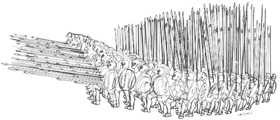
Although very long spears had been used since the dawn of organized warfare (notably illustrated in art showing Sumerian and Minoan warriors and hunters), the earliest recorded use of a pike-like weapon in the tactical method described above involved the Macedonian
Ancient Macedonians
The Macedonians originated from inhabitants of the northeastern part of the Greek peninsula, in the alluvial plain around the rivers Haliacmon and lower Axios...
sarissa, used by the troops of Alexander the Great's father, Philip II of Macedon
Philip II of Macedon
Philip II of Macedon "friend" + ἵππος "horse" — transliterated ; 382 – 336 BC), was a king of Macedon from 359 BC until his assassination in 336 BC. He was the father of Alexander the Great and Philip III.-Biography:...
, and successive dynasties, which dominated warfare for several centuries in many countries.
Medieval revival
In the Middle AgesMiddle Ages
The Middle Ages is a periodization of European history from the 5th century to the 15th century. The Middle Ages follows the fall of the Western Roman Empire in 476 and precedes the Early Modern Era. It is the middle period of a three-period division of Western history: Classic, Medieval and Modern...
, the principal users of the pike were urban militia troops such as the Flemings or the peasant array of the lowland Scots
Scottish people
The Scottish people , or Scots, are a nation and ethnic group native to Scotland. Historically they emerged from an amalgamation of the Picts and Gaels, incorporating neighbouring Britons to the south as well as invading Germanic peoples such as the Anglo-Saxons and the Norse.In modern use,...
. For example, the Scots used a spear formation known as the schiltron
Schiltron
A sheltron is a compact body of troops forming a battle array, shield wall or phalanx....
in several battles during the Wars of Scottish Independence
Wars of Scottish Independence
The Wars of Scottish Independence were a series of military campaigns fought between the independent Kingdom of Scotland and the Kingdom of England in the late 13th and early 14th centuries....
including the Battle of Bannockburn
Battle of Bannockburn
The Battle of Bannockburn was a significant Scottish victory in the Wars of Scottish Independence...
in 1314, and the Flemings used their geldon long spear to absorb the attack of French knights at the Battle of the Golden Spurs
Battle of the Golden Spurs
The Battle of the Golden Spurs, known also as the Battle of Courtrai was fought on July 11, 1302, near Kortrijk in Flanders...
in 1302, before other troops in the Flemish formation counterattacked the stalled knights with Goedendag
Goedendag
The goedendag was a weapon originally used by the militias of Medieval Flanders in the 14th century. It was essentially a combination of a club with a spear. Its body was a wooden staff roughly five feet long with a diameter of roughly four inches...
s. Both battles were seen by contemporaries as stunning victories of commoners over superbly equipped, mounted, military professionals, where victory was owed to the use of the pike and the brave resistance of the commoners who wielded them.
These formations were essentially immune to the attacks of mounted men-at-arms as long as the knights obligingly threw themselves on the spear wall, but the closely packed nature of pike formations rendered them vulnerable to enemy archers and crossbowmen who could shoot them down with impunity, especially when the pikemen did not have adequate armor. Many defeats, such as at Roosebeke
Battle of Roosebeke
The Battle of Roosebeke took place on November 27, 1382 on the Goudberg between a Flemish army under Philip van Artevelde and a French army under Louis II of Flanders who had called upon the help of the French king Charles VI after he had suffered a defeat during the Battle of Beverhoutsveld...
and Halidon Hill
Battle of Halidon Hill
The Battle of Halidon Hill was fought during the Second War of Scottish Independence. Scottish forces under Sir Archibald Douglas were heavily defeated on unfavourable terrain while trying to relieve Berwick-upon-Tweed.-The Disinherited:...
, were suffered by the militia pike armies when faced by cunning foes who employed their archers and crossbowmen to thin the ranks of the pike blocks before charging in with their (often dismounted) men-at-arms.
Medieval pike formations tended to have better success when they operated in an aggressive fashion. The Scots at the Battle of Stirling Bridge
Battle of Stirling Bridge
The Battle of Stirling Bridge was a battle of the First War of Scottish Independence. On 11 September 1297, the forces of Andrew Moray and William Wallace defeated the combined English forces of John de Warenne, 6th Earl of Surrey and Hugh de Cressingham near Stirling, on the River Forth.-The main...
(1297), for example, utilized the momentum of their charge to overrun an English army while the Englishmen were halfway through the process of crossing a narrow bridge. And then, at the Battle of Laupen
Battle of Laupen
The Battle of Laupen in 1339 was fought between the Bern and its allies on one side, and Freiburg together with feudal landholders from the County of Burgundy and Habsburg territories on the other. Bern was victorious, consolidating its position in the region...
(1339), Bernese pikemen overwhelmed the infantry forces of the opposing Habsburg/Burgundian army with a massive charge before wheeling over to strike and rout the Austro-Burgundian horsemen as well. It was not uncommon for aggressive pike formations to be composed of dismounted men-at-arms
Man-at-arms
Man-at-arms was a term used from the High Medieval to Renaissance periods to describe a soldier, almost always a professional warrior in the sense of being well-trained in the use of arms, who served as a fully armoured heavy cavalryman...
, as at the Battle of Sempach
Battle of Sempach
An armistice was agreed upon on 12 October, followed by a peace agreement valid for one year, beginning on 14 January 1387.The battle was a severe blow to Austrian interests in the region, and allowed for the further growth of the Old Swiss Confederacy....
(1389), where the dismounted Austrian vanguard, using their lances as pikes, had some initial success against their predominantly halberd
Halberd
A halberd is a two-handed pole weapon that came to prominent use during the 14th and 15th centuries. Possibly the word halberd comes from the German words Halm , and Barte - in modern-day German, the weapon is called Hellebarde. The halberd consists of an axe blade topped with a spike mounted on...
-equipped Swiss adversaries. Dismounted Italian men-at-arms also used the same method to defeat the Swiss at the Battle of Arbedo
Battle of Arbedo
The Battle of Arbedo was fought on June 30, 1422 between the Duchy of Milan and the Swiss Confederation.In 1419, Uri and Unterwalden bought the Bellinzona stronghold from the Sacco barons, but were unable to defend it adequately...
(1422).
Renaissance heyday

The Scots
Scottish people
The Scottish people , or Scots, are a nation and ethnic group native to Scotland. Historically they emerged from an amalgamation of the Picts and Gaels, incorporating neighbouring Britons to the south as well as invading Germanic peoples such as the Anglo-Saxons and the Norse.In modern use,...
predominantly used shorter spears in their schiltron
Schiltron
A sheltron is a compact body of troops forming a battle array, shield wall or phalanx....
formation; their attempt to adapt the longer Continental pike was dropped in masses after ineffective use led to a humiliating defeat at the Battle of Flodden.
Such Swiss and Landsknecht phalanxes also contained men armed with two-handed swords, or Zweihänder, and halberd
Halberd
A halberd is a two-handed pole weapon that came to prominent use during the 14th and 15th centuries. Possibly the word halberd comes from the German words Halm , and Barte - in modern-day German, the weapon is called Hellebarde. The halberd consists of an axe blade topped with a spike mounted on...
iers for close combat against both infantry and attacking cavalry.
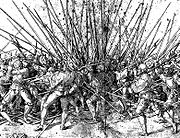
The Swiss were confronted with the German Landsknecht who used similar tactics as the Swiss, but more pikes in the more difficult deutschen Stoss (holding a pike that had its weight in the lower 1/3 at the end with two hands), which was utilized in a more flexible attacking column.
The high military reputation of the Swiss and the Landsknecht again led to the employment of mercenary units across Europe in order to train other armies in their tactics. These two and others, who had adopted their tactics, faced off in several wars leading to a series of developments as a result of these confrontations.
These formations had great successes on the battlefield, starting with the astonishing battlefield victories of the Swiss cantons against Charles the Bold of Burgundy
Duchy of Burgundy
The Duchy of Burgundy , was heir to an ancient and prestigious reputation and a large division of the lands of the Second Kingdom of Burgundy and in its own right was one of the geographically larger ducal territories in the emergence of Early Modern Europe from Medieval Europe.Even in that...
in the Burgundian Wars
Burgundian Wars
The Burgundian Wars were a conflict between the Dukes of Burgundy and the Kings of France, later involving the Old Swiss Confederacy, which would play a decisive role. Open war broke out in 1474, and in the following years the Duke of Burgundy, Charles the Bold, was defeated three times on the...
, in which the Swiss participated in 1476 and 1477. In the battles of Grandson
Battle of Grandson
The Battle of Grandson, took place on 2 March 1476, was part of the Burgundian Wars, and resulted in a major defeat for Charles the Bold, Duke of Burgundy.- Siege of Grandson, February 1476 :...
, Morat
Battle of Morat
The Battle of Morat was a battle in the Burgundian Wars fought June 22, 1476 between Charles I, Duke of Burgundy and a Swiss army at Morat, about 30 kilometres from Bern.-Background:...
and Nancy
Battle of Nancy
The Battle of Nancy was the final and decisive battle of the Burgundian Wars, fought outside the walls of Nancy on 5 January 1477 between Charles the Bold, Duke of Burgundy, and René II, Duke of Lorraine...
, the Swiss not only successfully resisted the attacks of knightly foes, as the relatively passive Scottish and Flemish infantry squares had done in the earlier Middle Ages, but also marched to the attack with great speed and in good formation, their attack columns steamrolling the Burgundian forces, sometimes with great massacre.
The deep pike attack column remained the primary form of effective infantry combat for the next forty years, and the Swabian War
Swabian War
The Swabian War of 1499 was the last major armed conflict between the Old Swiss Confederacy and the House of Habsburg...
saw the first conflict in which both sides had large formations of well-trained pikemen. After that war, its combatants—the Swiss (thereafter generally serving as mercenaries
Swiss mercenaries
Swiss mercenaries were notable for their service in foreign armies, especially the armies of the Kings of France, throughout the Early Modern period of European history, from the Later Middle Ages into the Age of the European Enlightenment...
) and their Landsknecht imitators—would often face each other again in the Italian Wars
Italian Wars
The Italian Wars, often referred to as the Great Italian Wars or the Great Wars of Italy and sometimes as the Habsburg–Valois Wars, were a series of conflicts from 1494 to 1559 that involved, at various times, most of the city-states of Italy, the Papal States, most of the major states of Western...
, which would become in many ways the military proving ground of the Renaissance.
Contemporary Japan experienced a parallel evolution of pole weapons. The Japanese style of warfare was, however, generally fast-moving and aggressive with far shallower formations than their European equivalents. The naginata
Naginata
The naginata is one of several varieties of traditionally made Japanese blades in the form of a pole weapon. Naginata were originally used by the samurai class in feudal Japan, and naginata were also used by ashigaru and sōhei .-Description:A naginata consists of a wooden shaft with a curved...
and yari
Yari
is the term for one of the traditionally made Japanese blades in the form of a spear, or more specifically, the straight-headed spear...
became common weapons for Japanese ashigaru
Ashigaru
The Japanese ashigaru were foot-soldiers of medieval Japan. The first known reference to ashigaru was in the 1300s, but it was during the Ashikaga Shogunate-Muromachi period that the use of ashigaru became prevalent by various warring factions.-Origins:Attempts were made in Japan by the Emperor...
foot soldiers (who sometimes used extremely long yari) and dismounted samurai
Samurai
is the term for the military nobility of pre-industrial Japan. According to translator William Scott Wilson: "In Chinese, the character 侍 was originally a verb meaning to wait upon or accompany a person in the upper ranks of society, and this is also true of the original term in Japanese, saburau...
due to the greater reach than swords, which samurai also carried. Naginata, first used around 750 AD, had a curved sword-like blade on a wood shaft with a metal counterweight, often spiked; it was used more with a slashing action and forced the introduction of sune-ate (shin guards) as cavalry battles became more important. Yari were spears of varying lengths; the straight blade usually had sharpened edges, sometimes protrusions from the central blade, and fitted to a hollowed shaft with an extremely long tang. Around later half of 16th century, pikemen holding pikes with length of 4.5 to 6.5 m (15 to 22 feet) or sometimes 10 m became main forces in armies. They formed lines, combined with arquebusiers and short spearmen. Pikemen formed two or three rows of line, and were forced to move up and down their pikes in unison under the command.
Finally, the rise of firearms and artillery
Artillery
Originally applied to any group of infantry primarily armed with projectile weapons, artillery has over time become limited in meaning to refer only to those engines of war that operate by projection of munitions far beyond the range of effect of personal weapons...
in the 16th century made the big pike columns vulnerable to being shot down despite their awesome close-combat power. The decline of the combat column of pikemen was starkly displayed at the terrible Battle of Bicocca
Battle of Bicocca
The Battle of Bicocca or La Bicocca was fought on April 27, 1522, during the Italian War of 1521–26. A combined French and Venetian force under Odet de Foix, Vicomte de Lautrec, was decisively defeated by a Spanish-Imperial and Papal army under the overall command of Prospero Colonna...
in 1522, for instance, where arquebus
Arquebus
The arquebus , or "hook tube", is an early muzzle-loaded firearm used in the 15th to 17th centuries. The word was originally modeled on the German hakenbüchse; this produced haquebute...
iers contributed to the heavy defeat of a force of Swiss pikemen.
Pike and shot
In the 16th century, the Spanish sought to develop a balance between the close-combat power of the pike and the shooting power of the firearm. They developed the TercioTercio
The tercio was a Renaissance era military formation made up of a mixed infantry formation of about 3,000 pikemen, swordsmen and arquebusiers or musketeers in a mutually supportive formation. It was also sometimes referred to as the Spanish Square...
formation, in which arquebus
Arquebus
The arquebus , or "hook tube", is an early muzzle-loaded firearm used in the 15th to 17th centuries. The word was originally modeled on the German hakenbüchse; this produced haquebute...
ier or musketeer
Musketeer
A musketeer was an early modern type of infantry soldier equipped with a musket. Musketeers were an important part of early modern armies, particularly in Europe. They sometimes could fight on horseback, like a dragoon or a cavalryman...
formations (or even longbowmen, in an English variation) fought on the flanks of the pikemen, in formations sometimes resembling a checkerboard.
These formations, eventually referred to as "pike and shot
Pike and shot
Pike and shot is a historical method of infantry combat, and also refers to an era of European warfare generally considered to cover the period from the Italian Wars to the evolution of the bayonet in the late seventeenth century...
", used a mixture of men, each with a different tactical role—the shooters dealt out casualties to the enemy, while the pikemen protected the shooters from enemy cavalry and fought if the Tercio closed in hand-to-hand combat. As a result, the Tercio deployed smaller numbers of pikemen than the huge Swiss and Landsknecht columns.
The Tercio proved more flexible and eventually prevailed over the grand pike block, its mixed formation became the norm for European infantrymen, and the percentage of men who were armed with firearms in Tercio-like formations steadily increased as firearms advanced in technology. In the late sixteenth into the 17th century, smaller pike formations were used, invariably defending attached musketeers, often as a central block with two sub-units of shooters, called "sleeves of shot", on either side of the pikes.
During this period the pike was typically 4.5 to 5.5 metres (15 to 18 feet) in length. The pike was also said to be 10 to 14 feet long.
End of the pike era
After the mid-17th century, armies that adopted the flintlockFlintlock
Flintlock is the general term for any firearm based on the flintlock mechanism. The term may also apply to the mechanism itself. Introduced at the beginning of the 17th century, the flintlock rapidly replaced earlier firearm-ignition technologies, such as the doglock, matchlock and wheellock...
musket
Musket
A musket is a muzzle-loaded, smooth bore long gun, fired from the shoulder. Muskets were designed for use by infantry. A soldier armed with a musket had the designation musketman or musketeer....
began to abandon the pike altogether, or to greatly decrease their numbers. The invention of the bayonet
Bayonet
A bayonet is a knife, dagger, sword, or spike-shaped weapon designed to fit in, on, over or underneath the muzzle of a rifle, musket or similar weapon, effectively turning the gun into a spear...
provided an anti-cavalry solution, and the musket's firepower was now so deadly that combat was often decided by shooting alone. Through the Napoleonic
Napoleon I
Napoleon Bonaparte was a French military and political leader during the latter stages of the French Revolution.As Napoleon I, he was Emperor of the French from 1804 to 1815...
era the spontoon
Spontoon
A Spontoon is a type of European lance that came into being alongside the pike. The spontoon was in wide use by the mid 17th century, and it continued to be used until the mid to late 19th century....
, a kind of shortened pike with side-wings, was retained as a symbol by some NCOs; in practice it was probably more useful for gesturing and signaling than as a weapon.
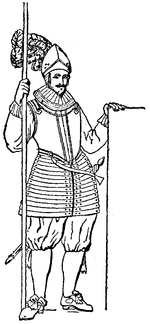
In such an environment, pikemen grew to intensely dislike their own weapon, as they were forced to stand inactive as the combat went on around them as the opposing musketeers dueled, feeling that they were mere targets rather than soldiers, and that they were adding nothing to the battle raging around them. There are examples of pikemen throwing their weapons down and seizing muskets from fallen comrades, a sign that the pike was on the wane as a weapon.
Prussian Army
The Royal Prussian Army was the army of the Kingdom of Prussia. It was vital to the development of Brandenburg-Prussia as a European power.The Prussian Army had its roots in the meager mercenary forces of Brandenburg during the Thirty Years' War...
and Austrian had already abandoned the pike by that date. Other armies, such as the Swedish and the Russian, continued to use it for several decades afterward (the Swedes of King Charles XII in particular using it to great effect until the 1720s). During the American Revolution
American Revolution
The American Revolution was the political upheaval during the last half of the 18th century in which thirteen colonies in North America joined together to break free from the British Empire, combining to become the United States of America...
, pikes called "trench spears" made by local blacksmiths saw limited use until enough bayonets could be procured for general use by both Continental Army
Continental Army
The Continental Army was formed after the outbreak of the American Revolutionary War by the colonies that became the United States of America. Established by a resolution of the Continental Congress on June 14, 1775, it was created to coordinate the military efforts of the Thirteen Colonies in...
and attached militia
Militia
The term militia is commonly used today to refer to a military force composed of ordinary citizens to provide defense, emergency law enforcement, or paramilitary service, in times of emergency without being paid a regular salary or committed to a fixed term of service. It is a polyseme with...
units.
As late as Poland
Poland
Poland , officially the Republic of Poland , is a country in Central Europe bordered by Germany to the west; the Czech Republic and Slovakia to the south; Ukraine, Belarus and Lithuania to the east; and the Baltic Sea and Kaliningrad Oblast, a Russian exclave, to the north...
's Kościuszko Uprising
Kosciuszko Uprising
The Kościuszko Uprising was an uprising against Imperial Russia and the Kingdom of Prussia led by Tadeusz Kościuszko in Poland, Belarus and Lithuania in 1794...
in 1794, the pike reappeared as a child of necessity which became, for a short period, a surprisingly effective weapon on the battlefield. In this case, General Thaddeus Kosciuszko, facing a shortage of firearm
Firearm
A firearm is a weapon that launches one, or many, projectile at high velocity through confined burning of a propellant. This subsonic burning process is technically known as deflagration, as opposed to supersonic combustion known as a detonation. In older firearms, the propellant was typically...
s and bayonet
Bayonet
A bayonet is a knife, dagger, sword, or spike-shaped weapon designed to fit in, on, over or underneath the muzzle of a rifle, musket or similar weapon, effectively turning the gun into a spear...
s to arm landless serf
SERF
A spin exchange relaxation-free magnetometer is a type of magnetometer developed at Princeton University in the early 2000s. SERF magnetometers measure magnetic fields by using lasers to detect the interaction between alkali metal atoms in a vapor and the magnetic field.The name for the technique...
partisans
Partisan (military)
A partisan is a member of an irregular military force formed to oppose control of an area by a foreign power or by an army of occupation by some kind of insurgent activity...
recruited straight from the wheat fields, had their sickle
Sickle
A sickle is a hand-held agricultural tool with a variously curved blade typically used for harvesting grain crops or cutting succulent forage chiefly for feeding livestock . Sickles have also been used as weapons, either in their original form or in various derivations.The diversity of sickles that...
s and scythe
Scythe
A scythe is an agricultural hand tool for mowing grass, or reaping crops. It was largely replaced by horse-drawn and then tractor machinery, but is still used in some areas of Europe and Asia. The Grim Reaper is often depicted carrying or wielding a scythe...
s heated and straightened out into something resembling crude "war scythe
War scythe
A war scythe is a kind of improvised pole weapon, similar to a fauchard, usually created from standard scythes. The blade of the scythe is transformed so as to extend upright from the pole, thus forming an infantry weapon practical both in offensive actions against infantry and as a defensive...
s". These weaponized agricultural accouterments were then used in battle as both slicing weapons, as well as makeshift pikes. The peasant
Peasant
A peasant is an agricultural worker who generally tend to be poor and homeless-Etymology:The word is derived from 15th century French païsant meaning one from the pays, or countryside, ultimately from the Latin pagus, or outlying administrative district.- Position in society :Peasants typically...
"pikemen" armed with these crude instruments played a pivotal role in securing a near impossible victory against a far larger and better equipped Russia
Russia
Russia or , officially known as both Russia and the Russian Federation , is a country in northern Eurasia. It is a federal semi-presidential republic, comprising 83 federal subjects...
n army at the Battle of Racławice on April 4 of that year.
Improvised pikes, made from bayonet
Bayonet
A bayonet is a knife, dagger, sword, or spike-shaped weapon designed to fit in, on, over or underneath the muzzle of a rifle, musket or similar weapon, effectively turning the gun into a spear...
s on poles, were used by escaped convicts during the Castle Hill rebellion
Castle Hill convict rebellion
The Castle Hill Rebellion of 4 March 1804, also called the Second Battle of Vinegar Hill, was a large-scale rebellion by Irish convicts against British colonial authority in Australia...
of 1804.
Indeed, as late as the Napoleonic Wars
Napoleonic Wars
The Napoleonic Wars were a series of wars declared against Napoleon's French Empire by opposing coalitions that ran from 1803 to 1815. As a continuation of the wars sparked by the French Revolution of 1789, they revolutionised European armies and played out on an unprecedented scale, mainly due to...
, at the dawning of the 19th century, even the Russian militia
Militia
The term militia is commonly used today to refer to a military force composed of ordinary citizens to provide defense, emergency law enforcement, or paramilitary service, in times of emergency without being paid a regular salary or committed to a fixed term of service. It is a polyseme with...
(mostly landless peasants, like the Polish partisans before them) could be found carrying shortened pikes into battle. As the 19th century progressed, the obsolete pike would still find a use in such countries as Ireland
Ireland
Ireland is an island to the northwest of continental Europe. It is the third-largest island in Europe and the twentieth-largest island on Earth...
, Russia, and China
China
Chinese civilization may refer to:* China for more general discussion of the country.* Chinese culture* Greater China, the transnational community of ethnic Chinese.* History of China* Sinosphere, the area historically affected by Chinese culture...
, generally in the hands of (as usual) desperate peasant rebel
Rebellion
Rebellion, uprising or insurrection, is a refusal of obedience or order. It may, therefore, be seen as encompassing a range of behaviors aimed at destroying or replacing an established authority such as a government or a head of state...
s who did not have access to firearms. John Brown
John Brown (abolitionist)
John Brown was an American revolutionary abolitionist, who in the 1850s advocated and practiced armed insurrection as a means to abolish slavery in the United States. He led the Pottawatomie Massacre during which five men were killed, in 1856 in Bleeding Kansas, and made his name in the...
planned to arm a rebel slave army in America
United States
The United States of America is a federal constitutional republic comprising fifty states and a federal district...
largely with pikes.
One attempt to resurrect the pike as a primary infantry weapon occurred during the American Civil War
American Civil War
The American Civil War was a civil war fought in the United States of America. In response to the election of Abraham Lincoln as President of the United States, 11 southern slave states declared their secession from the United States and formed the Confederate States of America ; the other 25...
when the Confederate States of America
Confederate States of America
The Confederate States of America was a government set up from 1861 to 1865 by 11 Southern slave states of the United States of America that had declared their secession from the U.S...
planned to recruit twenty regiments of pikemen in 1862. In April 1862 it was authorised that every Confederate infantry regiment would include two companies of pikemen, a plan supported by Robert E. Lee
Robert E. Lee
Robert Edward Lee was a career military officer who is best known for having commanded the Confederate Army of Northern Virginia in the American Civil War....
. Many pikes were produced but were never used in battle and the plan to include pikemen in the army was abandoned.
Shorter versions of pikes called boarding pikes were also used on warships—typically to repel boarding
Boarding (attack)
Boarding, in its simplest sense, refers to the insertion on to a ship's deck of individuals. However, when it is classified as an attack, in most contexts, it refers to the forcible insertion of personnel that are not members of the crew by another party without the consent of the captain or crew...
parties—as late as the third quarter of the 19th century. Examples of late 18th and early 19th century boarding pikes can be found here Boarding Pikes, Axes and Cutlasses.
The great Hawaiian
Native Hawaiians
Native Hawaiians refers to the indigenous Polynesian people of the Hawaiian Islands or their descendants. Native Hawaiians trace their ancestry back to the original Polynesian settlers of Hawaii.According to the U.S...
warrior king Kamehameha I had an elite force of men armed with very long spears who seem to have fought in a manner identical to European pikemen, despite the usual conception of his people's general disposition for individualistic dueling as their method of close combat. It is not known whether Kamehameha himself introduced this tactic or if it was taken from the use of traditional Hawaiian weapons.
The pike was issued as a British Home Guard
British Home Guard
The Home Guard was a defence organisation of the British Army during the Second World War...
weapon in 1942 after the War Office
War Office
The War Office was a department of the British Government, responsible for the administration of the British Army between the 17th century and 1964, when its functions were transferred to the Ministry of Defence...
misinterpreted a letter from Winston Churchill saying "every man must have a weapon of some kind, be it only a mace or pike". However, these hand-held weapons never left the stores after the pikes had "generated an almost universal feeling of anger and disgust from the ranks of the Home Guard, demoralised the men and led to questions being asked in both Houses of Parliament". The suggestion of using pikes made from old Lee-Enfield
Lee-Enfield
The Lee-Enfield bolt-action, magazine-fed, repeating rifle was the main firearm used by the military forces of the British Empire and Commonwealth during the first half of the 20th century...
rifle
Rifle
A rifle is a firearm designed to be fired from the shoulder, with a barrel that has a helical groove or pattern of grooves cut into the barrel walls. The raised areas of the rifling are called "lands," which make contact with the projectile , imparting spin around an axis corresponding to the...
bayonet
Bayonet
A bayonet is a knife, dagger, sword, or spike-shaped weapon designed to fit in, on, over or underneath the muzzle of a rifle, musket or similar weapon, effectively turning the gun into a spear...
blades in a modern industrial war was indeed one of the War Office's stranger wartime follies.
In Spain, in the cities, beginning in the 18th century and ending about 1980, there were night guards called "serenos":es:Sereno (oficio) who carried a short pike (about 1.5 m) called chuzo :es:chuzo.
Pikes live on today only in traditional roles, being used to carry the colours of an infantry
Infantry
Infantrymen are soldiers who are specifically trained for the role of fighting on foot to engage the enemy face to face and have historically borne the brunt of the casualties of combat in wars. As the oldest branch of combat arms, they are the backbone of armies...
regiment and with the Company of Pikemen and Musketeers of the Honourable Artillery Company
Honourable Artillery Company
The Honourable Artillery Company was incorporated by Royal Charter in 1537 by King Henry VIII. Today it is a Registered Charity whose purpose is to attend to the “better defence of the realm"...
.