

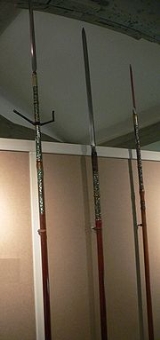
Yari

Encyclopedia

Spear
A spear is a pole weapon consisting of a shaft, usually of wood, with a pointed head.The head may be simply the sharpened end of the shaft itself, as is the case with bamboo spears, or it may be made of a more durable material fastened to the shaft, such as flint, obsidian, iron, steel or...
, or more specifically, the straight-headed spear. The martial art of wielding the yari is called sōjutsu
Sojutsu
, meaning "art of the spear" is the Japanese martial art of fighting with the Japanese .-Origins:Although the spear had a profound role in early Japanese mythology, where the islands of Japan themselves were said to be created by salt water dripping from the tip of a spear, as a weapon the first...
.
History
Nara period
The of the history of Japan covers the years from AD 710 to 794. Empress Gemmei established the capital of Heijō-kyō . Except for 5 years , when the capital was briefly moved again, it remained the capital of Japanese civilization until Emperor Kammu established a new capital, Nagaoka-kyō, in 784...
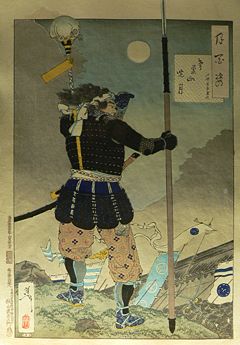
(710-794)., and while they were present in early Japan's history, the term yari appeared for the first time in written sources in 1334 but this type of spear did not become popular until the late 1400s. The original warfare of the bushi was not a thing for "commoners"; it was a ritualized combat usually between two warriors who would challenge each other via horseback archery and sword duels. However, the attempted Mongol invasions of Japan in 1274 and 1281 changed Japanese weaponry and warfare. The Mongol-employed Chinese and Korean footmen wielded long pikes, fought in tight formation, and moved in large units to stave off cavalry. Polearms (including naginata
Naginata
The naginata is one of several varieties of traditionally made Japanese blades in the form of a pole weapon. Naginata were originally used by the samurai class in feudal Japan, and naginata were also used by ashigaru and sōhei .-Description:A naginata consists of a wooden shaft with a curved...
and yari) were of much greater military use than swords, due to their much greater range, their lesser weight per unit length (though overall a polearm would be fairly hefty), and their great piercing ability. Swords in a full battle situation were therefore relegated to emergency sidearm status from the Heian
Heian period
The is the last division of classical Japanese history, running from 794 to 1185. The period is named after the capital city of Heian-kyō, or modern Kyōto. It is the period in Japanese history when Buddhism, Taoism and other Chinese influences were at their height...
through the Muromachi
Muromachi period
The is a division of Japanese history running from approximately 1336 to 1573. The period marks the governance of the Muromachi or Ashikaga shogunate, which was officially established in 1338 by the first Muromachi shogun, Ashikaga Takauji, two years after the brief Kemmu restoration of imperial...
periods. Around the latter half of the sixteenth century, ashigaru
Ashigaru
The Japanese ashigaru were foot-soldiers of medieval Japan. The first known reference to ashigaru was in the 1300s, but it was during the Ashikaga Shogunate-Muromachi period that the use of ashigaru became prevalent by various warring factions.-Origins:Attempts were made in Japan by the Emperor...
holding pikes (nagae yari) with length of 4.5 to 6.5 m (15 to 22 feet) or sometimes 10 m became the main forces in armies. They formed lines, combined with arquebus
Arquebus
The arquebus , or "hook tube", is an early muzzle-loaded firearm used in the 15th to 17th centuries. The word was originally modeled on the German hakenbüchse; this produced haquebute...
iers and short spearmen. Pikemen formed two or three row of line, and were forced to move up and down their pikes in unison under the command.
Yumi
is the Japanese term for bows, and includes the longer and the shorter used in the practice of kyūdō, or Japanese archery. The yumi was an important weapon of the samurai warrior during the feudal period of Japan.-History of the yumi:...
(bow) as a weapon for the samurai, and foot troops (ashigaru
Ashigaru
The Japanese ashigaru were foot-soldiers of medieval Japan. The first known reference to ashigaru was in the 1300s, but it was during the Ashikaga Shogunate-Muromachi period that the use of ashigaru became prevalent by various warring factions.-Origins:Attempts were made in Japan by the Emperor...
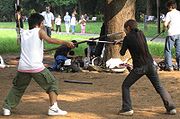
) used them extensively as well. But by the Edo period the yari had fallen into disuse: with the greater emphasis on small-scale close quarters combat and the convenience of swords (as opposed to long battlefield weapons), polearms and archery lost their practical value. During the peaceful Edo era, yari were still produced, sometimes even by good swordsmiths. They existed as a ceremonial weapon for most of this era.
Construction
Yari were characterized by a straight bladeBlade
A blade is that portion of a tool, weapon, or machine with a cutting edge and/or a pointed tip that is designed to cut and/or puncture, stab, slash, chop, slice, thrust, or scrape animate or inanimate surfaces or materials...
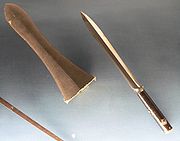
that could be anywhere from several centimeters, to 3 feet or more in length. The blades were made of the same steel (tamahagane) that traditional Japanese swords and arrow heads were forged with, and were very durable. Throughout history many variations of the straight yari blade were produced, often with protrusions on a central blade. Yari blades (points) often had an extremely long tang
Tang (weaponry)
A tang or shank is the back portion of a tool where it extends into stock material or is connected to a handle as on a knife, sword, spear, arrowhead, chisel, screwdriver, etc...
(nakago); typically the nagako would be longer than the sharpened portion of the blade. The nakago protruded into a re-enforced hollow portion of the handle (tachiuchi or tachiuke) resulting in a very stiff shaft making it nearly impossible for the blade to fall or break off.
The shaft (nagaye or ebu) came in many different lengths, widths and shapes; made of hardwood and covered in lacquered bamboo
Bamboo
Bamboo is a group of perennial evergreens in the true grass family Poaceae, subfamily Bambusoideae, tribe Bambuseae. Giant bamboos are the largest members of the grass family....
strips, these came in oval, round, or polygonal cross section. These in turn were often wrapped in metal rings or wire (dogane), and affixed with a metal pommel (ishizuki) on the butt end. Yari shafts were often decorated with inlays of metal or semiprecious materials such as brass pins, lacquer, or flakes of pearl. A sheath (saya) was also part of a complete yari.
Variations of yari blades
Various types of yari points or blades existed. The most common blade was a straight, flat, design that resembles a straight-bladed double edged daggerDagger
A dagger is a fighting knife with a sharp point designed or capable of being used as a thrusting or stabbing weapon. The design dates to human prehistory, and daggers have been used throughout human experience to the modern day in close combat confrontations...
. This type of blade could cut as well as stab and was sharpened like a razor edge. Though yari is a catchall for spear, it is usually distinguished between kama yari, which have additional horizontal blades, and simple su yari (choku-sō) or straight spears. Yari can also be distinguished by the types of blade cross section: the triangular sections were called sankaku yari and the diamond sections were called ryō-shinogi yari.
- Sankaku yari (三角槍, triangle spear) have a point that resembles a narrow spike with a triangular cross-section. A sankaku yari therefore had no cutting edge, only a sharp point at the end. The sankaku yari was therefore best suited for penetrating armor, even armor made of metal, which a standard yari was not as suited to. There are two types of sankaku yari, sei sankaku yari are yari blades that have a triangular cross section with three equal sides as in an equilateral triangle, and hira sankaku yari which have a triangular cross section with two equal sides like an isosceles triangle.
- Ryō-shinogi yari, a blade with a diamond shaped cross section.
- Fukuro yari (袋槍, bag spear or socket spear) were mounted to a shaft (nagaye or ebu) by means of a metal socket instead of a nakago (tang). The fukuro yari was forged as a single piece of both socket and blade.
- Kikuchi yari (菊池槍, spear of Kikuchi) were one of the rarest designs, possessing only a single edge. This created a weapon that could be used for hacking and closely resembled a tantoTantoA is one of the traditional Japanese swords that were worn by the samurai class of feudal Japan. The tantō dates to the Heian period, when it was mainly used as a weapon but evolved in design over the years to become more ornate...
. kikuchi yari are the only yari which use a habaki .
- Yajiri nari yari (鏃形槍, spade-shaped spear) had a very broad "spade-shaped" head. It often had a pair of holes centering the two ovoid halves.
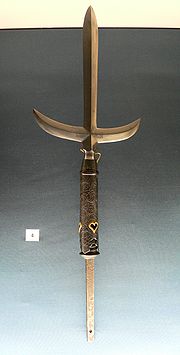
- Jūmonji yari (十文字槍), cross-shaped spear, also called magari yari (曲槍, curved spear), looked something similar to a tridentTridentA trident , also called a trishul or leister or gig, is a three-pronged spear. It is used for spear fishing and was also a military weapon. Tridents are featured widely in mythical, historical and modern culture. The major Hindu god, Shiva the Destroyer and the sea god Poseidon or Neptune are...
or partisanPartisan (weapon)A partisan is a type of polearm that was used in Europe during the middle ages. It consisted of a spearhead mounted on a long shaft with protrusions on the sides which aided the user in parrying sword thrusts...
and brandished a pair of curved blades around its central lance. Occasionally called maga yari in modern weaponry texts.
- Kama yariKamayariThe kamayari is similar to the jumonji yari. While it also had two protrusions shooting off the base of a main spear tip, in yari the offshoots were hooked back downward. The kamayari essentially is a yari with kama at the base of the blade to assist in hooking things...
(鎌槍, sickle spear) gets its name from a peasant weapon called kamaKama (weapon)The is a traditional Filipino and Japanese farming implement similar to a small scythe used for reaping crops and also employed as a weapon...
(lit. sickle or scythe). However, a kama isn't a scythe as most Westerners think of it, a giant, curved blade connected at right angles to a two-meter-long wooden handle, but rather a much smaller version, with a less dramatically curved blade and a straight wooden handle approximately two feet long.
- Kata kama yari (片鎌槍, single-sided sickle spear) had a radical weapon design sporting a blade that was two-pronged. Instead of being constructed like a military forkMilitary forkA fork is a pole weapon which was used in war in Europe between the 15th and 19th centuries. Like many polearms, the military fork traces its lineage to an agricultural tool, in this case the pitchfork....
, a straight blade (as in su yari) was intersected just below its midsection by a perpendicular blade. This blade was slightly shorter than the primary, had curved tips making a parallelogram, and was set off center so that only 1/6 of its length extended on the other side. This formed a kind of messy 'L' shape.
- Tsuki nari yari (月形槍, moon-shaped spear) barely looked like a 'spear' at all. A polearm that had a crescent blade for a head, this could be used for slashing and hooking.
- Kagi yari (鉤槍, hook spear) had a long blade with a side hook much like that found on a fauchardFauchardA fauchard is a type of polearm weapon, which was used in medieval Europe from the 11th through the 14th centuries. The design consisted of a curved blade put atop a 2 m long pole. The blade bore a moderate to strong curve along its length, however unlike a glaive the cutting edge was only on the...
. This could be used to catch another weapon, or even dismount a rider on horseback.
- Bishamon yari possessed some of the most ornate designs for any spear. Running parallel to the long central blade were two 'crescent moon' shaped blades facing outwards. They were attached in two locations by short cross bars, making the head look somewhat like a fleur-de-lisFleur-de-lisThe fleur-de-lis or fleur-de-lys is a stylized lily or iris that is used as a decorative design or symbol. It may be "at one and the same time, political, dynastic, artistic, emblematic, and symbolic", especially in heraldry...
.
- Hoko yari An old form of yari possibly from the Nara periodNara periodThe of the history of Japan covers the years from AD 710 to 794. Empress Gemmei established the capital of Heijō-kyō . Except for 5 years , when the capital was briefly moved again, it remained the capital of Japanese civilization until Emperor Kammu established a new capital, Nagaoka-kyō, in 784...
(710-794), a guard's spear with six-foot pole and eight inch blade either leaf-shape or waved (like the Malay kris) ; a sickle-shaped horn projected on one or both sides at the joint of blade.
The hoko yari had a hollow socket like the later period fukuro yari for the pole to fit into rather than a long tang.
- Sasaho yari A broad yari that is described as being "leaf shaped" or "bamboo leaf shaped".
- Su yari (sugu yari), a straight double edged blade.
- Omi no yari (omi yari), an extra long su yari blade.
Variations of yari shafts (nagaye or ebu)
A yari shaft can range in length from one meter to upwards of six meters (3.3 to 20 feet). The longer versions were called nagae yari while shorter ones were known as mochi yari or tae yari. The longest versions were carried by foot troops (ashigaruAshigaru
The Japanese ashigaru were foot-soldiers of medieval Japan. The first known reference to ashigaru was in the 1300s, but it was during the Ashikaga Shogunate-Muromachi period that the use of ashigaru became prevalent by various warring factions.-Origins:Attempts were made in Japan by the Emperor...
), while samurai
Samurai
is the term for the military nobility of pre-industrial Japan. According to translator William Scott Wilson: "In Chinese, the character 侍 was originally a verb meaning to wait upon or accompany a person in the upper ranks of society, and this is also true of the original term in Japanese, saburau...
usually carried a shorter yari.
- Kuda yari (管槍, tube spear). The shaft (nagaye or ebu) of the kuda yari goes through a hollow metal tube that allowed the kuda yari to be twisted while being thrust. This style of sojutsu is typified in the school Owari Kan Ryū.
- Makura Yari A yari with a short shaft (nagaye or ebu) that was used as a javelin.
Gallery
Image:Omi yari.jpg|Antique Japanese (samurai) omi yari, an extra long type of yari. 35.5 inches long with a 19 inch long blade and a 16.5 inch tang nakago.
Image:Jumonji yari.JPG| Antique Japanese (samurai) 3 bladed yari or Jumonji yari. This is a fukuro yari as it has a socket instead of a tang.
Image:Kikuchi yari..JPG|Antique Japanese (samurai) Edo period kikuchi yari.
Image:Sasaho yari.jpg|Antique Japanese (samurai) Sasaho yari.
See also
- QiangQiang (spear)Qiang is the Chinese term for spear. Due to its relative ease of manufacture, the spear in many variations was ubiquitous on the pre-modern Chinese battlefield...
- Radical 79Radical 79Radical 79 meaning "weapon" or "lance" is 1 of 34 Kangxi radicals composed of 4 strokes.In the Kangxi Dictionary there are 93 characters to be found under this radical.- Characters with Radical 79:...
- RanseurRanseurA ranseur was a type of polearm used across Europe up to the 15th century. It was still seen in court as a ceremonial weapon through the 17th century...
- Three Great Spears of Japan