


Naginata

Encyclopedia
The naginata is one of several varieties of traditionally made Japanese blades (nihonto) in the form of a pole weapon
. Naginata were originally used by the samurai
class in feudal Japan, and naginata were also used by ashigaru
(foot soldiers) and sōhei
(warrior monks).
or European glaive
. Usually it also had a sword-like hand guard (tsuba) between the blade and shaft. The 30 cm to 60 cm long naginata blade is forged in the same manner as traditional Japanese swords. The blade has a long tang (nakago) which is inserted in the shaft (nagaye or ebu), the blade is removable and is secured by means of a wood peg (mekugi) that passes though a hole (mekugi-ana) in both the nakago and the nagaye (ebu).
The nagaye (ebu) ranges from 120 cm to 240 cm in length and is oval shaped. The area of the nagaye (ebu) were the naginata nakago sits is the tachiuchi or tachiuke. The tachiuchi (tachiuke) would be re-enforced with metal rings (naginata dogane or semegane), and or metal sleeves (sakawa) and wrapped with cord (san-dan maki), the end of the nagaye (ebu) had a heavy metal end cap (ishizuki or hirumaki). When not in use the naginata blade would be covered with a wooden sheath (saya).
. It's difficult to tell when the naginata itself first appeared. Though often claimed as being invented by the sōhei
during the Nara period
, physical evidence of their existence dates only from the mid-Kamakura period
, and earlier literary sources are ambiguous. The earliest clear references to naginata date from 1146 in the late Heian period
, with one suggesting that the weapon may have been recent. Earlier 10th through 12th century sources refer to "long swords" that while a common medieval term or orthography for naginata, could also simply be referring to conventional swords; one source describes a naginata being drawn with the verb nuku, commonly associated with swords, rather than hazusu, the verb otherwise used in medieval texts for unsheathing naginata. However, some 11th and 12th century mentions of hoko may actually have been referring to naginata. The commonly-assumed association of the naginata and the sōhei is also unclear. Artwork from the late-13th and 14th centuries depict the sōhei with naginata but don't appear to place any special significance to it: the weapons appear as just part of a number of others carried by the monks, and are used by samurai and commoners as well. Depictions of naginata-armed sōhei in earlier periods were created centuries after the fact, and are likely using the naginata as a symbol to distinguish the sōhei from other warriors, rather than giving an accurate portrayal of the events.
During the Gempei War (1180–1185), in which the Taira clan
was pitted against Minamoto no Yoritomo
of the Minamoto clan
, the naginata rose to a position of particularly high esteem, being regarded as an extremely effective weapon by warriors. Cavalry
battles had become more important by this time, and the naginata proved excellent at dismounting cavalry and disabling riders. The widespread adoption of the naginata as a battlefield weapon forced the introduction of sune-ate
(shin guards) as a part of Japanese armor. The rise of importance for the naginata can be seen as being mirrored by the European pike
, another long pole weapon employed against cavalry. The introduction in 1543 of firearms in the form of the matchlock
(tanegashima) caused a great decrease in the appearance of the naginata on the battle
field. As battlefield tactics changed, the yari (spear) took the place of the naginata as the pole weapon of choice.
During the Edo Period
, as the naginata became less useful for men on the battlefield, it became a symbol of the social status of women of the samurai class. A functional naginata was often a traditional part of a samurai daughter's dowry
. Although they did not typically fight as normal soldiers, women of the samurai class were expected to be capable of defending their homes while their husbands were away at war. The naginata was considered one of the weapons most suitable for women, since it allows a woman to keep opponents at a distance, where any advantages in height, weight, and upper body strength would be lessened. An excellent example of the role of women in Japanese society and martial culture is Itagaki
, who, famous for her naginata skills, led the garrison
of 3,000 warriors stationed at Toeizakayama castle. Ten thousand Hōjō clan
warriors were dispatched to take the castle, and Itagaki led her troops out of the castle, killing a significant number of the attackers before being overpowered. The naginata saw its final uses in combat in 1868, at Aizu
, and in 1876, in Satsuma
.
Due to the influence of Westernization
, after the Meiji Restoration
the perceived value of martial arts
, the naginata included, dropped severely. It was from this time that the focus of training became the strengthening of the will and the forging of the mind and body. During the Showa period
, naginata training became a part of the public school system in 1912; and it "remains a staple of girls’ physical education"
Martial arts training in Japan was banned for five years by the Allied Forces
after Japan's surrender
at the end of World War II
. After the lifting of the ban in 1950, a modern form of naginata training, known as Atarashii naginata ("new naginata"), was developed. Since World War II, naginata has primarily been practiced as a sport with a particular emphasis on etiquette
and discipline
, rather than as military training.
Although associated with considerably smaller numbers of practitioners, a number of "koryu bujutsu" systems (old school martial arts) which include older and more combative forms of naginatajutsu remain existent, including Araki Ryu, Tendo Ryu, Jikishinkage ryu, Higo Koryu, Tenshin Shoden Katori Shinto Ryu,Toda-ha Buko Ryu and Yoshin ryu, some of which have authorized representatives outside Japan.
In the USA, there are an estimated 200 practitioners, half of whom are male.
and is used for the practice of katas (forms). This is quite light, and may or may not feature the tsuba between the blade and shaft sections. The second type, the shiai yo, uses a similar wooden shaft, but the blade is constructed from bamboo
and is replaceable as it can break through hard contact. This type is used in atarashii naginata, the bamboo blade being more forgiving on the target than a wooden or metal blade.
Many of the imitation "naginata" for sale to the public are not actually naginata at all, as may be concluded from the above details on proper construction. Specifically, these imitations have shorter, rounded shafts, very short blades, and screw-together sections.
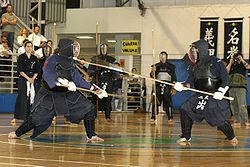 Naginata can be used to batter, stab or hook an opponent', but due to their relatively balanced center of mass, are often spun and turned to proscribe a large radius of reach. The curved blade makes for an effective tool for cutting due to the increased length of cutting surface. In the hands of a skilled practitioner, one 5-foot (1.5 m) tall wielder could conceivably cover and attack in 484 square feet (45 square meters) of open, level ground with a 5 foot (1.5 m) shaft, 3 foot (0.9 m) blade, 3 foot (0.9 m) reach.
Naginatas were often used by foot soldiers to create space on the battlefield. They have several situational advantages over a sword. Their reach was longer, allowing the wielder to keep out of reach of his opponent. The long shaft offered it more leverage in comparison to the hilt of the katana
, enabling the naginata to cut more efficiently. The weight of the weapon gave power to strikes and cuts, even though the weight of the weapon is usually thought of as a disadvantage. The weight at the end of the shaft and the shaft itself can be used both offensively and defensively. Swords, on the other hand, can be used to attack faster, have longer cutting edges (and therefore more striking surface and less area to grab), and were able to be more precisely controlled in the hands of an experienced swordsman.
The martial art of wielding the naginata is known as naginatajutsu
. Most naginata practice today is in a modernised form, a gendai budō
called atarashii Naginata meaning "new Naginata", in which competitions are held. Use of the naginata is also taught within the Bujinkan
and in some koryū
schools. Naginata practitioners may wear a form of the protective armour
known as bōgu
similar to that worn by kendō
practitioners. Wearing the bogu
means using a naginata that is a mix of light oak wood shaft, with a bamboo blade habu for atarashii Naginata.
The naginata has become associated in modern Japan as a woman's weapon as it is studied by women more than men, whereas in Europe
and Australia
naginata is practiced predominantly by men—this is however simply a reflection of the martial arts demographics of Europe, where there is no historical association—as there is in Japan—that naginatajutsu is for women.
Image:Naginata1.JPG| Two Edo period Japanese ( samurai ) naginata.
Image:Naginata2.JPG| Two Edo period Japanese ( samurai ) naginata.
Image:Naginata 1.JPG|Antique Japanese (samurai) naginata.
Pole weapon
A pole weapon or polearm is a close combat weapon in which the main fighting part of the weapon is placed on the end of a long shaft, typically of wood, thereby extending the user's effective range. Spears, glaives, poleaxes, halberds, and bardiches are all varieties of polearms...
. Naginata were originally used by the samurai
Samurai
is the term for the military nobility of pre-industrial Japan. According to translator William Scott Wilson: "In Chinese, the character 侍 was originally a verb meaning to wait upon or accompany a person in the upper ranks of society, and this is also true of the original term in Japanese, saburau...
class in feudal Japan, and naginata were also used by ashigaru
Ashigaru
The Japanese ashigaru were foot-soldiers of medieval Japan. The first known reference to ashigaru was in the 1300s, but it was during the Ashikaga Shogunate-Muromachi period that the use of ashigaru became prevalent by various warring factions.-Origins:Attempts were made in Japan by the Emperor...
(foot soldiers) and sōhei
Sohei
were Buddhist warrior monks of feudal Japan. At certain points of history they held considerable power, obliging the imperial and military governments to collaborate....
(warrior monks).
Description
A naginata consists of a wooden shaft with a curved blade on the end; it is similar to the Chinese Guan DaoGuan dao
A Guan Dao, Kwan Dao, or Kuan Tao is a type of Chinese pole weapon that is currently used in some forms of Chinese martial arts. In Chinese it is properly called a 偃月刀 yan yue dao , the name under which it always appears in texts from the Song to Qing dynasties such as the Wujing Zongyao and...
or European glaive
Glaive
A glaive is a European polearm weapon, consisting of a single-edged blade on the end of a pole. It is similar to the Japanese naginata and the Chinese Guan Dao....
. Usually it also had a sword-like hand guard (tsuba) between the blade and shaft. The 30 cm to 60 cm long naginata blade is forged in the same manner as traditional Japanese swords. The blade has a long tang (nakago) which is inserted in the shaft (nagaye or ebu), the blade is removable and is secured by means of a wood peg (mekugi) that passes though a hole (mekugi-ana) in both the nakago and the nagaye (ebu).
The nagaye (ebu) ranges from 120 cm to 240 cm in length and is oval shaped. The area of the nagaye (ebu) were the naginata nakago sits is the tachiuchi or tachiuke. The tachiuchi (tachiuke) would be re-enforced with metal rings (naginata dogane or semegane), and or metal sleeves (sakawa) and wrapped with cord (san-dan maki), the end of the nagaye (ebu) had a heavy metal end cap (ishizuki or hirumaki). When not in use the naginata blade would be covered with a wooden sheath (saya).
History
The naginata may have descended from the earlier hoko, possibly influenced by the Chinese Guan DaoGuan dao
A Guan Dao, Kwan Dao, or Kuan Tao is a type of Chinese pole weapon that is currently used in some forms of Chinese martial arts. In Chinese it is properly called a 偃月刀 yan yue dao , the name under which it always appears in texts from the Song to Qing dynasties such as the Wujing Zongyao and...
. It's difficult to tell when the naginata itself first appeared. Though often claimed as being invented by the sōhei
Sohei
were Buddhist warrior monks of feudal Japan. At certain points of history they held considerable power, obliging the imperial and military governments to collaborate....
during the Nara period
Nara period
The of the history of Japan covers the years from AD 710 to 794. Empress Gemmei established the capital of Heijō-kyō . Except for 5 years , when the capital was briefly moved again, it remained the capital of Japanese civilization until Emperor Kammu established a new capital, Nagaoka-kyō, in 784...
, physical evidence of their existence dates only from the mid-Kamakura period
Kamakura period
The is a period of Japanese history that marks the governance by the Kamakura Shogunate, officially established in 1192 in Kamakura by the first shogun Minamoto no Yoritomo....
, and earlier literary sources are ambiguous. The earliest clear references to naginata date from 1146 in the late Heian period
Heian period
The is the last division of classical Japanese history, running from 794 to 1185. The period is named after the capital city of Heian-kyō, or modern Kyōto. It is the period in Japanese history when Buddhism, Taoism and other Chinese influences were at their height...
, with one suggesting that the weapon may have been recent. Earlier 10th through 12th century sources refer to "long swords" that while a common medieval term or orthography for naginata, could also simply be referring to conventional swords; one source describes a naginata being drawn with the verb nuku, commonly associated with swords, rather than hazusu, the verb otherwise used in medieval texts for unsheathing naginata. However, some 11th and 12th century mentions of hoko may actually have been referring to naginata. The commonly-assumed association of the naginata and the sōhei is also unclear. Artwork from the late-13th and 14th centuries depict the sōhei with naginata but don't appear to place any special significance to it: the weapons appear as just part of a number of others carried by the monks, and are used by samurai and commoners as well. Depictions of naginata-armed sōhei in earlier periods were created centuries after the fact, and are likely using the naginata as a symbol to distinguish the sōhei from other warriors, rather than giving an accurate portrayal of the events.
During the Gempei War (1180–1185), in which the Taira clan
Taira clan
The was a major Japanese clan of samurai in historical Japan.In reference to Japanese history, along with Minamoto, Taira was a hereditary clan name bestowed by the emperors of the Heian Period to certain ex-members of the imperial family when they became subjects...
was pitted against Minamoto no Yoritomo
Minamoto no Yoritomo
was the founder and the first shogun of the Kamakura Shogunate of Japan. He ruled from 1192 until 1199.-Early life and exile :Yoritomo was the third son of Minamoto no Yoshitomo, heir of the Minamoto clan, and his official wife, a daughter of Fujiwara no Suenori, who was a member of the...
of the Minamoto clan
Minamoto clan
was one of the surnames bestowed by the Emperors of Japan upon members of the imperial family who were demoted into the ranks of the nobility. The practice was most prevalent during the Heian Period , although its last occurrence was during the Sengoku Era. The Taira were another such offshoot of...
, the naginata rose to a position of particularly high esteem, being regarded as an extremely effective weapon by warriors. Cavalry
Cavalry
Cavalry or horsemen were soldiers or warriors who fought mounted on horseback. Cavalry were historically the third oldest and the most mobile of the combat arms...
battles had become more important by this time, and the naginata proved excellent at dismounting cavalry and disabling riders. The widespread adoption of the naginata as a battlefield weapon forced the introduction of sune-ate
Greave
A greave is a piece of armour that protects the leg.-Description:...
(shin guards) as a part of Japanese armor. The rise of importance for the naginata can be seen as being mirrored by the European pike
Pike (weapon)
A pike is a pole weapon, a very long thrusting spear used extensively by infantry both for attacks on enemy foot soldiers and as a counter-measure against cavalry assaults. Unlike many similar weapons, the pike is not intended to be thrown. Pikes were used regularly in European warfare from the...
, another long pole weapon employed against cavalry. The introduction in 1543 of firearms in the form of the matchlock
Matchlock
The matchlock was the first mechanism, or "lock" invented to facilitate the firing of a hand-held firearm. This design removed the need to lower by hand a lit match into the weapon's flash pan and made it possible to have both hands free to keep a firm grip on the weapon at the moment of firing,...
(tanegashima) caused a great decrease in the appearance of the naginata on the battle
Battle
Generally, a battle is a conceptual component in the hierarchy of combat in warfare between two or more armed forces, or combatants. In a battle, each combatant will seek to defeat the others, with defeat determined by the conditions of a military campaign...
field. As battlefield tactics changed, the yari (spear) took the place of the naginata as the pole weapon of choice.
During the Edo Period
Edo period
The , or , is a division of Japanese history which was ruled by the shoguns of the Tokugawa family, running from 1603 to 1868. The political entity of this period was the Tokugawa shogunate....
, as the naginata became less useful for men on the battlefield, it became a symbol of the social status of women of the samurai class. A functional naginata was often a traditional part of a samurai daughter's dowry
Dowry
A dowry is the money, goods, or estate that a woman brings forth to the marriage. It contrasts with bride price, which is paid to the bride's parents, and dower, which is property settled on the bride herself by the groom at the time of marriage. The same culture may simultaneously practice both...
. Although they did not typically fight as normal soldiers, women of the samurai class were expected to be capable of defending their homes while their husbands were away at war. The naginata was considered one of the weapons most suitable for women, since it allows a woman to keep opponents at a distance, where any advantages in height, weight, and upper body strength would be lessened. An excellent example of the role of women in Japanese society and martial culture is Itagaki
Hangaku
was a female warrior samurai, one of the relatively few Japanese warrior women commonly known in history or classical literature.-Early life:She lived during the end of the Heian and the beginning of the Kamakura periods. Her other names include Itagaki...
, who, famous for her naginata skills, led the garrison
Garrison
Garrison is the collective term for a body of troops stationed in a particular location, originally to guard it, but now often simply using it as a home base....
of 3,000 warriors stationed at Toeizakayama castle. Ten thousand Hōjō clan
Hojo clan
See the late Hōjō clan for the Hōjō clan of the Sengoku Period.The in the history of Japan was a family who controlled the hereditary title of shikken of the Kamakura Shogunate. In practice, the family had actual governmental power, many times dictatorial, rather than Kamakura shoguns, or the...
warriors were dispatched to take the castle, and Itagaki led her troops out of the castle, killing a significant number of the attackers before being overpowered. The naginata saw its final uses in combat in 1868, at Aizu
Aizu
is an area comprising the westernmost third of Fukushima Prefecture in Japan. The principal city of the area is Aizuwakamatsu.During the Edo period, Aizu was a feudal domain known as and part of Mutsu Province.-History:...
, and in 1876, in Satsuma
Satsuma Province
was an old province of Japan that is now the western half of Kagoshima Prefecture on the island of Kyūshū. Its abbreviation is Sasshū .During the Sengoku Period, Satsuma was a fief of the Shimazu daimyo, who ruled much of southern Kyūshū from their castle at Kagoshima city.In 1871, with the...
.
Due to the influence of Westernization
Westernization
Westernization or Westernisation , also occidentalization or occidentalisation , is a process whereby societies come under or adopt Western culture in such matters as industry, technology, law, politics, economics, lifestyle, diet, language, alphabet,...
, after the Meiji Restoration
Meiji Restoration
The , also known as the Meiji Ishin, Revolution, Reform or Renewal, was a chain of events that restored imperial rule to Japan in 1868...
the perceived value of martial arts
Martial arts
Martial arts are extensive systems of codified practices and traditions of combat, practiced for a variety of reasons, including self-defense, competition, physical health and fitness, as well as mental and spiritual development....
, the naginata included, dropped severely. It was from this time that the focus of training became the strengthening of the will and the forging of the mind and body. During the Showa period
Showa period
The , or Shōwa era, is the period of Japanese history corresponding to the reign of the Shōwa Emperor, Hirohito, from December 25, 1926 through January 7, 1989.The Shōwa period was longer than the reign of any previous Japanese emperor...
, naginata training became a part of the public school system in 1912; and it "remains a staple of girls’ physical education"
Martial arts training in Japan was banned for five years by the Allied Forces
Allies of World War II
The Allies of World War II were the countries that opposed the Axis powers during the Second World War . Former Axis states contributing to the Allied victory are not considered Allied states...
after Japan's surrender
Surrender (military)
Surrender is when soldiers, nations or other combatants stop fighting and eventually become prisoners of war, either as individuals or when ordered to by their officers. A white flag is a common symbol of surrender, as is the gesture of raising one's hands empty and open above one's head.When the...
at the end of World War II
World War II
World War II, or the Second World War , was a global conflict lasting from 1939 to 1945, involving most of the world's nations—including all of the great powers—eventually forming two opposing military alliances: the Allies and the Axis...
. After the lifting of the ban in 1950, a modern form of naginata training, known as Atarashii naginata ("new naginata"), was developed. Since World War II, naginata has primarily been practiced as a sport with a particular emphasis on etiquette
Etiquette
Etiquette is a code of behavior that delineates expectations for social behavior according to contemporary conventional norms within a society, social class, or group...
and discipline
Discipline
In its original sense, discipline is referred to systematic instruction given to disciples to train them as students in a craft or trade, or to follow a particular code of conduct or "order". Often, the phrase "to discipline" carries a negative connotation. This is because enforcement of order –...
, rather than as military training.
Although associated with considerably smaller numbers of practitioners, a number of "koryu bujutsu" systems (old school martial arts) which include older and more combative forms of naginatajutsu remain existent, including Araki Ryu, Tendo Ryu, Jikishinkage ryu, Higo Koryu, Tenshin Shoden Katori Shinto Ryu,Toda-ha Buko Ryu and Yoshin ryu, some of which have authorized representatives outside Japan.
In the USA, there are an estimated 200 practitioners, half of whom are male.
Modern naginata Construction
The modern naginata is between 210 cm and 225 cm in length and must weigh over 650 grams. In contemporary naginatajutsu, there are two general constructions. The first, the kihon yo, is carved from one piece of Japanese white oakWhite oak
Quercus alba, the white oak, is one of the pre-eminent hardwoods of eastern North America. It is a long-lived oak of the Fagaceae family, native to eastern North America and found from southern Quebec west to eastern Minnesota and south to northern Florida and eastern Texas. Specimens have been...
and is used for the practice of katas (forms). This is quite light, and may or may not feature the tsuba between the blade and shaft sections. The second type, the shiai yo, uses a similar wooden shaft, but the blade is constructed from bamboo
Bamboo
Bamboo is a group of perennial evergreens in the true grass family Poaceae, subfamily Bambusoideae, tribe Bambuseae. Giant bamboos are the largest members of the grass family....
and is replaceable as it can break through hard contact. This type is used in atarashii naginata, the bamboo blade being more forgiving on the target than a wooden or metal blade.
Many of the imitation "naginata" for sale to the public are not actually naginata at all, as may be concluded from the above details on proper construction. Specifically, these imitations have shorter, rounded shafts, very short blades, and screw-together sections.
Usage
Naginatas were often used by foot soldiers to create space on the battlefield. They have several situational advantages over a sword. Their reach was longer, allowing the wielder to keep out of reach of his opponent. The long shaft offered it more leverage in comparison to the hilt of the katana
Katana
A Japanese sword, or , is one of the traditional bladed weapons of Japan. There are several types of Japanese swords, according to size, field of application and method of manufacture.-Description:...
, enabling the naginata to cut more efficiently. The weight of the weapon gave power to strikes and cuts, even though the weight of the weapon is usually thought of as a disadvantage. The weight at the end of the shaft and the shaft itself can be used both offensively and defensively. Swords, on the other hand, can be used to attack faster, have longer cutting edges (and therefore more striking surface and less area to grab), and were able to be more precisely controlled in the hands of an experienced swordsman.
The martial art of wielding the naginata is known as naginatajutsu
Naginatajutsu
is the Japanese martial art of wielding the . This is a weapon resembling the medieval European glaive. Most naginatajutsu practiced today is in a modernized form, a gendai budō, in which competitions also are held.-Debated origins:...
. Most naginata practice today is in a modernised form, a gendai budō
Gendai Budo
, meaning "modern martial way", are modern Japanese martial arts which were established after the Meiji Restoration . Koryū are the opposite: ancient martial arts established before the Meiji Restoration.-Scope and tradition:...
called atarashii Naginata meaning "new Naginata", in which competitions are held. Use of the naginata is also taught within the Bujinkan
Bujinkan
The Bujinkan is an international martial arts organization based in Japan and headed by Masaaki Hatsumi, it is best known for its association with ninjutsu. The system taught by this group, called Bujinkan Budō Tai jutsu, consists of nine separate martial arts traditions .-Origins:Hatsumi's...
and in some koryū
Koryu
is a Japanese word that is used in association with the ancient Japanese martial arts. This word literally translates as "old school" or "traditional school"...
schools. Naginata practitioners may wear a form of the protective armour
Armour
Armour or armor is protective covering used to prevent damage from being inflicted to an object, individual or a vehicle through use of direct contact weapons or projectiles, usually during combat, or from damage caused by a potentially dangerous environment or action...
known as bōgu
Bogu
is training armour used primarily in the Japanese martial art of kendo, with variants used for jukendo, naginatajutsu, and sojutsu. The name consists of two parts: bō meaning "protect" or "defend," and gu meaning "equipment" or "tool." A set of bogu has four components:: combined face mask and...
similar to that worn by kendō
Kendo
, meaning "Way of The Sword", is a modern Japanese martial art of sword-fighting based on traditional Japanese swordsmanship, or kenjutsu.Kendo is a physically and mentally challenging activity that combines strong martial arts values with sport-like physical elements.-Practitioners:Practitioners...
practitioners. Wearing the bogu
Bogu
is training armour used primarily in the Japanese martial art of kendo, with variants used for jukendo, naginatajutsu, and sojutsu. The name consists of two parts: bō meaning "protect" or "defend," and gu meaning "equipment" or "tool." A set of bogu has four components:: combined face mask and...
means using a naginata that is a mix of light oak wood shaft, with a bamboo blade habu for atarashii Naginata.
The naginata has become associated in modern Japan as a woman's weapon as it is studied by women more than men, whereas in Europe
Europe
Europe is, by convention, one of the world's seven continents. Comprising the westernmost peninsula of Eurasia, Europe is generally 'divided' from Asia to its east by the watershed divides of the Ural and Caucasus Mountains, the Ural River, the Caspian and Black Seas, and the waterways connecting...
and Australia
Australia
Australia , officially the Commonwealth of Australia, is a country in the Southern Hemisphere comprising the mainland of the Australian continent, the island of Tasmania, and numerous smaller islands in the Indian and Pacific Oceans. It is the world's sixth-largest country by total area...
naginata is practiced predominantly by men—this is however simply a reflection of the martial arts demographics of Europe, where there is no historical association—as there is in Japan—that naginatajutsu is for women.
Notable users
- Tomoe GozenTomoe Gozen, pronounced , was a late twelfth-century concubine of Minamoto no Yoshinaka.Tomoe was a rare female samurai warrior , known for her bravery and strength...
- Hangaku Gozen
- BenkeiSaito Musashibo Benkei, popularly called Benkei, was a Japanese warrior monk who served Minamoto no Yoshitsune. He is commonly depicted as a man of great strength and loyalty, and a popular subject of Japanese folklore.-Biography:...
- Nakano TakekoNakano Takekowas a Japanese female warrior of the Aizu domain, who fought and died during the Boshin War. Nakano, born in Edo, was the daughter of Nakano Heinai, an Aizu official. She was thoroughly trained in the martial and literary arts, and was adopted by her teacher Akaoka Daisuke...
See also
- BardicheBardicheA bardiche or berdiche is a type of glaive polearm known in the 16th and 17th centuries in Eastern Europe and Russia. Ultimately a descendant of the medieval sparth , the bardiche proper appears after 1500, but there are numerous medieval manuscripts that depict very similar weapons beginning ca....
- BudōBudois a Japanese term describing martial arts. In English, it is used almost exclusively in reference to Japanese martial arts.-Etymology:Budō is a compound of the root bu , meaning war or martial; and dō , meaning path or way. Specifically, dō is derived from the Buddhist Sanskrit mārga...
- YariYariis the term for one of the traditionally made Japanese blades in the form of a spear, or more specifically, the straight-headed spear...
- BisentoBisentoA is a kind of Japanese pole weapon which greatly resembles a naginata. It consists of a thick curved blade mounted atop a long wooden pole. Much heavier than the naginata in construction, there are some accounts of it being used as a training weapon to improve one's naginatajutsu...
- HalberdHalberdA halberd is a two-handed pole weapon that came to prominent use during the 14th and 15th centuries. Possibly the word halberd comes from the German words Halm , and Barte - in modern-day German, the weapon is called Hellebarde. The halberd consists of an axe blade topped with a spike mounted on...
- VoulgeVoulgethumb|VoulgesA voulge is a type of polearm that existed alongside the similar glaive in medieval Europe. Superficially, a voulge might strongly resemble a glaive, but there are some notable differences in construction...
- AtgeirAtgeirAn atgeir, sometimes called a "mail-piercer" or "hewing-spear," was a type of polearm in use in Viking Age Scandinavia and Norse colonies in the British Isles and Iceland. It is usually translated in English as "halberd", but most likely closer resembled a bill or glaive during the Viking age...
Gallery
Image:Naginata1.JPG| Two Edo period Japanese ( samurai ) naginata.
Image:Naginata2.JPG| Two Edo period Japanese ( samurai ) naginata.
Image:Naginata 1.JPG|Antique Japanese (samurai) naginata.
External links
- All Japan Naginata Federation
- US Naginata Federation home page and general information
- British Naginata Association
- Australian Naginata Federation
- Southern California Naginata Federation - history of the naginata
- Canadian Naginata Federation home page Brazilian Naginata Association Naginata webpage -(France) Naginata.be -(Belgium)
- A list of traditional Naginatajutsu Ryu at Koryu.com