
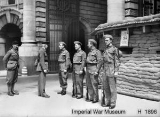
The
Home Guard was a defence organisation of the
British Army during the Second World WarThe British Army during the Second World War was, in 1939, a volunteer army, that introduced limited conscription in early 1939, and full conscription shortly after the declaration of war with Germany. During the early years of the war, the army suffered defeat in almost every theatre in which it...
. Operational from 1940 until 1944, the Home Guard—comprising 1.5 million local volunteers otherwise ineligible for military service, usually owing to age, hence the nickname 'Dad's Army' — acted as a secondary defence force, in case of invasion by the forces of
Nazi GermanyNazi Germany , also known as the Third Reich , but officially called German Reich from 1933 to 1943 and Greater German Reich from 26 June 1943 onward, is the name commonly used to refer to the state of Germany from 1933 to 1945, when it was a totalitarian dictatorship ruled by...
and their
alliesThe Axis powers , also known as the Axis alliance, Axis nations, Axis countries, or just the Axis, was an alignment of great powers during the mid-20th century that fought World War II against the Allies. It began in 1936 with treaties of friendship between Germany and Italy and between Germany and...
. The Home Guard guarded the coastal areas of Britain and other important places such as airfields, factories and explosives stores.
Early development
The origins of the Home Guard can be traced to Captain
Tom WintringhamThomas Henry Wintringham was a British soldier, military historian, journalist, poet, Marxist, politician and author. He was an important figure in the formation of the Home Guard during World War II and was one of the founders of the Common Wealth Party.-Early life:Tom Wintringham was born 1898...
, who returned from the
Spanish Civil WarThe Spanish Civil WarAlso known as The Crusade among Nationalists, the Fourth Carlist War among Carlists, and The Rebellion or Uprising among Republicans. was a major conflict fought in Spain from 17 July 1936 to 1 April 1939...
and wrote a book entitled
How to Reform the Army. In the book, as well as a large number of regular army reforms, Wintringham called for the creation of twelve divisions similar in composition to that of the International Brigade which had been formed in Spain during the conflict; the divisions would be raised through a process of voluntary enlistment targeting ex-servicemen and youths. Despite great interest by the
War OfficeThe War Office was a department of the British Government, responsible for the administration of the British Army between the 17th century and 1964, when its functions were transferred to the Ministry of Defence...
in the book's assertion that 'security is possible', Wintringham's call to train 100,000 men immediately was not implemented.
When Britain declared war on Germany on 3 September 1939, debates began in official circles about the possible ways in which the German military might launch an invasion of the
British IslesThe British Isles are a group of islands off the northwest coast of continental Europe that include the islands of Great Britain and Ireland and over six thousand smaller isles. There are two sovereign states located on the islands: the United Kingdom of Great Britain and Northern Ireland and...
; in the first week of the conflict numerous diplomatic and intelligence reports seemed to indicate that there was the possibility of an imminent German amphibious assault. Many government ministers and senior Army officials including the Commander in Chief Home Forces,
GeneralA general officer is an officer of high military rank, usually in the army, and in some nations, the air force. The term is widely used by many nations of the world, and when a country uses a different term, there is an equivalent title given....
Walter KirkeGeneral Sir Walter Mervyn St George Kirke GCB CMG DSO was the Commander in Chief of the British Home Forces during the Second World War.-Military career:...
, believed that the threat of invasion was greatly exaggerated and were sceptical but others were not, including
Winston ChurchillSir Winston Leonard Spencer-Churchill, was a predominantly Conservative British politician and statesman known for his leadership of the United Kingdom during the Second World War. He is widely regarded as one of the greatest wartime leaders of the century and served as Prime Minister twice...
the newly installed First Lord of the Admiralty. Churchill argued that some form of home defence force should be raised from members of the population who were ineligible to serve in the regular forces but wished to serve their country; in a letter he wrote to Samuel Hoare, the
Lord Privy SealThe Lord Privy Seal is the fifth of the Great Officers of State in the United Kingdom, ranking beneath the Lord President of the Council and above the Lord Great Chamberlain. The office is one of the traditional sinecure offices of state...
on 8 October 1939, Churchill called for a Home Guard force of 500,000 men over the age of forty to be formed. At the same time that government officials were debating the need for a home defence force, such a force was actually being formed without any official encouragement; in
EssexEssex is a ceremonial and non-metropolitan county in the East region of England, and one of the home counties. It is located to the northeast of Greater London. It borders with Cambridgeshire and Suffolk to the north, Hertfordshire to the west, Kent to the South and London to the south west...
, men not eligible for call-up into the armed forces were coming forward to join the self-styled '
Legion of FrontiersmenThe Legion of Frontiersmen is a paramilitary group formed in Britain in 1905 by Roger Pocock, a former Constable with the North-West Mounted Police and Boer War veteran, with its roots firmly set in another era, to bolster the defensive capacity of the British Empire...
'. Officials were soon informed of the development of the Legion, with the Adjutant-General, Sir Robert Gordon-Finlayson, arguing that the government should encourage the development of more unofficial organisations. However, the fear of invasion quickly waned as it became evident that the German military was not in a position to launch an invasion of Britain, and official enthusiasm for home defence forces waned, and the Legion appears to have dissolved itself at the same time.
The
Battle of FranceIn the Second World War, the Battle of France was the German invasion of France and the Low Countries, beginning on 10 May 1940, which ended the Phoney War. The battle consisted of two main operations. In the first, Fall Gelb , German armoured units pushed through the Ardennes, to cut off and...
began in May 1940, with the
WehrmachtThe Wehrmacht – from , to defend and , the might/power) were the unified armed forces of Nazi Germany from 1935 to 1945. It consisted of the Heer , the Kriegsmarine and the Luftwaffe .-Origin and use of the term:...
launching an invasion of
BelgiumBelgium , officially the Kingdom of Belgium, is a federal state in Western Europe. It is a founding member of the European Union and hosts the EU's headquarters, and those of several other major international organisations such as NATO.Belgium is also a member of, or affiliated to, many...
, the
NetherlandsThe Netherlands is a constituent country of the Kingdom of the Netherlands, located mainly in North-West Europe and with several islands in the Caribbean. Mainland Netherlands borders the North Sea to the north and west, Belgium to the south, and Germany to the east, and shares maritime borders...
and
FranceThe French Republic , The French Republic , The French Republic , (commonly known as France , is a unitary semi-presidential republic in Western Europe with several overseas territories and islands located on other continents and in the Indian, Pacific, and Atlantic oceans. Metropolitan France...
; by 20 May German forces had reached the
English ChannelThe English Channel , often referred to simply as the Channel, is an arm of the Atlantic Ocean that separates southern England from northern France, and joins the North Sea to the Atlantic. It is about long and varies in width from at its widest to in the Strait of Dover...
and on 28 May the
Belgian ArmyThe Land Component is organised using the concept of capacities, whereby units are gathered together according to their function and material. Within this framework, there are five capacities: the command capacity, the combat capacity, the support capacity, the services capacity and the training...
surrendered. The combination of the large-scale combined operations mounted by the Wehrmacht during the
invasion of NorwayOperation Weserübung was the code name for Germany's assault on Denmark and Norway during the Second World War and the opening operation of the Norwegian Campaign...
in April, and the prospect that much of the Channel coast would soon be occupied made the prospect of a German invasion of the British Isles alarmingly real. Fears of an invasion rapidly began to grow, spurred on by reports in both the press and from official government bodies, of a
Fifth ColumnFifth Column was a Canadian all-women experimental post-punk band from Toronto, which came about during the early 1980s. They took the name Fifth Column after a military manoeuvre by Francisco Franco during the Spanish Civil War, in which nationalist insurrectionists within besieged Republican...
operating in Britain which would aid an invasion by German airborne forces. The government soon found itself under increasing pressure to intern suspect aliens to prevent the formation of a Fifth Column and to allow the population to take up arms to defend themselves against an invasion. Calls for some form of home defence force soon began to be heard from the press and from private individuals as the government began to intern
GermanGermany , officially the Federal Republic of Germany , is a federal parliamentary republic in Europe. The country consists of 16 states while the capital and largest city is Berlin. Germany covers an area of 357,021 km2 and has a largely temperate seasonal climate...
and
AustriaAustria , officially the Republic of Austria , is a landlocked country of roughly 8.4 million people in Central Europe. It is bordered by the Czech Republic and Germany to the north, Slovakia and Hungary to the east, Slovenia and Italy to the south, and Switzerland and Liechtenstein to the...
n citizens in the country. The press baron Lord Kemsley privately proposed to the
War OfficeThe War Office was a department of the British Government, responsible for the administration of the British Army between the 17th century and 1964, when its functions were transferred to the Ministry of Defence...
that rifle clubs be formed to form the nucleus of a home defence force, and
Josiah WedgwoodColonel Josiah Clement Wedgwood, 1st Baron Wedgwood, DSO, PC, DL sometimes referred to as Josiah Wedgwood IV was a British Liberal and Labour politician who served in government under Ramsay MacDonald...
, a Labour MP, wrote to the Prime Minister asking that the entire adult population be trained in the use of arms and given weapons to defend themselves. Similar calls appeared in newspaper columns; in the 12 May issue of the
Sunday Express a Brigadier called on the government to issue free arms licenses and permits to buy ammunition to men possessing small arms, and on the same day the
Sunday Pictorial asked if the government had considered training golfers in rifle shooting to eliminate stray parachutists.
These calls alarmed government and senior military officials, who worried about the prospect of the population forming private defence forces that the Army would not be able to control, and in mid-May the Home Office issued a press release on the matter; it was the task of the army to deal with enemy parachutists, as any civilians who carried weapons and fired on German troops were likely to be executed if captured. Private defence forces soon began to be formed throughout the country, placing the government in an awkward position; these private forces, which the army might not be able to control, could well inhibit the attempts by the army during an invasion, yet to ignore the calls for a home defence force to be set up would be politically problematic. An officially sponsored home defence force would allow the government greater control and also allow for greater security around vulnerable areas such as munitions factories and airfields, but there was some confusion over who would form and control the force, with separate plans drawn up by the War Office and General Headquarters Home Forces under General Kirke. The government and senior military officials rapidly compared plans and by 13 May had worked out an improvised plan for a home defence force, to be called the Local Defence Volunteers, but the rush to complete a plan and announce it to the public had led to a number of administrative and logistical problems, such as how the volunteers in the new force would be armed, which would cause problems as the force evolved. However, on the evening of 14 May 1940 the
Secretary of State for WarThe position of Secretary of State for War, commonly called War Secretary, was a British cabinet-level position, first held by Henry Dundas . In 1801 the post became that of Secretary of State for War and the Colonies. The position was re-instated in 1854...
,
Anthony EdenRobert Anthony Eden, 1st Earl of Avon, KG, MC, PC was a British Conservative politician, who was Prime Minister from 1955 to 1957...
, gave a radio broadcast announcing the formation of the Local Defence Volunteers and called for volunteers to join the force.
Official recognition
In the radio announcement, Eden called on men between the ages of 17 and 65 in Britain, who were not in military service but wished to defend their country against an invasion, to enroll in the LDV at their local police station. The announcement was met with a great deal of enthusiasm on the part of the population, with 250,000 volunteers attempting to sign up in the first seven days; by July this number increased to 1.5 million. As volunteers and social groups such as cricket clubs began forming their own units, dubbed 'the parashots' by the press, the War Office continued to lay down the administrative and logistical foundations for the organisation. In telegrams to the
Lord LieutenantThe title Lord Lieutenant is given to the British monarch's personal representatives in the United Kingdom, usually in a county or similar circumscription, with varying tasks throughout history. Usually a retired local notable, senior military officer, peer or business person is given the post...
s of each county, it was explained that LDV units would operate in pre-defined military areas already used by the regular Army, with a General Staff Officer coordinating with civilian regional commissioners to divide these areas into smaller zones; in London this was organised on the basis of police districts. On 17 May the LDV achieved official legal status when the
Privy CouncilHer Majesty's Most Honourable Privy Council, usually known simply as the Privy Council, is a formal body of advisers to the Sovereign in the United Kingdom...
issued the
Defence (Local Defence Volunteers) Order in Council, and orders were issued from the War Office to regular Army headquarters throughout Britain explaining the status of LDV units; volunteers would be divided into sections, platoons and companies but would not be paid and leaders of units would not hold commissions or have the power to command regular forces.
However, implementation of the legislation proved to be extremely difficult, particularly as the primary focus of the War Office and General Headquarters Home Forces was on
Operation DynamoThe Dunkirk evacuation, commonly known as the Miracle of Dunkirk, code-named Operation Dynamo by the British, was the evacuation of Allied soldiers from the beaches and harbour of Dunkirk, France, between 26 May and the early hours of 3 June 1940, because the British, French and Belgian troops were...
and the evacuation of the
British Expeditionary ForceThe British Expeditionary Force was the British force in Europe from 1939–1940 during the Second World War. Commanded by General Lord Gort, the BEF constituted one-tenth of the defending Allied force....
from
Dunkirk between 27 May to 4 June. This apparent lack of focus led to many LDV members becoming impatient, particularly when it was announced that volunteers would only receive armbands printed with 'L.D.V.' on them until proper uniforms could be manufactured and there was no mention of weapons being issued to units; this impatience often led to units conducting their own patrols without official permission, often led by men who had previously served in the armed forces. The presence of many veterans, and the appointment of ex-officers as commanders of LDV units, only worsened the situation, with many believing that they did not require training before being issued weapons; this led to numerous complaints being received by the War Office and the press, and many ex-senior officers attempting to use their influence to obtain weapons or permission to begin patrolling. The issue of weapons to LDV units was particularly problematic for the War Office, as it was recognised that the re-arming and re-equipping of the regular forces would have to take precedence over the LDV. Instead, the War Office issued instructions on how to make Molotov cocktails and emergency orders were placed for First World War vintage
Ross RifleThe Ross rifle was a straight-pull bolt-action 0.303 inch calibre rifle produced in Canada from 1903 until the middle of the First World War....
s from
CanadaCanada is a North American country consisting of ten provinces and three territories. Located in the northern part of the continent, it extends from the Atlantic Ocean in the east to the Pacific Ocean in the west, and northward into the Arctic Ocean...
and Pattern 14 and
M1917The M1917 Enfield, the "American Enfield" , formally named "United States Rifle, cal .30, Model of 1917" was an American modification and production of the British .303 caliber P14 rifle developed and manufactured during the period 1917-1918.-History:Before World War I developed, the British had as...
Rifles from the
United StatesThe United States of America is a federal constitutional republic comprising fifty states and a federal district...
. In the absence of proper weapons, many LDV units broke into museums and appropriated whatever weapons could be found, or equipped themselves with private weapons such as shotguns.
Another problem that was encountered as the LDV was organised was the definition of the role the organisation was to play. In the eyes of the War Office and the Army, the LDV was to act as 'an armed police constabulary' which in the event of an invasion was to observe German troop movements, convey information to the regular forces and guard places of strategic or tactical importance. The War Office believed that the LDV would act best in such a passive role because of its lack of training, weapons and proper equipment. However such a role clashed with the expectations of LDV commanders and members, who believed that the organisation would be best suited to an active role, attacking and harassing German forces. This clash led to morale problems and even more complaints to the press and the War Office from LDV members who were opposed to, as they saw it, the government leaving them defenceless and placing them in a non-combatant role. Complaints about the role of the LDV, as well as continuing problems encountered by the War Office in its attempts to clothe and arm the LDV, led the government to respond to public pressure in August, redefining the role of the LDV to include delaying and obstructing German forces through any means possible. At the same time Winston Churchill, who had assumed the position of Prime Minister in May, became involved in the matter after being alerted to the problems, obtaining a summary of the current LDV position from the War Office on 22 June. After reviewing the summary, Churchill wrote to Eden stating that, in his opinion, one of the main causes of disciplinary and morale problems stemmed from the uninspiring title of the LDV and suggesting that it be renamed as the 'Home Guard'. Despite resistance from Eden and other government officials, who noted that one million 'LDV' armbands had already been printed and the cost of printing another million 'Home Guard' armbands would be excessive, Churchill would not be dissuaded; on 22 July the LDV was officially renamed the Home Guard.
The Home Guard also served as a cover for the
Auxiliary UnitsThe Auxiliary Units or GHQ Auxiliary Units were specially trained, highly secret units created by the United Kingdom government during the Second World War, with the aim of resisting the expected occupation of the United Kingdom by Nazi Germany, after a planned invasion codenamed Operation Sea Lion...
, a force of more highly trained volunteer troops that would function as guerilla units if the UK was invaded.
The Home Guard did not, initially, admit women to its ranks. Some women formed their own groups like the
Amazon Defence Corps. Later a more organised but still unofficial
Women's Home Defence (WHD) formed with many groups across the country. Limited female involvement was permitted later on the understanding that these would be in traditional female support roles and not in any way seen as combatants.
Later years
Even once the threat of invasion had passed, the Home Guard remained in existence manning guard posts and performing other duties to free up regular troops for duties overseas. In 1942 the National Service Act allowed for compulsory enrolment where units were below strength. At this time, the lowest rank within the Home Guard, 'volunteer', was renamed to 'private' to match the regular army usage.
However following the
successful landings in FranceOperation Overlord was the code name for the Battle of Normandy, the operation that launched the invasion of German-occupied western Europe during World War II by Allied forces. The operation commenced on 6 June 1944 with the Normandy landings...
and the drive towards Germany by the Allies, the Home Guard were formally stood down on 3 December 1944 and finally disbanded on 31 December 1945.
Male members were rewarded with a certificate. If he had served more then three years and requested it, members would be awarded the Defence Medal. It would not be until 1945 that those women who had helped as auxiliaries were recognised with their own certificate.
A modernised version of the Home Guard was briefly re-established in December 1951. Although units in coastal areas were authorised to recruit to full strength, it fell foul of a complete reassessment of Britain's defence posture following the advent of the H-bomb and was disbanded in July 1957. In the 1980s, the
Home Service ForceThe Home Service Force was a Home Guard type force established in the United Kingdom in 1982. It was linked to the Territorial Army and recruited from volunteers aged 18–60 with previous British forces experience...
was established, consisting of older ex-servicemen who could not meet Territorial Army (TA) training requirements; it was envisaged that this force, a company in every Territorial battalion, would be used to guard strategic points in the event of an emergency so as to free up the better-trained Territorial forces for more important roles. The Force was disbanded in 1993.
Equipment and training
Initially the LDV were poorly armed, since the regular forces had priority for weapons and equipment. The LDV's original role had largely been to observe and report enemy movements, but it swiftly changed to a more aggressive role. Nevertheless, they would have been expected to fight well-trained and equipped troops, despite having only negligible training and only weapons such as
pitchforkA pitchfork is an agricultural tool with a long handle and long, thin, widely separated pointed tines used to lift and pitch loose material, such as hay, leaves, grapes, dung or other agricultural materials. Pitchforks typically have two or three tines...
s and
shotgunA shotgun is a firearm that is usually designed to be fired from the shoulder, which uses the energy of a fixed shell to fire a number of small spherical pellets called shot, or a solid projectile called a slug...
s (a solid ammunition for shotguns was developed for this purpose) or firearms that belonged in museums. Patrols were carried out
on footInfantrymen are soldiers who are specifically trained for the role of fighting on foot to engage the enemy face to face and have historically borne the brunt of the casualties of combat in wars. As the oldest branch of combat arms, they are the backbone of armies...
,
by bicycleBicycle infantry are infantry soldiers who maneuver on battlefields using bicycles. The term dates from the late 19th century, when the "safety bicycle" became popular in Europe, the United States and Australia. Historically, bicycles lessened the need for horses, fuel and vehicle maintenance...
, even
on horsebackThe first use of horses in warfare occurred over 5,000 years ago. The earliest evidence of horses ridden in warfare dates from Eurasia between 4000 and 3000 BC. A Sumerian illustration of warfare from 2500 BC depicts some type of equine pulling wagons...
and often without uniforms, although all volunteers wore an armband that said "LDV". There were also river patrols using the private craft of members. Many officers from the First World War used their
WebleyWebley & Scott is an arms manufacturer based in Birmingham, England. Webley produced handguns and long guns from 1834 to 1979, when the company ceased to manufacture firearms and instead focused on producing air pistols and air rifles...
Mk VI .455 revolversThe Webley Revolver was, in various marks, the standard issue service pistol for the armed forces of the United Kingdom, the British Empire, and the Commonwealths from 1887 until 1963.The Webley is a top-break revolver with automatic extraction...
. There were also numerous private attempts to produce
armoured vehiclesAn armoured fighting vehicle is a combat vehicle, protected by strong armour and armed with weapons. AFVs can be wheeled or tracked....
by adding steel plates to cars or lorries, often armed with
machine gunA machine gun is a fully automatic mounted or portable firearm, usually designed to fire rounds in quick succession from an ammunition belt or large-capacity magazine, typically at a rate of several hundred rounds per minute....
s. Some even had access to armoured cars, though these were makes no longer in service with the regular army.
Ex-Communist and Spanish Civil War veteran Tom Wintringham, a journalist and key advocate of the LDV and later Home Guard, opened a private training camp for the LDV at
Osterley ParkOsterley Park is a mansion set in a large park of the same name. It is in the London Borough of Hounslow, part of the western suburbs of London. When the house was built it was surrounded by rural countryside. It was one of a group of large houses close to London which served as country retreats...
, outside London, in early July 1940. Wintringham's training methods were mainly based on his experience in the International Brigades in Spain. Those who had fought alongside him in Spain trained volunteers in
anti-tank warfareAnti-tank warfare was created by the need to seek technology and tactics to destroy tanks and their supporting infantry during the First World War...
and
demolitionDemolition is the tearing-down of buildings and other structures, the opposite of construction. Demolition contrasts with deconstruction, which involves taking a building apart while carefully preserving valuable elements for re-use....
s.
The U.S.
National Rifle AssociationThe National Rifle Association of America is an American non-profit 501 civil rights organization which advocates for the protection of the Second Amendment of the United States Bill of Rights and the promotion of firearm ownership rights as well as marksmanship, firearm safety, and the protection...
collected and shipped large numbers of privately donated rifles for use by the Home Guard. These were collected and destroyed after the war. Within a few months they were issued proper uniforms and equipment, as the immediate needs of the regular forces were satisfied. After September 1940 the army began to take charge of the Home Guard training in Osterley, and Wintringham and his associates were gradually sidelined. Wintringham resigned in April 1941. Ironically, despite his support of the Home Guard, Wintringham was never allowed to join the organisation himself because of a policy barring membership by
communistsCommunism is a social, political and economic ideology that aims at the establishment of a classless, moneyless, revolutionary and stateless socialist society structured upon common ownership of the means of production...
and
fascistsFascism is a radical authoritarian nationalist political ideology. Fascists seek to rejuvenate their nation based on commitment to the national community as an organic entity, in which individuals are bound together in national identity by suprapersonal connections of ancestry, culture, and blood...
.
An example of a Home Guard exercise is one in the small village of Dundry that defensively overlooks
BristolBristol is a city, unitary authority area and ceremonial county in South West England, with an estimated population of 433,100 for the unitary authority in 2009, and a surrounding Larger Urban Zone with an estimated 1,070,000 residents in 2007...
: the exercise involved the Home Guard units of several neighbouring villages. See Dundry for details.
It was not until 1943 that they were a properly trained and equipped force. They were frequently equipped with improvised weapons, or non-standard ones purchased by the government from abroad. For example, large numbers of M1917 Enfield rifles were purchased for the use of the Home Guard. These used the (
30-06The .30-06 Springfield cartridge or 7.62×63mm in metric notation, was introduced to the United States Army in 1906 and standardized, and was in use until the 1960s and early 1970s. It replaced the .30-03, 6 mm Lee Navy, and .30 US Army...
) cartridge - an American 0.30 inch round which was a totally different type of
ammunitionAmmunition is a generic term derived from the French language la munition which embraced all material used for war , but which in time came to refer specifically to gunpowder and artillery. The collective term for all types of ammunition is munitions...
from the
0.303 round.303 British, or 7.7x56mmR, is a .311 inch calibre rifle and machine gun cartridge first developed in Britain as a blackpowder round put into service in December 1888 for the Lee-Metford rifle, later adapted to use smokeless powders...
used by the British
Lee-EnfieldThe Lee-Enfield bolt-action, magazine-fed, repeating rifle was the main firearm used by the military forces of the British Empire and Commonwealth during the first half of the 20th century...
rifle. A 2 inches (50.8 mm) red band was painted around the fore end of the stock as a warning since a 0.303 round would load but jam the rifle. That the similar-in-appearance P14 rifle was supplied to the Home Guard, in 0.303 calibre that took the British round, only added to the confusion.
The Home Guard inherited weapons that the regular Army no longer required, such as the
Blacker BombardThe Blacker Bombard, also known as the 29mm Spigot Mortar, was an infantry anti-tank weapon devised by Lieutenant-Colonel Stewart Blacker in the early years of the Second World War.-Development:...
anti-tank weapon, and weapons they no longer desired, such as the
Sticky bombThe Grenade, Hand, Anti-Tank No. 74, commonly known as the sticky bomb, was a British hand grenade designed and produced during the Second World War. The grenade was one of a number of anti-tank weapons developed for use by the British Army and Home Guard as an ad hoc solution to a lack of...
. Their arsenal also included weapons that could be produced cheaply without consuming materials that were needed to produce armaments for the regular units such as the
Northover projectorThe Projector, 2.5 inch—more commonly known as the Northover Projector—was an ad hoc anti-tank weapon used by the British Army and Home Guard during the Second World War...
, a
blackpowderGunpowder, also known since in the late 19th century as black powder, was the first chemical explosive and the only one known until the mid 1800s. It is a mixture of sulfur, charcoal, and potassium nitrate - with the sulfur and charcoal acting as fuels, while the saltpeter works as an oxidizer...
-powered
mortarA mortar is an indirect fire weapon that fires explosive projectiles known as bombs at low velocities, short ranges, and high-arcing ballistic trajectories. It is typically muzzle-loading and has a barrel length less than 15 times its caliber....
; the
No. 76 Special Incendiary GrenadeThe No. 76 Special Incendiary Grenade also commonly known as the A.W. bomb or SIP Grenade was an incendiary grenade based on white phosphorus used during World War II....
, a glass bottle filled with highly flammable material and the
Smith GunThe Smith Gun was an ad hoc anti-tank artillery piece used by the British Army and Home Guard during the Second World War. With a German invasion of Great Britain seeming likely after the defeat in the Battle of France, most available weaponry was diverted to the regular British Army, leaving the...
, a small artillery gun that could be towed by an automobile. They also used lend-lease Tommy guns and American
Browning Automatic RifleThe Browning Automatic Rifle was a family of United States automatic rifles and light machine guns used by the United States and numerous other countries during the 20th century. The primary variant of the BAR series was the M1918, chambered for the .30-06 Springfield rifle cartridge and designed...
s.
Paratrooper defence
The use of German paratroopers in
RotterdamRotterdam is the second-largest city in the Netherlands and one of the largest ports in the world. Starting as a dam on the Rotte river, Rotterdam has grown into a major international commercial centre...
, where
Fallschirmjäger landed in a football
stadiumA modern stadium is a place or venue for outdoor sports, concerts, or other events and consists of a field or stage either partly or completely surrounded by a structure designed to allow spectators to stand or sit and view the event.)Pausanias noted that for about half a century the only event...
and then hijacked private transport to make their way to the city centre, demonstrated that nowhere was safe. Worse still, the airborne abduction attempt of the
Dutch royal familyThe Netherlands has been an independent monarchy since 16 March 1815, and has been governed by members of the House of Orange-Nassau since.-Constitutional role and position of the monarch:...
had failed only because the Dutch had possessed detailed plans of the operation well in advance. To counter the threat of an airborne assault, the Home Guard manned
observation postAn observation post, temporary or fixed, is a position from which soldiers can watch enemy movements, to warn of approaching soldiers , or to direct artillery fire...
s where soldiers spent every night until almost the end of the war continuously watching the skies, and initially armed with shotguns.
To spread word in the event of an invasion, the Home Guard set up a relatively simple code to warn their compatriots. For instance, the word '
CromwellOliver Cromwell was an English military and political leader who overthrew the English monarchy and temporarily turned England into a republican Commonwealth, and served as Lord Protector of England, Scotland, and Ireland....
' indicated that a paratrooper invasion was imminent, and 'Oliver' meant that the invasion had commenced. Additionally, the Home Guard arranged to use
church bellA church bell is a bell which is rung in a church either to signify the hour or the time for worshippers to go to church, perhaps to attend a wedding, funeral, or other service...
s as a call-to-arms for the rest of the LDV. This led to a series of complex rules governing who had keys to
bell towerA bell tower is a tower which contains one or more bells, or which is designed to hold bells, even if it has none. In the European tradition, such a tower most commonly serves as part of a church and contains church bells. When attached to a city hall or other civic building, especially in...
s, and the ringing of church bells was forbidden at all other times.
Foreign nationals
Between 50 and 60 US citizens living in London formed the 'American Squadron' commanded by General Wade H. Hayes. The US ambassador in London (
Joseph P. Kennedy, Sr.Joseph Patrick "Joe" Kennedy, Sr. was a prominent American businessman, investor, and government official....
) believed that this could cause, in the event of invasion, all US citizens living in London to be shot as
Francs-tireursFrancs-tireurs – literally "free shooters" – was used to describe irregular military formations deployed by France during the early stages of the Franco-Prussian War...
.
Social impact and representations
The
Chief ConstableChief constable is the rank used by the chief police officer of every territorial police force in the United Kingdom except for the City of London Police and the Metropolitan Police, as well as the chief officers of the three 'special' national police forces, the British Transport Police, Ministry...
of
GlasgowGlasgow is the largest city in Scotland and third most populous in the United Kingdom. The city is situated on the River Clyde in the country's west central lowlands...
suggested that criminal elements joined the Home Guard in order to break, enter and loot during the blackout.
The British wartime propaganda film
Went the Day Well?"Went the Day Well?" is a British war film produced by Ealing Studios in 1942 as unofficial propaganda. It tells of how an English village is taken over by German paratroopers . Made during the war, it reflects the greatest potential nightmares of many Britons of the time, although the threat of...
starring
Thora HirdDame Thora Hird DBE was an English actress.-Early life and career:Hird was born in the Lancashire seaside town of Morecambe. She first appeared on stage at the age of two months in a play her father was managing...
and made at
Ealing StudiosEaling Studios is a television and film production company and facilities provider at Ealing Green in West London. Will Barker bought the White Lodge on Ealing Green in 1902 as a base for film making, and films have been made on the site ever since...
in 1942 focuses on how the Home Guard and local people defeat a German
paratroopParatroopers are soldiers trained in parachuting and generally operate as part of an airborne force.Paratroopers are used for tactical advantage as they can be inserted into the battlefield from the air, thereby allowing them to be positioned in areas not accessible by land...
invasion.
Noel CowardSir Noël Peirce Coward was an English playwright, composer, director, actor and singer, known for his wit, flamboyance, and what Time magazine called "a sense of personal style, a combination of cheek and chic, pose and poise".Born in Teddington, a suburb of London, Coward attended a dance academy...
wrote a song in 1943, "
Could You Please Oblige Us with a Bren Gun?"Could You Please Oblige Us with a Bren Gun?" is a humorous song written and composed by Noel Coward in 1943.Like much of Coward's work it displays skill at wordplay and evokes a feeling of both good humour and patriotic pride...
" that pokes fun at the disorder and shortage of supplies and equipment that were common in the Home Guard, and indeed all of Britain, during the war.
The Home Guard also played a significant part in
Michael PowellMichael Latham Powell was a renowned English film director, celebrated for his partnership with Emeric Pressburger...
and
Emeric Pressburger'sEmeric Pressburger was a Hungarian-British screenwriter, film director, and producer. He is best known for his series of film collaborations with Michael Powell, in a multiple-award-winning partnership known as The Archers and produced a series of classic British films, notably 49th Parallel , The...
1943 film
The Life and Death of Colonel BlimpThe Life and Death of Colonel Blimp is a 1943 film by the British film making team of Michael Powell and Emeric Pressburger under the production banner of The Archers. It stars Roger Livesey, Deborah Kerr and Anton Walbrook. The title derives from the satirical Colonel Blimp comic strip by David...
. In it, the lead character, a career soldier who had retired from the active list, joins the Home Guard and rises to a leadership position in it.
The 1943 British film
Get CrackingGet Cracking is a 1943 British, black-and-white, comedy, war film, directed by Marcel Varnel and starring Ronald Shiner as Everett Manley and George Formby. It was produced by Marcel Varnel, Ben Henry and Columbia Productions.-Synopsis:...
starred George Formby as a Home Guard
Lance CorporalLance corporal is a military rank, used by many armed forces worldwide, and also by some police forces and other uniformed organizations. It is below the rank of corporal, and is typically the lowest non-commissioned officer, usually equivalent to the NATO Rank Grade OR-3.- Etymology :The presumed...
who is constantly losing and winning back his stripe. Formby's
platoonA platoon is a military unit typically composed of two to four sections or squads and containing 16 to 50 soldiers. Platoons are organized into a company, which typically consists of three, four or five platoons. A platoon is typically the smallest military unit led by a commissioned officer—the...
is involved in rivalry with the Home Guard sections of the local villages Major and Minor Wallop. At the end of the film Formby is promoted to sergeant after inventing a secret weapon - a home made tank.
The Home Guard was immortalised in the British television comedy
Dad's ArmyDad's Army is a British sitcom about the Home Guard during the Second World War. It was written by Jimmy Perry and David Croft and broadcast on BBC television between 1968 and 1977. The series ran for 9 series and 80 episodes in total, plus a radio series, a feature film and a stage show...
(1968–1977), which followed the formation and running of a platoon in the fictional south coast town of
"Walmington-on-SeaWalmington-on-Sea is a fictional seaside resort where the BBC Television sitcom, BBC radio series and film Dad's Army was based.Located on the channel coast of England in the county of Kent, the national "front line" following the evacuation of the British Expeditionary Force from Dunkirk during...
", and is widely regarded to have kept the efforts of the Home Guard in the public consciousness.
The Home Guard also featured in the 1971
DisneyWalt Disney Pictures is an American film studio owned by The Walt Disney Company. Walt Disney Pictures and Television, a subsidiary of the Walt Disney Studios and the main production company for live-action feature films within the Walt Disney Motion Pictures Group, based at the Walt Disney...
film
Bedknobs and BroomsticksBedknobs and Broomsticks is a 1971 musical film produced by Walt Disney Productions and released by Buena Vista Distribution Company which combines live action and animation and was released in North America on December 13, 1971...
, and in the 2003 "War Games" episode of the British detective series
Foyle's WarFoyle's War is a British detective drama television series set during World War II, created by screenwriter and author Anthony Horowitz, and was commissioned by ITV after the long-running series Inspector Morse came to an end in 2000. It has aired on ITV since 2002...
, which is set in
HastingsHastings is a town and borough in the county of East Sussex on the south coast of England. The town is located east of the county town of Lewes and south east of London, and has an estimated population of 86,900....
during WW2. In 2010,
an episodeLost in Time is a two-part story of The Sarah Jane Adventures which has been broadcast on CBBC on 8 and 9 November 2010. It is the fifth story of the fourth series.-Part 1:...
of the
Doctor WhoDoctor Who is a British science fiction television programme produced by the BBC. The programme depicts the adventures of a time-travelling humanoid alien known as the Doctor who explores the universe in a sentient time machine called the TARDIS that flies through time and space, whose exterior...
spin-off
The Sarah Jane AdventuresThe Sarah Jane Adventures is a British science fiction television series, produced by BBC Cymru Wales for CBBC, created by Russell T Davies and starring Elisabeth Sladen...
featured
Clyde LangerClyde Langer is a fictional character played by Daniel Anthony in the British children's science fiction television programme The Sarah Jane Adventures...
being transported back to the British coast during WW2, and featured the Home Guard.
In the last of his 'Old Sam' series of monologues,
Stanley HollowayStanley Augustus Holloway, OBE was an English stage and film actor, comedian, singer, poet and monologist. He was famous for his comic and character roles on stage and screen, especially that of Alfred P. Doolittle in My Fair Lady...
writes of the protagonist of the series, Sam, attempting to join the Army at the outbreak of war in 1939. In the series, Sam is a serviceman who fought at the
Battle of WaterlooThe Battle of Waterloo was fought on Sunday 18 June 1815 near Waterloo in present-day Belgium, then part of the United Kingdom of the Netherlands...
and in
World War IWorld War I , which was predominantly called the World War or the Great War from its occurrence until 1939, and the First World War or World War I thereafter, was a major war centred in Europe that began on 28 July 1914 and lasted until 11 November 1918...
as an adult. In the monologue dealing with World War II Sam is sent to the Home Guard instead of the front line, much to his bemusement, and whilst there finds that his stories of glory are debunked by another character who turns out to be the
Duke of WellingtonThe Dukedom of Wellington, derived from Wellington in Somerset, is a hereditary title in the senior rank of the Peerage of the United Kingdom. The first holder of the title was Arthur Wellesley, 1st Duke of Wellington , the noted Irish-born career British Army officer and statesman, and...
with whom he fought at Waterloo.
See also
- Armia Krajowa
The Armia Krajowa , or Home Army, was the dominant Polish resistance movement in World War II German-occupied Poland. It was formed in February 1942 from the Związek Walki Zbrojnej . Over the next two years, it absorbed most other Polish underground forces...
- Auxiliary Units
The Auxiliary Units or GHQ Auxiliary Units were specially trained, highly secret units created by the United Kingdom government during the Second World War, with the aim of resisting the expected occupation of the United Kingdom by Nazi Germany, after a planned invasion codenamed Operation Sea Lion...
− British post-invasion resistanceResistance movements during World War II occurred in every occupied country by a variety of means, ranging from non-cooperation, disinformation and propaganda to hiding crashed pilots and even to outright warfare and the recapturing of towns...
units
- Black Brigades
Black Brigades were one of the Fascist paramilitary groups operating in the Italian Social Republic , during the final years of World War II, and after the signing of the Italian Armistice in 1943...
- Canadian Rangers
The Canadian Rangers are a sub-component of the Canadian Forces reserve that provide a military presence in Canada's sparsely settled northern, coastal, and isolated areas. Formally established on May 23, 1947, a primary role of this part-time force is to conduct surveillance or sovereignty...
− a group in Canada that functions like the Home Guard
- Home Service Force
The Home Service Force was a Home Guard type force established in the United Kingdom in 1982. It was linked to the Territorial Army and recruited from volunteers aged 18–60 with previous British forces experience...
- Military history of the United Kingdom during World War II
Britain along with most of its dominions and Crown colonies, and British India, declared war on Nazi Germany in 1939. War with Japan began in 1941, after it attacked British colonies in Asia...
- National Guard (disambiguation)
- State Defense Forces
State defense forces in the United States are military units that operate under the sole authority of a state government; they are partially regulated by the National Guard Bureau but they are not a part of the Army National Guard of the United States...
− State military forces in the U.S. similar to the Home Guard
- Volkssturm
The Volkssturm was a German national militia of the last months of World War II. It was founded on Adolf Hitler's orders on October 18, 1944 and conscripted males between the ages of 16 to 60 years who were not already serving in some military unit as part of a German Home Guard.-Origins and...
- Volunteer Fighting Corps (Japan)
External links