

Tercio

Encyclopedia
The tercio was a Renaissance era
military formation made up of a mixed infantry
formation of about 3,000 pikemen
, swordsmen and arquebus
iers or musketeer
s in a mutually supportive formation. It was also sometimes referred to as the Spanish Square. It was widely adopted and dominated European battlefields in the sixteenth century and the first half of the seventeenth century.
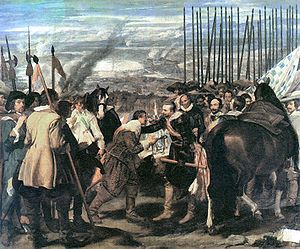
, in which the Spanish general, Gonzalo Fernández de Córdoba
, reorganized the Spanish army throughout a series of conflicts at the end of the 15th century and early 16th century, into a tactically unique combination of combined arms centered around armored infantry. At first the army consisted of units of around 6000 men, called coronelias, which by 1534 had been reduced to the tercios of 3000, for increased mobility on the offensive. Armies using the tercio generally intended to field them in brigades of at least three, with one tercio in the front and two behind, the rearward formations echeloned off on either side so that all three resembled a stepped pyramid, hence the name tercio, which means "one third" (that is, one third of the whole brigade or battle group).
(Landsknecht
), Italian
and Walloon territories of the Spanish Netherlands, as was characteristic of European warfare before the levies of the Napoleonic Wars
. In the 16th and 17th centuries however, the core of Spanish armies were formed by Spanish subjects, who were frequently praised by others for their cohesiveness, superiority in discipline and overall professionalism.
. The arquebusiers were usually split up in several mobile groups called sleeves (mangas) and deployed relative to the cuadro, typically with one manga at each corner. By virtue of this combined-arms approach, the formation simultaneously enjoyed both the staying power of its pike-armed infantry, as well as the ranged firepower of its arquebusiers. In addition to its inherent ability to repulse cavalry and other units along its front, the long-range firepower of its arquebusiers could also be easily reorganized to the flanks, making it versatile in both offensive and defensive evolutions, as demonstrated by the success of the tercios at the Battle of Pavia (1525).
Groups of tercios were typically arrayed in dragon-toothed formation (staggered—the leading edge of one unit level with the trailing edge of the preceding unit; see similar hedgehog defense concept). This enabled enfilade lines of fire and somewhat defiladed the army units themselves. Odd units alternated with even units, respectively one forward and one back, providing gaps for an unwary enemy to enter and outflank itself, where it would become subjected to the combined direct and raking cross fire from the guns of three separate tercios. From their inception, tercio formations were meant to co-ordinate their field operations with cavalry.
, who were kings of both Spain and the Holy Roman Empire. Sometimes these later tercios did not stick to the all-volunteer model of the regular Imperial Spanish army - when the Habsburg king Philip II
found himself in need of more troops, he raised a tercio of Catalan
criminals to fight in Flanders
, a trend he continued with most Catalan criminals for the rest of his reign. A large proportion of the Spanish army (which by the later half of the 16th century was entirely composed of tercio units) was deployed in the Netherlands to quell the increasingly difficult rebellion against the Habsburgs, although ironically many units of Spanish tercios became part of the problem rather than the solution when the time came to pay them. With the Spanish coffers depleted by constant warfare, unpaid tercio units often turned mutinous - in April 1574, just after winning a major victory, unpaid tercios mutinied and occupied the town of Antwerp, threatening to sack the town if their demands were not met. Bereft of troops, and thus his authority, the Spanish leader on the scene met the tercios demands.
 Portugal
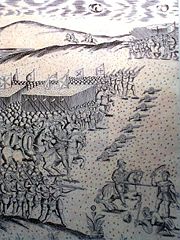
adopted the Spanish model of tercio in the 16th century, calling it terço. In 1578, under the reorganization of the Army conducted by the King Sebastian of Portugal
, four terços were organized: the Terço of Lisbon
, the Terço of Estremadura
, the Terço of Alentejo and the Terço of Algarve. Each terço had eight companies and about 2000 men.
The infantry of the army organized for the expedition to Morocco
in 1578 was made up of these four terços together with the Terço of the Adventurers (totally made up of young nobles), three mercenary terços (the German, the Italian and the Castilian) and a unit of elite sharpshooters of the Portuguese garrison of Tangier
. It was this force that fought in the Battle of Alcácer Quibir
.
While being united
with the Spanish Crown, from 1580 to 1640, Portugal kept the organization in terços, although the Army had declined. Several Spanish tercios were sent to Portugal; the principal of them, the Spanish infantry tercio of the City of Lisbon, occupied the main fortresses of the Portuguese capital. The terço of the Navy of the Crown of Portugal, the ancestor of the modern Portuguese Marines, was created in this period.
After the Restoration of the Independence of Portugal in 1640, the Army was reorganized by King John IV of Portugal
. The terços were the basic units of the Portuguese infantry. Two types of terços were organized: the paid terços (first line permanent units) and the auxiliary terços (second line militia units). Portugal won the Restoration War
with these terços.
At the end of the 17th century the terços were already organized as modern regiments. However, the first line terços were only transformed into regiments in 1707, during the War of the Spanish Succession
- after the Spanish tercios were transformed into regiments in 1704. The second line terços were only transformed into militia regiments in 1796. Some of the old terços are direct ancestors of modern regiments of the Portuguese Army
.
(1600). The victor of Nieuwpoort, the Dutch count Maurice of Nassau, believed he could improve on the tercio by combining its methods with the organisation of the Roman legion
. These shallower linear formations brought a greater proportion of available guns to bear on the enemy simultaneously. The result was that the tercios at Nieuwpoort were badly damaged by the weight of Dutch firepower. Yet the Spanish army very nearly succeeded in spite of internal dissensions that had compromised its regular command. The Eighty Years' War in the Low Countries
continued to be characterized by sieges of cities and forts, while field battles were of secondary importance. Nassau's reforms did not lead to a revolution in warfare, but he had created an army that could meet the tercios on an even basis and that pointed the way to future developments. During the Thirty Years War (1618–1648) tercio formations began to suffer some serious defeats to more linear formations led by the Swedish king–general, Gustavus Adolphus.
Throughout its history the tercio's form and composition was never static as it evolved to meet the new challenges. Tercio formations employed by well trained troops with good cavalry support continued to win major battles, as can be seen from the famous battles of White Mountain
(1620), Fleurus
(1622), Breda (1624), Nördlingen
(1634), and Thionville
(1639). It was not until the Rocroi
(1643) that the Spanish tercio's reputation for invincibility in major battles was shattered. Even then, the Rocroi defeat was precipitated by the collapse of the supporting cavalry arm rather than the failure of the tercios themselves, which had come close to besting the opposing infantry. Tercios continued to win important battles for a time after Rocroi and even after the Thirty Years war, but were already greatly modified from their older forms. By then, improvements in firearms and field artillery had given the new linear style a decided advantage. In response the later 17th century "tercios" had adopted so much of the linear style's organisation and tactics as to have little resemblance to the classic tercios of the previous century. In 1704, the Spanish tercios were transformed into regiments.
Renaissance
The Renaissance was a cultural movement that spanned roughly the 14th to the 17th century, beginning in Italy in the Late Middle Ages and later spreading to the rest of Europe. The term is also used more loosely to refer to the historical era, but since the changes of the Renaissance were not...
military formation made up of a mixed infantry
Infantry
Infantrymen are soldiers who are specifically trained for the role of fighting on foot to engage the enemy face to face and have historically borne the brunt of the casualties of combat in wars. As the oldest branch of combat arms, they are the backbone of armies...
formation of about 3,000 pikemen
Pike (weapon)
A pike is a pole weapon, a very long thrusting spear used extensively by infantry both for attacks on enemy foot soldiers and as a counter-measure against cavalry assaults. Unlike many similar weapons, the pike is not intended to be thrown. Pikes were used regularly in European warfare from the...
, swordsmen and arquebus
Arquebus
The arquebus , or "hook tube", is an early muzzle-loaded firearm used in the 15th to 17th centuries. The word was originally modeled on the German hakenbüchse; this produced haquebute...
iers or musketeer
Musketeer
A musketeer was an early modern type of infantry soldier equipped with a musket. Musketeers were an important part of early modern armies, particularly in Europe. They sometimes could fight on horseback, like a dragoon or a cavalryman...
s in a mutually supportive formation. It was also sometimes referred to as the Spanish Square. It was widely adopted and dominated European battlefields in the sixteenth century and the first half of the seventeenth century.
History
The tercio was the product of the Italian WarsItalian Wars
The Italian Wars, often referred to as the Great Italian Wars or the Great Wars of Italy and sometimes as the Habsburg–Valois Wars, were a series of conflicts from 1494 to 1559 that involved, at various times, most of the city-states of Italy, the Papal States, most of the major states of Western...
, in which the Spanish general, Gonzalo Fernández de Córdoba
Gonzalo Fernández de Córdoba
Gonzalo Fernández de Córdoba known as The Great Captain, Duke of Terranova and Santangelo, Andria, Montalto and Sessa, also known as Gonzalo de Córdoba, Italian: Gonsalvo or Consalvo Ernandes di Cordova was a Spanish general fighting in the times of the Conquest of Granada and the Italian Wars...
, reorganized the Spanish army throughout a series of conflicts at the end of the 15th century and early 16th century, into a tactically unique combination of combined arms centered around armored infantry. At first the army consisted of units of around 6000 men, called coronelias, which by 1534 had been reduced to the tercios of 3000, for increased mobility on the offensive. Armies using the tercio generally intended to field them in brigades of at least three, with one tercio in the front and two behind, the rearward formations echeloned off on either side so that all three resembled a stepped pyramid, hence the name tercio, which means "one third" (that is, one third of the whole brigade or battle group).
Composition and Characteristics
Although other powers adopted the tercio formation, their armies fell short of the fearsome reputation of the Spanish, who possessed a core of professional soldiers, which gave them an edge that was hard for other states to match. That army was further supplemented by "an army of different nations", a reference to the fact that many of the troops were mercenaries from GermanyGermany
Germany , officially the Federal Republic of Germany , is a federal parliamentary republic in Europe. The country consists of 16 states while the capital and largest city is Berlin. Germany covers an area of 357,021 km2 and has a largely temperate seasonal climate...
(Landsknecht
Landsknecht
Landsknechte were European, predominantly German mercenary pikemen and supporting foot soldiers from the late 15th to the late 16th century, and achieved the reputation for being the universal mercenary of Early modern Europe.-Etymology:The term is from German, Land "land, country" + Knecht...
), Italian
Italy
Italy , officially the Italian Republic languages]] under the European Charter for Regional or Minority Languages. In each of these, Italy's official name is as follows:;;;;;;;;), is a unitary parliamentary republic in South-Central Europe. To the north it borders France, Switzerland, Austria and...
and Walloon territories of the Spanish Netherlands, as was characteristic of European warfare before the levies of the Napoleonic Wars
Napoleonic Wars
The Napoleonic Wars were a series of wars declared against Napoleon's French Empire by opposing coalitions that ran from 1803 to 1815. As a continuation of the wars sparked by the French Revolution of 1789, they revolutionised European armies and played out on an unprecedented scale, mainly due to...
. In the 16th and 17th centuries however, the core of Spanish armies were formed by Spanish subjects, who were frequently praised by others for their cohesiveness, superiority in discipline and overall professionalism.
Formations
Within the tercio, ranks of pikemen arrayed themselves together into one large block (cuadro), similar to a pike squarePike square
The pike square was a military tactic developed by the Swiss Confederacy during the 15th century for use by its infantry.- History :The pike square was used to devastating effect at the Battle of Nancy against Charles the Bold of Burgundy in 1477, when the Swiss defeated a smaller but more...
. The arquebusiers were usually split up in several mobile groups called sleeves (mangas) and deployed relative to the cuadro, typically with one manga at each corner. By virtue of this combined-arms approach, the formation simultaneously enjoyed both the staying power of its pike-armed infantry, as well as the ranged firepower of its arquebusiers. In addition to its inherent ability to repulse cavalry and other units along its front, the long-range firepower of its arquebusiers could also be easily reorganized to the flanks, making it versatile in both offensive and defensive evolutions, as demonstrated by the success of the tercios at the Battle of Pavia (1525).
Groups of tercios were typically arrayed in dragon-toothed formation (staggered—the leading edge of one unit level with the trailing edge of the preceding unit; see similar hedgehog defense concept). This enabled enfilade lines of fire and somewhat defiladed the army units themselves. Odd units alternated with even units, respectively one forward and one back, providing gaps for an unwary enemy to enter and outflank itself, where it would become subjected to the combined direct and raking cross fire from the guns of three separate tercios. From their inception, tercio formations were meant to co-ordinate their field operations with cavalry.
Tercios and the Spanish Empire
Tercios were deployed all over Europe under the Habsburg EmperorsSpanish Empire
The Spanish Empire comprised territories and colonies administered directly by Spain in Europe, in America, Africa, Asia and Oceania. It originated during the Age of Exploration and was therefore one of the first global empires. At the time of Habsburgs, Spain reached the peak of its world power....
, who were kings of both Spain and the Holy Roman Empire. Sometimes these later tercios did not stick to the all-volunteer model of the regular Imperial Spanish army - when the Habsburg king Philip II
Philip II of Spain
Philip II was King of Spain, Portugal, Naples, Sicily, and, while married to Mary I, King of England and Ireland. He was lord of the Seventeen Provinces from 1556 until 1581, holding various titles for the individual territories such as duke or count....
found himself in need of more troops, he raised a tercio of Catalan
Catalan people
The Catalans or Catalonians are the people from, or with origins in, Catalonia that form a historical nationality in Spain. The inhabitants of the adjacent portion of southern France are sometimes included in this definition...
criminals to fight in Flanders
Flanders
Flanders is the community of the Flemings but also one of the institutions in Belgium, and a geographical region located in parts of present-day Belgium, France and the Netherlands. "Flanders" can also refer to the northern part of Belgium that contains Brussels, Bruges, Ghent and Antwerp...
, a trend he continued with most Catalan criminals for the rest of his reign. A large proportion of the Spanish army (which by the later half of the 16th century was entirely composed of tercio units) was deployed in the Netherlands to quell the increasingly difficult rebellion against the Habsburgs, although ironically many units of Spanish tercios became part of the problem rather than the solution when the time came to pay them. With the Spanish coffers depleted by constant warfare, unpaid tercio units often turned mutinous - in April 1574, just after winning a major victory, unpaid tercios mutinied and occupied the town of Antwerp, threatening to sack the town if their demands were not met. Bereft of troops, and thus his authority, the Spanish leader on the scene met the tercios demands.
The Portuguese terços
Portugal
Portugal , officially the Portuguese Republic is a country situated in southwestern Europe on the Iberian Peninsula. Portugal is the westernmost country of Europe, and is bordered by the Atlantic Ocean to the West and South and by Spain to the North and East. The Atlantic archipelagos of the...
adopted the Spanish model of tercio in the 16th century, calling it terço. In 1578, under the reorganization of the Army conducted by the King Sebastian of Portugal
Sebastian of Portugal
Sebastian "the Desired" was the 16th king of Portugal and the Algarves. He was the son of Prince John of Portugal and his wife, Joan of Spain...
, four terços were organized: the Terço of Lisbon
Lisbon
Lisbon is the capital city and largest city of Portugal with a population of 545,245 within its administrative limits on a land area of . The urban area of Lisbon extends beyond the administrative city limits with a population of 3 million on an area of , making it the 9th most populous urban...
, the Terço of Estremadura
Estremadura Province (historical)
Estremadura Province is one of the six historical provinces of Portugal....
, the Terço of Alentejo and the Terço of Algarve. Each terço had eight companies and about 2000 men.
The infantry of the army organized for the expedition to Morocco
Morocco
Morocco , officially the Kingdom of Morocco , is a country located in North Africa. It has a population of more than 32 million and an area of 710,850 km², and also primarily administers the disputed region of the Western Sahara...
in 1578 was made up of these four terços together with the Terço of the Adventurers (totally made up of young nobles), three mercenary terços (the German, the Italian and the Castilian) and a unit of elite sharpshooters of the Portuguese garrison of Tangier
Tangier
Tangier, also Tangiers is a city in northern Morocco with a population of about 700,000 . It lies on the North African coast at the western entrance to the Strait of Gibraltar where the Mediterranean meets the Atlantic Ocean off Cape Spartel...
. It was this force that fought in the Battle of Alcácer Quibir
Battle of Alcácer Quibir
The Battle of Ksar El Kebir, also known as Battle of Three Kings, or "Battle of Oued El Makhazeen" in Morocco, and Battle of Alcácer Quibir in Portugal , was fought in northern Morocco, near the town of Ksar-el-Kebir and Larache, on 4 August 1578...
.
While being united
Iberian Union
The Iberian union was a political unit that governed all of the Iberian Peninsula south of the Pyrenees from 1580–1640, through a dynastic union between the monarchies of Portugal and Spain after the War of the Portuguese Succession...
with the Spanish Crown, from 1580 to 1640, Portugal kept the organization in terços, although the Army had declined. Several Spanish tercios were sent to Portugal; the principal of them, the Spanish infantry tercio of the City of Lisbon, occupied the main fortresses of the Portuguese capital. The terço of the Navy of the Crown of Portugal, the ancestor of the modern Portuguese Marines, was created in this period.
After the Restoration of the Independence of Portugal in 1640, the Army was reorganized by King John IV of Portugal
John IV of Portugal
|-|John IV was the King of Portugal and the Algarves from 1640 to his death. He was the grandson of Catherine, Duchess of Braganza, who had in 1580 claimed the Portuguese crown and sparked the struggle for the throne of Portugal. John was nicknamed John the Restorer...
. The terços were the basic units of the Portuguese infantry. Two types of terços were organized: the paid terços (first line permanent units) and the auxiliary terços (second line militia units). Portugal won the Restoration War
Portuguese Restoration War
Portuguese Restoration War was the name given by nineteenth-century 'romantic' historians to the war between Portugal and Spain that began with the Portuguese revolution of 1640 and ended with the Treaty of Lisbon . The revolution of 1640 ended the sixty-year period of dual monarchy in Portugal...
with these terços.
At the end of the 17th century the terços were already organized as modern regiments. However, the first line terços were only transformed into regiments in 1707, during the War of the Spanish Succession
War of the Spanish Succession
The War of the Spanish Succession was fought among several European powers, including a divided Spain, over the possible unification of the Kingdoms of Spain and France under one Bourbon monarch. As France and Spain were among the most powerful states of Europe, such a unification would have...
- after the Spanish tercios were transformed into regiments in 1704. The second line terços were only transformed into militia regiments in 1796. Some of the old terços are direct ancestors of modern regiments of the Portuguese Army
Portuguese Army
The Portuguese Army is the ground branch of the Portuguese Armed Forces which, in co-operation with other branches of the Portuguese military, is charged with the defence of Portugal...
.
Obsolescence
The first challenge to the dominance of the tercios came at the Battle of NieuwpoortBattle of Nieuwpoort
The Battle of Nieuwpoort, between a Dutch army under Maurice of Nassau and Francis Vere and a Spanish army under Albert of Austria, took place on 2 July 1600 near the present-day Belgian city Nieuwpoort.-Campaign:...
(1600). The victor of Nieuwpoort, the Dutch count Maurice of Nassau, believed he could improve on the tercio by combining its methods with the organisation of the Roman legion
Roman legion
A Roman legion normally indicates the basic ancient Roman army unit recruited specifically from Roman citizens. The organization of legions varied greatly over time but they were typically composed of perhaps 5,000 soldiers, divided into maniples and later into "cohorts"...
. These shallower linear formations brought a greater proportion of available guns to bear on the enemy simultaneously. The result was that the tercios at Nieuwpoort were badly damaged by the weight of Dutch firepower. Yet the Spanish army very nearly succeeded in spite of internal dissensions that had compromised its regular command. The Eighty Years' War in the Low Countries
Low Countries
The Low Countries are the historical lands around the low-lying delta of the Rhine, Scheldt, and Meuse rivers, including the modern countries of Belgium, the Netherlands, Luxembourg and parts of northern France and western Germany....
continued to be characterized by sieges of cities and forts, while field battles were of secondary importance. Nassau's reforms did not lead to a revolution in warfare, but he had created an army that could meet the tercios on an even basis and that pointed the way to future developments. During the Thirty Years War (1618–1648) tercio formations began to suffer some serious defeats to more linear formations led by the Swedish king–general, Gustavus Adolphus.
Throughout its history the tercio's form and composition was never static as it evolved to meet the new challenges. Tercio formations employed by well trained troops with good cavalry support continued to win major battles, as can be seen from the famous battles of White Mountain
Battle of White Mountain
The Battle of White Mountain, 8 November 1620 was an early battle in the Thirty Years' War in which an army of 30,000 Bohemians and mercenaries under Christian of Anhalt were routed by 27,000 men of the combined armies of Ferdinand II, Holy Roman Emperor under Charles Bonaventure de Longueval,...
(1620), Fleurus
Battle of Fleurus (1622)
The Battle of Fleurus of August 29, 1622 was fought between a Spanish army, and the Protestant Powers of the Holy Roman Empire in the Thirty Years' War. The bloody struggle left the Protestants mangled and the Spanish masters of the field.-Campaign:...
(1622), Breda (1624), Nördlingen
Battle of Nördlingen (1634)
The Battle of Nördlingen was fought on 27 August or 6 September , 1634 during the Thirty Years' War. The Roman Catholic Imperial army, bolstered by 18,000 Spanish and Italian soldiers, won a crushing victory over the combined Protestant armies of Sweden and their German-Protestant allies .After...
(1634), and Thionville
Relief of Thionville
On June 7, 1639, a Spanish and Imperial relief column under Ottavio Piccolomini lifted the siege lines around Thionville and destroyed the besieging French army under the Marquis de Feuquieres.-Aftermath:...
(1639). It was not until the Rocroi
Battle of Rocroi
The Battle of Rocroi was fought on 19 May 1643, late in the Thirty Years' War. It resulted in a victory of the French army under the Duc d'Enghien, against the Spanish army under General Francisco de Melo.-Prelude:...
(1643) that the Spanish tercio's reputation for invincibility in major battles was shattered. Even then, the Rocroi defeat was precipitated by the collapse of the supporting cavalry arm rather than the failure of the tercios themselves, which had come close to besting the opposing infantry. Tercios continued to win important battles for a time after Rocroi and even after the Thirty Years war, but were already greatly modified from their older forms. By then, improvements in firearms and field artillery had given the new linear style a decided advantage. In response the later 17th century "tercios" had adopted so much of the linear style's organisation and tactics as to have little resemblance to the classic tercios of the previous century. In 1704, the Spanish tercios were transformed into regiments.
See also
- Spanish EmpireSpanish EmpireThe Spanish Empire comprised territories and colonies administered directly by Spain in Europe, in America, Africa, Asia and Oceania. It originated during the Age of Exploration and was therefore one of the first global empires. At the time of Habsburgs, Spain reached the peak of its world power....
- MusketeerMusketeerA musketeer was an early modern type of infantry soldier equipped with a musket. Musketeers were an important part of early modern armies, particularly in Europe. They sometimes could fight on horseback, like a dragoon or a cavalryman...
- Military HistoryMilitary historyMilitary history is a humanities discipline within the scope of general historical recording of armed conflict in the history of humanity, and its impact on the societies, their cultures, economies and changing intra and international relationships....
- The units of the modern Spanish LegionSpanish LegionThe Spanish Legion , formerly Spanish Foreign Legion, is an elite unit of the Spanish Army and Spain's Rapid Reaction Force. Founded as the Tercio de Extranjeros , it was originally intended as a Spanish equivalent of the French Foreign Legion, but in practice it recruited almost exclusively...
are also called tercios.