

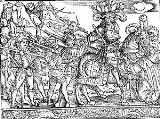
Battle of Nancy

Encyclopedia
The Battle of Nancy was the final and decisive battle of the Burgundian Wars
, fought outside the walls of Nancy on 5 January 1477 between Charles the Bold, Duke of Burgundy
, and René II, Duke of Lorraine
. René's forces won the battle, and Charles' mutilated body was found three days later.
, following its successful recapture by the forces of René II in 1476. Despite the harsh winter conditions Charles was determined to bring the siege to an end at all costs as he was well aware that sooner or later René would arrive with a relieving army once the weather had improved somewhat.
By late December René had gathered some 10-12,000 men from Lorraine, and the Lower Union (of the Rhine) as well as 10,000 Confederation Swiss mercenaries
to his banner. He began his advance on Nancy early in January 1477, moving cautiously through the snow-covered landscape until they reached Nancy early on the morning of 5 January. Charles finally learned that René's army was indeed close by and drew up the bulk of his army in a strong defensive position south of Nancy on a heavily wooded slope behind a stream at the narrowest part of the valley he knew the Swiss would have to advance down. The exact numbers available to Charles are hard to judge, but contemporary observers put the numbers between 2,000 and 4,000, for even his household troops were by this stage well below strength, while most of the Ordonnance companies were at best only 50% of their theoretical strength.
Charles, as usual, deployed his troops to a precise battle plan despite the short notice he received of the approach of René's forces. The infantry companies and dismounted gendarme
formed up in a large square formation with some 30 field guns in front at the top of the slope, while on either flank were mounted knights
and coutilliers.
If Charles suffered from a lack of scouting (which had cost him so dearly at Murten six months earlier), the same could not be said for the Allied army. Despite the driving snow cutting visibility to a few yards, the Allied scouts soon recognized that a frontal assault on the Burgundian position would be disastrous. The largely Swiss Vorhut (Vanguard) of 7,000 infantry and 2,000 cavalry, were instructed to attack from the right, while the principal thrust would come from the 8,000 infantry and 1,300 cavalry of the Gewalthut (Centre), which was dispatched on a difficult circuitous march round the left flank, over thickly wooded snow covered slopes out of view of the waiting Burgundians. The small Nachhut (Rearguard) of 800 handgunners acted as a reserve.
 After a march lasting some two hours, the Gewalthut emerged from the wooded slopes slightly to the rear of the Burgundian position and formed up in a wedge formation. The early notes of the Swiss horns sounded thrice, and the Swiss charged downhill into the Burgundian positions. The artillery attempted to retrain on the Gewalthut but could not elevate enough to be effective; the single volley discharged killing but two men. Although the right wing Burgundian cavalry saw off their Swiss rivals, the mass of Swiss infantry pushed on to engage the outnumbered Burgundian infantry square in a one-sided fight. The Vorhut threw back the Burgundian left wing and put the artillery to flight. As Charles attempted to vainly stem the Gewalthut's advance by transferring troops from his left flank, the sheer weight of numbers arrayed against him became obvious, and the once proud army of the Duchy of Burgundy started to melt away in flight.
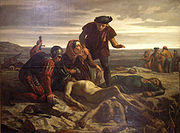
Determined to the last, Charles and his staff tried in vain to rally the broken army, but without success. His small band was carried with the flight until eventually surrounded by a party of Swiss. A halberdier quickly swung at the Duke's head and landed a deadly blow directly on his helmet. He was seen to fall but the battle flowed on around him. It was three days until the Duke's disfigured body was finally found and positively identified amongst the detritus of the slaughter. So passed the last of the Valois Dukes of Burgundy.
Burgundian Wars
The Burgundian Wars were a conflict between the Dukes of Burgundy and the Kings of France, later involving the Old Swiss Confederacy, which would play a decisive role. Open war broke out in 1474, and in the following years the Duke of Burgundy, Charles the Bold, was defeated three times on the...
, fought outside the walls of Nancy on 5 January 1477 between Charles the Bold, Duke of Burgundy
Duchy of Burgundy
The Duchy of Burgundy , was heir to an ancient and prestigious reputation and a large division of the lands of the Second Kingdom of Burgundy and in its own right was one of the geographically larger ducal territories in the emergence of Early Modern Europe from Medieval Europe.Even in that...
, and René II, Duke of Lorraine
René II, Duke of Lorraine
René II was Count of Vaudémont from 1470, Duke of Lorraine from 1473, and Duke of Bar from 1483 to 1508. He claimed the crown of the Kingdom of Naples and the County of Provence as the Duke of Calabria 1480–1493 and as King of Naples and Jerusalem 1493–1508...
. René's forces won the battle, and Charles' mutilated body was found three days later.
Background
Charles was besieging the city of Nancy, capital of LorraineLorraine (province)
The Duchy of Upper Lorraine was an historical duchy roughly corresponding with the present-day northeastern Lorraine region of France, including parts of modern Luxembourg and Germany. The main cities were Metz, Verdun, and the historic capital Nancy....
, following its successful recapture by the forces of René II in 1476. Despite the harsh winter conditions Charles was determined to bring the siege to an end at all costs as he was well aware that sooner or later René would arrive with a relieving army once the weather had improved somewhat.
By late December René had gathered some 10-12,000 men from Lorraine, and the Lower Union (of the Rhine) as well as 10,000 Confederation Swiss mercenaries
Swiss mercenaries
Swiss mercenaries were notable for their service in foreign armies, especially the armies of the Kings of France, throughout the Early Modern period of European history, from the Later Middle Ages into the Age of the European Enlightenment...
to his banner. He began his advance on Nancy early in January 1477, moving cautiously through the snow-covered landscape until they reached Nancy early on the morning of 5 January. Charles finally learned that René's army was indeed close by and drew up the bulk of his army in a strong defensive position south of Nancy on a heavily wooded slope behind a stream at the narrowest part of the valley he knew the Swiss would have to advance down. The exact numbers available to Charles are hard to judge, but contemporary observers put the numbers between 2,000 and 4,000, for even his household troops were by this stage well below strength, while most of the Ordonnance companies were at best only 50% of their theoretical strength.
Charles, as usual, deployed his troops to a precise battle plan despite the short notice he received of the approach of René's forces. The infantry companies and dismounted gendarme
Gendarme (historical)
A gendarme was a heavy cavalryman of noble birth, primarily serving in the French army from the Late Medieval to the Early Modern periods of European History...
formed up in a large square formation with some 30 field guns in front at the top of the slope, while on either flank were mounted knights
Heavy cavalry
Heavy cavalry is a class of cavalry whose primary role was to engage in direct combat with enemy forces . Although their equipment differed greatly depending on the region and historical period, they were generally mounted on large powerful horses, and were often equipped with some form of scale,...
and coutilliers.
If Charles suffered from a lack of scouting (which had cost him so dearly at Murten six months earlier), the same could not be said for the Allied army. Despite the driving snow cutting visibility to a few yards, the Allied scouts soon recognized that a frontal assault on the Burgundian position would be disastrous. The largely Swiss Vorhut (Vanguard) of 7,000 infantry and 2,000 cavalry, were instructed to attack from the right, while the principal thrust would come from the 8,000 infantry and 1,300 cavalry of the Gewalthut (Centre), which was dispatched on a difficult circuitous march round the left flank, over thickly wooded snow covered slopes out of view of the waiting Burgundians. The small Nachhut (Rearguard) of 800 handgunners acted as a reserve.
The battle
Determined to the last, Charles and his staff tried in vain to rally the broken army, but without success. His small band was carried with the flight until eventually surrounded by a party of Swiss. A halberdier quickly swung at the Duke's head and landed a deadly blow directly on his helmet. He was seen to fall but the battle flowed on around him. It was three days until the Duke's disfigured body was finally found and positively identified amongst the detritus of the slaughter. So passed the last of the Valois Dukes of Burgundy.
See also
- Battle of GrandsonBattle of GrandsonThe Battle of Grandson, took place on 2 March 1476, was part of the Burgundian Wars, and resulted in a major defeat for Charles the Bold, Duke of Burgundy.- Siege of Grandson, February 1476 :...
- Battle of MoratBattle of MoratThe Battle of Morat was a battle in the Burgundian Wars fought June 22, 1476 between Charles I, Duke of Burgundy and a Swiss army at Morat, about 30 kilometres from Bern.-Background:...
- Duchy of BurgundyDuchy of BurgundyThe Duchy of Burgundy , was heir to an ancient and prestigious reputation and a large division of the lands of the Second Kingdom of Burgundy and in its own right was one of the geographically larger ducal territories in the emergence of Early Modern Europe from Medieval Europe.Even in that...
- Old Swiss ConfederacyOld Swiss ConfederacyThe Old Swiss Confederacy was the precursor of modern-day Switzerland....