
All Topics  
Cycad

 
Cycad

   Email Print
   Bookmark   Link


Cycad


]]

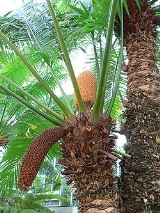
Cycads are a group of seed plants characterized by a large crown of compound leaves
Leaf

In botany, a leaf is an above-ground plant Organ specialized for photosynthesis. For this purpose, a leaf is typically flat and thin, to expose the cells containing chloroplast to light over a broad area, and to allow light to penetrate fully into the tissues....
 and a stout trunk
Trunk (botany)

In botany, trunk refers to the main structural member of a tree that supports the branches and is supported by and directly attached to the roots....
. They are evergreen
Evergreen

In botany, an evergreen plant is a plant having leaf all year round. This contrasts with deciduous plants, which completely lose their foliage for part of the year....
, gymnosperm
Gymnosperm

Gymnosperm is a group of spermatophyte seed-bearing plants with ovules on scales, which are usually arranged in cone-like structures. The other major group of seed-bearing plants, the angiosperms, [from the Greek, 'angion' - container] have ovules enclosed in a carpel, a sporophyll with fused margins....
ous, dioecious
Dioecious

Dioecious - from Greek language for "two households" - refers to species of seed-bearing plants having separate male and female plants. That is, no individual plant of the species produces both microspores and megaspores; individual plants are either male or female ....
 plants having large pinnately compound leaves. They are frequently confused with and mistaken for palms
Arecaceae

Palm or Palmae or Panamea , the palm family, is a family of flowering plants belonging to the Monocotyledon order, Arecales. There are roughly 202 currently known Genus with around 2600 species, most of which are restricted to tropics, subtropics, and warm temperate climates....
 or fern
Fern

A fern is any one of a group of about 20,000 species of plants classified in the phylum or division Pteridophyta, also known as Filicophyta....
s, but are related to neither, belonging to the division Cycadophyta.

Cycads are found across much of the subtropical and tropical parts of the world.


Discussion
Ask a question about 'Cycad'
Start a new discussion about 'Cycad'
Answer questions from other users
Full Discussion Forum


Encyclopedia


]]

Cycads are a group of seed plants characterized by a large crown of compound leaves
Leaf

In botany, a leaf is an above-ground plant Organ specialized for photosynthesis. For this purpose, a leaf is typically flat and thin, to expose the cells containing chloroplast to light over a broad area, and to allow light to penetrate fully into the tissues....
 and a stout trunk
Trunk (botany)

In botany, trunk refers to the main structural member of a tree that supports the branches and is supported by and directly attached to the roots....
. They are evergreen
Evergreen

In botany, an evergreen plant is a plant having leaf all year round. This contrasts with deciduous plants, which completely lose their foliage for part of the year....
, gymnosperm
Gymnosperm

Gymnosperm is a group of spermatophyte seed-bearing plants with ovules on scales, which are usually arranged in cone-like structures. The other major group of seed-bearing plants, the angiosperms, [from the Greek, 'angion' - container] have ovules enclosed in a carpel, a sporophyll with fused margins....
ous, dioecious
Dioecious

Dioecious - from Greek language for "two households" - refers to species of seed-bearing plants having separate male and female plants. That is, no individual plant of the species produces both microspores and megaspores; individual plants are either male or female ....
 plants having large pinnately compound leaves. They are frequently confused with and mistaken for palms
Arecaceae

Palm or Palmae or Panamea , the palm family, is a family of flowering plants belonging to the Monocotyledon order, Arecales. There are roughly 202 currently known Genus with around 2600 species, most of which are restricted to tropics, subtropics, and warm temperate climates....
 or fern
Fern

A fern is any one of a group of about 20,000 species of plants classified in the phylum or division Pteridophyta, also known as Filicophyta....
s, but are related to neither, belonging to the division Cycadophyta.

Cycads are found across much of the subtropical and tropical parts of the world. They are found in South
South America

South America is the southern continent of the Americas, situated entirely in the Western Hemisphere and mostly in the Southern Hemisphere, with a relatively small portion in the Northern Hemisphere....
 and Central America
Central America

Central America is a central geography region of the Americas. It is the southernmost, isthmus portion of the North American continent, which connects with South America on the southeast....
 (where the greatest diversity occurs), Mexico
Mexico

The United Mexican States , commonly known as Mexico , is a federalism constitutionalism republic in North America. It is bordered on the north by the United States; on the south and west by the Pacific Ocean; on the southeast by Guatemala, Belize, and the Caribbean Sea; and on the east by the Gulf of Mexico....
, the Antilles
Antilles

The Antilles Antillas in Spanish language; Antillen in Dutch language) refers to the islands forming the greater part of the Caribbean in the Caribbean Sea....
, south-eastern United States of America, Australia
Australia

Australia, officially the Commonwealth of Australia, is a country in the southern hemisphere comprising the Australia of the world's smallest continent, the major island of Tasmania, and numerous list of islands of Australia in the Indian Ocean and Pacific Oceans....
, Melanesia
Melanesia

Melanesia literally means "islands of the black-skinned people". It is a subregion of Oceania extending from the western side of the West Pacific to the Arafura Sea, north and northeast of Australia....
, Micronesia
Micronesia

Micronesia , from the Greek language mikros and nesos , is a subregion of Oceania, comprising hundreds of small islands in the Pacific Ocean....
, Japan
Japan

Japan is an island country in East Asia. Located in the Pacific Ocean, it lies to the east of the Sea of Japan, People's Republic of China, North Korea, South Korea and Russia, stretching from the Sea of Okhotsk in the north to the East China Sea and Taiwan in the south....
, China
China

China is a Culture of China, an ancient civilization, and, depending on perspective, a national or multinational entity extending over a large area in East Asia....
, Southeast Asia
Southeast Asia

Southeast Asia or Southeastern Asia is a subregion of Asia, consisting of the countries that are geographically south of China, east of India and north of Australia....
, India
India

India, officially the Republic of India , is a country in South Asia. It is the List of countries and outlying territories by total area country by geographical area, the List of countries by population country, and the most populous liberal democracy in the world....
, Sri Lanka
Sri Lanka

Sri Lanka, officially the Democratic Socialist Republic of Sri Lanka is an island country in South Asia, located about off the southern coast of India....
, Madagascar
Madagascar

Madagascar, or Republic of Madagascar , is an island nation in the Indian Ocean off the southeastern coast of Africa. The main island, also called Madagascar, is the List of islands by area, and is home to 5% of the world's plant and animal species, of which more than 80% are Endemism to Madagascar....
, and southern
Southern Africa

Southern Africa is the southernmost region of the African continent, variably defined by geography or geopolitics, consisting of numerous territories....
 and tropical Africa
Africa

Africa is the world's second-largest and second most-populous continent, after Asia. At about 30.2 million km? including adjacent islands, it covers 6% of the Earth's total surface area and 20.4% of the total land area....
, where at least 65 species occur. Some are renowned for survival in harsh semi-desert climate
Climate

Climate encompasses the temperatures, humidity, atmospheric pressure, winds, rainfall, atmospheric particle count and numerous other Meteorology elements in a given region over long periods of time, as opposed to the term weather, which refers to current activity of these same elements....
s, and can grow in sand
Sand

Sand is a naturally occurring granular material composed of finely divided rock and mineral particles.As the term is used by geologists, sand particles range in diameter from 0.0625 to 2 millimeters....
 or even on rock
Rock (geology)

In geology, rock is a naturally occurring solid aggregate of minerals and/or mineraloids.The Earth's outer solid layer, the lithosphere, is made of rock....
. They are able to grow in full sun or shade, and some are salt
Sodium chloride

Sodium chloride, also known as common salt, table salt, or halite, is a chemical compound with the chemical formula SodiumChlorine....
 tolerant. Though they are a minor component of the plant kingdom today, during the Jurassic
Jurassic

The Jurassic is a geologic period that extends from about annum to  Ma, that is, from the end of the Triassic to the beginning of the Cretaceous....
 period they were extremely common.

They have very specialized pollinator
Pollinator

A pollinator is the biotic agent that moves pollen from the male anthers of a flower to the female carpel of a flower to accomplish fertilization or syngamy of the female gamete in the ovule of the flower by the male gamete from the pollen grain....
s and have been reported to fix nitrogen
Nitrogen fixation

Nitrogen fixation is the process by which nitrogen is taken from its relatively inert molecular form in the Earth's atmosphere and converted into nitrogen compounds ....
 in association with a cyanobacterium living in the roots. This blue-green algae produces a neurotoxin
Neurotoxin

A neurotoxin is a toxin that acts specifically on nerve cells , usually by interacting with membrane proteins such as ion channels.Some sources are more general, and define the effect of neurotoxins as occurring at nerve tissue....
 called BMAA that is found in the seed
Seed

A seed is a small Plant embryogenesis plant enclosed in a covering called the seed coat, usually with some Food storage. It is the product of the ripened ovule of gymnosperm and angiosperm plants which occurs after fertilization and some growth within the mother plant....
s of cycads.

Origins

The cycad fossil record dates to the Early Permian
Permian

The PermianThe term "Permian" was introduced into geology in 1841 by Sir Roderick Murchison, president of the Geological Society of London, who identified typical strata in extensive Russian explorations undertaken with Edouard de Verneuil; Murchison asserted in 1841 that he named his "Permian system" after the ancient kingdom...
, 280 mya
Mya (unit)

In astronomy, geology, and paleontology, mya or "m.y.a." is an abbreviation for "million years ago". Like the related unit bya, mya is traditionally written in lower case....
. There is controversy over older cycad fossils that date to the late Carboniferous
Carboniferous

The Carboniferous is a geologic period that extends from the end of the Devonian period, about 359.2 ? 2.5 annum , to the beginning of the Permian period, about 299.0 ? 0.8 Ma ...
 period, 300–325  mya. One of the first colonizers of terrestrial habitats, this clade probably diversified extensively within its first few million years, although the extent to which it radiated is unknown because relatively few fossil specimens have been found. The regions to which cycads are restricted probably indicate their former distribution on the supercontinents Laurasia
Laurasia

Laurasia was a supercontinent that most recently existed as a part of the split of the Pangaean supercontinent in the late Mesozoic era . It included most of the landmasses which make up today's continents of the northern hemisphere, chiefly Laurentia , Baltica, Siberia , Kazakhstania, and the North China Craton and East China Craton craton...
 and Gondwana
Gondwana

Gondwana , originally Gondwanaland is the name given to a southern precursor-supercontinent and then as a remnant separated from Laurasia 180- during the breakup of the Pangaea supercontinent that existed about 500 to 200 Annum ago into two large segments.
.

The family Stangeriaceae (named for Dr. William Stanger, 1812(?)–1854), consisting of only three extant species, is thought to be of Gondwanan origin as fossils have been found in Lower Cretaceous deposits in Argentina
Argentina

Argentina, officially the Argentine Republic , is a country in South America, constituted as a federation of 23 provinces and an autonomous city....
, dating to 70–135 mya. Zamiaceae
Zamiaceae

The Zamiaceae are a family of cycads that are superficially palm or fern-like. They are divided into two subfamilies with eight genera and about 150 species in the tropical and warm temperate regions of Africa, Australia and North America and South America....
 is more diverse, with a fossil record extending from the Middle Triassic
Triassic

The Triassic is a geologic period that extends from about 251 to 199 annum . As the first period of the Mesozoic Era, the Triassic follows the Permian and is followed by the Jurassic....
 to the Eocene
Eocene

The Eocene Geologic time scale is a major division of the geologic timescale and the second epoch of the Palaeogene period in the Cenozoic era....
 (54–200 mya) in North
North America

North America is the northern continent of the Americas, situated in the Earth's northern hemisphere and almost totally in the western hemisphere....
 and South America, Europe
Europe

Europe is, conventionally, one of the world's seven continents. Comprising the westernmost peninsula of Eurasia, Europe is generally divided from Asia to its east by the water divide of the Ural Mountains, the Ural , the Caspian Sea, and by the Caucasus Mountains to the southeast....
, Australia, and Antarctica, implying that the family was present before the break-up of Pangea. Cycadaceae is thought to be an early offshoot from other cycads, with fossils from Eocene deposits (38–54 mya) in Japan
Japan

Japan is an island country in East Asia. Located in the Pacific Ocean, it lies to the east of the Sea of Japan, People's Republic of China, North Korea, South Korea and Russia, stretching from the Sea of Okhotsk in the north to the East China Sea and Taiwan in the south....
 and China
China

China is a Culture of China, an ancient civilization, and, depending on perspective, a national or multinational entity extending over a large area in East Asia....
, indicating that this family originated in Laurasia.
Cycas
Cycas

Cycas is the type genus and the only genus currently recognised in the cycad family Cycadaceae. About 95 species are currently accepted....
is the only genus in the family and contains 99 species, the most of any cycad genus. Molecular data has recently shown that Cycas species in Australasia
Australasia

Australasia is a region of Oceania: New Zealand, Australia, Papua New Guinea, and neighbouring islands in the Pacific Ocean. The term was coined by Charles de Brosses in Histoire des navigations aux terres australes ....
 and the east coast of Africa are recent arrivals, suggesting that adaptive radiation may have occurred. The current distribution of cycads may be due to radiations from a few ancestral types sequestered on Laurasia and Gondwana, or could be explained by genetic drift
Genetic drift

Genetic drift or allelic drift is the change in the relative frequency with which a gene variant occurs in a population that results from the fact that alleles in offspring are a Sampling of those in the parents, and because of the role of chance in determining whether a given individual survives and reproduces....
 following the separation of already evolved genera. Both explanations account for the strict endemism across present continental lines.

Taxonomy

There are about 305 described species, in 10–12 genera and 2–3 families of cycads (depending on taxonomic viewpoint). The classification below, proposed by Dennis Stevenson in 1990, is based upon a hierarchical structure based on cladistic analyses of morphological
Morphology (biology)

The term morphology in biology refers to form, structure and configuration of an organism. This includes aspects of the outward appearance as well as the form and structure of the internal parts like bones and organs....
, anatomical
Anatomy

Anatomy is a branch of biology that is the consideration of the body plan. It is a general term that includes human anatomy, animal anatomy and plant anatomy ....
, karyological, physiological
Physiology

Physiology is the study of the mechanical, physical, and biochemical functions of living organisms. Physiology has traditionally been divided between plant physiology and animal and all living things physiology but the principles of physiology are universal, no matter what particular organism is being studied....
 and phytochemical
Phytochemistry

Phytochemistry is in the strict sense of the word the study of phytochemicals. These are chemicals derived from plants. In a narrower sense the terms are often used to describe the large number of secondary metabolic compounds found in plants....
 data
DATA

Debt, AIDS, Trade in Africa is a multinational Non-governmental organization founded in January 2002 in London by U2's Bono along with Robert Sargent Shriver III and activists from the Jubilee 2000 Drop the Debt campaign....
.

The number of species in the clade
Clade

A clade is a term used in modern alpha taxonomy, the scientific classification of living and fossil organisms, to describe a monophyletic group, defined as a group consisting of a single common ancestor and all its descendants.The term "monophyletic group" is used in this article in the conventional sense of "an a...
 is low compared to the number of species in most other plant phyla
Phylum

A phylum "Phylum" is adopted from the Greek phylai, the clan-based voting groups in Greek city-states. is a taxonomic rank below Kingdom and above Class ....
. However, paleobotanical and molecular research indicates that diversity was higher in the history of the phylum. Fossil evidence shows that structural diversity in Mesozoic
Mesozoic

The Mesozoic Era is one of three Geologic time scale of the Phanerozoic eon . The division of time into eras dates back to Giovanni Arduino, in the 18th century, although his original name for the era now called the 'Mesozoic' was 'Secondary' ....
 cycad pollen "considerably exceeds that seen in surviving genera today". The impacts of extinction on diversity are highlighted below. The disparity in molecular sequences is very high between the three main lineages of cycads, implying that genetic diversity in the clade was once high, but this fact has led to major disagreements about the divisions within the Cycadales.

The number of described cycad species has doubled in the past 25 years, mostly due to improved sampling and further exploration. Experts assume there may still be about 100 undescribed species, based on the rate of discovery. These are likely to be in Asia and South America where areas of endemism are highest. Diversity hotspots
Biodiversity hotspot

A biodiversity hotspot is a biogeographic region with a significant reservoir of biodiversity that is threatened with destruction.The concept of biodiversity hotspots was originated by Dr....
 also occur in Australia, South Africa
South Africa

The Republic of South Africa, also known by Official names of South Africa, is a country located at the southern tip of the continent of Africa....
, Mexico, China and Vietnam
Vietnam

Vietnam , officially the Socialist Republic of Vietnam , is the easternmost country on the Indochina Peninsula in Southeast Asia. It is bordered by People's Republic of China to the north, Laos to the northwest, Cambodia to the southwest, and the South China Sea to the east....
, which together account for more than 70% of the world’s cycad species. The taxonomy of the Cycadophyta is, however, now stabilizing.

Cycad systematists reject the biological species concept, as clearly defined cycad species can interbreed and produce fertile offspring; this character is thus not disproportionately weighted when determining species barriers. The phenetic species concept, which states that a species is defined based on overall similarities with other individuals of the same species combined with a significant gap in variation with other species, is also rejected. Most cycad taxonomists agree on a modified version of the evolutionary species concept, termed the ‘morphogeographic’ species concept, which recognises the combined effects of geographical isolation and morphological disparity. Thus the presence of large geographical gaps in cycad distribution has greatly affected the way cycads are classified.

Suborder Cycadineae
Family Cycadaceae
Subfamily Cycadoideae
Cycas
Cycas

Cycas is the type genus and the only genus currently recognised in the cycad family Cycadaceae. About 95 species are currently accepted....
. About 105  species in the Old World
Old World

The Old World consists of those parts of Earth known to Europeans, Asians, and Africans in the 15th century....
 from Africa east to southern Japan, Australia and the western Pacific Ocean
Pacific Ocean

The Pacific Ocean is the largest of the Earth's oceanic divisions. Its name is derived from the Latin name Mare Pacificum, "peaceful sea", bestowed upon it by the Portugal explorer Ferdinand Magellan....
 islands; type:
C. circinalis
Cycas circinalis

Cycas circinalis, also known as the Queen Sago, is a type of cycad that was thought to be linked with the degenerative disease Lytico-Bodig disease on the island of Guam....
L.; see also C. pruinosa
Cycas pruinosa

Cycas pruinosa is a small to medium species of cycad. It is a widespread but sporadic species in the eastern and southern Kimberley of Western Australia, occurring also in the Spirit Hills on Bullo River station in the Northern Territory....
and C. revoluta
Cycas revoluta

Cycas revoluta , is an attractive plant native to southern Japan. Though often known by the common name of king sago palm, or just sago palm, it is not a Arecaceae at all, but a cycad....
Suborder Zamiineae
Family Stangeriaceae
Stangeriaceae

Stangeriaceae is the smallest family of cycads, both in number of living and fossil species. The family contains only two living genera, Stangeria and Bowenia, though the latter genus has been recommended for placement in a separate family by itself....
Subfamily Stangerioideae
Stangeria
Stangeria

Stangeria eriopus is a cycad endemic to southern Africa It is the sole species in the genus Stangeria, most closely related to the Australian genus Bowenia, with which it forms the family Stangeriaceae....
. One species in southern Africa; type: S. eriopus
Stangeria

Stangeria eriopus is a cycad endemic to southern Africa It is the sole species in the genus Stangeria, most closely related to the Australian genus Bowenia, with which it forms the family Stangeriaceae....
(Kunze) Baillon
Subfamily Bowenioideae
Bowenia
Bowenia

The genus Bowenia, includes two living and two fossil species of cycads in the family Stangeriaceae, and is entirely restricted to Australia....
. Two species in Queensland
Queensland

Queensland is a States and territories of Australia of Australia, occupying the north-eastern section of the mainland continent. It is bordered by the Northern Territory to the west, South Australia to the south-west and New South Wales to the south....
, Australia; type:
B. spectabilis
Bowenia spectabilis

Bowenia spectabilis is a species of plant in the Stangeriaceae family. It is Endemism to Australia. Its natural habitat is subtropical or tropical moist lowland forests....
Hook. ex Hook. f.
Family Zamiaceae
Zamiaceae

The Zamiaceae are a family of cycads that are superficially palm or fern-like. They are divided into two subfamilies with eight genera and about 150 species in the tropical and warm temperate regions of Africa, Australia and North America and South America....
Subfamily Encephalartoideae Tribe Diooeae
Dioon
Dioon

Dioon is a plant genus of 11 described species. They are cycads in the family Zamiaceae, and native to Mexico, Honduras, and Nicaragua. Their habitats include tropical forests, pine-oak forest, and dry hillsides, canyons and coastal dunes....
. 13 species in Mexico and Central America; type: D. edule
Dioon edule

Dioon edule is a cycadophyta native to Mexico, also known as palma de la Virgen.Two subspecies are known*Dioon edule subsp....
Lindley
Tribe Encephalarteae Subtribe Encephalartinae
Encephalartos
Encephalartos

File:Cycad cone.jpgEncephalartos is a genus of cycad native to Africa. Several species of Encephalartos are commonly referred to as bread palms, bread tree or Kaffir bread since a bread-like starchy food can be prepared from the centre of the stem....
. About 66 species in southeast Africa; type: E. friderici-guilielmi Lehmann, E. transvenosus (Modjadji cycad)
Subtribe Macrozamiinae
Macrozamia
Macrozamia

Macrozamia is a genus of 38-40 species of cycads, in the family Zamiaceae, endemic to Australia. The majority of the species occur in eastern Australia in southeast Queensland and New South Wales, with one species in the Macdonnell Ranges of Northern Territory and three in southern Western Australia....
. About 41 species in Australia; type: M. riedlei
Macrozamia riedlei

Macrozamia riedlei is a species of plant in the Zamiaceae family. It is Endemism to Western Australia.Found on lateritic soils and in Jarrah forests....
(Fischer ex Gaudichaud) C.A. Gardner
Lepidozamia
Lepidozamia

Lepidozamia is a genus of two species of cycad, native to Australia. The name, derived from the Greek word lepidos, meaning scaly, refers to the scale-like structure of the stem and leaf bases....
. Two species in eastern Australia; type: L. peroffskyana
Lepidozamia peroffskyana

Lepidozamia peroffskyana is a species of plant in the Zamiaceae family. It is Endemism to Australia....
Regel
Subfamily Zamioideae Tribe Ceratozamieae
Ceratozamia
Ceratozamia

Ceratozamia is a genus of New World cycads in the family Zamiaceae. The genus contains 16-18 currently living species and one or two fossil species....
. 26 species in southern Mexico and Central America; type: C. mexicana
Ceratozamia mexicana

Ceratozamia mexicana is a species of plant in the Zamiaceae family. It is Endemism to Mexico. Category:Flora of Mexico Its natural habitats are subtropical or tropical moist lowland forests and subtropical or tropical moist montanes....
Brongn.
Tribe Zamieae Subtribe Microcycadinae
Microcycas
Microcycas

Microcycas is a genus of cycads in the family Zamiaceae containing only one species, Microcycas calocoma, endemic to a small area in western Cuba in Pinar del R?o Province....
. One species in Cuba
Cuba

The Republic of Cuba is a country in the Caribbean. It consists of the island of Cuba , the island of Isla de la Juventud, and several adjacent small islands....
; type:
M. calocoma
Microcycas

Microcycas is a genus of cycads in the family Zamiaceae containing only one species, Microcycas calocoma, endemic to a small area in western Cuba in Pinar del R?o Province....
(Miquel) A. DC.
Subtribe Zamiinae
Chigua
Chigua

Chigua is a genus of cycads in the family Zamiaceae containing two species, endemic to small areas in northwestern Colombia. Described by botanist Dennis Stevenson in 1990, it is the most recently named genus....
. Two species in Colombia
Colombia

Colombia , officially the Republic of Colombia , is a country in north-western South America. Colombia is bordered to the east by Venezuela and Brazil; to the south by Ecuador and Peru; to the north by the Caribbean Sea; to the north west by Panama; and to the west by the Pacific Ocean....
; type:
C. restrepoi E. Stevenson
Zamia
Zamia

Zamia is a genus of cycad of the family Zamiaceae, containing around 50 species, native to North America, Central America and South America....
. About 65  species in the New World from Georgia
Georgia (U.S. state)

Georgia is a U.S. state in the United States and was one of the original Thirteen Colonies that revolted against United Kingdom rule in the American Revolution....
, USA south to Bolivia
Bolivia

The Republic of Bolivia , named after Sim?n Bol?var, is a landlocked country in central South America. It is bordered by Brazil on the north and east, Paraguay and Argentina on the south, and Chile and Peru on the west....
; type:
Z. pumila
Zamia pumila

Zamia pumila, or Coontie, is a small, tough, woody cycad of the West Indies and Cuba. Zamia pumila was the first species described for the genus and hence is the type species for the genus Zamia and the family Zamiaceae....
L.; see also Z. furfuracea
Zamia furfuracea

Zamia furfuracea is a cycad native to southeastern Veracruz state in eastern Mexico. Although not a palmtree , its growth habit is superficially similar to a palm; therefore it is commonly known as "Cardboard Palm" but the alternate name Cardboard Cycad is preferrable....


Cycads are most closely related to the extinct Bennettitales
Bennettitales

Bennettitales is an extinct order of spermatophyte that first appeared in the Triassic period and became extinct toward the end of the Cretaceous....
, and are also relatively close relatives to the Ginkgoales, as shown in the following phylogeny (Crepet 2000):

Traditional viewModern view


History

Modern knowledge about Cycads began in the 9th century with the recording by two Arab
Arab

An Arab is a person who Identity as such on linguistic or cultural grounds. The plural form, Arabs , refers to the Ethnocultural group at large....
 naturalists that the genus
Cycas was used as a source of flour
Flour

Flour is a powder made of cereal grains. It is the main ingredient of bread, which is a staple food for many civilizations, making the availability of adequate supplies of flour a major economic and political issue at various times throughout history....
 in India. Later, in the 16th century, Antonio Pigafetta
Antonio Pigafetta

Antonio Pigafetta , was a Republic of Venice scholar born in Vicenza. He was engaged to accompany and assist the Portugal captain Ferdinand Magellan and his Spanish crew on their trip to the Maluku Islands....
, Fernao Lopez de Castanheda and Francis Drake
Francis Drake

Sir Francis Drake, Vice Admiral , was an England sea captain, privateer, navigation, slaver, and politics of the Elizabethan era. Elizabeth I of England awarded Drake a knighthood in 1581....
 found Cycas plants in the Moluccas, where the seeds were eaten. The first report of cycads in the New World
New World

The New World is one of the names used for the non-Eurasian/non-African parts of the Earth, specifically the Americas and Australasia. When the term originated in the late 15th century, the Americas were new to the Europeans, who previously thought of the world as consisting only of Europe, Asia, and Africa ....
 was by Giovanni Lerio in his 1576 trip to Brazil, where he observed a plant named
ayrius by the indigenous people; this species is now classified in the genus Zamia.

Cycads belonging to the genus
Encephalartos
Encephalartos

File:Cycad cone.jpgEncephalartos is a genus of cycad native to Africa. Several species of Encephalartos are commonly referred to as bread palms, bread tree or Kaffir bread since a bread-like starchy food can be prepared from the centre of the stem....
were first described by Johann Georg Christian Lehmann
Johann Georg Christian Lehmann

Johann Georg Christian Lehmann was a Germany botanist.Born at Haselau, near Uetersen, Holstein, Lehmann studied medicine in Copenhagen and Goettingen, obtained a doctorate in medicine in 1813 and a doctorate in philosophy from he University of Jena in 1814....
 in 1834. The name is derived from the Greek
Greek language

Greek is an Indo-European languages native to the southern Balkan peninsula, the language of the Greek people. It forms an independent branch within Indo-European....
 articles "en", meaning "in", "cephale", meaning "head", and "artos", meaning "bread".

Throughout the 18th-19th centuries, discoveries of several species were reported by numerous naturalist researchers and discoverers traveling throughout the world. One of the most notable researchers of cycads was American botanist C.J. Chamberlain whose work is noteworthy for the quantity of data and the novelty of his approach to studying cycads. His 15 years of travel throughout Africa, the Americas and Australia to observe cycads in their natural habitat resulted in his 1919 publication of
The Living Cycads which remains current in its synthesis of taxonomy, morphology and reproductive biology of cycads, most of which was obtained from his original research. His 1940s monograph
Monograph

A monograph is a work of writing upon a single subject, usually also by a single author. It is often a scholarly essay or learned treatise, and may be released in the manner of a book, journal article, editorial or written rant....
 on the Cycadales, though never published (most likely because of his death) was never used by botanists. There are no other complete works on the cycads.

Uses

The generic
Genus

A genus is a low-level taxonomic rank used in the classification of living and fossil organisms. The taxonomic ranks are domain , kingdom , phylum, class , order , family , genus, and species....
 name refers to the starch
Starch

File:Amylose2.svgFile:Amylopektin Sessel.svgStarch or amylum is a polysaccharide carbohydrate consisting of a large number of glucose units joined together by glycosidic bonds....
 obtained from the stems which was used as food
Food

Food is any substance, usually composed of carbohydrates, fats, proteins and water, that can be Eating or Drinking by an animal or human for nutrition or pleasure....
 by some indigenous tribes. Tribal people grind and soak the nuts to remove the nerve toxin
Toxin

A toxin is a poisonous substance produced by living cells or organisms. For a toxic substance not produced by living organisms, "toxicant" is the more appropriate term, and "toxics" is an acceptable plural....
, making the food source generally safe to eat, although often not all the toxin is removed. In addition, consumers of bush meat may face a health threat as the meat comes from game which may have eaten cycad nuts and carry traces of the toxin in body fat
Fat

Fats consist of a wide group of compounds that are generally soluble in organic solvents and largely insoluble in water. Chemistry, fats are generally ester of glycerol and fatty acids....
.

There is some indication that the regular consumption of starch derived from cycads is a factor in the development of Lytico-Bodig disease
Lytico-Bodig disease

Lytico-Bodig disease, sometimes spelt Lytigo-bodig is a neurological disease that exists on the Island of Guam.It resembles both Amyotrophic lateral sclerosis and Parkinson's Disease....
, a neurological disease with symptoms similar to those of Parkinson's disease
Parkinson's disease

Parkinson's disease is a degenerative disorder of the central nervous system that often impairs the sufferer's motor skills and speech, as well as other functions....
 and ALS
Amyotrophic lateral sclerosis

Amyotrophic Lateral Sclerosis is a progressive, usually fatal, neurodegenerative disease caused by the degeneration of motor neurons, the nerve cells in the central nervous system that control voluntary muscle movement....
. Lytico-Bodic and its potential connection to cycasin ingestion is one of the subjects explored in Oliver Sacks
Oliver Sacks

Oliver Wolf Sacks, Doctor of Medicine, Royal College of Physicians, Order of the British Empire , is a British neurologist residing in New York City....
' 1997 book
Island of the Colourblind.

Distribution

Cycads World Distribution
Overall species diversity peaks at 17° 15"N and 28° 12"S, with a minor peak at the equator
Equator

The equator is the intersection of the Earth's surface with the Plane perpendicular to the Earth's rotation and containing the Earth's center of mass....
. There is therefore not a latitudinal diversity gradient
Latitudinal gradients in species diversity

The increase in species richness or biodiversity that occurs from the poles to the tropics, often referred to as the latitudinal gradient in species diversity, is one of the most widely recognized patterns in ecology....
 towards the equator but towards the tropics. However, the peak in the northern tropics is largely due to
Cycas in Asia and Zamia in the New World, whereas the peak in the southern tropics is due to Cycas again, and also to the diverse genus Encephalartos in southern and central Africa and Macrozamia in Australia. Thus the distribution pattern of cycad species with latitude appears to be an artifact of the geographical isolation of cycad genera, and is dependent on the remaining species in each genus that did not follow the extinction pattern of their ancestors. Cycas is the only genus that has a broad geographical range and can thus be used to infer that cycads tend to live in the upper and lower tropics. This is probably because these areas have a drier climate with relatively cool winters; while cycads require some rainfall, they appear to be partly xerophytic. Potted specimens are found and thrive in global locations such as Canada
Canada

Canada is a country occupying most of northern North America, extending from the Atlantic Ocean in the east to the Pacific Ocean in the west and northward into the Arctic Ocean....
, Russia
Russia

Russia , or the Russian Federation , is a list of countries spanning more than one continent country extending over much of northern Eurasia....
, Finland
Finland

Finland , officially the Republic of Finland , is a Nordic countries situated in the Fennoscandian region of northern Europe. It borders Sweden on the west, Russia on the east, and Norway on the north, while Estonia lies to its south across the Gulf of Finland....
, Chile
Chile

Chile, officially the Republic of Chile , is a country in South America occupying a long and narrow coastal strip wedged between the Andes mountains and the Pacific Ocean....
.

Speciation

There are no documented cases of sympatric speciation
Sympatric speciation

Sympatric and sympatry are terms from biogeography, referring to organisms whose ranges overlap or are even identical, so that they occur together at least in some places....
 in cycads and allopatry
Allopatric speciation

Allopatric and allopatry are terms from biogeography, referring to organisms whose ranges are entirely separate, so that they do not occur in any one place together....
 appears to be the most common form of speciation in the group. This is difficult to study as they are long-lived plants, and so natural experiments have been investigated. One example is
Cycas seemannii, which occurs only in Fiji
Fiji

Fiji , officially the Republic of the Fiji Islands , is an island nation in the South Pacific Ocean east of Vanuatu, west of Tonga and south of Tuvalu....
, New Caledonia
New Caledonia

New Caledonia , is a "sui generis collectivity" of France located in the subregion of Melanesia in the Oceania. It comprises a main island , the Loyalty Islands, and several smaller islands....
, Tonga
Tonga

The Kingdom of Tonga in the south Pacific Ocean comprises an archipelago of 171 islands, 48 of them inhabited, stretching over a distance of about 800 kilometres in a north-south line....
 and Vanuatu
Vanuatu

Vanuatu , officially the Republic of Vanuatu , is an island nation located in the South Pacific Ocean. The archipelago, which is of volcanic origin, is some east of northern Australia, north-east of New Caledonia, west of Fiji, and south of the Solomon Islands, near New Zealand....
. Genetic diversity
Genetic diversity

Genetic diversity is a level of biodiversity that refers to the total number of Genetics characteristics in the genetic makeup of a species. It is distinguished from genetic variability, which describes the tendency of genetic characteristics to vary....
 within populations was found to be significantly lower than between islands, suggesting that genetic drift is a likely mechanism for speciation, and is probably currently occurring between the isolated populations. Allopatry has also been proposed as the mechanism of speciation in
Dioon, which predominantly occurs in Mexico. The many rivers that have shaped the region, and repeated glaciation and consequent disjunction, are thought to have been important in reproductive isolation not only in Dioon but in many other plant and animal taxa. Parapatric speciation
Parapatric speciation

Parapatric and parapatry are terms from biogeography, referring to organisms whose ranges do not significantly overlap but are immediately adjacent to each other; they only occur together in the narrow contact zone, if at all....
 may also have occurred, especially as cycads are pollinated by insects rather than by wind. As the range of the species grows, the individuals furthest apart are prevented from interbreeding as insects have relatively small ranges and will not pollinate between these plants. If sympatric speciation has occurred in cycads this would most likely be because of a host shift in pollinators, due to the very fact that cycads are uniformly dioecious
Dioecious

Dioecious - from Greek language for "two households" - refers to species of seed-bearing plants having separate male and female plants. That is, no individual plant of the species produces both microspores and megaspores; individual plants are either male or female ....
.

Extinction

The probable former range of cycads can be inferred from their global distribution. For example, the family Stangeriaceae only contains three extant species, in Africa. Diverse fossils of this family have been dated to 135 mya, indicating that diversity may have been much greater before the Jurassic and late Triassic mass extinction events
Extinction event

An extinction event is a sharp decrease in the number of species in a relatively short period of time. Mass extinctions affect most major taxonomy groups present at the time ? birds, mammals, reptiles, amphibians, fish, invertebrates and other simpler life forms....
. However, the cycad fossil record is generally poor and little can be deduced about the effects of each mass extinction event on their diversity.

Instead, correlations can be made between the number of extant gymnosperms and angiosperms. It is likely that cycad diversity was affected more by the great angiosperm radiation in the mid-Cretaceous than by extinctions. Very slow cambial growth was first used to define cycads, and because of this characteristic the group could not compete with the rapidly growing, relatively short-lived angiosperms, which now number over 250,000 species, compared to the 947 remaining gymnosperms. It is surprising that the cycads are still extant, having been faced with extreme competition and five major extinctions. The ability of cycads to survive in relatively dry environments where plant diversity is generally lower, and their great longevity may explain their long persistence.

Conservation

In recent years, many cycads have been dwindling in numbers and may face risk of extinction because of theft and unscrupulous collection from their natural habitats, as well as from habitat destruction.

23% of the 305 extant cycad species are either critically endangered
Critically endangered

---- Organisms with a conservation status of critically endangered have an extremely high risk of becoming extinct....
 or endangered, and 15% are vulnerable
Vulnerable

Vulnerable may refer to:*Vulnerability*Vulnerable species* Vulnerable , by Tricky* Vulnerable * Vulnerable ...
. Thus 38% of cycads are on the IUCN Red List
IUCN Red List

The IUCN Red List of Threatened Species , created in 1963, is the world's most comprehensive inventory of the global Conservation movement status of plant and animal species....
 (2004), and the other 62% are in the Least concern
Least Concern

Least Concern is an World Conservation Union category assigned to extant species or lower taxa which have been evaluated but do not qualify for any other category....
 or Near Threatened
Near Threatened

Near Threatened is a conservation status assigned to species or lower taxa that may be considered threatened species with extinction in the near future, although it does not currently qualify for the threatened status....
 category (i.e. not actually on the Red List), or are data deficient
Data Deficient

Data Deficient is a category applied by the IUCN to a species when the available information is not sufficient for a proper assessment of conservation status to be made....
. This value has changed dramatically within the past few years; 46% of cycads were on the 1978 Red List, and this rose to 82% in 1997. This was largely due to the recent discovery of over 150 new species, disagreements about classification, and uncertainty. This has not been helpful for conservation planning for the group.

Zamia in the New World, Cycas in Asia and Encephalartos in Africa are the most threatened genera. This pattern reflects the pressures on species in these regions. At least two species, Encephalartos woodii
Encephalartos woodii

Encephalartos woodii, also known as Wood's Cycad, is a cycad in the genus Encephalartos, endemic to the KwaZulu-Natal Province area of South Africa....
and Encephalartos relictus (both from Africa), are confirmed extinct in the wild
Extinct in the Wild

Extinct in the Wild is a conservation status assigned to species or lower taxa, the only known living members of which are being kept in captivity or as a naturalized population outside its historic range....
. Cycads are long-lived with infrequent reproduction, and most populations are small, putting them at risk of extinction from habitat destruction and stochastic environmental events. Regionally, Australian cycads are the least at risk, as they are locally common and habitat fragmentation is low. However, land management with fire is thought to be a threat to Australian species. African cycads are rare and are thought to be naturally decreasing due to small population sizes, and there is controversy over whether to let natural extinction processes act on these cycads.

All cycads are in the CITES appendix appearing under the heading Plant Kingdom and under three family names, Cycadaceae, Stangeriaceae and Zamiaceae.

All cycads are CITES APPENDIX II except the following, in APPENDIX I:
  • Cycas beddomei
  • Stangeria eriopus
  • All Ceratozamia
  • All Chigua
  • All Encephalartos
  • Microcycas calocoma


Cycad seeds from species on APPENDIX II are not CITES regulated. APPENDIX I seeds are treated the same as the plants.

Horticulture

Cycads can be cut up into pieces to make new plants, or by direct planting of the seeds. Propagation by seeds is the preferred method of growth, and two unique risks to their germination exist. One is that the seeds have no dormancy, so that the embryo is biologically required to maintain growth and development, which means if the seed dries out, it dies. The second is that the emerging radicle and embryo can be very susceptible to fungal diseases in its early stages when in unhygienic or excessively wet conditions. Thus, many cycad growers pre-germinate the seeds in moist, sterile media such as vermiculite or perlite. However pre-germination is not necessary, and many report success by directly planting the seeds in regular potting soil. As with many plants, a combination of well-drained soil, sunlight, water and nutrients will help it to prosper. Although, because of their hardy nature, cycads do not necessarily require the most tender or careful treatment, they can grow in almost any medium, including soil-less ones. One of the most common cause of cycad death is from rotting stems and roots due to over-watering.

Some insect
Insect

Insects are the biggest class of arthropods and the only ones with wings. They are the most diverse group of animals on the planet. They are most diverse at the equator and their diversity declines toward the poles....
s, particularly scale insect
Scale insect

The scale insects are small insects of the order Hemiptera, generally classified as the superfamily Coccoidea. There are about 8,000 species of scale insects....
s, some weevil
Weevil

A weevil is any beetle from the Curculionidae superfamily. They are usually small, less than 6 mm , and Herbivore. Due to the shape of their heads, weevils are commonly known as snout beetles....
s and chewing insects can damage cycads, though the pests are susceptible to insecticide
Insecticide

An insecticide is a pesticide used against insects in all developmental forms. They include ovicides and larvicides used against the Egg and larvae of insects respectively....
s such as the horticulture soluble oil white oil. Sometimes bacterial preparations may be used to control insect infestation on cycads. However, when some of the mature plants prepare for reproduction, the presence of weevils have been shown to help accomplish pollination.

While the cycads have a reputation of slow growth, it is not always well-founded and some actually grow quite fast, achieving reproductive maturity in 2–3 years (as with some
Zamia species), while others in 15 years (as with some Cycas, Australian Macrozamia and Lepidozamia).

External links

  • Site with 1000's of large, high quality photos of cycads and associated flora. Includes information on habitat & cultivation.
  • Hill KD (1998-2004) The Cycad Pages, Royal Botanic Gardens Sydney. http://plantnet.rbgsyd.nsw.gov.au/PlantNet/cycad/index.html
  • , New York Times Magazine article on cycad collectorship and cycad smuggling