

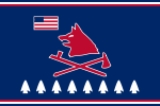
Pawnee

Encyclopedia
Pawnee people are a Caddoan-speaking Native American
tribe. They are federally recognized as the Pawnee Nation of Oklahoma.
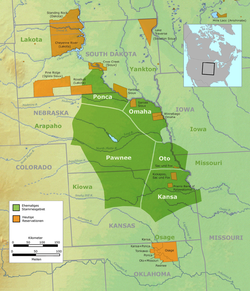
Historically, the Pawnee lived along outlying tributaries of the Missouri River
: the Platte
, Loup
and Republican
rivers in present-day Nebraska
and in northern Kansas
. They lived in permanent earth lodge
villages where they farmed. They left the villages on seasonal buffalo hunts, using tipis while traveling.
In the 1830s, the Pawnee numbered about 2,000 people, as they had escaped some of the depredations of exposure to Eurasian infectious disease
s. By 1859, their numbers were reduced to about 1,400. Still subject to encroachment by the Lakota and European Americans, finally most accepted relocation to a reservation in Indian Territory
. This is where most of the enrolled members of the nation live today. Their autonym is Chatickas-si-Chaticks, meaning "men of men".
and their elected president is Marshall R. Gover. They issue their own vehicle license tags, operate their housing authority, and maintain two casinos, four smoke shops, two fuel stations, and one truck stop. Their estimated economic impact is $10.5 million.
, French
and Americans
, as well as neighboring tribes, the Pawnee began to draw closer together.
The Pawnee generally settled close to the rivers and placed their lodges on the higher banks. They built earth lodge
s that by historical times tended to be oval in shape; at earlier stages, they were rectangular. They constructed the frame, made of 10-15 posts set some ten feet apart, which outlined the central room of the lodge. Lodge size varied based on the number of poles placed in the center of the structure. Most lodges had 4, 8 or 12 center poles. A common feature in Pawnee lodges were four painted poles, which represented the four cardinal directions and the four major star gods (not to be confused with the Creator
.) A second outer ring of poles outlined the outer circumference of the lodge. Horizontal beams linked the posts together.
The frame was covered first with smaller poles, tied with willow withes. The structure was covered with thatch, then earth. A hole left in the center of the covering served as a combined chimney/smoke hole and skylight. The door of each lodge was placed to the east and the rising sun. A long, low passageway, which helped keep out outside weather, led to an entry room that had an interior buffalo-skin door on a hinge. It could be closed at night and wedged shut. Opposite the door, on the west side of the central room, a buffalo
skull with horns was displayed. This was considered great medicine.
Mats were hung on the perimeter of the main room to shield small rooms in the outer ring, which served as sleeping and private spaces. The lodge was semi-subterranean, as the Pawnee recessed the base by digging it approximately three feet below ground level. This insulated the interior from extreme temperatures. Lodges were strong enough to support adults, who routinely sat on them, and the children who played on the top of the structures. (See photo above.)
As many as 30-50 people might live in each lodge, and they were usually of related families. A village could consist of as many as 300-500 people and 10-15 households. Each lodge was divided in two (the north and south), and each section had a head who oversaw the daily business. Each section was further subdivided into three duplicate areas, with tasks and responsibilities related to the age of women and girls, as described below. The membership of the lodge was quite flexible.
The tribe went on buffalo hunts in summer and winter. Upon their return, the inhabitants of a lodge would often move into another lodge, although they generally remained within the village. Men's lives were more transient than those of women. They had obligations of support for the wife (and family they married into), but could always go back to their mother and sisters for a night or two of attention. When young couples married, they lived with the woman's family.
Within the lodge, each north-south section included roles for the three classes of women:
Amongst the collection of lodges, the political designations for men were essentially between:
Women tended to be responsible for decisions about resource allocation, trade, and inter-lodge social negotiations. Men were responsible for decisions which pertained to hunting, war, and spiritual/health issues.
Women tended to remain within a single lodge, while men would typically move between lodges. They took multiple sexual partners in serially monogamous relationships.
, seven of pumpkins and squashes, and eight of beans. They planted their crops along the fertile river bottomlands. These crops provided a wide variety of nutrients and complemented each other in making whole proteins. In addition to varieties of flint corn
and flour corn for consumption, the women planted an archaic breed which they called "Wonderful" or "Holy Corn", specifically to be included in the sacred bundles.
The holy corn was cultivated and harvested to replace corn in the winter and summer sacred bundles. Seeds were taken from sacred bundles for the spring planting ritual. The cycle of corn determined the annual agricultural cycle, as it was the first to be planted and first to be harvested (with accompanying ceremonies involving priests and men of the tribe as well.)
In keeping with their cosmology
, the Pawnee classified the varieties of corn by color: black, spotted, white, yellow and red (which, excluding spotted, related to the colors associated with the four semi-cardinal directions). The women kept the different strains pure as they cultivated the corn. While important in agriculture, squash and beans were not given the same theological meaning as corn.
hunting seasons. With horses providing a greater range, the people traveled in both summer and winter westward to the Great Plains
for buffalo hunting. They often traveled 500 miles or more in a season. In summer the march began at dawn or before, but usually did not last the entire day.
Once buffalo were located, hunting did not begin until the medicine men of the tribe considered the time propitious. Then the hunt began by the men advancing together toward the buffalo, but no one could kill any buffalo until the warriors of the tribe gave the signal. Anyone who broke ranks was severely beaten. During the chase, the hunters guided their ponies with their knees and wielded bows and arrows. They could incapacitate buffalo with a single arrow shot into the flank between the lower ribs and the hip. The animal would soon lie down and perhaps bleed out, or the hunters would finish it off. An individual hunter might shoot as many as five buffalo in this way before backtracking and finishing them off. They preferred to kill cows and young bulls, as the taste of older bulls was disagreeable.
After successful kills, the women processed the bison meat and skin: the flesh was sliced into strips and dried on poles over slow fires and stored. Prepared in this way, it was usable for several years. Although the Pawnee preferred buffalo, they also hunted other game, including elk, bear, panther, and skunk, for meat and skins. The skins were used for clothing and accessories, storage bags, foot coverings, fastening ropes and ties, etc.
The people returned to their villages to harvest crops when the corn was ripe in late summer, or in the spring when the grass became green and they could plant a new cycle of crops. Summer hunts extended from late June to about the first of September; but might end early if hunting was successful. Sometimes the hunt was limited to what is now western Nebraska. Winter hunts were from late October until early April and were often to the southwest into what is now western Kansas.
bundles which included materials, such as an ear of corn, with great symbolic value. These were used in many religious ceremonies to maintain the balance of nature and the Pawnee relationship with the gods and spirits. The Pawnee were not part of the Sun Dance
tradition. In the 1890s, the people participated in the Ghost Dance
movement.
The Pawnee believed that the Morning Star and Evening Star gave birth to the first Pawnee woman. The first Pawnee man was the offspring of the union of the Moon and the Sun. As they believed they were descendants of the stars, cosmology had a central role in daily and spiritual life. They planted their crops according to the position of the stars, which related to the appropriate time of season for planting. Like many tribal bands, they sacrificed maize and other crops to the stars.
, specifically of captive girls, in the "Morning Star ritual". They continued this practice regularly through the 1810s and possibly after 1838, the last reported sacrifice. They believed the longstanding rite ensured the fertility of the soil and success of the crops, as well as renewal of all life in spring. The sacrifice was related to the belief that the first human being was a girl, born of the mating of the Morning Star
, the male figure of light, and Evening Star
, a female figure of darkness, in their creation story.
Typically, a warrior would dream of the Morning Star, usually in the autumn, which meant it was time to prepare for the various steps of the ritual. The visionary would consult with the Morning Star priest, who helped him prepare for his journey to find a sacrifice. With help from others, the warrior would capture a young unmarried girl from an enemy tribe. The Pawnee kept the girl and cared for her over the winter, taking her with them as they made their buffalo hunt. They arranged her sacrifice in the spring, in relation to the rising of the Morning Star. She was well treated and fed throughout this period.
When the morning star
rose ringed with red, the priest knew it was the signal for the sacrifice. He directed the men to carry out the rest of the ritual, including the construction of a scaffold outside the village. It was made of sacred woods and leathers from different animals, each of which had important symbolism. It was erected over a pit with elements corresponding to the four cardinal directions. All the elements of the ritual related to symbolic meaning and belief, and were necessary for the renewal of life. The preparations took four days.
A procession of all the men, boys and male infants accompanied the girl out of the village to the scaffold. Together they awaited the morning star. When the star was due to rise, the girl was placed and tied on the scaffold. At the moment the star appeared above the horizon, the girl was killed with an arrow, then the priest cut the skin of her chest to bleed. She was quickly shot with arrows by all the participating men and boys to hasten her death. The girl was carried to the east and placed face down so her blood would soak into the earth, with appropriate prayers for the crops and life she would bring to all life on the prairie.
About 1820-1821, news of the sacrifices reached the East Coast; it caused a sensation among European Americans. Before this, US Indian agents had counseled Pawnee chiefs to suppress the practice, as they warned of how it would upset the American settlers, who were arriving in ever greater number. Knife Chief ransomed at least two captives before sacrifice. For any individual, it was extremely difficult to try to change a practice tied so closely to Pawnee belief in the annual renewal of life for the tribe. In June 1818, the Missouri Gazette of St. Louis contained the account of a sacrifice. The last known child sacrifice was of Haxti, a 14-year-old Oglala Lakota girl, on April 22, 1838.
Writing in the 1960s, the historian Gene Weltfish drew from earlier work of Wissler and Spinden to suggest that the sacrificial practice might have been transferred in the early 16th century from the Aztec
of present-day Mexico
. More recently, historians have disputed the proposed connection to Mesoamerican practice. They believe that the sacrifice ritual originated separately within ancient traditional Pawnee culture.
 Francisco Vásquez de Coronado
visited the neighboring Wichita
in 1541 where he encountered a Pawnee chief from Harahey in Nebraska
. Nothing much is mentioned of the Pawnee until the seventeenth and eighteenth centuries when successive incursions of Spanish
, French
and English
settlers attempted to enlarge their possessions. The tribes tended to make alliances as and when it suited them. Different Pawnee subtribes could make treaties with warring Europe
an powers without disrupting the underlying unity; the Pawnee were masters at unity within diversity.
In the 18th century, they were allied with the French
, with whom they traded. They played an important role in halting Spanish expansion
onto the Great Plains
by decisively defeating the Villasur expedition
in battle in 1720.
Until the 1830s, the Pawnee in what became United States territory were relatively isolated from interaction with Europeans and escaped some of the losses due to introduction of Eurasia
n infectious diseases, such as measles
, smallpox
, and cholera
, to which Native Americans had no immunity
. In the 19th century, however, they were pressed by Siouan groups encroaching from the east, who also brought disease. Epidemics of smallpox
and cholera
, and endemic warfare
with the Sioux
and Cheyenne
drastically reduced the numbers of Pawnee. From an estimated population of 12,000 in the 1830s, they were reduced to 3,400 by 1859, when they went to a reservation in Nebraska.
In 1874 they requested relocation to Indian Territory
(Oklahoma), but the stress of the move, diseases and poor conditions in the Territory reduced their numbers even more. By 1900 the population as recorded by the US Census was only 633. Since then the tribe has begun to recover.
The historian Marcel Trudel documented that close to 2,000 Pawnee (Panis in French) slaves
lived in Canada
until the abolition of slavery in the colony in 1833. The Indian slaves comprised close to half of the known slaves in French Canada
(also called Lower Canada). Traditionally Native American and First Nations tribes sold captives from warfare as slaves to other tribes and to European traders.
In French Canada
, Indian slaves were generally called Panis (anglicized to Pawnee), as most had been captured from the Pawnee tribe. Pawnee became synonymous with "Indian slave" in general use in Canada. As early as 1670, a historical reference was recorded to a Panis in Montreal.
A Pawnee tribal delegation visited President Thomas Jefferson
. In 1806 Lieutenant Zebulon Pike
, Major G. C. Sibley, Major S. H. Long, amongt others, began visiting the Pawnee villages. Under pressure from Siouan tribes and European-American settlers, the Pawnee ceded territory to the United States government in treaties in 1818, 1825, 1833, 1848, 1857, and 1892. In 1857, they settled on the Pawnee Reservation
along the Loup River in present-day Nance County, Nebraska
, but managed to keep their regular pattern of life. They were subjected to continual raids by Lakota from the north and west. On one such raid, a Sioux war party of over 1,000 warriors ambushed a Pawnee hunting party of 350 men, women and children. The Pawnee had gained permission to leave the reservation and hunt buffalo. About 70 Pawnee were killed in this attack, which occurred in a canyon in present-day Hitchcock County
. The site is known as Massacre Canyon
. Because of the ongoing hostilities with the Sioux and encroachment from American settlers to the south and east, the Pawnee decided to leave their Nebraska reservation in the 1870s and settle on a new reservation in Indian Territory
, located in what is today Oklahoma.
In 1875 most members of the nation moved to Indian Territory, a large area reserved to receive tribes displaced from the east and elsewhere. Many Pawnee men joined the United States Cavalry
as scouts rather than face the ignominy of reservation life. The warriors resisted the loss of their freedom and culture by adapting to reservations. On November 23, 1892, the Pawnee in Oklahoma signed an agreement with the Cherokee Commission
to accept individual allotments.
In the 20th century, many Pawnee adopted Christianity
.
of 1936 and established the Pawnee Business Council, the Nasharo (Chiefs) Council, and a tribal constitution, bylaws, and charter.
In the 1960s, the government settled a suit by the Pawnee Nation regarding their compensation for lands ceded to the US government in the 19th century. By an out-of-court settlement in 1964, the Pawnee Nation was awarded $7,316,097 for land ceded to the US and undervalued by the federal government in the previous century.
Bills such as the Indian Self-Determination and Education Assistance Act of 1975 have helped address the mistakes of the past. The Pawnee Nation has regained some of its self-government, culture and pride. The Pawnee continue to practice cultural traditions, meeting twice a year for the inter-tribal gathering with their kinsmen the Wichita Indians. They have an annual four-day Pawnee Homecoming for Pawnee veterans in July. Many Pawnee also return to their traditional lands to visit relatives and take part in scheduled powwow
s.
Native Americans in the United States
Native Americans in the United States are the indigenous peoples in North America within the boundaries of the present-day continental United States, parts of Alaska, and the island state of Hawaii. They are composed of numerous, distinct tribes, states, and ethnic groups, many of which survive as...
tribe. They are federally recognized as the Pawnee Nation of Oklahoma.
Historically, the Pawnee lived along outlying tributaries of the Missouri River
Missouri River
The Missouri River flows through the central United States, and is a tributary of the Mississippi River. It is the longest river in North America and drains the third largest area, though only the thirteenth largest by discharge. The Missouri's watershed encompasses most of the American Great...
: the Platte
Platte River
The Platte River is a major river in the state of Nebraska and is about long. Measured to its farthest source via its tributary the North Platte River, it flows for over . The Platte River is a tributary of the Missouri River, which in turn is a tributary of the Mississippi River which flows to...
, Loup
Loup River
The Loup River is a tributary of the Platte River, approximately long, in central Nebraska in the United States. The river drains a sparsely populated rural agricultural area on the eastern edge of the Great Plains southeast of the Sandhills...
and Republican
Republican River
The Republican River is a river in the central Great Plains of North America, flowing through the U.S. states of Nebraska and Kansas.-Geography:...
rivers in present-day Nebraska
Nebraska
Nebraska is a state on the Great Plains of the Midwestern United States. The state's capital is Lincoln and its largest city is Omaha, on the Missouri River....
and in northern Kansas
Kansas
Kansas is a US state located in the Midwestern United States. It is named after the Kansas River which flows through it, which in turn was named after the Kansa Native American tribe, which inhabited the area. The tribe's name is often said to mean "people of the wind" or "people of the south...
. They lived in permanent earth lodge
Earth lodge
An earth lodge is a semi-subterranean building covered partially or completely with earth, best known from the Native American cultures of the Great Plains and Eastern Woodlands. Most earth lodges are circular in construction with a dome-like roof, often with a central or slightly-offset smoke...
villages where they farmed. They left the villages on seasonal buffalo hunts, using tipis while traveling.
In the 1830s, the Pawnee numbered about 2,000 people, as they had escaped some of the depredations of exposure to Eurasian infectious disease
Infectious disease
Infectious diseases, also known as communicable diseases, contagious diseases or transmissible diseases comprise clinically evident illness resulting from the infection, presence and growth of pathogenic biological agents in an individual host organism...
s. By 1859, their numbers were reduced to about 1,400. Still subject to encroachment by the Lakota and European Americans, finally most accepted relocation to a reservation in Indian Territory
Indian Territory
The Indian Territory, also known as the Indian Territories and the Indian Country, was land set aside within the United States for the settlement of American Indians...
. This is where most of the enrolled members of the nation live today. Their autonym is Chatickas-si-Chaticks, meaning "men of men".
Government and economic development
There are approximately 3,210 enrolled Pawnee, with 132 living in Oklahoma. Their tribal headquarters is in PawneePawnee, Oklahoma
Pawnee is a city in Pawnee County, Oklahoma, United States. The population was 2,230 at the 2000 census. It is the county seat of Pawnee County.-Geography:Pawnee is located at...
and their elected president is Marshall R. Gover. They issue their own vehicle license tags, operate their housing authority, and maintain two casinos, four smoke shops, two fuel stations, and one truck stop. Their estimated economic impact is $10.5 million.
Traditional culture
The Pawnee were divided into two large groupings—the Skidi living in the north and the South Bands (which were further divided into several villages). While the Skidi were the most populous group of Pawnee, the Chaui were generally the political leading group, although each band was autonomous. As was typical of many Indian tribes, each band saw to its own. In response to pressures from the SpanishSpain
Spain , officially the Kingdom of Spain languages]] under the European Charter for Regional or Minority Languages. In each of these, Spain's official name is as follows:;;;;;;), is a country and member state of the European Union located in southwestern Europe on the Iberian Peninsula...
, French
France
The French Republic , The French Republic , The French Republic , (commonly known as France , is a unitary semi-presidential republic in Western Europe with several overseas territories and islands located on other continents and in the Indian, Pacific, and Atlantic oceans. Metropolitan France...
and Americans
United States
The United States of America is a federal constitutional republic comprising fifty states and a federal district...
, as well as neighboring tribes, the Pawnee began to draw closer together.
Bands
- South Bands
- Chaui, Chawi, or Tsawi (‘People in the Middle’, also called "Grand Pawnee")
- Kithehaki or Kitkehaxki (‘Little Muddy Bottom Village’, often called "Republican Pawnee")
- Pitahaureat or Pitahawirata (‘People Downstream’, ‘Man-Going-East’, derived from Pita - ‘Man’ and Rata - ‘screaming’, the French called them "Tapage Pawnee" - ‘Screaming, Howling Pawnee’, later the Americans "Noisy Pawnee")
- Pitahaureat, Pitahawirata, (Pitahaureat proper, leading group)
- Kawarakis (derived from the Arikara languageArikara languageArikara is a Caddoan language spoken by the Arikara people, who reside primarily at Fort Berthold reservation in North Dakota. Arikara is very close to the Pawnee language, but they are not mutually intelligible....
Kawarusha - ‘Horse’ and Pawnee languagePawnee languageThe Pawnee language is a Caddoan language spoken by some Pawnee Native Americans now located in north central Oklahoma. Their traditional historic lands were along the Platte River in what is now Nebraska. Once the language of thousands of Pawnees, today Pawnee is spoken by a shrinking number of...
Kish - ‘People’ , some Pawnee argued that the Kawarakis spoke like the ArikaraArikaraArikara are a group of Native Americans in North Dakota...
living to the north, so perhaps they belonged to the refugees (1794–1795) from Lakota aggression, who joined their Caddo kin living south)
- Skidi-Federation or Skiri (derived from Tski'ki - ‘Wolf’ or Tskirirara - ‘Wolf-in-Water’, therefore called "Loups" - ‘Wolves’ by French and "Wolf Pawnee" by Americans), northernmost band
- Turikaku (‘Center Village’)
- Kitkehaxpakuxtu (‘Old Village’ or ‘Old-Earth-Lodge-Village’)
- Tuhitspiat (‘Village-Stretching-Out-in-the-Bottomlands’)
- Tukitskita (‘Village-on-Branch-of-a-River’)
- Tuhawukasa (‘Village-across-a-Ridge’ or ‘Village-Stretching-across-a-Hill’)
- Arikararikutsu (‘Big-Antlered-Elk-Standing’)
- Arikarariki (‘Small-Antlered-Elk-Standing’)
- Tuhutsaku (‘Village-in-a-Ravine’)
- Tuwarakaku (‘Village-in-Thick-Timber’)
- Akapaxtsawa (‘Buffalo-Skull-Painted-on-Tipi’)
- Tskisarikus (‘Fish-Hawk’)
- Tstikskaatit (‘Black-Ear-of-Corn,’ i.e.‘CornCornCorn is the name used in the United States, Canada, and Australia for the grain maize.In much of the English-speaking world, the term "corn" is a generic term for cereal crops, such as* Barley* Oats* Wheat* Rye- Places :...
-black’) - Turawiu (was only part of a village)
- Pahukstatu (‘Pumpkin-Vine’, did not join the Skidi and remained politically independent, but in general were counted as Skidi)
- Tskirirara (‘Wolf-in-Water’, although the Skidi-Federation got its name from them, they remained politically independent, but were counted within the Pawnee as Skidi)
Villages
The Pawnee had a sedentary lifestyle combining village life and seasonal hunting, which had long been established on the Plains. Archeology studies of ancient sites have demonstrated the people lived in this pattern for nearly 700 years, since about 1250 CE.The Pawnee generally settled close to the rivers and placed their lodges on the higher banks. They built earth lodge
Earth lodge
An earth lodge is a semi-subterranean building covered partially or completely with earth, best known from the Native American cultures of the Great Plains and Eastern Woodlands. Most earth lodges are circular in construction with a dome-like roof, often with a central or slightly-offset smoke...
s that by historical times tended to be oval in shape; at earlier stages, they were rectangular. They constructed the frame, made of 10-15 posts set some ten feet apart, which outlined the central room of the lodge. Lodge size varied based on the number of poles placed in the center of the structure. Most lodges had 4, 8 or 12 center poles. A common feature in Pawnee lodges were four painted poles, which represented the four cardinal directions and the four major star gods (not to be confused with the Creator
Creator deity
A creator deity is a deity responsible for the creation of the world . In monotheism, the single God is often also the creator deity, while polytheistic traditions may or may not have creator deities...
.) A second outer ring of poles outlined the outer circumference of the lodge. Horizontal beams linked the posts together.
The frame was covered first with smaller poles, tied with willow withes. The structure was covered with thatch, then earth. A hole left in the center of the covering served as a combined chimney/smoke hole and skylight. The door of each lodge was placed to the east and the rising sun. A long, low passageway, which helped keep out outside weather, led to an entry room that had an interior buffalo-skin door on a hinge. It could be closed at night and wedged shut. Opposite the door, on the west side of the central room, a buffalo
Bison
Members of the genus Bison are large, even-toed ungulates within the subfamily Bovinae. Two extant and four extinct species are recognized...
skull with horns was displayed. This was considered great medicine.
Mats were hung on the perimeter of the main room to shield small rooms in the outer ring, which served as sleeping and private spaces. The lodge was semi-subterranean, as the Pawnee recessed the base by digging it approximately three feet below ground level. This insulated the interior from extreme temperatures. Lodges were strong enough to support adults, who routinely sat on them, and the children who played on the top of the structures. (See photo above.)
As many as 30-50 people might live in each lodge, and they were usually of related families. A village could consist of as many as 300-500 people and 10-15 households. Each lodge was divided in two (the north and south), and each section had a head who oversaw the daily business. Each section was further subdivided into three duplicate areas, with tasks and responsibilities related to the age of women and girls, as described below. The membership of the lodge was quite flexible.
The tribe went on buffalo hunts in summer and winter. Upon their return, the inhabitants of a lodge would often move into another lodge, although they generally remained within the village. Men's lives were more transient than those of women. They had obligations of support for the wife (and family they married into), but could always go back to their mother and sisters for a night or two of attention. When young couples married, they lived with the woman's family.
Political structure
The Pawnee are a matrilineal people. Ancestral descent is traced through the mother, and, traditionally, a young couple moved into the bride's parents' lodge. People work together in collaborative ways, marked by both independence and cooperation, without coercion. Both women and men are active in political life, with independent decision-making responsibilities.Within the lodge, each north-south section included roles for the three classes of women:
- Mature women (usually married and mothers), who did most of the labor;
- Young single women, just learning their responsibilities; and
- Older women, who looked after the young children.
Amongst the collection of lodges, the political designations for men were essentially between:
- the Warrior Clique; and
- the Hunting Clique.
Women tended to be responsible for decisions about resource allocation, trade, and inter-lodge social negotiations. Men were responsible for decisions which pertained to hunting, war, and spiritual/health issues.
Women tended to remain within a single lodge, while men would typically move between lodges. They took multiple sexual partners in serially monogamous relationships.
Agriculture
The Pawnee women were "skilled horticulturalists" and cooks, cultivating and processing ten varieties of cornMaize
Maize known in many English-speaking countries as corn or mielie/mealie, is a grain domesticated by indigenous peoples in Mesoamerica in prehistoric times. The leafy stalk produces ears which contain seeds called kernels. Though technically a grain, maize kernels are used in cooking as a vegetable...
, seven of pumpkins and squashes, and eight of beans. They planted their crops along the fertile river bottomlands. These crops provided a wide variety of nutrients and complemented each other in making whole proteins. In addition to varieties of flint corn
Flint corn
Flint corn, is the same species as, but a different variant of maize...
and flour corn for consumption, the women planted an archaic breed which they called "Wonderful" or "Holy Corn", specifically to be included in the sacred bundles.
The holy corn was cultivated and harvested to replace corn in the winter and summer sacred bundles. Seeds were taken from sacred bundles for the spring planting ritual. The cycle of corn determined the annual agricultural cycle, as it was the first to be planted and first to be harvested (with accompanying ceremonies involving priests and men of the tribe as well.)
In keeping with their cosmology
Cosmology
Cosmology is the discipline that deals with the nature of the Universe as a whole. Cosmologists seek to understand the origin, evolution, structure, and ultimate fate of the Universe at large, as well as the natural laws that keep it in order...
, the Pawnee classified the varieties of corn by color: black, spotted, white, yellow and red (which, excluding spotted, related to the colors associated with the four semi-cardinal directions). The women kept the different strains pure as they cultivated the corn. While important in agriculture, squash and beans were not given the same theological meaning as corn.
Hunting
After they obtained horses, the Pawnee adapted their culture and expanded their buffaloAmerican Bison
The American bison , also commonly known as the American buffalo, is a North American species of bison that once roamed the grasslands of North America in massive herds...
hunting seasons. With horses providing a greater range, the people traveled in both summer and winter westward to the Great Plains
Great Plains
The Great Plains are a broad expanse of flat land, much of it covered in prairie, steppe and grassland, which lies west of the Mississippi River and east of the Rocky Mountains in the United States and Canada. This area covers parts of the U.S...
for buffalo hunting. They often traveled 500 miles or more in a season. In summer the march began at dawn or before, but usually did not last the entire day.
Once buffalo were located, hunting did not begin until the medicine men of the tribe considered the time propitious. Then the hunt began by the men advancing together toward the buffalo, but no one could kill any buffalo until the warriors of the tribe gave the signal. Anyone who broke ranks was severely beaten. During the chase, the hunters guided their ponies with their knees and wielded bows and arrows. They could incapacitate buffalo with a single arrow shot into the flank between the lower ribs and the hip. The animal would soon lie down and perhaps bleed out, or the hunters would finish it off. An individual hunter might shoot as many as five buffalo in this way before backtracking and finishing them off. They preferred to kill cows and young bulls, as the taste of older bulls was disagreeable.
After successful kills, the women processed the bison meat and skin: the flesh was sliced into strips and dried on poles over slow fires and stored. Prepared in this way, it was usable for several years. Although the Pawnee preferred buffalo, they also hunted other game, including elk, bear, panther, and skunk, for meat and skins. The skins were used for clothing and accessories, storage bags, foot coverings, fastening ropes and ties, etc.
The people returned to their villages to harvest crops when the corn was ripe in late summer, or in the spring when the grass became green and they could plant a new cycle of crops. Summer hunts extended from late June to about the first of September; but might end early if hunting was successful. Sometimes the hunt was limited to what is now western Nebraska. Winter hunts were from late October until early April and were often to the southwest into what is now western Kansas.
Religion
Like many other Native American tribes, the Pawnee had a cosmology with elements of all of nature represented in it. They based many rituals in the four cardinal directions. Medicine men created sacredSacred
Holiness, or sanctity, is in general the state of being holy or sacred...
bundles which included materials, such as an ear of corn, with great symbolic value. These were used in many religious ceremonies to maintain the balance of nature and the Pawnee relationship with the gods and spirits. The Pawnee were not part of the Sun Dance
Sun Dance
The Sun Dance is a religious ceremony practiced by a number of Native American and First Nations peoples, primarily those of the Plains Nations. Each tribe has its own distinct practices and ceremonial protocols...
tradition. In the 1890s, the people participated in the Ghost Dance
Ghost Dance
The Ghost Dance was a new religious movement which was incorporated into numerous Native American belief systems. The traditional ritual used in the Ghost Dance, the circle dance, has been used by many Native Americans since prehistoric times...
movement.
The Pawnee believed that the Morning Star and Evening Star gave birth to the first Pawnee woman. The first Pawnee man was the offspring of the union of the Moon and the Sun. As they believed they were descendants of the stars, cosmology had a central role in daily and spiritual life. They planted their crops according to the position of the stars, which related to the appropriate time of season for planting. Like many tribal bands, they sacrificed maize and other crops to the stars.
The Morning Star ritual
The Skidi Pawnee practiced child sacrificeChild sacrifice
Child sacrifice is the ritualistic killing of children in order to please, propitiate or force a god or supernatural beings in order to achieve a desired result...
, specifically of captive girls, in the "Morning Star ritual". They continued this practice regularly through the 1810s and possibly after 1838, the last reported sacrifice. They believed the longstanding rite ensured the fertility of the soil and success of the crops, as well as renewal of all life in spring. The sacrifice was related to the belief that the first human being was a girl, born of the mating of the Morning Star
Morning Star
Morning star is the name given to the planet Venus when it appears in the east before sunrise.*Phosphorus , in Greek and biblical mythology** Eosphorus, the "dawn-bearer" in Greek mythology**Lucifer, the Latin translation of Phosphorus...
, the male figure of light, and Evening Star
Evening Star
Evening Star is the name given to the planet Venus when it appears in the West after sunset; the ancient Greeks gave it the name Hesperus. It may also refer to:-People:* Arwen, an elf-maiden in J.R.R...
, a female figure of darkness, in their creation story.
Typically, a warrior would dream of the Morning Star, usually in the autumn, which meant it was time to prepare for the various steps of the ritual. The visionary would consult with the Morning Star priest, who helped him prepare for his journey to find a sacrifice. With help from others, the warrior would capture a young unmarried girl from an enemy tribe. The Pawnee kept the girl and cared for her over the winter, taking her with them as they made their buffalo hunt. They arranged her sacrifice in the spring, in relation to the rising of the Morning Star. She was well treated and fed throughout this period.
When the morning star
Morning Star
Morning star is the name given to the planet Venus when it appears in the east before sunrise.*Phosphorus , in Greek and biblical mythology** Eosphorus, the "dawn-bearer" in Greek mythology**Lucifer, the Latin translation of Phosphorus...
rose ringed with red, the priest knew it was the signal for the sacrifice. He directed the men to carry out the rest of the ritual, including the construction of a scaffold outside the village. It was made of sacred woods and leathers from different animals, each of which had important symbolism. It was erected over a pit with elements corresponding to the four cardinal directions. All the elements of the ritual related to symbolic meaning and belief, and were necessary for the renewal of life. The preparations took four days.
A procession of all the men, boys and male infants accompanied the girl out of the village to the scaffold. Together they awaited the morning star. When the star was due to rise, the girl was placed and tied on the scaffold. At the moment the star appeared above the horizon, the girl was killed with an arrow, then the priest cut the skin of her chest to bleed. She was quickly shot with arrows by all the participating men and boys to hasten her death. The girl was carried to the east and placed face down so her blood would soak into the earth, with appropriate prayers for the crops and life she would bring to all life on the prairie.
About 1820-1821, news of the sacrifices reached the East Coast; it caused a sensation among European Americans. Before this, US Indian agents had counseled Pawnee chiefs to suppress the practice, as they warned of how it would upset the American settlers, who were arriving in ever greater number. Knife Chief ransomed at least two captives before sacrifice. For any individual, it was extremely difficult to try to change a practice tied so closely to Pawnee belief in the annual renewal of life for the tribe. In June 1818, the Missouri Gazette of St. Louis contained the account of a sacrifice. The last known child sacrifice was of Haxti, a 14-year-old Oglala Lakota girl, on April 22, 1838.
Writing in the 1960s, the historian Gene Weltfish drew from earlier work of Wissler and Spinden to suggest that the sacrificial practice might have been transferred in the early 16th century from the Aztec
Aztec
The Aztec people were certain ethnic groups of central Mexico, particularly those groups who spoke the Nahuatl language and who dominated large parts of Mesoamerica in the 14th, 15th and 16th centuries, a period referred to as the late post-classic period in Mesoamerican chronology.Aztec is the...
of present-day Mexico
Mexico
The United Mexican States , commonly known as Mexico , is a federal constitutional republic in North America. It is bordered on the north by the United States; on the south and west by the Pacific Ocean; on the southeast by Guatemala, Belize, and the Caribbean Sea; and on the east by the Gulf of...
. More recently, historians have disputed the proposed connection to Mesoamerican practice. They believe that the sacrifice ritual originated separately within ancient traditional Pawnee culture.
History
Francisco Vásquez de Coronado
Francisco Vásquez de Coronado y Luján was a Spanish conquistador, who visited New Mexico and other parts of what are now the southwestern United States between 1540 and 1542...
visited the neighboring Wichita
Wichita (tribe)
The Wichita people are indigenous inhabitants of North America, who traditionally spoke the Wichita language, a Caddoan language. They have lived in Kansas, Oklahoma, and Texas...
in 1541 where he encountered a Pawnee chief from Harahey in Nebraska
Nebraska
Nebraska is a state on the Great Plains of the Midwestern United States. The state's capital is Lincoln and its largest city is Omaha, on the Missouri River....
. Nothing much is mentioned of the Pawnee until the seventeenth and eighteenth centuries when successive incursions of Spanish
Spain
Spain , officially the Kingdom of Spain languages]] under the European Charter for Regional or Minority Languages. In each of these, Spain's official name is as follows:;;;;;;), is a country and member state of the European Union located in southwestern Europe on the Iberian Peninsula...
, French
France
The French Republic , The French Republic , The French Republic , (commonly known as France , is a unitary semi-presidential republic in Western Europe with several overseas territories and islands located on other continents and in the Indian, Pacific, and Atlantic oceans. Metropolitan France...
and English
England
England is a country that is part of the United Kingdom. It shares land borders with Scotland to the north and Wales to the west; the Irish Sea is to the north west, the Celtic Sea to the south west, with the North Sea to the east and the English Channel to the south separating it from continental...
settlers attempted to enlarge their possessions. The tribes tended to make alliances as and when it suited them. Different Pawnee subtribes could make treaties with warring Europe
Europe
Europe is, by convention, one of the world's seven continents. Comprising the westernmost peninsula of Eurasia, Europe is generally 'divided' from Asia to its east by the watershed divides of the Ural and Caucasus Mountains, the Ural River, the Caspian and Black Seas, and the waterways connecting...
an powers without disrupting the underlying unity; the Pawnee were masters at unity within diversity.
In the 18th century, they were allied with the French
French colonization of the Americas
The French colonization of the Americas began in the 16th century, and continued in the following centuries as France established a colonial empire in the Western Hemisphere. France founded colonies in much of eastern North America, on a number of Caribbean islands, and in South America...
, with whom they traded. They played an important role in halting Spanish expansion
Spanish colonization of the Americas
Colonial expansion under the Spanish Empire was initiated by the Spanish conquistadores and developed by the Monarchy of Spain through its administrators and missionaries. The motivations for colonial expansion were trade and the spread of the Christian faith through indigenous conversions...
onto the Great Plains
Great Plains
The Great Plains are a broad expanse of flat land, much of it covered in prairie, steppe and grassland, which lies west of the Mississippi River and east of the Rocky Mountains in the United States and Canada. This area covers parts of the U.S...
by decisively defeating the Villasur expedition
Villasur expedition
The Villasur expedition of 1720 was a Spanish military expedition intended to check the growing French presence on the Great Plains of central North America...
in battle in 1720.
Until the 1830s, the Pawnee in what became United States territory were relatively isolated from interaction with Europeans and escaped some of the losses due to introduction of Eurasia
Eurasia
Eurasia is a continent or supercontinent comprising the traditional continents of Europe and Asia ; covering about 52,990,000 km2 or about 10.6% of the Earth's surface located primarily in the eastern and northern hemispheres...
n infectious diseases, such as measles
Measles
Measles, also known as rubeola or morbilli, is an infection of the respiratory system caused by a virus, specifically a paramyxovirus of the genus Morbillivirus. Morbilliviruses, like other paramyxoviruses, are enveloped, single-stranded, negative-sense RNA viruses...
, smallpox
Smallpox
Smallpox was an infectious disease unique to humans, caused by either of two virus variants, Variola major and Variola minor. The disease is also known by the Latin names Variola or Variola vera, which is a derivative of the Latin varius, meaning "spotted", or varus, meaning "pimple"...
, and cholera
Cholera
Cholera is an infection of the small intestine that is caused by the bacterium Vibrio cholerae. The main symptoms are profuse watery diarrhea and vomiting. Transmission occurs primarily by drinking or eating water or food that has been contaminated by the diarrhea of an infected person or the feces...
, to which Native Americans had no immunity
Immunity (medical)
Immunity is a biological term that describes a state of having sufficient biological defenses to avoid infection, disease, or other unwanted biological invasion. Immunity involves both specific and non-specific components. The non-specific components act either as barriers or as eliminators of wide...
. In the 19th century, however, they were pressed by Siouan groups encroaching from the east, who also brought disease. Epidemics of smallpox
Smallpox
Smallpox was an infectious disease unique to humans, caused by either of two virus variants, Variola major and Variola minor. The disease is also known by the Latin names Variola or Variola vera, which is a derivative of the Latin varius, meaning "spotted", or varus, meaning "pimple"...
and cholera
Cholera
Cholera is an infection of the small intestine that is caused by the bacterium Vibrio cholerae. The main symptoms are profuse watery diarrhea and vomiting. Transmission occurs primarily by drinking or eating water or food that has been contaminated by the diarrhea of an infected person or the feces...
, and endemic warfare
Endemic warfare
Endemic warfare is the state of continual, low-threshold warfare in a tribal warrior society. Endemic warfare is often highly ritualized and plays an important function in assisting the formation of a social structure among the tribes' men by proving themselves in battle.Ritual fighting permits...
with the Sioux
Sioux
The Sioux are Native American and First Nations people in North America. The term can refer to any ethnic group within the Great Sioux Nation or any of the nation's many language dialects...
and Cheyenne
Cheyenne
Cheyenne are a Native American people of the Great Plains, who are of the Algonquian language family. The Cheyenne Nation is composed of two united tribes, the Só'taeo'o and the Tsétsêhéstâhese .The Cheyenne are thought to have branched off other tribes of Algonquian stock inhabiting lands...
drastically reduced the numbers of Pawnee. From an estimated population of 12,000 in the 1830s, they were reduced to 3,400 by 1859, when they went to a reservation in Nebraska.
In 1874 they requested relocation to Indian Territory
Indian Territory
The Indian Territory, also known as the Indian Territories and the Indian Country, was land set aside within the United States for the settlement of American Indians...
(Oklahoma), but the stress of the move, diseases and poor conditions in the Territory reduced their numbers even more. By 1900 the population as recorded by the US Census was only 633. Since then the tribe has begun to recover.
The historian Marcel Trudel documented that close to 2,000 Pawnee (Panis in French) slaves
Slavery
Slavery is a system under which people are treated as property to be bought and sold, and are forced to work. Slaves can be held against their will from the time of their capture, purchase or birth, and deprived of the right to leave, to refuse to work, or to demand compensation...
lived in Canada
Canada
Canada is a North American country consisting of ten provinces and three territories. Located in the northern part of the continent, it extends from the Atlantic Ocean in the east to the Pacific Ocean in the west, and northward into the Arctic Ocean...
until the abolition of slavery in the colony in 1833. The Indian slaves comprised close to half of the known slaves in French Canada
French Canada
French Canada, also known as "Lower Canada", is a term to distinguish the French Canadian population of Canada from English Canada.-Definition:...
(also called Lower Canada). Traditionally Native American and First Nations tribes sold captives from warfare as slaves to other tribes and to European traders.
In French Canada
French Canada
French Canada, also known as "Lower Canada", is a term to distinguish the French Canadian population of Canada from English Canada.-Definition:...
, Indian slaves were generally called Panis (anglicized to Pawnee), as most had been captured from the Pawnee tribe. Pawnee became synonymous with "Indian slave" in general use in Canada. As early as 1670, a historical reference was recorded to a Panis in Montreal.
A Pawnee tribal delegation visited President Thomas Jefferson
Thomas Jefferson
Thomas Jefferson was the principal author of the United States Declaration of Independence and the Statute of Virginia for Religious Freedom , the third President of the United States and founder of the University of Virginia...
. In 1806 Lieutenant Zebulon Pike
Zebulon Pike
Zebulon Montgomery Pike Jr. was an American officer and explorer for whom Pikes Peak in Colorado is named. As a United States Army captain in 1806-1807, he led the Pike Expedition to explore and document the southern portion of the Louisiana Purchase and to find the headwaters of the Red River,...
, Major G. C. Sibley, Major S. H. Long, amongt others, began visiting the Pawnee villages. Under pressure from Siouan tribes and European-American settlers, the Pawnee ceded territory to the United States government in treaties in 1818, 1825, 1833, 1848, 1857, and 1892. In 1857, they settled on the Pawnee Reservation
Pawnee Reservation
The Pawnee Reservation in Nebraska was located on the Loup River in Platte and Nance counties in mid-central Nebraska. The Kawarakis Pawnees, the ancestors of the Chaui, Kitkehahki, and Pitahawirata Bands, settled in southeastern Nebraska in approximately 900....
along the Loup River in present-day Nance County, Nebraska
Nance County, Nebraska
-History:The land that comprises Nance County was originally part of the Pawnee Reservation, created in 1857 when the Pawnee Indians signed a treaty with the United States ceding its lands in exchange for the reservation. After the state of Nebraska was admitted into the Union, the state government...
, but managed to keep their regular pattern of life. They were subjected to continual raids by Lakota from the north and west. On one such raid, a Sioux war party of over 1,000 warriors ambushed a Pawnee hunting party of 350 men, women and children. The Pawnee had gained permission to leave the reservation and hunt buffalo. About 70 Pawnee were killed in this attack, which occurred in a canyon in present-day Hitchcock County
Hitchcock County, Nebraska
-History:Hitchcock County was formed in 1873. It was named after the US Senator Phineas Warren Hitchcock.-Demographics:As of the census of 2000, there were 3,111 people, 1,287 households, and 899 families residing in the county. The population density was 4 people per square mile . There were...
. The site is known as Massacre Canyon
Massacre Canyon
The Massacre Canyon Battle took place on August 5, 1873, in Hitchcock County, Nebraska. It was one of the last battles between the Pawnee and the Sioux and the last large-scale battle between Native American tribes in the area of the present-day United States of America...
. Because of the ongoing hostilities with the Sioux and encroachment from American settlers to the south and east, the Pawnee decided to leave their Nebraska reservation in the 1870s and settle on a new reservation in Indian Territory
Indian Territory
The Indian Territory, also known as the Indian Territories and the Indian Country, was land set aside within the United States for the settlement of American Indians...
, located in what is today Oklahoma.
In 1875 most members of the nation moved to Indian Territory, a large area reserved to receive tribes displaced from the east and elsewhere. Many Pawnee men joined the United States Cavalry
United States Cavalry
The United States Cavalry, or U.S. Cavalry, is the designation of the mounted force of the United States Army. The role of the U.S. Cavalry is reconnaissance, security and mounted assault. Cavalry has served as a part of the Army forces in every war in which the United States has participated...
as scouts rather than face the ignominy of reservation life. The warriors resisted the loss of their freedom and culture by adapting to reservations. On November 23, 1892, the Pawnee in Oklahoma signed an agreement with the Cherokee Commission
Cherokee Commission
The Cherokee Commission, was a three-person bi-partisan body created by President Benjamin Harrison to operate under the direction of the Secretary of the Interior, as empowered by Section 14 of the Indian Appropriations Act of March 2, 1889. Section 15 of the same Act empowered the President to...
to accept individual allotments.
In the 20th century, many Pawnee adopted Christianity
Christianity
Christianity is a monotheistic religion based on the life and teachings of Jesus as presented in canonical gospels and other New Testament writings...
.
Recent history
The US government dismantled the Pawnee tribal government and civic institutions in 1906. The tribe reorganized under the Oklahoma Indian Welfare ActOklahoma Indian Welfare Act
The Oklahoma Indian Welfare Act of 1936, also known as the Thomas-Rogers Act, is a United States federal law that extended the US Indian Reorganization Act of 1934. It sought to return some form of tribal government to the many tribes in former Indian Territory...
of 1936 and established the Pawnee Business Council, the Nasharo (Chiefs) Council, and a tribal constitution, bylaws, and charter.
In the 1960s, the government settled a suit by the Pawnee Nation regarding their compensation for lands ceded to the US government in the 19th century. By an out-of-court settlement in 1964, the Pawnee Nation was awarded $7,316,097 for land ceded to the US and undervalued by the federal government in the previous century.
Bills such as the Indian Self-Determination and Education Assistance Act of 1975 have helped address the mistakes of the past. The Pawnee Nation has regained some of its self-government, culture and pride. The Pawnee continue to practice cultural traditions, meeting twice a year for the inter-tribal gathering with their kinsmen the Wichita Indians. They have an annual four-day Pawnee Homecoming for Pawnee veterans in July. Many Pawnee also return to their traditional lands to visit relatives and take part in scheduled powwow
PowWow
PowWow is a wireless sensor network mote developed by the Cairn team of IRISA/INRIA. The platform is currently based on IEEE 802.15.4 standard radio transceiver and on an MSP430 microprocessor...
s.
Notable Pawnee
- Acee Blue EagleAcee Blue EagleAcee Blue Eagle , also named Alex C. McIntosh, Chebon Ahbulah , and Lumhee Holot-Tee , was a Muscogee Creek-Pawnee-Wichita artist, educator, dancer, and flute player.-Background:...
, artist and educator - Big Spotted HorseBig Spotted HorseBig Spotted Horse was a Pawnee warrior and raider who lived during the 19th century.-The killing of Alights-on-the-Clouds:In 1852 the Pawnee tribe, while engaged in the summer buffalo hunt, on the Solomon Fork in what is now Kansas were attacked by a band of Plains Indians...
, 19th c. warrior and raider - Moses J. "Chief" Yellow Horse, Major League baseballMajor League BaseballMajor League Baseball is the highest level of professional baseball in the United States and Canada, consisting of teams that play in the National League and the American League...
player - John EchoHawkJohn EchoHawkJohn E. EchoHawk is a Native American attorney, and a leading member of the Native American self-determination movement.A member of the Pawnee tribe, EchoHawk is a founder and leader of the Native American Rights Fund . He is a lawyer who has dedicated his life to protecting Indian land and...
, lawyer and founder of the Native American Rights FundNative American Rights FundThe Native American Rights Fund, also known as NARF, is a non-profit organization that uses existing laws and treaties to ensure that state governments and the national government live up to their legal obligations... - Larry EchoHawkLarry EchoHawkLarry EchoHawk is an attorney and legal scholar. On May 20, 2009, EchoHawk joined the administration of U.S. President Barack Obama as the head of the United States Bureau of Indian Affairs. He served as Attorney General of Idaho from 1991 to 1995.-Biography:EchoHawk was raised in Farmington, New...
, Bureau of Indian AffairsBureau of Indian AffairsThe Bureau of Indian Affairs is an agency of the federal government of the United States within the US Department of the Interior. It is responsible for the administration and management of of land held in trust by the United States for Native Americans in the United States, Native American...
Director. He was elected Attorney General of IdahoIdahoIdaho is a state in the Rocky Mountain area of the United States. The state's largest city and capital is Boise. Residents are called "Idahoans". Idaho was admitted to the Union on July 3, 1890, as the 43rd state....
(1991–1995). He is a law professor at Brigham Young UniversityBrigham Young UniversityBrigham Young University is a private university located in Provo, Utah. It is owned and operated by The Church of Jesus Christ of Latter-day Saints , and is the United States' largest religious university and third-largest private university.Approximately 98% of the university's 34,000 students...
. - Kevin Gover, director of the National Museum of the American IndianNational Museum of the American IndianThe National Museum of the American Indian is a museum operated under the auspices of the Smithsonian Institution that is dedicated to the life, languages, literature, history, and arts of the native Americans of the Western Hemisphere...
. - Old Lady Grieves The EnemyOld Lady Grieves The EnemyOld-Lady-Grieves-The-Enemy was a Pawnee woman who gained her name in the 19th century. Her village was attacked by the Ponca and Sioux, and the men tried to run away. At this point she grabbed a war club and attacked the enemy, thus shaming the men and causing them to take action.-References:...
, 19th c. woman warrior - PetalesharoPetalesharoPetalesharo was a Skidi Pawnee chief who rescued an Ietan Comanche girl from a ritual human sacrifice in 1817 and earned publicity for his act in national newspapers. In 1821, he was one of numerous Great Plains tribal chiefs to go to Washington, DC as part of the O'Fallon Delegation...
, a Skidi Pawnee chief who rescued an Ietan Comanche girl in 1817 from ritual human sacrifice. - Anna Lee WaltersAnna Lee WaltersAnna Lee Walters is an award-winning Pawnee/Otoe-Missouria author from Oklahoma.-Career:Walters works at the Diné College in Arizona, where she directs the college press. She lives in Tsaile, Arizona with her husband Harry Walters...
(b. 1946), Otoe-Missouria-Pawnee author and educator - Wicked ChiefWicked ChiefSharitahrish, also known as The Wicked Chief, was principal chief or head man of the Grand Pawnees. He was succeeded by his brother Ishcatape, a name given him by the Omahas, or Pawnee Mah as. Sharitarish died when he was just 30 years old.-References:...
, visited President James MonroeJames MonroeJames Monroe was the fifth President of the United States . Monroe was the last president who was a Founding Father of the United States, and the last president from the Virginia dynasty and the Republican Generation...
in 1822 with a delegation of Indian dignitaries.
Further reading
- Mark Van De Logt. War Party in Blue: Pawnee Scouts in the U.S. Army (University of Oklahoma Press; 2010) 368 pages; examines the key role of Pawnee scouts in U.S. Army campaigns between 1864 and 1877.
External links
- Pawnee Nation Official Website
- Pawnee Indian Tribe
- Pawnee Indian History in Kansas
- The Pawnee; mythology (Part I) Collected under the auspices of the Carnegie Institution of Washington, by George A. Dorsey, 1906. (a searchable facsimile at the University of Georgia Libraries; DjVuDjVuDjVu is a computer file format designed primarily to store scanned documents, especially those containing a combination of text, line drawings, and photographs. It uses technologies such as image layer separation of text and background/images, progressive loading, arithmetic coding, and lossy...
& layered PDF format) - Pawnee Indian Village Museum; A museum featuring the excavated floor of a large 1820s Pawnee earth lodge and associated artifacts. (Kansas State Historical Society)
- Non-invasive imagery of a Pawnee archaeological site ;Non-destructive imaging techniques are used to map the archaeological remains of a late 18th and early 19th century Pawnee village site located on the Republican River in north central Kansas.
- "The Indigenous Maps and Mapping of North American Indians"
- Gene Weltfish Pawnee Field Notes at Newberry LibraryNewberry LibraryThe Newberry Library is a privately endowed, independent research library for the humanities and social sciences in Chicago, Illinois. Although it is private, non-circulating library, the Newberry Library is free and open to the public...
Further reading
- Robert O. Lagace, "Pawnee: Culture summary", Ethnographic Atlas, University of Kent, Canterbury
- "Pawnee", Encyclopedia of North American Indians, New York: Houghton Mifflin
- J. S. Clark, "A Pawnee Buffalo Hunt", Oklahoma Chronicles, Volume 20, No. 4, December 1942, Oklahoma State Historical Society