
All Topics  
Ghost Dance


   Email Print
   Bookmark   Link


Ghost Dance


Noted in historical accounts as the Ghost Dance of 1890, the Ghost Dance was a religious movement incorporated into numerous Native American
Indigenous peoples of the Americas

The indigenous peoples of the Americas are the pre-Columbian inhabitants of the Americas, their descendants, and many ethnic groups who identify with those peoples....
 belief systems. The traditional ritual used in the Ghost Dance, the circle dance
Circle dance

Circle dance, is the most common name for a style of traditional dance usually done in a circle without partners to musical accompaniment....
, has been used by many Native Americans since prehistoric times, but was first performed in accordance with Jack Wilson
Wovoka

Wovoka , also known as Jack Wilson, was the Northern Paiute religious leader who founded the Ghost Dance movement. Wovoka means ?wood cutter? in the Northern Paiute language....
's teachings among the Nevada
Nevada

Nevada is a U.S. state located in the Western United States of the United States of America. The capital is Carson City and the largest city is Las Vegas, Nevada....
 Paiute
Paiute

Paiute refers to two related groups of Native Americans in the United States — the Northern Paiute of California, Nevada and Oregon, and the Southern Paiute of Arizona, southeastern California and Nevada, and Utah....
 in 1889.


Discussion
Ask a question about 'Ghost Dance'
Start a new discussion about 'Ghost Dance'
Answer questions from other users
Full Discussion Forum


Encyclopedia


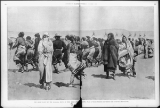
Ghost Dance At Pine Ridge
Noted in historical accounts as the Ghost Dance of 1890, the Ghost Dance was a religious movement incorporated into numerous Native American
Indigenous peoples of the Americas

The indigenous peoples of the Americas are the pre-Columbian inhabitants of the Americas, their descendants, and many ethnic groups who identify with those peoples....
 belief systems. The traditional ritual used in the Ghost Dance, the circle dance
Circle dance

Circle dance, is the most common name for a style of traditional dance usually done in a circle without partners to musical accompaniment....
, has been used by many Native Americans since prehistoric times, but was first performed in accordance with Jack Wilson
Wovoka

Wovoka , also known as Jack Wilson, was the Northern Paiute religious leader who founded the Ghost Dance movement. Wovoka means ?wood cutter? in the Northern Paiute language....
's teachings among the Nevada
Nevada

Nevada is a U.S. state located in the Western United States of the United States of America. The capital is Carson City and the largest city is Las Vegas, Nevada....
 Paiute
Paiute

Paiute refers to two related groups of Native Americans in the United States — the Northern Paiute of California, Nevada and Oregon, and the Southern Paiute of Arizona, southeastern California and Nevada, and Utah....
 in 1889. The practice swept throughout much of the American West, quickly reaching areas of California
California

California is a U.S. state on the West Coast of the United States of the United States, along the Pacific Ocean. It is bordered by Oregon to the north, Nevada to the east, Arizona to the southeast, and to the south the Mexico state of Baja California....
 and Oklahoma
Oklahoma

Oklahoma is a U.S. state and a sovereignty located in the South Central United States and Southern United States of the United States of America ....
. As the Ghost Dance spread from its original source, Native American tribes synthesized selective aspects of the ritual with their own beliefs, often creating change in both the society
Society

A society is a group of humans characterized by patterns of relationships between individuals that share a distinctive culture and/or institutions....
 that integrated it and the ritual itself. At the core of the movement was the prophet
Prophet

In religion, a prophet is a person who has claimed to have encountered the supernatural or the Divinity, often one who serves as an intermediary with humanity....
 of peace Jack Wilson, known as Wovoka
Wovoka

Wovoka , also known as Jack Wilson, was the Northern Paiute religious leader who founded the Ghost Dance movement. Wovoka means ?wood cutter? in the Northern Paiute language....
 among the Paiute
Paiute

Paiute refers to two related groups of Native Americans in the United States — the Northern Paiute of California, Nevada and Oregon, and the Southern Paiute of Arizona, southeastern California and Nevada, and Utah....
, who prophesied a peaceful end to white American expansion while preaching messages of clean living, an honest life, and cross-cultural cooperation. Perhaps the best known facet of the Ghost Dance movement is the role it reportedly played in instigating the Wounded Knee massacre
Wounded Knee Massacre

In the Wounded Knee Massacre, on December 29, 1890, 500 troops of the U.S. 7th Cavalry Regiment, supported by four Hotchkiss guns , surrounded an encampment of Miniconjou Sioux and Hunkpapa Sioux ....
 in 1890, which resulted in the deaths of at least 153 Lakota Sioux
Sioux

Sioux are a Native Americans in the United States and First Nations people. The term can refer to any ethnic group within the Great Sioux Nation or any of the nation's many dialects....
. The Sioux variation on the Ghost Dance tended towards millenarianism
Millenarianism

Millenarianism is the belief by a religious, social, or political group or movement in a coming major transformation of society after which all things will be changed in a positive direction....
, an innovation which distinguished the Sioux interpretation from Jack Wilson's original teachings.

Historical foundations


Paiute background

The Northern Paiutes living in Mason Valley
Mason Valley

The Mason Valley is a valley in western Nevada, between the Singatse Range and the Wassuk Range.The Walker River flows through the valley from south to north. The city of Yerington, Nevada is located in the center of the valley....
, in what is now the U.S. state
U.S. state

A U.S. state is any one of the 50 state of the United States that share sovereignty with the federal government of the United States . Because of this shared sovereignty, an United States is a citizen both of the federal entity and of his or her state of Domicile ....
 of Nevada
Nevada

Nevada is a U.S. state located in the Western United States of the United States of America. The capital is Carson City and the largest city is Las Vegas, Nevada....
, at the time of settlement by white American homesteaders, were known collectively as the Tövusi-dökadö, (Tövusi- : Cyperus
Cyperus

Cyperus is a large genus of about 600 species of Cyperaceaes, distributed throughout all continents in both tropical and temperate regions. They are annual or perennial plants, mostly aquatic ecosystem and growing in still or slow-moving water up to 0.5 m deep....
-bulb
and dökadö : eaters). The Northern Paiute community thrived upon a subsistence pattern of foraging
Foraging

Foraging theory is a branch of behavioral ecology that studies the foraging behavior of animals in response to the environment in which the animal lives....
 through this locally plentiful food source for a portion of the year, also augmenting their diets with fish, pine nuts, and the occasional clubbing of wild game.

The Tövusi-dökadö lacked any permanent political organization or officials, instead operating within a less stratified social system of self-proclaimed spiritually blessed individuals organizing events or activities for the betterment of the group as a whole. Usually, community events centered on the observance of a ritual at a prescribed time of year or was intended to organize activities like harvests or hunting parties. One such extraordinary instance occurred in 1869 when Hawthorne Wodziwob
Wodziwob

Wodziwob was a Northern Paiute prophet who performed the first Ghost Dance rituals around 1869. The movement spread to other tribes, but died out before Wovoka, better known as Jack Wilson, reintroduced the movement in 1889....
, a Paiute man, organized a series of community dances to announce his vision. He spoke of a journey to the land of the dead and of promises made to him by the souls of the recently deceased. They promised to return to their loved ones within a period of 3-4 years. Wodziwob’s peers accepted this vision, probably due to his already reputable status as a healer, as he urged the populace to dance the common circle dance as was customary during a time of festival. He continued preaching this message for 3 years with the help of a local "weather doctor" named Tavibo, the father of Jack Wilson.

Prior to Wodziwob
Wodziwob

Wodziwob was a Northern Paiute prophet who performed the first Ghost Dance rituals around 1869. The movement spread to other tribes, but died out before Wovoka, better known as Jack Wilson, reintroduced the movement in 1889....
’s religious movement, a devastating typhoid epidemic struck in 1867. This and other European diseases killed approximately one tenth of the total population, resulting in widespread psychological and emotional trauma, which brought grave disorder to the economic system
Economic system

An economic system or ?conomic system is a system that involves the Economic production, distribution and consumption of Good and Service between the entities in a particular society....
. Many families were prevented from continuing their nomadic lifestyle, following pine nut harvests and wild game herds. Left with few options, many families ended up in Virginia City
Virginia City

Virginia City is a city located in Storey County, Nevada.Virginia City may also refer to:* Virginia City, Montana* Virginia City, Nevada...
 seeking wage work.

Round dance precursors

The physical form of the ritual associated with the Ghost Dance religion did not originate with Jack Wilson, nor did it die with him. Referred to as the “round dance”, this ritual form characteristically includes a circular community dance held around an individual who leads the ceremony. Often accompanying the ritual are intermissions of trance
Trance

Trance denotes a variety of processes, techniques, modalities and states of mind, awareness and consciousness. Trance states may occur involuntarily and unbidden....
, exhortations and prophesying
Prophecy

Prophecy, generally, describes the disclosing of information that is not known to the prophet by any ordinary means. In religion, this is thought to be a divinely inspired revelation or interpretation....
.

The term “prophet dances
Prophetic dance

Prophetic dance is a ritual dance in which the purpose is to obtain a communication from God or spirits. They exist in various cultures....
” was applied during an investigation of Native American rituals carried out by anthropologist Leslie Spier, a student of Franz Boas
Franz Boas

Franz Boas was a Germans-United States anthropologist and a pioneer of modern anthropology who has been called the "Father of American Anthropology"....
. He noted that versions of the round dance were present throughout much of the Pacific Northwest
Pacific Northwest

The Pacific Northwest is a region in the northwest of North America . There are several partially overlapping definitions but the term Pacific Northwest should not be confused with the Northwest Territory or the Northwest Territories of Canada....
 including the Columbia plateau
Columbia River Plateau

The Columbia River Plateau is a geology and geography region that lies across parts of the U.S. states of Washington, Oregon, and Idaho. It is a wide flood basalt plateau between the Cascade Mountains and Rocky Mountains, cut through by the Columbia River....
 (a region including Washington
Washington

Washington is a U.S. state in the Pacific Northwest region of the United States. Washington was carved out of the western part of Washington Territory which had been ceded by Britain in 1846 by the Oregon Treaty as settlement of the Oregon Boundary Dispute....
, Oregon
Oregon

Oregon is a U.S. state in the Pacific Northwest region of the United States. The area was inhabited by many indigenous tribes before the arrival of traders, explorers and settlers....
, Idaho
Idaho

The State of Idaho is a U.S. state in the Pacific Northwest region of the United States of America. The state's largest city and Capital is Boise, Idaho....
, and parts of western Montana
Montana

Montana is a U.S. state in the Western United States. The western third of the state contains numerous mountain ranges; other 'island' ranges are found in the central third of the state, for a total of 77 named ranges of the Rocky Mountains....
). However, Spier’s study was conducted at a time when most of these rituals had already incorporated Christian
Christian

A Christian is a person who adheres to Christianity, a Monotheism#Christian view religion centered on the life and teachings of Jesus and interpreted by Christians to have been prophesied in the Hebrew Bible/Old Testament....
 elements, which further complicated the investigation of the round dance’s origin.

European impact on native populations (often prior to actual physical exploration of the more remote regions of the continent) has made it difficult to acquire “pristine” data on North American societies during their “pre-historic” or “proto-historic” eras. Changes in Native American societies before physical contact with Europeans can be attributed to severe disease epidemics, an increased frequency and volume in trade caused by the introduction of European goods, from Europeans purchasing local resources and the introduction of the horse (which revolutionized the foraging lifestyle for some aboriginal
Indigenous peoples

File:Kaiapos.jpegThe term indigenous peoples or autochthonous peoples can be used to describe any ethnic group of people who inhabit a geographic region with which they have the earliest known historical connection, alongside immigrants which have populated the region and which are greater in number....
 societies).

Enculturation
Enculturation

Enculturation is the process by which a person learns the requirements of the culture by which he or she is surrounded, and acquires values and behaviours that are appropriate or necessary in that culture....
 and diffusion are not the only explanations for the common circle dance rituals. Anthropologist James Mooney
James Mooney

James Mooney was an American anthropologist who lived for several years among the Cherokee. He was born at Richmond, Indiana, Indiana. In 1885 he became connected with the Bureau of American Ethnology at Washington, D.C....
 was one of the first to study the circle dance. He observed striking similarities in many Native American rituals. However, he also claimed that “a hope and longing common to all humanity, manifests through behavior rooted in human physiology and common experience”; therefore, alluding to either the notion of universal imprints on the human mind, or to ubiquitous behaviors drawn from universal life courses that led to the ritual form.

Jack Wilson’s vision

Wovoka Paiute Shaman
Jack Wilson, the prophet formerly known as Wovoka
Wovoka

Wovoka , also known as Jack Wilson, was the Northern Paiute religious leader who founded the Ghost Dance movement. Wovoka means ?wood cutter? in the Northern Paiute language....
 until his adoption of a westernized name, was believed to have experienced a vision
Hallucination

A hallucination, in the broadest sense, is a perception in the absence of a stimulus . In a stricter sense, hallucinations are defined as perceptions in a conscious and awake state in the absence of external stimuli which have qualities of real perception, in that they are vivid, substantial, and located in external objective space....
 during a solar eclipse
Solar eclipse

A solar eclipse occurs when the Moon passes between the Sun and the Earth so that the Sun is wholly or partially obscured. This can only happen during a new moon, when the Sun and Moon are in conjunction as seen from the Earth....
 on January 1, 1889. It was reportedly not his first time experiencing a vision directly from God; but as a young adult, he claimed that he was then better equipped, spiritually, to handle this message. Jack had received training from an experienced holy man under his parents’ guidance after they realized that he was having difficulty interpreting his previous visions. Jack was also training to be a “weather doctor”, following in his father’s footsteps, and was known throughout Mason Valley as a gifted and blessed young leader. He often presided over circle dances, which symbolizes the sun’s heavenly path across the sky, while preaching a message of universal love.

Anthropologist James Mooney
James Mooney

James Mooney was an American anthropologist who lived for several years among the Cherokee. He was born at Richmond, Indiana, Indiana. In 1885 he became connected with the Bureau of American Ethnology at Washington, D.C....
 conducted an interview with this charismatic preacher in 1892. Mooney confirmed that his message matched that given to his fellow aboriginal Americans. This study compared letters between tribes and notes that Jack asked his pilgrims to take upon their arrival at Mason Valley. Jack told Mooney that he had stood before God in Heaven, and had seen many of his ancestors engaged in their favorite pastimes. God showed Jack a beautiful land filled with wild game, and instructed him to return home to tell his people that they must love each other, not fight, and live in peace with the whites. God also stated that Jack’s people must work, not steal or lie, and that they must not engage in the old practices of war or the traditional self-mutilation practices connected with mourning the dead. God said that if his people abided by these rules they would be united with their friends and family in the other world.

In God’s presence, Jack proclaimed, there would be no sickness, disease, or old age. According to Jack, he was then given the Ghost Dance and commanded to take it back to his people. Jack preached that if this five-day dance was performed in the proper intervals, the performers would secure their happiness and hasten the reunion of the living and deceased. God purportedly gave Jack powers over weather and told him that he would be the deputy in charge of affairs in the Western United States, leaving current President Harrison
Benjamin Harrison

Benjamin Harrison was the List of Presidents of the United States President of the United States, serving one term from 1889 to 1893. Harrison was born in North Bend, Ohio, and at age 21 moved to Indianapolis, Indiana, where he became a prominent state politician....
 as God’s deputy in the East. Jack claims that he was then told to return home and preach God’s message.

Jack Wilson claimed to have left the presence of God convinced that if every Indian in the West danced the new dance to “hasten the event,” all evil in the world would be swept away leaving a renewed Earth filled with food, love, and faith. Quickly accepted by his Paiute brethren, the new religion was termed “Dance In A Circle”. Because the first European contact with the practice came by way of the Sioux, their expression Spirit Dance was adopted as a descriptive title for all such practices. This was subsequently translated as “Ghost Dance”.

Role in Wounded Knee Massacre

Through Native Americans and some Anglo Americans, Jack Wilson’s message spread across much of the western portion of the United States. Early in the religious movement many tribes sent members to investigate the self-proclaimed prophet, while other communities sent delegates only to be cordial. Regardless of their motivations, many left believers and returned to their homeland preaching his message. The Ghost Dance was also investigated by many Mormons from Utah
Utah

The State of Utah is a western United States U.S. state of the United States. It was the List of U.S. states by date of statehood admitted to the United States on January 4, 1896....
, for whom the concepts of the Native American prophet were familiar and often accepted.
Deadbigfoot
While most followers of the Ghost Dance understood Wovoka’s role as being that of a teacher of pacifism and peace, others did not.

An alternate interpretation of the Ghost Dance tradition may be seen in the so-called Ghost Shirts
Ghost Shirts

Ghost shirts were vests held sacred by certain factions of the Lakota people that were supposed to guard against bullets through spiritual power....
, which were special garments rumored to repel bullets through spiritual power. It is uncertain where this belief originated, although some observers such as James Mooney have argued that the most likely source is the Mormon endowment “garment” (which some Mormons believed would protect the pious wearer from danger). Despite the uncertainty of its origins, it is generally accepted that chief Kicking Bear
Kicking Bear

Kicking Bear , also called Mato Wanartaka, was an Oglala Lakota people who became a band chief of the Minneconjou Lakota people Sioux. He fought in several battles during the Black Hills War, including the Battle of Little Big Horn ....
 brought the concept to his own people, the Lakota Sioux, in 1890.

Another Lakota interpretation of Jack’s religion is drawn from the idea of a “renewed Earth” in which “all evil is washed away”. This Lakota interpretation included the removal of all Anglo Americans from their lands, unlike Jack’s version of the Ghost Dance which encouraged harmonious co-existence with Anglos.

In February 1890, the United States government broke a Lakota treaty by adjusting the Great Sioux Reservation
Great Sioux reservation

The Great Sioux Reservation was established in the Fort Laramie Treaty , and includes all of modern Western South Dakota and modern Boyd County, Nebraska....
 of South Dakota
South Dakota

South Dakota is a U.S. state located in the Midwestern United States of the United States of America. It is named after the Lakota people and Sioux Sioux Native Americans in the United States tribes....
 (an area that formerly encompassed the majority of the state) into five smaller reservations. This was done to accommodate white homesteaders from the Eastern United States and was in accordance with the government’s clearly stated “policy of breaking up tribal relationships” and “conforming Indians to the white man’s ways, peaceably if they will, or forcibly if they must.” Once on the reduced reservations, tribes were separated into family units on plots, forced to farm, raise livestock, and send their children to boarding schools that forbade any inclusion of Native American traditional culture and language.

To help support the Sioux during the period of transition, the Bureau of Indian Affairs
Bureau of Indian Affairs

The Bureau of Indian Affairs is an agency of the federal government of the United States within the United States Department of the Interior charged with the administration and management of 55.7 million acres of land held in trust by the United States for Native Americans in the United States, List of Native American Tribal Entities and A...
 (BIA), was delegated the responsibility of supplementing the Sioux with food and hiring white farmers as teachers for the people. The farming plan failed to take into account the difficulty Sioux farmers would have in trying to cultivate crops in the semi-arid region of South Dakota. By the end of the 1890 growing season, a time of intense heat and low rainfall, it was clear that the land was unable to produce substantial agricultural yields. Unfortunately, this was also the time when the government’s patience with supporting the so-called “lazy Indians” ran out, resulting in rations to the Sioux being cut in half. With the bison
Bison

Bison is a taxonomic group containing six species of large even-toed ungulates within the subfamily Bovinae. Only two of these species still exist: the American bison and the European bison, or wisent , each with two subspecies....
 virtually eradicated from the plains a few years earlier, the Sioux had no options available to escape starvation.

Increased performances of the Ghost Dance ritual ensued, frightening the supervising agents of the BIA. Kicking Bear was forced to leave Standing Rock, but when the dances continued unabated, Agent McLaughlin asked for more troops, claiming that Hunkpapa
Hunkpapa

The Hunkpapa are a Native Americans in the United States group, one of the seven branches of the Lakota people tribe. During the 1870s, when the Native Americans of the Great Plains were fighting the United States, they were asked to join and did fight alongside Sitting Bull....
 spiritual leader Sitting Bull
Sitting Bull

Sitting Bull was a Hunkpapa Lakota people Sioux holy man, born near the Grand River in South Dakota and killed by reservation police on the Standing Rock Indian Reservation during an attempt to arrest him and prevent him from supporting the Ghost Dance movement....
 was the real leader of the movement. A former agent, Valentine McGillycuddy
Valentine McGillycuddy

Dr. Valentine Trant McGillycuddy was a controversial pioneer of the effort to build a sustainable relationship between the United States and the Native Americans in the United States people....
, saw nothing extraordinary in the dances and ridiculed the panic that seemed to have overcome the agencies, saying: “The coming of the troops has frightened the Indians. If the Seventh-Day Adventists
Seventh-day Adventist Church

The Seventh-day Adventist Church is a Christianity Religious denomination which is distinguished mainly by its observance of Saturday, the original Days of the week of the Judeo-Christian week, as the Sabbath and Seventh-day Adventism....
 prepare the ascension robes for the Second Coming of the Savior, the United States Army is not put in motion to prevent them. Why should not the Indians have the same privilege? If the troops remain, trouble is sure to come.”

Nonetheless, thousands of additional U.S. Army troops were deployed to the reservation. On December 15, 1890, Sitting Bull was arrested on the reservation for failing to stop his people from practicing the Ghost Dance.During the incident, a Sioux witnessing the arrest fired at one of the soldiers prompting an immediate retaliation; this conflict resulted in deaths on both sides, including the loss of Sitting Bull himself.

Big Foot
Big Foot

Big Foot , also known as Si T?a?ka or Spotted Elk, was the name of a chief of the Miniconjou Lakota Sioux. He was son of chief Lone Horn, and became a chief upon the death of his father....
, a Miniconjou leader on the U.S. Army’s list of trouble-making Indians, was stopped while en route to convene with the remaining Sioux chiefs. U.S. Army officers forced him and his people to relocate to a small camp close to the Pine Ridge
Pine Ridge Indian Reservation

The Pine Ridge Indian Reservation is an Oglala Sioux Native Americans in the United States Indian reservation located in the U.S. state of South Dakota....
 Agency so that the soldiers could more closely watch the old chief. That evening, December 28, the small band of Sioux erected their tipis on the banks of Wounded Knee Creek
Wounded Knee Creek

Wounded Knee Creek is a tributary of the White River , approximately 50 mi long, in southwestern South Dakota in the United States. LakotaIts Lakota language name is Chankwe Opi Wakpala....
. The following day, during an attempt by the officers to collect any remaining weapons from the band, one young and deaf Sioux warrior refused to relinquish his arms. A struggle followed in which somebody's weapon discharged into the air. One U.S. officer gave the command to open fire and the Sioux responded by taking up previously confiscated weapons; the U.S. forces responded with carbine
Carbine

A carbine is a firearm similar to a rifle or musket, but generally shorter and of lesser power. Many carbines, especially modern designs, were developed from rifles, being essentially shortened versions of full rifles firing the same ammunition, although often at a lower velocity....
 firearms and several rapid fire light artillery (Hotchkiss) guns
Hotchkiss gun

The Hotchkiss gun can refer to different products of the Hotchkiss et Cie arms company starting in the late 1800s. It usually refers to the 1.65-inch light mountain gun; there was also a 3-inch Hotchkiss gun....
 mounted on the overlooking hill. When the fighting had concluded, 25 U.S. soldiers lay dead, many killed by friendly fire, amongst the 153 dead Sioux, most of whom were women and children.

Following the massacre, chief Kicking Bear
Kicking Bear

Kicking Bear , also called Mato Wanartaka, was an Oglala Lakota people who became a band chief of the Minneconjou Lakota people Sioux. He fought in several battles during the Black Hills War, including the Battle of Little Big Horn ....
 officially surrendered his weapon to General Nelson A. Miles
Nelson A. Miles

Nelson Appleton Miles was an American soldier who served in the American Civil War, Indian Wars, and the Spanish-American War.Early life...
. Outrage in the Eastern United States emerged as the general population learned about the events that had transpired. The U.S. government had insisted on numerous occasions that the Native American had already been successfully pacified, and many Americans felt the U.S. Army actions were harsh; some related the massacre at Wounded Knee Creek to the “ungentlemanly act of kicking a man when he is already down.” Public uproar played a role in the reinstatement of the previous treaty’s terms including full rations and more monetary compensation for lands taken away.

However, twenty of the soldiers involved received Medals of Honor
Medal of Honor

The Medal of Honor is the highest Awards and decorations of the United States military awarded by the United States government. It is bestowed on a member of the United States armed forces who distinguishes himself "conspicuously by gallantry and intrepidity at the risk of his life above and beyond the call of duty while engaged in an action...
 for their part in the slaughter; these awards have never been revoked.

Relevant anthropological theory


Religious revitalization model

Anthropologist Anthony F. C. Wallace’s model (1956) describes the process of a revitalization movement
Revitalization movement

In 1956, Anthony F. C. Wallace published a paper called "Revitalization Movements" to describe how cultures change themselves. A revitalization movement is a "deliberate, organized, conscious effort by members of a group to create a new culture," and Wallace describes at length the processes by which a revitalization movement takes place....
. It is derived from studies of another Native American religious movement, The Code of Handsome Lake
Handsome Lake

Handsome Lake or Ganioda'yo was a Seneca tribe religious leader of the Iroquois people. He was also half-brother to Cornplanter....
, which may have led to the formation of the Longhouse Religion
Longhouse Religion

The Longhouse Religion, refers to the religious movement, founded in 1799, among peoples who formerly lived in longhouses. Prior to the adoption of the single family dwelling, various groups of peoples lived in large, extended-family homes also known as long houses....
.

I. Period of generally satisfactory adaptation to a group’s social and natural environment.

II. Period of increased individual stress. While the group as a whole is able to survive through its accustomed cultural behavior, however changes in the social or natural environment frustrate efforts of many people to obtain normal satisfactions of their needs.

III. Period of cultural distortion. Changes in the group’s social or natural environment drastically reduce the capacity of accustomed cultural behavior to satisfy most persons’ physical and emotional needs.

IV. Period of revitalization: (1) reformulation of the cultural pattern; (2) its communication; (3) organization of a reformulated cultural pattern; (4) adaptation of the reformulated pattern to better meet the needs and preferences of the group; (5) cultural transformation; (6) routinization-the adapted reformulated cultural pattern becomes the standard cultural behavior for the group.

V. New period of generally satisfactory adaptation to the group's changed social and/or natural environment.

Ghost Dance within revitalization model

In Alice Beck Kehoe’s ethnohistory
Ethnohistory

Ethnohistory is the study of Ethnography cultures and Indigenous peoples customs by examining History. It is also the study of the history of various Ethnic group that may or may not exist today....
 of the Ghost Dance, she presents the movement within the framework of Wallace’s model of religious revitalization. The Tövusi-dökadö’s age of traditional subsistence patterns constitutes a period of generally satisfactory cultural adaptation to their environment
Natural environment

The natural environment, commonly referred to simply as the environment, is a term that encompasses all life and non-living things occurring nature on Earth or some region thereof....
 which lasted until around 1860. Corresponding with an influx of white settlers begins the second phase of Wallace’s model, hallmarked by increased individual stress placed on some members of the community. Almost the entire 1880s are placed into the model’s third period, that of cultural distortion, due to the increased presence of white agribusiness
Agribusiness

In agriculture, agribusiness is a generic term that refers to the various businesses involved in food production, including farming and contract farming, seed supply, agrichemicals, agricultural machinery, wholesale and distribution, processed food, marketing, and retail sales....
 and the United States’ government. With the introduction of Jack Wilson’s Ghost Dance, the fourth period of revitalization is ushered which characteristically occurs after sufficient changes accrue to significantly warp the society’s cultural pattern. Following the revitalization is yet another period of satisfactory adaptation which is dated to about 1900. By this time almost all sources of traditional food were eradicated from the Tövusi-dökadö’s long-established homeland, leading to the adoption of white American subsistence methods while still maintaining a Paiute culture.

Reason for rejection

“Worthless words” was the description given to the Ghost Dance in 1890 by Navajo
Navajo people

The Navajo or Din? of the Southwestern United States are the largest Native Americans in the United States tribe of North America....
 leaders. Three years later James Mooney
James Mooney

James Mooney was an American anthropologist who lived for several years among the Cherokee. He was born at Richmond, Indiana, Indiana. In 1885 he became connected with the Bureau of American Ethnology at Washington, D.C....
 arrived at the Navajo reservation in northern Arizona
Arizona

The State of Arizona is a U.S. state located in the Southwestern United States of the United States. The capital and largest city is Phoenix, Arizona....
 during his study of the Ghost Dance movement, only to discover that the ritual was never incorporated into Navajo society even during the brief period of its widespread acceptance in western portions of the United States
United States

The United States of America is a Federal government constitutional republic comprising U.S. state and a federal district. The country is situated mostly in central North America, where its Contiguous United States and Washington, D.C., the Capital districts and territories, lie between the Pacific Ocean and Atlantic Oceans, Borders of the U...
. According to Kehoe, the movement did not gain fervor there in 1890 due to higher levels of social and economic satisfaction at that time. Another factor at play was the fear of ghosts
Fear of ghosts

The fear of ghosts in many human cultures is based on beliefs that some ghosts may be malignant towards people and dangerous .The fear of ghosts is sometimes referred to as phasmophobia and erroneously spectrophobia, the latter being an established term for fear of mirrors and one's own reflections....
 and spirits among the Navajo, based in their own particular religious beliefs. Kehoe continues to elaborate on the circumstances of the Navajos’ later acceptance of the Peyote Religion
Native American Church

Native American Church, a religious denomination which practices Peyotism or the Peyote religion, originated in the U.S. state of Oklahoma, and is the most widespread indigenous peoples religion among Native Americans ....
 during more desperate times.

Movements with similarities


  • 1856-1857 Cattle-Killing
    History of Cape Colony from 1806 to 1870

    The history of Cape Colony from 1806 to 1870 spans the period of the history of Cape Colony during the Cape Frontier Wars, also called the Kaffir Wars, which lasted from 1811 to 1858....
     in South Africa in which perhaps 60,000 of the Xhosa
    Xhosa

    The Xhosa people are speakers of Bantu languages living in south-east South Africa, and in the last two centuries throughout the southern and central-southern parts of the country....
     people died of self-induced starvation. They destroyed their food supplies based on a vision that came to Nongqawuse
    Nongqawuse

    Nongqawuse was the Xhosa prophetess whose prophecies led to a millennialist movement that culminated in the Xhosa cattle-killing crisis of 1856?1857....
    .
  • The Righteous Harmony Society
    Righteous Harmony Society

    The Righteous Harmony Society , or Boxers, was a village sect founded in the Northern Shandong province of China that spread to many parts of North China and executed the unsuccessful Boxer Rebellion in the closing years of the 19th century....
     was a Chinese movement which also believed in magical clothing, reacting against Western colonialism.
  • The Maji Maji Rebellion
    Maji Maji Rebellion

    The Maji Maji Rebellion, sometimes called the Maji Maji War, was a violent African resistance to colonial rule in the German colony of Tanganyika, an uprising by several African indigenous communities in German East Africa against the Germany rule in response to a German policy designed to force African peoples to grow cotton for export...
     where an African spirit medium gave his followers war medicine that he said would turn German bullets into water.
  • Melanesian cargo cult
    Cargo cult

    A cargo cult may appear in tribal societies in the wake of interaction with technologically advanced, non-native cultures. The cult is focused on obtaining the material wealth of the advanced culture through magical thinking, religious rituals and practices, believing that the wealth was intended for them by their deity and ancestors....
    s believed in a return of their ancestors brought by Western technology (see Vailala Madness
    Vailala Madness

    The Vailala Madness was a social movement in the Papuan Gulf, in the Papua beginning in the later part of 1919 and petering out after 1922. It is generally accepted as the first well-documented cargo cult, a class of Millenarianism religio-political movements, although the expression cargo cult itself dates from the mid 1940s....
    , Jon Frum).
  • The Spanish Carlist troops fought against secularism and believed in the detente bala
    Detente bala

    "Detente bala" is an inscription used by Spain soldiers in the 19th and 20th centuries.The phrase detente bala means "stop, bullet" in Spanish language....
     — pieces of cloth with an image of the Holy Heart of Jesus — would protect them against bullets.
  • Burkhanism
    Burkhanism

    Burkhanism or Ak Jang is a new religious movement that flourished among the Indigenous peoples of Asia people of Russia's Altai Republic region between 1904 and the 1930s....
     was an Altay
    Altay people

    The Altay or Altai are an ethnic group of Turkic people living in the Northern indigenous peoples of Russia Altai Republic and Altai Krai and surrounding areas of Tuva and Mongolia....
    an movement that reacted against Russification.
  • Child soldiers in the civil wars of Liberia
    Liberia

    Liberia , officially the Republic of Liberia, is a country on the west coast of Africa, bordered by Sierra Leone, Guinea, C?te d'Ivoire, and the Atlantic Ocean....
     wore wigs and wedding gowns to confuse enemy bullets by assuming a dual identity. See Joshua Blahyi
    Joshua Blahyi

    Joshua Milton Blahyi , also known as General Butt Naked, is a Liberian warlord-turned-preacher. He was a fiercely violent and eccentric leader on the side of Roosevelt Johnson in the First Liberian Civil War in the first half of the 1990s....
    .


See also

  • Catherine Weldon
    Catherine Weldon

    Catherine Weldon was a 19th century artist and widow from Brooklyn, New York whose commitment to the cause of Native Americans in the United States led her to the Indian territories of the Lakotas in the 1890s....
  • Medicine man
    Medicine man

    "Medicine man" or "Medicine woman" are English language terms used to describe Indigenous peoples of the Americas healers and spiritual figures....
  • Nongqawuse
    Nongqawuse

    Nongqawuse was the Xhosa prophetess whose prophecies led to a millennialist movement that culminated in the Xhosa cattle-killing crisis of 1856?1857....
  • Wovoka
    Wovoka

    Wovoka , also known as Jack Wilson, was the Northern Paiute religious leader who founded the Ghost Dance movement. Wovoka means ?wood cutter? in the Northern Paiute language....
  • Rastafari Movement
    Rastafari movement

    The Rastafari movement is a monotheism, Abrahamic religions, new religious movement that accepts Haile Selassie I of Ethiopia, the former Emperor of Ethiopia, as the incarnation of God, called Jah or Jah Rastafari....
  • The Great Peacemaker
    The Great Peacemaker

    The Great Peacemaker, sometimes referred to as Deganawida or "Dekanawida" was, along with Hiawatha, the traditional founder of the Haudenosaunee Confederacy, a political and cultural union of several Native Americans in the United States tribes residing in the present day state of New York....


Further reading

  • Brown, Dee. Bury My Heart at Wounded Knee
    Bury My Heart at Wounded Knee

    Bury My Heart at Wounded Knee by American writer Dee Brown is a history of Native Americans in the United States in the American West in the late nineteenth century, and their displacement and slaughter by the United States federal government....
    : An Indian History of the American West
    . Owl Books; 1970
  • Du Bois, Cora. The 1870 Ghost Dance. University of California Press; Berkeley, 1939.
  • Hirschefekder, Arlene and Molin, Paulette. Encyclopedia of Native American Religions. Checkmark Books.
  • Kehoe, B Alice The Ghost Dance: Ethnohistory and Revitalization Thompson publishing; 1989
  • Osterreich, Shelley Anne. The American Indian Ghost Dance, 1870 and 1890. Greenwood Press; New York, 1991.
  • "Ghost Dance" (Hale, 1997) by *Adam Wright - Author, a fictional Western based on the Ghost Dance.
  • Stannard, David E. American Holocaust: The Conquest of the New World. Oxford University Press; 1992


External links

  • by Kicking Bear
    Kicking Bear

    Kicking Bear , also called Mato Wanartaka, was an Oglala Lakota people who became a band chief of the Minneconjou Lakota people Sioux. He fought in several battles during the Black Hills War, including the Battle of Little Big Horn ....
  • (German)