

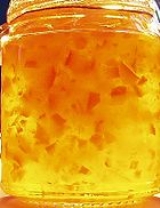
Marmalade

Encyclopedia
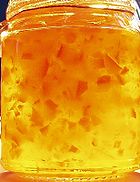
Fruit preserves
Fruit preserves are preparations of fruits and sugar, often canned or sealed for long-term storage. The preparation of fruit preserves today often involves adding commercial or natural pectin as a gelling agent, although sugar or honey may be used, as well. Prior to World War II, fruit preserve...
made from the juice and peel of citrus fruits
Citrus
Citrus is a common term and genus of flowering plants in the rue family, Rutaceae. Citrus is believed to have originated in the part of Southeast Asia bordered by Northeastern India, Myanmar and the Yunnan province of China...
, boiled with sugar
Sugar
Sugar is a class of edible crystalline carbohydrates, mainly sucrose, lactose, and fructose, characterized by a sweet flavor.Sucrose in its refined form primarily comes from sugar cane and sugar beet...
and water. The benchmark citrus fruit for marmalade production in Britain is the "Seville orange
Bitter orange
The name "bitter orange", also known as Seville orange, sour orange, bigarade orange, and marmalade orange, refers to a citrus tree and its fruit. Many varieties of bitter orange are used for their essential oil, which is used in perfume and as a flavoring...
" from Spain, Citrus aurantium var. aurantium, thus called because it was originally only grown in Seville
Seville
Seville is the artistic, historic, cultural, and financial capital of southern Spain. It is the capital of the autonomous community of Andalusia and of the province of Seville. It is situated on the plain of the River Guadalquivir, with an average elevation of above sea level...
in Spain
Spain
Spain , officially the Kingdom of Spain languages]] under the European Charter for Regional or Minority Languages. In each of these, Spain's official name is as follows:;;;;;;), is a country and member state of the European Union located in southwestern Europe on the Iberian Peninsula...
; it is higher in pectin
Pectin
Pectin is a structural heteropolysaccharide contained in the primary cell walls of terrestrial plants. It was first isolated and described in 1825 by Henri Braconnot...
than sweet oranges
Orange (fruit)
An orange—specifically, the sweet orange—is the citrus Citrus × sinensis and its fruit. It is the most commonly grown tree fruit in the world....
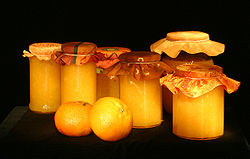
and therefore gives a good set. The peel has a distinctive bitter taste which it imparts to the marmalade. Marmalade can be made from lemons, limes, grapefruits, mandarins and sweet oranges or any combination thereof. For example, California-style marmalade is made from the peel of sweet oranges and consequently lacks the bitter taste of Seville orange marmalade.
In languages other than English, "marmalade" can mean preserves made with fruit other than citrus. For example, in Spanish the term usually refers to what in English is called jam (and "jalea" is similar to the English jelly). In Portuguese "marmelada" applies chiefly to quince jam (from "marmelo", the Portuguese for quince). In Italian
Italian language
Italian is a Romance language spoken mainly in Europe: Italy, Switzerland, San Marino, Vatican City, by minorities in Malta, Monaco, Croatia, Slovenia, France, Libya, Eritrea, and Somalia, and by immigrant communities in the Americas and Australia...
too, marmellata means every jam and marmalade, as it does Mermelada in Italian-influenced Rioplatense Spanish
Rioplatense Spanish
Rioplatense Spanish or River Plate Spanish is a dialectal variant of the Spanish language spoken mainly in the areas in and around the Río de la Plata basin of Argentina and Uruguay, and also in Rio Grande do Sul, although features of the dialect are shared with the varieties of Spanish spoken...
.
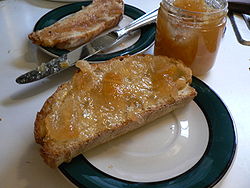
Marmalade recipes include sliced or chopped fruit peel simmered in sugar, fruit juice and water until soft. Marmalade is sometimes described as jam containing fruit peel but manufacturers also produce peel-free marmalade. Marmalade is often eaten on toast for breakfast.
Origins
Quince
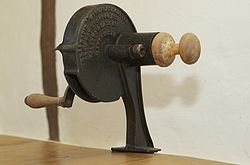
The quince , or Cydonia oblonga, is the sole member of the genus Cydonia and native to warm-temperate southwest Asia in the Caucasus region...
s slowly cooked with honey would "set" when cool (though they did not know about fruit pectin
Pectin
Pectin is a structural heteropolysaccharide contained in the primary cell walls of terrestrial plants. It was first isolated and described in 1825 by Henri Braconnot...
). Greek μελίμηλον (melimēlon, "honey fruit") transformed into "marmelo"—for in Greek μῆλον (mēlon, "apple") stands for all globular fruits, and most quinces are too astringent
Astringent
An astringent substance is a chemical compound that tends to shrink or constrict body tissues, usually locally after topical medicinal application. The word "astringent" derives from Latin adstringere, meaning "to bind fast"...
to be used without honey. A Roman cookbook attributed to Apicius
Apicius
Apicius is the title of a collection of Roman cookery recipes, usually thought to have been compiled in the late 4th or early 5th century AD and written in a language that is in many ways closer to Vulgar than to Classical Latin....
gives a recipe for preserving whole quinces, stems and leaves attached, in a bath of honey diluted with defrutum
Defrutum
Defrutum, carenum, and sapa were reductions of must used in Ancient Roman cuisine. They were made by boiling down grape juice or must in large kettles until it had been reduced to two-thirds the original volume, carenum;...
—Roman marmalade. Preserves of quince and lemon appear—along with rose, apple, plum and pear—in the Book of ceremonies of the Byzantine Emperor Constantine VII Porphyrogennetos
Constantine VII
Constantine VII Porphyrogennetos or Porphyrogenitus, "the Purple-born" was the fourth Emperor of the Macedonian dynasty of the Byzantine Empire, reigning from 913 to 959...
, "a book that is not only a treatise on the etiquette of imperial banquetting in the ninth century, but a catalogue of the foods available and dishes made from them."
Medieval quince preserves, which went by the French name cotignac, produced in a clear version and a fruit pulp version, began to lose their medieval seasoning of spices in the 16th century. In the 17th century, La Varenne
La Varenne
La Varenne may refer to:* La Varenne-Saint-Hilaire, a small town in the suburbs of Paris, part of the commune of Saint-Maur-des-Fossés, in France...
provided recipes for both thick and clear cotignac.
In 1524, Henry VIII received a "box of marmalade" from Mr. Hull of Exeter. As it was in a box, this was likely to have been marmelada, a quince paste from Portugal , still made and sold in southern Europe. Its Portuguese origins from marmalado can be detected in the remarks in letters to Lord Lisle, from William Grett, 12 May 1534, "I have sent to your lordship a box of marmaladoo, and another unto my good lady your wife" and from Richard Lee, 14 December 1536, "He most heartily thanketh her Ladyship for her marmalado".
The extension of "marmalade" in the English language to refer to citrus fruits was made in the 17th century, when citrus first began to be plentiful enough in England for the usage to become common.
In some continental Europe languages, Polish
Polish language
Polish is a language of the Lechitic subgroup of West Slavic languages, used throughout Poland and by Polish minorities in other countries...
for instance, a word sharing a root with "marmalade" refers to all gelled fruit conserves, and those derived from citrus fruits merit no special word of their own. Due to British influence, however, only citrus products may be sold as "marmalade" in the European Union
European Union
The European Union is an economic and political union of 27 independent member states which are located primarily in Europe. The EU traces its origins from the European Coal and Steel Community and the European Economic Community , formed by six countries in 1958...
(with certain exceptions), which has led to considerable complaints from those countries.
In Portugal, where the modern use of the word originated, "marmelada" refers only to a solid gel-like substance made of quinces. Any other use of the word is considered improper both linguistically and technically.
Etymology
Oxford English Dictionary
The Oxford English Dictionary , published by the Oxford University Press, is the self-styled premier dictionary of the English language. Two fully bound print editions of the OED have been published under its current name, in 1928 and 1989. The first edition was published in twelve volumes , and...
, "marmalade" appeared in English language in 1480, borrowed from French
French language
French is a Romance language spoken as a first language in France, the Romandy region in Switzerland, Wallonia and Brussels in Belgium, Monaco, the regions of Quebec and Acadia in Canada, and by various communities elsewhere. Second-language speakers of French are distributed throughout many parts...
marmelade which, in turn, came from the Portuguese
Portuguese language
Portuguese is a Romance language that arose in the medieval Kingdom of Galicia, nowadays Galicia and Northern Portugal. The southern part of the Kingdom of Galicia became independent as the County of Portugal in 1095...
marmelada. According to José Pedro Machado’s Dicionário Etimológico da Língua Portuguesa, the oldest known document where this Portuguese word is to be found is Gil Vicente
Gil Vicente
Gil Vicente , called the Trobadour, was a Portuguese playwright and poet who acted in and directed his own plays. Considered the chief dramatist of Portugal he is sometimes called the "Portuguese Plautus,"[3] often referred to as the "Father of Portuguese drama" and as one of Western literature's...
’s play Comédia de Rubena, written in 1521:
- Temos tanta marmelada
- Que minha mãe vai me dar um pouco
In Portuguese, according to the root of the word, which is marmelo, "quince
Quince
The quince , or Cydonia oblonga, is the sole member of the genus Cydonia and native to warm-temperate southwest Asia in the Caucasus region...
", marmelada is a preserve made from quinces, quince cheese
Quince cheese
Quince cheese is a sweet, thick, quince jelly or quince candy.The recipe is probably of ancient origin; the Roman cookbook of Apicius, a collection of Roman cookery recipes compiled in the late 4th or early 5th century AD, gives recipes for stewing quince with honey.Historically marmalade was made...
. Marmelo in turn derives from Latin
Latin
Latin is an Italic language originally spoken in Latium and Ancient Rome. It, along with most European languages, is a descendant of the ancient Proto-Indo-European language. Although it is considered a dead language, a number of scholars and members of the Christian clergy speak it fluently, and...
melimelum, “honey apple”, which in turn comes from the earlier Greek
Greek language
Greek is an independent branch of the Indo-European family of languages. Native to the southern Balkans, it has the longest documented history of any Indo-European language, spanning 34 centuries of written records. Its writing system has been the Greek alphabet for the majority of its history;...
μελίμηλον (melímēlon), from "μέλι" (meli), "honey" + "μήλον" (mēlon), "apple".
Dundee Marmalade
The ScottishScotland
Scotland is a country that is part of the United Kingdom. Occupying the northern third of the island of Great Britain, it shares a border with England to the south and is bounded by the North Sea to the east, the Atlantic Ocean to the north and west, and the North Channel and Irish Sea to the...
city of Dundee has a long association with marmalade. In 1797, James Keiller and his mother Janet ran a small sweet and preserves shop in the Seagate section of Dundee; they opened a factory to produce "Dundee Marmalade", a marmalade containing thick chunks of Seville orange rind, a business that eventually prospered. Keillers' well-known claim to have 'invented' orange marmalade in 1797 is debunked by such references as "My wife has made marmalade of oranges for you" in James Boswell's
James Boswell
James Boswell, 9th Laird of Auchinleck was a lawyer, diarist, and author born in Edinburgh, Scotland; he is best known for the biography he wrote of one of his contemporaries, the English literary figure Samuel Johnson....
letter to Dr. Johnson
Samuel Johnson
Samuel Johnson , often referred to as Dr. Johnson, was an English author who made lasting contributions to English literature as a poet, essayist, moralist, literary critic, biographer, editor and lexicographer...
of April 24, 1777.
Classical Meisterfloetist and American cryptology pioneer Lambros D. Callimahos
Lambros D. Callimahos
Lambros Demetrios Callimahos was a US Army cryptologist. Born in Alexandria of Greek parents, the family emigrated to the United States when he was four...
was a great lover of Dundee marmalade, establishing amongst his students an informal group he called the Dundee Society
Dundee Society
The Dundee Society was a society of graduates of CA-400, a National Security Agency course in cryptology devised by Lambros D. Callimahos, which included the Zendian Problem . The class was held once a year, and new members were inducted into the Society upon completion of the class...
.
External links
- Making the most of marmalade - History facts at BBC Cooking
- Marmalade? No ..it's orange jam - Sunday Mirror
- Marmalade - Simple recipe. - Evil Mad Scientist Laboratories.