

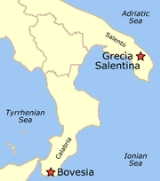
Greek-Calabrian dialect

Encyclopedia
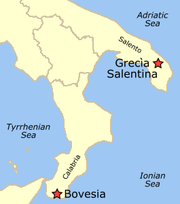
The Calabrian dialect of Greek
, or Greek-Bovesian, is the version of Italian Greek
used by the ethnic Griko people
in Calabria
, as opposed to the Italian Greek dialect spoken in the Grecìa Salentina
. Both are remnants of the ancient
and Byzantine
Greek colonisation of the region. They are frequently lumped together as Italiot Greek (Katoitaliótika) or Grecanic or Griko
, but have different developmental histories.
Calabrian Greek is mentioned in the Red Book of UNESCO
on endangered languages http://www.helsinki.fi/~tasalmin/europe_report.html#Italiot, together with the Grecanic; in addition, Euromosaic analyzes http://www.uoc.edu/euromosaic/web/document/grec/an/i1/i1.html and recognizes it as being an endangered and minority language in the European Union
. It is also mentioned by Ethnologue
as a dialect of Modern Greek
http://www.ethnologue.com/show_language.asp?code=ell, in the sense of a modern vernacular language of the Hellenic family (as is the case with Pontic and Tsakonian
Greek.
However, this form of Greek has never experienced an extensive growth period during its history, and it has only ever been used in basic day-to-day communications, without ever playing a significant role in the fields of administration, literature, or ecclesiastical matters.
until the 15th to 16th century, when it was gradually replaced by a Romance dialect (Calabrian), even though there are influences of Calabrian Greek on the grammar and in a large part of the latter's vocabulary. During the Angevin Age
the Greek dialect was widely spoken in a large area between Seminara
, Taurianova
, the Mésima's valley and the plateau of Poro
. A brief historical analysis illustrates quite readily the progressive disappearance of the Greek dialect in different Calabrian areas from the 16th century onwards.
Around the mid 16th century this dialect had disappeared from the fields of Petrace, particularly from the high valley of Diverso and Tasi
. During the following century the regression spread to some valleys in the western side of Aspromonte
near the Straits of Messina, such as the Catona and Gallico
Valleys. During the 19th century it was lost in some villages like Pentedattilo
, Africo
, Brancaleone, Motta San Giovanni
, Montebello
, and San Lorenzo, on the Ionic side of Aspromonte; and in the first years of the 20th century this spread to the towns of Palizzi
, Staiti
, Cardeto
, Roccaforte del Greco
, Amendolea and Condofuri
.
period in Italy, linguistic minorities were strongly discouraged from using their mother tongues and this inevitably affected the use of Calabrian Greek.
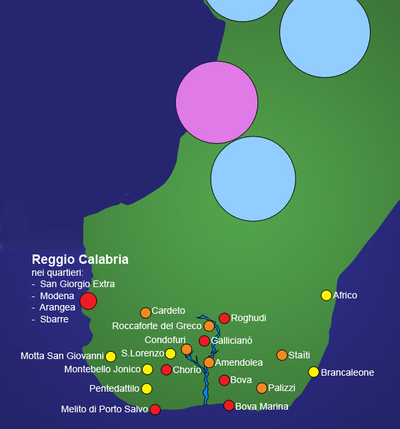
including Bova Superiore, Roghudi
, Gallicianò
, but also Chorìo di Roghudi, Bova Marina
, and in the city of Reggio di Calabria in the neighborhoods of San Giorgio Extra and Rione Modena.
Several hundred Griko people
continue to speak the Greek-Calabian dialect in the Arangea and Sbarre neighbourhoods of Reggio Calabria
and another small number in Melito di Porto Salvo
have been reported, mainly thanks to immigration from Roghudi and from Chorìo after the floods that occurred in 1971.
About 2,000 Griko people
speak and understand the language, and only about 50 of these are less than 35 years old, despite the efforts of cultural associations and administrative agencies.
In Bova many study Modern Greek rather than Calabrian Greek.
, while others assert that it comes directly from Ancient Greek and particularly from Doric Greek
spoken in Magna Grecia, with an independent evolution uninfluenced by Koine Greek
.
The evidence is based on archaicisms of this language with the presence of words derived from Doric Greek but actually disused in Greece (except in Tsakonian
. There are also quite a few distinctive characteristics in comparison with standard Modern Greek. For example, in many cases the final "-s" in most words has been lost (i.e. gaidaros (donkey) becomes gadaro in Calabrian Greek). Moreover, a future tense does not exist in this dialect, this grammatical requirement met by the use of the present tense.
An important peculiarity is that it uses the Latin alphabet
and not the Greek
.
In the late 1970s the association Jalò tu Vúa initiated a research group to set up methodological standards to teach Calabrian Greek and draft a grammar for the schools. The commune for Bova published it as pamphlet in 1979 with the title La Glossa di Bova (Bova's gloss).
and in the Renaissance
. Indeed the Hellenistics in this period frequently came from Calabria
maybe because of the Greek influence. The rediscovery of Ancient Greek was very difficult because this language had been almost forgotten. In this period the presence of Calabrian humanists or refugees from Constantinople was fundamental.
The study of Ancient Greek, in this period, was mainly a work of two monks of the monastery of Seminara
: Barlaam
, bishop of Gerace, and his disciple, Leonzio Pilato.
Leonzio Pilato, in particular, was ethnic Greek Calabrian born near Reggio Calabria
. He was an important teacher of Ancient Greek and translator, and he helped Giovanni Boccaccio
in the translations of Homer
's works.
An annual festival called "Palea riza" (that means "Ancient Root" in Calabrian Greek and standard Greek) of World and Calabrian Greek music is held in Bova and other picturesque towns of the area.
In 1970 this group established a cultural association named La Ionica and the pamphlet became a magazine which contained poetry and prose in both Italian and in Greek Calabrian. The same association established contacts with Greek speakers of Grecìa Salentina
aimed at creating the UGIM (Union of Greeks of South Italy) in order to jointly protect the region's bilingualism and to demand formal state recognition in such areas, such as bilingual road signs.
Following the example of La Ionica, other local associations were established, including Zoí ce glossa (Life and language) in Reggio Calabria, Cinurio Cosmó (New World) and Jalò tu Vúa in Bova Marina, CUMELCA in Gallicianò and Roghudi and Apodiafázi (Dawn) in Bova Superiore.
At the moment, there are no radio stations that broadcast in the Calabrian Greek dialect, mostly due to the crisis of the local private radio stations. In fact, between 1977 and 1984, coinciding with the boom in local stations, some stations used to air programs in this language. Among these were the Radio Antenna Don Bosco at Bova Marina, Radio San Paolo at Reggio di Calabria and RTM at Mélito di Porto Salvo.
This dialect has never been used on television.
, through the Associazione Internazionale degli Ellenofoni (SFEE) or the International Association of Greek speakers, has established relations with La Ionica and has officially invited Calabrian Greeks at the annual meetings they host in Greece
. Apart from this, La Ionica has not been well supported by government public institutions; in fact awareness of this problem has only really surfaced in the last few years.
The Calabria
n region has encouraged the education of the dialect in schools, along with what already happens regarding Albanian
, thus promoting bilingualism. In 1993 the region also created an Istituto Regionale Superiore di Studi Ellenofoni (Regional Institute of Advanced Greek Studies) based in Bova Marina.
Despite this initial activity, the program has not made many advances because of the lack of qualified teachers and the fact that bilingualism is not present in the administration. The improvements are very small and at the moment, for example, only the towns of Bova and Bova Marina have bilingual street signs.
The language was preserved whilst the population remained isolated in the mountains of the Aspromonte
. Following the migrations from these zones of the bulk of the population, the younger generations of today have only a very basic knowledge of the language and improved education standards encourage the use of other languages, such as Italian, even on a day to day basis.
Activity in the area of education, even if it is supported by local administration and legislation in promoting the presence of Greek in the classroom and in universities, is limited because lecturers and tutors with an adequate knowledge of Greek Calabrian are not available to offer courses. Initial activity has been limited to the initiatives of cultural groups at a local level, with the financial support of the odd local council.
The teaching of the language in schools has not followed a bilingual format, but rather, it has been offered more as an optional subject at primary school level, thanks to the financial support of the regional government and the European Community. In any case, student numbers have remained quite low.
The teaching of the language is completely absent at the secondary school level. Still, the cultural associations offer courses aimed at adults.
Therefore the biggest problem remains the limited knowledge of the language on the part of the teaching fraternity for whom bilingualism is not a mandatory element of their qualification. Some further education of such graduates is offered by the odd cultural association such as Jalò tu Vúa, but thanks only to the support of the European Community. This same association has even worked towards the creation of a Greek Calabrian grammar.
However, interest among the youth in learning standard Greek continues to grow.
Greek language
Greek is an independent branch of the Indo-European family of languages. Native to the southern Balkans, it has the longest documented history of any Indo-European language, spanning 34 centuries of written records. Its writing system has been the Greek alphabet for the majority of its history;...
, or Greek-Bovesian, is the version of Italian Greek
Griko language
Griko, sometimes spelled Grico, is a form of the Greek language which is spoken by the Griko people in southern Italy. The Greeks consider it as a Modern Greek dialect and often call it Katoitaliotika or Grekanika...
used by the ethnic Griko people
Griko people
The Griko people sometimes spelled Grico, Greco and Grecanici in Calabria are an ethnic Greek community of Southern Italy, they are found principally in regions of Calabria and Puglia ,...
in Calabria
Calabria
Calabria , in antiquity known as Bruttium, is a region in southern Italy, south of Naples, located at the "toe" of the Italian Peninsula. The capital city of Calabria is Catanzaro....
, as opposed to the Italian Greek dialect spoken in the Grecìa Salentina
Grecìa Salentina
Grecia Salentina is an area in the peninsula of Salento in southern Italy, near the town of Lecce which is inhabited by the Griko people, an ethnic Greek minority living in southern Italy who traditionally spoke a Greek Language dialect also called Griko. It consists of eleven towns and belongs to...
. Both are remnants of the ancient
Ancient Greece
Ancient Greece is a civilization belonging to a period of Greek history that lasted from the Archaic period of the 8th to 6th centuries BC to the end of antiquity. Immediately following this period was the beginning of the Early Middle Ages and the Byzantine era. Included in Ancient Greece is the...
and Byzantine
Byzantine Greeks
Byzantine Greeks or Byzantines is a conventional term used by modern historians to refer to the medieval Greek or Hellenised citizens of the Byzantine Empire, centered mainly in Constantinople, the southern Balkans, the Greek islands, Asia Minor , Cyprus and the large urban centres of the Near East...
Greek colonisation of the region. They are frequently lumped together as Italiot Greek (Katoitaliótika) or Grecanic or Griko
Griko language
Griko, sometimes spelled Grico, is a form of the Greek language which is spoken by the Griko people in southern Italy. The Greeks consider it as a Modern Greek dialect and often call it Katoitaliotika or Grekanika...
, but have different developmental histories.
Calabrian Greek is mentioned in the Red Book of UNESCO
UNESCO
The United Nations Educational, Scientific and Cultural Organization is a specialized agency of the United Nations...
on endangered languages http://www.helsinki.fi/~tasalmin/europe_report.html#Italiot, together with the Grecanic; in addition, Euromosaic analyzes http://www.uoc.edu/euromosaic/web/document/grec/an/i1/i1.html and recognizes it as being an endangered and minority language in the European Union
European Union
The European Union is an economic and political union of 27 independent member states which are located primarily in Europe. The EU traces its origins from the European Coal and Steel Community and the European Economic Community , formed by six countries in 1958...
. It is also mentioned by Ethnologue
Ethnologue
Ethnologue: Languages of the World is a web and print publication of SIL International , a Christian linguistic service organization, which studies lesser-known languages, to provide the speakers with Bibles in their native language and support their efforts in language development.The Ethnologue...
as a dialect of Modern Greek
Modern Greek
Modern Greek refers to the varieties of the Greek language spoken in the modern era. The beginning of the "modern" period of the language is often symbolically assigned to the fall of the Byzantine Empire in 1453, even though that date marks no clear linguistic boundary and many characteristic...
http://www.ethnologue.com/show_language.asp?code=ell, in the sense of a modern vernacular language of the Hellenic family (as is the case with Pontic and Tsakonian
Tsakonian language
Tsakonian, Tsaconian, Tzakonian or Tsakonic is a Hellenic language, spoken in the Tsakonian region of the Peloponnese, Greece....
Greek.
However, this form of Greek has never experienced an extensive growth period during its history, and it has only ever been used in basic day-to-day communications, without ever playing a significant role in the fields of administration, literature, or ecclesiastical matters.
Diffusion
Diffusion in the past
Calabrian Greek was spoken throughout the whole of south CalabriaCalabria
Calabria , in antiquity known as Bruttium, is a region in southern Italy, south of Naples, located at the "toe" of the Italian Peninsula. The capital city of Calabria is Catanzaro....
until the 15th to 16th century, when it was gradually replaced by a Romance dialect (Calabrian), even though there are influences of Calabrian Greek on the grammar and in a large part of the latter's vocabulary. During the Angevin Age
Capetian House of Anjou
The Capetian House of Anjou, also known as the House of Anjou-Sicily and House of Anjou-Naples, was a royal house and cadet branch of the direct House of Capet. Founded by Charles I of Sicily, a son of Louis VIII of France, the Capetian king first ruled the Kingdom of Sicily during the 13th century...
the Greek dialect was widely spoken in a large area between Seminara
Seminara
Seminara is a comune in the Province of Reggio Calabria in the Italian region Calabria, located about 90 km southwest of Catanzaro and about 30 km northeast of Reggio Calabria....
, Taurianova
Taurianova
Taurianova is a comune in the Province of Reggio Calabria in the Italian region Calabria, located about 80 km southwest of Catanzaro and about 40 km northeast of Reggio Calabria...
, the Mésima's valley and the plateau of Poro
Poro
The Poro, or Purrah or Purroh, is a secret society of Sierra Leone and Liberia.-Structure:Only males are admitted to its ranks, but two other affiliated and secret associations exist, the Yassi and the Bundu, the first of which is nominally reserved for females, but members of the Poro are admitted...
. A brief historical analysis illustrates quite readily the progressive disappearance of the Greek dialect in different Calabrian areas from the 16th century onwards.
Around the mid 16th century this dialect had disappeared from the fields of Petrace, particularly from the high valley of Diverso and Tasi
TASI
TASI can mean:* Technical Advisory Service for Images* Time-assignment speech interpolation* The Theoretical Advanced Study Institute in elementary particle physics at the University of Colorado at Boulder, best known for the TASI lectures in astrophysics and high energy physics* The Tadawul All...
. During the following century the regression spread to some valleys in the western side of Aspromonte
Aspromonte
Aspromonte is a mountain massif in the province of Reggio Calabria . The name means "rough mountains", so named by the farmers who found its steep terrain and rocky soil difficult to cultivate. It overlooks the Strait of Messina, being limited by the Ionian and Tyrrhenian Seas and by the Pietrace...
near the Straits of Messina, such as the Catona and Gallico
Gallico
Gallico is a surname, and may refer to:* Elisha Gallico , Palestinian Jewish Talmudist* Paul Gallico , American novelist...
Valleys. During the 19th century it was lost in some villages like Pentedattilo
Pentedattilo
Pentedattilo is a ghost town in Calabria, southern Italy, administratively a frazione of Melito di Porto Salvo. Until 1811, before the unification of Italy, it was a separate commune...
, Africo
Africo
Africo is a comune in the province of Reggio Calabria, in the Southern Italian region of Calabria at 74 km from Reggio Calabria.Africo consists of two main centers. The first, Africo Vecchio , is located some 15 km in the mainland at the feet of the Aspromonte. The old town was destroyed...
, Brancaleone, Motta San Giovanni
Motta San Giovanni
Motta San Giovanni is a comune in the Province of Reggio Calabria in the Italian region Calabria, located about 130 km southwest of Catanzaro and about 13 km southeast of Reggio Calabria....
, Montebello
Montebello
Montebello is the name of several places:* Montebello Islands, Australia* Montebello, Quebec, Canada* Montebello della Battaglia, Pavia, Italy* Montebello, Rimini, Province of Rimini, Italy * Montebello Vicentino, Vicenza, Italy...
, and San Lorenzo, on the Ionic side of Aspromonte; and in the first years of the 20th century this spread to the towns of Palizzi
Palizzi
Palizzi is a comune in the Province of Reggio Calabria in the Italian region Calabria, located about 120 km southwest of Catanzaro and about 30 km southeast of Reggio Calabria...
, Staiti
Staiti
Staiti is a comune in the Province of Reggio Calabria in the Italian region Calabria, located about 110 km southwest of Catanzaro and about 35 km southeast of Reggio Calabria. As of 31 December 2004, it had a population of 335 and an area of 15.9 km².Staiti borders the following...
, Cardeto
Cardeto
Cardeto is a comune in the Province of Reggio Calabria in the Italian region Calabria, located about 120 km southwest of Catanzaro and about 10 km southeast of Reggio Calabria...
, Roccaforte del Greco
Roccaforte del Greco
Roccaforte del Greco is a comune in the Province of Reggio Calabria in the Italian region Calabria, located about 110 km southwest of Catanzaro and about 20 km southeast of Reggio Calabria....
, Amendolea and Condofuri
Condofuri
Condofuri is a comune in the Province of Reggio Calabria in the Italian region Calabria, located about 120 km southwest of Catanzaro and about 38 km southeast of Reggio Calabria....
.
Repressive measures of Fascism
During the fascistFascism
Fascism is a radical authoritarian nationalist political ideology. Fascists seek to rejuvenate their nation based on commitment to the national community as an organic entity, in which individuals are bound together in national identity by suprapersonal connections of ancestry, culture, and blood...
period in Italy, linguistic minorities were strongly discouraged from using their mother tongues and this inevitably affected the use of Calabrian Greek.
Current diffusion
Today Calabrian Greek is spoken in nine towns of BovesìaBovesia
Bovesia, otherwise known as Grecìa Calabra , is one of the two remaining Griko-speaking areas in southern Italy, the other being Grecìa Salentina. It is located at the tip of Calabria, near Reggio, and consists of nine villages...
including Bova Superiore, Roghudi
Roghudi
Roghudi is a comune in the Province of Reggio Calabria in the Italian region Calabria, located about 130 km southwest of Catanzaro and about 20 km southeast of Reggio Calabria....
, Gallicianò
Gallicianò
Gallicianò is a village in Calabria, southern Italy, administratively a frazione of Condofuri. It has some 200 inhabitants, who are entirely Greek-Calabrian dialect speaking....
, but also Chorìo di Roghudi, Bova Marina
Bova Marina
Bova Marina is a comune in the Province of Reggio Calabria in the Italian region Calabria, located about 120 km southwest of Catanzaro and about 30 km southeast of Reggio Calabria...
, and in the city of Reggio di Calabria in the neighborhoods of San Giorgio Extra and Rione Modena.
Several hundred Griko people
Griko people
The Griko people sometimes spelled Grico, Greco and Grecanici in Calabria are an ethnic Greek community of Southern Italy, they are found principally in regions of Calabria and Puglia ,...
continue to speak the Greek-Calabian dialect in the Arangea and Sbarre neighbourhoods of Reggio Calabria
Reggio Calabria
Reggio di Calabria , commonly known as Reggio Calabria or Reggio, is the biggest city and the most populated comune of Calabria, southern Italy, and is the capital of the Province of Reggio Calabria and seat of the Council of Calabrian government.Reggio is located on the "toe" of the Italian...
and another small number in Melito di Porto Salvo
Melito di Porto Salvo
Melito di Porto Salvo is a comune in the Province of Reggio Calabria in the Italian region Calabria, located about 130 km southwest of Catanzaro and about 25 km southeast of Reggio Calabria; and is also the country's southernmost city...
have been reported, mainly thanks to immigration from Roghudi and from Chorìo after the floods that occurred in 1971.
About 2,000 Griko people
Griko people
The Griko people sometimes spelled Grico, Greco and Grecanici in Calabria are an ethnic Greek community of Southern Italy, they are found principally in regions of Calabria and Puglia ,...
speak and understand the language, and only about 50 of these are less than 35 years old, despite the efforts of cultural associations and administrative agencies.
In Bova many study Modern Greek rather than Calabrian Greek.
Characteristics
This language has a lot in common with standard Greek. When speaking of its origins, some philologists assert that it is a dialect derived from Medieval GreekMedieval Greek
Medieval Greek, also known as Byzantine Greek, is the stage of the Greek language between the beginning of the Middle Ages around 600 and the Ottoman conquest of the city of Constantinople in 1453. The latter date marked the end of the Middle Ages in Southeast Europe...
, while others assert that it comes directly from Ancient Greek and particularly from Doric Greek
Doric Greek
Doric or Dorian was a dialect of ancient Greek. Its variants were spoken in the southern and eastern Peloponnese, Crete, Rhodes, some islands in the southern Aegean Sea, some cities on the coasts of Asia Minor, Southern Italy, Sicily, Epirus and Macedon. Together with Northwest Greek, it forms the...
spoken in Magna Grecia, with an independent evolution uninfluenced by Koine Greek
Koine Greek
Koine Greek is the universal dialect of the Greek language spoken throughout post-Classical antiquity , developing from the Attic dialect, with admixture of elements especially from Ionic....
.
The evidence is based on archaicisms of this language with the presence of words derived from Doric Greek but actually disused in Greece (except in Tsakonian
Tsakonian language
Tsakonian, Tsaconian, Tzakonian or Tsakonic is a Hellenic language, spoken in the Tsakonian region of the Peloponnese, Greece....
. There are also quite a few distinctive characteristics in comparison with standard Modern Greek. For example, in many cases the final "-s" in most words has been lost (i.e. gaidaros (donkey) becomes gadaro in Calabrian Greek). Moreover, a future tense does not exist in this dialect, this grammatical requirement met by the use of the present tense.
An important peculiarity is that it uses the Latin alphabet
Latin alphabet
The Latin alphabet, also called the Roman alphabet, is the most recognized alphabet used in the world today. It evolved from a western variety of the Greek alphabet called the Cumaean alphabet, which was adopted and modified by the Etruscans who ruled early Rome...
and not the Greek
Greek alphabet
The Greek alphabet is the script that has been used to write the Greek language since at least 730 BC . The alphabet in its classical and modern form consists of 24 letters ordered in sequence from alpha to omega...
.
Literature
The literature is scarce and consists of books of poetry, local history or calendars, frequently in three languages (Italian, Calabrian Greek and Modern Greek). Unfortunately this dialect has suffered due to the lack of a linguistic authority and the absence of a body of literature, with the language predominantly used in rural or pastoral environments.In the late 1970s the association Jalò tu Vúa initiated a research group to set up methodological standards to teach Calabrian Greek and draft a grammar for the schools. The commune for Bova published it as pamphlet in 1979 with the title La Glossa di Bova (Bova's gloss).
The root of humanism
It is important to highlight the presence of Calabrians in HumanismHumanism
Humanism is an approach in study, philosophy, world view or practice that focuses on human values and concerns. In philosophy and social science, humanism is a perspective which affirms some notion of human nature, and is contrasted with anti-humanism....
and in the Renaissance
Renaissance
The Renaissance was a cultural movement that spanned roughly the 14th to the 17th century, beginning in Italy in the Late Middle Ages and later spreading to the rest of Europe. The term is also used more loosely to refer to the historical era, but since the changes of the Renaissance were not...
. Indeed the Hellenistics in this period frequently came from Calabria
Calabria
Calabria , in antiquity known as Bruttium, is a region in southern Italy, south of Naples, located at the "toe" of the Italian Peninsula. The capital city of Calabria is Catanzaro....
maybe because of the Greek influence. The rediscovery of Ancient Greek was very difficult because this language had been almost forgotten. In this period the presence of Calabrian humanists or refugees from Constantinople was fundamental.
The study of Ancient Greek, in this period, was mainly a work of two monks of the monastery of Seminara
Seminara
Seminara is a comune in the Province of Reggio Calabria in the Italian region Calabria, located about 90 km southwest of Catanzaro and about 30 km northeast of Reggio Calabria....
: Barlaam
Barlaam of Calabria
Barlaam of Seminara , ca. 1290-1348, or Barlaam of Calabria was a southern Italian scholar and clergyman of the 14th century. Humanist, philologist, and theologian. He brought an accusation of heresy against Gregory Palamas for the latter's defence of Hesychasm...
, bishop of Gerace, and his disciple, Leonzio Pilato.
Leonzio Pilato, in particular, was ethnic Greek Calabrian born near Reggio Calabria
Reggio Calabria
Reggio di Calabria , commonly known as Reggio Calabria or Reggio, is the biggest city and the most populated comune of Calabria, southern Italy, and is the capital of the Province of Reggio Calabria and seat of the Council of Calabrian government.Reggio is located on the "toe" of the Italian...
. He was an important teacher of Ancient Greek and translator, and he helped Giovanni Boccaccio
Giovanni Boccaccio
Giovanni Boccaccio was an Italian author and poet, a friend, student, and correspondent of Petrarch, an important Renaissance humanist and the author of a number of notable works including the Decameron, On Famous Women, and his poetry in the Italian vernacular...
in the translations of Homer
Homer
In the Western classical tradition Homer , is the author of the Iliad and the Odyssey, and is revered as the greatest ancient Greek epic poet. These epics lie at the beginning of the Western canon of literature, and have had an enormous influence on the history of literature.When he lived is...
's works.
Music
Calabrian Greek has never had a broad tradition in music; however, at present there are a number of local folk groups who sing in this dialect.An annual festival called "Palea riza" (that means "Ancient Root" in Calabrian Greek and standard Greek) of World and Calabrian Greek music is held in Bova and other picturesque towns of the area.
Cultural associations
Inspired by the efforts of Rohlfs, a group of university students looked to further increase the exposure of this dialect by publishing a pamphlet entitled La Ionica. This was the first organised activity aimed at protecting the language.In 1970 this group established a cultural association named La Ionica and the pamphlet became a magazine which contained poetry and prose in both Italian and in Greek Calabrian. The same association established contacts with Greek speakers of Grecìa Salentina
Grecìa Salentina
Grecia Salentina is an area in the peninsula of Salento in southern Italy, near the town of Lecce which is inhabited by the Griko people, an ethnic Greek minority living in southern Italy who traditionally spoke a Greek Language dialect also called Griko. It consists of eleven towns and belongs to...
aimed at creating the UGIM (Union of Greeks of South Italy) in order to jointly protect the region's bilingualism and to demand formal state recognition in such areas, such as bilingual road signs.
Following the example of La Ionica, other local associations were established, including Zoí ce glossa (Life and language) in Reggio Calabria, Cinurio Cosmó (New World) and Jalò tu Vúa in Bova Marina, CUMELCA in Gallicianò and Roghudi and Apodiafázi (Dawn) in Bova Superiore.
Mass media
There exist two periodicals in Calabrian Greek: I Riza which is trilingual (Italian, Calabrian Greek and modern Greek) and is published by the Jalò tu Vúa association, and CUMELCA. The former is a four-monthly publication while the latter is published every three months, however in reality it only appears on the shelves at irregular intervals. The region gives some financial aid to support these publications.At the moment, there are no radio stations that broadcast in the Calabrian Greek dialect, mostly due to the crisis of the local private radio stations. In fact, between 1977 and 1984, coinciding with the boom in local stations, some stations used to air programs in this language. Among these were the Radio Antenna Don Bosco at Bova Marina, Radio San Paolo at Reggio di Calabria and RTM at Mélito di Porto Salvo.
This dialect has never been used on television.
Education and awareness raising
The Greek government in AthensAthens
Athens , is the capital and largest city of Greece. Athens dominates the Attica region and is one of the world's oldest cities, as its recorded history spans around 3,400 years. Classical Athens was a powerful city-state...
, through the Associazione Internazionale degli Ellenofoni (SFEE) or the International Association of Greek speakers, has established relations with La Ionica and has officially invited Calabrian Greeks at the annual meetings they host in Greece
Greece
Greece , officially the Hellenic Republic , and historically Hellas or the Republic of Greece in English, is a country in southeastern Europe....
. Apart from this, La Ionica has not been well supported by government public institutions; in fact awareness of this problem has only really surfaced in the last few years.
The Calabria
Calabria
Calabria , in antiquity known as Bruttium, is a region in southern Italy, south of Naples, located at the "toe" of the Italian Peninsula. The capital city of Calabria is Catanzaro....
n region has encouraged the education of the dialect in schools, along with what already happens regarding Albanian
Albanian language
Albanian is an Indo-European language spoken by approximately 7.6 million people, primarily in Albania and Kosovo but also in other areas of the Balkans in which there is an Albanian population, including western Macedonia, southern Montenegro, southern Serbia and northwestern Greece...
, thus promoting bilingualism. In 1993 the region also created an Istituto Regionale Superiore di Studi Ellenofoni (Regional Institute of Advanced Greek Studies) based in Bova Marina.
Despite this initial activity, the program has not made many advances because of the lack of qualified teachers and the fact that bilingualism is not present in the administration. The improvements are very small and at the moment, for example, only the towns of Bova and Bova Marina have bilingual street signs.
Critical points
The gradual decline in the use of Greek Calabrian is mainly because the population views it as nothing more than a dialect–in other words, as a form of expression of the lower classes, typical of rural and/or illiterate peoples. The lack of linguistic registers (i.e. use in environments other than at a familiar level) is a further impediment to its survival.The language was preserved whilst the population remained isolated in the mountains of the Aspromonte
Aspromonte
Aspromonte is a mountain massif in the province of Reggio Calabria . The name means "rough mountains", so named by the farmers who found its steep terrain and rocky soil difficult to cultivate. It overlooks the Strait of Messina, being limited by the Ionian and Tyrrhenian Seas and by the Pietrace...
. Following the migrations from these zones of the bulk of the population, the younger generations of today have only a very basic knowledge of the language and improved education standards encourage the use of other languages, such as Italian, even on a day to day basis.
Activity in the area of education, even if it is supported by local administration and legislation in promoting the presence of Greek in the classroom and in universities, is limited because lecturers and tutors with an adequate knowledge of Greek Calabrian are not available to offer courses. Initial activity has been limited to the initiatives of cultural groups at a local level, with the financial support of the odd local council.
The teaching of the language in schools has not followed a bilingual format, but rather, it has been offered more as an optional subject at primary school level, thanks to the financial support of the regional government and the European Community. In any case, student numbers have remained quite low.
The teaching of the language is completely absent at the secondary school level. Still, the cultural associations offer courses aimed at adults.
Therefore the biggest problem remains the limited knowledge of the language on the part of the teaching fraternity for whom bilingualism is not a mandatory element of their qualification. Some further education of such graduates is offered by the odd cultural association such as Jalò tu Vúa, but thanks only to the support of the European Community. This same association has even worked towards the creation of a Greek Calabrian grammar.
However, interest among the youth in learning standard Greek continues to grow.