

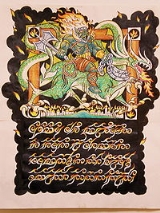
Balrog

Encyclopedia
Balrogs are fictional demon
ic beings who appear in J. R. R. Tolkien
's Middle-earth
legendarium
. Such creatures first appeared in print in his novel The Lord of the Rings
, though they figured in earlier writings that posthumously appeared in The Silmarillion
and other books.
Balrogs are described as tall and menacing with the ability to shroud themselves in fire, darkness, and shadow. They frequently appeared armed with fiery whips "of many thongs", and occasionally used long swords. In Tolkien's later conception, they could not be casually destroyed; significant power was required. Only dragons
rivalled their capacity for ferocity and destruction, and during the First Age
of Middle-earth, they were among the most feared of Morgoth
's forces.
Melkor
, who corrupted them to his service in the days of his splendour before the making of Arda
.
At the dawn of the First Age
, upon the waking of the Elves
, the Valar captured Melkor and destroyed his fortresses Utumno and Angband
. But they overlooked the deepest pits, where, with many of Melkor's other allies, the Balrogs fled into hiding. When Melkor returned to Middle-earth from Valinor
, now bearing the epithet Morgoth, he was attacked by Ungoliant
, a spider-like creature; and his piercing scream drew the Balrogs out of hiding to his rescue.
When the Noldor
arrived in Beleriand
in pursuit of Morgoth, they won a swift victory over his Orcs
in the Dagor-nuin-Giliath
. Fëanor
pressed on towards Angband; but the Balrogs came against him, and Fëanor was mortally wounded by Gothmog, Lord of Balrogs. Fëanor's sons fought off the Balrogs, but Fëanor died of his wounds shortly afterward.
In The Lays of Beleriand
, The Lay of Leithian mentions Balrog captains leading Orc
s: "the Orcs went forth to rape
and war, and Balrog captains marched before".
Tolkien tells of two Balrogs slain by Elves in the fall of Gondolin. During the assault on the city, Ecthelion of the Fountain
fought Gothmog, and "each slew the other." Glorfindel
fought a Balrog who waylaid an escape party from the fallen city; both fell from the mountainside in the struggle and perished.
In the War of Wrath
that ended the First Age, most of the Balrogs were destroyed, although at least one, the Balrog known as Durin's Bane, managed to escape and hide in "caverns at the roots of the earth".
In The Fellowship of the Ring
, the Fellowship of the Ring ventured through Moria and were attacked in the Chamber of Mazarbul by Orcs and the Balrog. Gandalf faced the Balrog at the Bridge of Khazad-dûm. He slew the Balrog but perished himself at the same time — to be sent back as the more powerful Gandalf the White.
while at the storming of Gondolin, Balrogs in the hundreds ride on the backs of the Dragons. They are roughly of twice human size, and were occasionally killed in battle by Elves and, at the Fall of Gondolin, five were slain by Tuor. They were fierce demons, associated with fire, armed with fiery whips of many thongs and claws like steel, and Morgoth delighted in using them to torture his captives. They were loyal to Morgoth, and once came out of hiding to save him from capture.
In the published version of The Lord of the Rings, however, Balrogs became altogether more sinister and more powerful. Christopher Tolkien
notes the difference, saying that in earlier versions they were "less terrible and certainly more destructible". He quotes a very late margin note that was not incorporated into the text saying "at most seven" ever existed; though in the Annals of Aman
, written as late as 1958, after the publication of The Lord of the Rings, Melkor still commands "a host of Balrogs". In later writings they ceased to be creatures, but are instead Maiar
, lesser Ainur
like Gandalf or Sauron, spirits of fire whom Melkor had corrupted before the creation of the World. They required power of the order of Gandalf's to destroy them, and as Maiar, only their physical forms could be destroyed.
Tolkien says of the Valar (including the Maiar) that they can change their shape at will, and move unclad in the raiment of the world, meaning invisible and without form. But it seems that Morgoth, Sauron
, and their associated Maiar could lose this ability: Morgoth, for example, was unable to heal his burns from the Silmaril
s or wounds from Fingolfin
and Thorondor; and Sauron lost his ability to assume a fair-seeming form after his physical body was destroyed in the downfall of Númenor
.
Tolkien does not address this specifically for Balrogs. In "the Bridge of Khazad-dûm" in The Fellowship of the Ring, the Balrog appears "like a great shadow, in the middle of which was a dark form, of man-shape maybe, yet greater". Though previously the Balrog had entered the "large square chamber" of Mazarbul, at the Bridge of Khazad-dûm it "drew itself to a great height, and its wings spread from wall to wall" in what was a vast hall.
The Balrog's size and shape, therefore, are not given precisely. When Gandalf threw it from the peak of Zirakzigil, the Balrog "broke the mountain-side where he smote it in his ruin".
Whether Balrogs have wings (and if so, whether they can fly) is unclear. This is due partly to Tolkien's changing conception of Balrogs, but mostly to his imprecise but suggestive and possibly figurative description of the Balrog that confronted Gandalf in Moria.
The two key quotations:
The argument hinges on whether the "wings" are physical wings or simply figurative wings of shadow. Many additional facts are adduced to the argument, but there is not enough firm description in Tolkien's writing to settle the argument definitively.
The Balrog of Moria used a flaming sword ("From out of the shadow a red sword leapt flaming") and the characteristic many-thonged whip of flame in its battle with Gandalf. In The Silmarillion
, they also used black axes and maces. Earlier writings also speak of steel claws and iron mail.
, one of the earliest texts Tolkien wrote (ca. 1918). An early list of names described Balrog as "an Orc-word with no pure Quenya
equivalent: 'borrowed Malaroko-' ".
In Gnomish Balrog is parsed as balc 'cruel' + graug 'demon', with a Quenya equivalent Malkarauke. Variant forms of the latter include Nalkarauke and Valkarauke.
By the 1940s, when Tolkien began writing The Lord of the Rings, he had come to think of Balrog as Noldorin balch 'cruel' + rhaug 'demon', with a Quenya equivalent Malarauko (from nwalya- 'to torture' + rauko 'demon'.
The last etymology, appearing in Quendi and Eldar, derives Balrog as the Sindarin translation of the Quenya form Valarauko (Demon of Might). This etymology was published in The Silmarillion.
The Sindarin plural for Balrog is not known. Tolkien consistently used Balrogs, but this is generally considered an anglicization because Sindarin does not form plurals that way. In one case Tolkien used Balrogath, similar to Periannath 'Halflings
' and Dagorath 'battles'. However, the -ath suffix was often used as a 'class plural' (cf. giliath 'all stars of the firmament'), and thus Balrogath might mean 'Balrogkind' rather than simply 'Balrogs'. Linguists disagree about how a simple Sindarin plural would be formed, but most often suggest either *Balroeg or *Belryg.
The plural of Quenya Valarauko is attested as Valaraukar.
Gandalf
on the bridge of Khazad-dûm calls the Balrog "flame of Udûn" (Udûn being the Sindarin name of Morgoth's fortress Utumno).
Gothmog is called a "son of Melko", though creatures that appear as offspring of the Valar in early recensions of the stories instead become Maiar in later versions.
 Gothmog appears in various versions of Silmarillion material. He is physically massive and strong, and in one version he is some 12 feet tall. He wields a black axe and whip of flame as his weapons.
He holds the titles of the Lord of the Balrogs (but see Lungorthin below), the High Captain of Angband
, and Marshal of the Hosts.
In the Second Battle, Dagor-nuin-Giliath
, he leads a force that ambushes Fëanor
and wounds him mortally. He leads Balrogs, Orc
-hosts, and Dragons as Morgoth's commander in the field in the Fifth Battle, Nírnaeth Arnoediad
, and slays Fingon
, High King of the Noldor
. In that same battle, he captures Húrin
of Dor-lómin, who had slain his personal guard of Battle-trolls
, and brings him to Angband. As Marshal of the Hosts he is in command of the Storming of Gondolin. He threatens to kill Tuor
when Ecthelion of the Fountain
, a Noldorin Elf-lord, intervenes. Gothmog fights Ecthelion in single combat, and they kill each other.
In The Book of Lost Tales
, Tolkien describes Kosomot, the original version of Gothmog, as a son of Morgoth and the ogress, Fluithuin or Ulbandi.
Gothmog is Sindarin and means 'Dread Oppressor'.
Kosomot is often considered Gothmog's Quenya name; however, in the Quenya name-list of The Fall of Gondolin another version appears, Kosomoko.
In The Lord of the Rings
, a different character bears the name "Gothmog"; see Gothmog (Third Age)
.
as "Lungorthin, Lord of Balrogs". This might be another name for Gothmog (above), though Christopher Tolkien thought it more likely that Lungorthin was simply "a Balrog lord".
This Balrog appears in The Lord of the Rings, encountered by the Fellowship of the Ring in the Mines of Moria
.
It survived the defeat of Morgoth in the War of Wrath
and escaped to hide beneath the Misty Mountains
. For more than five millennia, the Balrog remained in its deep hiding place at the roots of the mountains in Khazad-dûm
, until in the Third Age
the mithril
-miners of Dwarf
-King Durin VI disturbed it (or released it from its prison) in . Durin was killed by the Balrog, whence it was called Durin's Bane by the Dwarves.
The Dwarves attempted to fight the Balrog, but its power was far too great. Despite their efforts to hold Khazad-dûm against it, King Náin and many other Dwarves were killed and the survivors were forced to flee. This disaster also reached the Silvan Elves
of Lórien, many of whom also fled the "Nameless Terror" (it was not recognized as a Balrog at the time). The Elves
called the place Moria, the "Black Pit" or "Black Chasm" (though the name Moria also appears on the West Gate of Moria, constructed thousands of years earlier in the Second Age
).
For another 500 years, Moria was left to the Balrog; though according to Unfinished Tales
, Orcs crept in almost immediately after the Dwarves were driven out, leading to Nimrodel's flight. Around Sauron
began to put his plans for war into effect, and he sent Orcs
and Trolls
to the Misty Mountains to bar all of the passes: Some of these creatures came to Moria, and the Balrog allowed them to remain.
During the reign of Thráin II
, the Dwarves attempted to retake Moria in the War of the Dwarves and Orcs, culminating in the Battle of Azanulbizar before the eastern gate of Moria in . This was a victory for the Dwarves, but the presence of the Balrog prevented their occupying Moria. Dáin Ironfoot
, having slain the Orc Azog near the gate, perceived the terror of the Balrog within and warned Thráin that Moria was unachievable until some force could change the world and remove the Balrog. The Dwarves thus departed and resumed their exile.
Despite Dáin's warning, Balin
attempted to recolonize Moria in , but his party was destroyed. Dáin was killed in battle at the end of the War of the Ring
in , just as the change he spoke of was coming to pass.
In January , the Fellowship of the Ring travelled through Moria on the way to Mount Doom
. They were attacked in the Chamber of Mazarbul by Orcs. The Fellowship fled through a side door, but when the wizard Gandalf the Grey tried to place a "shutting spell" on the door to block the pursuit behind them, the Balrog entered the chamber on the other side and cast a counterspell. Gandalf spoke a word of Command to stay the door, but the door shattered and the chamber collapsed. Gandalf was severely weakened by this encounter. The company fled with him, but the Orcs and the Balrog, taking a different route, caught up with them at the bridge of Khazad-dûm. The Elf Legolas
instantly recognized the Balrog and Gandalf tried to hold the bridge against it. Since Gandalf and the Balrog were both Maiar
, they were beings of the same order. As they faced each other, Gandalf said, "You cannot pass!", and broke the Bridge beneath the Balrog. As it fell, the Balrog wrapped its whip about Gandalf's knees, dragging him to the brink. As the Fellowship looked on in horror, Gandalf cried "Fly, you fools!" and fell.
After the long fall, the two landed in a subterranean lake, which extinguished the flames of the Balrog's body; however it remained "a thing of slime, stronger than a strangling snake". They fought in the water, with the Balrog clutching at Gandalf to strangle him, and Gandalf hewing the Balrog with his sword, until finally the Balrog fled into ancient tunnels of unknown origin. Gandalf pursued the creature for eight days, until they climbed to the peak of Zirakzigil, where the Balrog was forced to turn and fight once again, its body erupting into new flame. Here they fought for two days and nights. In the end, the Balrog was defeated and cast down, breaking the mountainside where it fell "in ruin". Gandalf himself died following this ordeal, but he was later sent back to Middle-earth with even greater powers, as Gandalf the White, "until his task was finished". Tolkien does not reveal the ultimate fate of the Balrog.
's 1978 animated version resembled a winged lion complete with a mane, who walked upright, not much larger than man-sized but considerably heavier, and it did fly.
Peter Jackson
's film versions of The Fellowship of the Ring and The Two Towers, released in 2001 and 2002 respectively, ultimately decided on a very large, winged monster that resembled lava covered with a dark crust. During the fight with Gandalf, however, the Balrog could not (or at least did not) fly. Jackson's films used the design of Tolkien illustrator John Howe, which had previously appeared in licensed merchandise. Howe explained the presence of wings in the tie-in book The Art of the Fellowship of the Ring: "It doesn't say they don't have wings, so why not? That was Peter's tongue-in-cheek approach, too!" Concept art was drawn up for a "slime Balrog", but it was not used in the film for budgetary reasons.
Balrogs also appear in computer and video games based on The Lord of the Rings
.
In the real-time strategy
game The Lord of the Rings: The Battle for Middle-earth
, and its sequel
, both based on Jackson's movies, the Balrog can use its wings, although only in short leaps. In the role-playing game
The Lord of the Rings: The Third Age
, also based on the Jackson movies, the Balrog uses its wings to fly into the air, and comes crashing down, sending a tremendously damaging shockwave of flames at the player. In another game based on Jackson's movies, The Lord of the Rings: Conquest
, the Balrog is a playable hero.
Balrogs also appear in games unconnected to the New Line
franchise. The Minions of Sauron may summon Balrogs in the real-time strategy game The Lord of the Rings: War of the Ring
. Thaurlach is a Balrog invented for the massively multiplayer online role-playing game
The Lord of the Rings Online: Shadows of Angmar
. Due to Thaurlach's imprisonment over several thousands of years, and consequential weakness, it is no longer nearly as powerful as a regular Balrog, and players are capable of defeating it with the help of an ancient elf. Durin's Bane also makes an appearance in The Lord of the Rings Online: Mines of Moria
in a flashback mission, where it is shown to be far more powerful than any of the other enemies in the game and players have no choice but to flee from it.
Demon
call - 1347 531 7769 for more infoIn Ancient Near Eastern religions as well as in the Abrahamic traditions, including ancient and medieval Christian demonology, a demon is considered an "unclean spirit" which may cause demonic possession, to be addressed with an act of exorcism...
ic beings who appear in J. R. R. Tolkien
J. R. R. Tolkien
John Ronald Reuel Tolkien, CBE was an English writer, poet, philologist, and university professor, best known as the author of the classic high fantasy works The Hobbit, The Lord of the Rings, and The Silmarillion.Tolkien was Rawlinson and Bosworth Professor of Anglo-Saxon at Pembroke College,...
's Middle-earth
Middle-earth
Middle-earth is the fictional setting of the majority of author J. R. R. Tolkien's fantasy writings. The Hobbit and The Lord of the Rings take place entirely in Middle-earth, as does much of The Silmarillion and Unfinished Tales....
legendarium
Tolkien's legendarium
The phrase Tolkien's legendarium is used in the literary discipline of Tolkien studiesto refer to the part of J. R. R. Tolkien's high fantasy fiction being concerned with his Elven legends; that is, historic events that have become legendary from the perspective of the characters of The Lord of the...
. Such creatures first appeared in print in his novel The Lord of the Rings
The Lord of the Rings
The Lord of the Rings is a high fantasy epic written by English philologist and University of Oxford professor J. R. R. Tolkien. The story began as a sequel to Tolkien's earlier, less complex children's fantasy novel The Hobbit , but eventually developed into a much larger work. It was written in...
, though they figured in earlier writings that posthumously appeared in The Silmarillion
The Silmarillion
The Silmarillion is a collection of J. R. R. Tolkien's mythopoeic works, edited and published posthumously by his son Christopher Tolkien in 1977, with assistance from Guy Gavriel Kay, who later became a noted fantasy writer. The Silmarillion, along with J. R. R...
and other books.
Balrogs are described as tall and menacing with the ability to shroud themselves in fire, darkness, and shadow. They frequently appeared armed with fiery whips "of many thongs", and occasionally used long swords. In Tolkien's later conception, they could not be casually destroyed; significant power was required. Only dragons
Dragon (Middle-earth)
J. R. R. Tolkien's Middle-earth legendarium features dragons closely based on those of European legend.Besides dragon , Tolkien variously used the terms drake and worm .-History:The dragons were created by Morgoth...
rivalled their capacity for ferocity and destruction, and during the First Age
First Age
In the fiction of J. R. R. Tolkien, the First Age, or First Age of the Children of Ilúvatar is the heroic period in which most of Tolkien's early legends are set...
of Middle-earth, they were among the most feared of Morgoth
Morgoth
Morgoth Bauglir is a fictional character from J. R. R. Tolkien’s Middle-earth legendarium. He is the main antagonist of The Silmarillion, figures in The Children of Húrin, and is mentioned briefly in The Lord of the Rings.Melkor was the most powerful of the Ainur, but turned to darkness and became...
's forces.
History
According to The Silmarillion, the Valaraukar (which were called Balrogs in Middle-Earth) were a type of Maiar that were "scourges of fire". They were seduced by the evil ValaVala (Middle-earth)
The Valar are fictional characters in J. R. R. Tolkien's legendarium. They are first mentioned in The Lord of the Rings, but The Silmarillion develops them into the Powers of Arda or the Powers of the World...
Melkor
Morgoth
Morgoth Bauglir is a fictional character from J. R. R. Tolkien’s Middle-earth legendarium. He is the main antagonist of The Silmarillion, figures in The Children of Húrin, and is mentioned briefly in The Lord of the Rings.Melkor was the most powerful of the Ainur, but turned to darkness and became...
, who corrupted them to his service in the days of his splendour before the making of Arda
Arda
In J. R. R. Tolkien's legendarium, Arda is the name given to the Earth in a period of prehistory, wherein the places mentioned in The Lord of the Rings and related material once existed...
.
At the dawn of the First Age
First Age
In the fiction of J. R. R. Tolkien, the First Age, or First Age of the Children of Ilúvatar is the heroic period in which most of Tolkien's early legends are set...
, upon the waking of the Elves
Elf (Middle-earth)
In J. R. R. Tolkien's legendarium, Elves are one of the races that inhabit a fictional Earth, often called Middle-earth, and set in the remote past. They appear in The Hobbit and in The Lord of the Rings, but their complex history is described more fully in The Silmarillion...
, the Valar captured Melkor and destroyed his fortresses Utumno and Angband
Angband (Middle-earth)
-External links:*...
. But they overlooked the deepest pits, where, with many of Melkor's other allies, the Balrogs fled into hiding. When Melkor returned to Middle-earth from Valinor
Valinor
Valinor is a fictional location in J. R. R. Tolkien's legendarium, the realm of the Valar in Aman. It was also known as the Undying Lands, along with Tol Eressëa and the outliers of Aman. This is something of a misnomer; only immortal beings were allowed to reside there, but the land itself,...
, now bearing the epithet Morgoth, he was attacked by Ungoliant
Ungoliant
Ungoliant is a fictional character in J. R. R. Tolkien's Middle-earth legendarium, described as an evil spirit in the form of a spider. She is mentioned briefly in The Lord of the Rings, and plays a supporting role in The Silmarillion. Her origins are unclear, as Tolkien's writings don't explicitly...
, a spider-like creature; and his piercing scream drew the Balrogs out of hiding to his rescue.
When the Noldor
Noldor
In the works of J. R. R. Tolkien, the Noldor are Elves of the Second Clan who migrated to Valinor and lived in Eldamar. The Noldor are called Golodhrim or Gódhellim in Sindarin, and Goldoi by Teleri of Tol Eressëa. The singular form of the Quenya noun is Noldo and the adjective is Noldorin...
arrived in Beleriand
Beleriand
In J. R. R. Tolkien's fictional legendarium, Beleriand was a region in northwestern Middle-earth during the First Age. Events in Beleriand are described chiefly in his work The Silmarillion, which tells the story of the early ages of Middle-earth in a style similar to the epic hero tales of Nordic...
in pursuit of Morgoth, they won a swift victory over his Orcs
Orc (Middle-earth)
In J. R. R. Tolkien's fantasy writings, Orcs or Orks are a race of creatures who are used as soldiers and henchmen by both the greater and lesser villains of The Silmarillion and The Lord of the Rings — Morgoth, Sauron and Saruman...
in the Dagor-nuin-Giliath
Dagor-nuin-Giliath
In J. R. R. Tolkien's fictional Middle-earth, the Dagor-nuin-Giliath is the second battle of the Wars of Beleriand, but the first involving the Noldor....
. Fëanor
Fëanor
Fëanor is a fictional character from J. R. R. Tolkien's legendarium who plays an important part in The Silmarillion. He was the eldest son of Finwë, the High King of the Noldor, and his first wife Míriel Serindë...
pressed on towards Angband; but the Balrogs came against him, and Fëanor was mortally wounded by Gothmog, Lord of Balrogs. Fëanor's sons fought off the Balrogs, but Fëanor died of his wounds shortly afterward.
In The Lays of Beleriand
The Lays of Beleriand
The Lays of Beleriand, published in 1985, is the third volume of Christopher Tolkien's 12-volume book series, The History of Middle-earth, in which he analyzes the unpublished manuscripts of his father J. R. R...
, The Lay of Leithian mentions Balrog captains leading Orc
Orc
An orc is one of a race of mythical human-like creatures, generally described as fierce and combative, with grotesque features and often black, grey or greenish skin. This mythology has its origins in the writings of J. R. R. Tolkien....
s: "the Orcs went forth to rape
Rape
Rape is a type of sexual assault usually involving sexual intercourse, which is initiated by one or more persons against another person without that person's consent. The act may be carried out by physical force, coercion, abuse of authority or with a person who is incapable of valid consent. The...
and war, and Balrog captains marched before".
Tolkien tells of two Balrogs slain by Elves in the fall of Gondolin. During the assault on the city, Ecthelion of the Fountain
Ecthelion of the Fountain
Ecthelion of the Fountain is a fictional character from J. R. R. Tolkien's Middle-earth legendarium. He was a High Elf and one of the greatest warriors of the First Age....
fought Gothmog, and "each slew the other." Glorfindel
Glorfindel
In the fiction of J. R. R. Tolkien, Glorfindel is a name used twice for an Elf appearing in the tales of Middle-earth. He is introduced in various material relating to the First Age of Middle-earth, including The Silmarillion. The second instance is for a character of The Lord of the Rings, which...
fought a Balrog who waylaid an escape party from the fallen city; both fell from the mountainside in the struggle and perished.
In the War of Wrath
War of Wrath
The War of Wrath, or the Great Battle, is a key plot development in J.R.R. Tolkien's legendarium, portraying the final war against Morgoth at the end of the First Age....
that ended the First Age, most of the Balrogs were destroyed, although at least one, the Balrog known as Durin's Bane, managed to escape and hide in "caverns at the roots of the earth".
In The Fellowship of the Ring
The Fellowship of the Ring
The Fellowship of the Ring is the first of three volumes of the epic novel The Lord of the Rings by the English author J. R. R. Tolkien. It takes place in the fictional universe Middle-earth. It was originally published on July 29, 1954 in the United Kingdom...
, the Fellowship of the Ring ventured through Moria and were attacked in the Chamber of Mazarbul by Orcs and the Balrog. Gandalf faced the Balrog at the Bridge of Khazad-dûm. He slew the Balrog but perished himself at the same time — to be sent back as the more powerful Gandalf the White.
Characteristics
Tolkien's conception of Balrogs changed over time. In all his early writing, they are numerous. There is a host of them stated to number a thousand in Quenta SilmarillionQuenta Silmarillion
Quenta Silmarillion is a collection of fictional legends written by the high fantasy writer J. R. R. Tolkien. It was published after the author's death in The Silmarillion together with four shorter stories...
while at the storming of Gondolin, Balrogs in the hundreds ride on the backs of the Dragons. They are roughly of twice human size, and were occasionally killed in battle by Elves and, at the Fall of Gondolin, five were slain by Tuor. They were fierce demons, associated with fire, armed with fiery whips of many thongs and claws like steel, and Morgoth delighted in using them to torture his captives. They were loyal to Morgoth, and once came out of hiding to save him from capture.
In the published version of The Lord of the Rings, however, Balrogs became altogether more sinister and more powerful. Christopher Tolkien
Christopher Tolkien
Christopher Reuel Tolkien is the third and youngest son of the author J. R. R. Tolkien , and is best known as the editor of much of his father's posthumously published work. He drew the original maps for his father's The Lord of the Rings, which he signed C. J. R. T. The J...
notes the difference, saying that in earlier versions they were "less terrible and certainly more destructible". He quotes a very late margin note that was not incorporated into the text saying "at most seven" ever existed; though in the Annals of Aman
Annals of Aman
The Annals of Aman is a text written by J. R. R. Tolkien that serves as a chronology of fictional events taking place in his invented world of Middle-earth...
, written as late as 1958, after the publication of The Lord of the Rings, Melkor still commands "a host of Balrogs". In later writings they ceased to be creatures, but are instead Maiar
Maia (Middle-earth)
The Maiar are beings from J. R. R. Tolkien's high fantasy legendarium. They are lesser Ainur who entered Eä in the beginning of time. Tolkien uses the term Valar to refer both to all the Ainur who entered Eä, and specifically to the greatest among them, the fourteen Lords and Queens of the Valar...
, lesser Ainur
Ainur (Middle-earth)
The Ainur are the immortal Spirits existing before Creation in J. R. R. Tolkien's fictional universe. These were the first beings made of the thought of God or Eru Ilúvatar.- External Origin :...
like Gandalf or Sauron, spirits of fire whom Melkor had corrupted before the creation of the World. They required power of the order of Gandalf's to destroy them, and as Maiar, only their physical forms could be destroyed.
Tolkien says of the Valar (including the Maiar) that they can change their shape at will, and move unclad in the raiment of the world, meaning invisible and without form. But it seems that Morgoth, Sauron
Sauron
Sauron is the primary antagonist and titular character of the epic fantasy novel The Lord of the Rings by J. R. R. Tolkien.In the same work, he is revealed to be the same character as "the Necromancer" from Tolkien's earlier novel The Hobbit...
, and their associated Maiar could lose this ability: Morgoth, for example, was unable to heal his burns from the Silmaril
Silmaril
The Silmarils are three brilliant jewels which contained the unmarred light of the Two Trees in J. R. R. Tolkien's legendarium. The Silmarils were made out of the crystalline substance silima by Fëanor, a Noldorin Elf, in Valinor during the Years of the Trees...
s or wounds from Fingolfin
Fingolfin
Fingolfin is a fictional character in J. R. R. Tolkien's legendarium, appearing in The Silmarillion.-Internal history:He was a High King of the Noldor in Beleriand, second eldest son of Finwë, full brother of Finarfin, and half-brother of Fëanor, who was the eldest of Finwë's sons. His mother was...
and Thorondor; and Sauron lost his ability to assume a fair-seeming form after his physical body was destroyed in the downfall of Númenor
Númenor
Númenor is a fictional place in J. R. R. Tolkien's writings. It was a huge island located in the Sundering Seas to the west of Middle-earth, the main setting of Tolkien's writings, and was known to be the greatest realm of Men...
.
Tolkien does not address this specifically for Balrogs. In "the Bridge of Khazad-dûm" in The Fellowship of the Ring, the Balrog appears "like a great shadow, in the middle of which was a dark form, of man-shape maybe, yet greater". Though previously the Balrog had entered the "large square chamber" of Mazarbul, at the Bridge of Khazad-dûm it "drew itself to a great height, and its wings spread from wall to wall" in what was a vast hall.
The Balrog's size and shape, therefore, are not given precisely. When Gandalf threw it from the peak of Zirakzigil, the Balrog "broke the mountain-side where he smote it in his ruin".
Whether Balrogs have wings (and if so, whether they can fly) is unclear. This is due partly to Tolkien's changing conception of Balrogs, but mostly to his imprecise but suggestive and possibly figurative description of the Balrog that confronted Gandalf in Moria.
The two key quotations:
His enemy halted again, facing him, and the shadow about it reached out like two vast wings.
… suddenly it drew itself up to a great height, and its wings were spread from wall to wall …
The argument hinges on whether the "wings" are physical wings or simply figurative wings of shadow. Many additional facts are adduced to the argument, but there is not enough firm description in Tolkien's writing to settle the argument definitively.
The Balrog of Moria used a flaming sword ("From out of the shadow a red sword leapt flaming") and the characteristic many-thonged whip of flame in its battle with Gandalf. In The Silmarillion
The Silmarillion
The Silmarillion is a collection of J. R. R. Tolkien's mythopoeic works, edited and published posthumously by his son Christopher Tolkien in 1977, with assistance from Guy Gavriel Kay, who later became a noted fantasy writer. The Silmarillion, along with J. R. R...
, they also used black axes and maces. Earlier writings also speak of steel claws and iron mail.
Name
The name "Balrog," but not the meaning, emerges early in Tolkien's work: it appears in the Fall of GondolinFall of Gondolin
In the writings of J.R.R. Tolkien, the "Fall of Gondolin" is the name of one of the original Lost Tales which formed the basis for a section in his later work, The Silmarillion....
, one of the earliest texts Tolkien wrote (ca. 1918). An early list of names described Balrog as "an Orc-word with no pure Quenya
Quenya
Quenya is a fictional language devised by J. R. R. Tolkien, and used in his Secondary world, often called Middle-earth.Quenya is one of the many Elvish languages spoken by the immortal Elves, called Quendi in Quenya. The tongue actually called Quenya was in origin the speech of two clans of Elves...
equivalent: 'borrowed Malaroko-' ".
In Gnomish Balrog is parsed as balc 'cruel' + graug 'demon', with a Quenya equivalent Malkarauke. Variant forms of the latter include Nalkarauke and Valkarauke.
By the 1940s, when Tolkien began writing The Lord of the Rings, he had come to think of Balrog as Noldorin balch 'cruel' + rhaug 'demon', with a Quenya equivalent Malarauko (from nwalya- 'to torture' + rauko 'demon'.
The last etymology, appearing in Quendi and Eldar, derives Balrog as the Sindarin translation of the Quenya form Valarauko (Demon of Might). This etymology was published in The Silmarillion.
The Sindarin plural for Balrog is not known. Tolkien consistently used Balrogs, but this is generally considered an anglicization because Sindarin does not form plurals that way. In one case Tolkien used Balrogath, similar to Periannath 'Halflings
Hobbit
Hobbits are a fictional diminutive race who inhabit the lands of Middle-earth in J. R. R. Tolkien's fiction.Hobbits first appeared in the novel The Hobbit, in which the main protagonist, Bilbo Baggins, is the titular hobbit...
' and Dagorath 'battles'. However, the -ath suffix was often used as a 'class plural' (cf. giliath 'all stars of the firmament'), and thus Balrogath might mean 'Balrogkind' rather than simply 'Balrogs'. Linguists disagree about how a simple Sindarin plural would be formed, but most often suggest either *Balroeg or *Belryg.
The plural of Quenya Valarauko is attested as Valaraukar.
Gandalf
Gandalf
Gandalf is a character in J. R. R. Tolkien's novels The Hobbit and The Lord of the Rings. In these stories, Gandalf appears as a wizard, member and later the head of the order known as the Istari, as well as leader of the Fellowship of the Ring and the army of the West...
on the bridge of Khazad-dûm calls the Balrog "flame of Udûn" (Udûn being the Sindarin name of Morgoth's fortress Utumno).
Gothmog is called a "son of Melko", though creatures that appear as offspring of the Valar in early recensions of the stories instead become Maiar in later versions.
Gothmog
He holds the titles of the Lord of the Balrogs (but see Lungorthin below), the High Captain of Angband
Angband (Middle-earth)
-External links:*...
, and Marshal of the Hosts.
In the Second Battle, Dagor-nuin-Giliath
Dagor-nuin-Giliath
In J. R. R. Tolkien's fictional Middle-earth, the Dagor-nuin-Giliath is the second battle of the Wars of Beleriand, but the first involving the Noldor....
, he leads a force that ambushes Fëanor
Fëanor
Fëanor is a fictional character from J. R. R. Tolkien's legendarium who plays an important part in The Silmarillion. He was the eldest son of Finwë, the High King of the Noldor, and his first wife Míriel Serindë...
and wounds him mortally. He leads Balrogs, Orc
Orc (Middle-earth)
In J. R. R. Tolkien's fantasy writings, Orcs or Orks are a race of creatures who are used as soldiers and henchmen by both the greater and lesser villains of The Silmarillion and The Lord of the Rings — Morgoth, Sauron and Saruman...
-hosts, and Dragons as Morgoth's commander in the field in the Fifth Battle, Nírnaeth Arnoediad
Nirnaeth Arnoediad
In J. R. R. Tolkien's legendarium of Middle-earth, the Nírnaeth Arnoediad or Unnumbered Tears was the climactic Fifth Battle in the Wars of Beleriand.-The Fifth Battle as told in The Silmarillion:...
, and slays Fingon
Fingon
Fingon is a fictional character in J. R. R. Tolkien's Middle-earth legendarium. He is introduced in The Silmarillion.-Character overview:...
, High King of the Noldor
Noldor
In the works of J. R. R. Tolkien, the Noldor are Elves of the Second Clan who migrated to Valinor and lived in Eldamar. The Noldor are called Golodhrim or Gódhellim in Sindarin, and Goldoi by Teleri of Tol Eressëa. The singular form of the Quenya noun is Noldo and the adjective is Noldorin...
. In that same battle, he captures Húrin
Húrin
Húrin is a fictional character in the Middle-earth legendarium of J. R. R. Tolkien. He is introduced in The Silmarillion as a hero of Men during the First Age, said to be the greatest warrior of both the Edain and all the other Men in Middle-earth...
of Dor-lómin, who had slain his personal guard of Battle-trolls
Troll (Middle-earth)
In J. R. R. Tolkien's legendarium, Trolls are large humanoids of great strength and poor intellect.While in Norse mythology, the Troll was a magical creature with special skills, in Tolkien's writings they are portrayed as evil, stupid, with crude habits, although still intelligent enough to...
, and brings him to Angband. As Marshal of the Hosts he is in command of the Storming of Gondolin. He threatens to kill Tuor
Tuor
Tuor is a fictional character from J. R. R. Tolkien's Middle-earth legendarium. He is the grandfather of Elrond Half-elven and one of the most renowned ancestors of the Men of Númenor and of the King of the Reunited Kingdom Aragorn Elessar...
when Ecthelion of the Fountain
Ecthelion of the Fountain
Ecthelion of the Fountain is a fictional character from J. R. R. Tolkien's Middle-earth legendarium. He was a High Elf and one of the greatest warriors of the First Age....
, a Noldorin Elf-lord, intervenes. Gothmog fights Ecthelion in single combat, and they kill each other.
In The Book of Lost Tales
The Book of Lost Tales
The Book of Lost Tales is the title of a collection of early stories by J. R. R. Tolkien, and of the first two volumes of Christopher Tolkien's 12-volume series The History of Middle-earth, in which he presents and analyses the manuscripts of those stories, which were the earliest form of the...
, Tolkien describes Kosomot, the original version of Gothmog, as a son of Morgoth and the ogress, Fluithuin or Ulbandi.
Gothmog is Sindarin and means 'Dread Oppressor'.
Kosomot is often considered Gothmog's Quenya name; however, in the Quenya name-list of The Fall of Gondolin another version appears, Kosomoko.
In The Lord of the Rings
The Lord of the Rings
The Lord of the Rings is a high fantasy epic written by English philologist and University of Oxford professor J. R. R. Tolkien. The story began as a sequel to Tolkien's earlier, less complex children's fantasy novel The Hobbit , but eventually developed into a much larger work. It was written in...
, a different character bears the name "Gothmog"; see Gothmog (Third Age)
Gothmog (Third Age)
Gothmog is a fictional character from J. R. R. Tolkien's Middle-earth legendarium. He appears briefly in The Return of the King, the third volume of The Lord of the Rings as originally printed....
.
Lungorthin
Lungorthin appears in Tolkien's early Lay of the Children of HúrinThe Lays of Beleriand
The Lays of Beleriand, published in 1985, is the third volume of Christopher Tolkien's 12-volume book series, The History of Middle-earth, in which he analyzes the unpublished manuscripts of his father J. R. R...
as "Lungorthin, Lord of Balrogs". This might be another name for Gothmog (above), though Christopher Tolkien thought it more likely that Lungorthin was simply "a Balrog lord".
Balrog of Moria
This Balrog appears in The Lord of the Rings, encountered by the Fellowship of the Ring in the Mines of Moria
Moria (Middle-earth)
In the fiction of J. R. R. Tolkien, Moria was the name given by the Eldar to an enormous underground complex in north-western Middle-earth, comprising a vast network of tunnels, chambers, mines and huge halls or 'mansions', that ran under and ultimately through the Misty Mountains...
.
It survived the defeat of Morgoth in the War of Wrath
War of Wrath
The War of Wrath, or the Great Battle, is a key plot development in J.R.R. Tolkien's legendarium, portraying the final war against Morgoth at the end of the First Age....
and escaped to hide beneath the Misty Mountains
Misty Mountains
In J. R. R. Tolkien's fantasy world of Middle-earth, the Misty Mountains is a mountain range, running for 795 miles from north to south, between Eriador and the valley of the Great River, Anduin, and...
. For more than five millennia, the Balrog remained in its deep hiding place at the roots of the mountains in Khazad-dûm
Moria (Middle-earth)
In the fiction of J. R. R. Tolkien, Moria was the name given by the Eldar to an enormous underground complex in north-western Middle-earth, comprising a vast network of tunnels, chambers, mines and huge halls or 'mansions', that ran under and ultimately through the Misty Mountains...
, until in the Third Age
Third Age
The Third Age is a time period from J. R. R. Tolkien's Middle-earth fantasy writings. The history of Middle-earth is to be taken fictionally as a history of the real Earth....
the mithril
Mithril
Mithril is a fictional metal, originally used in J. R. R. Tolkien's Middle-earth fantasy writings. It is described as silvery and stronger than steel but much lighter in weight. The malleability, lack of tarnishing and use of the metal in jewellery suggest some similarity to the non-fictional metal...
-miners of Dwarf
Dwarf (Middle-earth)
In the fiction of J. R. R. Tolkien, the Dwarves are a race inhabiting the world of Arda, a fictional prehistoric Earth which includes the continent Middle-earth....
-King Durin VI disturbed it (or released it from its prison) in . Durin was killed by the Balrog, whence it was called Durin's Bane by the Dwarves.
The Dwarves attempted to fight the Balrog, but its power was far too great. Despite their efforts to hold Khazad-dûm against it, King Náin and many other Dwarves were killed and the survivors were forced to flee. This disaster also reached the Silvan Elves
Silvan Elves
Silvan Elves are an ethnic group of Elves in J. R. R. Tolkien's fictional universe of Middle-earth, mainly the Elves of Mirkwood and Lothlórien.In the First Age the Elves of Ossiriand, or Laiquendi, were also referred to as wood-elves....
of Lórien, many of whom also fled the "Nameless Terror" (it was not recognized as a Balrog at the time). The Elves
Elf (Middle-earth)
In J. R. R. Tolkien's legendarium, Elves are one of the races that inhabit a fictional Earth, often called Middle-earth, and set in the remote past. They appear in The Hobbit and in The Lord of the Rings, but their complex history is described more fully in The Silmarillion...
called the place Moria, the "Black Pit" or "Black Chasm" (though the name Moria also appears on the West Gate of Moria, constructed thousands of years earlier in the Second Age
Second Age
The Second Age is a time period from J. R. R. Tolkien's Middle-earth fantasy writings. Tolkien intended for the history of Middle-earth to be considered fictionally as a precursor to the history of the real Earth....
).
For another 500 years, Moria was left to the Balrog; though according to Unfinished Tales
Unfinished Tales
Unfinished Tales is a collection of stories and essays by J. R. R. Tolkien that were never completed during his lifetime, but were edited by his son Christopher Tolkien and published in 1980.Unlike The Silmarillion, for which the narrative fragments were modified to connect into a consistent and...
, Orcs crept in almost immediately after the Dwarves were driven out, leading to Nimrodel's flight. Around Sauron
Sauron
Sauron is the primary antagonist and titular character of the epic fantasy novel The Lord of the Rings by J. R. R. Tolkien.In the same work, he is revealed to be the same character as "the Necromancer" from Tolkien's earlier novel The Hobbit...
began to put his plans for war into effect, and he sent Orcs
Orc (Middle-earth)
In J. R. R. Tolkien's fantasy writings, Orcs or Orks are a race of creatures who are used as soldiers and henchmen by both the greater and lesser villains of The Silmarillion and The Lord of the Rings — Morgoth, Sauron and Saruman...
and Trolls
Troll (Middle-earth)
In J. R. R. Tolkien's legendarium, Trolls are large humanoids of great strength and poor intellect.While in Norse mythology, the Troll was a magical creature with special skills, in Tolkien's writings they are portrayed as evil, stupid, with crude habits, although still intelligent enough to...
to the Misty Mountains to bar all of the passes: Some of these creatures came to Moria, and the Balrog allowed them to remain.
During the reign of Thráin II
Thráin II
Thráin II is a fictional character in J. R. R. Tolkien's legendarium. He is first mentioned in The Hobbit, and more of his history is given in Unfinished Tales.A Dwarven king, Thráin is the son of Thrór and father of Thorin Oakenshield...
, the Dwarves attempted to retake Moria in the War of the Dwarves and Orcs, culminating in the Battle of Azanulbizar before the eastern gate of Moria in . This was a victory for the Dwarves, but the presence of the Balrog prevented their occupying Moria. Dáin Ironfoot
Dáin II Ironfoot
Dáin II Ironfoot was a Dwarf and king of Erebor in J. R. R. Tolkien's high fantasy legendarium concerning Middle-earth. His story is told primarily in Appendix A of The Lord of the Rings, and he appears briefly in The Hobbit....
, having slain the Orc Azog near the gate, perceived the terror of the Balrog within and warned Thráin that Moria was unachievable until some force could change the world and remove the Balrog. The Dwarves thus departed and resumed their exile.
Despite Dáin's warning, Balin
Balin (Middle-earth)
Balin is a fictional character in J. R. R. Tolkien's legendarium. He is an important supporting character in The Hobbit, and is mentioned in The Fellowship of the Ring.-In the books:...
attempted to recolonize Moria in , but his party was destroyed. Dáin was killed in battle at the end of the War of the Ring
War of the Ring
In the fictional high fantasy-world of J. R. R. Tolkien, the War of the Ring was fought between Sauron and the free peoples of Middle-earth for control of the One Ring and dominion over the continent. The War of the Ring took place at the end of the Third Age. Together with the Quest of Mount Doom,...
in , just as the change he spoke of was coming to pass.
In January , the Fellowship of the Ring travelled through Moria on the way to Mount Doom
Mount Doom
Mount Doom is a volcano in J. R. R. Tolkien's Middle-earth legendarium. It is located in the heart of the black land of Mordor and close to Barad-dûr, it is approximately high. Alternative names, in Tolkien's invented language of Sindarin, include Orodruin and Amon Amarth...
. They were attacked in the Chamber of Mazarbul by Orcs. The Fellowship fled through a side door, but when the wizard Gandalf the Grey tried to place a "shutting spell" on the door to block the pursuit behind them, the Balrog entered the chamber on the other side and cast a counterspell. Gandalf spoke a word of Command to stay the door, but the door shattered and the chamber collapsed. Gandalf was severely weakened by this encounter. The company fled with him, but the Orcs and the Balrog, taking a different route, caught up with them at the bridge of Khazad-dûm. The Elf Legolas
Legolas
Legolas is a fictional character in J. R. R. Tolkien's legendarium, featured in The Lord of the Rings. He is an Elf of the Woodland Realm and one of nine members of the Fellowship of the Ring.- Literature :...
instantly recognized the Balrog and Gandalf tried to hold the bridge against it. Since Gandalf and the Balrog were both Maiar
Maia (Middle-earth)
The Maiar are beings from J. R. R. Tolkien's high fantasy legendarium. They are lesser Ainur who entered Eä in the beginning of time. Tolkien uses the term Valar to refer both to all the Ainur who entered Eä, and specifically to the greatest among them, the fourteen Lords and Queens of the Valar...
, they were beings of the same order. As they faced each other, Gandalf said, "You cannot pass!", and broke the Bridge beneath the Balrog. As it fell, the Balrog wrapped its whip about Gandalf's knees, dragging him to the brink. As the Fellowship looked on in horror, Gandalf cried "Fly, you fools!" and fell.
After the long fall, the two landed in a subterranean lake, which extinguished the flames of the Balrog's body; however it remained "a thing of slime, stronger than a strangling snake". They fought in the water, with the Balrog clutching at Gandalf to strangle him, and Gandalf hewing the Balrog with his sword, until finally the Balrog fled into ancient tunnels of unknown origin. Gandalf pursued the creature for eight days, until they climbed to the peak of Zirakzigil, where the Balrog was forced to turn and fight once again, its body erupting into new flame. Here they fought for two days and nights. In the end, the Balrog was defeated and cast down, breaking the mountainside where it fell "in ruin". Gandalf himself died following this ordeal, but he was later sent back to Middle-earth with even greater powers, as Gandalf the White, "until his task was finished". Tolkien does not reveal the ultimate fate of the Balrog.
Adaptations
For movie adaptations of the book, the issues regarding Balrog wings and size needed to be resolved. The Balrog in Ralph BakshiRalph Bakshi
Ralph Bakshi is an Israeli-American director of animated and live-action films. In the 1970s, he established an alternative to mainstream animation through independent and adult-oriented productions. Between 1972 and 1992, he directed nine theatrically released feature films, five of which he wrote...
's 1978 animated version resembled a winged lion complete with a mane, who walked upright, not much larger than man-sized but considerably heavier, and it did fly.
Peter Jackson
Peter Jackson
Sir Peter Robert Jackson, KNZM is a New Zealand film director, producer, actor, and screenwriter, known for his The Lord of the Rings film trilogy , adapted from the novel by J. R. R...
's film versions of The Fellowship of the Ring and The Two Towers, released in 2001 and 2002 respectively, ultimately decided on a very large, winged monster that resembled lava covered with a dark crust. During the fight with Gandalf, however, the Balrog could not (or at least did not) fly. Jackson's films used the design of Tolkien illustrator John Howe, which had previously appeared in licensed merchandise. Howe explained the presence of wings in the tie-in book The Art of the Fellowship of the Ring: "It doesn't say they don't have wings, so why not? That was Peter's tongue-in-cheek approach, too!" Concept art was drawn up for a "slime Balrog", but it was not used in the film for budgetary reasons.
Balrogs also appear in computer and video games based on The Lord of the Rings
Middle-earth in video games
While an immense number of computer and video games owe a great deal to J. R. R. Tolkien's works and the many other high fantasy settings based upon his, relatively few games have been directly adapted from his world of Middle-earth...
.
In the real-time strategy
Real-time strategy
Real-time strategy is a sub-genre of strategy video game which does not progress incrementally in turns. Brett Sperry is credited with coining the term to market Dune II....
game The Lord of the Rings: The Battle for Middle-earth
The Lord of the Rings: The Battle for Middle-earth
The Lord of the Rings: The Battle for Middle-earth is a PC real-time strategy game developed by EA Los Angeles. It is based on Peter Jackson's The Lord of the Rings film trilogy, in turn based on J. R. R. Tolkien's original novel. The game uses short video clips from the movies and a number of the...
, and its sequel
The Lord of the Rings: The Battle for Middle-earth II
The Lord of the Rings: The Battle for Middle-earth II, abbreviated BFMEII, is a real-time strategy video game developed and published by Electronic Arts. It is based on the fantasy novels The Lord of the Rings and The Hobbit by J. R. R. Tolkien and its live-action film trilogy adaptation...
, both based on Jackson's movies, the Balrog can use its wings, although only in short leaps. In the role-playing game
Role-playing game
A role-playing game is a game in which players assume the roles of characters in a fictional setting. Players take responsibility for acting out these roles within a narrative, either through literal acting, or through a process of structured decision-making or character development...
The Lord of the Rings: The Third Age
The Lord of the Rings: The Third Age
The Lord of the Rings: The Third Age is a role-playing game by EA Games for all three of the late sixth-generation game consoles. The player controls a core group of characters that are used during the adventure, levelling up according to experience gained from battles and quests.-Plot:The plot of...
, also based on the Jackson movies, the Balrog uses its wings to fly into the air, and comes crashing down, sending a tremendously damaging shockwave of flames at the player. In another game based on Jackson's movies, The Lord of the Rings: Conquest
The Lord of the Rings: Conquest
The Lord of the Rings: Conquest is an action game developed by Pandemic Studios and published by Electronic Arts. It is based on The Lord of the Rings film trilogy, and borrows many gameplay mechanics from Pandemic's Star Wars: Battlefront games...
, the Balrog is a playable hero.
Balrogs also appear in games unconnected to the New Line
New Line Cinema
New Line Cinema, often simply referred to as New Line, is an American film studio. It was founded in 1967 by Robert Shaye and Michael Lynne as a film distributor, later becoming an independent film studio. It became a subsidiary of Time Warner in 1996 and was merged with larger sister studio Warner...
franchise. The Minions of Sauron may summon Balrogs in the real-time strategy game The Lord of the Rings: War of the Ring
The Lord of the Rings: War of the Ring
The Lord of the Rings: War of the Ring is a 2003 real-time strategy game developed by Liquid Entertainment, the makers of the previous Battle Realms and its expansion, Winter of the Wolf, and published by Sierra Entertainment. Set in J. R. R...
. Thaurlach is a Balrog invented for the massively multiplayer online role-playing game
Massively multiplayer online role-playing game
Massively multiplayer online role-playing game is a genre of role-playing video games in which a very large number of players interact with one another within a virtual game world....
The Lord of the Rings Online: Shadows of Angmar
The Lord of the Rings Online: Shadows of Angmar
The Lord of the Rings Online: Shadows of Angmar is a massively multiplayer online role-playing game for Microsoft Windows set in a fantasy universe based upon J. R. R. Tolkien's Middle-earth writings...
. Due to Thaurlach's imprisonment over several thousands of years, and consequential weakness, it is no longer nearly as powerful as a regular Balrog, and players are capable of defeating it with the help of an ancient elf. Durin's Bane also makes an appearance in The Lord of the Rings Online: Mines of Moria
The Lord of the Rings Online: Mines of Moria
The Lord of the Rings Online: Mines of Moria is the first retail expansion pack for the MMORPG The Lord of the Rings Online: Shadows of Angmar released on November 18, 2008. It was announced on March 14, 2008 at ....
in a flashback mission, where it is shown to be far more powerful than any of the other enemies in the game and players have no choice but to flee from it.