


Minas Tirith

Encyclopedia
Minas Tirith originally named Minas Anor, is a fictional city and castle in J. R. R. Tolkien
's Middle-earth
writings. It became the heavily fortified capital
of Gondor
in the second half of the Third Age
. It was originally built to guard the former capital, Osgiliath, from attack from the west, but became the capital when Osgiliath fell into ruin following the Kin-strife and the Great Plague. It is often referred to as the White City (though that name is not in the book triology) and the City of the Kings. The Rohirrim sometimes translated this into their own language
as "the Mundburg". In the climax of The Lord of the Rings
the city comes under a very large and determined attack by the allied forces of Mordor
.
The name Minas Tirith means "The Tower of Guard" or "The Tower of Watch" in the Elvish
language Sindarin
. It was originally named Minas Anor, "The Tower of the Sun", in connection with Minas Ithil, "The Tower of the Moon". Minas Ithil was later conquered by orcs
from Mordor
and was renamed Minas Morgul, "The Tower of Black Sorcery".
Minas Tirith was built on a hill with seven concentric tiers culminating in the Citadel at the summit. Each of the seven levels stood 100 ft (30 m) higher than the one below it, each surrounded by a white wall, with the exception of the wall of the First Circle, which was black. The outer face of this outer wall, the lowest, was made of black stone, the same material used in Orthanc; it was vulnerable only to earthquakes capable of rending the ground where it stood.
Each wall held a gate, and each gate faced a different direction.
.
In front of the Great Gate there was a large paved area called the Gateway. The roads to Minas Tirith met here, including the North-way that joined the Great West Road to Rohan
, the South Road to the southern provinces of Gondor, and the road to Osgiliath.
The gates were built with siege in mind: constructed of iron, they were extremely difficult to break into. The Great Gate was made of iron and steel guarded by stone towers and bastions. The iron doors of the Gate rolled back to open. Passwords were required to enter the Great Gate and each of the six other gates of Minas Tirith. This gate had been assaulted and felled only once.
The Great Gate was destroyed during the War of the Ring. Sauron
's forces under the command of the Witch-king of Angmar
besieged the City on March 13. Before dawn on March 15, the battering ram Grond smashed the Great Gate three times while the Witch-king spoke words of power. "As if stricken by some blasting spell it burst asunder: there was a flash of searing lightning, and the doors tumbled in riven fragments to the ground." The Witch-king rode through the Gate where Gandalf
awaited him, but then the Rohirrim arrived and the Witch-king went to fight them in the Battle of the Pelennor Fields
where he was defeated.
A temporary barricade was erected in place of the Great Gate. After the war on May 1, Aragorn
received the Crown of Gondor in front of the gate and then entered the City.
The Great Gate was rebuilt of mithril
(the hardest of all metals in Tolkien's writing) and steel by Gimli
and Dwarves of Erebor from the Lonely Mountain
who had settled in the Glittering Caves.
between the city and Mindolluin was Rath Dínen (The Silent Street), where the tombs of the Kings of Gondor
and their Stewards
were built. It was reached by a door in the Sixth Level, which was almost always closed and hence called the "Closed Door". The Sixth Level also contained stables for riders, and the famed Houses of Healing.
The Seventh Gate led to the Citadel. It faced eastward in line with the Great Gate, which was 700 ft (213 m) below. The Seventh Gate could be reached through a sloping tunnel delved into the spur of rock that jutted out of the eastern face of the Hill of Guard. The keystone of the tunnel's archway was carved with the head of a crowned King. Guards of the Citadel manned the Seventh Gate.
. It is pronounced with the emphasis on the penultimate syllable ("pe LEN nor").
After Minas Ithil had fallen and been renamed Minas Morgul
, the Pelennor Fields were surrounded by the great wall of Rammas Echor, to prevent an invasion. This wall was in ruins shortly before the War of the Ring
, but was rebuilt in time on the orders of the Steward, Denethor II. The gate and accompanying watch-towers of Rammas Echor were known as the Causeway Forts and were the strongest section of the entire wall. In total the wall consisted of three main gates; north, east and south.
During the War of the Ring
, the Pelennor Fields were the location of the largest battle of the Third Age
, the Battle of the Pelennor Fields
, when Sauron
's Orc
s and evil Men
overran the Rammas Echor by blasting through it and besieged the city. The siege was broken by the arrival of the Rohirrim though their King Théoden
was slain in the battle. After the War of the Ring
, the Rammas Echor was rebuilt by the Dwarves
of Aglarond, led by Gimli
the Dwarf.
rested in a secret chamber at the top of the Tower. In a court before the Tower grew the White Tree, the symbol of Gondor. The topmost level also contained lodgings for the Steward of Gondor, the King's House, Merethrond the Hall of Feasts, barracks for the Guard of the Citadel, and other buildings for guests and other workers.
The first level included an inn, the Old Guesthouse. The wide paved street it was on was called Lampwrights' Street (Rath Celerdain), which led to the gate.
Map #40 in Barbara Strachey's Journeys of Frodo
is a plan of Minas Tirith. Pages 138&139 in Karen Wynn Fonstad
's revised The Atlas of Middle-earth
show a different plan of Minas Tirith. They are at variance with each other, as the only authoritative maps by Tolkien are just sketches.
In the book The Return of the King
, the Guard of the Citadel
, of whom Beregond was a member originally, was assigned to the highest circle of Minas Tirith and protected the hall of the king and the houses of the dead. Peregrin Took
was eventually assigned to serve with the Guard.
, younger brother of Isildur
and second son of Elendil
, High King of Arnor
. Ostoher rebuilt the city in as a summer residence, and it became the capital of Gondor in , when King Tarondor moved the King's House from Osgiliath following the Great Plague, which devastated the population of the much larger and populous old capital.
In T.A. 2002, the White City's companion city, Minas Ithil
, Tower of the Moon (Moontower), on the borders of Mordor
, was captured by the Nazgûl
and renamed Minas Morgul, Tower of Black Sorcery (Dead City, accursed tower). Minas Anor was renamed Minas Tirith, meaning "Tower of Guard", to indicate that since the fall of Minas Ithil, Minas Tirith assumed the role of guarding Gondor against Mordor's forces. For the next thousand years, the two cities were in a stalemate, with neither able to topple the other. With the rebuilding of the Dark Tower and the open return of Sauron, the forces of Mordor gathered their strength to topple Minas Tirith in the upcoming War of the Ring
.
and garrisoned, though Osgiliath itself remained in ruins. This outwall was built by Ecthelion II but fell into disrepair after his death, only to be repaired in the year leading up to the War.
As told in The Return of the King
, the Rammas proved an ineffective defence due to the overwhelming Orc
legions of Mordor, who penetrated the wall and laid siege to the city before the Battle of the Pelennor Fields
. However this proved to the detriment of these legions when the forces of Rohan arrived; for, as noted by King Théoden, they could have held the Rammas against Rohan's attack.
of Dol Amroth
and Gandalf
saved him and the counter-attack allowed the rest of Gondor's soldiers to reach the safety of the city.
Minas Tirith was besieged by troops of Mordor, the Easterlings
and the Haradrim, and the land fell under the darkness generated by Mordor. Significant damage was done to the first circle of the city but the Enemy was unable to break through the wall — except in one place. The gate of the city was broken by a combination of the battering ram Grond and the Witch-king
's sorcery. However, the Witch-king was halted at the entrance by Gandalf.
During the siege the House of the Stewards in Rath Dìnen was destroyed by a fire lit by the Steward Denethor in suicidal despair at the illness of his son Faramir.
The timely arrival of the Rohirrim led by King Théoden forced the armies of Mordor to face the newcomers instead of assaulting the city. The resulting Battle of the Pelennor Fields
took place on March 15, 3019 in the fields surrounding the city. Despite heavy losses, Minas Tirith itself was not seriously threatened again and the battle was won by Gondor and its allies from Rohan
and Gondor's fiefs.
's coronation took place on the plain outside Minas Tirith, he then entered the city as King.
Minas Tirith is known to have stood firm well into the Fourth Age
. Gimli the Dwarf
and some of Durin's folk
used mithril
, a nigh-indestructible metal, to replace the gates that had been broken in the War of the Ring
. The Dwarves also improved the layout of the city's streets. The elves planted trees in the city.
"In his time the City was made more fair than it had ever been, even in the days of its first glory; and it was filled with trees and with fountains, and its gates were wrought of mithril and steel, and its streets were paved with white marble; and the Folk of the Mountain laboured in it, and the Folk of the Wood rejoiced to come there; and all was healed and made good, and the houses were filled with men and women and the laughter of children, and no window was blind nor any courtyard empty; and after the ending of the Third Age of the world into the new age it preserved the memory and the glory of the years that were gone". Source: (The Return of the King: "The Steward and the King," p. 246)
It remained the chief city of Gondor, as it is not actually known whether Osgiliath was ever rebuilt. Minas Ithil, however, was destroyed by Elessar, King of Gondor, soon after the War of the Ring
.
The eagle
who brings the news of Sauron
's defeat to Minas Tirith refers to the city as the Tower of Anor. The eagle might have been speaking poetically, but as Of the Rings of Power and the Third Age
in The Silmarillion
says, the city is referred to Minas Anor again after Sauron's overthrow.
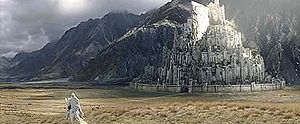 Tolkien's description of the physical layout of the city of Minas Tirith itself is followed relatively faithfully in Peter Jackson
's film The Lord of the Rings: The Return of the King
, (the city also has a cameo in The Lord of the Rings: The Fellowship of the Ring, when Gandalf goes there to discern the identity of Bilbo
's ring, and it also can be seen in the distance for a few seconds when Faramir
takes Frodo
, Sam
, and Gollum
to Osgiliath in The Lord of the Rings: The Two Towers) Jackson interpreting the top of the rock as flattened and paved. In the films Minas Tirith is the location for the coronation of Aragorn
. However, as with most other landmarks in the film, the city is portrayed as relatively isolated, while the Rammas, the Pelennor, the River Anduin and Gondor's abundant populace are virtually not featured.
Portions of Minas Tirith were constructed as full-scale sets, and the whole city as a very large, highly detailed miniature or "bigature" by Weta Workshop
. A remarkably detailed three-dimensional digital model, for CGI
shots, along with the whole of its surrounding environment including the Pelennor Fields and Mindolluin (but not the Rammas Echor, which was visually omitted from the films, despite being mentioned in the dialogue, where Théoden
gave the order to the Rohirrim beginning "After you pass the Wall..." quoted directly from the book.) was created by Weta Digital
. The set was built on the foundations of the disassembled Helm's Deep set.
According to the non-canon New Line book The Lord of the Rings: Weapons and Warfare, in the films, the height of Minas Tirith from the bottom to the top of the Tower of Ecthelion, which individually is said to be 300 ft (91 m) tall is around 1000 ft (305 m), same as the Eiffel Tower
, and the diameter of the city almost three-quarters of a mile (3960 ft (1,207 m)). The book also suggests that the towering bastion of stone, shaped like the keel of a ship, which rose from behind the Great Gates on the first level to the citadel on the seventh, was seven hundred feet tall. However this height does not take into account the Tower of Ecthelion, which was situated on the seventh level. In the book, the Tower of Ecthelion was said to be fifty fathoms tall (Vi) meaning that in total the city is about 1000 feet tall. This height is further supported by the statement "[above the citadel] the banner of the Stewards floated a thousand feet above the plain" (Vi).
In The Atlas of Middle-earth
, predating the New Line films by over a decade, Karen Wynn Fonstad
estimates the diameter of the city to be much smaller - estimating 3100 ft (945 m) for the First Circle of the City.
In the novel, the walls of Minas Tirith are virtually indestructible like the similar black surface of Orthanc, as they were built by the Dúnedain
before their craft waned in exile, and Tolkien says only an earthquake or similar seismic convulsion could cause them significant damage.
Despite the description of Minas Tirith's outermost wall as a black, indestructible wall, Jackson depicted all of the walls as white, and many of them were easily destroyed.
In the films, the towers of Minas Tirith are equipped with trebuchet
s. However, this kind of siege engine is not specifically mentioned in the book. The book also mentions that the engines in the city had insufficient range to hinder the assembling of the enemy's catapults, while in the movie at least one catapult was destroyed by a direct hit. It is possible, however, that after assembly the catapults were moved forward, thus bringing them in range of the walls' defences.
According to the "Making Of" featurettes on the Extended Edition DVDs, the appearance and structure of the city was based upon Mont Saint-Michel
, France.
referred to the city in his review of The Lord of the Rings: The Return of the King
as a "spectacular achievement", and showcased the filmmakers ability to blend digital and real sets into one piece, and comparing it to the Emerald City
from The Wizard of Oz
. In Lord of the Rings: Conquest video game, players in the evil campaign can destroy the city.
J. R. R. Tolkien
John Ronald Reuel Tolkien, CBE was an English writer, poet, philologist, and university professor, best known as the author of the classic high fantasy works The Hobbit, The Lord of the Rings, and The Silmarillion.Tolkien was Rawlinson and Bosworth Professor of Anglo-Saxon at Pembroke College,...
's Middle-earth
Middle-earth
Middle-earth is the fictional setting of the majority of author J. R. R. Tolkien's fantasy writings. The Hobbit and The Lord of the Rings take place entirely in Middle-earth, as does much of The Silmarillion and Unfinished Tales....
writings. It became the heavily fortified capital
Capital City
Capital City was a television show produced by Euston Films which focused on the lives of investment bankers in London living and working on the corporate trading floor for the fictional international bank Shane-Longman....
of Gondor
Gondor
Gondor is a fictional kingdom in J. R. R. Tolkien's writings, described as the greatest realm of Men in the west of Middle-earth by the end of the Third Age. The third volume of The Lord of the Rings, The Return of the King, is concerned with the events in Gondor during the War of the Ring and with...
in the second half of the Third Age
Third Age
The Third Age is a time period from J. R. R. Tolkien's Middle-earth fantasy writings. The history of Middle-earth is to be taken fictionally as a history of the real Earth....
. It was originally built to guard the former capital, Osgiliath, from attack from the west, but became the capital when Osgiliath fell into ruin following the Kin-strife and the Great Plague. It is often referred to as the White City (though that name is not in the book triology) and the City of the Kings. The Rohirrim sometimes translated this into their own language
Rohirric
In the fictional world of Middle-earth by J. R. R. Tolkien, Rohirric is the language of the Rohirrim of Rohan.-Description:...
as "the Mundburg". In the climax of The Lord of the Rings
The Lord of the Rings
The Lord of the Rings is a high fantasy epic written by English philologist and University of Oxford professor J. R. R. Tolkien. The story began as a sequel to Tolkien's earlier, less complex children's fantasy novel The Hobbit , but eventually developed into a much larger work. It was written in...
the city comes under a very large and determined attack by the allied forces of Mordor
Mordor
In J. R. R. Tolkien's fictional universe of Middle-earth, Mordor or Morhdorh was the dwelling place of Sauron, in the southeast of northwestern Middle-earth to the East of Anduin, the great river. Orodruin, a volcano in Mordor, was the destination of the Fellowship of the Ring in the quest to...
.
Description
Tolkien described Minas Tirith as built on a hill, called the Hill of Guard, right against the face of Mount Mindolluin. The city looked eastward over the Pelennor Fields, which were used for farmland, toward Osgiliath, the former capital of Gondor that Minas Tirith replaced.The name Minas Tirith means "The Tower of Guard" or "The Tower of Watch" in the Elvish
Elf (Middle-earth)
In J. R. R. Tolkien's legendarium, Elves are one of the races that inhabit a fictional Earth, often called Middle-earth, and set in the remote past. They appear in The Hobbit and in The Lord of the Rings, but their complex history is described more fully in The Silmarillion...
language Sindarin
Sindarin
Sindarin is a fictional language devised by J. R. R. Tolkien, and used in his secondary world, often called Middle-earth.Sindarin is one of the many languages spoken by the immortal Elves, called the Eledhrim or Edhellim in Sindarin....
. It was originally named Minas Anor, "The Tower of the Sun", in connection with Minas Ithil, "The Tower of the Moon". Minas Ithil was later conquered by orcs
Orc (Middle-earth)
In J. R. R. Tolkien's fantasy writings, Orcs or Orks are a race of creatures who are used as soldiers and henchmen by both the greater and lesser villains of The Silmarillion and The Lord of the Rings — Morgoth, Sauron and Saruman...
from Mordor
Mordor
In J. R. R. Tolkien's fictional universe of Middle-earth, Mordor or Morhdorh was the dwelling place of Sauron, in the southeast of northwestern Middle-earth to the East of Anduin, the great river. Orodruin, a volcano in Mordor, was the destination of the Fellowship of the Ring in the quest to...
and was renamed Minas Morgul, "The Tower of Black Sorcery".
Minas Tirith was built on a hill with seven concentric tiers culminating in the Citadel at the summit. Each of the seven levels stood 100 ft (30 m) higher than the one below it, each surrounded by a white wall, with the exception of the wall of the First Circle, which was black. The outer face of this outer wall, the lowest, was made of black stone, the same material used in Orthanc; it was vulnerable only to earthquakes capable of rending the ground where it stood.
Each wall held a gate, and each gate faced a different direction.
Great Gate
The Great Gate was the main gate on the first level of the City of Minas Tirith. It was in the City Wall — or Othram — facing eastward across the Pelennor Fields toward the AnduinAnduin
In J. R. R. Tolkien's fictional Middle-earth, Anduin is the Sindarin name for the Great River of Wilderland, the longest river in the Third Age . The ancestors of the Rohirrim called it Langflood. It flowed from its source in the Grey and Misty Mountains to the Mouths of Anduin in the Great Sea...
.
In front of the Great Gate there was a large paved area called the Gateway. The roads to Minas Tirith met here, including the North-way that joined the Great West Road to Rohan
Rohan
Rohan is a realm in J. R. R. Tolkien's fantasy era of Middle-earth. It is a grassland which lies north of its ally Gondor and north-west of Mordor, the realm of Sauron, their enemy . It is inhabited by the Rohirrim, a people of herdsmen and farmers who are well-known for their horses and cavalry....
, the South Road to the southern provinces of Gondor, and the road to Osgiliath.
The gates were built with siege in mind: constructed of iron, they were extremely difficult to break into. The Great Gate was made of iron and steel guarded by stone towers and bastions. The iron doors of the Gate rolled back to open. Passwords were required to enter the Great Gate and each of the six other gates of Minas Tirith. This gate had been assaulted and felled only once.
The Great Gate was destroyed during the War of the Ring. Sauron
Sauron
Sauron is the primary antagonist and titular character of the epic fantasy novel The Lord of the Rings by J. R. R. Tolkien.In the same work, he is revealed to be the same character as "the Necromancer" from Tolkien's earlier novel The Hobbit...
's forces under the command of the Witch-king of Angmar
Witch-king of Angmar
The Witch-king of Angmar, also known as the Lord of the Nazgûl and the Black Captain among other names, is a fictional character and a major antagonist in J. R. R. Tolkien's Middle-earth fantasy writings. In Tolkien's novel The Lord of the Rings, he is the chief of the Nazgûl , the chief servants...
besieged the City on March 13. Before dawn on March 15, the battering ram Grond smashed the Great Gate three times while the Witch-king spoke words of power. "As if stricken by some blasting spell it burst asunder: there was a flash of searing lightning, and the doors tumbled in riven fragments to the ground." The Witch-king rode through the Gate where Gandalf
Gandalf
Gandalf is a character in J. R. R. Tolkien's novels The Hobbit and The Lord of the Rings. In these stories, Gandalf appears as a wizard, member and later the head of the order known as the Istari, as well as leader of the Fellowship of the Ring and the army of the West...
awaited him, but then the Rohirrim arrived and the Witch-king went to fight them in the Battle of the Pelennor Fields
Battle of the Pelennor Fields
In J. R. R. Tolkien's fantasy fiction, the Battle of Pelennor Fields is the battle for the city of Minas Tirith between the forces of Gondor and its allies, and the forces of the Dark Lord Sauron...
where he was defeated.
A temporary barricade was erected in place of the Great Gate. After the war on May 1, Aragorn
Aragorn
Aragorn II is a fictional character from J. R. R. Tolkien's legendarium, one of the main protagonists of The Lord of the Rings. He is first introduced by the name Strider, which the hobbits continue to call him...
received the Crown of Gondor in front of the gate and then entered the City.
The Great Gate was rebuilt of mithril
Mithril
Mithril is a fictional metal, originally used in J. R. R. Tolkien's Middle-earth fantasy writings. It is described as silvery and stronger than steel but much lighter in weight. The malleability, lack of tarnishing and use of the metal in jewellery suggest some similarity to the non-fictional metal...
(the hardest of all metals in Tolkien's writing) and steel by Gimli
Gimli (Middle-earth)
Gimli is a fictional character from J. R. R. Tolkien's Middle-earth legendarium, featured in The Lord of the Rings. A Dwarf warrior, he is the son of Glóin ....
and Dwarves of Erebor from the Lonely Mountain
Lonely Mountain
In J. R. R. Tolkien's Middle-earth legendarium, the Lonely Mountain is a mountain in the northeast of Rhovanion. It is also the source of the Celduin river.- Origins of the Kingdom Under the Mountain :...
who had settled in the Glittering Caves.
Other gates
The gates of the Second Level through the Sixth Level were staggered at different positions of the wall. The Second Level gate faces south-east, that of the Third north-east, and so forth. This measure was designed to make capture of the already heavily fortified city even more difficult. Also, a spur of rock, the summit of which was level with the city's uppermost tier, jutted out from the hill in an easterly direction, dividing all but the first level into two parts. On the saddleMountain pass
A mountain pass is a route through a mountain range or over a ridge. If following the lowest possible route, a pass is locally the highest point on that route...
between the city and Mindolluin was Rath Dínen (The Silent Street), where the tombs of the Kings of Gondor
Kings of Gondor
This is a list of kings of Gondor from the fictional universe of Middle-earth by J. R. R. Tolkien.The kings of Gondor through Amandil claimed descent from the Lords of Andúnië, and from there to Silmariën and the Kings of Númenor....
and their Stewards
Stewards of Gondor
The Stewards of Gondor were rulers from J. R. R. Tolkien's legendarium of Middle-earth.-Overview:Steward was the traditional title of a chief counsellor to one of the Kings of Gondor. The office of Arandur first came into existence during the reign of King Rómendacil I...
were built. It was reached by a door in the Sixth Level, which was almost always closed and hence called the "Closed Door". The Sixth Level also contained stables for riders, and the famed Houses of Healing.
The Seventh Gate led to the Citadel. It faced eastward in line with the Great Gate, which was 700 ft (213 m) below. The Seventh Gate could be reached through a sloping tunnel delved into the spur of rock that jutted out of the eastern face of the Hill of Guard. The keystone of the tunnel's archway was carved with the head of a crowned King. Guards of the Citadel manned the Seventh Gate.
Pelennor Fields
The Pelennor Fields were the townlands and fields of Minas Tirith. The name Pelennor means fenced land in SindarinSindarin
Sindarin is a fictional language devised by J. R. R. Tolkien, and used in his secondary world, often called Middle-earth.Sindarin is one of the many languages spoken by the immortal Elves, called the Eledhrim or Edhellim in Sindarin....
. It is pronounced with the emphasis on the penultimate syllable ("pe LEN nor").
After Minas Ithil had fallen and been renamed Minas Morgul
Minas Morgul
Minas Morgul , also known by its earlier name of Minas Ithil , is a fictional fortified city in J. R. R. Tolkien's Middle-earth...
, the Pelennor Fields were surrounded by the great wall of Rammas Echor, to prevent an invasion. This wall was in ruins shortly before the War of the Ring
War of the Ring
In the fictional high fantasy-world of J. R. R. Tolkien, the War of the Ring was fought between Sauron and the free peoples of Middle-earth for control of the One Ring and dominion over the continent. The War of the Ring took place at the end of the Third Age. Together with the Quest of Mount Doom,...
, but was rebuilt in time on the orders of the Steward, Denethor II. The gate and accompanying watch-towers of Rammas Echor were known as the Causeway Forts and were the strongest section of the entire wall. In total the wall consisted of three main gates; north, east and south.
During the War of the Ring
War of the Ring
In the fictional high fantasy-world of J. R. R. Tolkien, the War of the Ring was fought between Sauron and the free peoples of Middle-earth for control of the One Ring and dominion over the continent. The War of the Ring took place at the end of the Third Age. Together with the Quest of Mount Doom,...
, the Pelennor Fields were the location of the largest battle of the Third Age
Third Age
The Third Age is a time period from J. R. R. Tolkien's Middle-earth fantasy writings. The history of Middle-earth is to be taken fictionally as a history of the real Earth....
, the Battle of the Pelennor Fields
Battle of the Pelennor Fields
In J. R. R. Tolkien's fantasy fiction, the Battle of Pelennor Fields is the battle for the city of Minas Tirith between the forces of Gondor and its allies, and the forces of the Dark Lord Sauron...
, when Sauron
Sauron
Sauron is the primary antagonist and titular character of the epic fantasy novel The Lord of the Rings by J. R. R. Tolkien.In the same work, he is revealed to be the same character as "the Necromancer" from Tolkien's earlier novel The Hobbit...
's Orc
Orc (Middle-earth)
In J. R. R. Tolkien's fantasy writings, Orcs or Orks are a race of creatures who are used as soldiers and henchmen by both the greater and lesser villains of The Silmarillion and The Lord of the Rings — Morgoth, Sauron and Saruman...
s and evil Men
Man (Middle-earth)
The race of Men in J. R. R. Tolkien's Middle-earth books, such as The Hobbit and The Lord of the Rings, refers to humanity and does not denote gender...
overran the Rammas Echor by blasting through it and besieged the city. The siege was broken by the arrival of the Rohirrim though their King Théoden
Théoden
Théoden is a fictional character in J. R. R. Tolkien's fantasy novel, The Lord of the Rings. He appears as a major supporting character in The Two Towers and The Return of the King.-Appearances:...
was slain in the battle. After the War of the Ring
War of the Ring
In the fictional high fantasy-world of J. R. R. Tolkien, the War of the Ring was fought between Sauron and the free peoples of Middle-earth for control of the One Ring and dominion over the continent. The War of the Ring took place at the end of the Third Age. Together with the Quest of Mount Doom,...
, the Rammas Echor was rebuilt by the Dwarves
Dwarf (Middle-earth)
In the fiction of J. R. R. Tolkien, the Dwarves are a race inhabiting the world of Arda, a fictional prehistoric Earth which includes the continent Middle-earth....
of Aglarond, led by Gimli
Gimli (Middle-earth)
Gimli is a fictional character from J. R. R. Tolkien's Middle-earth legendarium, featured in The Lord of the Rings. A Dwarf warrior, he is the son of Glóin ....
the Dwarf.
Facts
The seventh wall contained the Citadel with the white Tower of Ecthelion, which was 300 ft (91 m) high, so that its pinnacle was one thousand feet above the plain. The Seeing Stone of Minas AnorPalantír
A palantír is a magical artifact from J. R. R. Tolkien's fantasy legendarium. A palantír A palantír (pl. palantíri) is a magical artifact from J. R. R. Tolkien's fantasy legendarium. A palantír A palantír (pl. palantíri) is a magical artifact from J. R. R. Tolkien's fantasy legendarium. A palantír...
rested in a secret chamber at the top of the Tower. In a court before the Tower grew the White Tree, the symbol of Gondor. The topmost level also contained lodgings for the Steward of Gondor, the King's House, Merethrond the Hall of Feasts, barracks for the Guard of the Citadel, and other buildings for guests and other workers.
The first level included an inn, the Old Guesthouse. The wide paved street it was on was called Lampwrights' Street (Rath Celerdain), which led to the gate.
Map #40 in Barbara Strachey's Journeys of Frodo
Journeys of Frodo
Journeys of Frodo: An Atlas of J. R. R. Tolkien's The Lord of the Rings by Barbara Strachey is an atlas based on the fictional realm of Middle-earth, which traces the journeys undertaken by the characters in Tolkien's epic....
is a plan of Minas Tirith. Pages 138&139 in Karen Wynn Fonstad
Karen Wynn Fonstad
Karen Wynn Fonstad, née Wynn was the author of several atlases of fictional worlds.Born Karen Lea Wynn in Oklahoma City to parents James and Estis Wynn, she graduated from Norman High School in Norman, Oklahoma, and then earned a B.S. degree in Physical Therapy and an M.A...
's revised The Atlas of Middle-earth
The Atlas of Middle-earth
The Atlas of Middle-earth by Karen Wynn Fonstad is an atlas of J. R. R. Tolkien's fictional realm of Middle-earth. It was published in 1981, after Tolkien's major works The Hobbit, and The Lord of the Rings, and The Silmarillion....
show a different plan of Minas Tirith. They are at variance with each other, as the only authoritative maps by Tolkien are just sketches.
In the book The Return of the King
The Return of the King
The Return of the King is the third and final volume of J. R. R. Tolkien's The Lord of the Rings, following The Fellowship of the Ring and The Two Towers.-Title:...
, the Guard of the Citadel
Tower Guard of Gondor
The Tower Guard are a military unit in Gondor in J. R. R. Tolkien's Legendarium. They are part of the permanent garrison of Minas Tirith; members include Beregond and Peregrin Took. They famously saw action in the Siege of Gondor defending the city alongside Gandalf...
, of whom Beregond was a member originally, was assigned to the highest circle of Minas Tirith and protected the hall of the king and the houses of the dead. Peregrin Took
Peregrin Took
Peregrin Took, more commonly known as Pippin, is a fictional character from J. R. R. Tolkien's fantasy novel The Lord of the Rings. Pippin is introduced as a Hobbit who plays a major role as one of the companions of Frodo Baggins, in his quest to destroy the One Ring.Peregrin was the only son of...
was eventually assigned to serve with the Guard.
Early history
Originally known as Minas Anor, the "Tower of the Sun", Minas Tirith was built in by AnárionAnárion
Anárion is a fictional character in J. R. R. Tolkien's Middle-earth legendarium. His name is derived from Anar, which means "Sun" in Tolkien's invented language of Quenya...
, younger brother of Isildur
Isildur
Isildur is a fictional character in J. R. R. Tolkien's legendarium. He appears in the author's books The Lord of the Rings, The Silmarillion, and Unfinished Tales....
and second son of Elendil
Elendil
Elendil is a fictional character in J. R. R. Tolkien's legendarium. He appears in The Lord of the Rings, The Silmarillion and Unfinished Tales....
, High King of Arnor
Arnor
Arnor is a fictional kingdom in J. R. R. Tolkien's writings. Arnor, or the Northern Kingdom, was a kingdom of the Dúnedain in the land of Eriador in Middle-earth. The name probably means "Land of the King", from Sindarin Ara- + dor...
. Ostoher rebuilt the city in as a summer residence, and it became the capital of Gondor in , when King Tarondor moved the King's House from Osgiliath following the Great Plague, which devastated the population of the much larger and populous old capital.
In T.A. 2002, the White City's companion city, Minas Ithil
Minas Morgul
Minas Morgul , also known by its earlier name of Minas Ithil , is a fictional fortified city in J. R. R. Tolkien's Middle-earth...
, Tower of the Moon (Moontower), on the borders of Mordor
Mordor
In J. R. R. Tolkien's fictional universe of Middle-earth, Mordor or Morhdorh was the dwelling place of Sauron, in the southeast of northwestern Middle-earth to the East of Anduin, the great river. Orodruin, a volcano in Mordor, was the destination of the Fellowship of the Ring in the quest to...
, was captured by the Nazgûl
Nazgûl
The Nazgûl are fictional characters in J. R. R. Tolkien's Middle-earth legendarium...
and renamed Minas Morgul, Tower of Black Sorcery (Dead City, accursed tower). Minas Anor was renamed Minas Tirith, meaning "Tower of Guard", to indicate that since the fall of Minas Ithil, Minas Tirith assumed the role of guarding Gondor against Mordor's forces. For the next thousand years, the two cities were in a stalemate, with neither able to topple the other. With the rebuilding of the Dark Tower and the open return of Sauron, the forces of Mordor gathered their strength to topple Minas Tirith in the upcoming War of the Ring
War of the Ring
In the fictional high fantasy-world of J. R. R. Tolkien, the War of the Ring was fought between Sauron and the free peoples of Middle-earth for control of the One Ring and dominion over the continent. The War of the Ring took place at the end of the Third Age. Together with the Quest of Mount Doom,...
.
The War of the Ring
(–3019), Minas Tirith is said to have had less than half of the population which could have dwelt there at ease. Many of the buildings had fallen into ruin and disrepair, a sad yet fitting picture of Gondor in those latter days.Rammas Echor
In the latter part of the Third Age, Minas Tirith and its lands were surrounded by the Rammas Echor, a fortified wall encircling the Pelennor Fields and meeting up with Osgiliath, where the Causeway Forts were built on the west bank of the AnduinAnduin
In J. R. R. Tolkien's fictional Middle-earth, Anduin is the Sindarin name for the Great River of Wilderland, the longest river in the Third Age . The ancestors of the Rohirrim called it Langflood. It flowed from its source in the Grey and Misty Mountains to the Mouths of Anduin in the Great Sea...
and garrisoned, though Osgiliath itself remained in ruins. This outwall was built by Ecthelion II but fell into disrepair after his death, only to be repaired in the year leading up to the War.
As told in The Return of the King
The Return of the King
The Return of the King is the third and final volume of J. R. R. Tolkien's The Lord of the Rings, following The Fellowship of the Ring and The Two Towers.-Title:...
, the Rammas proved an ineffective defence due to the overwhelming Orc
Orc (Middle-earth)
In J. R. R. Tolkien's fantasy writings, Orcs or Orks are a race of creatures who are used as soldiers and henchmen by both the greater and lesser villains of The Silmarillion and The Lord of the Rings — Morgoth, Sauron and Saruman...
legions of Mordor, who penetrated the wall and laid siege to the city before the Battle of the Pelennor Fields
Battle of the Pelennor Fields
In J. R. R. Tolkien's fantasy fiction, the Battle of Pelennor Fields is the battle for the city of Minas Tirith between the forces of Gondor and its allies, and the forces of the Dark Lord Sauron...
. However this proved to the detriment of these legions when the forces of Rohan arrived; for, as noted by King Théoden, they could have held the Rammas against Rohan's attack.
Siege
Faramir and the garrison were unable to hold Osgiliath and the Causeway Forts against the overwhelming forces of Mordor and were driven back with heavy loss. Leading the rearguard against the onslaught, he was wounded and nearly slain but the cavalry charge of Prince ImrahilImrahil
Imrahil is a fictional character in J. R. R. Tolkien's Middle-earth legendarium. He is introduced in Return of the King as the twenty-second Prince of Dol Amroth.-Biography:...
of Dol Amroth
Dol Amroth
In J. R. R. Tolkien's legendarium, Dol Amroth was a hill along the coast of Gondor, on a peninsula on the Bay of Belfalas; and also the city that grew up there, mainly in the Third Age as the seat of the principality of the same name. The Prince of Dol Amroth was one of the principal subjects of...
and Gandalf
Gandalf
Gandalf is a character in J. R. R. Tolkien's novels The Hobbit and The Lord of the Rings. In these stories, Gandalf appears as a wizard, member and later the head of the order known as the Istari, as well as leader of the Fellowship of the Ring and the army of the West...
saved him and the counter-attack allowed the rest of Gondor's soldiers to reach the safety of the city.
Minas Tirith was besieged by troops of Mordor, the Easterlings
Easterlings
In the fiction of J. R. R. Tolkien, "Easterling" and "Easterlings" were generic terms for Men who lived in the east of Middle-earth, who mostly fought under Morgoth and Sauron, not directly but rather on behalf of their own High Lord....
and the Haradrim, and the land fell under the darkness generated by Mordor. Significant damage was done to the first circle of the city but the Enemy was unable to break through the wall — except in one place. The gate of the city was broken by a combination of the battering ram Grond and the Witch-king
Witch-king of Angmar
The Witch-king of Angmar, also known as the Lord of the Nazgûl and the Black Captain among other names, is a fictional character and a major antagonist in J. R. R. Tolkien's Middle-earth fantasy writings. In Tolkien's novel The Lord of the Rings, he is the chief of the Nazgûl , the chief servants...
's sorcery. However, the Witch-king was halted at the entrance by Gandalf.
During the siege the House of the Stewards in Rath Dìnen was destroyed by a fire lit by the Steward Denethor in suicidal despair at the illness of his son Faramir.
The timely arrival of the Rohirrim led by King Théoden forced the armies of Mordor to face the newcomers instead of assaulting the city. The resulting Battle of the Pelennor Fields
Battle of the Pelennor Fields
In J. R. R. Tolkien's fantasy fiction, the Battle of Pelennor Fields is the battle for the city of Minas Tirith between the forces of Gondor and its allies, and the forces of the Dark Lord Sauron...
took place on March 15, 3019 in the fields surrounding the city. Despite heavy losses, Minas Tirith itself was not seriously threatened again and the battle was won by Gondor and its allies from Rohan
Rohan
Rohan is a realm in J. R. R. Tolkien's fantasy era of Middle-earth. It is a grassland which lies north of its ally Gondor and north-west of Mordor, the realm of Sauron, their enemy . It is inhabited by the Rohirrim, a people of herdsmen and farmers who are well-known for their horses and cavalry....
and Gondor's fiefs.
Later
On May 1, 3019 King ElessarAragorn
Aragorn II is a fictional character from J. R. R. Tolkien's legendarium, one of the main protagonists of The Lord of the Rings. He is first introduced by the name Strider, which the hobbits continue to call him...
's coronation took place on the plain outside Minas Tirith, he then entered the city as King.
Minas Tirith is known to have stood firm well into the Fourth Age
Fourth Age
In the fictional world of middle earth "'the fourth age'" and the ages that preceded it, are time periods from J. R. R. Tolkien's universe of Middle-earth, described in his fantasy writings...
. Gimli the Dwarf
Gimli (Middle-earth)
Gimli is a fictional character from J. R. R. Tolkien's Middle-earth legendarium, featured in The Lord of the Rings. A Dwarf warrior, he is the son of Glóin ....
and some of Durin's folk
Durin's folk
In J. R. R. Tolkien's fictional universe of Middle-earth, Durin's folk, also known as the Longbeards, were the most important clan of Dwarves. Their name comes from that of their first king, Durin I "The Deathless". They were the eldest and greatest of the seven Dwarf-clans.They originally...
used mithril
Mithril
Mithril is a fictional metal, originally used in J. R. R. Tolkien's Middle-earth fantasy writings. It is described as silvery and stronger than steel but much lighter in weight. The malleability, lack of tarnishing and use of the metal in jewellery suggest some similarity to the non-fictional metal...
, a nigh-indestructible metal, to replace the gates that had been broken in the War of the Ring
War of the Ring
In the fictional high fantasy-world of J. R. R. Tolkien, the War of the Ring was fought between Sauron and the free peoples of Middle-earth for control of the One Ring and dominion over the continent. The War of the Ring took place at the end of the Third Age. Together with the Quest of Mount Doom,...
. The Dwarves also improved the layout of the city's streets. The elves planted trees in the city.
"In his time the City was made more fair than it had ever been, even in the days of its first glory; and it was filled with trees and with fountains, and its gates were wrought of mithril and steel, and its streets were paved with white marble; and the Folk of the Mountain laboured in it, and the Folk of the Wood rejoiced to come there; and all was healed and made good, and the houses were filled with men and women and the laughter of children, and no window was blind nor any courtyard empty; and after the ending of the Third Age of the world into the new age it preserved the memory and the glory of the years that were gone". Source: (The Return of the King: "The Steward and the King," p. 246)
It remained the chief city of Gondor, as it is not actually known whether Osgiliath was ever rebuilt. Minas Ithil, however, was destroyed by Elessar, King of Gondor, soon after the War of the Ring
War of the Ring
In the fictional high fantasy-world of J. R. R. Tolkien, the War of the Ring was fought between Sauron and the free peoples of Middle-earth for control of the One Ring and dominion over the continent. The War of the Ring took place at the end of the Third Age. Together with the Quest of Mount Doom,...
.
The eagle
Eagle (Middle-earth)
In J. R. R. Tolkien's fictional universe of Middle-earth, the eagles were immense flying birds that were sapient and could speak. Often emphatically referred to as the Great Eagles, they appear, usually and intentionally serving as agents of deus ex machina , in various parts of his legendarium,...
who brings the news of Sauron
Sauron
Sauron is the primary antagonist and titular character of the epic fantasy novel The Lord of the Rings by J. R. R. Tolkien.In the same work, he is revealed to be the same character as "the Necromancer" from Tolkien's earlier novel The Hobbit...
's defeat to Minas Tirith refers to the city as the Tower of Anor. The eagle might have been speaking poetically, but as Of the Rings of Power and the Third Age
Of the Rings of Power and the Third Age
Of the Rings of Power and the Third Age is the fifth and last part of The Silmarillion by J. R. R. Tolkien. It is relatively short, consisting of about 20 pages....
in The Silmarillion
The Silmarillion
The Silmarillion is a collection of J. R. R. Tolkien's mythopoeic works, edited and published posthumously by his son Christopher Tolkien in 1977, with assistance from Guy Gavriel Kay, who later became a noted fantasy writer. The Silmarillion, along with J. R. R...
says, the city is referred to Minas Anor again after Sauron's overthrow.
Portrayal in adaptations
Peter Jackson
Sir Peter Robert Jackson, KNZM is a New Zealand film director, producer, actor, and screenwriter, known for his The Lord of the Rings film trilogy , adapted from the novel by J. R. R...
's film The Lord of the Rings: The Return of the King
The Lord of the Rings: The Return of the King
The Lord of the Rings: The Return of the King is a 2003 epic fantasy-drama film directed by Peter Jackson that is based on the second and third volumes of J. R. R. Tolkien's The Lord of the Rings...
, (the city also has a cameo in The Lord of the Rings: The Fellowship of the Ring, when Gandalf goes there to discern the identity of Bilbo
Bilbo Baggins
Bilbo Baggins is the protagonist and titular character of The Hobbit and a supporting character in The Lord of the Rings, two of the most well-known of J. R. R...
's ring, and it also can be seen in the distance for a few seconds when Faramir
Faramir
In J. R. R. Tolkien's Middle-earth legendarium, Faramir is a fictional character appearing in The Lord of the Rings. He is introduced as the younger brother of Boromir of the Fellowship of the Ring and second son of Denethor II, the Steward of the realm of Gondor...
takes Frodo
Frodo Baggins
Frodo Baggins is a fictional character in J. R. R. Tolkien's legendarium.He is the main protagonist of Tolkien's The Lord of the Rings. He was a hobbit of the Shire who inherited Sauron's Ring from Bilbo Baggins and undertook the quest to destroy it in the fires of Mount Doom...
, Sam
Samwise Gamgee
Samwise Gamgee, later known as Samwise Gardner and commonly as Sam, is a fictional character in J. R. R. Tolkien's legendarium. Samwise is one of the chief characters in Tolkien's novel The Lord of the Rings, in which he fills an archetypical role as the sidekick of the protagonist, Frodo...
, and Gollum
Gollum
Gollum is a fictional character from J. R. R. Tolkien's legendarium. He was introduced in the author's fantasy novel The Hobbit, and became an important supporting character in its sequel, The Lord of the Rings....
to Osgiliath in The Lord of the Rings: The Two Towers) Jackson interpreting the top of the rock as flattened and paved. In the films Minas Tirith is the location for the coronation of Aragorn
Aragorn
Aragorn II is a fictional character from J. R. R. Tolkien's legendarium, one of the main protagonists of The Lord of the Rings. He is first introduced by the name Strider, which the hobbits continue to call him...
. However, as with most other landmarks in the film, the city is portrayed as relatively isolated, while the Rammas, the Pelennor, the River Anduin and Gondor's abundant populace are virtually not featured.
Portions of Minas Tirith were constructed as full-scale sets, and the whole city as a very large, highly detailed miniature or "bigature" by Weta Workshop
Weta Workshop
Weta Workshop is a special effects and prop company based in Miramar, New Zealand, producing effects for television and film.Founded in 1987 by Richard Taylor and Tania Rodger as RT Effects, Weta Workshop has produced creatures and makeup effects for the TV series Hercules: The Legendary Journeys...
. A remarkably detailed three-dimensional digital model, for CGI
Computer-generated imagery
Computer-generated imagery is the application of the field of computer graphics or, more specifically, 3D computer graphics to special effects in art, video games, films, television programs, commercials, simulators and simulation generally, and printed media...
shots, along with the whole of its surrounding environment including the Pelennor Fields and Mindolluin (but not the Rammas Echor, which was visually omitted from the films, despite being mentioned in the dialogue, where Théoden
Théoden
Théoden is a fictional character in J. R. R. Tolkien's fantasy novel, The Lord of the Rings. He appears as a major supporting character in The Two Towers and The Return of the King.-Appearances:...
gave the order to the Rohirrim beginning "After you pass the Wall..." quoted directly from the book.) was created by Weta Digital
Weta Digital
Weta Digital is a digital visual effects company based in Wellington, New Zealand. It was founded by Peter Jackson, Richard Taylor, and Jamie Selkirk in 1993 to produce the digital special effects for Heavenly Creatures. In 2007 Weta Digital’s Senior Visual Effects Supervisor, Joe Letteri, was...
. The set was built on the foundations of the disassembled Helm's Deep set.
According to the non-canon New Line book The Lord of the Rings: Weapons and Warfare, in the films, the height of Minas Tirith from the bottom to the top of the Tower of Ecthelion, which individually is said to be 300 ft (91 m) tall is around 1000 ft (305 m), same as the Eiffel Tower
Eiffel Tower
The Eiffel Tower is a puddle iron lattice tower located on the Champ de Mars in Paris. Built in 1889, it has become both a global icon of France and one of the most recognizable structures in the world...
, and the diameter of the city almost three-quarters of a mile (3960 ft (1,207 m)). The book also suggests that the towering bastion of stone, shaped like the keel of a ship, which rose from behind the Great Gates on the first level to the citadel on the seventh, was seven hundred feet tall. However this height does not take into account the Tower of Ecthelion, which was situated on the seventh level. In the book, the Tower of Ecthelion was said to be fifty fathoms tall (Vi) meaning that in total the city is about 1000 feet tall. This height is further supported by the statement "[above the citadel] the banner of the Stewards floated a thousand feet above the plain" (Vi).
In The Atlas of Middle-earth
The Atlas of Middle-earth
The Atlas of Middle-earth by Karen Wynn Fonstad is an atlas of J. R. R. Tolkien's fictional realm of Middle-earth. It was published in 1981, after Tolkien's major works The Hobbit, and The Lord of the Rings, and The Silmarillion....
, predating the New Line films by over a decade, Karen Wynn Fonstad
Karen Wynn Fonstad
Karen Wynn Fonstad, née Wynn was the author of several atlases of fictional worlds.Born Karen Lea Wynn in Oklahoma City to parents James and Estis Wynn, she graduated from Norman High School in Norman, Oklahoma, and then earned a B.S. degree in Physical Therapy and an M.A...
estimates the diameter of the city to be much smaller - estimating 3100 ft (945 m) for the First Circle of the City.
In the novel, the walls of Minas Tirith are virtually indestructible like the similar black surface of Orthanc, as they were built by the Dúnedain
Dúnedain
In J. R. R. Tolkien's legendarium, the Dúnedain were a race of Men descended from the Númenóreans who survived the sinking of their island kingdom and came to Eriador in Middle-earth, led by Elendil and his sons, Isildur and Anárion...
before their craft waned in exile, and Tolkien says only an earthquake or similar seismic convulsion could cause them significant damage.
Despite the description of Minas Tirith's outermost wall as a black, indestructible wall, Jackson depicted all of the walls as white, and many of them were easily destroyed.
In the films, the towers of Minas Tirith are equipped with trebuchet
Trebuchet
A trebuchet is a siege engine that was employed in the Middle Ages. It is sometimes called a "counterweight trebuchet" or "counterpoise trebuchet" in order to distinguish it from an earlier weapon that has come to be called the "traction trebuchet", the original version with pulling men instead of...
s. However, this kind of siege engine is not specifically mentioned in the book. The book also mentions that the engines in the city had insufficient range to hinder the assembling of the enemy's catapults, while in the movie at least one catapult was destroyed by a direct hit. It is possible, however, that after assembly the catapults were moved forward, thus bringing them in range of the walls' defences.
According to the "Making Of" featurettes on the Extended Edition DVDs, the appearance and structure of the city was based upon Mont Saint-Michel
Mont Saint-Michel
Mont Saint-Michel is a rocky tidal island and a commune in Normandy, France. It is located approximately one kilometre off the country's north-western coast, at the mouth of the Couesnon River near Avranches...
, France.
Reception
Roger EbertRoger Ebert
Roger Joseph Ebert is an American film critic and screenwriter. He is the first film critic to win a Pulitzer Prize for Criticism.Ebert is known for his film review column and for the television programs Sneak Previews, At the Movies with Gene Siskel and Roger Ebert, and Siskel and Ebert and The...
referred to the city in his review of The Lord of the Rings: The Return of the King
The Lord of the Rings: The Return of the King
The Lord of the Rings: The Return of the King is a 2003 epic fantasy-drama film directed by Peter Jackson that is based on the second and third volumes of J. R. R. Tolkien's The Lord of the Rings...
as a "spectacular achievement", and showcased the filmmakers ability to blend digital and real sets into one piece, and comparing it to the Emerald City
Emerald City
The Emerald City is the fictional capital city of the Land of Oz in L. Frank Baum's Oz books, first described in The Wonderful Wizard of Oz...
from The Wizard of Oz
The Wizard of Oz (1939 film)
The Wizard of Oz is a 1939 American musical fantasy film produced by Metro-Goldwyn-Mayer. It was directed primarily by Victor Fleming. Noel Langley, Florence Ryerson and Edgar Allan Woolf received credit for the screenplay, but there were uncredited contributions by others. The lyrics for the songs...
. In Lord of the Rings: Conquest video game, players in the evil campaign can destroy the city.