
Home      Discussion      Topics      Dictionary      Almanac
Signup       Login
That Hideous Strength

That Hideous Strength

Overview
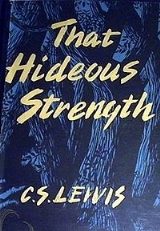
That Hideous Strength is a 1945 novel
Novel
A novel is a book of long narrative in literary prose. The genre has historical roots both in the fields of the medieval and early modern romance and in the tradition of the novella. The latter supplied the present generic term in the late 18th century....

 by C. S. Lewis
C. S. Lewis
Clive Staples Lewis , commonly referred to as C. S. Lewis and known to his friends and family as "Jack", was a novelist, academic, medievalist, literary critic, essayist, lay theologian and Christian apologist from Belfast, Ireland...

, the final book in Lewis's theological science fiction
Science fiction
Science fiction is a genre of fiction dealing with imaginary but more or less plausible content such as future settings, futuristic science and technology, space travel, aliens, and paranormal abilities...

 Space Trilogy
The Space Trilogy
The Space Trilogy, Cosmic Trilogy or Ransom Trilogy is a trilogy of science fiction novels by C. S. Lewis, famous for his later series The Chronicles of Narnia. A philologist named Elwin Ransom is the hero of the first two novels and an important character in the third.The books in the trilogy...

. The events of this novel follow those of Out of the Silent Planet
Out of the Silent Planet
Out of the Silent Planet is the first novel of a science fiction trilogy written by C. S. Lewis, sometimes referred to as the Space Trilogy, Ransom Trilogy or Cosmic Trilogy. The other volumes are Perelandra and That Hideous Strength, and a fragment of a sequel was published posthumously as The...

and Perelandra
Perelandra
Perelandra is the second book in the Space Trilogy of C. S. Lewis, set in the Field of Arbol...

(a.k.a. Voyage to Venus) and once again feature the philologist Elwin Ransom
Elwin Ransom
Elwin Ransom is the prominent character from C. S. Lewis's Space Trilogy series. He is the main character in the books Out of the Silent Planet and Perelandra, which are told almost entirely from his point of view...

. Yet, unlike the principal events of those two novels, the story takes place on Earth rather than in space or on other planets in the solar system
Solar System
The Solar System consists of the Sun and the astronomical objects gravitationally bound in orbit around it, all of which formed from the collapse of a giant molecular cloud approximately 4.6 billion years ago. The vast majority of the system's mass is in the Sun...

. The story involves the allegedly scientific institute, the N.I.C.E., which is a front for sinister supernatural forces.
Discussion
Ask a question about 'That Hideous Strength'
Start a new discussion about 'That Hideous Strength'
Answer questions from other users
Full Discussion Forum
 
Encyclopedia
That Hideous Strength is a 1945 novel
Novel
A novel is a book of long narrative in literary prose. The genre has historical roots both in the fields of the medieval and early modern romance and in the tradition of the novella. The latter supplied the present generic term in the late 18th century....

 by C. S. Lewis
C. S. Lewis
Clive Staples Lewis , commonly referred to as C. S. Lewis and known to his friends and family as "Jack", was a novelist, academic, medievalist, literary critic, essayist, lay theologian and Christian apologist from Belfast, Ireland...

, the final book in Lewis's theological science fiction
Science fiction
Science fiction is a genre of fiction dealing with imaginary but more or less plausible content such as future settings, futuristic science and technology, space travel, aliens, and paranormal abilities...

 Space Trilogy
The Space Trilogy
The Space Trilogy, Cosmic Trilogy or Ransom Trilogy is a trilogy of science fiction novels by C. S. Lewis, famous for his later series The Chronicles of Narnia. A philologist named Elwin Ransom is the hero of the first two novels and an important character in the third.The books in the trilogy...

. The events of this novel follow those of Out of the Silent Planet
Out of the Silent Planet
Out of the Silent Planet is the first novel of a science fiction trilogy written by C. S. Lewis, sometimes referred to as the Space Trilogy, Ransom Trilogy or Cosmic Trilogy. The other volumes are Perelandra and That Hideous Strength, and a fragment of a sequel was published posthumously as The...

and Perelandra
Perelandra
Perelandra is the second book in the Space Trilogy of C. S. Lewis, set in the Field of Arbol...

(a.k.a. Voyage to Venus) and once again feature the philologist Elwin Ransom
Elwin Ransom
Elwin Ransom is the prominent character from C. S. Lewis's Space Trilogy series. He is the main character in the books Out of the Silent Planet and Perelandra, which are told almost entirely from his point of view...

. Yet, unlike the principal events of those two novels, the story takes place on Earth rather than in space or on other planets in the solar system
Solar System
The Solar System consists of the Sun and the astronomical objects gravitationally bound in orbit around it, all of which formed from the collapse of a giant molecular cloud approximately 4.6 billion years ago. The vast majority of the system's mass is in the Sun...

. The story involves the allegedly scientific institute, the N.I.C.E., which is a front for sinister supernatural forces.

The novel was heavily influenced by the writing of Lewis's friend and fellow Inkling
Inklings
The Inklings was an informal literary discussion group associated with the University of Oxford, England, for nearly two decades between the early 1930s and late 1949. The Inklings were literary enthusiasts who praised the value of narrative in fiction, and encouraged the writing of fantasy...

 Charles Williams
Charles Williams (UK writer)
Charles Walter Stansby Williams was a British poet, novelist, theologian, literary critic, and member of the Inklings.- Biography :...

, and is markedly dystopia
Dystopia
A dystopia is the idea of a society in a repressive and controlled state, often under the guise of being utopian, as characterized in books like Brave New World and Nineteen Eighty-Four...

n in style. In the book's preface Lewis acknowledges science-fiction writer Olaf Stapledon
Olaf Stapledon
William Olaf Stapledon was a British philosopher and author of several influential works of science fiction.-Life:...

 and his work: "Mr. Stapledon is so rich in invention that he can well afford to lend, and I admire his invention (though not his philosophy) so much that I should feel no shame to borrow."

In the foreword, Lewis states that the novel's point is the same as that in his non-fiction work The Abolition of Man
The Abolition of Man
The Abolition of Man is a 1943 book by C. S. Lewis. It is subtitled "Reflections on education with special reference to the teaching of English in the upper forms of schools," and uses that as a starting point for a defense of objective value and natural law, and a warning of the consequences of...

.

The title is taken from a poem written by David Lyndsay
David Lyndsay
Sir David Lyndsay of the Mount, was a Scottish Lord Lyon and poet of the 16th century, whose works reflect the spirit of the Renaissance.-Biography:...

 in 1555, , also known as The Monarche. The couplet in question, "", refers to the Tower of Babel
Tower of Babel
The Tower of Babel , according to the Book of Genesis, was an enormous tower built in the plain of Shinar .According to the biblical account, a united humanity of the generations following the Great Flood, speaking a single language and migrating from the east, came to the land of Shinar, where...

.

Plot summary


Young academic Mark Studdock has accepted an appointment in sociology
Sociology
Sociology is the study of society. It is a social science—a term with which it is sometimes synonymous—which uses various methods of empirical investigation and critical analysis to develop a body of knowledge about human social activity...

 at Bracton College in the University of Edgestow
University of Edgestow
The University of Edgestow is a fictional university which appears in the novel That Hideous Strength by C. S. Lewis. It is a small collegiate institution, dating back to at least the 14th Century. It has four colleges:* Bracton College...

, just when it is engaged in selling off a portion of its land, Bragdon Wood, to a new scientific Institute the NICE (National Institute for Co-ordinated Experiments) whose personnel already includes staff of the college. The sale is agreed to but the college Warden wants to back out of the deal. The sub-warden, Curry, Mark Studdock and some NICE insiders have a dinner together to decide how to keep the deal alive. Curry is proud of having brought the NICE to Edgestow believing it to mark the beginning of the "really scientific era". There is discussion of Mark being employed as a sociologist at the NICE, initiated by Lord Feverstone.

Meanwhile Mark's wife, Jane, another scholar, has been having peculiar nightmares that trouble her, one in particular involving a severed head. She meets the wife of an old tutor from her recent grad student days, Mrs. Dimble, who is being evicted from her property due to sale of land to the NICE. When Jane talks about her dreams, Dimble leads her to seek counsel with a Miss Ironwood who lives in a mansion in the nearby town of St. Anne's.

Mark spends an evening getting acquainted with the top brass at the NICE at their current headquarters in Belbury. He has great difficulty trying to figure out the exact nature of the job they want him to do. The lines of authority seem poorly defined, while at the same time the NICE is convinced the future of the human race depends on their success. Mark meets a scientist named Bill Hingest who is both with Bracton College and the NICE but is resigning the latter and warns Mark to get out as soon as possible.

At the same time, Jane finally works up the courage to visit Miss Ironwood at St. Anne's. She is greeted by Camilla Denniston, the spouse of the man who almost got Mark's appointment instead of him. She says they have been expecting Jane at St. Anne's. She leads her through the large house to meet Miss Ironwood. She is dressed just as Jane had dreamed of her. She is convinced that Jane's dreams are visions of genuine events. When Jane returns, she discovers that her maid, Ivy Maggs, has also been evicted from her dwelling by the NICE, and has gone to live at the Manor at St. Anne's with the Dimbles.

Mark discovers that the NICE has a plan for the demolition of a scenic village called Cure Hardy so that a river can be diverted through its original location. This will be rationalized by its philosophy of "liquidation of anachronisms" such as the "backward labourer" or the "wastefully supported pauper". Mark journeys to Cure Hardy to write the report that will justify the demolition. During this time, he discovers that the man who resigned from the NICE. Hingest, has been mysteriously murdered shortly after departing the headquarters.

The next morning he returns to NICE determined to find out the exact nature of his work and to whom he is supposed to be reporting. His official boss, Steele, seems to have no idea what is going on. Mark demands to see the Deputy Director but is put off. He runs into the head of the NICE's private police force, a mannish woman named Fairy Hardcastle, who insists he must not worry about this sort of thing, and that the NICE is not run along conventional bureaucratic lines. In a later interview with the Deputy Director, John Wither, he is told that "elasticity" is the cornerstone of the Institute, and that they have no watertight compartments.

Fog comes in on the towns of Edgestow and Belbury while there is an increase in violent incidents in the town, many apparently engineered by the NICE.

Jane develops further personal ties to the group in the mansion at St. Anne's. She is introduced to Dr. Elwin Ransom who is the protagonist of the first two books in Lewis' space trilogy. He has previously traveled to Mars and Venus, both of which are unaffected by the Biblical Fall of Man. He is now the legitimate king or Pendragon
Pendragon
Pendragon or Pen Draig, meaning "head dragon" or "chief dragon" , is the name of several traditional Kings of the Britons:...

 of the nation of Logres
Logres
Logres is the name of King Arthur's realm in the Matter of Britain. It derives from the Welsh word Lloegr, a name of uncertain origin meaning "England"....

, the legitimate heir of King Arthur
King Arthur
King Arthur is a legendary British leader of the late 5th and early 6th centuries, who, according to Medieval histories and romances, led the defence of Britain against Saxon invaders in the early 6th century. The details of Arthur's story are mainly composed of folklore and literary invention, and...

. Also living at St. Anne's is a Mr. MacPhee who is politely skeptical of Ransom's claims.

At Belbury Mark has a conversation with the Italian physiologist Dr. Filostrato. He admires the "purity" of the moon given that it has no organic life. He declares that underground is a race that has almost broken free of the organic, free of Nature. Mark is then introduced to the "Head" of the NICE. They have preserved the head of a recently executed scientist and restored the head to life with artificial scientific devices, where blood and air are pumped through it. It becomes clear that the NICE is engineering the creation of a new species relatively free of the organic.

Meanwhile the NICE police have completely taken over the entire town of Edgestow, and have attempted to arrest Jane.

Jane tells the group at St. Anne's that she has had dreams of a place in which the NICE have been digging up the grave of a long-buried man. Believing they know the actual place, the company of St. Anne's travel there. They believe the NICE is looking for the body of the magician Merlin
Merlin
Merlin is a legendary figure best known as the wizard featured in the Arthurian legend. The standard depiction of the character first appears in Geoffrey of Monmouth's Historia Regum Britanniae, written c. 1136, and is based on an amalgamation of previous historical and legendary figures...

, who was buried but not actually dead. It is revealed that the NICE are mainly interested in Jane, for her psychic abilities, and are afraid of her getting into the wrong hands. Mark, now trying to leave the NICE, is arrested in Edgestow on trumped-up charges of the murder of Bill Hingest, and is brought back to NICE headquarters at Belbury, though he does not originally realize that is where he is. When he does, it becomes clear to him the NICE killed Hingest as well.

On a stormy night, both the company of St. Anne's and Belbury personnel are on the trail of Merlin who has apparently revived. He has taken the clothes of a tramp through his powers of hypnosis, and gotten hold of a wild horse. He meets the company of St. Anne's, but rides away. Members of the NICE locate the tramp and mistakenly believe him to be Merlin.

Merlin arrives at St. Anne's on his own. Ransom reveals that there are Satanic forces behind the NICE. He further reveals that Merlin is to be possessed by the angelic powers called eldils that guide each of the planets of the solar system. Until now Earth had been under a quarantine with a rule that the dark demonic forces that govern Earth could not travel beyond the orbit of the moon, and the angelic powers ruling the rest of the solar system could not come to Earth. However, since the forces of darkness broke the lunar barrier in the events of the earlier books, it is now possible for the good angelic forces to come to Earth.

At St. Anne's, Jane Studdock has two very powerful mystical experiences, the first with the earth-bound counterpart of the ruling angel of Venus, and the second with God. This occurs at the same time that Mark at NICE is being initiated by Professor Frost into a dark ritual meant to cultivate absolute objectivity by killing human emotion relegated to the status of a mere "chemical phenomenon".

The angelic spirits that possess Merlin are guardians of each of the planets of the solar system and correspond to some gods and goddesses of Greek mythology. He then disguises himself as a Basque priest and answers an advertisement put out by the NICE as an interpreter of ancient languages. Later, he is brought to interview the tramp who the NICE still believe may be the real Merlin. Both Merlin and the tramp are brought to attend a celebratory dinner put on by the NICE in honor of the public head of NICE, a science popularizer named Horace Jules. At that dinner, Merlin pronounces upon them the same curse that was placed on the Tower of Babel
Tower of Babel
The Tower of Babel , according to the Book of Genesis, was an enormous tower built in the plain of Shinar .According to the biblical account, a united humanity of the generations following the Great Flood, speaking a single language and migrating from the east, came to the land of Shinar, where...

, causing all present to speak unintelligible gibberish. There are also massive earthquakes which ruin the building as well as much of the town of Edgestow, and cause the deaths of most of the NICE personnel and the liberation of many caged animals upon whom they were conducting experiments. Many of the animals make their way back to St. Anne's. The angel of Venus now lingers as Ransom is now meant to be transported back to that planet, known to the rest of the solar system as Perelandra. The presence of Venus puts many of the animals who are there into an amorous mood. Mark has now arrived on his own at St. Anne's and sees a vision of Venus who leads him into a new bridal chamber that Jane has been preparing for him. The couple are re-united.

Context in Space Trilogy


Elwin Ransom, introduced in this story in Chapter 7, is the main protagonist of the first two books in Lewis' space trilogy and his point-of-view dominates their narrative. Lord Feverstone (formerly Dick Devine) was a villain in the first novel who, along with the now-deceased Professor Weston, had abducted Ransom to Mars. When Feverstone speaks in That Hideous Strength of Weston having been murdered by "the opposition", he is speaking of Ransom having killed Weston on Venus in the second novel. The first two books fully explicate Lewis' mythology (based on a combination of the Bible and Elizabethan astrology) according to which each of the planets of the solar system has a guiding angelic spirit that rules over it. This mythos is re-introduced slowly and gradually in this story whose main protagonists, the earthbound Mark and Jane Studdock, are unaware of these realities when the story opens.

Characters

  • Mark Gainsby Studdock — Protagonist; sociologist, and ambitious
    Ambition
    Ambition is the desire for personal achievement. It provides the motivation and determination necessary to achieve a particular end or condition. Ambitious people are characterised by their strong desire for attainment, power, or superiority...

     to the point of obsession with reaching the "inner circle" of the social environment to which he has been granted preliminary admittance.
  • Jane Tudor Studdock— Protagonist; Mark's wife, a scholar and a seer.
  • vagabond tinker — mistaken by the N.I.C.E. for Merlinus Ambrosius when the latter steals his clothes and horse at his camp in Bragdon Wood.

N.I.C.E.


The National Institute of Coordinated Experiments ("N.I.C.E."), a scientific and social planning agency, furtively pursues its program of the exploitation of nature and the annihilation of humanity. The Institute is secretly inspired and directed by fallen eldila, whom they refer to as "macrobes", superior beings. Their takeover of Edgestow and its surrounding area is a case in point of the manner in which they use human pride and greed to get what they want. After the N.I.C.E. would achieve its ends, the earth would only belong to the "macrobes".
  • François Alcasan — "The Head", a French scientist executed for murder
    Murder
    Murder is the unlawful killing, with malice aforethought, of another human being, and generally this state of mind distinguishes murder from other forms of unlawful homicide...

     early in the book. His head is recovered by the N.I.C.E. and appears to be kept alive by the technology of man while actually having become a communication mechanism for the "Macrobes", the fallen eldila.
  • John Wither — Long-winded bureaucrat and "Deputy Director" of the N.I.C.E. He is the true leader of the N.I.C.E., and a servant of the Macrobes. Long-term association with the Macrobes has "withered" his mind, and his speech and thinking are characterized by vagueness and jargon. He does not engage in a normal sleep cycle, but maintains a continual dreamy wakefulness that affords him the ability to maintain a shadowy, supernatural presence throughout the Institute.
  • Professor Augustus Frost — A psychologist and assistant to Wither, he is the only other N.I.C.E member who knows the true nature of the Head, and of the Macrobes. He views emotions and values as mere chemical phenomena to be ignored as distractions from scientific inquiry. He is coldhearted and unemotional and he has an exact, precise manner of speech and thinking.
  • Miss/Major Hardcastle (a.k.a "The Fairy") — The sadistic head of the N.I.C.E. Institutional Police and its female auxiliary, the "Waips". Torture is her favorite interrogation method, and she takes special pleasure in abusing female prisoners. It is clearly implied that she is a sadomasochistic lesbian
    Lesbian
    Lesbian is a term most widely used in the English language to describe sexual and romantic desire between females. The word may be used as a noun, to refer to women who identify themselves or who are characterized by others as having the primary attribute of female homosexuality, or as an...

    .
  • Dr. Filostrato — An obese Italian eunuch
    Eunuch
    A eunuch is a person born male most commonly castrated, typically early enough in his life for this change to have major hormonal consequences...

     physiologist, who has seemingly preserved Alcasan's head. He does not understand the Head's nature and believes it to be truly Alcasan. His ultimate goal is to free humanity from the constraints of organic life.
  • Lord Feverstone (Dick Devine)
    Lord Feverstone
    Richard Devine, Lord Feverstone is a fictional character in two of the books of C. S. Lewis's Interplanetary Trilogy.Richard Devine knew the protagonist, Elwin Ransom, at school, where they did not get on. Ransom meets him again years later, in Out of the Silent Planet...

    — The politician and recently ennobled businessman who lures Mark into the N.I.C.E. Feverstone was one of the two men who kidnapped Ransom in Out of the Silent Planet, and the person responsible for getting Mark Studdock his fellowship at Bracton. A classic sociopath, he is motivated in all circumstances by the perceived benefit to himself. Although he is aware of the Macrobes, he has no interest in them.
  • Reverend Straik — "The Mad Parson". He believes that any sort of power is a manifestation of God's will. Straik is ready to obliterate that "organisation of ordered Sin called Society." When Mark objects that he must not want to preserve Society because he believes in an afterlife, Straik objects that Jesus' real teaching was justice here and now. Emphasis on an afterlife has, he thinks, emasculated and sidetracked the real meaning of Jesus' teaching. This belief, along with other beliefs, makes him a suitable candidate for introduction to the Macrobes. Straik was "a good man once", but became deranged by the death of his daughter.
  • Horace Jules — A novelist, tabloid reporter, cockney, and pseudo-scientific journalist who has been appointed the nominal Director of the N.I.C.E. His minimal understanding of science allows him to be unaware of the true nature of the Institute and to be manipulated by Wither and Frost. He has a strong anti-clerical bias, and objects to Wither appointing "parsons" (such as Straik) to the Institute. He is in part a caricature of H.G. Wells. Wells's "The Shape of Things to Come" has a future world government which systematically persecutes Christianity (and all other religions), presented as a positive activity.

St. Anne's

  • Dr. Elwin Ransom
    Elwin Ransom
    Elwin Ransom is the prominent character from C. S. Lewis's Space Trilogy series. He is the main character in the books Out of the Silent Planet and Perelandra, which are told almost entirely from his point of view...

    — sometimes called the "Pendragon" or "Mr. Fisher King
    Fisher King
    The Fisher King, or the Wounded King, figures in Arthurian legend as the latest in a line charged with keeping the Holy Grail. Versions of his story vary widely, but he is always wounded in the legs or groin, and incapable of moving on his own...

    ". He alone communicates with the benevolent eldila. Back from Perelandra, Ransom is a kingly figure among his small band of followers, and is usually referred to as "The Director". Ransom attributes his following to a divine Power, presumably Maleldil.
  • Grace Ironwood — The seemingly stern but kind psychologist and doctor who helps Jane interpret her dreams.
  • Dr. Cecil Dimble — Another academic, an old friend of Ransom, and close adviser on matters of Arthurian scholarship and pre-Norman Britain.
  • Margaret "Mother" Dimble — Mrs. Dimble; She and Mr. Dimble have no children, much to their sadness, but have compensated by their kindness to students. Very maternal.
  • Ivy Maggs — Formerly a part-time domestic servant for Jane Studdock; now driven out of the town by the N.I.C.E. and living at St. Anne's. Jane is puzzled at first by her status as an equal at the house. Ivy's husband Tom is in prison for petty theft.
  • Merlinus Ambrosius — The wizard Merlin
    Merlin
    Merlin is a legendary figure best known as the wizard featured in the Arthurian legend. The standard depiction of the character first appears in Geoffrey of Monmouth's Historia Regum Britanniae, written c. 1136, and is based on an amalgamation of previous historical and legendary figures...

    , awakened and returned to serve the Pendragon and save England. Receives the powers of the eldila. He has been in a deep sleep since the time of King Arthur, and both sides initially believe he will join the N.I.C.E. His appearance at St. Anne's comes as a surprise.
  • Andrew MacPhee — A scientist, skeptic, and rationalist, who is a close friend of Dr. Ransom and joins him at St. Anne's. Though not religious, he is deeply influenced by his Presbyterian family background. He is mentioned parenthetically in Perelandra
    Perelandra
    Perelandra is the second book in the Space Trilogy of C. S. Lewis, set in the Field of Arbol...

    , and he appears in The Dark Tower
    The Dark Tower (1977 novel)
    The Dark Tower is an incomplete manuscript allegedly written by C. S. Lewis that appears to be an unfinished sequel to the science fiction novel, Out of the Silent Planet. Perelandra instead became the second book of Lewis' Space Trilogy, concluded by That Hideous Strength...

    . MacPhee, like Ransom, was an officer in the First World War. MacPhee desires to fight the N.I.C.E. with human powers. He is an argumentative character who claims to have no opinions, merely stating facts and illustrating implications. His position in the establishment is to be skeptical, testing every hypothesis and Jane's dreams; however, the awakened Merlin believes MacPhee to be Ransom's "fool" (i.e. jester), because MacPhee is "obstructive and rather rude...yet never gets sat on". The character may have been based on William T. Kirkpatrick, former headmaster of Lurgan College and an admired tutor of the young Lewis.
  • Mr. Bultitude — Last of the seven bears of Logres
    Logres
    Logres is the name of King Arthur's realm in the Matter of Britain. It derives from the Welsh word Lloegr, a name of uncertain origin meaning "England"....

    , who escaped from a zoo and was tamed by Ransom, who has regained man's legendary authority over the beasts.
  • Arthur and Camilla Denniston - Arthur is an academic at Edgestow and an old University friend of Mark Studdock's, before Studdock began to be obsessed with reaching the "inner circle" at Bracton College. Camilla, married to Arthur, is described as very tall, and she is the first person Jane meets when visiting St. Anne's for the first time.

Reception


Some two years before writing his own Nineteen Eighty-Four
Nineteen Eighty-Four
Nineteen Eighty-Four by George Orwell is a dystopian novel about Oceania, a society ruled by the oligarchical dictatorship of the Party...

, George Orwell
George Orwell
Eric Arthur Blair , better known by his pen name George Orwell, was an English author and journalist...

 reviewed That Hideous Strength for the Manchester Evening News
Manchester Evening News
The Manchester Evening News is a regional daily newspaper covering Greater Manchester in the United Kingdom. It is published every day except Sunday and is owned by Trinity Mirror plc following its sale by Guardian Media Group in early 2010. It has an average daily circulation of 90,973 copies...

commenting: "Plenty of people in our age do entertain the monstrous dreams of power that Mr. Lewis attributes to his characters [the N.I.C.E. scientists], and we are within sight of the time when such dreams will be realizable". It is noteworthy that the review was written in the direct aftermath of the nuclear bombings of Hiroshima
Hiroshima
is the capital of Hiroshima Prefecture, and the largest city in the Chūgoku region of western Honshu, the largest island of Japan. It became best known as the first city in history to be destroyed by a nuclear weapon when the United States Army Air Forces dropped an atomic bomb on it at 8:15 A.M...

 and Nagasaki, which are referred to in the text.

However, Orwell argued that Lewis's book "would have been stronger without the supernatural elements". Particularly, Orwell objected to the ending in which N.I.C.E. is overthrown by divine intervention: "[Lewis] is entitled to his beliefs, but they weaken his story, not only because they offend the average reader’s sense of probability but because in effect they decide the issue in advance. When one is told that God and the Devil are in conflict, one always knows which side is going to win. The whole drama of the struggle against evil lies in the fact that one does not have supernatural aid".

In popular culture

  • Physicist Freeman Dyson
    Freeman Dyson
    Freeman John Dyson FRS is a British-born American theoretical physicist and mathematician, famous for his work in quantum field theory, solid-state physics, astronomy and nuclear engineering. Dyson is a member of the Board of Sponsors of the Bulletin of the Atomic Scientists...

     cites That Hideous Strength and the N.I.C.E. organization on pages 141–143 of his book A Many-Colored Glass: Reflections on the Place of Life in the Universe (University of Virginia Press
    University of Virginia Press
    The University of Virginia Press , founded in 1963, is a university press that is part of the University of Virginia.-External links:*...

    , 2007) as an example of theofiction.
  • The post-hardcore band Thrice
    Thrice
    Thrice is an American rock band from Irvine, California, formed in 1998. The group was founded by guitarist/vocalist Dustin Kensrue and guitarist Teppei Teranishi while they were in high school....

     based their song "That Hideous Strength" (a b-side from their The Illusion of Safety recordings and released on their EP, If We Could Only See Us Now
    If We Could Only See Us Now
    If We Could Only See Us Now is a dual disc release by the post hardcore band Thrice, and has been certified Gold by the RIAA. The first disc is a CD of rarities including unreleased songs...

    ) on Lewis's novel.
  • Christian Progressive Death Metal band Becoming the Archetype
    Becoming the Archetype
    Becoming the Archetype is a Christian progressive death metal band signed to Solid State Records and Century Media Records formed in 1999 in Dacula, Georgia. They have released four albums on Solid State Records. Dichotomy, released in November 2008, sold around 2,300 copies in the United States...

    's 2008 album Dichotomy
    Dichotomy (album)
    Dichotomy is the third studio album by metal band Becoming the Archetype. The album features guest appearances by Devin Townsend, Ryan Clark, a soprano named Suzanne Richter, and Aslan.The Album is based heavily on C.S...

    is based heavily on the book.
  • English electronic musician Belbury Poly
    Belbury Poly
    Belbury Poly is an alias of electronic musician Jim Jupp . Jupp's releases are on the Ghost Box Music label .-Belbury Poly's sound:...

     takes his name from the town of Belbury. Many of his peers on the Ghost Box Music
    Ghost Box Music
    Ghost Box Music is an English independent record label, established in 2004 by Julian House and Jim Jupp.-Concept:The concept for the label was hatched by House and Jupp Ghost Box Music is an English independent record label, established in 2004 by Julian House and Jim Jupp.-Concept:The concept for...

     label pay similar homage to Lewis' mythology of Belbury.
  • Progressive rock band Glass Hammer
    Glass Hammer
    Glass Hammer is a progressive rock band from Chattanooga, Tennessee. They formed in 1992 when multi-instrumentalists Steve Babb and Fred Schendel began to write and record Journey of the Dunadan, a concept album based on the story of Aragorn from J.R.R. Tolkien's The Lord of the Rings...

     has a song titled That Hideous Strength on their concept album Perelandra
    Perelandra (album)
    Perelandra is the second studio album of the progressive rock band Glass Hammer. Its concept is based around the stories of Space Trilogy and The Chronicles of Narnia by C.S...

    , which is based on the stories of The Space Trilogy
    The Space Trilogy
    The Space Trilogy, Cosmic Trilogy or Ransom Trilogy is a trilogy of science fiction novels by C. S. Lewis, famous for his later series The Chronicles of Narnia. A philologist named Elwin Ransom is the hero of the first two novels and an important character in the third.The books in the trilogy...

     and The Chronicles of Narnia
    The Chronicles of Narnia
    The Chronicles of Narnia is a series of seven fantasy novels for children by C. S. Lewis. It is considered a classic of children's literature and is the author's best-known work, having sold over 100 million copies in 47 languages...

    by C. S. Lewis.

Publication history

  • 1945, UK, The Bodley Head, N/A, Pub date ? December 1945, hardback (first edition)
  • 1946, USA Macmillan Publishing Co. New York, NY
  • 1996, USA Scribner Classics
  • 1996, USA, Simon & Schuster, ISBN 0-684-83367-0, pub date 28 October 1996, hardback
  • 1996, USA, Simon & Schuster, ISBN 0-684-82385-3, pub date 1 June 1996, paperback

  • 1946 Paperback edition abridged by the author published in the USA under the title The Tortured Planet by MacMillan and under its original title in Britain by PAN books.

External links