


One Ring

Encyclopedia
The One Ring is a fictional artifact that appears as the central plot element in J. R. R. Tolkien
's Middle-earth
fantasy novels
. It is described in an earlier story, The Hobbit
(1937), as a magic ring
of invisibility
. The sequel The Lord of the Rings
(1954–55) describes its powers as being more encompassing than invisibility, and states that the Ring is in fact malevolent. The Lord of the Rings concerns the quest to destroy the Ring, which was created by the primary antagonist, Sauron
.
during the Second Age
in order to gain dominion over the free peoples of Middle-earth
. In disguise as Annatar, or "Lord of Gifts", he aided the Elven
smiths of Eregion
and their leader Celebrimbor
in the making of the Rings of Power
. He then forged the One Ring himself in the fires of Mount Doom
.
Sauron intended it to be the most powerful of all Rings, able to rule and control those who wore the others. Since the other Rings were themselves powerful, Sauron was obliged to place much of his native power into the One to achieve his purpose.
Creating the Ring simultaneously strengthened and weakened Sauron's power. On the one hand, as long as Sauron had the Ring, he could control the power of all the other Rings, and thus he was significantly more powerful after its creation than before; and putting such a great portion of his own power into the Ring ensured Sauron's continued existence so long as the Ring existed. On the other hand, by binding his power within the Ring, Sauron became dependent on it — without it his power was significantly diminished.
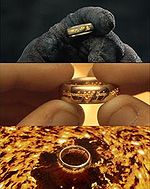
fire. Like some lesser rings forged by the Elves as "essays in the craft" – but unlike the other Rings of Power – it bore no gem, but its identity could be determined by a simple (though little-known) test: when placed in a fire, it displayed a fiery Tengwar
inscription in the Black Speech
of Mordor, with lines from a rhyme of lore describing the Rings:
The lines inscribed on the Ring (the ones bolded in the translation above) were evidently also part of the spell that imbued the One Ring with power; for the Elven smiths heard Sauron utter these words during the Ring's creation, whereupon they became aware of his purpose and took off their own Rings to foil his plan.
A person wearing the Ring would enter a shadowy world revealing the physical world from a different aspect, and from which physical objects were harder to see. The wearer was mostly invisible to ordinary beings, like Men
, but highly visible to the Nazgûl
. The Ring dimmed the wearer's sight, while at the same time sharpening the other senses.
The enigmatic Tom Bombadil
appeared to be unaffected by the Ring and to have some power over it; when he wore the Ring, it did not make him invisible, and Frodo could not become invisible to him by wearing the Ring. Also, Tom played with the Ring like a conjurer borrowing someone's watch for a trick, seemingly making it disappear and reappear.
The Ring slowly but inevitably corrupted its bearer, regardless of the bearer's initial intent. Whether this effect was specifically designed into the Ring's magic or simply a consequence of its evil origins is unknown. For this reason the Wise, including Gandalf
, Elrond
, and Galadriel
, refused to wield it themselves, but determined instead that it should be destroyed. The corrupting power of the ring was apparently stronger on individuals more inclined to evil and selfishness: it took almost immediate hold of the greedy Sméagol as soon as he saw it, and corrupted Boromir
after a few months of near proximity, while its effects were only starting to be seen in the noble Bilbo after 60 years of owning it. This corrupting power also seems to grow stronger the closer the ring is to its place of origin, Mount Doom.
The Ring had the ability to change size. As well as adapting to fingers of varying size, from Sauron's to Frodo's, it sometimes suddenly expanded in order to give its wearer the slip.
, a language devised by Sauron
and used in his land of Mordor
. It is written in tengwar
. The inscription embodied the One Ring's power to control the other Rings of Power
. The inscription used Elvish letters because the Black Speech did not have its own script.
Normally the One Ring appeared perfectly plain and featureless, but when cast into fire the inscription appeared in fiery letters on the Ring. A drawing of the Inscription and a transliteration provided by Gandalf appears in Book I, Chapter 2 of The Fellowship of the Ring
, "The Shadow of the Past".

Translated, the words mean:
When Isildur
picked up his fathers blade and first cut the Ring from Sauron's hand, it was burning hot; the letters were legible, and Isildur was able to transcribe the inscription before it faded as the Ring cooled. This transcription survived in a document Isildur left behind in Gondor before marching north to the Gladden Fields, where he was killed and the Ring lost.
Gandalf first learned of the Ring's inscription when he read Isildur's account. When Gandalf subsequently heated the ring that Bilbo Baggins
had left to Frodo
, the inscription reappeared. The wizard
then had no doubt that Frodo's ring was the One Ring. When Gandalf recited the inscription in Black Speech at the Council of Elrond, everyone trembled:
The first Ballantine paperback edition of The Fellowship of the Ring
printed the inscription upside-down. Some recent editions accidentally omit the first half of the translation in Chapter 2, an error corrected for the 50th Anniversary edition.
to describe a person who has possession of the One Ring. The term is also used to refer to bearers of other Rings of Power
.
In The Lord of the Rings
, Frodo Baggins
was appointed Ring-bearer by the Council of Elrond in Rivendell
. His task was to carry the One Ring from Rivendell to the Crack of Doom in Mordor
and to destroy it before Sauron
or his servants could recover it. During this journey, Frodo's companion Samwise Gamgee
also carried the ring briefly while Frodo was held captive in the Tower of Cirith Ungol. Near the onset of this journey the Ring was handled also by Tom Bombadil
, upon whom the Ring had no apparent effect, and by Gandalf
, who cast it into Frodo's fireplace to verify that it was the One Ring.
Frodo inherited the Ring from his uncle Bilbo Baggins
. In Tolkien's earlier novel, The Hobbit
, Bilbo found the Ring in caverns beneath the Misty Mountains
. It had been lost in the caverns by Gollum
, who used the invisibility it conferred to hunt orcs to eat. Gollum, a hobbit previously known as Sméagol, had kept the Ring for hundreds of years. He had murdered his cousin Déagol
to get the Ring shortly after Déagol found it in the river Anduin
. Many centuries earlier Isildur
, fleeing from orcs, lost the Ring there, and becoming visible, was killed by the orcs. Isildur in turn had cut the Ring from the hand of Sauron
, who had made the Ring and let much of his power flow into it. Sauron was the Ring's true master, and the only being who could bend it completely to his will.
Though Déagol and Gandalf had handled the Ring, the only individuals ever to wear it were Sauron, Isildur, Gollum, Bilbo, Frodo, Tom Bombadil, and Samwise. None but Bilbo, Frodo, and Samwise are actually called "Ring-bearers" in any of Tolkien's works. As Ring-bearers, they were granted passage to the Undying Lands, though Sam lived in the Shire
for many years after the departure of Bilbo and Frodo before making the journey himself.
, and killed Celebrimbor
, the maker of the three rings of the Elves. But King Tar-Minastir of Númenor
sent a great fleet to Middle-earth, and with this aid Gil-galad
destroyed Sauron's army and forced Sauron to return to Mordor.
In S.A. 3261, Ar-Pharazôn, the last and most powerful king of Númenor, landed at Umbar
at the head of an immense army to do battle with Sauron. The sheer size and might of the Númenórean army was enough to force Sauron's armies to flee. Sauron surrendered to Ar-Pharazôn and was taken back to Númenor as a prisoner. Tolkien, in a letter written in 1958 (#211) wrote that the surrender was both "voluntary and cunning" so he could gain access to Númenor. Sauron was able to use the Númenóreans' fear of death as a way to turn them against the Valar, and manipulate them into worshiping his master, Morgoth
, and performing human sacrifice
.
Although Sauron's body was destroyed in the Fall of Númenor
, his spirit was able to travel back to Middle-earth and wield the One Ring in his renewed war against the Last Alliance of Elves and Men between S.A. 3429 and 3441. Tolkien emphasized that Sauron used his ring in Númenor to gain complete control over its people; and while Sauron's body perished in the Fall, the Ring somehow made it back to Middle-earth. Tolkien wrote, "I do not think one need boggle at this spirit carrying off the One Ring, upon which his power of dominating minds now largely depended." (letter #211).
Sauron was killed again by Gil-galad
and Elendil
at the end of the Last Alliance. The Ring was cut from Sauron's hand by Elendil's son, Isildur
, on the slopes of Mount Doom. Though counseled to destroy the Ring, he was swayed by its power and kept it safe instead, "as weregild
for my father, and my brother". A few years later, Isildur was ambushed by orcs by the River Anduin
near the Gladden Fields
; he put on the Ring to escape, but it slipped from his finger as he swam across the river, and, suddenly visible, he was killed by the orcs. Since the Ring indirectly caused Isildur's death, it was known in Gondor
ian lore as "Isildur's Bane".
The Ring remained hidden in the river bed for almost two and a half millennia, until it was discovered on a fishing trip by a Stoor hobbit
named Déagol
. His friend and relative Sméagol, who had gone fishing with him, was immediately ensnared by the Ring's power and demanded that Déagol give it to him as a "birthday present"; when Déagol refused, Sméagol strangled him and took it for himself. The Ring corrupted his body and mind, turning him into the creature known as Gollum
. The Ring, which Sauron had endowed with a will
of its own, manipulated Gollum into hiding in a cave under the Misty Mountains
near Mirkwood
, where Sauron was beginning to resurface. There Gollum remained for nearly 500 years, until the Ring tired of him and fell off his finger as he was hunting an orc.
As is told in The Hobbit
, Bilbo found the Ring shortly afterward while lost in the tunnels near Gollum's lair. When The Hobbit was written, Tolkien had not yet conceived of the Ring's sinister history. Thus, in the first edition of The Hobbit, Gollum surrenders the Ring to Bilbo as a reward for winning the Riddle Game. When Tolkien revised the nature of the Ring for The Lord of the Rings, he realized that the Ring's grip on Gollum would never permit him to give it up willingly. Tolkien therefore revised the second edition of The Hobbit: after losing the Riddle Game to Bilbo, Gollum went to get his "Precious" (as he always called it) so he could kill and eat Bilbo, but flew into a rage when he found the Ring missing. Deducing from Bilbo's last question — "What have I got in my pocket?" — that Bilbo had found the Ring, Gollum chased him through the caves, not realizing that the hobbit had discovered the Ring's powers of invisibility and was following him to the cave's exit. Bilbo escaped Gollum and the goblins by remaining invisible, but when he rejoined Gandalf and the dwarves
he was traveling with, he decided not to tell them that the Ring had made him invisible. In fact he told them a story that closely followed the first edition of The Hobbit: that Gollum had given him the Ring and showed him the way out. Gandalf was not convinced and later forced the real story from Bilbo; he was thus immediately suspicious of the Ring.
Gollum eventually left the Misty Mountains to track down and reclaim the Ring. He wandered for decades, eventually to be captured and interrogated by Sauron himself, to whom he revealed the existence of Bilbo and the Shire
.
In , the Ring was beginning to strain Bilbo, leaving him feeling "stretched-out and thin", and so he decided to leave the Shire, intending to leave the Ring to his adopted heir Frodo
. He briefly gave in to the Ring's power, even calling it "my precious"; alarmed, Gandalf spoke harshly to his old friend to persuade him to give it up, which Bilbo eventually did, becoming the first Ringbearer to willingly surrender it.
By this time Sauron had regained much of his power, and the Dark Tower
in Mordor had been rebuilt. In order to prevent Sauron from reclaiming his Ring, Frodo and eight other companions set out from Rivendell
for Mordor in an attempt to destroy the Ring in the fires of Mount Doom
. During the quest, Frodo gradually became more and more susceptible to the Ring's power, and feared that it was going to corrupt him. When he and his faithful companion Samwise Gamgee
discovered Gollum on their trail and "tamed" him into guiding them to Mordor, Frodo began to feel a strange bond with the wretched, treacherous creature, while Gollum warmed to Frodo's kindness and made at least some effort to keep his promise. Gollum eventually gave in to the Ring's temptation, however, and betrayed them to the spider Shelob
. Believing Frodo to be dead, Sam bore the Ring himself for a short time and experienced the temptation it induced; he wore it briefly twice, but never succumbed to it.
Sam rescued Frodo from a band of orcs at the Tower of Cirith Ungol. The hobbits, followed by Gollum, eventually arrived at Mount Doom, where Frodo was overcome by the Ring's power and claimed it for himself. At that moment, however, Gollum attacked him and bit off his finger, finally taking back the Ring; he got too close to the edge as he gloated over his prize, however, and fell into the fires of Mount Doom, taking the Ring with him. Thus, the Ring was finally destroyed, and with it Sauron's power.
A mortal wearing the Ring was made effectively invisible except to those able to perceive the non-physical world, with only a thin, shaky shadow discernible in the brightest sunlight. Whether immortals would be made invisible by it is unknown. The only direct example given is Tom Bombadil
, over whom the Ring seemed to have no power. The Ring would also extend a mortal possessor's life indefinitely by preventing natural ageing. Gandalf explained that it does not "grant new life", but that the possessor merely "continues" until life becomes unbearably wearisome. However, the Ring could not protect its bearer from immediate death or destruction; Gollum perished in the Crack of Doom while in possession of the Ring, and even Sauron himself (as the only one who could truly control the full power of the Ring) could not preserve his body from destruction during the downfall of Númenor. Likewise, the Ring could not protect its bearer from physical harm; Frodo (while bearing the Ring) was seriously injured by the Witch-king on Weathertop
. In the same way, Frodo and Sauron each lost a finger while actually wearing the Ring. Like the Nine Rings, the One Ring also has the effect of physically corrupting mortals who wore it for extended periods of time, eventually transforming them into wraiths. Hobbits were somewhat resistant to this process, as proved by Gollum.
It might have also given its wielder the ability to read minds, as Galadriel suggested to Frodo when he asked if he could learn to communicate telepathically as she did. When Samwise wears the ring to avoid being seen by orcs, the Ring sharpened his hearing at the expense of his visual acuity.
Within the land of Mordor where it was forged, the Ring's powers increased so tangibly that even without wearing it, its wielders could draw upon its powers. Seemingly, the Ring actually in some way inspired or caused its wielders to access its powers. One power the Ring could give was an aura of terrible power which would emanate from the Ring and onto its wielder. When Sam encountered an orc in the Tower of Cirith Ungol and held the Ring, he appeared to the orc as a powerful warrior cloaked in shadow "[holding] some nameless menace of power and doom." The orc was so terrified of this vision of the otherwise unintimidating Sam that it fled. Similarly at Mount Doom, when Frodo and Sam were attacked by Gollum, Frodo grabbed the Ring and appeared as "a figure robed in white... [and] it held a wheel of fire." In this scene, Frodo also accessed a second power of the Ring. Frodo told Gollum "in a commanding voice" that "If you touch me ever again, you shall be cast yourself into the Fire of Doom," a statement fulfilled when Gollum fell into Mount Doom with the Ring. Although the Ring was certainly invoked with this statement, it is unclear whether Frodo was prophesying a fate of Gollum (Frodo previously had less sinister visions while in possession of the Ring), or if Frodo was laying a curse upon Gollum.
As it contained a large part of Sauron's native power, it was endowed with a malevolent sentience of sorts. While separated from Sauron, the Ring would strive to either manipulate its bearer into claiming it for themselves or returning to him, both by impelling its bearer to yield to Sauron or his servants, and by abandoning its possessor at key moments. For example, it slipped from Isildur's finger during the ambush at Gladden Fields; moments later he was killed by orcs. It also slipped off of Gollum's finger when the time was right for it to be brought back into the world at large. Frodo carried it on a chain, having been warned by Bilbo that it tended to slip away if it were not attended to otherwise.
To fully master all of these abilities, a wielder of the Ring would need an extremely disciplined and well-trained mind, a strong will, and a high degree of spiritual development. Those with weaker minds such as Hobbits and lesser Men, would have gained very little benefit from the Ring, let alone realized its full potential. Even for someone with the necessary prerequisites it would have taken time to master the Ring's powers to the point where he was strong enough to overthrow Sauron. Yet in the end, the Ring's inherent corruption would have twisted its bearer into another Dark Lord as evil as Sauron was, or worse, regardless of his intentions at the outset. Ironically, this is the main appeal that the ring holds over all those who come in contact with it. It is seen as a symbol of hope for anyone strong enough to dominate it, that they would have the power to defeat Sauron and bring peace to the world.
Despite its powerful qualities, the Ring was not omnipotent, nor was its power over others absolute. Three times Sauron suffered military defeat with it in his possession, first by Gil-galad in the War of Sauron and the Elves, again by Ar-Pharazôn when Númenórean power so overawed his armies that they deserted him, and again at the end of the Second Age with his personal defeat at the hands of Gil-galad and Elendil. Tolkien indicates that this would not have been possible during the waning years of the Third Age
when the strength of the free peoples was greatly diminished. At that time there were no remaining heroes of the stature of Gil-galad, Elendil, or Isildur; the strength of the Elves was fading and they were departing to the Blessed Realm of Aman
; the Dwarves had been driven out of Moria
and would have been unwilling to concentrate their strength in any event; and the Númenórean kingdoms had either declined or been destroyed, and had few allies.
, Frodo Baggins
, and Samwise Gamgee
. Bilbo, having borne the Ring longest of the three, had reached a very advanced age for a hobbit. Frodo suffered both physical and psychological scars from his strenuous quest to destroy the Ring. Samwise, having only briefly kept the Ring, was affected the least and simply carried on a normal life following the Ring's destruction.
In consideration of the trials the Ring-bearers had endured, special dispensation was granted them by the Valar
to travel to the Undying Lands
, where it was hoped they could find rest and healing. At the close of The Return of the King
, Bilbo and Frodo embark for the voyage to the West along with Galadriel
, Elrond
, and many of their folk, as well as Gandalf
. Near the end of his life, Samwise is also said to have been taken to the Undying Lands, after living in the Shire for many years and raising a large family.
Tolkien emphasized that the restorative sojourn of the Ring-bearers in the Undying Lands would not have been permanent; as mortals, the Gift of the One
would eventually lead them to die and leave the world of Eä.
Tolkien always strongly held that The Lord of the Rings was not allegorical
, particularly in reference to political events of his time such as World War II
or the Cold War
. At the same time he conceded "applicability" as being within the "freedom" of the reader, and indeed many people have been inclined to view the One Ring as a symbol
or metaphor
. The notion of a power too great for humans to safely possess is an evocative one, and already in the 1930s there were technologies available to suggest the idea. By the time the work was published, though not when most of it was written, the existence of nuclear power
and nuclear weapon
s were common knowledge, and the Ring was often taken as symbolic of them. The effect of the Ring and its physical and spiritual after-effects on Bilbo and Frodo are obsessions that have been compared with drug addiction; actor Andy Serkis
who played Gollum
in the film trilogy cited drug addiction as an inspiration for his performance.
Parallels have been drawn between the literary device of Tolkien's Curse
d Ring and the titular ring in Richard Wagner
's Der Ring des Nibelungen
. Tolkien dismissed critics' direct comparisons to Wagner, telling his publisher, 'Both rings were round, and there the resemblance ceases.' According to Humphrey Carpenter
's biography of Tolkien, the author held Wagner's interpretation of the relevant Germanic myths in contempt. In the contrary sense, some critics hold that Tolkien's work borrows so liberally from Wagner that Tolkien's work exists in the shadow of Wagner's. Others, such as Tom Shippey
and Gloriana St. Clair, attribute the resemblances to the fact that Tolkien and Wagner have created homologue works based in the same sources. However, Shippey and other researchers have written on an intermediary position, stating that both the authors, indeed, used the same source materials but that Tolkien was, in fact, indebted to some of the original developments, insights and artistic uses made upon those sources that first appeared in Wagner.
 In the 1981 BBC Radio
serial of The Lord of the Rings
, the Nazgûl
chant the Ring-inscription.
In Peter Jackson
's The Lord of the Rings film trilogy
, the wearer of the Ring is always portrayed as moving through a shadowy realm where everything is distorted. In the book, neither Bilbo Baggins
nor Frodo Baggins
ever mentioned anything about this while using the Ring, but when Sam
puts on the Ring at the end of The Two Towers
he does experience something similar to this. Sam never wore the Ring on screen in Jackson's films. The actual Ring for the movies was designed and created by Jens Hansen Gold & Silversmith in Nelson, New Zealand
. In The Lord of the Rings: The Fellowship of the Ring (2001
), Gandalf (Ian McKellen
) pronounces the Ring-inscription in a slightly different manner and at a different time.
J. R. R. Tolkien
John Ronald Reuel Tolkien, CBE was an English writer, poet, philologist, and university professor, best known as the author of the classic high fantasy works The Hobbit, The Lord of the Rings, and The Silmarillion.Tolkien was Rawlinson and Bosworth Professor of Anglo-Saxon at Pembroke College,...
's Middle-earth
Middle-earth
Middle-earth is the fictional setting of the majority of author J. R. R. Tolkien's fantasy writings. The Hobbit and The Lord of the Rings take place entirely in Middle-earth, as does much of The Silmarillion and Unfinished Tales....
fantasy novels
Tolkien's legendarium
The phrase Tolkien's legendarium is used in the literary discipline of Tolkien studiesto refer to the part of J. R. R. Tolkien's high fantasy fiction being concerned with his Elven legends; that is, historic events that have become legendary from the perspective of the characters of The Lord of the...
. It is described in an earlier story, The Hobbit
The Hobbit
The Hobbit, or There and Back Again, better known by its abbreviated title The Hobbit, is a fantasy novel and children's book by J. R. R. Tolkien. It was published on 21 September 1937 to wide critical acclaim, being nominated for the Carnegie Medal and awarded a prize from the New York Herald...
(1937), as a magic ring
Magic ring
A magic ring is a ring, usually a finger ring, that has magical properties. It appears frequently in fantasy and fairy tales. Magic rings are found in the folklore of every country where rings are worn, and they endow the wearer with a variety of abilities, including invisibility, the granting of...
of invisibility
Invisibility
Invisibility is the state of an object that cannot be seen. An object in this state is said to be invisible . The term is usually used as a fantasy/science fiction term, where objects are literally made unseeable by magical or technological means; however, its effects can also be seen in the real...
. The sequel The Lord of the Rings
The Lord of the Rings
The Lord of the Rings is a high fantasy epic written by English philologist and University of Oxford professor J. R. R. Tolkien. The story began as a sequel to Tolkien's earlier, less complex children's fantasy novel The Hobbit , but eventually developed into a much larger work. It was written in...
(1954–55) describes its powers as being more encompassing than invisibility, and states that the Ring is in fact malevolent. The Lord of the Rings concerns the quest to destroy the Ring, which was created by the primary antagonist, Sauron
Sauron
Sauron is the primary antagonist and titular character of the epic fantasy novel The Lord of the Rings by J. R. R. Tolkien.In the same work, he is revealed to be the same character as "the Necromancer" from Tolkien's earlier novel The Hobbit...
.
Description
The One Ring was created by the Dark Lord SauronSauron
Sauron is the primary antagonist and titular character of the epic fantasy novel The Lord of the Rings by J. R. R. Tolkien.In the same work, he is revealed to be the same character as "the Necromancer" from Tolkien's earlier novel The Hobbit...
during the Second Age
Second Age
The Second Age is a time period from J. R. R. Tolkien's Middle-earth fantasy writings. Tolkien intended for the history of Middle-earth to be considered fictionally as a precursor to the history of the real Earth....
in order to gain dominion over the free peoples of Middle-earth
Middle-earth peoples
Peoples of Middle-earth refers to the many different peoples or races in J. R. R. Tolkien's fictional fantasy world of Middle-earth.- Ainur :See also Vala and Maia Angelic spirits created by Eru Ilúvatar at the Beginning...
. In disguise as Annatar, or "Lord of Gifts", he aided the Elven
Elf (Middle-earth)
In J. R. R. Tolkien's legendarium, Elves are one of the races that inhabit a fictional Earth, often called Middle-earth, and set in the remote past. They appear in The Hobbit and in The Lord of the Rings, but their complex history is described more fully in The Silmarillion...
smiths of Eregion
Eregion
In the fiction of J. R. R. Tolkien, Eregion or Hollin was a kingdom of the Noldorin Elves in Eriador during the Second Age, located near the West Gate of Moria under the shadow of the Hithaeglir . Its capital was Ost-in-Edhil...
and their leader Celebrimbor
Celebrimbor
Celebrimbor is a fictional character In J. R. R. Tolkien's Middle-earth. His name means "silver fist" or "Hand of silver" in Sindarin ....
in the making of the Rings of Power
Rings of Power
The Rings of Power in J. R. R. Tolkien's Middle-earth legendarium are magical rings created by Sauron or by the Elves of Eregion under Sauron's tutelage...
. He then forged the One Ring himself in the fires of Mount Doom
Mount Doom
Mount Doom is a volcano in J. R. R. Tolkien's Middle-earth legendarium. It is located in the heart of the black land of Mordor and close to Barad-dûr, it is approximately high. Alternative names, in Tolkien's invented language of Sindarin, include Orodruin and Amon Amarth...
.
Sauron intended it to be the most powerful of all Rings, able to rule and control those who wore the others. Since the other Rings were themselves powerful, Sauron was obliged to place much of his native power into the One to achieve his purpose.
Creating the Ring simultaneously strengthened and weakened Sauron's power. On the one hand, as long as Sauron had the Ring, he could control the power of all the other Rings, and thus he was significantly more powerful after its creation than before; and putting such a great portion of his own power into the Ring ensured Sauron's continued existence so long as the Ring existed. On the other hand, by binding his power within the Ring, Sauron became dependent on it — without it his power was significantly diminished.
Appearance
The Ring seemed simply to be made of gold, but was impervious to damage. It could be destroyed only by throwing it into the pit of the volcanic Mount Doom where it had originally been forged. Unlike other rings, the One Ring was not susceptible to dragonDragon (Middle-earth)
J. R. R. Tolkien's Middle-earth legendarium features dragons closely based on those of European legend.Besides dragon , Tolkien variously used the terms drake and worm .-History:The dragons were created by Morgoth...
fire. Like some lesser rings forged by the Elves as "essays in the craft" – but unlike the other Rings of Power – it bore no gem, but its identity could be determined by a simple (though little-known) test: when placed in a fire, it displayed a fiery Tengwar
Tengwar
The Tengwar are an artificial script created by J. R. R. Tolkien. In his fictional universe of Middle-earth, the tengwar were invented by the Elf Fëanor, and used first to write the Elven tongues: Quenya, Telerin, and also Valarin. Later a great number of languages of Middle-earth were written...
inscription in the Black Speech
Black Speech
The Black Speech is a fictional language created by J. R. R. Tolkien.One of the languages of Arda in Tolkien's Middle-earth legendarium, it was spoken in the realm of Mordor...
of Mordor, with lines from a rhyme of lore describing the Rings:
Three RingsThree RingsIn Tolkien's legendarium, the Three Rings are magical artifacts forged by the Elves of Eregion. After the One Ring, they are the most powerful of the twenty Rings of Power....
for the ElvenElf (Middle-earth)In J. R. R. Tolkien's legendarium, Elves are one of the races that inhabit a fictional Earth, often called Middle-earth, and set in the remote past. They appear in The Hobbit and in The Lord of the Rings, but their complex history is described more fully in The Silmarillion...
-kings under the sky,
Seven for the Dwarf-lordsDwarf (Middle-earth)In the fiction of J. R. R. Tolkien, the Dwarves are a race inhabiting the world of Arda, a fictional prehistoric Earth which includes the continent Middle-earth....
in their halls of stone,
Nine for Mortal MenMan (Middle-earth)The race of Men in J. R. R. Tolkien's Middle-earth books, such as The Hobbit and The Lord of the Rings, refers to humanity and does not denote gender...
doomed to die,
One for the Dark LordSauronSauron is the primary antagonist and titular character of the epic fantasy novel The Lord of the Rings by J. R. R. Tolkien.In the same work, he is revealed to be the same character as "the Necromancer" from Tolkien's earlier novel The Hobbit...
on his dark throne
In the Land of MordorMordorIn J. R. R. Tolkien's fictional universe of Middle-earth, Mordor or Morhdorh was the dwelling place of Sauron, in the southeast of northwestern Middle-earth to the East of Anduin, the great river. Orodruin, a volcano in Mordor, was the destination of the Fellowship of the Ring in the quest to...
where the Shadows lie.
One Ring to rule them all, One Ring to find them,
One Ring to bring them all and in the darkness bind them
In the Land of Mordor where the Shadows lie.
The lines inscribed on the Ring (the ones bolded in the translation above) were evidently also part of the spell that imbued the One Ring with power; for the Elven smiths heard Sauron utter these words during the Ring's creation, whereupon they became aware of his purpose and took off their own Rings to foil his plan.
A person wearing the Ring would enter a shadowy world revealing the physical world from a different aspect, and from which physical objects were harder to see. The wearer was mostly invisible to ordinary beings, like Men
Man (Middle-earth)
The race of Men in J. R. R. Tolkien's Middle-earth books, such as The Hobbit and The Lord of the Rings, refers to humanity and does not denote gender...
, but highly visible to the Nazgûl
Nazgûl
The Nazgûl are fictional characters in J. R. R. Tolkien's Middle-earth legendarium...
. The Ring dimmed the wearer's sight, while at the same time sharpening the other senses.
The enigmatic Tom Bombadil
Tom Bombadil
Tom Bombadil is a supporting character in J. R. R. Tolkien's legendarium. He appears in Tolkien's high fantasy epic The Lord of the Rings, published in 1954 and 1955. In the first volume, The Fellowship of the Ring, Frodo Baggins and company meet Bombadil in the Old Forest...
appeared to be unaffected by the Ring and to have some power over it; when he wore the Ring, it did not make him invisible, and Frodo could not become invisible to him by wearing the Ring. Also, Tom played with the Ring like a conjurer borrowing someone's watch for a trick, seemingly making it disappear and reappear.
The Ring slowly but inevitably corrupted its bearer, regardless of the bearer's initial intent. Whether this effect was specifically designed into the Ring's magic or simply a consequence of its evil origins is unknown. For this reason the Wise, including Gandalf
Gandalf
Gandalf is a character in J. R. R. Tolkien's novels The Hobbit and The Lord of the Rings. In these stories, Gandalf appears as a wizard, member and later the head of the order known as the Istari, as well as leader of the Fellowship of the Ring and the army of the West...
, Elrond
Elrond
Elrond Half-elven is a fictional character in J. R. R. Tolkien's Middle-earth legendarium. He is introduced in The Hobbit, and plays a supporting role in The Lord of the Rings and The Silmarillion.-Character overview:...
, and Galadriel
Galadriel
Galadriel is a character created by J.R.R. Tolkien, appearing in his Middle-earth legendarium. She appears in The Lord of the Rings, The Silmarillion, and Unfinished Tales....
, refused to wield it themselves, but determined instead that it should be destroyed. The corrupting power of the ring was apparently stronger on individuals more inclined to evil and selfishness: it took almost immediate hold of the greedy Sméagol as soon as he saw it, and corrupted Boromir
Boromir
Boromir is a fictional character in J. R. R. Tolkien's legendarium. He appears in the first two volumes of The Lord of the Rings , and is mentioned in the last volume, The Return of the King....
after a few months of near proximity, while its effects were only starting to be seen in the noble Bilbo after 60 years of owning it. This corrupting power also seems to grow stronger the closer the ring is to its place of origin, Mount Doom.
The Ring had the ability to change size. As well as adapting to fingers of varying size, from Sauron's to Frodo's, it sometimes suddenly expanded in order to give its wearer the slip.
Inscription
The ring-inscription is in the Black SpeechBlack Speech
The Black Speech is a fictional language created by J. R. R. Tolkien.One of the languages of Arda in Tolkien's Middle-earth legendarium, it was spoken in the realm of Mordor...
, a language devised by Sauron
Sauron
Sauron is the primary antagonist and titular character of the epic fantasy novel The Lord of the Rings by J. R. R. Tolkien.In the same work, he is revealed to be the same character as "the Necromancer" from Tolkien's earlier novel The Hobbit...
and used in his land of Mordor
Mordor
In J. R. R. Tolkien's fictional universe of Middle-earth, Mordor or Morhdorh was the dwelling place of Sauron, in the southeast of northwestern Middle-earth to the East of Anduin, the great river. Orodruin, a volcano in Mordor, was the destination of the Fellowship of the Ring in the quest to...
. It is written in tengwar
Tengwar
The Tengwar are an artificial script created by J. R. R. Tolkien. In his fictional universe of Middle-earth, the tengwar were invented by the Elf Fëanor, and used first to write the Elven tongues: Quenya, Telerin, and also Valarin. Later a great number of languages of Middle-earth were written...
. The inscription embodied the One Ring's power to control the other Rings of Power
Rings of Power
The Rings of Power in J. R. R. Tolkien's Middle-earth legendarium are magical rings created by Sauron or by the Elves of Eregion under Sauron's tutelage...
. The inscription used Elvish letters because the Black Speech did not have its own script.
Normally the One Ring appeared perfectly plain and featureless, but when cast into fire the inscription appeared in fiery letters on the Ring. A drawing of the Inscription and a transliteration provided by Gandalf appears in Book I, Chapter 2 of The Fellowship of the Ring
The Fellowship of the Ring
The Fellowship of the Ring is the first of three volumes of the epic novel The Lord of the Rings by the English author J. R. R. Tolkien. It takes place in the fictional universe Middle-earth. It was originally published on July 29, 1954 in the United Kingdom...
, "The Shadow of the Past".
Ash nazg durbatulûk, ash nazg gimbatul,
Ash nazg thrakatulûk agh burzum-ishi krimpatul.
Translated, the words mean:
One ring to rule them all, one ring to find them,
One ring to bring them all and in the darkness bind them.
When Isildur
Isildur
Isildur is a fictional character in J. R. R. Tolkien's legendarium. He appears in the author's books The Lord of the Rings, The Silmarillion, and Unfinished Tales....
picked up his fathers blade and first cut the Ring from Sauron's hand, it was burning hot; the letters were legible, and Isildur was able to transcribe the inscription before it faded as the Ring cooled. This transcription survived in a document Isildur left behind in Gondor before marching north to the Gladden Fields, where he was killed and the Ring lost.
Gandalf first learned of the Ring's inscription when he read Isildur's account. When Gandalf subsequently heated the ring that Bilbo Baggins
Bilbo Baggins
Bilbo Baggins is the protagonist and titular character of The Hobbit and a supporting character in The Lord of the Rings, two of the most well-known of J. R. R...
had left to Frodo
Frodo Baggins
Frodo Baggins is a fictional character in J. R. R. Tolkien's legendarium.He is the main protagonist of Tolkien's The Lord of the Rings. He was a hobbit of the Shire who inherited Sauron's Ring from Bilbo Baggins and undertook the quest to destroy it in the fires of Mount Doom...
, the inscription reappeared. The wizard
Wizard (Middle-earth)
In the fiction of J. R. R. Tolkien, the Wizards of Middle-earth are a group of beings outwardly resembling Men but possessing much greater physical and mental power. They are also called the Istari by the Elves. The Sindarin word is Ithryn...
then had no doubt that Frodo's ring was the One Ring. When Gandalf recited the inscription in Black Speech at the Council of Elrond, everyone trembled:
The change in the wizard's voice was astounding. Suddenly it became menacing, powerful, harsh as stone. A shadow seemed to pass over the high sun, and the porch for a moment grew dark. All trembled, and the Elves stopped their ears.
The first Ballantine paperback edition of The Fellowship of the Ring
The Fellowship of the Ring
The Fellowship of the Ring is the first of three volumes of the epic novel The Lord of the Rings by the English author J. R. R. Tolkien. It takes place in the fictional universe Middle-earth. It was originally published on July 29, 1954 in the United Kingdom...
printed the inscription upside-down. Some recent editions accidentally omit the first half of the translation in Chapter 2, an error corrected for the 50th Anniversary edition.
Ring-bearers
The term Ring-bearer is used in The Lord of the RingsThe Lord of the Rings
The Lord of the Rings is a high fantasy epic written by English philologist and University of Oxford professor J. R. R. Tolkien. The story began as a sequel to Tolkien's earlier, less complex children's fantasy novel The Hobbit , but eventually developed into a much larger work. It was written in...
to describe a person who has possession of the One Ring. The term is also used to refer to bearers of other Rings of Power
Rings of Power
The Rings of Power in J. R. R. Tolkien's Middle-earth legendarium are magical rings created by Sauron or by the Elves of Eregion under Sauron's tutelage...
.
In The Lord of the Rings
The Lord of the Rings
The Lord of the Rings is a high fantasy epic written by English philologist and University of Oxford professor J. R. R. Tolkien. The story began as a sequel to Tolkien's earlier, less complex children's fantasy novel The Hobbit , but eventually developed into a much larger work. It was written in...
, Frodo Baggins
Frodo Baggins
Frodo Baggins is a fictional character in J. R. R. Tolkien's legendarium.He is the main protagonist of Tolkien's The Lord of the Rings. He was a hobbit of the Shire who inherited Sauron's Ring from Bilbo Baggins and undertook the quest to destroy it in the fires of Mount Doom...
was appointed Ring-bearer by the Council of Elrond in Rivendell
Rivendell
Rivendell is an Elven outpost in Middle-earth, a fictional realm created by J. R. R. Tolkien. It was established and ruled by Elrond in the Second Age of Middle-earth...
. His task was to carry the One Ring from Rivendell to the Crack of Doom in Mordor
Mordor
In J. R. R. Tolkien's fictional universe of Middle-earth, Mordor or Morhdorh was the dwelling place of Sauron, in the southeast of northwestern Middle-earth to the East of Anduin, the great river. Orodruin, a volcano in Mordor, was the destination of the Fellowship of the Ring in the quest to...
and to destroy it before Sauron
Sauron
Sauron is the primary antagonist and titular character of the epic fantasy novel The Lord of the Rings by J. R. R. Tolkien.In the same work, he is revealed to be the same character as "the Necromancer" from Tolkien's earlier novel The Hobbit...
or his servants could recover it. During this journey, Frodo's companion Samwise Gamgee
Samwise Gamgee
Samwise Gamgee, later known as Samwise Gardner and commonly as Sam, is a fictional character in J. R. R. Tolkien's legendarium. Samwise is one of the chief characters in Tolkien's novel The Lord of the Rings, in which he fills an archetypical role as the sidekick of the protagonist, Frodo...
also carried the ring briefly while Frodo was held captive in the Tower of Cirith Ungol. Near the onset of this journey the Ring was handled also by Tom Bombadil
Tom Bombadil
Tom Bombadil is a supporting character in J. R. R. Tolkien's legendarium. He appears in Tolkien's high fantasy epic The Lord of the Rings, published in 1954 and 1955. In the first volume, The Fellowship of the Ring, Frodo Baggins and company meet Bombadil in the Old Forest...
, upon whom the Ring had no apparent effect, and by Gandalf
Gandalf
Gandalf is a character in J. R. R. Tolkien's novels The Hobbit and The Lord of the Rings. In these stories, Gandalf appears as a wizard, member and later the head of the order known as the Istari, as well as leader of the Fellowship of the Ring and the army of the West...
, who cast it into Frodo's fireplace to verify that it was the One Ring.
Frodo inherited the Ring from his uncle Bilbo Baggins
Bilbo Baggins
Bilbo Baggins is the protagonist and titular character of The Hobbit and a supporting character in The Lord of the Rings, two of the most well-known of J. R. R...
. In Tolkien's earlier novel, The Hobbit
The Hobbit
The Hobbit, or There and Back Again, better known by its abbreviated title The Hobbit, is a fantasy novel and children's book by J. R. R. Tolkien. It was published on 21 September 1937 to wide critical acclaim, being nominated for the Carnegie Medal and awarded a prize from the New York Herald...
, Bilbo found the Ring in caverns beneath the Misty Mountains
Misty Mountains
In J. R. R. Tolkien's fantasy world of Middle-earth, the Misty Mountains is a mountain range, running for 795 miles from north to south, between Eriador and the valley of the Great River, Anduin, and...
. It had been lost in the caverns by Gollum
Gollum
Gollum is a fictional character from J. R. R. Tolkien's legendarium. He was introduced in the author's fantasy novel The Hobbit, and became an important supporting character in its sequel, The Lord of the Rings....
, who used the invisibility it conferred to hunt orcs to eat. Gollum, a hobbit previously known as Sméagol, had kept the Ring for hundreds of years. He had murdered his cousin Déagol
Déagol
Déagol is a fictional character in J. R. R. Tolkien's legendarium. His story is related in The Fellowship of the Ring, the first of three volumes comprising Tolkien's most famous novel, The Lord of the Rings, in the chapter "The Shadow of the Past"....
to get the Ring shortly after Déagol found it in the river Anduin
Anduin
In J. R. R. Tolkien's fictional Middle-earth, Anduin is the Sindarin name for the Great River of Wilderland, the longest river in the Third Age . The ancestors of the Rohirrim called it Langflood. It flowed from its source in the Grey and Misty Mountains to the Mouths of Anduin in the Great Sea...
. Many centuries earlier Isildur
Isildur
Isildur is a fictional character in J. R. R. Tolkien's legendarium. He appears in the author's books The Lord of the Rings, The Silmarillion, and Unfinished Tales....
, fleeing from orcs, lost the Ring there, and becoming visible, was killed by the orcs. Isildur in turn had cut the Ring from the hand of Sauron
Sauron
Sauron is the primary antagonist and titular character of the epic fantasy novel The Lord of the Rings by J. R. R. Tolkien.In the same work, he is revealed to be the same character as "the Necromancer" from Tolkien's earlier novel The Hobbit...
, who had made the Ring and let much of his power flow into it. Sauron was the Ring's true master, and the only being who could bend it completely to his will.
Though Déagol and Gandalf had handled the Ring, the only individuals ever to wear it were Sauron, Isildur, Gollum, Bilbo, Frodo, Tom Bombadil, and Samwise. None but Bilbo, Frodo, and Samwise are actually called "Ring-bearers" in any of Tolkien's works. As Ring-bearers, they were granted passage to the Undying Lands, though Sam lived in the Shire
Shire (Middle-earth)
The Shire is a region of J. R. R. Tolkien's fictional Middle-earth, described in The Lord of the Rings and other works. The Shire refers to an area settled exclusively by Hobbits and largely removed from the goings-on in the rest of Middle-earth. It is located in the northwest of the continent, in...
for many years after the departure of Bilbo and Frodo before making the journey himself.
History
After its original forging (about ) Sauron waged the War of the Elves and Sauron against the Elves and all who opposed him. Sauron invaded and destroyed EregionEregion
In the fiction of J. R. R. Tolkien, Eregion or Hollin was a kingdom of the Noldorin Elves in Eriador during the Second Age, located near the West Gate of Moria under the shadow of the Hithaeglir . Its capital was Ost-in-Edhil...
, and killed Celebrimbor
Celebrimbor
Celebrimbor is a fictional character In J. R. R. Tolkien's Middle-earth. His name means "silver fist" or "Hand of silver" in Sindarin ....
, the maker of the three rings of the Elves. But King Tar-Minastir of Númenor
Númenor
Númenor is a fictional place in J. R. R. Tolkien's writings. It was a huge island located in the Sundering Seas to the west of Middle-earth, the main setting of Tolkien's writings, and was known to be the greatest realm of Men...
sent a great fleet to Middle-earth, and with this aid Gil-galad
Gil-galad
Ereinion Gil-galad is a fictional character in J. R. R. Tolkien's Middle-earth legendarium. He is mentioned in The Lord of the Rings, and featured in The Silmarillion.- Character overview :...
destroyed Sauron's army and forced Sauron to return to Mordor.
In S.A. 3261, Ar-Pharazôn, the last and most powerful king of Númenor, landed at Umbar
Umbar
Umbar is a fictional place in J. R. R. Tolkien's legendarium. It was a great haven and seaport to the far south of Gondor in Middle-earth.'Umbar' was a name—of unknown meaning—given to the area by its original inhabitants...
at the head of an immense army to do battle with Sauron. The sheer size and might of the Númenórean army was enough to force Sauron's armies to flee. Sauron surrendered to Ar-Pharazôn and was taken back to Númenor as a prisoner. Tolkien, in a letter written in 1958 (#211) wrote that the surrender was both "voluntary and cunning" so he could gain access to Númenor. Sauron was able to use the Númenóreans' fear of death as a way to turn them against the Valar, and manipulate them into worshiping his master, Morgoth
Morgoth
Morgoth Bauglir is a fictional character from J. R. R. Tolkien’s Middle-earth legendarium. He is the main antagonist of The Silmarillion, figures in The Children of Húrin, and is mentioned briefly in The Lord of the Rings.Melkor was the most powerful of the Ainur, but turned to darkness and became...
, and performing human sacrifice
Human sacrifice
Human sacrifice is the act of killing one or more human beings as part of a religious ritual . Its typology closely parallels the various practices of ritual slaughter of animals and of religious sacrifice in general. Human sacrifice has been practised in various cultures throughout history...
.
Although Sauron's body was destroyed in the Fall of Númenor
Akallabêth
Akallabêth is the fourth part of the fantasy work The Silmarillion by J. R. R. Tolkien. It is relatively short, consisting of about thirty pages.-Synopsis:...
, his spirit was able to travel back to Middle-earth and wield the One Ring in his renewed war against the Last Alliance of Elves and Men between S.A. 3429 and 3441. Tolkien emphasized that Sauron used his ring in Númenor to gain complete control over its people; and while Sauron's body perished in the Fall, the Ring somehow made it back to Middle-earth. Tolkien wrote, "I do not think one need boggle at this spirit carrying off the One Ring, upon which his power of dominating minds now largely depended." (letter #211).
Sauron was killed again by Gil-galad
Gil-galad
Ereinion Gil-galad is a fictional character in J. R. R. Tolkien's Middle-earth legendarium. He is mentioned in The Lord of the Rings, and featured in The Silmarillion.- Character overview :...
and Elendil
Elendil
Elendil is a fictional character in J. R. R. Tolkien's legendarium. He appears in The Lord of the Rings, The Silmarillion and Unfinished Tales....
at the end of the Last Alliance. The Ring was cut from Sauron's hand by Elendil's son, Isildur
Isildur
Isildur is a fictional character in J. R. R. Tolkien's legendarium. He appears in the author's books The Lord of the Rings, The Silmarillion, and Unfinished Tales....
, on the slopes of Mount Doom. Though counseled to destroy the Ring, he was swayed by its power and kept it safe instead, "as weregild
Weregild
Weregild was a value placed on every human being and every piece of property in the Salic Code...
for my father, and my brother". A few years later, Isildur was ambushed by orcs by the River Anduin
Anduin
In J. R. R. Tolkien's fictional Middle-earth, Anduin is the Sindarin name for the Great River of Wilderland, the longest river in the Third Age . The ancestors of the Rohirrim called it Langflood. It flowed from its source in the Grey and Misty Mountains to the Mouths of Anduin in the Great Sea...
near the Gladden Fields
Gladden Fields
The Gladden Fields is a location in J. R. R. Tolkien's Middle-earth. In his works, the Gladden Fields are located where the Gladden river joins the Anduin....
; he put on the Ring to escape, but it slipped from his finger as he swam across the river, and, suddenly visible, he was killed by the orcs. Since the Ring indirectly caused Isildur's death, it was known in Gondor
Gondor
Gondor is a fictional kingdom in J. R. R. Tolkien's writings, described as the greatest realm of Men in the west of Middle-earth by the end of the Third Age. The third volume of The Lord of the Rings, The Return of the King, is concerned with the events in Gondor during the War of the Ring and with...
ian lore as "Isildur's Bane".
The Ring remained hidden in the river bed for almost two and a half millennia, until it was discovered on a fishing trip by a Stoor hobbit
Hobbit
Hobbits are a fictional diminutive race who inhabit the lands of Middle-earth in J. R. R. Tolkien's fiction.Hobbits first appeared in the novel The Hobbit, in which the main protagonist, Bilbo Baggins, is the titular hobbit...
named Déagol
Déagol
Déagol is a fictional character in J. R. R. Tolkien's legendarium. His story is related in The Fellowship of the Ring, the first of three volumes comprising Tolkien's most famous novel, The Lord of the Rings, in the chapter "The Shadow of the Past"....
. His friend and relative Sméagol, who had gone fishing with him, was immediately ensnared by the Ring's power and demanded that Déagol give it to him as a "birthday present"; when Déagol refused, Sméagol strangled him and took it for himself. The Ring corrupted his body and mind, turning him into the creature known as Gollum
Gollum
Gollum is a fictional character from J. R. R. Tolkien's legendarium. He was introduced in the author's fantasy novel The Hobbit, and became an important supporting character in its sequel, The Lord of the Rings....
. The Ring, which Sauron had endowed with a will
Will (philosophy)
Will, in philosophical discussions, consonant with a common English usage, refers to a property of the mind, and an attribute of acts intentionally performed. Actions made according to a person's will are called "willing" or "voluntary" and sometimes pejoratively "willful"...
of its own, manipulated Gollum into hiding in a cave under the Misty Mountains
Misty Mountains
In J. R. R. Tolkien's fantasy world of Middle-earth, the Misty Mountains is a mountain range, running for 795 miles from north to south, between Eriador and the valley of the Great River, Anduin, and...
near Mirkwood
Mirkwood
Mirkwood is a name used for two distinct fictional forests in J. R. R. Tolkien's legendarium. In the First Age, the highlands of Dorthonion north of Beleriand were known as Mirkwood after falling under Morgoth's control. During the Third Age, the large forest in Rhovanion, east of the Anduin in ...
, where Sauron was beginning to resurface. There Gollum remained for nearly 500 years, until the Ring tired of him and fell off his finger as he was hunting an orc.
As is told in The Hobbit
The Hobbit
The Hobbit, or There and Back Again, better known by its abbreviated title The Hobbit, is a fantasy novel and children's book by J. R. R. Tolkien. It was published on 21 September 1937 to wide critical acclaim, being nominated for the Carnegie Medal and awarded a prize from the New York Herald...
, Bilbo found the Ring shortly afterward while lost in the tunnels near Gollum's lair. When The Hobbit was written, Tolkien had not yet conceived of the Ring's sinister history. Thus, in the first edition of The Hobbit, Gollum surrenders the Ring to Bilbo as a reward for winning the Riddle Game. When Tolkien revised the nature of the Ring for The Lord of the Rings, he realized that the Ring's grip on Gollum would never permit him to give it up willingly. Tolkien therefore revised the second edition of The Hobbit: after losing the Riddle Game to Bilbo, Gollum went to get his "Precious" (as he always called it) so he could kill and eat Bilbo, but flew into a rage when he found the Ring missing. Deducing from Bilbo's last question — "What have I got in my pocket?" — that Bilbo had found the Ring, Gollum chased him through the caves, not realizing that the hobbit had discovered the Ring's powers of invisibility and was following him to the cave's exit. Bilbo escaped Gollum and the goblins by remaining invisible, but when he rejoined Gandalf and the dwarves
Dwarf (Middle-earth)
In the fiction of J. R. R. Tolkien, the Dwarves are a race inhabiting the world of Arda, a fictional prehistoric Earth which includes the continent Middle-earth....
he was traveling with, he decided not to tell them that the Ring had made him invisible. In fact he told them a story that closely followed the first edition of The Hobbit: that Gollum had given him the Ring and showed him the way out. Gandalf was not convinced and later forced the real story from Bilbo; he was thus immediately suspicious of the Ring.
Gollum eventually left the Misty Mountains to track down and reclaim the Ring. He wandered for decades, eventually to be captured and interrogated by Sauron himself, to whom he revealed the existence of Bilbo and the Shire
Shire (Middle-earth)
The Shire is a region of J. R. R. Tolkien's fictional Middle-earth, described in The Lord of the Rings and other works. The Shire refers to an area settled exclusively by Hobbits and largely removed from the goings-on in the rest of Middle-earth. It is located in the northwest of the continent, in...
.
In , the Ring was beginning to strain Bilbo, leaving him feeling "stretched-out and thin", and so he decided to leave the Shire, intending to leave the Ring to his adopted heir Frodo
Frodo Baggins
Frodo Baggins is a fictional character in J. R. R. Tolkien's legendarium.He is the main protagonist of Tolkien's The Lord of the Rings. He was a hobbit of the Shire who inherited Sauron's Ring from Bilbo Baggins and undertook the quest to destroy it in the fires of Mount Doom...
. He briefly gave in to the Ring's power, even calling it "my precious"; alarmed, Gandalf spoke harshly to his old friend to persuade him to give it up, which Bilbo eventually did, becoming the first Ringbearer to willingly surrender it.
By this time Sauron had regained much of his power, and the Dark Tower
Barad-dûr
Barad-dûr is the fortress of Sauron in the heart of the black land of Mordor and close to Mount Doom in the fantasy world of J. R. R. Tolkien's The Lord of the Rings...
in Mordor had been rebuilt. In order to prevent Sauron from reclaiming his Ring, Frodo and eight other companions set out from Rivendell
Rivendell
Rivendell is an Elven outpost in Middle-earth, a fictional realm created by J. R. R. Tolkien. It was established and ruled by Elrond in the Second Age of Middle-earth...
for Mordor in an attempt to destroy the Ring in the fires of Mount Doom
Mount Doom
Mount Doom is a volcano in J. R. R. Tolkien's Middle-earth legendarium. It is located in the heart of the black land of Mordor and close to Barad-dûr, it is approximately high. Alternative names, in Tolkien's invented language of Sindarin, include Orodruin and Amon Amarth...
. During the quest, Frodo gradually became more and more susceptible to the Ring's power, and feared that it was going to corrupt him. When he and his faithful companion Samwise Gamgee
Samwise Gamgee
Samwise Gamgee, later known as Samwise Gardner and commonly as Sam, is a fictional character in J. R. R. Tolkien's legendarium. Samwise is one of the chief characters in Tolkien's novel The Lord of the Rings, in which he fills an archetypical role as the sidekick of the protagonist, Frodo...
discovered Gollum on their trail and "tamed" him into guiding them to Mordor, Frodo began to feel a strange bond with the wretched, treacherous creature, while Gollum warmed to Frodo's kindness and made at least some effort to keep his promise. Gollum eventually gave in to the Ring's temptation, however, and betrayed them to the spider Shelob
Shelob
Shelob is a fictional character from J. R. R. Tolkien's Middle-earth legendarium. She appears at the end of the fourth book, second volume , of The Lord of the Rings.-Literature:...
. Believing Frodo to be dead, Sam bore the Ring himself for a short time and experienced the temptation it induced; he wore it briefly twice, but never succumbed to it.
Sam rescued Frodo from a band of orcs at the Tower of Cirith Ungol. The hobbits, followed by Gollum, eventually arrived at Mount Doom, where Frodo was overcome by the Ring's power and claimed it for himself. At that moment, however, Gollum attacked him and bit off his finger, finally taking back the Ring; he got too close to the edge as he gloated over his prize, however, and fell into the fires of Mount Doom, taking the Ring with him. Thus, the Ring was finally destroyed, and with it Sauron's power.
Powers
The Ring's primary power was control of the other Rings of Power, including "mastery over [their] powers" and domination of the wills of their users. By extension, the Ring also conferred the power to dominate the wills of other beings whether they were wearing Rings or not. However, this is its least accessible power since it granted this ability in proportion to the user's natural capacity. In the same way, it amplified any inherent power its owner possessed.A mortal wearing the Ring was made effectively invisible except to those able to perceive the non-physical world, with only a thin, shaky shadow discernible in the brightest sunlight. Whether immortals would be made invisible by it is unknown. The only direct example given is Tom Bombadil
Tom Bombadil
Tom Bombadil is a supporting character in J. R. R. Tolkien's legendarium. He appears in Tolkien's high fantasy epic The Lord of the Rings, published in 1954 and 1955. In the first volume, The Fellowship of the Ring, Frodo Baggins and company meet Bombadil in the Old Forest...
, over whom the Ring seemed to have no power. The Ring would also extend a mortal possessor's life indefinitely by preventing natural ageing. Gandalf explained that it does not "grant new life", but that the possessor merely "continues" until life becomes unbearably wearisome. However, the Ring could not protect its bearer from immediate death or destruction; Gollum perished in the Crack of Doom while in possession of the Ring, and even Sauron himself (as the only one who could truly control the full power of the Ring) could not preserve his body from destruction during the downfall of Númenor. Likewise, the Ring could not protect its bearer from physical harm; Frodo (while bearing the Ring) was seriously injured by the Witch-king on Weathertop
Weathertop
In the works of J. R. R. Tolkien, Weathertop is a hill in the Eriador region of Middle-earth, the southernmost and highest summit of the Weather Hills...
. In the same way, Frodo and Sauron each lost a finger while actually wearing the Ring. Like the Nine Rings, the One Ring also has the effect of physically corrupting mortals who wore it for extended periods of time, eventually transforming them into wraiths. Hobbits were somewhat resistant to this process, as proved by Gollum.
It might have also given its wielder the ability to read minds, as Galadriel suggested to Frodo when he asked if he could learn to communicate telepathically as she did. When Samwise wears the ring to avoid being seen by orcs, the Ring sharpened his hearing at the expense of his visual acuity.
Within the land of Mordor where it was forged, the Ring's powers increased so tangibly that even without wearing it, its wielders could draw upon its powers. Seemingly, the Ring actually in some way inspired or caused its wielders to access its powers. One power the Ring could give was an aura of terrible power which would emanate from the Ring and onto its wielder. When Sam encountered an orc in the Tower of Cirith Ungol and held the Ring, he appeared to the orc as a powerful warrior cloaked in shadow "[holding] some nameless menace of power and doom." The orc was so terrified of this vision of the otherwise unintimidating Sam that it fled. Similarly at Mount Doom, when Frodo and Sam were attacked by Gollum, Frodo grabbed the Ring and appeared as "a figure robed in white... [and] it held a wheel of fire." In this scene, Frodo also accessed a second power of the Ring. Frodo told Gollum "in a commanding voice" that "If you touch me ever again, you shall be cast yourself into the Fire of Doom," a statement fulfilled when Gollum fell into Mount Doom with the Ring. Although the Ring was certainly invoked with this statement, it is unclear whether Frodo was prophesying a fate of Gollum (Frodo previously had less sinister visions while in possession of the Ring), or if Frodo was laying a curse upon Gollum.
As it contained a large part of Sauron's native power, it was endowed with a malevolent sentience of sorts. While separated from Sauron, the Ring would strive to either manipulate its bearer into claiming it for themselves or returning to him, both by impelling its bearer to yield to Sauron or his servants, and by abandoning its possessor at key moments. For example, it slipped from Isildur's finger during the ambush at Gladden Fields; moments later he was killed by orcs. It also slipped off of Gollum's finger when the time was right for it to be brought back into the world at large. Frodo carried it on a chain, having been warned by Bilbo that it tended to slip away if it were not attended to otherwise.
To fully master all of these abilities, a wielder of the Ring would need an extremely disciplined and well-trained mind, a strong will, and a high degree of spiritual development. Those with weaker minds such as Hobbits and lesser Men, would have gained very little benefit from the Ring, let alone realized its full potential. Even for someone with the necessary prerequisites it would have taken time to master the Ring's powers to the point where he was strong enough to overthrow Sauron. Yet in the end, the Ring's inherent corruption would have twisted its bearer into another Dark Lord as evil as Sauron was, or worse, regardless of his intentions at the outset. Ironically, this is the main appeal that the ring holds over all those who come in contact with it. It is seen as a symbol of hope for anyone strong enough to dominate it, that they would have the power to defeat Sauron and bring peace to the world.
Despite its powerful qualities, the Ring was not omnipotent, nor was its power over others absolute. Three times Sauron suffered military defeat with it in his possession, first by Gil-galad in the War of Sauron and the Elves, again by Ar-Pharazôn when Númenórean power so overawed his armies that they deserted him, and again at the end of the Second Age with his personal defeat at the hands of Gil-galad and Elendil. Tolkien indicates that this would not have been possible during the waning years of the Third Age
Third Age
The Third Age is a time period from J. R. R. Tolkien's Middle-earth fantasy writings. The history of Middle-earth is to be taken fictionally as a history of the real Earth....
when the strength of the free peoples was greatly diminished. At that time there were no remaining heroes of the stature of Gil-galad, Elendil, or Isildur; the strength of the Elves was fading and they were departing to the Blessed Realm of Aman
Aman
-External links:*...
; the Dwarves had been driven out of Moria
Moria (Middle-earth)
In the fiction of J. R. R. Tolkien, Moria was the name given by the Eldar to an enormous underground complex in north-western Middle-earth, comprising a vast network of tunnels, chambers, mines and huge halls or 'mansions', that ran under and ultimately through the Misty Mountains...
and would have been unwilling to concentrate their strength in any event; and the Númenórean kingdoms had either declined or been destroyed, and had few allies.
Fate of the Ring-bearers
Of the several bearers of the One Ring, three were still alive following the One Ring's destruction: Bilbo BagginsBilbo Baggins
Bilbo Baggins is the protagonist and titular character of The Hobbit and a supporting character in The Lord of the Rings, two of the most well-known of J. R. R...
, Frodo Baggins
Frodo Baggins
Frodo Baggins is a fictional character in J. R. R. Tolkien's legendarium.He is the main protagonist of Tolkien's The Lord of the Rings. He was a hobbit of the Shire who inherited Sauron's Ring from Bilbo Baggins and undertook the quest to destroy it in the fires of Mount Doom...
, and Samwise Gamgee
Samwise Gamgee
Samwise Gamgee, later known as Samwise Gardner and commonly as Sam, is a fictional character in J. R. R. Tolkien's legendarium. Samwise is one of the chief characters in Tolkien's novel The Lord of the Rings, in which he fills an archetypical role as the sidekick of the protagonist, Frodo...
. Bilbo, having borne the Ring longest of the three, had reached a very advanced age for a hobbit. Frodo suffered both physical and psychological scars from his strenuous quest to destroy the Ring. Samwise, having only briefly kept the Ring, was affected the least and simply carried on a normal life following the Ring's destruction.
In consideration of the trials the Ring-bearers had endured, special dispensation was granted them by the Valar
Vala (Middle-earth)
The Valar are fictional characters in J. R. R. Tolkien's legendarium. They are first mentioned in The Lord of the Rings, but The Silmarillion develops them into the Powers of Arda or the Powers of the World...
to travel to the Undying Lands
Aman
-External links:*...
, where it was hoped they could find rest and healing. At the close of The Return of the King
The Return of the King
The Return of the King is the third and final volume of J. R. R. Tolkien's The Lord of the Rings, following The Fellowship of the Ring and The Two Towers.-Title:...
, Bilbo and Frodo embark for the voyage to the West along with Galadriel
Galadriel
Galadriel is a character created by J.R.R. Tolkien, appearing in his Middle-earth legendarium. She appears in The Lord of the Rings, The Silmarillion, and Unfinished Tales....
, Elrond
Elrond
Elrond Half-elven is a fictional character in J. R. R. Tolkien's Middle-earth legendarium. He is introduced in The Hobbit, and plays a supporting role in The Lord of the Rings and The Silmarillion.-Character overview:...
, and many of their folk, as well as Gandalf
Gandalf
Gandalf is a character in J. R. R. Tolkien's novels The Hobbit and The Lord of the Rings. In these stories, Gandalf appears as a wizard, member and later the head of the order known as the Istari, as well as leader of the Fellowship of the Ring and the army of the West...
. Near the end of his life, Samwise is also said to have been taken to the Undying Lands, after living in the Shire for many years and raising a large family.
Tolkien emphasized that the restorative sojourn of the Ring-bearers in the Undying Lands would not have been permanent; as mortals, the Gift of the One
Gift of Men
The Gift of Men in Middle-earth refers to a gift of Ilúvatar to his Younger Children, which remains a source of some confusion for Tolkien enthusiasts. The concept includes both mortality and free will...
would eventually lead them to die and leave the world of Eä.
Symbolism
Tolkien wrote the following about the idea behind the One Ring: "I should say that it was a mythical way of representing the truth that potency (or perhaps potentiality) if it is to be exercised, and produce results, has to be externalized and so as it were passes, to a greater or lesser degree, out of one's direct control." (Letter #211, 1958).Tolkien always strongly held that The Lord of the Rings was not allegorical
Allegory
Allegory is a demonstrative form of representation explaining meaning other than the words that are spoken. Allegory communicates its message by means of symbolic figures, actions or symbolic representation...
, particularly in reference to political events of his time such as World War II
World War II
World War II, or the Second World War , was a global conflict lasting from 1939 to 1945, involving most of the world's nations—including all of the great powers—eventually forming two opposing military alliances: the Allies and the Axis...
or the Cold War
Cold War
The Cold War was the continuing state from roughly 1946 to 1991 of political conflict, military tension, proxy wars, and economic competition between the Communist World—primarily the Soviet Union and its satellite states and allies—and the powers of the Western world, primarily the United States...
. At the same time he conceded "applicability" as being within the "freedom" of the reader, and indeed many people have been inclined to view the One Ring as a symbol
Symbol
A symbol is something which represents an idea, a physical entity or a process but is distinct from it. The purpose of a symbol is to communicate meaning. For example, a red octagon may be a symbol for "STOP". On a map, a picture of a tent might represent a campsite. Numerals are symbols for...
or metaphor
Metaphor
A metaphor is a literary figure of speech that uses an image, story or tangible thing to represent a less tangible thing or some intangible quality or idea; e.g., "Her eyes were glistening jewels." Metaphor may also be used for any rhetorical figures of speech that achieve their effects via...
. The notion of a power too great for humans to safely possess is an evocative one, and already in the 1930s there were technologies available to suggest the idea. By the time the work was published, though not when most of it was written, the existence of nuclear power
Nuclear power
Nuclear power is the use of sustained nuclear fission to generate heat and electricity. Nuclear power plants provide about 6% of the world's energy and 13–14% of the world's electricity, with the U.S., France, and Japan together accounting for about 50% of nuclear generated electricity...
and nuclear weapon
Nuclear weapon
A nuclear weapon is an explosive device that derives its destructive force from nuclear reactions, either fission or a combination of fission and fusion. Both reactions release vast quantities of energy from relatively small amounts of matter. The first fission bomb test released the same amount...
s were common knowledge, and the Ring was often taken as symbolic of them. The effect of the Ring and its physical and spiritual after-effects on Bilbo and Frodo are obsessions that have been compared with drug addiction; actor Andy Serkis
Andy Serkis
Andrew Clement G. "Andy" Serkis is an English actor, director and author. He is popularly known for playing Gollum in The Lord of the Rings film trilogy, for which he earned several award nominations, including the Saturn Award for Best Supporting Actor for his performance in The Two Towers...
who played Gollum
Gollum
Gollum is a fictional character from J. R. R. Tolkien's legendarium. He was introduced in the author's fantasy novel The Hobbit, and became an important supporting character in its sequel, The Lord of the Rings....
in the film trilogy cited drug addiction as an inspiration for his performance.
Parallels have been drawn between the literary device of Tolkien's Curse
Curse
A curse is any expressed wish that some form of adversity or misfortune will befall or attach to some other entity—one or more persons, a place, or an object...
d Ring and the titular ring in Richard Wagner
Richard Wagner
Wilhelm Richard Wagner was a German composer, conductor, theatre director, philosopher, music theorist, poet, essayist and writer primarily known for his operas...
's Der Ring des Nibelungen
Der Ring des Nibelungen
Der Ring des Nibelungen is a cycle of four epic operas by the German composer Richard Wagner . The works are based loosely on characters from the Norse sagas and the Nibelungenlied...
. Tolkien dismissed critics' direct comparisons to Wagner, telling his publisher, 'Both rings were round, and there the resemblance ceases.' According to Humphrey Carpenter
Humphrey Carpenter
Humphrey William Bouverie Carpenter was an English biographer, writer, and radio broadcaster.-Biography:...
's biography of Tolkien, the author held Wagner's interpretation of the relevant Germanic myths in contempt. In the contrary sense, some critics hold that Tolkien's work borrows so liberally from Wagner that Tolkien's work exists in the shadow of Wagner's. Others, such as Tom Shippey
Tom Shippey
Thomas Alan Shippey is a scholar of medieval literature, including that of Anglo-Saxon England, and of modern fantasy and science fiction, in particular the works of J. R. R. Tolkien, about whom he has written several scholarly studies. He is widely considered one of the leading academic scholars...
and Gloriana St. Clair, attribute the resemblances to the fact that Tolkien and Wagner have created homologue works based in the same sources. However, Shippey and other researchers have written on an intermediary position, stating that both the authors, indeed, used the same source materials but that Tolkien was, in fact, indebted to some of the original developments, insights and artistic uses made upon those sources that first appeared in Wagner.
Adaptations
BBC Radio
BBC Radio is a service of the British Broadcasting Corporation which has operated in the United Kingdom under the terms of a Royal Charter since 1927. For a history of BBC radio prior to 1927 see British Broadcasting Company...
serial of The Lord of the Rings
The Lord of the Rings (1981 radio series)
In 1981 the UK radio station BBC Radio 4 broadcast a dramatisation of J. R. R. Tolkien's The Lord of the Rings in 26 half-hour stereo instalments...
, the Nazgûl
Nazgûl
The Nazgûl are fictional characters in J. R. R. Tolkien's Middle-earth legendarium...
chant the Ring-inscription.
In Peter Jackson
Peter Jackson
Sir Peter Robert Jackson, KNZM is a New Zealand film director, producer, actor, and screenwriter, known for his The Lord of the Rings film trilogy , adapted from the novel by J. R. R...
's The Lord of the Rings film trilogy
The Lord of the Rings film trilogy
The Lord of the Rings is an epic film trilogy consisting of three fantasy adventure films based on the three-volume book of the same name by English author J. R. R. Tolkien. The films are The Fellowship of the Ring , The Two Towers and The Return of the King .The films were directed by Peter...
, the wearer of the Ring is always portrayed as moving through a shadowy realm where everything is distorted. In the book, neither Bilbo Baggins
Bilbo Baggins
Bilbo Baggins is the protagonist and titular character of The Hobbit and a supporting character in The Lord of the Rings, two of the most well-known of J. R. R...
nor Frodo Baggins
Frodo Baggins
Frodo Baggins is a fictional character in J. R. R. Tolkien's legendarium.He is the main protagonist of Tolkien's The Lord of the Rings. He was a hobbit of the Shire who inherited Sauron's Ring from Bilbo Baggins and undertook the quest to destroy it in the fires of Mount Doom...
ever mentioned anything about this while using the Ring, but when Sam
Samwise Gamgee
Samwise Gamgee, later known as Samwise Gardner and commonly as Sam, is a fictional character in J. R. R. Tolkien's legendarium. Samwise is one of the chief characters in Tolkien's novel The Lord of the Rings, in which he fills an archetypical role as the sidekick of the protagonist, Frodo...
puts on the Ring at the end of The Two Towers
The Two Towers
The Two Towers is the second volume of J. R. R. Tolkien's high fantasy novel The Lord of the Rings. It is preceded by The Fellowship of the Ring and followed by The Return of the King.-Title:...
he does experience something similar to this. Sam never wore the Ring on screen in Jackson's films. The actual Ring for the movies was designed and created by Jens Hansen Gold & Silversmith in Nelson, New Zealand
Nelson, New Zealand
Nelson is a city on the eastern shores of Tasman Bay, and is the economic and cultural centre of the Nelson-Tasman region. Established in 1841, it is the second oldest settled city in New Zealand and the oldest in the South Island....
. In The Lord of the Rings: The Fellowship of the Ring (2001
2001 in film
The year 2001 in film involved some significant events, including the first of the Harry Potter series and also the first of The Lord of the Rings trilogy...
), Gandalf (Ian McKellen
Ian McKellen
Sir Ian Murray McKellen, CH, CBE is an English actor. He has received a Tony Award, two Academy Award nominations, and five Emmy Award nominations. His work has spanned genres from Shakespearean and modern theatre to popular fantasy and science fiction...
) pronounces the Ring-inscription in a slightly different manner and at a different time.