
All Topics  
The Hobbit

 
The Hobbit

   Email Print
   Bookmark   Link


The Hobbit


The Hobbit, or There and Back Again is an award-winning fantasy novel
Juvenile fantasy

Juvenile fantasy is children's literature with fantasy elements: fantasy intended for readers not yet adult.The protagonists are usually children or teens who have unique abilities, gifts, possessions or even allies that allow them to face powerful adversaries....
 and children's book by J. R. R. Tolkien
J. R. R. Tolkien

John Ronald Reuel Tolkien, Order of the British Empire was an English people English literature, poetry, Philology, and university professor, best known as the author of the classic high fantasy works The Hobbit, The Lord of the Rings and The Silmarillion....
, written in the tradition of the fairy tale
Fairy tale

A fairy tale is a fictional story that may feature folklore characters such as Fairy, goblins, Elf, trolls, giant , and talking animals, and usually enchanted, often involving a far-fetched sequence of events....
. Tolkien wrote the story in the early 1930s to amuse his three sons. It was published on 21 September 1937 to wide critical acclaim, being nominated for the Carnegie Medal
Carnegie Medal

The Carnegie Medal in Literature was established in the United Kingdom in 1936 in honour of Scotland philanthropist Andrew Carnegie. It is awarded to an outstanding children's literature and young adult readers....
 and awarded a prize from the New York Herald Tribune
New York Herald Tribune

The New York Herald Tribune was a daily newspaper created in 1924 when the New York Tribune acquired the New York Herald. The Herald Tribune was a leading Republican Party paper, and a voice for moderate "internationalism" Republicans as opposed to the "isolationism" variety represented by the Chicago Tribune....
 for best juvenile fiction. More recently, The Hobbit has been recognized as the "Most Important 20th-Century Novel (for Older Readers)" by the children's book magazine Books for Keeps.


Discussion
Ask a question about 'The Hobbit'
Start a new discussion about 'The Hobbit'
Answer questions from other users
Full Discussion Forum


Recent Posts


Quotations


I am Thorin son of Thrain son of Thror King under the Mountain! I return!

Sorry! I don't want any adventures here, thank you. Not today. Good morning!

Thief, thief, thief! Baggins! We hates it, we hates it, we hates it forever!

wargs Beorn the bear/human

Far over the misty mountains coldTo dungeons deep and caverns oldWe must away ere break of dayTo seek the pale enchanted gold.

In a hole in the ground there lived a hobbit. Not a nasty, dirty, wet hole, filled with the ends of worms and an oozy smell, nor yet a dry, bare, sandy hole with nothing in it to sit down on or to eat: it was a hobbit-hole, and that means comfort.

I am looking for someone to share in an adventure that I am arranging, and it's very difficult to find anyone.

:"I should think so — in these parts! We are plain quiet folk and have no use for adventures. Nasty disturbing uncomfortable things! Make you late for dinner!"


Encyclopedia


The Hobbit, or There and Back Again is an award-winning fantasy novel
Juvenile fantasy

Juvenile fantasy is children's literature with fantasy elements: fantasy intended for readers not yet adult.The protagonists are usually children or teens who have unique abilities, gifts, possessions or even allies that allow them to face powerful adversaries....
 and children's book by J. R. R. Tolkien
J. R. R. Tolkien

John Ronald Reuel Tolkien, Order of the British Empire was an English people English literature, poetry, Philology, and university professor, best known as the author of the classic high fantasy works The Hobbit, The Lord of the Rings and The Silmarillion....
, written in the tradition of the fairy tale
Fairy tale

A fairy tale is a fictional story that may feature folklore characters such as Fairy, goblins, Elf, trolls, giant , and talking animals, and usually enchanted, often involving a far-fetched sequence of events....
. Tolkien wrote the story in the early 1930s to amuse his three sons. It was published on 21 September 1937 to wide critical acclaim, being nominated for the Carnegie Medal
Carnegie Medal

The Carnegie Medal in Literature was established in the United Kingdom in 1936 in honour of Scotland philanthropist Andrew Carnegie. It is awarded to an outstanding children's literature and young adult readers....
 and awarded a prize from the New York Herald Tribune
New York Herald Tribune

The New York Herald Tribune was a daily newspaper created in 1924 when the New York Tribune acquired the New York Herald. The Herald Tribune was a leading Republican Party paper, and a voice for moderate "internationalism" Republicans as opposed to the "isolationism" variety represented by the Chicago Tribune....
 for best juvenile fiction. More recently, The Hobbit has been recognized as the "Most Important 20th-Century Novel (for Older Readers)" by the children's book magazine Books for Keeps. The book has sold an estimated 100 million copies worldwide since first publication.

The Hobbit is set in a time "Between the Dawn of Færie and the Dominion of Men", and follows the quest of home-loving Bilbo Baggins
Bilbo Baggins

Bilbo Baggins is the protagonist of The Hobbit and also makes a few appearances in The Lord of the Rings, two of the most well-known of J....
 (the titular "Hobbit") to win his share of the treasure guarded by the dragon, Smaug
Smaug

Smaug is a fictional character in The Hobbit by J. R. R. Tolkien, and the main antagonist within the story....
. His journey takes him from light-hearted, rural surroundings into darker, deeper territory, meeting diverse denizens of the Wilderland along the way. By accepting the disreputable, romantic, fey and adventurous side of his nature (the "Took
Took clan

In J. R. R. Tolkien's Middle-earth legendarium, the Took clan was one of the most famous Hobbit families. The first recorded Took was an Isumbras Took, who became the 13th Thain of the Shire after Gordenhad Oldbuck crossed into Buckland , becoming Master there....
ish" side) and applying his wits and common sense, Bilbo develops a new level of maturity, competence and wisdom.

The story is told in the form of an episodic quest: most chapters introduce a specific creature, or type of creature, of Tolkien's Wilderland. The prose adventure is interspersed with songs and poetry, many of which serve to lighten the tone of otherwise frightening or dramatic scenes. The final chapters deal with the climactic Battle of Five Armies, where many of the characters and creatures from earlier chapters re-emerge to engage in conflict. Critics have drawn parallels with Tolkien's own experiences and the themes of other writers who fought in World War I.

A sequel was requested by his publishers, and as work on the The Lord of the Rings
The Lord of the Rings

The Lord of the Rings is an Epic poetry high fantasy novel written by Philology J.R.R. Tolkien. The story began as a sequel to Tolkien's earlier, less complex children's fantasy novel The Hobbit , but eventually developed into a much larger work....
 progressed, Tolkien made accommodations for it in one chapter of The Hobbit. These few but significant changes were integrated into the second edition. Further editions followed, correcting minor errors and reflecting Tolkien's changing concept of the world into which Bilbo stumbled.

The work has never been out of print since the paper shortages of the Second World War. Its ongoing legacy encompasses many adaptations for stage, screen, radio, and gaming, both board and video games. Some of these adaptations have received critical recognition of their own, including a video game that won the Golden Joystick Award, a scenario of a war game that won an Origins Award, and an animated picture nominated for a Hugo Award
Hugo Award

The Hugo Awards are given every year for the best science fiction or fantasy works and achievements of the previous year. The award is named after Hugo Gernsback, the founder of the pioneering science fiction magazine Amazing Stories....
.

Characters

  • Bilbo Baggins
    Bilbo Baggins

    Bilbo Baggins is the protagonist of The Hobbit and also makes a few appearances in The Lord of the Rings, two of the most well-known of J....
    , the titular protagonist, a respectable, conservative hobbit
    Hobbit

    In J. R. R. Tolkien's Tolkien's legendarium, Hobbits are a diminutive race that inhabit the lands of Middle-earth. Known as "Halflings" to most and "Periannath" by the Elves, the word "Hobbit" is derived from the name "Holbytlan" which means "hole-dwellers" in the tongue of the Rohirrim ....
    . While travelling, Bilbo often refers to the contents of his larder at home and wishes he had more food. Until he finds the magic ring
    One Ring

    The One Ring is an Artifact that appears as the pivotal plot element in J. R. R. Tolkien's Middle-earth Tolkien's legendarium. It is described in an earlier story, The Hobbit , as a magic ring of invisibility....
    , he takes on tasks set out for him only reluctantly. Bilbo's manner is informal and his speech colloquial and modern. The story follows an arc
    Story arc

    A story arc is an extended or continuing narrative in episode storytelling media such as television, comic books, comic strips, boardgames, video games, and in some cases, films....
     of Bilbo's growing capability, independence of action and sense of community.
  • Gandalf
    Gandalf

    Gandalf is a fictional character with major roles in J. R. R. Tolkien's novels The Hobbit and The Lord of the Rings. In these stories, Gandalf appears as a Magician , member and later the head of the order known as the Wizard , as well as leader of the Fellowship of the Ring and the army of the West....
    , an itinerant wizard
    Wizard (Middle-earth)

    In the fiction of J. R. R. Tolkien, the Wizards of Middle-earth are a group of beings outwardly resembling Man but possessing much greater physical and mental power....
     who introduces Bilbo to a company of thirteen dwarves
    Dwarf (Middle-earth)

    In the Tolkien's legendarium of J. R. R. Tolkien, the Dwarf are a race inhabiting the world of Arda, a fictional prehistoric Earth which includes the continent Middle-earth....
    , later disappearing and re-appearing at key points in the story. While Gandalf is wise, his knowledge is limited, and he is out to serve his own purposes while only incidentally assisting the dwarves.
  • Thorin Oakenshield
    Thorin Oakenshield

    Thorin Oakenshield is a significant character in The Hobbit and has a minor presence in The Lord of the Rings. He was the leader of the Company of Dwarf who aimed to reclaim the Lonely Mountain from Smaug the Dragon , and was the son of Thr?in II and the grandson of King Thr?r....
    , pompous head of the company of dwarves and heir to a dwarven kingdom under the Lonely Mountain
    Lonely Mountain

    In J. R. R. Tolkien's Middle-earth legendarium, the Lonely Mountain is a mountain in the northeast of Rhovanion. It is also the source of the Celduin#C river....
    . Thorin's leadership is inept, often relying on Gandalf or Bilbo to get him out of trouble, but he proves himself a mighty warrior.
  • Smaug
    Smaug

    Smaug is a fictional character in The Hobbit by J. R. R. Tolkien, and the main antagonist within the story....
    , a dragon
    Dragon (Middle-earth)

    J. R. R. Tolkien's Middle-earth legendarium features western dragon closely based on those of European legend.Besides dragon , Tolkien variously used the terms drake and worm ....
     who long ago pillaged the dwarven kingdom of Thorin's grandfather and sleeps upon the vast treasure. In many ways the Smaug episode reflects and references the dragon of Beowulf
    Beowulf

    Beowulf is an Old English language heroic Epic poetry of unknown authorship, dating as recorded in the Nowell Codex manuscript from between the 8th to the early 11th century, and relates events described as having occurred in what is now Denmark and Sweden....
    , and Tolkien uses the episode to put into practice some of the ground-breaking literary theories he had developed about the Anglo-Saxon
    Anglo-Saxon

    Anglo-Saxon may refer to:* Anglo-Saxons, a Germanic people inhabiting parts of England during the Dark Ages* Anglo-Saxon architecture* Anglo-Saxon economy ...
     poem and its portrayal of the dragon as having bestial intelligence rather than being of purely symbolic value. Smaug the dragon and his golden hoard may be seen as a symbol of the traditional relationship between evil and metallurgy as collated in the depiction of Pandæmonium
    Pandæmonium (Paradise Lost)

    Pand?monium is the capital of Hell in the epic poem Paradise Lost by the 17th century England poet John Milton."Pand?monium" stems from Greek language "pa?", meaning "all" or "every", and "da???????", meaning "little spirit" or "little angel", or, as Christians interpreted it, "little daemon", and later, "demon" ; or it can be i...
     with its "Belched fire and rolling smoke" in Milton's Paradise Lost
    Paradise Lost

    Paradise Lost is an epic poem in blank verse by the 17th-century England poet John Milton. It was originally published in 1667 in ten books....
    . Of all the characters, Smaug's speech is the most modern, using idiom
    Idiom

    An idiom is a phrase whose meaning cannot be determined by the literal definition of the phrase itself, but refers instead to a figurative language meaning that is known only through common use....
    s such as "Don't let your imagination run away with you!"


The plot involves a host of other characters of varying importance, such as the twelve other dwarves of the company; two types of elves
Elf (Middle-earth)

In J. R. R. Tolkien's legendarium, an Elf is an individual member of one of the races that inhabit the lands of Arda. They appear in The Hobbit and in The Lord of the Rings, but their complex history is described in full only in The Silmarillion, edited and published after Tolkien's death....
, both puckish
Puck (Shakespeare)

Puck, also known as Robin Goodfellow, is a character in William Shakespeare's play A Midsummer Night's Dream that was based on the ancient figure in England mythology, also called Puck ....
 and more serious warrior types; men
Man (Middle-earth)

The race of Men in J. R. R. Tolkien's Middle-earth books, such as The Hobbit and The Lord of the Rings, refers to humanity and does not denote gender....
 (humans); trolls
Troll (Middle-earth)

In J. R. R. Tolkien's world of Middle-earth, Trolls are very large humanoids of great strength and poor intellect. While in Norse mythology, the Troll was a magical creature with special skills, and are so accepted to this day in Scandinavia, in Tolkien's writings they are portrayed as evil, stupid, with crude habits, although still intellig...
 with "cockney
Cockney

The term Cockney has both geographical and linguistic associations. Geographically and culturally, it often refers to working class Londoners, particularly those in the East End of London....
" accents; cave-dwelling goblins
Orc (Middle-earth)

In J. R. R. Tolkien's fantasy writings, Orcs or Orks are a race of creatures who are used as soldiers and henchmen by both the greater and lesser villains of The Silmarillion and The Lord of the Rings — Morgoth, Sauron and Saruman....
; forest-dwelling giant spiders who can speak; immense and heroic eagles
Eagle (Middle-earth)

In J. R. R. Tolkien's fictional universe of Middle-earth, the eagles were immense flying birds that were Sapience and could speak. Often emphatically referred to as the Great Eagles, they appear, usually and intentionally serving as agents of deus ex machina , in various parts of his Tolkien's legendarium, from The Silmarillion...
 who also speak; evil wolves who are allied with the goblins; Elrond
Elrond

Elrond Half-elven is a fictional character in J. R. R. Tolkien's Middle-earth legendarium. He is introduced in The Hobbit, and plays a supporting role in The Lord of the Rings and The Silmarillion....
 the sage; Gollum
Gollum

Gollum is a fictional character from J. R. R. Tolkien's Tolkien's legendarium. He was first introduced in the author's fantasy novel The Hobbit, and later became an important supporting character in its sequel, The Lord of the Rings....
, a mysterious creature inhabiting an underground lake; Beorn
Beorn

In J. R. R. Tolkien's Middle-earth Tolkien's legendarium, Beorn was a shapeshifting , a man who could assume the appearance of a great black bear....
, a man who can assume bear form; and Bard the Bowman, a heroic archer of Lake-town
Esgaroth

|Esgaroth, or Lake-town is a fictitious community of Man upon the Long Lake , in The Hobbit by J. R. R. Tolkien. The town is constructed entirely of wood and stands upon wooden pillars sunk into the bed of the Long Lake, south of the Lonely Mountain and east of Mirkwood....
.

Plot

Gandalf tricks Bilbo into hosting a party for Thorin's band of dwarves, who sing of reclaiming the Lonely Mountain
Lonely Mountain

In J. R. R. Tolkien's Middle-earth legendarium, the Lonely Mountain is a mountain in the northeast of Rhovanion. It is also the source of the Celduin#C river....
 and its vast treasure from the Dragon
Dragon (Middle-earth)

J. R. R. Tolkien's Middle-earth legendarium features western dragon closely based on those of European legend.Besides dragon , Tolkien variously used the terms drake and worm ....
 Smaug. When the music ends, Gandalf unveils a map showing a secret door
Secret passage

A secret passage is a hidden route that is used to travel stealthily. Such passageways may be inside a building leading to a secret room, or be a way of entering somewhere without being seen....
 into the Mountain and proposes that the dumbfounded Bilbo serve as the expedition's "burglar". The dwarves ridicule the idea, but Bilbo, indignant, joins despite himself.

The group travel into the wild, where Gandalf saves the company from trolls and leads them to Rivendell
Rivendell

Rivendell is an Elf outpost in Middle-earth, a fictional realm created by J. R. R. Tolkien. It was established and ruled by Elrond in the Second Age of Middle-earth ....
. While there, Elrond reveals more secrets from the map. Passing over the Misty Mountains
Misty Mountains

In J. R. R. Tolkien's fantasy world of Middle-earth, the Misty Mountains is a mountain range, running for 795 miles from north to south, between Eriador and the valley of the Great River, Anduin, and from Mount Gundabad in the far north to Methedras in the south....
, they are caught by goblins and driven deep underground. Although Gandalf rescues them, Bilbo gets separated from the others as they flee the goblin tunnels. Lost and disoriented, he stumbles across a mysterious ring
One Ring

The One Ring is an Artifact that appears as the pivotal plot element in J. R. R. Tolkien's Middle-earth Tolkien's legendarium. It is described in an earlier story, The Hobbit , as a magic ring of invisibility....
 and then encounters Gollum
Gollum

Gollum is a fictional character from J. R. R. Tolkien's Tolkien's legendarium. He was first introduced in the author's fantasy novel The Hobbit, and later became an important supporting character in its sequel, The Lord of the Rings....
, who engages him in a game of riddles with deadly stakes. With the help of the ring, which confers invisibility
Invisibility

Invisibility is the state of an object which cannot be Visual perception. An object in this state is said to be invisible . The term is usually used as a fantasy/science fiction term, where objects are literally made unseeable by Magic or Technology means; however, its effects can also be seen in the real world, particularly in physic...
, Bilbo escapes and rejoins the dwarves, raising his reputation with them. The goblins and Warg
Warg

In Old Norse language, wikt:vargr is a term for "wolf" . In Norse mythology, wargs are in particular the wolf Fenrisulfr and his sons Skoll and Hati....
s give chase and the company are saved by eagles before resting in the house of Beorn
Beorn

In J. R. R. Tolkien's Middle-earth Tolkien's legendarium, Beorn was a shapeshifting , a man who could assume the appearance of a great black bear....
, the skin-changer.

The company enter the black forest of Mirkwood
Mirkwood

Mirkwood is a name used for two distinct fictional forests in J. R. R. Tolkien's Tolkien's legendarium. In the First Age, the highlands of Dorthonion north of Beleriand were known as Mirkwood after falling under Morgoth's control....
 without Gandalf. In Mirkwood, Bilbo first saves the dwarves from Giant Spiders and then from the dungeons of the Wood-elves
Silvan Elves

In J. R. R. Tolkien's fictional universe of Middle-earth, the best known Silvan Elves are the Elf of northern Mirkwood and Lothl?rien. In the First Age the Elves of Ossiriand, or Laiquendi, were also referred to as wood-elves....
. Nearing the Lonely Mountain, the travellers are welcomed by the human inhabitants of Lake-town, who hope the dwarves will fulfil prophecies of Smaug's demise. The expedition travel to the Mountain and find the secret door; Bilbo scouts the dragon's lair, stealing a great cup and learning of a weakness in Smaug's armour. The enraged dragon, deducing that Lake-town has aided the intruder, sets out to destroy the town. A noble thrush
Thrush (bird)

The Thrushes, family Turdidae, are a group of passerine birds that occur mainly but not exclusively in the Old World....
 who overheard Bilbo's report of Smaug's vulnerability reports it to Bard the Bowman, who slays the Dragon.

When the dwarves take possession of the mountain, Bilbo finds the Arkenstone, an heirloom of Thorin's dynasty, and steals it. The Wood-elves and Lake-men besiege the Mountain and request compensation for their aid, reparations for Lake-town's destruction, and settlement of old claims on the treasure. Thorin refuses and, having summoned his kin from the north, reinforces his position. Bilbo tries to ransom the Arkenstone to head off a war, but Thorin is intransigent. He banishes Bilbo, and battle seems inevitable.

Gandalf reappears to warn all of an approaching army of goblins and Wargs. The dwarves, men, and elves band together, but only with the timely arrival of the eagles and Beorn do they win the climactic Battle of Five Armies. Thorin, mortally wounded, lives long enough to part from Bilbo as a friend. The treasure is divided fairly, but, having no need or desire for it, Bilbo refuses most of his contracted share. Nevertheless, he returns home wealthy.

Concept and creation


Background

In the early 1930s J. R. R. Tolkien was pursuing an academic career at Oxford as Rawlinson and Bosworth Professor of Anglo-Saxon
Rawlinson and Bosworth Professor of Anglo-Saxon

The Rawlinson and Bosworth Professorship of Anglo-Saxon, until 1916 known as the Rawlinsonian Professorship of Anglo-Saxon, was established by Richard Rawlinson of St....
, with a fellowship at Pembroke College
Pembroke College, Oxford

Pembroke College is one of the Colleges of the University of Oxford of the University of Oxford in England, located in Pembroke Square, Oxford. As of 2007, Pembroke had an estimated financial endowment of ?45.5 million....
. He had had two poems published in small collections: Goblin Feet and The Cat and the Fiddle: A Nursery Rhyme Undone and its Scandalous Secret Unlocked
The Man in the Moon Stayed Up Too Late

The Man in the Moon Stayed Up Too Late is the imagined original ditty that is recorded in 'our time' as the simplified nursery rhyme "Hey Diddle Diddle"....
, a reworking of the nursery rhyme
Nursery rhyme

The term nursery rhyme is used for ?traditional? songs for young children in Britain and many English speaking countries, but usage only dates from the nineteenth century and in North America the older ?Mother Goose Rhymes? is still often used....
 Hey Diddle Diddle
Hey Diddle Diddle

Hey Diddle Diddle , The Cat and the Fiddle, or The Cow Jumped Over the Moon is an English culture nursery rhyme. The earliest recorded version of the poem dates to 1765 while the phrase "high diddle diddle" dates to Elizabethan times and is found in Shakespeare....
. His creative endeavours at this time also included letters from Father Christmas
The Father Christmas Letters

The Father Christmas Letters is a collection of Letter written and illustrated by J. R. R. Tolkien between 1920 and 1942 for his children, from "Father Christmas"....
 to his children – illustrated manuscripts that featured warring gnomes and goblins, and a helpful polar bear
Polar Bear

The polar bear is a bear native to the Arctic Ocean and its surrounding seas. The world's largest carnivore found on land, and shares the title of largest land predator with the Kodiak Bear, an adult male weighs around , while an adult female is about half that size....
 – alongside the development of elven languages
Sindarin

Sindarin is an artificial language developed by J. R. R. Tolkien. In Tolkien's mythos, it was the Elvish languages most commonly spoken in Middle-earth in the Third Age....
 and an attendant mythology
The Book of Lost Tales

The Book of Lost Tales is the title of a collection of early stories by J. R. R. Tolkien, and of the first two volumes of Christopher Tolkien's 12-volume series The History of Middle-earth, in which he presents and analyzes the manuscripts of those stories, which were the earliest form of the complex fictional mythologys that would e...
, which he had been developing since 1917. These works all saw posthumous publication.

In a 1955 letter to W. H. Auden
W. H. Auden

Wystan Hugh Auden who signed his works W. H. Auden, was an Anglo-American poet, regarded by many as one of the greatest writers of the 20th century....
, Tolkien recollects that he began work on The Hobbit one day early in the 1930s, when he was marking School Certificate papers. He found a blank page. Suddenly inspired, he wrote the words, "In a hole in the ground there lived a hobbit." By late 1932 he had finished the story and then lent the manuscript to several friends, including C. S. Lewis
C. S. Lewis

Clive Staples Lewis , commonly referred to as C. S. Lewis and known to his friends and family as Jack, was an academic, medievalist, literary critic, essayist, lay theologian and Christian apologist....
  and a student of Tolkien's named Elaine Griffiths. In 1936, when Griffiths was visited in Oxford by Susan Dagnall, a staff member of the publisher George Allen & Unwin
Allen & Unwin

Allen & Unwin, formerly a major British publishing house, is now an independent book publisher and distributor based in Australia. The Australian directors have been the sole owners of the Allen & Unwin name since effecting a management buy out at the time the UK parent company, Unwin Hyman, was sold to HarperCollins in 1990....
, she is reported to have either lent Dagnall the book or suggested she borrow it from Tolkien. In any event, Miss Dagnall was impressed by it, and showed the book to Stanley Unwin
Stanley Unwin (publisher)

Sir Stanley Unwin was a British publisher, founder of the George Allen and Unwin house in 1914. This published serious and sometimes controversial authors like Bertrand Russell and Mahatma Gandhi....
, who then asked his 10-year-old son Rayner
Rayner Unwin

Rayner Stephens Unwin was the son of publisher Sir Stanley Unwin of the publishing firm George Allen & Unwin.Young Unwin was a test subject for the firm; his father believed that children were the best judges of what made good children's books....
 to review it. After Rayner wrote a short piece about the book, it was published by Allen & Unwin.

Publication

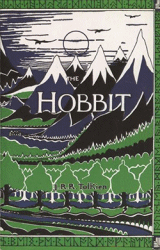
Hobbit Cover
George Allen & Unwin, Ltd. of London published the first edition of The Hobbit on 21 September 1937. It was illustrated with many black-and-white drawings by Tolkien, who also designed the dust jacket. The original printing numbered 1,500 copies and sold out by December due to enthusiastic reviews. Houghton Mifflin
Houghton Mifflin

Houghton Mifflin Harcourt Publishing Company is a leading educational publisher in the United States. The company's headquarters is located in Boston's Back Bay....
 of Boston
Boston, Massachusetts

Boston is the State capital and largest city of the Commonwealth of Massachusetts, and is one of the oldest cities in the United States. The largest city in New England, Boston is considered the economic and cultural center of the region, and is sometimes regarded as the unofficial "Capital of New England." Boston city proper had a 2007 est...
 and New York reset type for an American edition, to be released early in 1938, in which four of the illustrations would be colour plates. Allen & Unwin decided to incorporate the colour illustrations into their second printing, released at the end of 1937. Despite the book's popularity, paper rationing
Rationing

Rationing is the controlled distribution of resources and scarcity goods or services. Rationing controls the size of the ration, one's allotted portion of the resources being distributed on a particular day or at a particular time....
 brought on by wartime
World War II

World War II, or the Second World War , was a global military conflict which involved a Participants in World War II, including all of the great powers, organised into two opposing military alliances: the Allies of World War II and the Axis powers....
 conditions and not ending until 1949 meant that the book was often unavailable in this period.

Subsequent editions in English were published in 1951, 1966, 1978 and 1995. The novel has been reprinted frequently by many publishers
English-language editions of The Hobbit

This list contains only complete, printed English-language editions of The Hobbit. It is not for derived or unprinted works such as screenplays, graphic novels, or audio books....
. In addition, The Hobbit has been translated into over forty languages
Translations of The Hobbit

J. R. R. Tolkien?s The Hobbit has been translated into many languages. Known translations, with the first date of publishing, are:...
; some languages have seen multiple translations.

Revisions
In December 1937, The Hobbits publisher, Stanley Unwin, asked Tolkien for a sequel. In response he provided drafts for The Silmarillion
The Silmarillion

The Silmarillion is a collection of J. R. R. Tolkien's Mythopoeia works, edited and published posthumously by his son Christopher Tolkien in 1977, with assistance from Guy Gavriel Kay, who later became a noted fantasy writer....
, but the editors rejected them, believing that the public wanted "more about hobbits". Tolkien subsequently began work on what would become The Lord of the Rings
The Lord of the Rings

The Lord of the Rings is an Epic poetry high fantasy novel written by Philology J.R.R. Tolkien. The story began as a sequel to Tolkien's earlier, less complex children's fantasy novel The Hobbit , but eventually developed into a much larger work....
, a course that would not only change the context of the original story, but also lead to substantial changes to the character of Gollum.

In the first edition of
The Hobbit, Gollum willingly bets his magic ring on the outcome of the riddle-game, and he and Bilbo part amicably. In order to reflect the new concept of the ring
One Ring

The One Ring is an Artifact that appears as the pivotal plot element in J. R. R. Tolkien's Middle-earth Tolkien's legendarium. It is described in an earlier story, The Hobbit , as a magic ring of invisibility....
 and its corrupting abilities, in the second edition edits Tolkien made Gollum more aggressive towards Bilbo and distraught at losing the ring. The encounter ends with Gollum's blood-curdling curse, "Thief! Thief, Baggins! We hates it, we hates it, we hates it forever!", foreshadowing the nature of the character in
The Lord of the Rings.

Tolkien sent this revised version of the chapter "Riddles in the Dark" to Unwin as an example of the kinds of changes needed to bring the book into conformance with
The Lord of the Rings, but he heard nothing back for years. When he was sent galley proof
Galley proof

In printing and publication, proofs are preliminary versions of publications. They may be uncut and Bookbinding, or in some cases electronic publishing....
s of a new edition, Tolkien was surprised to find the sample text incorporated. In
The Lord of the Rings, the original version of the riddle game is explained as a "lie" made up by Bilbo, whereas the revised version contains the "true" account. The revised text became the second edition, published in 1951 in both the UK and the USA.

After an unauthorized paperback edition of
The Lord of the Rings appeared from Ace Books
Ace Books

Ace Books is the oldest active specialty publisher of science fiction and fantasy books. The company was founded in New York City in 1952 by A. A....
 in 1965, Houghton Mifflin and Ballantine
Ballantine Books

The Ballantine Publishing Group, better known as Ballantine Books, is a major American book publisher founded in 1952 by Ian Ballantine. It was acquired by Random House in 1973 and remains part of that company today....
 requested Tolkien to refresh the text of
The Hobbit in order to renew US copyright. This text became the 1966 third edition. Tolkien took the chance to align the narrative even more closely to The Lord of the Rings and to cosmological developments from his still unpublished Quenta Silmarillion
Quenta Silmarillion

Quenta Silmarillion is a collection of fictional legends written by the fantasy writer J. R. R. Tolkien. It was published after the author's death in The Silmarillion together with four shorter stories....
as it stood at that time. These small edits included, for example, changing the phrase elves that are now called Gnomes from the first and second editions on page 63, to High Elves of the West, my kin in the third edition. Tolkien had used "gnome
Gnome

A gnome is a mythical creature characterized by its extremely small size and wiktionary:subterranean lifestyle. The word gnome is derived from the New Latin gnomus....
" in his earlier writing to refer to the second kindred of the High Elves
High elves

Many fantasy settings contain Elves in fantasy fiction and games, often, particularly in western fantasy elves are divided into multiple different kinds....
—the Noldor
Noldor

In the works of J. R. R. Tolkien, the Noldor were those of the second clan of the Elf , the Tatyar, who came to Aman. According to legend, the clan was founded by Tata , the second Elf to awake at Cuivi?nen, his spouse Tati? and their 54 companions, but it was Finw?, the first Noldo to come to Valinor with Orom? and the other Elven kin...
 (or "Deep Elves")—thinking "gnome
Gnome

A gnome is a mythical creature characterized by its extremely small size and wiktionary:subterranean lifestyle. The word gnome is derived from the New Latin gnomus....
", derived from the Greek
gnosis (knowledge), was a good name for the wisest of the elves. However, because of its common denotation of a garden gnome, derived from the 16th Century Paracelsus
Paracelsus

Paracelsus was a Medieval physician, botanist, alchemy, astrologer, and general occultist. Born Phillip von Hohenheim, he later took up the name Philippus Theophrastus Aureolus Bombastus von Hohenheim, and still later took the title Paracelsus, meaning "equal to or greater than Celsus", a Roman encyclopedist, Aulus Cornelius Celsus fro...
, Tolkien ultimately abandoned the term.

In order to fit the tone of
The Hobbit better to its sequel, Tolkien began a new version in 1966, removing the narrative asides. He abandoned the new revision at chapter three after he received criticism that it "just wasn't The Hobbit", implying it had lost much of its light-hearted tone and quick pace.

Posthumous editions
Since the author's death, two editions of
The Hobbit have been published with commentary on the creation, emendation and development of the text.

In
The Annotated Hobbit Douglas Anderson provides the entire text of the published book, alongside commentary and illustrations. Anderson's commentary shows many of the sources Tolkien brought together in preparing the text, and chronicles in detail the changes Tolkien made to the various published editions. Alongside the annotations, the text is illustrated by pictures from many of the translated editions, including images by Tove Jansson
Tove Jansson

Tove Marika Jansson was a Finland novelist, Painting, illustrator and comic strip author. She was the author of, among other works, the Moomin books....
. Also printed here are a number of hard to find texts such as the 1923 version of Tolkien's poem "Iumonna Gold Galdre Bewunden". Micheal D. C. Frout and Hilary Wynn comment the work provides a solid foundation for further criticism.

With
The History of the Hobbit
The History of The Hobbit

The History of The Hobbit is a two-volume study of J. R. R. Tolkien?s The Hobbit. It was published by HarperCollins in June and July 2007 in the United Kingdom, with both volumes released in the United States by Houghton Mifflin on September 21, 2007; a boxed set combining The Hobbit with The History of The Hobbit was released...
, published in two parts in 2007, John Rateliff provides the full text of the earliest and intermediary drafts of the book, alongside commentary that shows relationships to Tolkien's scholarly and creative works, both contemporary and later. Rateliff also provides the abandoned 1960s retelling. The book keeps Rateliff's commentary separate from Tolkien's text, allowing the reader to read the original draft as a story. Rateliff also provides previously unpublished illustrations by Tolkien. Jason Fisher, published in Mythlore, states in his review that the work is "an indispensable new starting point for the study of The Hobbit.

Illustration and design

Tolkien's correspondence and publisher's records show that Tolkien was involved in the design and illustration of the entire book. All elements were the subject of considerable correspondence and fussing over by Tolkien. Rayner Unwin, in his publishing memoir, comments:

Even the maps of which Tolkien originally proposed five, were considered and debated. He wished Thror's map to be tipped in (that is, glued in after the book has been bound) at first mention in the text, and with the moon-letters (Anglo-Saxon runes) on the reverse so they could be seen when held up to the light. In the end the cost, as well as the shading of the maps, which would be difficult to reproduce, resulted in the final design of two maps as endpapers,
Thror's map, and the Map of the Wilderland, both printed in black and red on the paper's cream background.

Originally Allen & Unwin planned to illustrate the book only with the endpaper maps, but Tolkien's first tendered sketches so charmed the publisher's staff that they opted to include them without raising the book's price despite the extra cost. Thus encouraged, Tolkien supplied a second batch of illustrations. The publisher accepted all of these as well, giving the first edition ten black-and-white illustrations plus the two endpaper maps. The illustrated scenes were:
The Hill: Hobbiton across the Water, The Trolls, The Mountain Path, The Misty Mountains looking West from the Eyrie towards Goblin Gate, Beorn's Hall, Mirkwood, The Elvenking's Gate, Lake Town, and the Front Gate. All but one of the illustrations were a full page, and one, the Mirkwood illustration, required a separate plate.

Satisfied with his skills, the publishers thence asked Tolkien to design a dust jacket. This project, too, became the subject of many iterations and much correspondence, with Tolkien always writing disparagingly of his own ability to draw. The runic inscription around the edges of the illustration are a phonetic transliteration
Transliteration

Transliteration is the practice of transcribing a word or text written in one writing system into another writing system or system of rules for such practice....
 of English, giving the title of the book and details of the author and publisher. The original jacket design contained several shades of several colours, but Tolkien redrew it several times using fewer colours each time. His final design consisted of four colours. The publishers, mindful of the cost, removed the red from the sun to end up with only black, blue, and green ink on white stock.

The publisher's production staff designed a binding, but Tolkien objected to several elements. Through several iterations, the final design ended up as mostly the author's. The spine shows Anglo Saxon runes: two "þ" (Thrain and Thror) and one "D" (Door). The front and back covers were mirror images of each other, with an elongated dragon characteristic of Tolkien's style stamped along the lower edge, and with a sketch of the Misty Mountains stamped along the upper edge.

Once illustrations were approved for the book, Tolkien proposed colour plates as well. The publisher would not relent on this, so Tolkien pinned his hopes on the American edition to be published about six months later. Houghton Mifflin rewarded these hopes with the replacement of the frontispiece (
The Hill: Hobbiton-across-the Water) in colour and the addition of new colour plates: Rivendell, Bilbo Woke Up with the Early Sun in His Eyes, Bilbo comes to the Huts of the Raft-elves and a Conversation with Smaug, which features a dwarvish curse written in Tolkien's invented script Tengwar
Tengwar

Tengwar is a script that was invented by J.R.R. Tolkien. In his works, the tengwar script, invented by F?anor, was used to write a number of the languages of Middle-earth, including Quenya and Sindarin....
, and signed with two "þ, "Th" runes. The additional illustrations proved so appealing that George Allen & Unwin adopted the colour plates as well for their second printing, with exception of
Bilbo Woke Up with the Early Sun in His Eyes).

Different editions have been illustrated in diverse ways. Many follow the original scheme at least loosely, but many others are illustrated by other artists, especially the many translated editions. Some cheaper editions, particularly paperback, are not illustrated except with the maps. "The Children's Book Club" edition of 1942 includes the black-and-white pictures but no maps, an anomaly.

Tolkien's use of runes, both as decorative devices and as magical signs within the story, has been cited as a major cause for the popularisation of Norse runes within "New Age
New Age

New Age is a decentralized western culture social movement and new religious movement that seeks universality Truth and the attainment of the highest individual human potential....
" and esoteric literature, stemming from Tolkien's popularity with the elements of counter-culture
Counterculture of the 1960s

The counterculture of the 1960s refers to the counterculture supported by a loosely connected yet large community of people who, in their strength of numbers, powerful personalities, creative or destructive works, politics, and/or other activities, served as counterpoints to the existing "The Establishment" of "powers that be" in American so...
 in the 1970s.

Genre

The Hobbit takes cues from narrative models of children's literature
Children's literature

Children's literature is for readers and listeners up to about age twelve and is often illustrated. The term is used in senses which sometimes exclude young-adult fiction, comic books, or other genres....
, as shown by its omniscient narrator and characters that pre-adolescent children can identify with, such as the small, food-obsessed, and morally ambiguous Bilbo. The text emphasizes the relationship between time and narrative progress and it openly distinguishes "safe" from "dangerous" in its geography. Both are key elements of works intended for children, as is the "home-away-home" (or
there and back again) plot structure typical of the Bildungsroman
Bildungsroman

A bildungsroman is a novelistic genre that arose during the German Enlightenment, in which the author presents the psychological, moral and social shaping of the personality of a protagonist....
. While Tolkien claimed later to dislike the aspect of the narrative voice addressing the reader directly, the narrative voice contributes significantly to the success of the novel, and the story is, therefore, often read aloud. Emer O'Sullivan, in her
Comparative Children's Literature, notes The Hobbit as one of a handful of children's books that is accepted into mainstream literature, alongside Jostein Gaarder
Jostein Gaarder

Jostein Gaarder is a Norway intellectual and author of several novels, short story and children's books. Gaarder often writes from the perspective of children, exploring their sense of wonder about the world....
's
Sophie's World
Sophie's World

Sophie's World is a novel by Jostein Gaarder, published in 1991. It was originally written in Norwegian, but has since been translated into English language and many other languages....
(1991) and J. K. Rowling
J. K. Rowling

Joanne "Jo" Rowling Order of the British Empire , who writes under the pen name J. K. Rowling, is a United Kingdom author, best known as the creator of the Harry Potter fantasy series, the idea for which was conceived whilst on a train trip from Manchester to London in 1990....
's
Harry Potter
Harry Potter

Harry Potter is a Heptalogy fantasy novels written by British author J. K. Rowling. The books chronicle the adventures of the eponymous adolescent wizard Harry Potter , together with Ron Weasley and Hermione Granger, his friends from the Hogwarts School of Witchcraft and Wizardry....
series (1997–2007).

Tolkien intended
The Hobbit as a fairy story and wrote it in a tone suited to addressing children. Many of the initial reviews refer to the work as a fairy story. However, Bilbo Baggins is not the usual fairy tale protagonist – not the handsome eldest son or beautiful youngest daughter – but a plump, middle-aged, well-to-do Hobbit. The work is much longer than Tolkien's ideal proposed in his essay On Fairy Stories. Many fairy tale motifs, such as the repetition of similar events seen in the dwarves' arrival at Bilbo's and Beorn's homes, and folklore themes, such as trolls turning to stone, are to be found in the story. The Hobbit conforms to Vladimir Propp
Vladimir Propp

Vladimir Yakovlevich Propp was a Russian Formalism scholar who analyzed the basic plot components of Russian folk tales to identify their simplest irreducible narrative elements....
's 31-motif model of folktales presented in his 1928 work
Morphology of the Folk Tale, based on a structuralist analysis of Russian folklore.

The book is popularly called (and often marketed as) a fantasy
Fantasy literature

Fantasy literature is fantasy in written form. Historically speaking, the majority of fantasy works have been literature. Since the 1950s however, a growing segment of the fantasy genre has taken the form of films, television programs, graphic novels, video games, music, painting, and other media....
 novel, but like
Peter Pan and Wendy by J. M. Barrie
J. M. Barrie

Sir James Matthew Barrie, 1st Baronet Order of Merit , more commonly known as J. M. Barrie, was a Scotland author and dramatist. He is best remembered for creating Peter Pan, the boy who refused to grow up, whom he based on his friends, the Llewelyn Davies boys....
 and
The Princess and the Goblin

The Princess and the Goblin is a children's fantasy novel by George MacDonald. It was published in 1872 by Strahan & Co.The sequel to this book is The Princess and Curdie, in which Princess Irene and Curdie are a year or two older, and must overthrow a set of corrupt ministers who are poisoning Irene's father, the king....
by George MacDonald
George MacDonald

George MacDonald was a Scotland author, poet, and Christian minister.Though no longer well known, his works have inspired admiration in such notables as W....
, both of which influenced Tolkien and contain fantasy elements, it is primarily identified as being children's literature. The two genres are not mutually exclusive, so some definitions of high fantasy
High fantasy

High fantasy or epic fantasy is a Genre of fantasy that is set in invented or Parallel universe . Built upon the platform of a diverse body of works in the already very popular fantasy genre, high fantasy came to fruition through the work of authors such as C....
 include works for children by authors such as L. Frank Baum
L. Frank Baum

Lyman Frank Baum was an United States author, poet, playwright, actor and independent filmmaker, best known today as the creator, along with illustrator W....
 and Lloyd Alexander
Lloyd Alexander

Lloyd Chudley Alexander was a widely-influential United States author of more than forty books, mostly fantasy novels for children and adolescents, as well as several adult books....
 alongside the works of Gene Wolfe
Gene Wolfe

Gene Wolfe is an United States science fiction and fantasy writer. He is noted for his dense, allusive prose as well as the strong influence of his Catholic faith, to which he converted after marrying a Catholic....
 and Jonathan Swift
Jonathan Swift

Jonathan Swift was an Anglo-Irish satire, essayist, political pamphleteer , poet and cleric who became Dean of St. Patrick's Cathedral, Dublin, Dublin....
, which are more often considered adult literature. Sullivan credits the first publication of
The Hobbit as an important step in the development of high fantasy, and further credits the 1960s paperback debuts of The Hobbit and The Lord of the Rings as essential to the creation of a mass market for fiction of this kind as well the fantasy genre's current status.

Style

Tolkien's prose is unpretentious and straightforward, taking as given the existence of his imaginary world and describing its details in a matter-of-fact way, while often introducing the new and fantastic in an almost casual manner. This style, also found in later fantasy such as Richard Adams
Richard Adams

Richard Adams , a non-conforming England Presbyterian divine, author of various sermons and other writings in divinity, was the grandson of Richard Adams, the rector of Woodchurch, in the part of Cheshire which is called the hundred of Metropolitan Borough of Wirral, and son of Charles Adams , who, with his brother Randall Adams, was brought...
'
Watership Down
Watership Down

Watership Down is a heroic fantasy novel about a small group of rabbits, written by United Kingdom author Richard Adams. Although the animals in the story live in their natural environment, they are Anthropomorphism, possessing their own culture, language , proverbs, poetry, and mythology....
and Peter Beagle's The Last Unicorn
The Last Unicorn

The Last Unicorn is a fantasy novel written by Peter S. Beagle and published in 1968. It has sold more than five million copies worldwide since its original publication, and has been translated into at least twenty languages....
, accepts readers into the fictional world, rather than cajoling or attempting to convince them of its reality. While The Hobbit is written in a simple, friendly language, each of its characters has a unique voice. The narrator, who occasionally interrupts the narrative flow with asides (a device common to both children's and Anglo-Saxon literature), has his own linguistic style separate from those of the main characters.

The basic form of the story is that of a quest
Quest

In mythology and literature a quest ? a journey towards a goal ? serves as a Plot device and as a symbol. Quests appear in the folklore of every nation and also figure prominently in non-national cultures....
, told in episodes. For the most part of the book, each chapter introduces a different denizen of the Wilderland, some friendly towards the protagonists, and some threatening. While many of the encounters are dangerous or threatening, the general tone is light-hearted, and interspersed with songs. One example of the use of song to maintain tone is when Thorin and Company are kidnapped by goblins, who, when marching them into the underworld, sing:

This onomatopœic singing undercuts the dangerous scene with a sense of humour. Tolkien achieves balance of humour and danger through other means as well, as seen in the foolishness and provincial speech
Cockney

The term Cockney has both geographical and linguistic associations. Geographically and culturally, it often refers to working class Londoners, particularly those in the East End of London....
 of the trolls and in the drunkenness of the elven captors. The general form—that of a journey into strange lands, told in a light-hearted mood and interspersed with songs—may be following the model of
The Icelandic Journals by Tolkien's literary idol William Morris
William Morris

William Morris was an English architect, furniture and textile designer, artist, writer, and Socialism associated with the Pre-Raphaelite Brotherhood and the English Arts and Crafts Movement....
.

The novel draws on Tolkien's knowledge of historical languages and early Northern European texts. The names of Gandalf and all but one of the thirteen dwarves were taken directly from the Old Norse
Old Norse

Old Norse is a North Germanic languages that was spoken by inhabitants of Scandinavia and inhabitants of their overseas settlements during the Viking Age, until about 1300....
 poem
Völuspá
Völuspá

V?lusp? is the first and best known poem of the Poetic Edda. It tells the story of the creation of the world and its coming end related by a v?lva addressing Odin....
from the Poetic Edda
Poetic Edda

The Poetic Edda is a collection of Old Norse poems primarily preserved in the Icelandic mediaeval manuscript Codex Regius. Along with Snorri Sturluson's Prose Edda, the Poetic Edda is the most important extant source on Norse mythology and Germanic heroic legends....
. Several of the author's illustrations (including the dwarven map, the frontispiece and the dust jacket) make use of Anglo-Saxon runes. The names of the dwarf-friendly ravens are also derived from the Old Norse for raven and rook, but their characters are unlike the typical war-carrion from Old Norse and Anglo-Saxon literature. Tolkien, however, is not simply skimming historical sources for effect: linguistic
Linguistic

Linguistic may mean:*pertaining to language**specifically, pertaining to natural language*pertaining to the field of linguistics...
 styles, especially the relationship between the modern and ancient, has been seen to be one of the major themes explored by the story.

Critical analysis


Themes

The development and maturation of the protagonist, Bilbo Baggins, is central to the story. This journey of maturation, where Bilbo gains a clear sense of identity and confidence in the outside world, may be seen as a Bildungsroman
Bildungsroman

A bildungsroman is a novelistic genre that arose during the German Enlightenment, in which the author presents the psychological, moral and social shaping of the personality of a protagonist....
 rather than a traditional fantasy quest. The Jungian
Carl Jung

Carl Gustav Jung was a Swiss psychiatrist, an influential thinker and the founder of Analytical psychology. Jung's approach to psychology has been influential in the field of depth psychology and in counterculture movements across the globe....
 concept of individuation
Individuation

Individuation is a concept which appears in numerous fields and may be encountered in work by Gilbert Simondon, Bernard Stiegler, Gilles Deleuze, Henri Bergson, David Bohm, and Manuel De Landa....
 is also reflected through this theme of growing maturity and capability, with the author contrasting Bilbo's personal growth against the arrested development of the dwarves. The analogue of the "underworld
Underworld

In the study of mythology and religion, the underworld is a generic term approximately equivalent to the lay term afterlife, referring to any place to which newly the dead souls go....
" and the hero returning from it with a boon (such as the ring, or Elvish blades) that benefits his society is seen to fit the mythic archetype
Archetype

An archetype is an original model of a person, ideal example, or a prototype after which others are copied, patterned, or emulated; a symbol universally recognized by all....
s regarding initiation and male coming-of-age as described by Joseph Campbell
Joseph Campbell

Joseph John Campbell was an United States mythologist, writer, and lecturer best known for his work in the fields of comparative mythology and comparative religion....
. Jane Chance compares the development and growth of Bilbo against other characters to the concepts of just Kingship verses sinful kingship derived from the Ancrene Wisse
Ancrene Wisse

Ancrene Wisse or Guide for Anchoresses is a monastic rule for anchorite, written in the early 1200s. 'Ancrene Wisse' was originally written for three 'sisters' who chose to enter the contemplative life....
 (which Tolkien had written on in 1929) and a Christian understanding of Beowulf.

The overcoming of greed and selfishness has been seen as the central moral of the story. Whilst greed is a recurring theme in the novel, with many of the episodes stemming from one or more of the characters' simple desire for food (be it trolls eating dwarves or dwarves eating Wood-elf fare) or a desire for beautiful objects, such as gold and jewels, it is only through the Arkenstone's influence upon Thorin that greed, and its attendant vices "coveting" and "malignancy" come fully to the fore in the story, and provides the moral crux of the tale. Bilbo steals this most ancient relic from the dwarves and attempts to use it to bargain with Thorin. However, Thorin turns on the Hobbit as a traitor, disregarding all the promises and "at your services" he had previously bestowed. However, Bilbo gives up the precious stone and most of his share of the treasure, in order to help those in greater need and keep peace. The motif of jewels that inspire intense greed which corrupts those that covet them is also explored in the
Silmarillion, and there are connections between the words "Arkenstone" and "Silmaril" in Tolkien's invented etymologies.

The Hobbit employs themes of animism
Animism

Animism is a philosophical, religious or spiritual idea that souls or spirits exist not only in humans and animals but also in plants, rock s, natural phenomena such as thunder, geographic features such as mountains or rivers, or other entities of the natural environment, a proposition also known as hylozoism in philosophy....
. An important concept in anthropology
Anthropology

Anthropology is the study of humans and humanity in its totality. Anthropology has origins in the natural sciences, and the humanities. In Great Britain it was originally divided into physical anthropology and cultural anthropology, which itself was divided into archaeology, technology, ethnology and sociology ....
 and child development
Child development

Child development stages describe theoretical milestones of child development. Many stage models of development have been proposed, used as working concepts and in some cases asserted as nativism theories....
, animism is the idea that all things—including inanimate objects and natural events, such as storms or purses, as well as living things like animals and plants—possess human-like intelligence. John D. Rateliff calls this the "Doctor Dolittle
Doctor Dolittle

Doctor John Dolittle is the central character of a series of children's books by Hugh Lofting. He is a doctor who shuns human patients in favour of animals, with whom he can speak in their own languages....
 Theme" in
The History of the Hobbit, and cites the multitude of talking animals as indicative of this theme. These talking creatures include Smaug himself, alongside the anthropomorphic goblins and elves. Patrick Curry notes that animism is also found in Tolkien's other works, and mentions the "roots of mountains" and "feet of trees" in The Hobbit as a shift in level from the inanimate to animate. Tolkien saw the idea of animism as closely linked to the emergence of human language and myth: "...The first men to talk of 'trees and stars' saw things very differently. To them, the world was alive with mythological beings... To them the whole of creation was "myth-woven and elf-patterned".'

Interpretation

The Hobbit can be seen as a creative exposition of Tolkien's theoretical and academic work. Themes found in early English literature, and specifically by the poem Beowulf
Beowulf

Beowulf is an Old English language heroic Epic poetry of unknown authorship, dating as recorded in the Nowell Codex manuscript from between the 8th to the early 11th century, and relates events described as having occurred in what is now Denmark and Sweden....
, have a heavy presence in defining the ancient world Bilbo stepped into. Tolkien is credited with being the first critic to expound on Beowulf as a literary work with value beyond merely historical, and his 1936 lecture Beowulf: the Monsters and the Critics
Beowulf: the monsters and the critics

"Beowulf: The Monsters and the Critics" was a 1936 lecture given by J. R. R. Tolkien on literary criticism on the Old English language heroic epic poem Beowulf....
is still required reading for students of Anglo-Saxon. The Beowulf poem contains several elements that Tolkien borrowed for The Hobbit, including a monstrous, intelligent dragon and named blades of renown, adorned in runes. It is in the use of his elf-blade that we see Bilbo finally taking his first independent heroic action. By his naming the blade "Sting" we also see Bilbo's acceptance of the kinds of cultural and linguistic practices found in Beowulf, signifying his entrance into the ancient world in which he found himself. This progression culminates in Bilbo stealing a cup from the dragon's hoard, rousing him to wrath—an incident directly mirroring Beowulf, and an action entirely determined by traditional narrative patterns. As Tolkien wrote, "...The episode of the theft arose naturally (and almost inevitably) from the circumstances. It is difficult to think of any other way of conducting the story at this point. I fancy the author of Beowulf would say much the same."

As in plot and setting, Tolkien brings his literary theories to bear in forming characters and their interactions. He portrays Bilbo as a modern anachronism
Anachronism

An anachronism is an error in chronology, especially a chronological misplacing of persons, events, objects, or customs in regard to each other....
 exploring an essentially antique world. Bilbo is able to negotiate and interact within this antique world because language and tradition make connections between the two worlds. For example, Gollum's riddles are taken from old historical sources, while those of Bilbo come from modern nursery books. It is the form of the riddle game, familiar to both, which allows Gollum and Bilbo to understand each other, rather than the content of the riddles themselves. This idea of a superficial contrast between characters' individual linguistic style, tone and sphere of interest, leading to an understanding of the deeper unity between the ancient and modern, is a recurring theme in
The Hobbit.

Just as Tolkien's literary theories have been seen to influence the tale, so have Tolkien's experiences.
The Hobbit may be read as Tolkien's parable of World War I
World War I

World War I, or the First World War , was a global military conflict which involved the Great powers, organized into two opposing military alliances: the Allies of World War I and the Central Powers....
, where the hero is plucked from his rural home and thrown into a far-off war where traditional types of heroism are shown to be futile. The tale as such explores the theme of heroism. As Jane Croft notes, Tolkien's literary reaction to war at this time differed from most post-war writers by eschewing irony as a method for distancing events and instead using mythology to mediate his experiences. Similarities to the works of other writers who faced the Great War
World War I

World War I, or the First World War , was a global military conflict which involved the Great powers, organized into two opposing military alliances: the Allies of World War I and the Central Powers....
 are seen in
The Hobbit, including portraying warfare as anti-pastoral
Pastoral

Pastoral, as an adjective, refers to the lifestyle of shepherds and pastoralists, moving livestock around larger areas of land according to seasons and availability of water and food....
: in "The Desolation of Smaug", both the area under the influence of Smaug before his demise and the setting for "The Battle of the Five Armies" later are described as barren, damaged landscapes.
The Hobbit makes a warning against repeating the tragedies of World War I, and Tolkien's attitude as a veteran may well be summed up by Bilbo's comment:

Reception

On first publication in October 1937,
The Hobbit was met with almost unanimously favourable reviews from publications both in the UK and the USA, including The Times
The Times

The Times is a daily national newspaper published in the United Kingdom since 1785 when it was known as The Daily Universal Register.The Times and its sister paper The Sunday Times are published by Times Newspapers Limited, a subsidiary of News International....
, Catholic World and The New York Post
New York Post

The New York Post is the 13th-oldest newspaper published in the United States and generally acknowledged as the oldest to have been published continually as a daily, although -- like most other papers -- its publication has been interrupted by labor actions....
. C. S. Lewis
C. S. Lewis

Clive Staples Lewis , commonly referred to as C. S. Lewis and known to his friends and family as Jack, was an academic, medievalist, literary critic, essayist, lay theologian and Christian apologist....
, friend of Tolkien (and later author of
The Chronicles of Narnia

The Chronicles of Narnia is a series of seven fantasy novels for children written by C. S. Lewis. It is considered a classic of children's literature and is the author's best-known work, having sold over 120 million copies in 41 languages....
between 1949-1964), writing in The Times reports: Lewis also compares the book to Alice in Wonderland in that both children and adults may find different things to enjoy in it, and places it alongside Flatland
Flatland

Flatland: A Romance of Many Dimensions is an 1884 in literature science fiction novella by the England schoolmaster Edwin Abbott Abbott.As a satire, Flatland offered pointed observations on the social hierarchy of Victorian era culture....
, Phantastes
Phantastes

Phantastes: A Faerie Romance for Men and Women is a fantasy novel written by George MacDonald, first published in London in 1858. Its importance was recognized in its later revival in paperback by Ballantine Books as the fourteenth volume of the celebrated Ballantine Adult Fantasy series in April 1970....
, and The Wind in the Willows
The Wind in the Willows

The Wind in the Willows is a classic of children's literature by Kenneth Grahame, first published in 1908 in literature. Alternately slow moving and fast paced, it focuses on four anthropomorphised animal characters in a pastoral version of England....
. W. H. Auden
W. H. Auden

Wystan Hugh Auden who signed his works W. H. Auden, was an Anglo-American poet, regarded by many as one of the greatest writers of the 20th century....
, in his review of the sequel
The Fellowship of the Ring

The Fellowship of the Ring is the first of three volumes of the epic novel The Lord of the Rings by the England author J. R. R. Tolkien....
calls The Hobbit "one of the best children's stories of this century". Auden was later to correspond with Tolkien, and they became friends. The Hobbit was nominated for the Carnegie Medal
Carnegie Medal

The Carnegie Medal in Literature was established in the United Kingdom in 1936 in honour of Scotland philanthropist Andrew Carnegie. It is awarded to an outstanding children's literature and young adult readers....
 and awarded a prize from the
New York Herald Tribune

The New York Herald Tribune was a daily newspaper created in 1924 when the New York Tribune acquired the New York Herald. The Herald Tribune was a leading Republican Party paper, and a voice for moderate "internationalism" Republicans as opposed to the "isolationism" variety represented by the Chicago Tribune....
for best juvenile fiction of the year (1938). More recently, the book has been recognized as "Most Important 20th-Century Novel (for Older Readers)" in the Children's Books of the Century poll in Books for Keeps.

Publication of the sequel
The Lord of the Rings altered many critics' reception of the work. Instead of approaching The Hobbit as a children's book in its own right, critics such as Randell Helms picked up on the idea of The Hobbit as being a "prelude", relegating the story to a dry-run for the later work. Countering a presentist
Presentism (literary and historical analysis)

Presentism is a mode of historical analysis in which present-day ideas and perspectives are anachronism introduced into depictions or interpretations of the past....
 interpretation are those who say this approach misses out on much of the original's value as a children's book and as a work of high fantasy in its own right, and that it disregards the book's influence on these genres. Commentators such as Paul Kocher, John D. Rateliff and C. W. Sullivan encourage readers to treat the works separately, both because
The Hobbit was conceived, published, and received independently of the later work, and also in order to prevent the reader from having false expectations of tone and style dashed.

Legacy

While
The Hobbit has been adapted and elaborated upon in many ways, its sequel The Lord of the Rings is often claimed to be its greatest legacy. The plots share the same basic structure progressing in the same sequence: the stories begin at Bag End, the home of Bilbo Baggins; Gandalf sends the protagonist into a quest eastward; Elrond offers a haven and advice; the adventurers escape dangerous creatures underground (Goblin Town/Moria
Moria (Middle-earth)

In the fiction of J. R. R. Tolkien, Moria was the name given by the Eldar to an enormous underground complex in north-western Middle-earth, comprising a vast network of tunnels, chambers, mines and huge halls or 'mansions', that ran under and ultimately through the Hithaeglir....
); they engage another group of elves (The Elf King's realm
Mirkwood

Mirkwood is a name used for two distinct fictional forests in J. R. R. Tolkien's Tolkien's legendarium. In the First Age, the highlands of Dorthonion north of Beleriand were known as Mirkwood after falling under Morgoth's control....
/Lothlórien); they traverse a desolate region (Desolation of Smaug/the Dead Marshes
Dead Marshes

The Dead Marshes is a fictional place from J. R. R. Tolkien's universe, Middle-earth....
); they fight in a massive battle; a descendant of kings is restored to his ancestral throne (Bard
Kings of Dale

This is a list of kings of Dale from J. R. R. Tolkien's Middle-earth Tolkien's legendarium. Girion is named as the last Lord of Dale before the arrival of the Dragon Smaug at Erebor, the Lonely Mountain; later Kings, his descendants, ruled after Smaug's death and the restoration of Dale following the Battle of the Five Armies....
/Aragorn
Aragorn

Aragorn II is a fictional character from J. R. R. Tolkien's Middle-earth legendarium. He is also known as Strider. He is first introduced in The Fellowship of the Ring, and becomes a central character in the story of The Lord of the Rings....
); and the questing party returns home to find it in a deteriorated condition (having possessions auctioned off/the scouring of the Shire
Shire (Middle-earth)

The Shire is a region of J. R. R. Tolkien's fictional Middle-earth, described in The Lord of the Rings and other works. The Shire refers to an area settled exclusively by Hobbits and largely removed from the goings-on in the rest of Middle-earth....
).

The Lord of the Rings contains several more supporting scenes, and has a more sophisticated plot structure, following the paths of multiple characters. Tolkien wrote the later story in much less humorous tones and infused it with more complex moral and philosophical themes. The differences between the two stories can cause difficulties when readers, expecting them to be similar, find that they are not. Many of the thematic and stylistic differences arose because Tolkien wrote The Hobbit as a story for children, and The Lord of the Rings for the same audience, who had subsequently grown up since its publication. Some differences are in minor details; for example, goblins are more often referred to as Orcs in The Lord of the Rings. Further, Tolkien's concept of Middle-earth
Middle-earth

Middle-earth refers to the fictional lands where most of the stories of author J. R. R. Tolkien take place. These stories include The Hobbit and The Lord of the Rings....
 was to continually change and slowly evolve throughout his life and writings.

The Hobbit in education

The style and themes of the book have been seen to help stretch precocious young readers' literacy skills, preparing them to approach the works of Dickens
Charles Dickens

Charles John Huffam Dickens, Royal Society of Arts , pen-name "Boz", was the most popular English people novelist of the Victorian era, as well as a vigorous Reform movement....
 and Shakespeare
William Shakespeare

William Shakespeare was an English people poet and playwright, widely regarded as the greatest writer in the English language and the world's preeminent dramatist....
. By contrast, offering readers modern teenage-oriented fiction may not exercise their advanced reading skills, while the material may contain themes more suited to adolescents. As one of several books that has been recommended for 11–14 year old boys to encourage literacy in that demographic,
The Hobbit is promoted as "the original and still the best fantasy ever written."

Several teaching guides and books of study notes have been published to help teachers and students gain the most from the book.
The Hobbit introduces literary concepts, notably allegory
Allegory

Allegory is generally treated as a figure of rhetoric, but an allegory does not have to be expressed in language: it may be addressed to the eye, and is often found in realistic painting, sculpture or some other form of Mimesis, or representative art....
, to young readers, as the work has been seen to have allegorical aspects reflecting the life and times of the author. Meanwhile the author himself rejected an allegorical reading of his work. This tension can help introduce readers to 'readerly' and 'writerly' interpretations, to tenets of New Criticism
New Criticism

New Criticism was a dominant trend in England and United States literary criticism of the mid twentieth century, from the 1920s to the early 1960s....
, and critical tools from Freudian analysis, such as sublimation
Sublimation (psychology)

In psychology, sublimation is a term coined by Friedrich Nietzsche which was eventually used to describe the spirit as a reflection of the libido....
, in approaching literary works.

Another approach to critique taken in the classroom has been to propose the insignificance of female characters in the story as sexist. While Bilbo may be seen as a literary symbol of 'small folk' of any gender, a gender-conscious approach can help students establish notions of a "socially symbolic text" where meaning is generated by tendentious readings of a given text. Ironically, by this interpretation, the first authorized adaptation was a stage production in a girls' school.

Adaptations


In 1969 (over 30 years after first publication), Tolkien sold the film and merchandising rights to
The Hobbit to United Artists
United Artists

United Artists Entertainment LLC is an United States film studio. The current United Artists was formed in November 2006 under a partnership between producer/actor Tom Cruise and his production partner, Paula Wagner, and Metro-Goldwyn-Mayer Studios Inc., an MGM company....
 under an agreement stipulating a lump sum payment of £10,000 plus a 7.5% royalty after costs, payable to Allen & Unwin and the author. In 1976 (three years after the author's death) United Artists sold the rights to Saul Zaentz
Saul Zaentz

Saul Zaentz is an American film producer and former record company executive. He has won the Academy Award for Best Picture three times and in 1996 won the Irving G....
 Company, who trade as Tolkien Enterprises
Tolkien Enterprises

Tolkien Enterprises , a doing business as for the Saul Zaentz Company, owns the worldwide exclusive rights to certain elements of J. R. R. Tolkien's two most famous literary works; The Lord of the Rings and The Hobbit....
. Since then all "authorised" adaptations have been signed-off by Tolkien Enterprises. In 1997 Tolkien Enterprises licensed the film rights to Miramax, which assigned them in 1998 to New Line Cinema
New Line Cinema

New Line Cinema, founded in 1967, is major film studios United States film studios. Though it initially began as an independent film studio, it became a subsidiary of Time Warner and is now a division of Warner Bros....
. The heirs of Tolkien, including his son Christopher Tolkien
Christopher Tolkien

Christopher Reuel Tolkien is the youngest son of the author J. R. R. Tolkien , and is best known as the editing of much of his father's Posthumous work published work....
, filed suit against New Line Cinema
New Line Cinema

New Line Cinema, founded in 1967, is major film studios United States film studios. Though it initially began as an independent film studio, it became a subsidiary of Time Warner and is now a division of Warner Bros....
 in February 2008 seeking payment of profits and to be "entitled to cancel... all future rights of New Line... to produce, distribute, and/or exploit future films based upon the Trilogy and/or the Films... and/or... films based on
The Hobbit."

The first authorised adaptation of
The Hobbit appeared in March 1953, a stage production by St. Margaret's School, Edinburgh
St. Margaret's School, Edinburgh

St. Margaret's School is an independent school in Edinburgh, Scotland. The curriculum is based on the Scottish education system....
.
The Hobbit has since been adapted for other media many times.

The BBC Radio 4
BBC Radio 4

BBC Radio 4 is a domestic UK radio station that broadcasts a wide variety of spoken-word programmes, including news, drama, comedy, science and history....
 series
The Hobbit
The Hobbit (1968 radio series)

The Hobbit is a 1968 BBC Radio adaptation of J. R. R. Tolkien's 1937 children's fantasy novel The Hobbit.The series was adapted by Michael Kilgarriff and produced by John Powell in eight half-hour Monaural episodes for BBC Radio 4....
radio drama
Radio drama

File:Opname van een hoorspel Recording a radio play.jpgRadio drama is a form of audio storytelling broadcast on radio broadcasting. With no visual component, radio drama depends on dialogue, music and sound effects to help the listener imagination the story....
 was an adaptation by Michael Kilgarriff
Michael Kilgarriff

Michael Kilgarriff is a United Kingdom actor, born 16 June 1937 in Brighton. As an actor he is well known for two things: his rich voice, leading to much radio and voice over work; and his height....
, broadcast in eight parts (four total hours) from September to November 1968. It starred Anthony Jackson
Anthony Jackson (actor)

Anthony Jackson was an England actor , who reached his widest audiences as founder of the eponymous ghost hiring agency in the long-running BBC children's comedy series Rentaghost....
 as narrator, Paul Daneman
Paul Daneman

Paul Daneman was an England film, television, theatre and Voice acting actor.Daneman was born in London. He attended the Haberdashers' Aske's Boys School and Sir William Borlase's Grammar School in Marlow and studied stage design at Reading University where he joined the dramatic society....
 as Bilbo and Heron Carvic
Heron Carvic

Heron Carvic was a British actor and writer who provided the voice acting for Gandalf in the BBC Radio version of The Hobbit. As a writer he wrote the first five of the Miss Seeton mysteries....
 as Gandalf. The series was released on audio cassette
Compact Cassette

The Compact Cassette, often referred to as audio cassette, cassette tape, cassette, or simply tape, is a magnetic tape Sound recording and reproduction format....
 in 1988 and on CD in 1997.

The Hobbit, an animated version of the story produced by Rankin/Bass
Rankin/Bass

Rankin/Bass Productions, Inc. , also known as Rankin/Bass Animated Entertainment, was an United States stop-motion production company, known for its seasonal television specials....
, debuted as a television movie in the United States in 1977. In 1978, Romeo Muller won a Peabody Award
Peabody Award

The George Foster Peabody Awards, better known as simply the Peabody Awards, are annual, international awards for excellence in radio and television broadcasting....
 for his teleplay for
The Hobbit. The film was also nominated for the Hugo Award for Best Dramatic Presentation
Hugo Award for Best Dramatic Presentation

The Hugo Awards are given annually by members of the World Science Fiction Convention for the best science fiction or fantasy works. The awards are named after Hugo Gernsback, the founder of the pioneering science fiction magazine Amazing Stories, and given in various categories....
, but lost to
Star Wars
Star Wars Episode IV: A New Hope

Star Wars Episode IV: A New Hope is an Cinema of the United States 1977 in film space opera film, written and directed by George Lucas. It was the first of six films released in the Star Wars saga: Star Wars#Original trilogy continue the story, while a Star Wars#Prequel trilogy contributes backstory, primarily for the troubled charac...
. The adaptation has been called "excruciable" and confusing for those not already familiar with the plot.
Hobbit 2
A live-action film version is to be co-produced by MGM and New Line Cinema
New Line Cinema

New Line Cinema, founded in 1967, is major film studios United States film studios. Though it initially began as an independent film studio, it became a subsidiary of Time Warner and is now a division of Warner Bros....
, produced
Film producer

A film producer is someone who creates the conditions for making film. The producer initiates, co-ordinates, supervises and controls matters such as fund-raising, hiring key personnel and arranging for distributors....
 by
Lord of the Rings
The Lord of the Rings film trilogy

The Lord of the Rings film trilogy consists of three live action fantasy epic films: The Lord of the Rings: The Fellowship of the Ring , The Lord of the Rings: The Two Towers and The Lord of the Rings: The Return of the King ....
director
Film director

A film director, or filmmaker, is a person who directs the making of a film. A film director visualizes the Screenplay, controlling a film's artistic and dramatic aspects, while guiding the technical crew and actors in the fulfillment of his or her vision....
 Peter Jackson
Peter Jackson

Peter Robert Jackson, New Zealand Order of Merit is a three-time Academy Award-winning New Zealand filmmaker, film producer and screenwriter, best known for The Lord of the Rings film trilogy trilogy adapted from the The Lord of the Rings by J....
 and directed by
Pan's Labyrinth
Pan's Labyrinth

Pan's Labyrinth is a 2006 in film Spanish films of 2006 Spanish language fantasy film written and directed by Mexico film-maker Guillermo del Toro....
director Guillermo Del Toro
Guillermo del Toro

Guillermo del Toro G?mez is an Academy Award-nominated Mexican filmmaker. He is one of the film directors known as the Three Amigos that include Alfonso Cuar?n and Alejandro Gonz?lez I??rritu....
. A date of 2011 has been proposed for its release. It is to be shot simultaneously with another movie related to
The Lord of the Rings. Del Toro was quoted in 2006 as saying: "I don't like little guys and dragons, hairy feet, hobbits – I've never been into that ... I hate all that stuff." The director signed on to the project in 2008. After taking the job, he was recorded by Weta
Weta

Weta is the name applied to about 70 insect species endemic to the New Zealand archipelago. There are many similar species around the World but most are in the southern hemisphere....
 as saying, "Rereading
The Hobbit just recently I was quite moved by discovering, through Bilbo's eyes, the illusory nature of possession, the sins of hoarding and the banality of war – whether in the Western Front
Western Front

Western Front was a term used during the World War I and World War II world war to describe the "contested armed frontier" between lands controlled by Germany to the East and the Allies to the West....
 or at a Valley in Middle Earth. Lonely is the mountain indeed."

ME Games Ltd
Middle-earth PBM

A turn-based, strategy Play-by-mail_game and play-by-mail game set in the world of J.R.R. Tolkien?s The Lord of the Rings and The Hobbit, including elements from ICE's Middle-earth Role Playing...
 (formerly
Middle-earth Play-by-Mail), which has won several Origin Award
Origins Award

The Origins Awards are American awards for outstanding work in the game industry. They are presented by the Academy of Adventure Gaming Arts and Design at the Origins Game Fair on an annual basis for the previous year, so the 1979 awards were given at the 1980 Origins Game Fair....
s, uses the
Battle of Five Armies as an introductory scenario to the full game and includes characters and armies from the book.

Several computer and video games, both licensed and unlicensed, have been based on the story. One of the most successful was
The Hobbit
The Hobbit (video game)

The Hobbit is a Video game released in 1982 in video gaming and based on the book The Hobbit, by J. R. R. Tolkien. It was developed at Beam Software by Phillip Mitchell and Veronika Megler and published by Melbourne House for most home computers available at the time, from more popular models such as the ZX Spectrum, the Commodore 64...
, an award-winning computer game developed in 1982 by Beam Software and published by Melbourne House
Melbourne House

Krome Studios Melbourne, formerly Melbourne House, is a video game developer studio owned by Krome Studios and based in Melbourne. They were founded in 1980 under the name Beam Software by Alfred Milgrom and Naomi Besen....
 with compatibility for most computers available at the time. A copy of the novel was included in each game package in order to encourage players to engage the text, since ideas for gameplay could be found therein. Likewise, it can be seen that the game is not attempting to re-tell the story, but rather sits along-side it, using the narrative to both structure and motivate gameplay. The game won the Golden Joystick Award for Strategy Game of the Year in 1983 and was responsible for popularizing the phrase, "Thorin sits down and starts singing about gold."

Collectors' market

The enduring popularity of
The Hobbit makes early printings of the book attractive collectors' items. The first printing of the first English-language edition can sell for between £6,000 and £20,000 at auction, although the price for a signed first edition has reached over £60,000.

See also


  • English-language editions of The Hobbit
    English-language editions of The Hobbit

    This list contains only complete, printed English-language editions of The Hobbit. It is not for derived or unprinted works such as screenplays, graphic novels, or audio books....
  • Early American editions of The Hobbit
    Early American editions of The Hobbit

    The early North America editions of J. R. R. Tolkien's The Hobbit were published by the Houghton Mifflin Company of Boston and New York. They are very collectible but extraordinarily difficult to identify....
  • Translations of The Hobbit
    Translations of The Hobbit

    J. R. R. Tolkien?s The Hobbit has been translated into many languages. Known translations, with the first date of publishing, are:...
  • "The Quest of Erebor
    The Quest of Erebor

    "The Quest of Erebor" is a work of fantasy fiction by J. R. R. Tolkien, posthumously published by his son Christopher Tolkien in Unfinished Tales ....
    ", Tolkien's retconned backstory for the novel published in
    Unfinished Tales
    Unfinished Tales

    Unfinished Tales is a collection of stories and essays by J. R. R. Tolkien that were unfinished work during his lifetime, but were edited by his son Christopher Tolkien and published in 1980....
  • The Hobbit (film)
    The Hobbit (film)

    J. R. R. Tolkien's The Hobbit was adapted into an animation television movie by Rankin/Bass Productions in 1977 in film. It manages to economically retell most of the story within its 78-minute duration....


External links